Wareable examines Project Sansar

"Project Sansar" promotional image via linden Lab
Project Sansar promotional image via Linden Lab

In Virtual worlds reborn: Can Second Life’s second life democratise VR? Sophie Charara, features editor at Wareable, examines Project Sansar, using in part Ebbe’s comments from an on-stage discussion they had, together with Ken Bretschneider of The Void during the December 2015 Web Summit. I’ve embedded the video of that discussion at the end of this article.

While the piece in Wearable doesn’t offer much that’s new to those who have been following the Lab’s conversations to the press and SL users about their hopes for the new platform, the article does offer some interesting insights to what the Lab is doing and some of their thinking behind Sansar.

Sophie Charara
Sophie Charara

Starting out with what we already know – the Lab is pitching the platform as “WordPress for VR”: an environment where people can come in and create virtual environments without the need to be a software engineer, coder, etc. – the article covers a lot of ground, with comparisons to Second Life, references to other pioneers in VR (Chris Milk, Nonny de la Pena and Jeremy Bailenson) and a further look at hoped-for time frames with “Sansar”.

The Lab has, on numerous occasions, indicated that initially, Sansar is being targeted at some very specific verticals where immersive VR has practical application. Education, healthcare, simulation, business, design and architecture have all be very specifically mentioned in this regard. So a point of interest for me was reading the specific example cited by Ebbe as to how Sansar is already been used, albeit on a test basis, by an architect:

An architect named Diego, who works for a big firm that is completing a major medical centre project, built the entire building in Sansar as an experiment.

“When he experienced it in virtual reality for the first time, he walked into the lobby and said ‘Damn, it’s too big,'” said Altberg. “It took him one second to realise that something was off and he’d been working on this project for a long time. That had value instantly.”

In this instance, the power of virtual realisation is clear, and having a platform which allows companies and individuals easily leverage this kind of visualisation, connect with other and have them shared in such visualisations / experiences / models is clear. In the example above, it is only a short step from Diego witnessing the flaws in his design (and being able to correct them as a result) to him being able to invite his clients into the model, so they can witness first-hand what his company’s vision for the project is. It also potentially allows his company to retain the model as a part of a virtual portfolio of projects they can showcase to future clients.

That the Lab had identified architecture as a suitable environment where Sansar could offer significant value for clients can also be ssen in the fact that the first public demonstration of the new platform took place San Francisco’s month-long Architecture and the City Festival in September 2015.
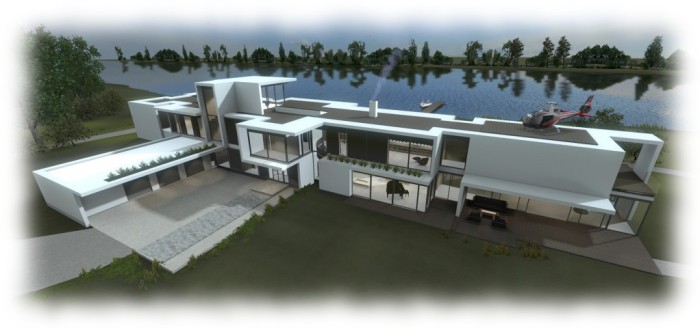
VR capabilities have a huge potential for various vertical markets, such as architecture and design, and these are markets the Lab have indicated they are targeting (image archvertical.com)
In 2014, Jon Brouchoud demonstrated the potential of architectural visualisation using the Oculus Rift and Unity 3D (image archvertical.com)

Hence why “Sansar” could, potentially, be a very powerful platform with the sectors the Lab has identified, particularly if it really does allow clients the freedom to create environments which can be standalone or interconnected, and / or which can be accessed directly through a closed Intranet, or open to all via direct web portal, according to individual needs.

Picture, for example, a university using Sansar to build a virtual teaching environment, access through its own Intranet and using it’s exiting log-in and authentication process so students and staff can seamlessly move into and out of the virtual space. They could then open a public portal to elements of that space, and / or link-up with other education institutions, enabling students to share in their virtual learning spaces, building-up their own “world” of connected experiences.
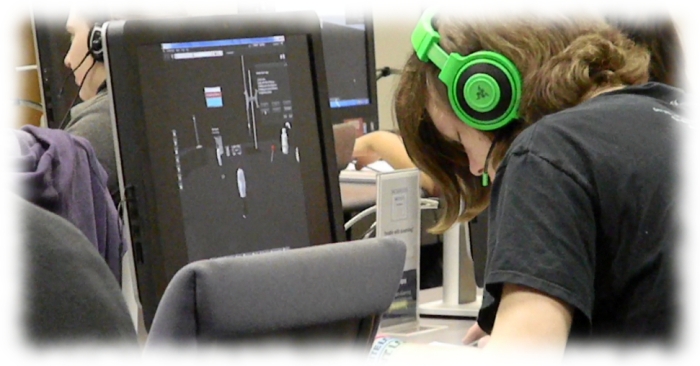
Second Life has proven itself and the value of virtual environments in education. "Project Sansar" could present opportunities to significantly build on the foundations laid by SL
Second Life has proven itself and the value of virtual environments in education. “Project Sansar” could present opportunities to significantly build on the foundations laid by SL

Not that Sansar is purely about these niche environments. The potential social power of virtual spaces and virtual opportunities has long been established by Second Life, and the article does make it clear that as things progress, the Lab does see Sansar as potentially being able to replicate a lot of what Second Life can already do and offering it to an audience as a much more accessible medium.

This obviously is something of a worry for those of us deeply rooted in Second Life – much has already been made of the potential for the “cannibalisation effect” Sansar might have on the current Second Life user base. It’s actually a valid concern, and something we should perhaps be prepared for at some point down the road, if Sansar proves to be a success and starts to pull SL users away from this platform. But frankly, it’s not something which should be held up as a reason for the Lab not to press ahead with Project Sansar.

Continue reading “Wareable examines Project Sansar”

In the Press: Social VR – Sansar and Second Life

"Project Sansar" promotional image via linden Lab
“Project Sansar” promotional image via linden Lab

I caught a Tweet on December 22nd (my apologies to the sender, I forgot to bookmark it and so can’t state form whom it came It was Rocky Constantine, as he correctly reminds me in the comments) which pointed those reading it to an article on the PSFK website with the enticing title, A Look Into a More Social Virtual Reality With the Makers of Second Life, by Ido Lechner. It makes for an interesting read.

The banner image is that of Second Life – and for once, it’s actually post circa 2010, and is quite reasonable in looks, and gets kudos points for being there, rather than the more usual 2007/8 images which tend to get used. Although that said, an image of the old v1 UI, circa 2007/8, plonked in the middle of the article doesn’t do SL any favours.

After a slightly blusterful introduction lauding Virtual Reality for already being a major disruptive force in our lives (and then admitting it has yet to go mainstream), the article settles down to discuss – and the title suggests – the more social aspects of VR in a chat with Lab’s own Ebbe Altberg and Director of Global Communication, Peter Gray.

This is a terse, and to-the-point piece, managing to both cover familiar ground (LL’s “head start” in running SL for 12+ years,  the ability for users to generate content – and income – with the service, etc), and to give more insight into what “Project Sansar” may offer in terms of accessibility, and some of the reasoning behind the Lab moving in that direction. In particular, and where accessibility is concerned, Lechner notes:

PC games have traditionally had a heightened learning curve for older audiences who have a hard time navigating worlds with mouse and keyboard, but Project Sansar looks to be an all-inclusive medium thanks to a more instinctual set of controls. Gesture-based movements, advanced expressive avatars (the kind that’s rigged to your real life expressions), voice chat, haptic feedback and other progressive modes of interaction will all be welcome additions to the game.

That the Lab is looking at the plethora of new hardware that being developed around the first wave of VR headsets isn’t exactly news – Ebbe Altberg has pointed to this very fact a number of times of late. However, it does again point to the fact that while very distinct and separate entities, “Sansar” and Philip Rosedale’s High Fidelity are in some ways travelling the same road in terms of aspirations with their ability to adopt emerging technology. But there is something else in this statement which draws my attention.

When it comes to all these new and wonderful ways of interacting with the digital, people are very quick to blame the keyboard and mouse. In 2014, for example, Philip Rosedale when addressing the VWBPE conference that year, directly pointed to the poor old keyboard and mouse as being one of “the” technological barriers to entry into virtual environments.

Yet the fact is, the keyboard and mouse have been our primary means of interaction with computer systems for so long that using them is sort-of “intuitive”; we can all grasp their use pretty easily. Who is to say all these wonderful now methodologies for interaction won’t also bring their own issues with them, thus presenting those “older audiences” Lechner mentions with precisely the same kind of “heightened learning curve” as is perceived to be the case when it comes to using the keyboard and mouse within certain environments?

Professor Jeremy Bailenson (image: Stanford University)
Professor Jeremy Bailenson – a strong influence on the Lab’s thinking (image: Stanford University)

Another common thread between High Fidelity and “Project Sansar” (which again should not be taken to mean the two are in any way linked) comes in the persona of Jeremy Bailenson of the Virtual Human Interaction Lab at Stanford.

Bailenson serves as an advisor to High Fidelity, alongside of Tony Parisi and Ken Perlin in particular, and as I’ve previously covered in these pages and Peter Gray states to Lechner, Bailenson’s work is greatly influencing the Lab’s approach to Sansar, which is no bad thing.

Certainly, Bailenson has offered some incisive views on the potential and pitfalls in VR, and his views and outlook are very relevant when considering the social / psychological impact of VR. Hence the Lab would seem to be availing itself of the right spheres of influence as it develops “Sansar”.

The focus on the social aspect of Second Life (and potentially of “Project Sansar”) is an interesting new direction to take when comparing this with earlier media discussions the Lab has had. In those, the focus has tended more towards emphasising the potential for “Sansar” among a defined set use cases with those vertical markets where VR can be seen has having great potential: education, training, design, healthcare, architecture, etc (again, it is no accident that the first public demonstration of “Sansar” came during San Francisco’s month-long Architecture and the City Festival in September 2015). Although all of these do get a mention at the end of the piece.

Certainly, there can be no doubting the social power that Second Life has, and both Altberg and Gray are entirely correct in pointing towards the added depth the environment has given developing relationships. So really, there is no reason to doubt that, as / if / when “Sansar” can be accessed by more-and-more people, the same cannot be repeated there.

Nevertheless, I confess to remaining sceptical of “Sansar” really ever reaching the kind of audience numbers the Lab has tended to boldly predict. Second Life has had a hard time reaching beyond a certain level in terms of user traction. Like it or not, the central reason for that isn’t really to do with the difficulty in entering SL or the UI, or “understanding” what SL is “about” once people are inside it (although all have a role to play, for sure).

It simply comes down to people not seeing Second Life as having relevance in their daily lives. Given that VR is supposed to bring us a whole new world of immersive opportunities, distractions, capabilities and so forth, all designed to keep us informed, entertained, involved and immersed – who is to say “Sansar” and environments like it also won’t face a similar uphill batter when it comes to people seeing them as relevant to their already involved physical and virtual lives?

Which doesn’t mean the I don’t think “Sansar” will “fail” or isn’t worth the effort. The Lab does need to move with the times, and there is certainly no reason that while Sansar may remain niche is a similar manner to SL having always been niche, there is no reason why it cannot settle into a much larger niche. Or, as seems more likely to be the case, take up residence in multiple niches and ride along comfortably within them.

In the Press: the future of VR with Bloomberg

Emily Chang from Bloomberg Business discusses the future of VR with Ebbe Altberg and AltspaceVR CEO Eric Romo
Emily Chang from Bloomberg Business discusses the future of VR with Ebbe Altberg and AltspaceVR CEO Eric Romo (via Bloomberg Business)

On Monday, December 7th, Linden Lab CEO Ebbe Altberg appeared alongside AltspaceVR’s CEO and founder, Eric Romo  on Bloomberg Business with Emily Chang, to discuss How to Find Realistic Timeline for Virtual Reality. In the interview, which lasts just under 5 minutes, the three discussed the potential of VR including.

The foundation for the interview is a report by TrendForce which proclaims the VR market will be worth around US $70 billion by 2020, with some US $20 billion coming from hardware purchases and US $50 billion from software and applications. It’s the latest in a bullish series of predictions on the future of the technology, many of which have gone unchallenged – and even then, TrendForce believe their prediction is an “understatement”. But how likely is it?

The Trend Force prediction for VR growth (via Bloomberg Business)

US $70 billion represents a tenfold increase in market worth for an industry slated to generate around US $6.7 billion in 2016. However you look at it, that’s a pretty steep growth curve. Both Ebbe and Eric see it as “reasonable”, with the latter citing the idea that a lot of companies which might not be considered as “VR companies” seeing a value proposition in the technology and leveraging it within their business model. In particular, he refers to the expected upsurge in VR as a paradigm shift comparable to that witnessed with the smartphone revolution.

Others are more cautious, as is the case with Oculus VR CEO Brendan Iribe, who is shown commenting:

We definitely believe the mass market … there’s going to be a lot of adopters, early adopters, of VR. but if you’re looking at the kind of smartphone scale, you know, billions of users out there, that’s going to take a long time.

While not nay-saying the potential of VR, other analysts view the TrendForce report as being unhelpful. When approached by Tweak Town, for example, Moor Insights & Strategy’s VR Analyst Anshel Sag, had this to say:

$70 billion by 2020 is more than extremely ambitious, $70 billion assumes that VR is a mature and mainstream market. There is no way that VR will explode into such a mature market within effectively 4 years. While I am extremely optimistic about the future of VR, such projections do nothing but hurt the future of VR by setting unrealistic expectations. There are no players in any part of the market that could turn this industry into a $70 billion industry in 4 years.

During the Bloomberg discussion, there is an acceptance that VR needs to overcome certain technical hurdles to gain more of a mass-market appeal. Certainly, these issues – cost, reliance on high-end supporting technology, etc. – are real, and doubtless will be overcome. But they aren’t the single issue facing VR in terms of its adoption.

Like it or not, VR is actually an isolating experience. Sure, you can in theory see anything, go anywhere, etc., while using it. But you do so at the expense of pretty much cutting you off from the rest of the world around you. It curtails your ability to properly interact with the things around you, to multi-task, etc. For many people and situations, even those seen as potential VR use-cases, that could curb the appeal.

There’s something else as well to be considered when discussing VR and its potential; what might be called the elephant in the room: augmented reality.

While AR is off to a slower start that VR, it is fair to say that it has the potential to reach into many of those markets and use-cases as seen to be ideal for VR, and offer a more attractive option in doing so. Initial AR systems are far more self-contained and portable; those on the horizon promise a wealth of capabilities (up to and including VR). More to the point, they do not isolate users from the world around them, something which could make AR far more practical and appealing for everyday use in the house, at work, on the street, etc.

By the time VR is really in a position to offer low-cost, lightweight systems freed from requiring high-end computing power, it could be facing stiff competition from AR for many of the markets seen as "ideal" for its use
By the time VR is really in a position to offer low-cost, lightweight systems freed from requiring high-end computing power, it could be facing stiff competition from AR for many of the markets seen as “ideal” for its use (image via CastAR)

So, it could be said that AR appears to be a far more natural proposition for widespread adoption and use, becoming a far more natural evolution from (and with) mobile and smartphone technologies. Hence why some put AR’s market worth as being in excess for US $100 billion by 2020.

Which is not to say that VR doesn’t have a place in the future. There are very niche and compelling cases where it will gain momentum. But whether it will ever reach the level of adoption comparable to the smartphone, as is so often cited, is questionable. There is no reason why, that for many of those potentially uses of VR outside of entertainment and gaming, AR might not offer a far better value proposition for take-up when compared to VR, leading to the latter being subsumed by it well before it has the opportunity to reach the scale of growth predicted for it.

You can catch the Bloomberg video by flowing the link towards the top of this piece, or you can catch the audio below.

Lab Chat #1: Ebbe Altberg – transcript and audio

Lab Chat LogoThursday, November 19th saw the launch of what is hoped will become a new series of monthly discussions. Lab Chat is billed as “an opportunity for you to ask Lindens your questions during a live taping that will be recorded and archived for everyone to view.”

The first show featured the Lab’s CEO, Ebbe Altberg in his alter ego of Ebbe Linden. In preparation for the recording, Second Life users were invited to ask questions about the Lab, Second Life, “Project Sansar”, etc on a forum thread.

Over 40 questions were asked, and members of the production crew selected seven questions they thought would be of most interest to the attending audience, to be asked during the show, whist also leaving time for further questions from the audience itself.  Discussions are under way with the Lab to try to ensure those questions from the forum thread which weren’t asked as a part of the recording do get addressed in some manner.

The following pages present a transcript of Ebbe Altberg’s replies to both the seven core questions selected by the Lab Chat team, together with any additional follow-ups or observations from show hosts Saffia Widdershins (SW) and Jo Yardley (JY), and the answers given to those questions raised during the open Q&A session.

Note that this is not a full transcript of the entire recording, the focus is very much on the answers given to questions and any relevant comments. For ease of reference, the transcript is split into three parts, each with its own navigation and links, and links to all of the questions:

  • Those questions and answers those related to Second Life
  • Those focused more on Project Sansar
  • The general Q&A session.

Each question / answer includes an audio extract of that question and answer for those who wish to listen rather than read, or in addition to reading, the transcript text.

The Quick Links section below will take you directly to each of these three sections, or to any of the individual discussion points within them.

Those wishing to watch the official video, can see the three parts here, here, and here.

Quick Links

Right-to-left: Saffia Widdershin, Ebbe Linden and Jo Yardley during the first Lab Chat recording
Right-to-left: Saffia Widdershins, Ebbe Linden and Jo Yardley during the first Lab Chat recording

In the Press: discussing Sansar and Second Life with TNW

Second Life: "almost as diverse as the physical world we live in" - Ebbe Altberg
Second Life: “almost as diverse as the physical world we live in” – Ebbe Altberg

Martin Bryant, Editor-at-Large at The Next Web caught up with Linden Lab’s CEO, Ebbe Altberg, in Dublin at the start of November, where they had both been attending the 2015 Web summit conference.

During a 10-minute audio interview, Mr. Bryant offers a series of questions which, while they may not reveal anything new to those engaged in Second Life or following the unfolding news about “Project Sansar”, nevertheless cover interesting ground and offer food for thought on a number of fronts.

Martin Bryant, Editor-at-large for The Next Web, discusses SL and "Project Sansar" with Ebbe Altberg
Martin Bryant, Editor-at-large for The Next Web

The recording is prefaced with a series of useful bullet points under the title Think Second Life died? It has a higher GDP than some countries, itself is an eye-catching title, which help put some perspective on just what Second Life has actually managed to achieve over 12 years, and sets the stage for the broader discussion.

The interview starts from the position that the media have tended to get Second Life wrong, noting that far from having failed or gone away, it is still operating, still engaged some 900,000 active users every month, just 200,000 a month down from when it hit a peak of around 1.1 million 7+ years ago. Not only do these figures tend to highlight Second Life’s (albeit very niche) ability to attract and hold an audience, they also put oft-repeated claims that people are somehow leaving Second Life en masse into perspective. The outward trickle of active users is there, but it’s hardly a the deluge all too often portrayed. And those who remain are still capable of powering an economy with a GDP of some US $500 million.

From here, the conversations travels by way of the kind of virtual goods on offer inside Second Life to arrive at a question about the “typical” Second Life user, which generates a well-rounded reply.

Well, it’s a huge variety … there’s no typical about it. It’s like asking, “what’s a typical person from Ireland?” There are educators, there are students, there are health professionals, there are patients, there are fashion fashionistas, there’s partiers, gamers, role-players. People just socialise around pretty much anything you can think of. It’s almost as diverse as the physical world we live in.

Further into the conversation, there is a re-emphasis that even with “Project Sansar” coming along, there are no plans on the part of the Lab to discontinue Second Life, with Ebbe again demonstrating a pragmatic view on the amount of investment users of Second Life have made in the platform.

Second Life will continue. We have no plans to shut down Second life or forcibly migrate users from one to the other. So users can ultimate choose where they want to spend their time. And there are probably so users that have spent so much time creating incredible communities around all kinds of interesting subject matter that might just fine it too much effort to do it all over again on a new platform. so they can stay in Second Life, that’s fine.

Obviously, if the vast majority of users in Second Life opt to make a full transition to “Project Sansar”, then it will call into question how long SL can remain a commercially viable platform – but is this likely to happen overnight? Probably not  (which is not to say it won’t, at some point happen) over time). The transition is liable to be gradual, simply because it is going to take “Project Sansar” to grow to a level of sophistication offered by SL: as the Lab has made clear throughout 2015, everything isn’t simply going to be in place when the open alpha commences in early 2016 – that’s why they’re calling it an “alpha”.

An image from the Project Sansar: looking to the future of VR

The more detailed discussion of  “Project Sansar” starts with a reiteration that it is being specifically – but not exclusively – developed to operate with coming plethora of VR HMDs and other devices, and that it will be “consumable” (i.e. accessed via) computers (initially PCs) and mobile devices. It is here that mention is made of something that may have been missed in broader discussions about the new platform: there will be no “one-size-fits all” client / viewer.

Instead, client functionality will be determined by client device capability. If you’re on a PC platform, you’ll have access to the full range of capabilities to both “consume” (that is, access, use and participate in) “Project Sansar” experiences and you’ll have access to the tools to enable the creation of those experiences. If you’re using a mobile device, you’ll be able to “consume” experiences, but not the tools to build them. Which makes sense.

Ebbe Altberg: talking Second Life, "Project Sansar" and virtual currency compliance with TNW's Martin Bryant
Ebbe Altberg: offering a good perspective on LL, SL and “Project Sansar” for TNW readers / listeners

In discussing the likely impact of VR, Ebbe takes the pragmatic view that things aren’t going to happen overnight, just because the first generation of high-end headsets are going to appear in a few months; it’s going to take time for the market to grow, and there is still much more to be sorted out.

This is a view I hold myself, so no argument from me. However, where I do perhaps hold a differing view on things is to just how important avatar based virtual experiences are actually going to be outside of some very niche environments.

Even if VR isn’t overhauled by AR in terms of practical ease-of-use, widespread practical applications, convenience, and appeal, I also cannot help but feel consumer-focused VR might offer such incredible opportunities for immersion, entertainment, training, etc., that it will see the use of avatar focused virtual environments remain somewhat marginalised in terms of acceptance with the greater VR community, just as Second Life has been marginalised with the greater on-line social community.

Continue reading “In the Press: discussing Sansar and Second Life with TNW”

Ebbe’s fireside chat: Sansar, Second Life and VR

Nick Ochoa and Ebbe Altberg talk Sansar, SL and virtual spaces (image courtesy of UploadVR)

On August 3rd, Upload VR posted a video chat to YouTube which features a cosy fireside chat between Nick Ochoa and Linden Lab CEO Ebbe Altberg, which examines Sansar and virtual environments – touching on Second Life in some places.

The 30-minute  conversation is very relaxed and approachable; Ebbe is clearly at ease (possibly helped by the glass of red wine!) and Nick is a very competent host in his ability to keep a conversational flow going. The camera is a tad wobbly in places, suggesting whoever was holding it may have been enjoying a sip or six of the wine / beer (!), but not excessively so. A lot of ground is covered in the time, and while it may be frustrating that some items are passed on rather than followed-up, keep in mind that this is more a conversation than in-depth interview / QA, serving to offer a non-SL audience a flavour of what that Lab is up to.

In terms of Sansar, we do get to learn that times are running very slightly behind schedule, in that we’re still a “couple of weeks” away from the start of initial closed alpha testing under NDA, but everything else remains pretty much as stated: NDA Alpha ramp-up through 2015 into 2016 and a more public beta in 2016.

(image courtesy of UploadVR)

We do get to learn a little more about how the closed alpha will run: those invited to join will be able to install and application with hooks into Maya, the tool of choice for initial testing. They build their “scenes” (“experiences”)  in Maya and push a button in the application to “publish” the results on Sansar and obtain links they can share with others involved in the testing. Given Ebbe’s previous comments about “optimising” content for delivery across Sansar, I wonder if this approach will be how things are handled when Sansar is broadened to encompass other external content creation tools.

Beyond this, we get more on the Sansar / WordPress.com analogy, which first came to the fore in an article published by Variety online. This whole aspect of Sansar is a fascinating point of speculation to me, in that it suggests the platform is conceptually analogous to the concept of a Platform as a Service (PaaS), something which I think stands to make Sansar potentially far more powerful and flexible than people perhaps credit. However, as this is only speculation on my part, I’ll leave that to one side for now – but promise I will explore it further in a future article.

Within the UploadVR discussion, Ebbe’s focus on the WordPress.com analogy is tightly focused on the aspect  of “discoverability”. The idea that right now and with SL, people have to join the platform in order to discover the experience, whereas Sansar should be more like WordPress – where people discover the blogs and don’t necessarily care about the platform on which the blogs are run.

A clearly relaxed Ebbe gets into talking avatar dancing
A clearly relaxed Ebbe gets into talking avatar dancing (image courtesy of UploadVR)

Sansar’s revenue model gets a little more clarification, with the “sales tax” aspect clearly being applied to the platform’s GDP as a whole – which is Second Life’s case is an estimated half billion US dollars a year. Previously, there had been some confusion as to precisely where the “sale tax” might fall, particularly following an article in Xconomy.com, so the further clarification is welcome.

A direct parallel is drawn to on-line retail sites where up to 30% might be charged in commission. However, I wouldn’t take this to mean that’s necessarily what the Lab is looking to charge; Ebbe is making comparisons, not stating policy.

A more meaningful question to ask here is to how rapidly can Sansar realistically grow in user numbers order for such a model to be able to push the platform into the black? Unless there is some immediate and large influx of users, it could take a while for the Sansar economy to really get rolling; so conceivably, and depending on the associated overheads in providing the platform, the Lab could be operating Sansar as something of a loss leader for a time after it is “launched” to the world at large.

From here, the conversation broadens out to discuss the virtual opportunities that already exist in Second Life, from content creation through activities to monetization for users, to an overview of the many different communities present in-world, all of which almost seamlessly blends into more of a general chat on the potential and perils of VR which in turn bounces across health, the work of Jeremy Bailenson at Stanford University, and more besides. This actually makes for the interview’s most entertaining 10 minutes, as Ochoa and Altberg, obviously at ease, forget the presence of the camera as they chat.

Overall, this is a comfortable and pleasing discussion – not revelatory or packed with news, but one which is nevertheless interesting and within its own personal richness – not the least is the rapport which is clearly present between Altberg and Ochoa.