On Thursday August 1st, Linden Lab launched Blocksworld, the latest in its new product line, a day later than anticipated.
Announced in a press release from the Lab, Blocksworld was originally the work of Boldai AB, a team of three programmers who jokingly refer to themselves as being, “From the country that gave you Minecraft and the country next to the country that invented Lego”. It is described as, “A perfect mix of Lego and Minecraft.” Boldai were acquired by Linden Lab at the start of the year.
The press release announcing the launch of the application for the Apple iPad states in part:
Blocksworld is a light-hearted build-and-play system for kids and grownups alike that brings the imaginative play of toy blocks to your iPad’s touch-screen, allowing you to bring your digital creations to life. Snap together colourful 3D blocks to create anything you can imagine – from crazy characters to cars, space rockets, animals, robots, planes, monsters, and much more – and then bring your creations to life and play with them! Simple drag-and-drop controls make it easy to add interactivity and animations to anything you make. Tap “Play” and get ready to smile as your creations walk and talk, jump, drive, fly, shoot lasers, fire rockets, or even explode.
A new video accompanies the launch, which sees a return of some of the humour found in Boldai’s own video promos.
In keeping with the Lab’s philosophy with its new products, Blocksworld creations can be shared with other users.
The app is available free of charge on Apple’s App store, with the Lab going with the model they eventually adopted for Creatorverse – sell “themed packs” as in-app purchases which users can then bolt-on to the basic application and increase their creative opportunities. The expansion packs can be seen in action on the Blocksworld website, and it would seem that some of them call into question as to what capabilities are actually available in the free product. The promo video shows rockets flying, for example, but the rocket capability is one of the in-app purchases, along with wheels and walkers, which also feature in the promo video.
As a 3D building tool which has already been shown to have appeal among children prior to Boldai being acquired by LL, and allowing for the possible need to buy the various expansion packs to do much of what is shown in the promo video, Blocksworld could prove to be far more of a success that Creatorverse, and more visually engaging (think electronic Lego).
Whether Blocksworld will debut on other devices – such as Android tablets – remains to be seen. Boldai did originally have plans in this regard, but little has been said on the subject since they were acquired by LL.
Both Desura and Blocksworld have made their individual debuts on Linden Lab’s corporate website, with Desura appearing on Friday July 26th, and Blocksworld a little earlier in the week.
Both have links to introductory pages which in turn lead to their respective websites, as well as banners at the top of the corporate site’s home page.
Blocksworld and Desura both now appear on LL’s corporate website, with their own banners at the top of the home page and links to their introductory pages
The Desura introductory page includes a brief description of the service, which reads:
Desura is a community-driven digital distribution service for gamers, putting the best games, mods and downloadable content from developers at gamers fingertips, ready to buy and play.
The free Desura application can serve and patch games, mods, and add-ons directly for customers around the world.
Developers and publishers can share news, images, videos, and other content through their profiles, while every member of the Desura community can post comments, submit reviews, and upload screenshots from their own playing experiences.
The page also includes an introductory video from August 2011 entitled Introduction to Desura and (presumably) narrated by DesuraNET’s founder, Scott Reismanis.
While in-depth and useful for someone wanting to get to grips with Desura, the video is not really in keeping with the other promotional videos on the other product pages, so I wouldn’t be surprised if it is swapped-out for something a little lighter from the Lab in the near future (“Hello everyone. I’m Rod Humble, CEO of Linden Lab, makers of shared creative spaces…” ;-)) .
The link from the page goes directly to Desura’s website, which has yet to show any signs of rebranding – which is hardly a surprise, all things considered. The Lab has some grand ambitions for the service, and so it’s likely to be a while yet before we start seeing significant changes and updates.
The last time I reported on Blocksworld, I pointed to rumours that it could be launching in July. These came via All Things D’s Eric Johnson, following a Q&A with Rod Humble which appeared at the start of July.
The new(ish) Blocksworld introductory page on the Lab’s website is a little less forthcoming, stating only that it is coming soon to the iPad, with the rest of the text reading:
Blocksworld is a lighthearted build-and-play system for kids and grownups alike that brings the imaginative play of toy blocks to your iPad’s touch-screen, allowing you to bring your digital creations to life.
Snap together colorful 3D blocks to create anything you can imagine – from crazy characters to cars, space rockets, animals, robots, planes, monsters, and much more – and then bring your creations to life and play with them!
The Lab’s “official” Blocksworld video also appears on the page, and while it is good, I confess to still preferring Boldai’s own videos, but I’m again including it here for completeness.
The Blocksworld website hasn’t changed since my last report on it, and it most likely won’t until we do see the app launched. I wonder if the Lab will still push the product forward on Android, once it has launched…
Kris Ligman over at Gamasutra had an interesting chat with Rod Humble recently, in which the Lab’s CEO discussed the acquisition of Desura earlier in July, providing more of an insight into why it was done and – perhaps – some of the longer-term thinking going on at the Lab.
I’ve been intrigued by the acquisition since first reading the press release. Of all of the Lab’s moves to establish itself beyond SL, this is perhaps the one which could stick, and stick well – if they can follow-through on it. For one thing, Desura isn’t a start-up facing an uphill fight to gain a marketshare. It’s already established and, despite being a minnow to Steam’s whale, has nevertheless carved out a niche for itself in a sector which offers the potential for growth.
I’m not a gamer by any stretch of the imagination, but in digging around Gamasutra, Desura et al, I tend to agree with Iris Ophelia on the positives around the move.
Desura: have LL boxed clever on their latest acqusition
There would also appear to be attractions beyond those Iris states. For a start, there could be the opportunity for something of a symbiotic relationship between the Lab and game developers which grows out of the acquisition.
The Lab is looking around and trying to establish a broader portfolio of products and hopefully develop them into revenue streams. At the same time, it is possible that some game developers are looking at Desura as a means of honing skills and perhaps getting noticed “out there” by a games house. Thus, through Desura, the Lab potentially gains a platform through which they can scout talent they may wish to recruit at some point, and game developers have a service they can use to promote their offerings without jumping through hoops or fighting for attention, as Iris points to being the case with Steam’s Greenlight, and be aware that the Lab might just see something they like and snap them up.
While it is unlikely to have been a consideration in the acquisition, Desura does now mean the Lab has a direct channel-to-market for any PC / Mac / Linux games and software they produce – such as Patterns, which is already offered through Steam, but which would appear to be a good fit for Desura as well. Might we yet see the hinted-at versions of Creatorverse for PC and Mac popping-up on Desura at some point in the future (assuming Creatorverse is actually still under active development)?
Patterns: an additional channel-to-market via Desura?
However, Humble’s comments in the article make it clear that the Lab is looking at Desura in far broader and more ambitious terms. In framing the reason for acquisition to Ligman, Humble states (emphasis mine):
[We want] to make it the most open, developer- and user-friendly distribution service for all kinds of digital goods, starting out with games and mods and going from there. For us it’s a natural step… We’re about user-to-user transactions and empowering people’s creativity.
This is a pretty hefty ambition, and suggests that the Lab might be willing to take Desura into more open competition with Steam, which started offering “other” digital goods in the form of non-games software last year. And while this is pure speculation on my part, could it perhaps also be that LL have their eye on content creators interested in being able to sell their mesh creations to users of virtual worlds – not just SL, but OpenSim (and perhaps even Cloud Party)?
This may not happen immediately (if at all), but the idea needn’t be that much of a stretch. Desura is already geared to handle payments in the user’s local currency, so it would be relatively easy – and attractive to content creators – to provide a means by which they could potentially reach multiple grids without having to fiddle-fart with local on-line markets or deal with different virtual currencies. Sure, users would mostly likely have to upload whatever they buy to their chosen grid (and pay any associated upload costs), but this needn’t necessarily be a huge blocker to the idea.
Pushing my own speculations to one side, that the Lab does have ambitions for Desura inevitably raises a couple of questions: can the Lab actually live-up to its own ambitions. and will it actually be allowed to do so?
In terms of the first question, the concerns are twofold. Desura is community-oriented, and the Lab’s track record of community relations within SL hasn’t exactly been stellar. Can they fare better with the Desura user community? The other, perhaps more vital, point is that while it is already up and running and has its own community, Desura is still pretty small and needs a lot of commitment and nurturing in order to grow. This will require time and effort on the Lab’s part – do they actually have the patience and willingness to run the course (as well as the expertise to run it well), particularly among the board, who are liable to have one eye firmly on ROI? In this, it is interesting that the Lab may not actually be looking to go it alone, with Humble admitting they could well be looking to bring-in partners.
The answer to the second question – will the Lab be allowed to develop Desura in keeping with their ambitions – in a way comes down to Valve and Steam. Currently, Steam’s focus is slewed towards the bigger names in games development, and Steam Greenlight currently appears to have a number of barriers standing in the way of the smaller developers. However, should Valve sense that Desura is getting a little too big, there would be nothing stopping them from making their own offering far more appealing to game devs across the board, undermining Desura’s appeal, and leaving it starved for growth.
The interview with Ligman is perhaps one of the more forthcoming Humble has given – in some respects, would that he’d be as candid when talking SL. It’s fair to say that in the piece he’s gone a good way to answering the question of “why?” regarding the acquisition, and which has been on a lot of lips since the move was announced. As to the additional questions as to whether they can bring their ambitions for the service to fruition – well that, as they say, will be determined in time.
On Wednesday July 10th, Linden Lab announced they had acquired Australia-based digital distribution service Desura Pty Ltd, which distributes games and related media online and which might be said to be somewhat akin to Steam.
Desura puts the best games, mods, and downloadable content from developers at gamers’ fingertips, ready to buy and play. The free Desura application can serve and patch games, mods, and add-ons directly for customers around the world. Developers and publishers can share news, images, videos, and other content through their profiles, while every member of the Desura community can post comments, submit reviews, and upload screenshots from their own playing experiences. Desura also demystifies user-made mods and add-ons for games by making them as easy to find and install or update as professional titles.
“Desura’s talented team, thriving business, and impressive technology are a great fit for Linden Lab,” said Rod Humble, CEO of Linden Lab. “This acquisition gives us a global platform for serving creative developers of all kinds, and we’re looking forward to growing both Desura’s global community of gamers and its fantastic portfolio of thousands of games, mods, and other content.”
The Desura website
This is an interesting move on the Lab’s part on a number of levels, and one which is bound to provide a range of reactions. In terms of the former, for example, does it indicate that the link-up with Steam has been abandoned?
Announced in August 2012, the deal to promote Second Life through Steam never materialised. More recently, there had been unofficial hints coming out of the Lab that a technical hitch with provisioning the viewer through Steam may have delayed matters at some point. Whether or not these had stopped the deal dead in its tracks is unclear, but when talking to Rod Humble recently, I found it interesting he drew something of a line from the non-appearance of SL on Steam with the hook-up with Amazon which came towards the end of 2012.
The Desura acquisition is also obviously interesting in what it says about the Lab’s broader ambitions. Although somewhat similar to Steam – but nowhere near as large – Desura is aimed at a different market. Whereas Steam predominantly distributes titles from larger software houses, Desura leans towards smaller indie games produced by smaller developers who do not necessarily have the clout to deal with Steam.
In this, Desura would appear to be something of a potentially good fit for the Lab, giving their acquisition of small houses such as LittleTextPeople and Boldai – they gain the exposure they are seeking within the indie market by potentially building a name as a distributor of games and a host for the indie game / modding communities (Desura provides a strong modding capability for games and also boasts something of a community-centric environment for users).
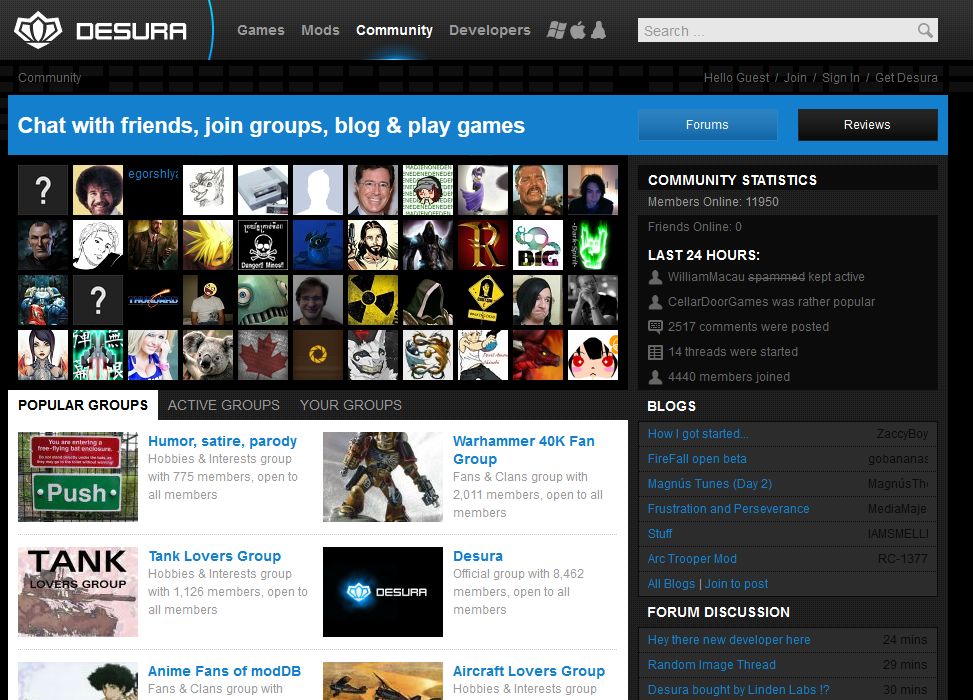
The Desura community pages
There may also be some speculation as to what this might mean to Second Life. A potential attraction of the Steam hook-up was the possibility of enticing games modders and 3D content makers interested in building for SL (particularly given the opportunities for selling their content in-world and / or through the SL Marketplace). Depending upon how the Desura acquisition is developed and prompted, a similar opportunity might exist here. Time will tell on that.
If nothing else, the Lab had set itself a pretty big goal in acquiring Desura – which is available on the Windows, Linux and Mac platforms. This is, according to Humble’s quote in the Lab’s press release, “To invest and support the Desura team in making it the most open and developer-friendly platform in the world.”
It’ll be interesting to see what rebranding of Desura takes place (if any) as a result of this move.
Amidst all the focus on Second Life and the emerging press coverage on its tenth anniversary – with Gamastura being the latest, providing a very short, punchy and positive piece based on the All Things D article which I examined here over the weekend – it is easy to miss the fact that another of LL’s products, Versu, has also gained a little media attention.
Versu, the Lab’s interactive storytelling application for the iPad, launched back in February with little fuss or flag-waving. Since then, there’s been little news. It doesn’t appear as if the library of titles available for it has grown to any degree, and there has been little in the way of any word from the Lab as to the future of the product. Versu hasn’t been updated since March 2013, the promised Android version has yet to surface, and there has been no news on the Lab’s broader plans to allow users to write and publish their own stories.
However, in June, UK magazine New Scientist published a piece on Versu, AI gets socially savvy, written by Douglas Heaven. The article was born out of Richard Evans, one of Versu’s co-creators, presenting a paper entitled Versu: A Simulationist Interactive Drama, at the Games and Media Event held in May 2013 at the Imperial College London. Heaven’s piece also appeared in New Scientist Online under the title AI makes social game characters all too human.
One of the current Versu titles
It’s a fascinating read. Not only does it give a greater insight into the power and versatility of Versu – something which is potentially easy to dismiss when first encountering the product on paper -, it also suggests ways in which applications such as Versu could be used to assist with or study a range of real-world social and other situations.
FLIRTY, shy or gossipy… these aren’t the typical traits of a bit of computer code. But a simulation system that gives computer-controlled agents a sense of social propriety could change that, leading to more realistic interactions between humans and characters in games.
So opens Heaven’s piece, before going on to give some background on Evans himself, who is not only one of the two minds behind Versu, but also worked on The Sims 3, before going on to set-up LittleTextPeople with Emily Short, which the Lab acquired in January 2013, and from which Versu was born. Interestingly, one of the motivations to generate such a rich depth to Versu’s non-player characters was the frustration Evans had with the behaviour of characters in The Sims 3 where, Heaven notes, computer-controlled characters would suddenly behave inexplicably, shattering the illusion of realism – such as visiting a neighbour’s house and having a bath…
To avoid this, Versu characters are not scripted, per se, as the New Scientist piece notes:
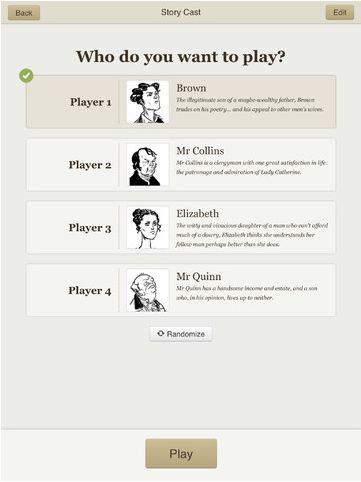
Versu character screen: you chose the character you wish to play, the rest will react to you based on a range of social rules, their own goals, and your own actions in the story (image courtesy of Linden Research / Apple Computers)
Each of its computer-controlled characters is governed by a deep model of social propriety. They react to rudeness, disapprove of bad manners, and they know a violated social norm when they see one. They gossip, show off and flirt. To make such behaviour possible, Evans streamlined the code that defines characters’ beliefs and desires. This allows them to weigh the consequences of many possible actions before deciding how to behave…
The behaviour of the agents [characters] is not scripted. Instead, they each have a unique set of goals and desires that govern their behaviour. No two play-throughs are likely to be the same.
This approach allows the Versu characters to “play out their own soap opera independently”, which can have some very surprising repercussions, as Evans noted in his presentation. In it, he relates that when testing Versu, he was surprised to find he was being snubbed by one of the characters. It wasn’t until he examined the game’s logs that he found out why. Earlier in the game, he had been rude to another character, who had gone on to tell others of his unpleasantness, with the result that Evans found himself snubbed later in the game.
Because Versu uses social rules to govern the actions and reactions of non-player characters, it is seen as a particularly powerful tool for modelling human interactions, which is in turn bringing it to the attention of academics as well as gamers.
Evans also sees a wider potential for the technology developed for Versu, suggesting that it could be used in a wide variety of activities – such as helping soldiers learn to interact with civilians in a war zone, or young people to deal with bullies.
Of all the new products launched to date by the Lab, Versu is the one which has piqued my curiosity the most – and it is also the one I’ve found to be the most frustrating, given it is restricted to the iPad and lack of any further news on it coming out of the Lab. Evans’ paper and this New Scientist article therefore both provide welcome insight into the app, and on its potential for the future – assuming the Lab shares in those aims and remains committed to developing and enhancing Versu.
Back at the start of 2013, Linden Lab acquired Boldai AB, a team of three programmers who jokingly refer to themselves as being, “From the country that gave you Minecraft and the country next to the country that invented Lego”.
Together, the Boldai AB team had created Blocksworld, which they described as “the ultimate building game – only it isn’t really a game, but you build stuff”, in their very creative initial marketing trailer. Early reviews of the app referred to it as a “perfect mix of Lego and Minecraft.”
Since the acquisition, the former Boldai AB team have been a little quiet (other than the odd Tweet on things), and their website has carried little more than news of their acquisition and a link to the Lab’s Beta Product sign-up page, together with a new promotional video. The latter may well demonstrate the app – including the ability to share your Blocksworld creations, a common theme within LL’s new products -, but it lacks the shine and fun of Boldai’s own efforts; such is the price, perhaps, of putting on a corporate jacket.
Well, now we have confirmation – albeit confirmation easily missed – that Blocksworld may well launch in July, appearing on the platform for which it was originally developed – the iPad.
There are no official details of any launch as yet, other than the (almost throwaway) comment which forms a part of an introductory piece for an interview with Rod Humble by All Things D, including whether, as Boldai originally intimated prior to their acquisition, whether Blocksworld will also be made available for other platforms following the initial iPad release. It’s also not clear whether this initial release will be a “full” release of the product or an initial “beta” of some description. Time will tell on these latter points.
In the meantime, if you wish to try to keep abreast of LL’s new products, and have not already done so, you might want to consider signing-up to the Beta Product page, and I’ll leave you with Boldai’s original and imaginative trailer video.
 On Thursday August 1st, Linden Lab launched Blocksworld, the latest in its new product line, a day later than anticipated.




 Inara Pey: Living in a Modemworld