Further Direct Delivery Beta testing

On November 3rd, a blog post appeared from Commerce Linden, referring to a further Beta of Direct Delivery. Unlike the first Beta, this appears open to all merchants. The blog post, appearing in the Commerce section – which doesn’t appear on people’s account dashboards, states:

“To improve the quality of upcoming releases, we are launching a Beta program for the Marketplace. Starting today, Aditi will be used as the Marketplace Beta testing  grid.* All merchants will be able to test new features and bug fixes at least five days before each Marketplace release. In addition to the Marketplace Beta release notes that are produced on the wiki, updates will be posted in the “Technical Announcements” section of the Marketplace Merchant Admin to alert merchants of current beta tests.”

The post continues:

“In December, all merchants will have the opportunity to purchase and list items using Direct Delivery on Aditi. We will be allowing a limited number of merchants to Beta test Direct Delivery in production before the official launch, which will not occur until after the New Year. If you would like to learn more about Direct Delivery, please see the updated Direct Delivery FAQ.”

This last paragraph will come as a relief to many, who were fearing LL might roll-out DD ahead of the Christmas season and inadvertently create issues for merchants as a result.

The full blog post can be read here, so if you’re a merchant and wish to find out more on DD, if you’ve not involved yourself to date, take a look at the notes for access the Beta grid (Aditi) if you not done so before, and head on over.

Another step or two for Direct Delivery

Alongside the new Viewer 3 UI that has reached the Development Viewer, further small steps have been taken with Direct Delivery (DD).

On the 18th October, DD related code previously released onto Le Tigre was rolled out on the main server release channel. Again, this does not mean that DD is now active, just that the road is being further prepared for DD’s arrival – or to allow for further code compatibility testing.

The code was rolled-out alongside an Agent Inventory update which means that any TPVs that have merged merged since Viewer 2.5.1 should experience much faster inventory response times than previously.

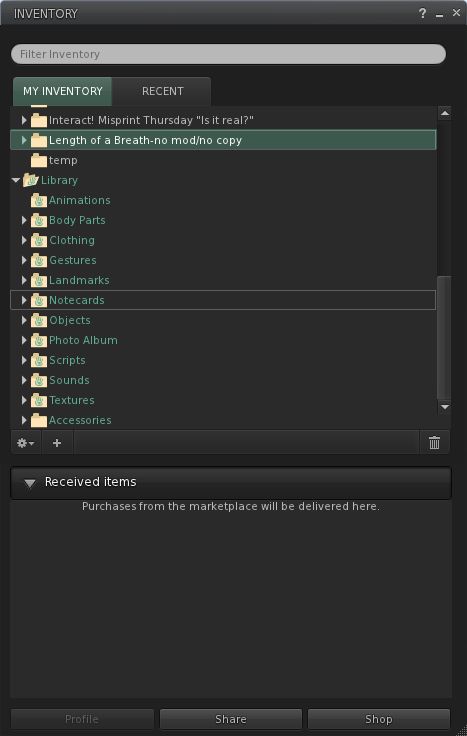
Direct Delivery: Received Items section added to the Inventory floater

Alongside of this, the latest Development Viewer, as well as getting the new UI shiny, also gets an update aimed at Direct Delivery: a new section in the Inventory floater called RECEIVED ITEMS.

Click on this, and you Inventory floater opens a new panel (left), wherein any items you purchase via the SL Marketplace will be delivered once Direst Delivery goes live, either boxed or in a folder hierarchy (or both, in some cases).

One assumes items delivered to this area can be drag-and-dropped into your main Inventory folders; as I’m not in the DD beta, I’ve actually no way of testing this. However, until the DD system is active, Marketplace deliveries will continue to be made as before, with items arriving in the main section of Inventory.

There is currently no corresponding new section (or folder) that can be used by the system to retrieve merchants’ items that are to be listed on the Marketplace. One assumes this is to prevent any confusion with people thinking DD is now active and thus trying to use the capability.

So, that’s another couple of steps forward, although the silence that has followed what are valid and reasonable questions on the project from merchants has now been going on for long enough to give the crickets leave to start chiruping.

A step closer to Direct Delivery?

Direct Delivery (DD), the means by which items purchased via SL Marketplace (and which in theory should make Magic Boxes as used by merchants a thing of the past eventually) took a step closer with the arrival of code on the Le Tigre release channel.

This does not necessarily signify that the new service is about to go live. It may signify that Linden Lab are pushing the code out for the purposes of production-side beta testing or perhaps for compatibility testing. News on the move is rather scarce. Brooke Linden promised to clarify the roll-out on the 4th October (when the code initially reached Le Tigre), but nothing further has been forthcoming from the Commerce Team.

New Delivery System

For those not in the know, Direct Delivery is intended to massively improve the way in which customers receive good purchased through SL Marketplace, and how merchants manage their SL Marketplace inventory locally. The beta for the system was originally announced back in April, although at the time the call was light on specifics.

So, in a very brief summary, for those purchasing items through the Marketplace it broadly means:

  • Recipients will no longer need to accept delivery of an object in order for the item to be successfully delivered in-world. Items will be delivered whether the recipient in in-world or offline, and a notification of arrival sent
  • Rolling restarts will not result in failed deliveries
  • Purchased items should be received in a new system folder, probably to be called “Incoming Items”, with purchases delivered to their own folder (or folder hierarchy) within this system folder
  • Failed deliveries as a result of multiple purchases through the Marketplace should cease.

For Merchants, the new system broadly means:

  • No requirement to use Magic Boxes (although support for Magic Boxes will continue for an unspecified period after DD has rolled-out)
  • No requirement to box items (although boxed items will continue to be supported)
  • Local management of inventory handled through a new system folder, probably to be called “Outgoing Items”. Items placed in this folder will be automatically retrieved and copied to the Merchant’s Marketplace inventory ready for listing (no copy items will be flagged as such and then moved to the SLM inventory once the merchant has OK’d the move)

Other aspects of the new system include:

  • To prevent over-inflation of local inventories as a result of large numbers of items being delivered into folder from the Marketplace, the number of objects a merchant can place in a folder will be limited. If a merchant is selling a large number of items in a single listing, they will be required to box objects within their folder hierarchy
  • The system will allow merchants to indicate to purchasers whether an item will be delivered boxed or unboxed
  • Merchants will no longer need to keep adding one unit to no copy item listings whenever one unit sells
  • Gifting and limited-quantity items will continue to be supported by DD.

There is also an API for the marketplace that is being developed with should also provide merchants with additional capabilities within the Marketplace. As well as Direct Delivery, work is ongoing to improve inventory services in general, including faster and more reliable inventory loading within the Viewer.

Concern

Overall, if implemented properly, these changes should benefit everyone.

However, it is fair to say that Linden Lab have not exactly covered themselves in glory when making massive changes to the Marketplace environment, as many of those involved in the switch-over from SL Exchange to SL Marketplace will testify. More recently, the Commerce team caused considerable consternation when making changes to the Marketplace.

Ergo, people are understandably nervous around the implementation of DD as a whole, the benefits it will bring notwithstanding. A number of merchants have already requested (via the Commerce Forum) than any formal roll-out of the new system be delayed until after the New Year, so that merchants face minimal disruption in the run-up to, and through, the busy Christmas period.

Taking stock of your Inventory

The upcoming changes to the Marketplace – specifically, replacing the traditional in-world boxes with a Direct Delivery system is causing a lot of concern. Beta testing for the new system has begun – or is due to begin – shortly. However, even that isn’t without its problems, with people being asked – yet again – to sign-up “blind” to an NDA.

These changes to the Marketplace environment are part and parcel of a wider programme that used to go via the acronym AIS – the Avatar Inventory System. Now known as the Inventory API, this is an on-going series of improvements that are specifically targeting how inventory is handled between the Viewer, the Asset Server(s) that “store” your “inventory” (i.e. hold the “master” data for inventory items) and the simulator servers themselves. The idea appears to be to develop an extensible system that allows for better, more focused tweaking of the inventory handling code that, among other things, should allow Linden Lab to more readily identify and fix problems related to inventory management as well as making the inventory system more scalable and robust overall than is currently the case. Hopefully, this will provide:

  • A more stable inventory management environment, one that can comfortably handle active inventories of 60K+ per avatar without the current issues and frustrations people experience on hitting these levels (inexplicable inventory losses, inventory failing to load or constantly having to box-up “unused” inventory simply to get the damned inventory “list” to download to the Viewer in a reasonable space of time, etc.)
  • A more robust means of ensuring Viewer, simulator and asset server remain synchronised in terms of inventory asset data, leading to fewer user-experienced problems when moving around the grid in terms of object rezzing failures, etc.

Overall, the changes being planned are all to the good; one of the biggest banes of comfortable Second Life living is problems associated with inventory; as many are all too aware, when problems occur with inventory vanishing, 98% of the time users are effectively left to suck-it-and-see in attempts to resolve the problem using a variety of care-worn techniques such a manual cache clearing in the Viewer, frequent relogging, frequent sim hops and inventory loads – with (sadly and most irritatingly) an almost “well, t’ain’t our problem,” attitude from LL’s own help desk.

Discipline

However, the new system is not going to be all plain sailing. In order to work effectively, the new system apparently requires your inventory to be reasonably-well ordered and structured. In particular, Merchants using the new Direct Delivery system will have to have their goods specifically arranged and ordered, while there will be a limit as to the number of individual items that can be placed in a single folder (rumoured to be around the 650 mark).

Some have seen these requirements as being negative points against the new system; I have to say that personally, I find it hard to understand why. While it is true that many don’t manage their inventories that well, the fact of the matter is that we’re actually provided with a basic system of default – and protected – folders for inventory items by Linden Lab themselves (Body Parts, Clothing, Objects, etc.), which can be readily used to create a well-ordered  inventory system, providing one applies a little discipline.

I also suspect that the majority of merchants are like me, and already have a well-defined folder structure for their goods. While such systems more than likely won’t meet the requirements that the new Direct Delivery system, they do mean that merchants already have the necessary self-discipline to get their products sorted and ready for the new system. For others, many people already use the #RLV “shared folders” system – and not necessarily for BDSM-related items (although this is obviously its primary use); so again the concept of a well-ordered inventory may not be so alien to people as some may think.

Whether the new system will require an complete overhaul of a person’s inventory remains unclear; we’ve had the Client-side code in both Viewer 2.x and Viewer 1.x for night-on two years now with it impacting on everyday inventory manage, so again, undue critique of AIS / Inventory API in the widest sense  may be a little premature. And even if the new system doesn’t require widespread changes, for those that tend to leave everything in the top level of their inventory after unpacking (i.e. in folders directly under MY INVENTORY), the fact that Linden Lab are taking steps to try and make the inventory management system more robust might be seen as a reason to perhaps get things sorted.

If nothing else, the default folders provided by the Lab have a big advantage over user-created folders: they cannot be accidentally deleted. Ergo, moving, say, all of one’s clothing folders under CLOTHING, gives one (albeit small) measure of protection against accidentally right-clicking on a top level folder and deleting it and then purging it from Trash before you’ve taken stock of what you’ve done. Furthermore, and while I admittedly have no first-hand experience of this (I’ve always kept a very well-ordered inventory), there is much anecdotal evident that ordering your inventory within the default folders provided by LL decreases the chances of items becoming lost or vanishing.

Yes, there are issues around  some  of elements of the AIS / Inventory API – such as the Direct Delivery system  – in terms of the impact they’ll have elsewhere in Second Life (such as the impact on in-world stores on a variety of levels, some of which I touched on in my post on Direct Delivery itself. However, I’d respectfully suggest that such concerns are more a part of a wider dialogue that is required about the Marketplace in general, and its potential impact on in-world revenue streams – including LL’s tier-derived income – rather than restricting them to discussions on AIS / Inventory API in and of itself.

At the end of the day we’ve all suffered from inventory issues at one time or another. Given the woeful track record from LL in terms of helping people deal with the issues they encounter – such as frustratingly being able to see a portion of their inventory but be unable to use it, simply because the current system has “moved” folders up to the same level as MY INVENTORY, and thus made them inaccessible – then I’d tend to take the attitude that anything that comes along that decreases the chances of such errors occurring in future and which more readily enable LL to rectify inventory errors is to be welcomed; any additional effort required on our part to help get the system working more efficiently notwithstanding.
SLM: How about some Direct Disclosure?

Yesterday, Brooke Linden blogged requesting SL Merchants volunteer to help with the new SL Marketplace Direct Delivery system. I actually missed the post, as unlike the old Jive system, news such as this doesn’t get pushed to the Featured News announcements on people’s dashboards, so you have to go hunting for the sodding information – which is about as pleasant as dropping a hardback edition of the OED on an exposed toe or two (and I speak from a position of authority on this latter point).

Direct Delivery (as it is now to be called) is a method by which the current Magic Boxes (themselves a hold-over from the days when SLM was still XStreet SL) can be replaced by a method to deliver items direct from a merchant’s inventory. This in itself is not a bad idea – some OS Grids actually already have such a system.

However, as it currently stands, the testing programme for this new system looks like it might not get out of the starting gate because Linden Lab seem hell-bent on keeping the whole thing a Sooper Sekrit to the point of absurdity.

  • There is no actual information on what the testing actually involves, beyond the broadest outlines (people will need to spend “several hours a week” involved in “trying to find problems” and “try out typical Marketplace Merchant activities”
  • There is no real information on how the system works, what set-up is entailed, how the Beta might impact a Merchant’s store and current delivery mechanisms, what additional overheads will be involved on the part of Merchants in order to actually position themselves in preparation for taking part in the programme
  • No information on what support will be available from Linden Lab for Merchants in the event of significant problems occurring that impact a Merchant’s ability to do business or which might adversely impact their reputation
  •  No information on what this is likely to do to inventory loads and organisation, etc., is provided.

The lack of such up-front information means that it is next to impossible for any Merchant to reasonably evaluate whether or not they should offer to participate – and this despite previous promises from Brooke that such information would be forthcoming.

Instead, Merchants are being asked to blindly sign a Non Disclosure Agreement (NDA) covering their involvement in the programme. On the one hand, this suggests that there is a high degree of paranoia evident at LL (an NDA is required for testing an enhancement to a product for which there is not credible competition in terms of scale? Is there something broader going on here that users are being kept in the dark about?). On the other hand, LL’s NDAs have in the past helped to create rifts between company and users, so the use of the term “(updated) NDA” in the sign-up form is already going down faster than a lead balloon among many well-established Merchants.

There are a myriad of other questions surrounding SLM as a whole, and precisely where LL are going with it.

While many are reporting that their SLM sales are growing (I’m one of them), in-world sales are equally declining for many (I’ve seen my own in-world sales significantly drop). Significant drops in-world sales calls into question the viability of keeping stores and shops open. After all, why pay $40-$100 a month in tier if you can achieve the same volume of sales for $2-$5 dollars a month in SLM commissions?  This in turn opens up the risk of land rentals plummeting as stores are closed down and Merchants re-focus their effort on web sales supported by perhaps a single, low-cost store, and thus further undermine an already fragile in-world economy.

At the same time, there cannot be any doubt that Search in the SLM works somewhat better than the Viewer 2 in-world Search; so why isn’t effort being put into actually sorting the latter out properly and making it possible for people to enjoy shopping in-world once more?

Make no mistake, there is a need for a service such as SLM, and a Direct Delivery mechanism such as appears to be under development would be a welcome addition to managing stocks. However, the manner in which LL are once more approaching what should be a relatively straightforward development and implementation of a worthwhile feature is fast becoming shrouded in frustration and mistrust.

So how about it Brooke – or better yet, Rodvik – can we please have some Direct Disclosure around the topic of Direct Delivery before we’re asked to sign our lives away…again…?