SL project updates 2017-4/2: Content Creation User Group w/audio

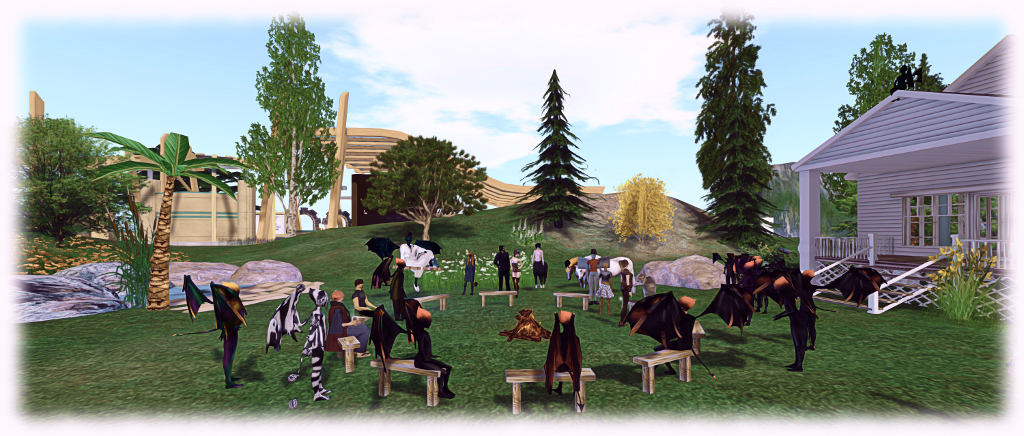
The Content Creation User Group has re-formed out of the Bento User Group, and is held at the Hippotropolis Camp Fire Circle. Imp costumes entirely optional :D .
The Content Creation User Group has re-formed out of the Bento User Group, and is held at the Hippotropolis Campfire Circle. Imp costumes entirely optional 😀 .

The following notes are taken from the Content Creation User Group meeting, held on  Thursday January 26th, 2017 at 1:00pm SLT at the the Hippotropolis Campfire Circle. The meeting is chaired by Vir Linden, and agenda notes, etc, are available on the Content Creation User Group wiki page.

Core Topics

  • Potential follow-on projects
  • Modelling for efficient rendering
  • Animations
  • Outfits

Follow-up projects

There has been no further progression on the potential follow-on projects from Bento (see my week #2 Content Creation Group meeting report for details of follow-ups).

  • In terms of the baked texture on mesh idea, the Lab has asked for specific content there “onion” meshes are used – and it has been reiterated this is most of the common mesh bodies and heads
  • There is still some confusion as to what may be causing the animation conflict issue. While it may be that changes will be made to the animation system in the future, as per the suggestions Vir forward previously (see the link above), the solution for now is to try to address the issue at a scripting level to prevent conflicts.

Modelling for Efficient Rendering

Medhue Simoni has been producing a series on the use of Level of Detail (LOD) to help with generating rendering efficient models in Second Life. Part 1 is embedded below, and Part 2 can be found here. A third part will be available soon, and hopefully, he and I will be producing a companion article in this blog once that part is available on-line.

Efficient modelling for Second Life has long been a problem within the platform, and something exacerbated by the arrival of full mesh support. Given this:

  • The Lab is considering revising the rendering cost calculations “at some point” to encourage people to consider more efficient models (e.g. making more use of normal maps to add detail to models where appropriate, rather than rely on always producing an extremely high poly count model).
  • It has been suggested that providing some basic indicators of what might be considered “reasonable” number – poly counts, proportionate scaling of LODs, etc. – for models could be produced, together with videos (by content creators with a solid understanding of the subject and Second Life)  on efficient use of normal and specular maps
Using a normal map to enhance the detail on a low-polygon model
Using a normal map to enhance the detail on a low-polygon model. The image on the left shows a model of some 4 million triangles. The centre image shows a model with just 500 triangles. The image on the right shows the 500-triangle model with a normal map taken from the model on the left applied to it. Credit: Wikipedia

The discussion broadened to cover awareness among content creators as to what actually works and where falsehoods / misunderstanding lie. A cited example in the meeting was that of mesh clothing makers avoiding the use of normal maps because they want their clothing to look the “same” to everyone, even though doing so can severely impact the user experience for those on lower-end system, and thus discourage users from buying their goods.

.BVH Animations and Animation Playback

Animations can be uploaded to Second Life in one of two formats, .ANIM and .BVH. The latter are optimised as a part of the upload process, and this is proving to be a particular problem for Maya users when animating facial expressions. These require finer bone movements in the animation, which the optimisation process is filtering out, requiring Maya users to use exaggerated movements. Blender users can avoid the issue by using .ANIM, which does not pass through any form of optimisation / filtering.

While it is recognised that the thresholds used by the .BVH optimisation / filtering process may not be the best for very small bone movements, there are currently no plans to alter / refine the .BVH uploader. Nor is it really feasible to adjust the thresholds for hand and face bones, as this could have an adverse effect where these bones are re-purposed for other uses (as Bento is intended to allow).

There are two possible workarounds which may help with these issues for anyone using the .BVH format:

  • Swap to using .ANIM files, which do not go through any similar optimisation process. Unfortunately, this isn’t an option for Maya users, as there is current no .ANIM exporter for Maya, although Aura Linden is working on one in her own time, and is hoping to get time in about three weeks to sit down and finish it
  • Alter the frame rate of the animation itself – so rather than creating it at 30 fps, try 15 or 10 fps, depending on the animation.

There was also some confusion over the maximum file size for animations, as per my 2016 week #25 report, this was increased from 120 Kb to 250 Kb in June 2016. The wiki page on SL limits has now been correctly updated to reflect this. It’s also worth noting, as an aside, that animations will be moving to delivery via the CDN network in the future.

There was an extended conversation around Outfits and the Outfits folder. While much of this revolved around the Visual Outfits Browser option for Outfits, a couple of significant items were discussed.

The first was on the subject of saving gestures with outfits. As noted in my Bento update #26 and Bento update #27, gestures cannot be automatically saved with an outfit, but can be manually added as links / copies. However, Medhue Simoni has found a catch: should the outfit ever be re-saved, the gestures are removed. Expect a JIRA soon

A common request for the Outfit system to allow nested folders once more the ability was removed with viewer 2.1 (see VWR-19774), and while it was at the time noted as a possible “priority” item for consideration by the Lab, the topic has only recently again come up in internal conversations as a result of feature request BUG-41826. However, the amount of work involved to make it happen makes it unclear if the request will be accepted.

One request for Outfits which is unlikely to be acted upon, is to have links to other folders in addition to objects. This is seen as even more complex than allowing nested folders within the Outfits hierarchy.

Next Meeting

The Next Content Creation User Group meeting will be on Thursday, February 16th, 2017.
SL project updates 2017-3/2: texture uploads, Content Creation UG

An Uncertain Destiny, Mystic; Inara Pey, January 2017, on FlickrAn Uncertain Destinyblog post

Server Deployments – Recap

  • The Main (SLS) channel was restarted on Tuesday, 17th January, but there was no associated code deployment
  • A new server maintenance package was deployed to the RC channels on Wednesday, January 18th, comprising a partial fix for (non-public) BUG-3286, “Can’t move object” fail notifications (fixes for regions/objects with longer names are pending) + internal server and logging enhancements

SL Viewer

No further updates to the current viewer pipeline list.

Texture Uploads and First Time Rendering

The Lab has been making some hardware (/communication?) changes to the texture upload / delivery mechanism (e.g. both the handling of texture uploads from the viewer to the asset system, and then from the asset system back out to the viewer via the CDN). When deployed to the main grid, these should see improvements in the uploading of new textures and their appearance on in-world objects, whether uploaded individually or in bulk (e.g. hopefully little / no grey panels in new texture upload previews when viewing them from inventory, and few / no grey object faces when uploading a texture and then immediately applying it to an object face).

Content Creation User Group

Summary of General Points

  • No further movement on the potential “Bento follow-up” project ideas (see my Content Creation UG notes for week #2).
  • The next Avastar release is in advanced testing, with a potential release around late February / March, but will include devkit support and a large number of bug fixes.
  • Appearance sliders:
    • A question was asked whether the slider system could be updated to allow for easier scaling for smaller avatars utilising Bento (as not all Bento bones are linked to sliders). Vir noted this is unlikely, as it would require a change for the base slider scaling which could break existing avatars.
    • However, Vir noted that suggestions to offer new sliders for sizing things like wings and tales have been discussed at the Lab, but nothing has as yet been decided.

Pain Points / Blockers to Bento Content

A general question thrown out by Simon Linden was whether people are experiencing particular “pain points” in producing Bento content: what they might be waiting for tools-wise or in any other way etc. this quickly spilled out into a much broader discussion on various tools and suggested tutorials. However, core points raised were:

  • Available time, learning to use external tools such as Blender,
  • Waiting on Avastar, plus tutorials, both generic and on using specific tools (e.g. Avastar and Mayastar) – which will hopefully come in time
  • Mention was made of making people more aware of SL-specific areas such as level of detail (LOD), managing physics, LI calculation rules, etc.

It was also noted that possibly having idea of having some for of sample content (e.g. wings, hands), which creators could use as an example / baseline for their own creations, together with a broader selection of documentation / tutorials / videos.

Simon pointed out that in terms of Lab developed tutorials and documentation, there are only limited resources. Many third-parties also produce tutorials (Mehdue Simoni, for example is waiting for the new Avastar to reach release before working on his video tutorials for it).

Others have also put together documentation, but are finding it hard to get that documentation seen heard above the broad range of misinformation on content creation which is  in circulation. Vir has suggested that meaningful documentation and tutorials could be linked to through the SL wiki.

In terms of the wiki, there are a range of resources available for content  creation / Bento:


SL project updates 2017-2/2: Content Creation User Group with audio

The Content Creation User Group has re-formed out of the Bento User Group, and is held at the Hippotropolis Camp Fire Circle. Imp costumes entirely optional :D .
The Content Creation User Group has re-formed out of the Bento User Group, and is held at the Hippotropolis Campfire Circle. Imp costumes entirely optional 😀 .

The following notes are taken from the Content Creation User Group meeting, held on  Thursday January 12th, 2017 at 1:00pm SLT at the the Hippotropolis Campfire Circle. The meeting is chaired by Vir Linden, and agenda notes, etc, are available on the Content Creation User Group wiki page.

Core Topics

  • Bento request from Troy Linden.
  • Supplemental animations that run alongside the main animation (e.g., flapping wings while walking).
  • Possible future project – applying baked textures to mesh avatars.

Bento Request From Troy Linden

Troy Linden is preparing a presentation on Project Bento for an upcoming Second Life meeting within Linden Lab in which he plans to review the project, the interactions with content creators, the benefits this brought to the project, etc. In particular, he would like to demonstrate Bento content people are making and impress on LL’s executives how the project has been received, and how things might be followed-up.

To help with this, he is requesting that anyone with glamour shots of Bento avatars, etc., videos of avatars and Bento items  to contact him via IM to discuss and / or send him what they have (troy-at-lindenlab.com).

Supplemental Animations

Introduced in 2013, llSetAnimationOverride() is one of a series of animation commands keyed directly into the server’s animation states, allowing for faster, smoother animation state changes than with AO systems using the older llPlayAnimation() command. However, llSetAnimation() only allows one animation to be played  at a time for any given state, and this can lead to conflicts when trying to run custom animations as well (see BUG-41048 . An example of this is trying to use llSetAnimationOverride() to walk whilst using an animation to flap wings (below), which causes while the walk, set by llSetAnimationOverride(), to freeze in favour of running the wings flapping, as they are also seen as a locomotion animation.

Vir has identified two possible courses of action to deal with this. The first would be to extend llSetAnimationOverride() to allow “supplemental” animations to run alongside the animation states keyed by llSetAnimationOverride(), effectively allowing them to play together. The other would be to provide a means for people to define their own custom animation states (with associated animations) which the simulator would be able to recognise and handle alongside the existing animations states, rather than having the associated animation conflict with the default animation states.

No decision has been made on which route to take, and Vir is putting together a proposal on approaches, which he’ll put forward at a future meeting.

Applying Baked Textures to Mesh Avatars

This would allow the skin and clothing layers (skin, tattoo, under shirt, shirt, etc., “wearables”) to be directly applied to mesh avatars. In theory, this could be done, and could make it easier to do things like match skins between, say a mesh body and a non-mesh head without having to use applier systems. It could in theory even reduce the complexity of mesh avatars, which currently have to be made up of multiple layers (the so-called “onion meshes”).


A further benefit would be for non-human avatars a well. Providing the same UV is used across all elements of an avatar, it could allow creators to offer different pelts  / skins for their animal / creature avatars and, if they make their UV maps available to other creators, allow them to produce things like additional skins.

However, there are problems in proceeding this way.The baking service is capped at a limit of 512×512 texture resolution, which would mean a loss of detail trying to “stretch” such textures over a mesh avatar, which would result in the ability potentially being ignored in favour of using the current “onion mesh” and appliers approach.  It might also mean that wearable layers would be used in non-standard ways (e.g. using a “skirt” layer to apply a skin), which could lead to user confusion (“why am I using a skirt to wear a skin?”) – although this could be overcome by adding further wearable types specific for use with avatar meshes to the system.

An alternative would be to increase the texture resolution for the baking service to 1024×1024. While not entirely ruled out, it does carry with it a set of unknowns as well – what would be the back-end resource hit, could it lead to an uptick in texture trashing issues in the viewer, etc.).

Baking Textures on In-World Mesh and prim Surfaces

Part of the above discussion overlapped with the idea of allowing textures to be baked on arbitrary meshes (thus allowing for compositing, etc).

Vir noted that this would be a far more complex project due to the nature of the baking service, and thus would likely not be considered as a part of making changes to how system wearables might be applied to mesh avatars. However, he is interested in seeing feature requests on how this might be done and the benefits it would bring to SL, and a related JIRA – BUG-7486 – is in the process of being re-opened for comments along these lines.

Other Items

The latest version of Avastar is support of Bento is still undergoing testing. Those using it report it is behaving well, so hopefully a realise won’t be too far off.