LL August blog update

Linden Lab today issued the second in their “monthly updates”, covering August. I’m still not sure I like this monthly approach to keeping us informed on things – particularly as most of the “news” is once again somewhat stale.

The new social aspects of web profiles get prominence in the update, unsurprisingly. I’ve nothing against the new system, but I do still wonder at how popular it will prove, compared to the likes (and convenience) of Twitter. I’ve used the Feed aspect a few times, but few of those on my Friends list appear especially captivated with the new toys.

The new-look Viewer 2 (2.8 onwards) log-in / splash screen gets a section as well. There are some things missing from this, as I’ve mentioned in my review of the new screen, and will be poking LL on the matter as well.

The new server-side controls that allow a region’s environment to be better controlled are also reviewed, as are the new privacy capabilities (“Hide Avatar”), which operate at parcel level. Passing mention is made on the work to improve payment methods, and mesh just about gets a look-in with the recent call for further Main grid volunteers.

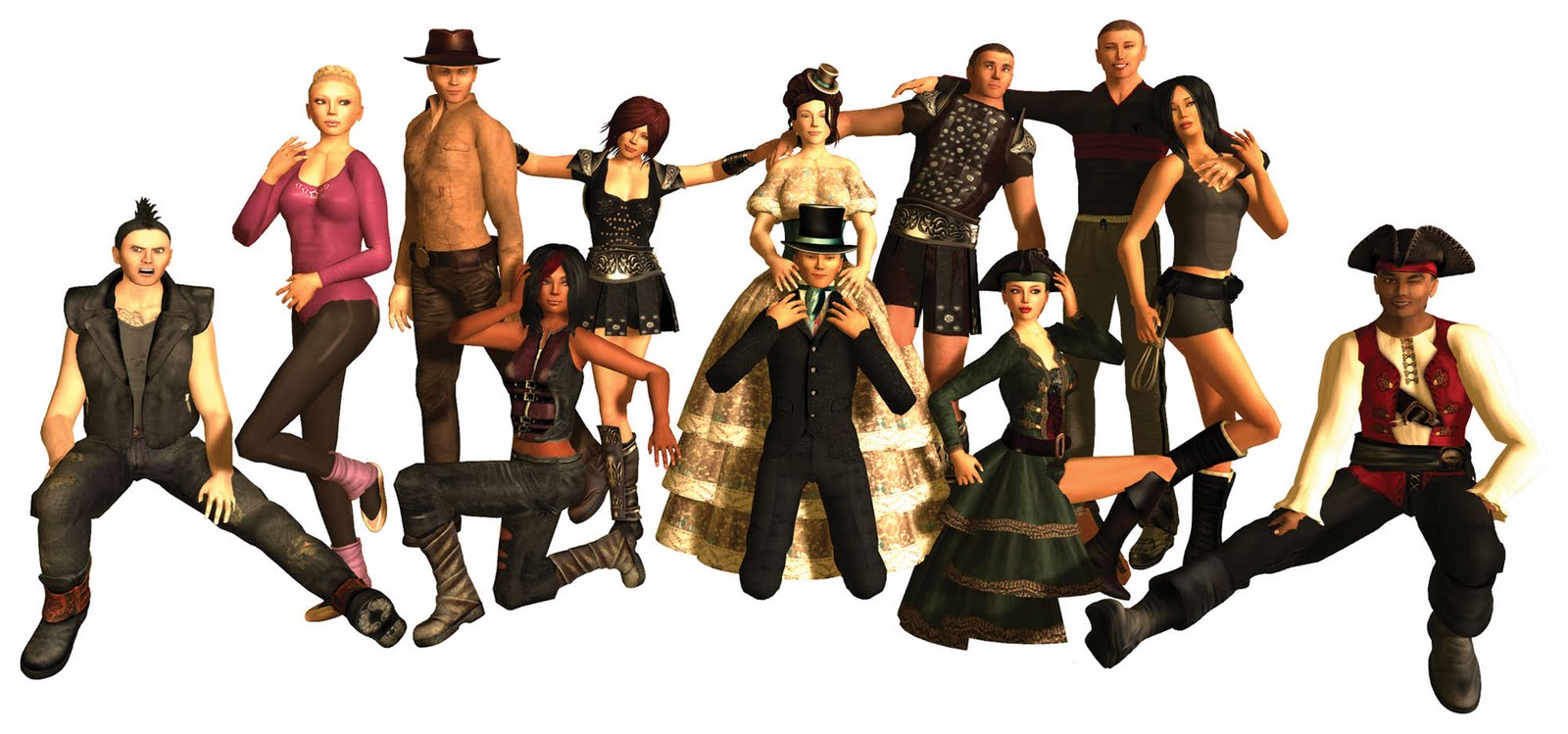
There are also some shiny new avatars for those to choose from when signing-up to SL / creating additional accounts:

New Avatar choices (image courtesy of Linden Lab)

Personally, the one piece of news the update contained – and most welcome it is, concerns e-mails from LL:

If you’ve unsubscribed to optional news and promotional emails in the past, you can now resubscribe to emails by category. It’s important that you enter the email address that’s connected to your SL account. These subscription options don’t affect the emails you receive for transactions, instant messages from friends and/or customer service responses.

The ability to opt-out of specific e-mail categories from LL has long been a failing of the system, and something I’ve critiqued in the past; that we can now do so on a more granular level is most welcome, and kudos to LL for listening to those of us who have complained over this lack of flexibility in the past.

As a round-up, the blog post is not bad, as an “update” for the month of August its, frankly, disappointing, containing very little that users most likely aren’t already aware of.

Meeroos: LL’s CS shoots itself in the foot. Again

I hate wagging the finger at Rodvik, I really do. But there are times when it has to be done; and this is one of them.

As has been the talk of Twitter, Malevay,  the creators of Meeroos recently came under a form of attack: one day old avatar accounts with names closely approximating the official “Meeroo Resident” asset management account started to be used in attempts to cash-in on the Meeroo success – right under Malvay’s own noses. You can read about the situation in detail here.

As a result, the Malevay raised a series of tickets against the culprit accounts – and to cut a long story short, someone at LL’s Customer Support reacted in a totally lackadaisical and inexcusable manner and simply banned all account names looking like “Meeroo Resident” without thought or consideration as to the possible consequences. The result: the official Meeroo asset management account also got banned, with potentially serious repercussions for all involved.

How this came about is unclear, but what is apparent is that it smacks of sloppy enforcement and LL’s Customer Services end, and a lack of checks and balances to prevent avoidable mistakes occurring when dealing with people’s accounts. As Crap Mariner points out, are LL’s Customer Services incapable of carrying out the most rudimentary of checks on accounts prior to blocking them?

Insult was added to injury when the account was apparently reinstated on the QT without the account holder receiving any communication from Customer Services. They simply found out when they another periodic attempt to log-in to the account and see if it was there.

Now, this is not the first time this kind of thing has happened; numerous people have reported they’ve experienced their accounts being suspended without warning, only to be subsequently reinstated equally without notification, for no readily apparent reasons.

Back when the new “communications platform” was launched, people  – like Darrius Gothly – who accidentally violated the community standards for the platform were horrified to find members of the Customer Services team were publicly chastising them and using screen captures that clearly showed personal information – although why the heck Customer Services should need to capture screenshots was, and remains, a mystery. At the time, Amanda Linden tried to excuse the situation as “working out the kinks” in the new system. And explanation which, frankly, floated on the sea of scrutiny about as well a brick on the Atlantic.

This most recent incident involving Meeroos has many questions around it; to be fair, a lot of them are unrelated to LL’s Customer Service operations per se. However, it is and will be the actions on the part of LL’s Customer Services that will continue to receive a lot of attention – and a lot of criticism – both for the original account blocking error and the manner in which it was silently reinstated.

Had this been a one-off situation, people might be a little more forgiving, but it is not, as pointed out above. Rodvik identified customer services as being one of the Achilles’ Heels of Second Life. This situation with Meeroos demonstrates that this is very much still the case, and that it really is about time LL were seen to be tackling the problems, rather than people being left feeling they’re still only talking about tackling them.

Listening and hearing

On Friday, Rod Humble kicked-off what he promised (via Twitter), to be a resumption of communications from the Lab regarding what is going on around SL and the Lab’s efforts relating to it. At the same time, we also got an update on what we can expect in terms of news on Mesh by the end of the month.

Many have critiqued LL – and Rodvik – for their use of Twitter; a commentator on this very blog took issue in the way communications are being handled –  claiming LL had “missed the boat” in their efforts. I’ve also been critical of the Lab, not just recently but throughout the life of this blog, for their lack of prowess when it comes to listening and engaging.

But, as Tateru today points out – things are changing. Rodvik is not only listening, he’s hearing and reacting- and kudos to him for doing so.

Just a few weeks ago, Theia Magic and others were making constructive blog posts and Tweets on the state of the new user welcome areas (notably Ahern and the lack of coordinated help for new users. The abuse is something a group of us had a round-robin on one evening (again via Twitter), when two of us pointed out the absurdity that when it comes to the official forums, LL are so paranoid about language and misunderstandings, that they actually blanked the use of the name “Dick van Dyke” for fear of upsetting the teens (or their parents) – and yet anyone arriving like Ahern risks being subjected to the most foul written and verbal (if Voice enabled) abuse which LL apparently deemed as “acceptable”.

Whether it came about as a result of Rodvik’s involvement in Twitter exchanges is 100% clear (although his intervention in issues is a matter of record), he has confirmed the return of the Resident Help Network. This cannot be anything but a good move – providing it is properly managed and coordinated. LL cannot be expected to keep their thumb on the pulse of everything in SL, so the proper used of something like SHN could be of major benefit – and it hopefully represents a first real step towards practical re-engagement with the user community – something that has again been something of a bee in my bonnet.

Also on Twitter, and while it received largely positive feedback, the new user sign-up process was critiqued because it only features human avatars. Again, Rodvik took time out to respond to these comments – and in his latest post he advises us that LL are expanding the available choice of avatars, “We know that the beauty of Second Life is the diversity and richness of how we choose to represent ourselves inworld. So, we’re adding 12 animal and 12 Robots and soon we’ll have Vehicles too. Then, we’ll also commission another set of human avatars that represent a wider, more diverse audience.

Both of these responses indicate that not only is Rodvik – the man at the top  – listening, he’s hearing what is being said and reacting to it.

A critical part in communications – again, as Tateru notes – is feedback – and this is something that, while there are still frustrations over a number of issues – Rodvik is paving the way. His blog posts are refreshing as they provide information and feedback clearly, and place him squarely alongside Frank Ambrose (FJ Linden) for providing quality communications. LL aren’t out of the woods where the entire issue of company / user interaction / engagement is concerned, but Rodviks efforts on Twitter, and he openness in blogging are certain steps in the right direction.

Twittering with Rodvik

Yesterday evening, Rodvik Linden – LL’s CEO Rod Humble – popped up on Twitter and chatted with some of us there in what was another of the warm an open conversations that have been a hallmark of his time at LL so far.

I actually came late-in-the-day to the conversation, logging-in to Twitter to catch this from Rodvik, replying to a comment on things SL:

@SecondLie I think we need to put purchasing into Basic first 🙂

Given the Basic mode of the Viewer is something that has been occupying my thoughts of late, I Tweeted in return:

@rodvik how about offering a better “step up”, help-wise from Basic to Advanced? – pointing to my recent post on the subject, and:

@rodvik If you keep adding functionality to the Basic mode, won’t you end up with…the Advanced mode?

I’ve no idea if Rodvik went and read the post in question; but it sparked something of a short discussion on the Basic mode and the Viewer in general in which he responded very positively to all making comments. In particular, he tweaked my curiosity with a reply to my suggestion that perhaps the Viewer should be made more modular:

@InaraPey Maybe yeah. Bagman keeps telling me that would be a good approach.

Bagman Linden is Jeff Petersen, the Lab’s newly-appointed VP of Engineering, and I have to admit, hearing that he’s thinking along similar lines  – and leaving my precious little ego well out of things – does raise my spirits, and it suggests that we just might be seeing a wholly new iteration of the Viewer at some point that may well achieve something Viewer 2 has so far failed to do. Going the modular route just – to me at least – seems the most common-sense approach to take; what isn’t clear is just how much effort it will take…

I also took the opportunity to both congratulate and tease Rodvik on the new Avatar sign-up pages. As reported yesterday, these are a superb step forward, but the lack of overall QA on their compatibility with all browsers really lets them down. Rodvik took the tease in good spirits:

@rodvik. The new sign-up process is very clean; hope the compatibility issues are sorted ASAP; they tend to defeat the hard work put in.

@InaraPey Thanks, yeah should be fixed quickly. Even with those the results have been amazing.

This comment is interesting, as it’s been stated that new user sign-ups are running as high as about 10K a day; although it’s hard to see this reflected in on-going concurrency, which has been dropping. I’d really like to know more as to what has been the effect of the new sign-up pages, and how badly things like new users ending up bewildered and confused by SL once they are here are affecting user retention.

Again, leaving aside any ego-boo I get from chatting with Rod Humble via Twitter, I found the time he took to address questions and suggestions as best he could to be refreshing and open. Of course, there is a temptation to bemoan the fact that while he is chatting on Twitter, the rest of LL seem to be engaged in an obstinate silence on their own Community Platform – but the fact is (and providing it goes beyond purely touchy-feely “niceness”), Twitter does offer an immediacy the CP lacks.

What would be good- and where Linden Lab are most definitely missing a trick – is in not having a Twitter feed or two on their own web pages. I really would recommend a couple of  live feeds from the likes of Rodvik and Pete “Ballyhoo” Linden direct to people’s Dashboards would prove very useful in demonstrating to users that LL are communicating.

So how about it, Rodvik, Pete?

SLM: How about some Direct Disclosure?

Yesterday, Brooke Linden blogged requesting SL Merchants volunteer to help with the new SL Marketplace Direct Delivery system. I actually missed the post, as unlike the old Jive system, news such as this doesn’t get pushed to the Featured News announcements on people’s dashboards, so you have to go hunting for the sodding information – which is about as pleasant as dropping a hardback edition of the OED on an exposed toe or two (and I speak from a position of authority on this latter point).

Direct Delivery (as it is now to be called) is a method by which the current Magic Boxes (themselves a hold-over from the days when SLM was still XStreet SL) can be replaced by a method to deliver items direct from a merchant’s inventory. This in itself is not a bad idea – some OS Grids actually already have such a system.

However, as it currently stands, the testing programme for this new system looks like it might not get out of the starting gate because Linden Lab seem hell-bent on keeping the whole thing a Sooper Sekrit to the point of absurdity.

  • There is no actual information on what the testing actually involves, beyond the broadest outlines (people will need to spend “several hours a week” involved in “trying to find problems” and “try out typical Marketplace Merchant activities”
  • There is no real information on how the system works, what set-up is entailed, how the Beta might impact a Merchant’s store and current delivery mechanisms, what additional overheads will be involved on the part of Merchants in order to actually position themselves in preparation for taking part in the programme
  • No information on what support will be available from Linden Lab for Merchants in the event of significant problems occurring that impact a Merchant’s ability to do business or which might adversely impact their reputation
  •  No information on what this is likely to do to inventory loads and organisation, etc., is provided.

The lack of such up-front information means that it is next to impossible for any Merchant to reasonably evaluate whether or not they should offer to participate – and this despite previous promises from Brooke that such information would be forthcoming.

Instead, Merchants are being asked to blindly sign a Non Disclosure Agreement (NDA) covering their involvement in the programme. On the one hand, this suggests that there is a high degree of paranoia evident at LL (an NDA is required for testing an enhancement to a product for which there is not credible competition in terms of scale? Is there something broader going on here that users are being kept in the dark about?). On the other hand, LL’s NDAs have in the past helped to create rifts between company and users, so the use of the term “(updated) NDA” in the sign-up form is already going down faster than a lead balloon among many well-established Merchants.

There are a myriad of other questions surrounding SLM as a whole, and precisely where LL are going with it.

While many are reporting that their SLM sales are growing (I’m one of them), in-world sales are equally declining for many (I’ve seen my own in-world sales significantly drop). Significant drops in-world sales calls into question the viability of keeping stores and shops open. After all, why pay $40-$100 a month in tier if you can achieve the same volume of sales for $2-$5 dollars a month in SLM commissions?  This in turn opens up the risk of land rentals plummeting as stores are closed down and Merchants re-focus their effort on web sales supported by perhaps a single, low-cost store, and thus further undermine an already fragile in-world economy.

At the same time, there cannot be any doubt that Search in the SLM works somewhat better than the Viewer 2 in-world Search; so why isn’t effort being put into actually sorting the latter out properly and making it possible for people to enjoy shopping in-world once more?

Make no mistake, there is a need for a service such as SLM, and a Direct Delivery mechanism such as appears to be under development would be a welcome addition to managing stocks. However, the manner in which LL are once more approaching what should be a relatively straightforward development and implementation of a worthwhile feature is fast becoming shrouded in frustration and mistrust.

So how about it Brooke – or better yet, Rodvik – can we please have some Direct Disclosure around the topic of Direct Delivery before we’re asked to sign our lives away…again…?

Business, Collaboration and Creative Growth

“In the long history of humankind (and animal kind, too) those who learned to collaborate and improvise most effectively have prevailed”

The above quote, often – and possibly wrongly – attributed to Charles Darwin, serves as a worthy bookend to this piece.

Collaboration is a term frequently used in business to denote innovative strategies, projects, products and tools. It is stamped on marketing media and blurb as a hallmark of success. Collaboration indicates a company can create dialogues that can be leveraged into tangible benefits that generate growth for all concerned.

Over the years, Linden Lab has struggled to find a broader home – a workable market – for Second Life. In this they have been hampered by a number of issues, perhaps the biggest of which is the dichotomy of how to actually see Second Life.

On the one hand, it is a digital nirvana-in-the-making that will massively impact and transform the human condition; on the other, it is a commercial exercise. The former view is at the heart of Philip Rosedale’s perception of Second Life, as this comment from July 2010, demonstrates:

“Second Life and virtual worlds are going to profoundly affect the human experience, profoundly, and in a positive way. That is the mission of the company to make that happen and it’s my personal inspiration and dream to see that happen.”

In other words, it doesn’t matter whether or not Second Life makes money. But Linden Lab is founded upon venture capital – and so there is an emphasis on its ability to perform well enough not only to survive and return the initial investment, but demonstrate it can grow beyond it, attracting more capital along the way.

The SL Adventure was just Beginning

Rosedale’s view is firmly planted in the early days of Second Life. Back then the potential of the platform was untapped and no-one really knew what they had on their hands. Users were giving form and substance to the vision, bringing it into a fledgling reality; LL could afford to step back and encourage and tweak without overtly interfering.

During those formative years there were good communications between the Lab and users; policies would be announced, Town Hall meetings would be called; issues put into the public domain, feedback would be accepted and ruminated and acted upon. People had the feeling of participation; that the Lab and the community were on the same side. Where policy intruded – as with the 2003 Tax Revolt, the users made it clear it was the policy that was the issue, rather than making it personal, and issues were generally resolved with a degree of compromise on both sides.

The Undiscovered Platform

In November 2005, CNNMoney ran a piece on money-making in virtual worlds. This was followed a week later by an article by Paul Sloan, focusing on Anshe Chung, whom he referred as a Virtual Rockefeller.  It became the story that wouldn’t go away, rolling on for a full year.

Suddenly Second Life was the darling of business hype – without either big business orLinden Lab really understanding why. Businesses leapt onto the Second Life bandwagon without having any real idea why; they all just wanted to tap into this strange and hip new market.

It was an aberration. While it was true that with an enterprising bent and a desire to succeed, a person could make money from within the virtual environment, the opportunities for large organisations to do so were far more limited – if they existed at all.

By late 2007, the initial love affair was all but over. And while all the publicity had generated a significant upswing in user sign-ups, it’s very probable that those sitting in the Boardroom viewed the 2006/7 period as something of a missed opportunity. What exactly had gone wrong? Why hadn’t Second Life proven to be something that big business could recognise as a value proposition? What was missing, where did SL lack relevance? How could it become relevant once more?

Second Life 2: The Search for a Market

Out of this came what can only be described as a determination to refocus Second Life as a tool fit for business. To achieve this, the mystic vision that surrounded Second Life needed to be dispersed and replaced by something far more tangible and appealing that would cause big business not only to show an interest, but actively pursue the platform.

So 2008 started as the “year of change”:

  • Philip Rosedale’s March announcement that he was stepping down as CEO
  • The announcement that same month of the new Trademark Policy
  • The appointment of Mark Kingdon, a seasoned marketing executive, as the new CEO in April.

Kingdon’s arrival started the drive to make Second Life a “killer app” for big business; a drive which saw:

  • A redefinition of the platform as a service
  • The start of a drive to radically reinvent the Viewer
  • Engagement with the likes of RiversRunRed to develop “immersive workspaces”
  • The development of what would become known as the “out of the box” Second Life Enterprise (SLE) “tool” and Second Life Workspaces.

In moving this way, LL ignored a wealth of history that demonstrated that the best way for a young start-up to grow is to work from within rather than try to reinvent itself. Worse, it completely overlooked the fact that the company’s own working ethos, perhaps more than anything else, made it fundamentally incapable of achieving the desired goal.

Mark Kingdon departed Linden Lab in June 2010, the final admission that the Great Experiment had failed. While there was something of a minor rise in user sign-ups, over all, little changed in that period – other than the steady erosion of user confidence in the Lab itself, as I documented in Change in Second Life.

The Voyage Home

Today LL is in almost precisely the same position as it was two years ago: trying to bridge the gap  between early adoption and mainstream use. Even so, rather than accepting the conventional wisdom that the gap is best crossed by leveraging niche areas in the current user base, LL’s eyes have resolutely remained turn outwards, constantly looking for the Next Big Thing to which they can pin their hopes.

And it needs to stop.

The fact is that, far from being predominantly maladjusted individuals, as Mitch Kapor unfortunately inferred in his 2008 SL5B address, the SL user community is highly representative of the audience Linden Lab are seeking. It is made up of gamers, designers, builders, actors, musicians, digital filmmakers, role-players, artists, pundits, educators – the list goes on. What better way then, to actively promote the platform to the world at large than to tap into the wellspring of talent already using it?

That this hasn’t happened speaks volumes about a failure of vision within a company founded upon a vision. Fortunately, it is something that can be rectified. And it starts with LL re-establishing the trust that once existed between themselves and the user community. It needs to return to constructive, two-way communication and demonstrate it can:

  • Embrace the fact that while it may be a harsh critic, the user community is a loyal spouse, ready to defend, support and promote the platform
  • Accept that the community might just understand the nuances of the platform, and the hurdles that lay between LL and a wider market share at least as well as LL themselves
  • Help to better promote events within Second Life to the world at large through, for example, access to the LL PR team for those events that demonstrate they can reach beyond the current user base into new audiences
  • Work with the community to develop tools the community can use to pro-actively promote activities and events both in-world and out world
  • Provide the means by which the community can provides gateways from other media into Second Life so they can draw audiences in-world
  • Help to give the community the ability to effectively crowd source and create buzz

In short, Linden Lab needs to start collaborating with the user community once more and thinking more holistically about their product. Doing so isn’t going to solve all of SL’s woes (would it were that easy); but it will represent a major step in the right direction.

Regardless of whether or not Darwin actually wrote the quote at the top of this article, the truth of the observation it contains is clear: collaboration lends to success and growth.

Further Reading