In October last year, I wrote about Alpha and Omega Points in SL. Operated by Masoon Ringo and Sweetlemon Jewell, these two sims are home to incredible builds that straddle the sci-fi / fantasy divide and offer visitors much to see and do, as I reported at the time.
I dropped in on the sims at the end of April to find they were under reconstruction. What I saw then intrigued me, so I decided to wait a couple of weeks and pop back over and see what has happened.
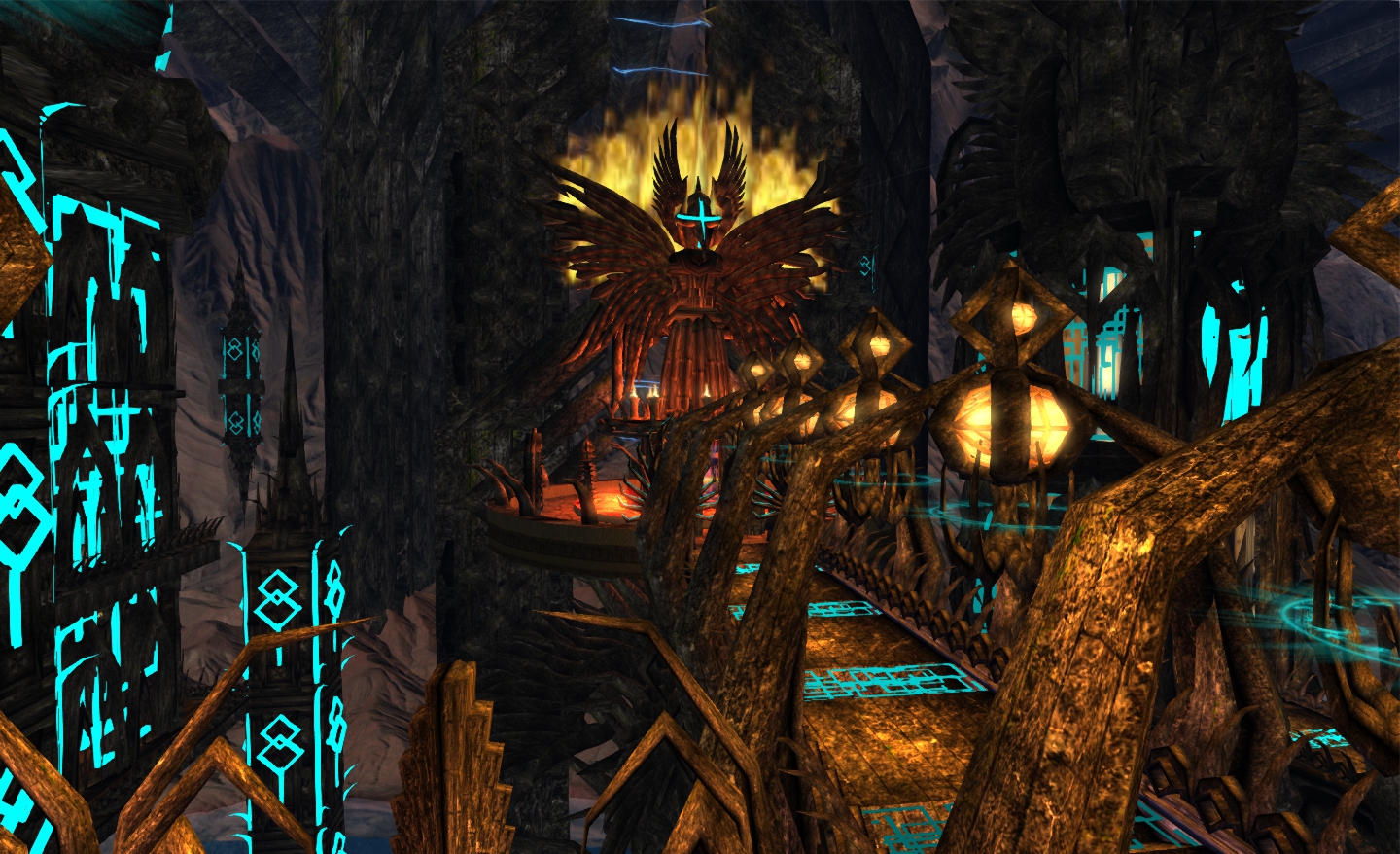
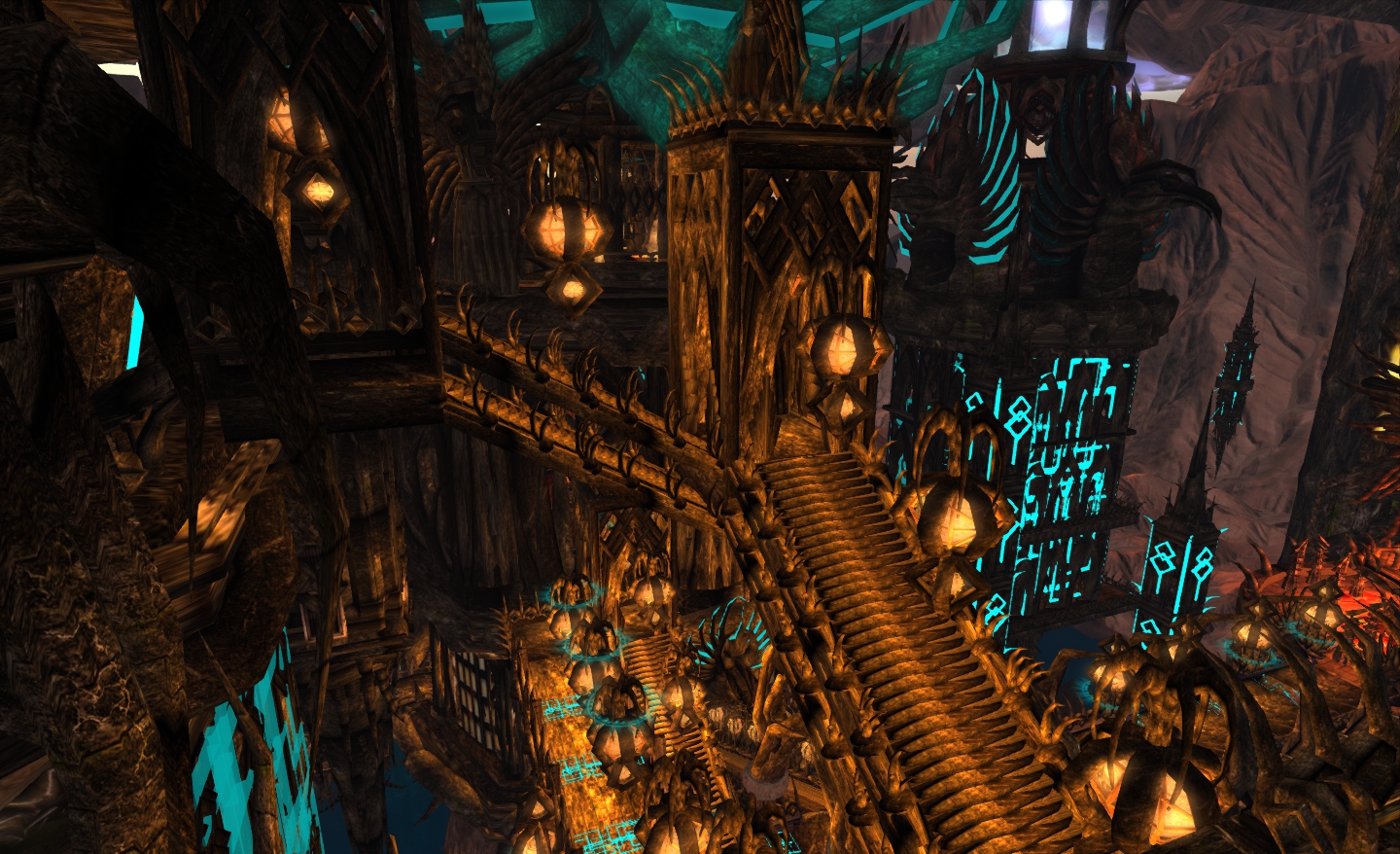
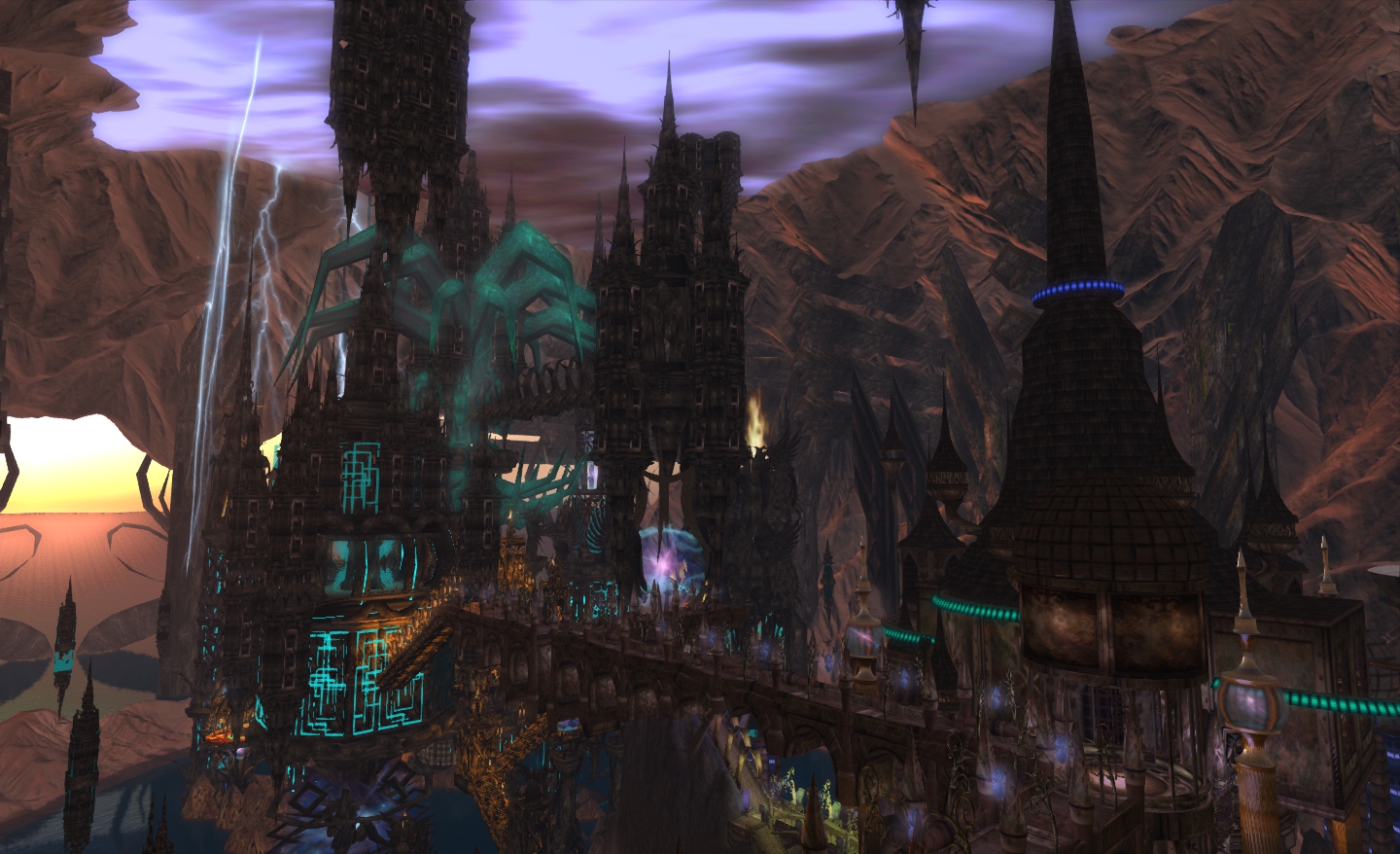
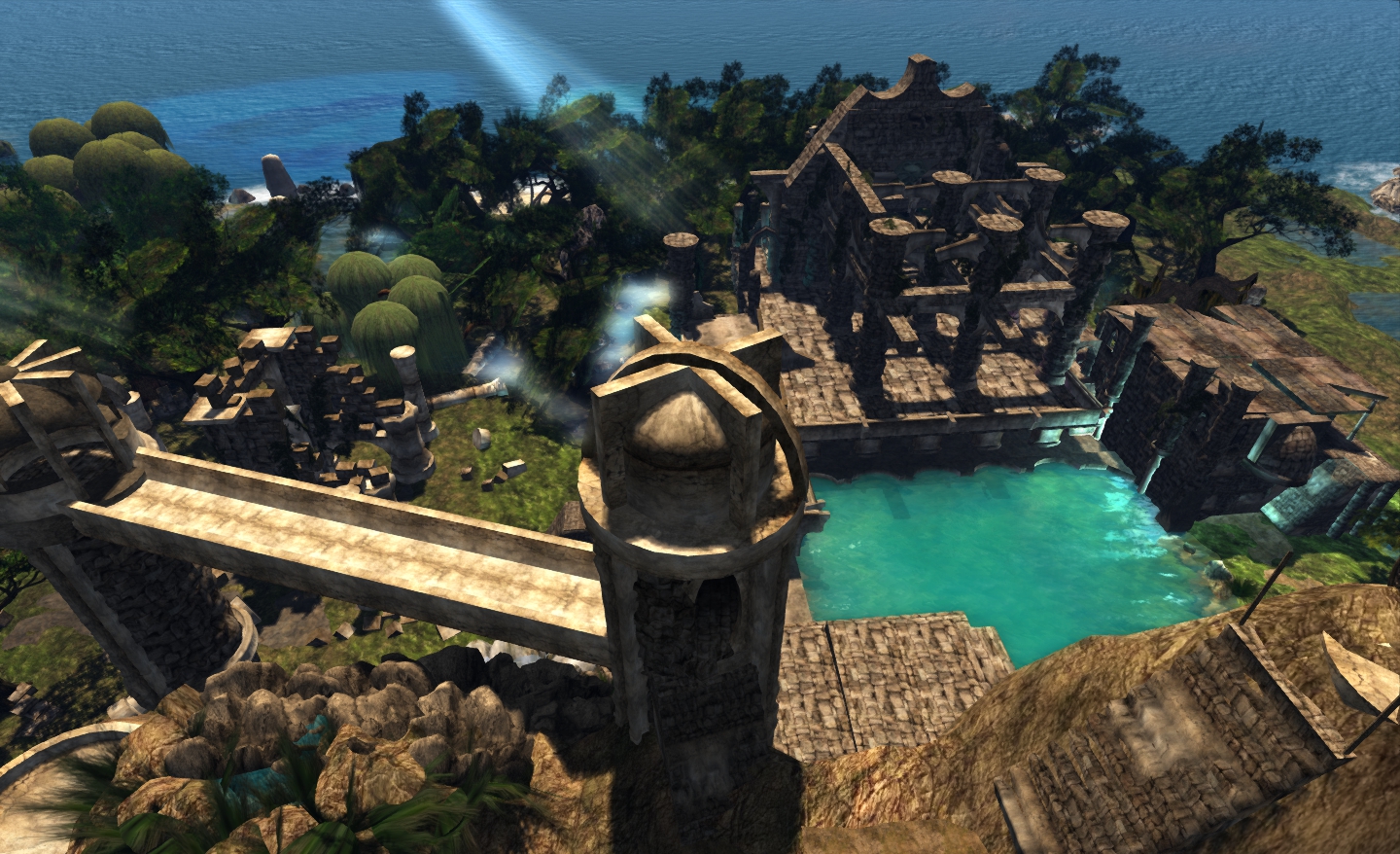
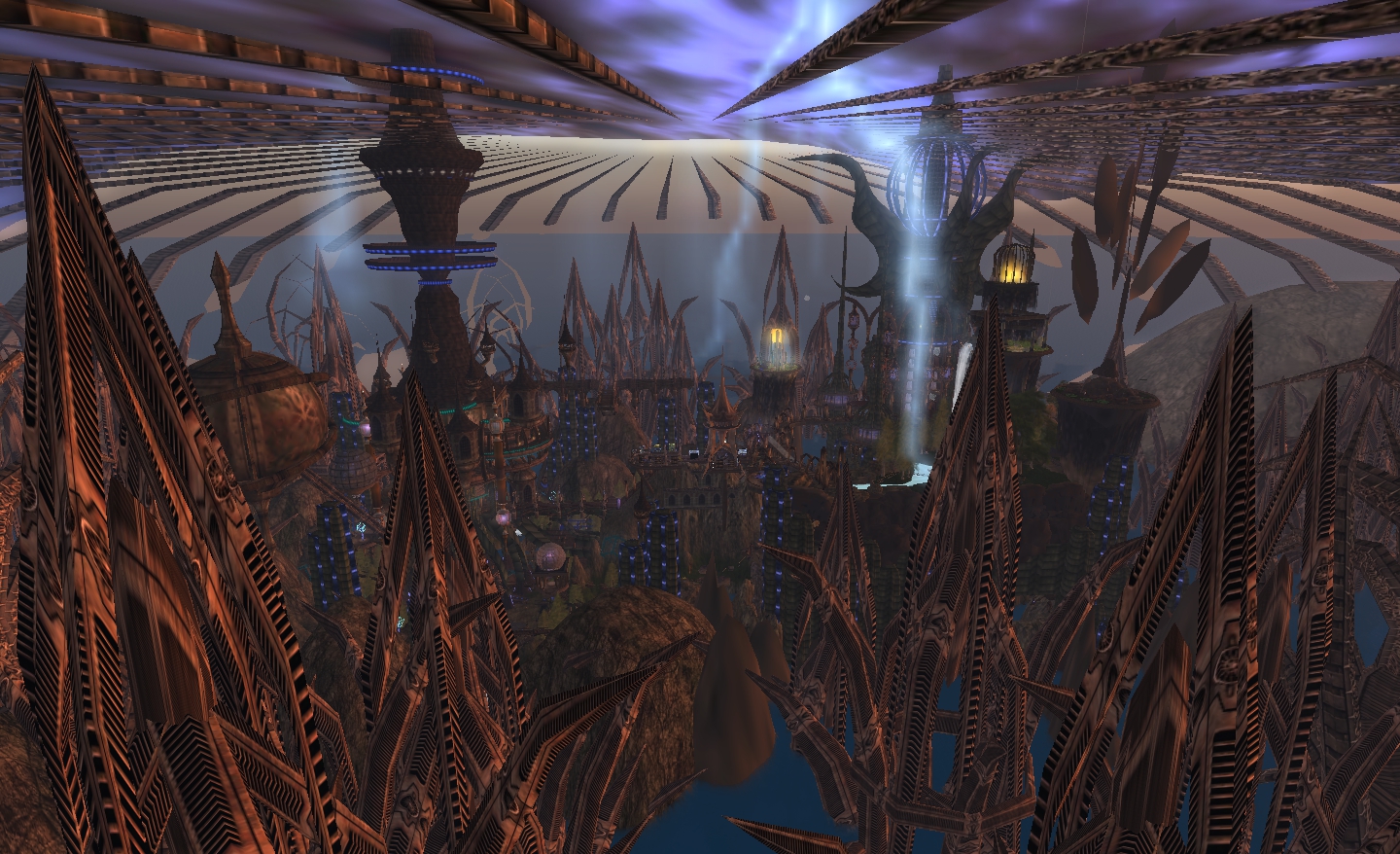
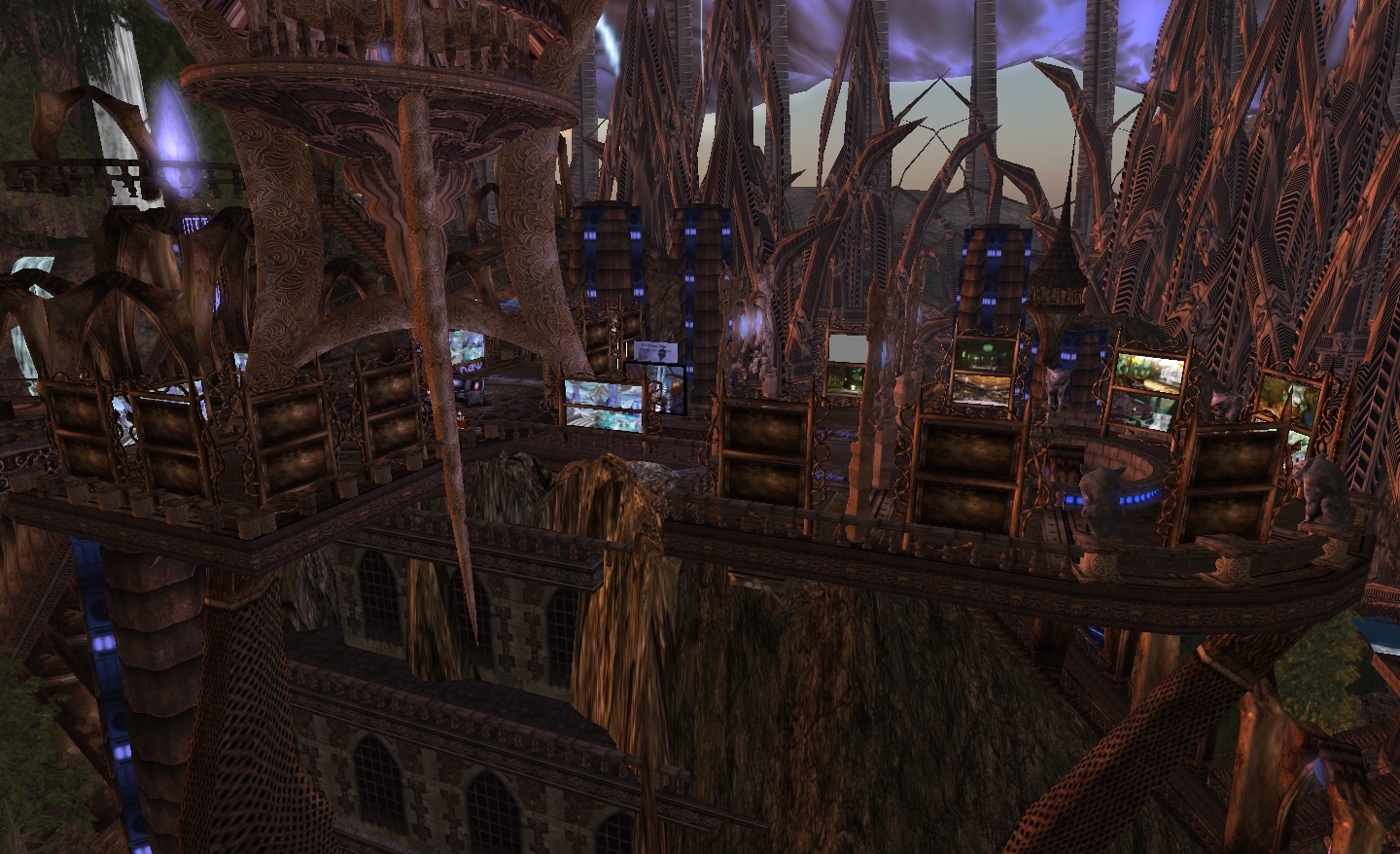
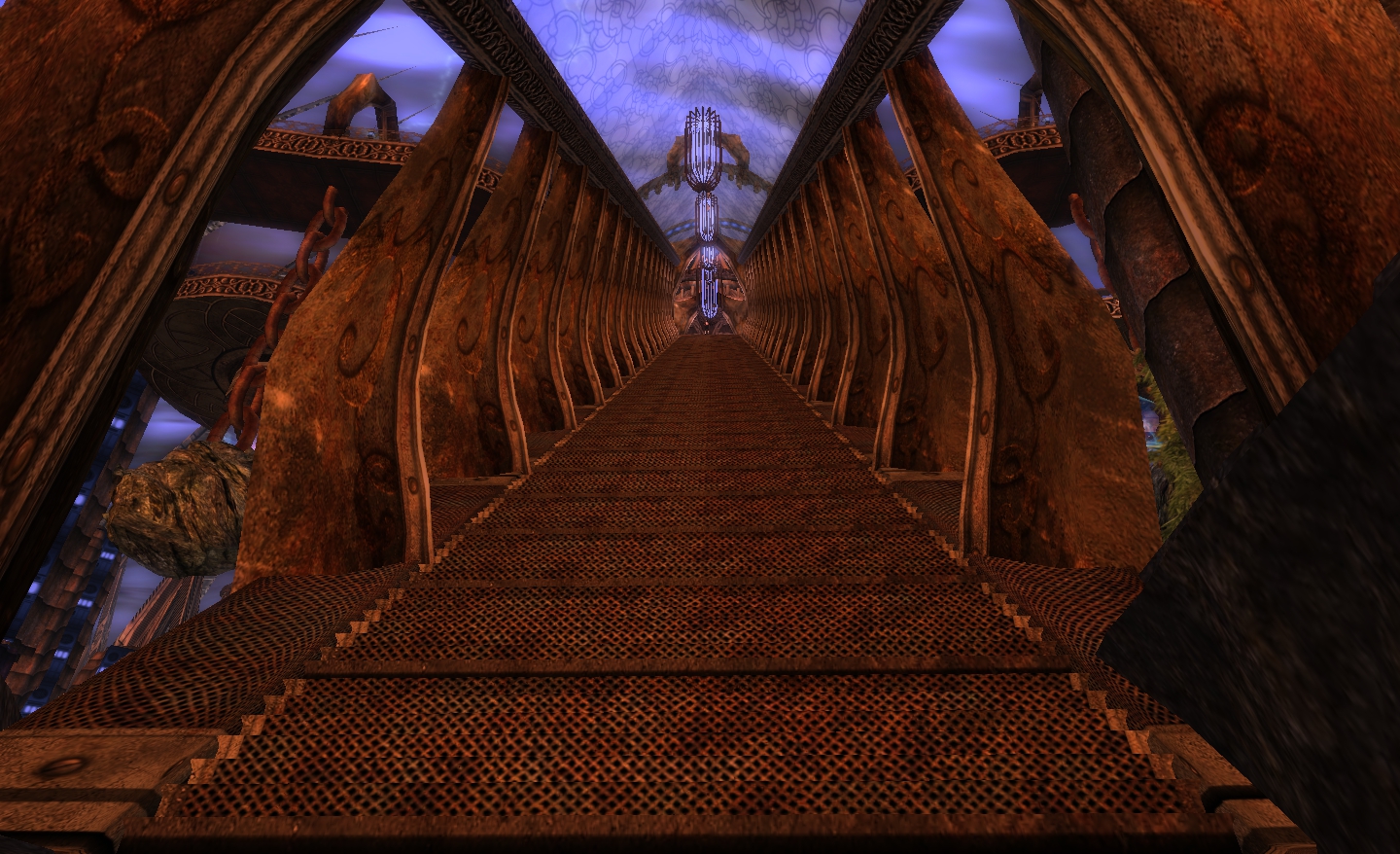
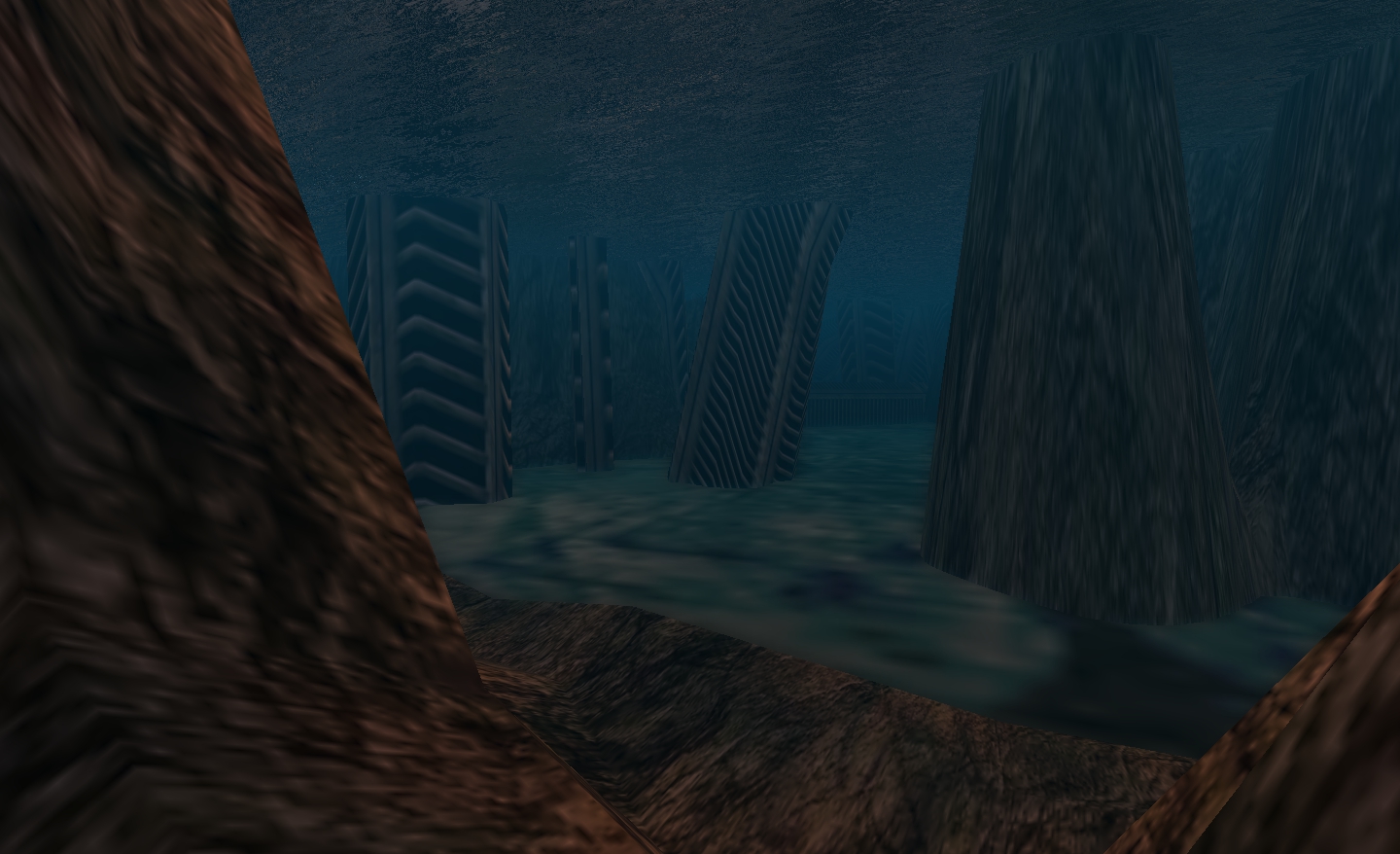
The “ground level” build has changed extensively, although there are still strong echoes with the previous build: the same lowering skies, the lightning, and so on, while elements of the build itself carry echoes of the last: similar hanging walkways, elegant stairways, ornate sculptures and hidden surprises. But there is also much that has changed, and elements that give this build something of a “darker” feel – at least on the outside.
The “Village To Heaven” appears to remain unchanged – and is still as magnificent as on my last visit, and the Fall Pods are still available for those wishing to take a ride back down to the lower builds.
Update August 4th: the region containing the cathedral is no longer available.
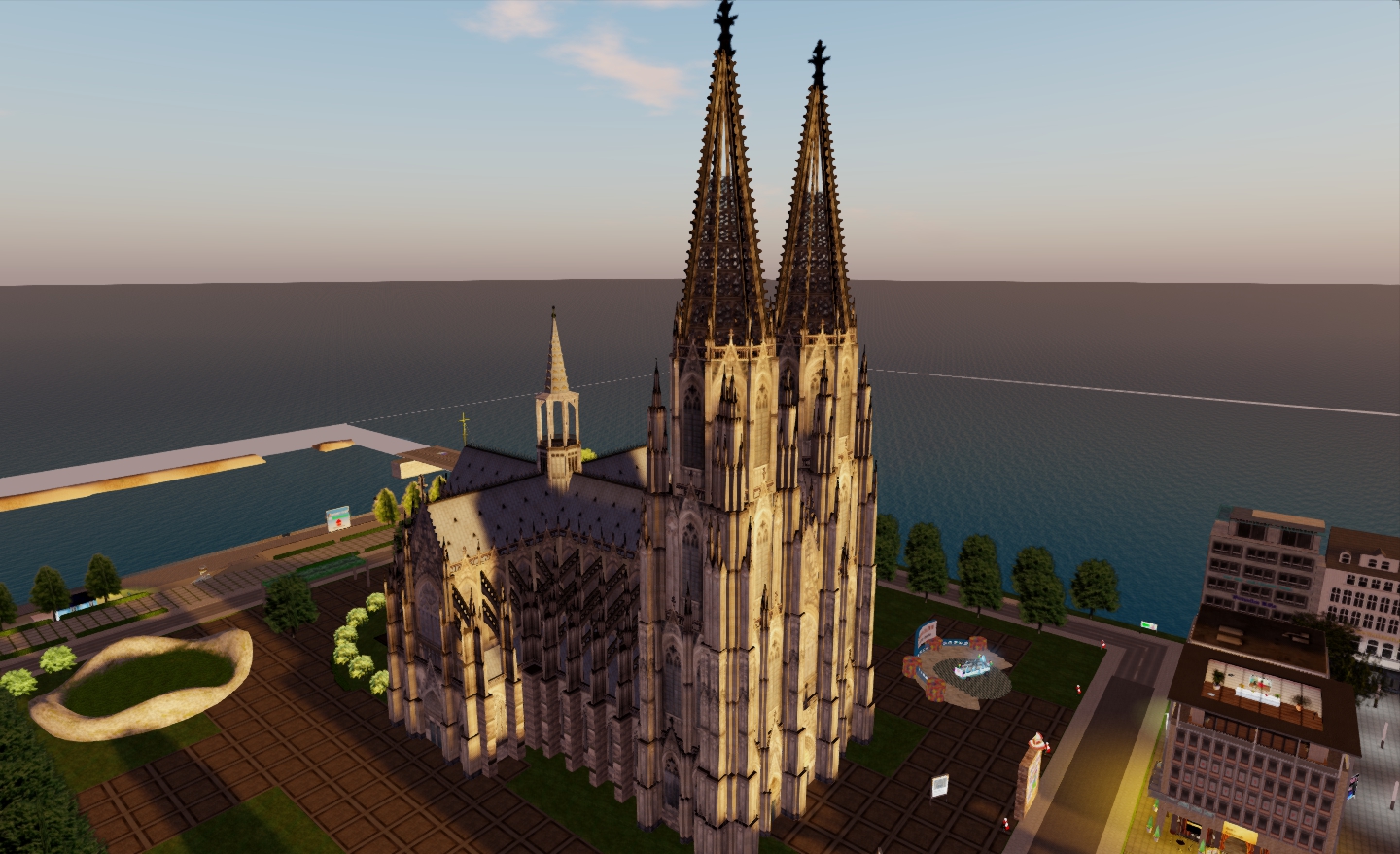
Working on Fallingwater put me in mind of some of the truly great builds in Second Life. One of the most famous is perhaps that of Cologne Cathedral / Kölner Dom. Taking up the majority of Koelner Dom (with the arrivals point on neighbouring Virtuelles Kolen), the cathedral is a powerful tour-de-force of what can be achieved in SL with patience, prims and high-quality texturing.
The build is the work of Seminal 3D, and has long been regarded as an example of what can be achieved architecturally within SL. The initial version of the cathedral opened in Second Life in 2007, and had the full support of the Cologne Cathedral Administration team from real life, and drew on the expertise of the Cathedral’s architect, Barbara Schock-Werner.
“Version 2.0” of the build has been underway since approximately late 2007, and I’m actually uncertain as to the overall status of things: there are still “under construction” signs to be found inside the build itself, together with notices outside relating to the renovations, but I’ve been unable to find any more recent news on the project than items dated mid-2011.
Nevertheless, the Cathedral is well worth a visit, particularly if you’re into photography in SL and / or are using a Viewer such as Niran’s or Exodus, which really bring the beauty of the build to the fore when using their enhanced graphics capabilities.
The magnificence of 13,000 well-ordered primsA beautiful use of textures captures many features of the original…which continues inside the build……and up to the ornate flying buttresses, seen here from one of the towers
There is sadly little in the way of internal details in the cathedral at present: the nave and transept columns are all present, as are most of the magnificent stained-glass windows, but of alter, seating, etc, there is nothing. It would be nice to see the inclusion of something like the Nave Organ, a 1998 addition to the original, perched high over the nave itself – but with the build apparently pushing the parcel limits, one can understand why such are not currently to be found.
The nave, looking east
Even so, for those that appreciate building and architecture in SL, as well as those who enjoy capturing the sights of SL in photos, Kölner Dom is worth your time for a visit.
Update:Enchanted Unicorn and Enchanted Swansong have been separated and extensively redeveloped and no longer appear as described here.
Enchanted Swansong and Enchanted Unicorn are described as “a magical atmosphere in SL where the forests are filled with fairy tale creatures and romance is always in the air” and where you can, “Live your dreams here in the land of the faeres.” They are operated by the Enchanted Unicorn group, with the larger, full sim of Enchanted Unicorn rated Adult, and the Homestead sim of Enchanted Swansong, created by Andrek Lowell, rated Moderate. Both are enchanting places to visit, especially for those into photography and / or romance.
Enchanted Swansong (foreground left) with Enchanted Unicorn beyond
Both regions use Windlight presets set to sunset, and I’d recommend that you keep these settings when visiting.
Enchanted Swansong is a tall, verdant forest within which wind water ways that run between tall trees and past candle-lit gazebos, the air filled with the rich sounds of nature. There are also green pools of water masquerading as lush grass – so be careful as to where you tread!
Walking through the trees, one does expect to come across a Mallorn tree or to hear soft, sweet elven voices singing in the distance – Enchanted Swansong has that kind of Tolkien-esque feel about it in places, even with some of the more ominous sounds audible from deeper in the woods.
Glades, gazebos and harps
If you are able to explore with shadows enabled – and particularly with a Viewer like Niran’s or Exodus with the “extras” active, exploring Enchanted Swansong gains an added depth as sunlight filters through the trees, and you path is dappled by shadows.
As you explore, you may come across a teleporter pad. Then leads the way up to the sky forest and the Roman baths, hidden overhead. For those romantically inclined, both offer quiet retreats in which to spend time. I particularly like the Roman baths, tucked inside a skybox; they remind me of a swimming pool at a country house hotel I like to frequent in summer here in the UK…
The Roman baths
Across the water to the west of Enchanted Swansong is Enchanted Unicorn, which also has a dedicated start-point. While still wooded, this is a very different enchanted land to that of Swansong. The music of the pan pipe hovers in the air together with birds’ songs and the sounds, perhaps, of spring; the trees are more varied and a greater feeling of faerie pervades the air. This is an adult region, and those of a sensitive nature should remember that fae nudity is accepted here. There are also gazebos, pavilions and tree houses where couples and friends can enjoy romantic trysts or meet for friendly conversation.
Like Enchanted Swansong, there is a teleporter to carry you skywards (or if you use the start-point, both around the sky and to the ground), which you can use to reach a ballroom, a club, hanging gardens and other delights.
The hanging gardens and Unicorn start-point floating beyond
Not everywhere may be reachable via teleport, however, so it’s worthwhile keeping your eyes open as you explore – there is a lot to find within Enchanted Unicorn both in the air and on the ground. One way to see more is to find the old white balloon and take to the skies, steering your way around the region while sitting in the basket admiring the view. Just be careful when sending the balloon home when you’re done as it requests – or you might end up standing on thin air!
Would you like to fly/In my lil’ white balloon…
The Enchanted sims make for a wonderful visit, regardless as to whether you’re into the fae scene or not – both are beautifully developed, and AliceDeejay Aya and Andrek Lowell have done a fabulous job in putting them together. Both are very photogenic and offer some wonderful opportunities for those key on SL photography. For those who enjoy faerie or are looking for romantic spots witin SL, or who simply enjoy exploring the sights of Second Life, Enchanted Unicorn and Enchanted Swansong together make a very worthwhile destination.
ballroom (l) and club, hovering over Enchanted UnicornEnchanted Unicorn as seen from Enchanted SwansongThe far pavilions – and nearby swing!
All images captured using Exodus 12.01.03(b), no post-processing applied. All images using deferred rendering, gamma correction, active depth of field. Tone mapping active in all but images (1) and (3).
Update: Lost World has closed and Beguile no longer exists as a region name.
I’m the first to admit I’m not the world’s greatest SL photographer, but I love finding places in SL that are both interesting to explore and can make excellent backdrops / subjects for photography; and if they have a hint of a story of their own – so much the better.
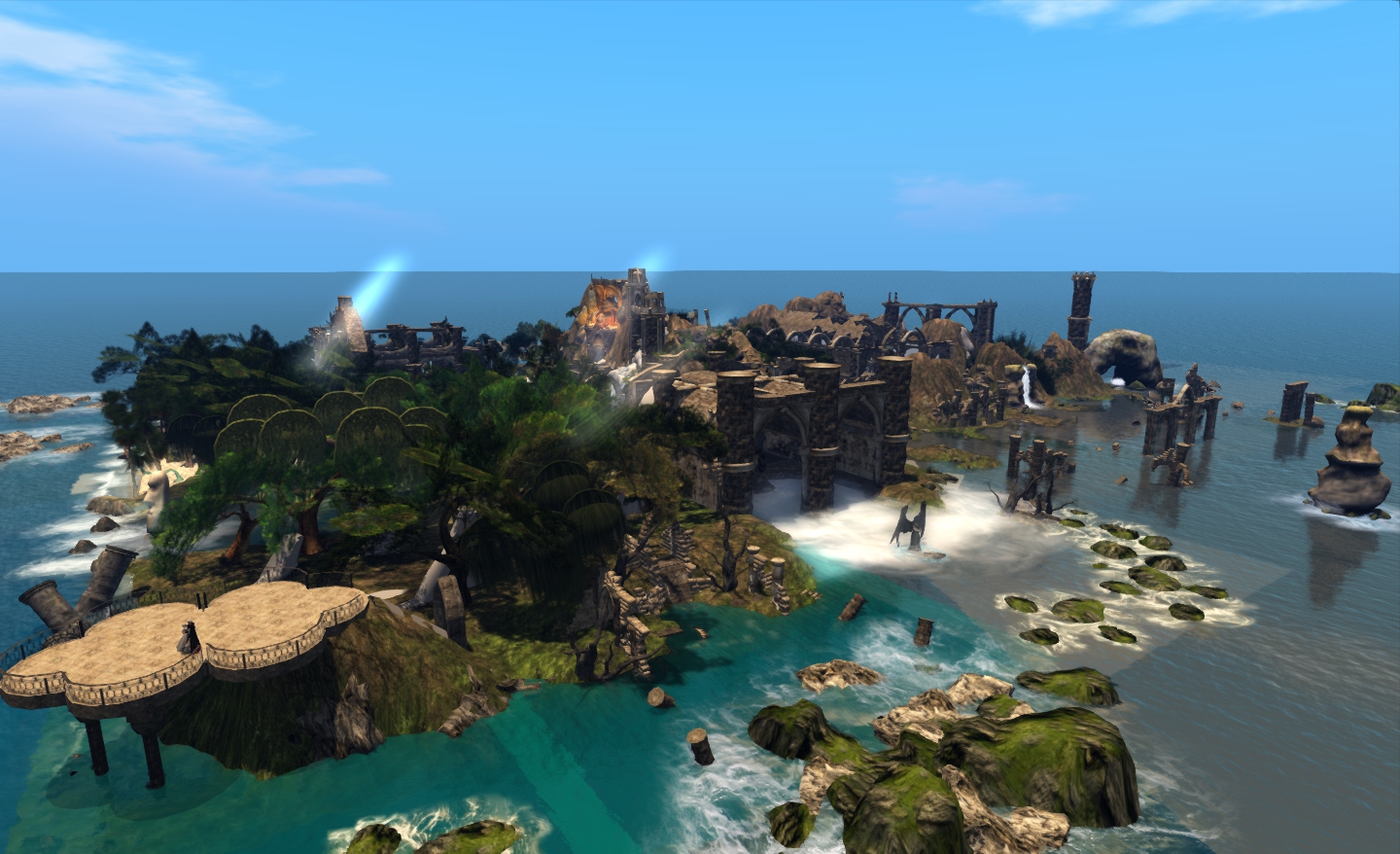
One such place that combines opportunities for in-world photography with the hint of a mysterious back story is ! Lost World !, created by Lolmac Shan.
This is a fabulous build covering the region of Beguile that calls out to photographers and machinima makers alike.Here you’ll find the ruins of … what? a great house? An Abbey or religious centre? A castle? A once-thriving port? ..
Ancient ruins: ! Lost World !
You arrive in the middle of the ruins, standing at the crossways of two ancient walkways. Before you lies the ruins of a great hall (Lolmac’s store), the roof long gone, the supporting arches starting to collapse themselves. From here, it is up to you as to where you go…
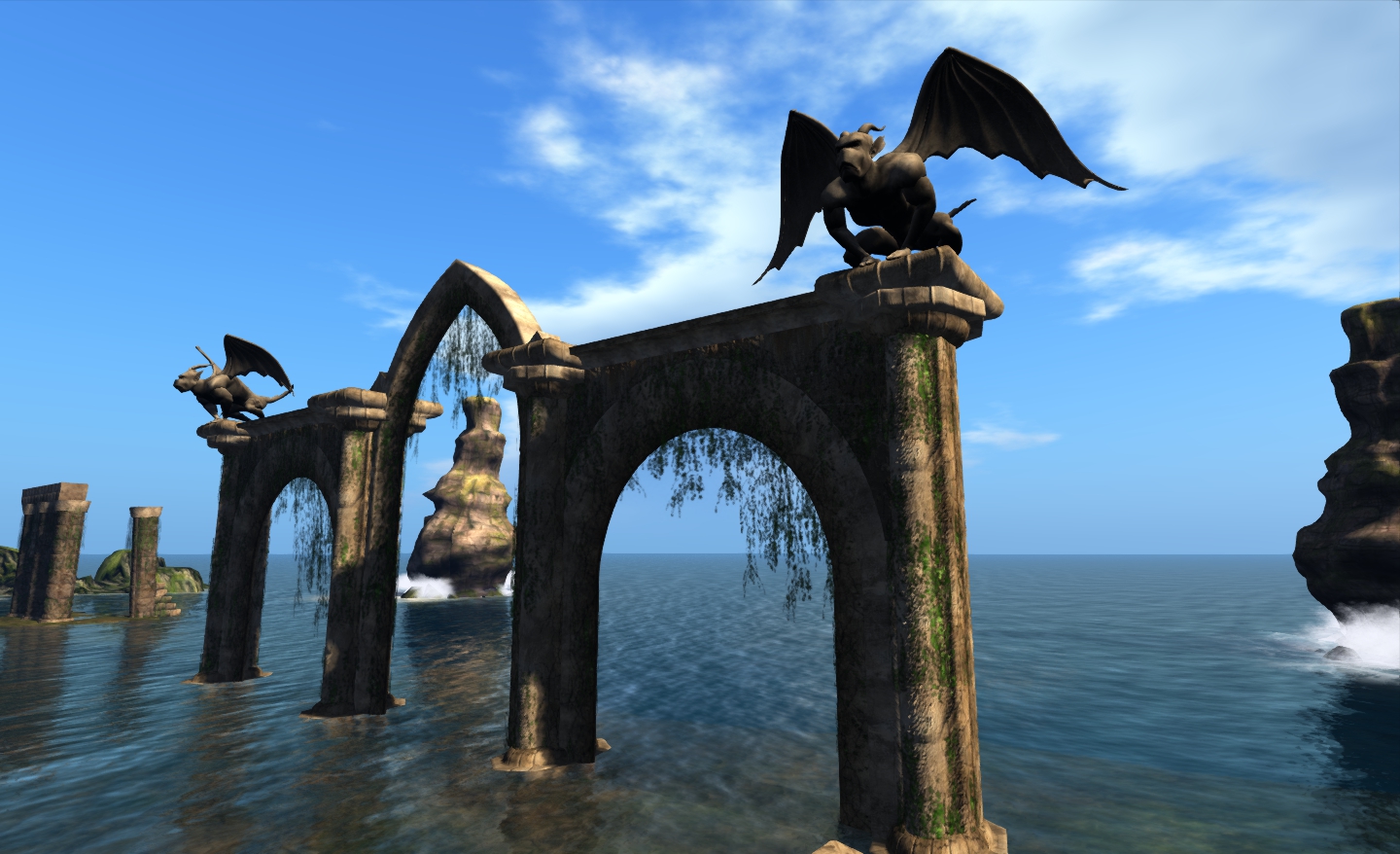
Behind you, a short distance away, the ruins stand sentinel in a losing battle against the encroaching sea; aches stand in isolation, their winged gargoyles facing inland as waves crash against weathered and deformed stone carvings beyond, fallen columns and walls littering the waters, while here and there further fragments of whatever once stood here rise from what has become their own little islands in the fight against the incoming sea.
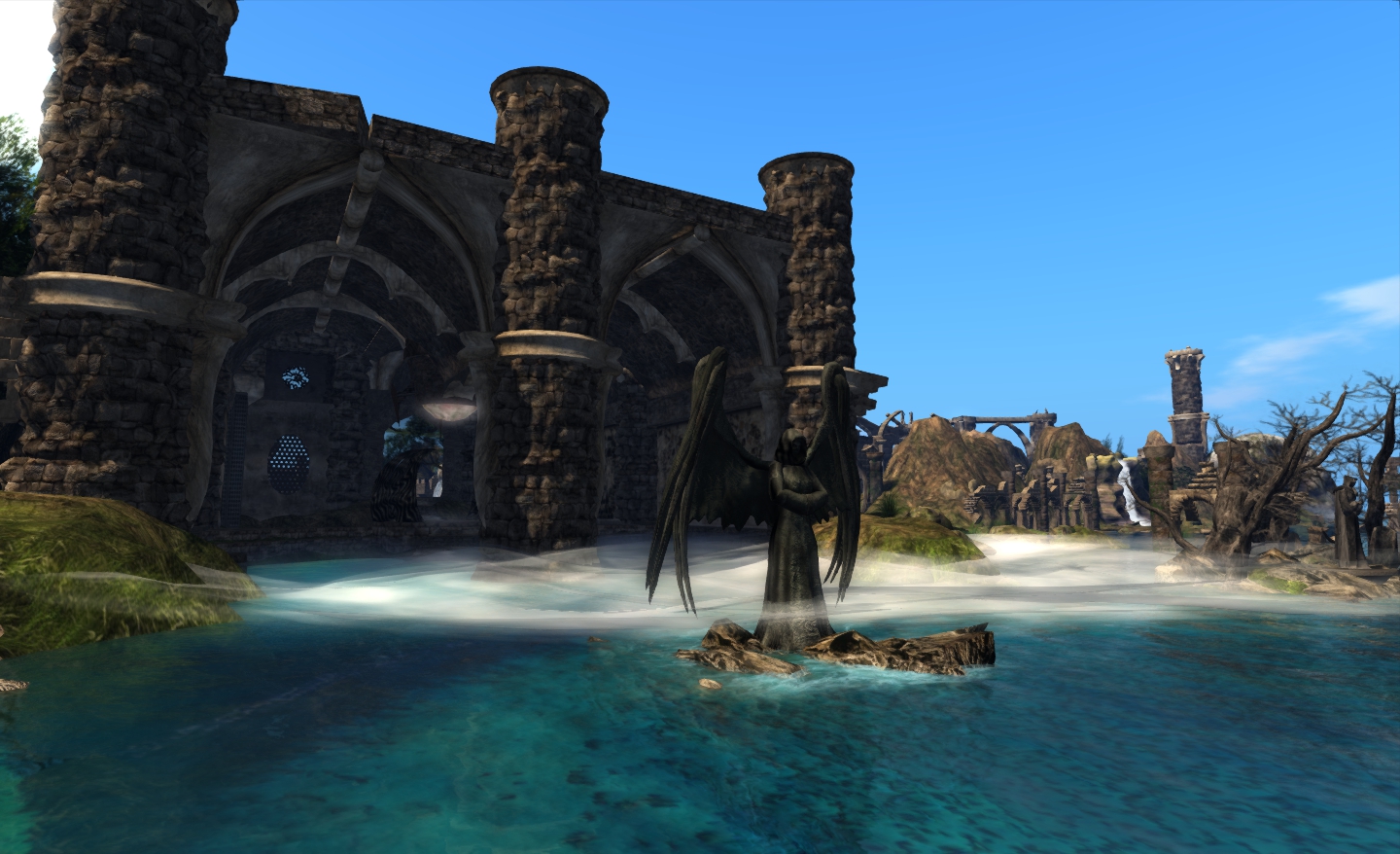
A little further along the coast stands another building, looking for all the world like a covered dock where ships may have once sought shelter while offloading their cargoes. Here is a hint of a possible religious element to the place: a great winged figure – an angel? – seems to stand guard before the arches of the building, face set sternly towards the ocean…
Further inland, there are other hints of a religious nature, and what appears to be the remnants of a great abbey, complete with what seem to be a flooded cloisters…
Carved face
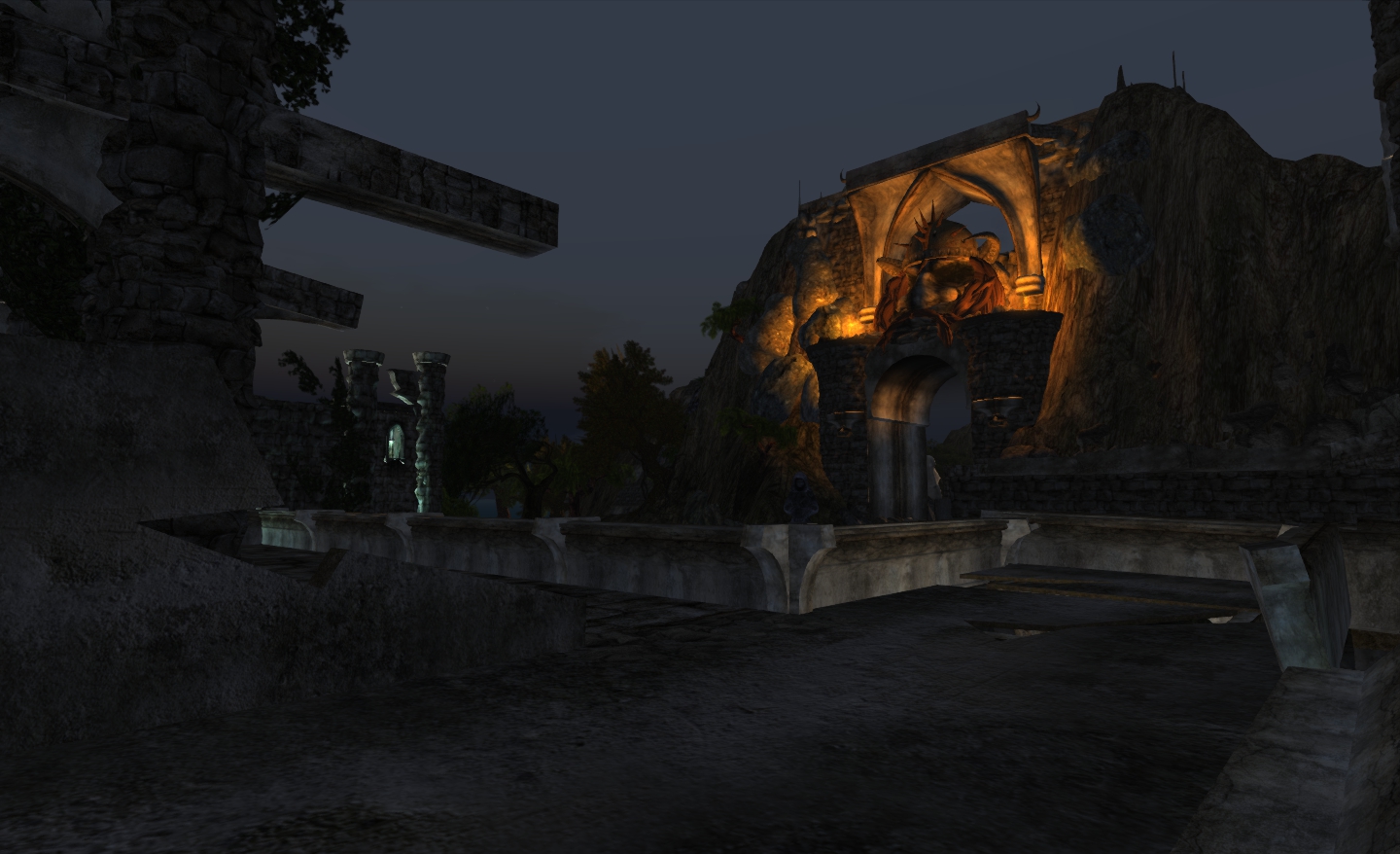
But look up and across the quiet, blue water, and the gigantic stone face staring back at you suggests that if this were a place of religion – it might just have been one that embraced violence and strange rites…
It is these contradictions that make ! Lost World ! so alluring; it is if nothing is quite what it seems. Having looked upon the great stone face, with its horned and barbed helm, it is hard not to look on the winged figure on the shoreline and not imagine it to have a more sinister purpose, or at the gargoyles atop the flooded arches without finding them somehow more menacing, as if standing guard to prevent anyone leaving this place…
Guardians – or guarding?
And there are secrets to find within this place, if you are prepared to look; and not all is in quite the ruinous state as seems to be the case…
But even with these sinister or mysterious edges, there is no denying ! Lost World ! is a mesmerizing place, and considerable thought and creativity has gone into its development, making it a marvellous location for filming and photography. The careful visitor is liable to find a veritable treasure-trove of detail while exploring on foot – although at times an airborne look helps one fully appreciate the build as a whole.It may not be as extensive as some, but the balance it exhibits is sublime.
This is a place I love to come to simply because it is so beautiful and yet thought-provoking. It’s a place I can visit and wander and dream up stories; it’s a place I love to photograph, and it’s a place where I can always find some corner or nook, and simply watch the passing world and quietly observe those who also come to visit…
And despite the undertones of sinister mystery, this is also a place for romance in all its many forms. Here you can sit with a loved one and whisper quietly to one another amidst the tumbled walls and pillars, or you can wander together through the trees and along the banks of the waterways, or dance together as the sun sets behind you…
But don’t simply take my word for it – why not pay a visit yourself?
Update June 6th 2012: Sadly, Al Andalus Alhambra, Second Life, closed on June 6th 2012. My slideshow of the build will remain on this site as a reminder.
It is one of the most stunning palaces in the whole of Europe, one that brings together light, life, culture and geometry in a stunning tour de force of medieval Islamic architecture – albeit one forced to incorporate western European styles as exemplified by the Palacio de Carlos V. It is the Calat Alhambra, al-Qal‘at al-Ḥamrā’, the Red Fortress.
Occupying the top of the hill of the Assabica in southwestern Granada, the palace symbolised the height of the Islamic presence in Spain, with Granada itself the last of the great city-states of Islam within Spain to ceded itself to Christian rule when Ferdinand and Isabella conquered the city in January 1492.
Christian history would have us believe that the reconquista of Al Andalus – the Moorish name for Spain – was a Christian fight against an invading and oppressive Islamic nation – yet nothing could be further from the truth. Alhambra in many respects stood at the pinnacle of some 700 years of progressive Islamic rule in Spain which saw places such as Cordoba recognised as remarkable centres of learning for all – some 70 public libraries lay within its walls at a time when the rest of Europe saw books and learning the reserve of religion and those who ruled, while the teachings of ancient Greece – so thoroughly embraced by the people of Islam – were often regarded as heretical by the church.
al-Qal‘at al-Ḥamrā’ as it looks today
Alhambra takes its name from the rich red clays of the soil upon which it is built, rather than from any bloody elements of its history – although in some respects the fortress did initially grow out of bloodshed: following a particularly violent meeting between the Muladies and Arabs, the latter fled south to take refuge in a red castle on or near the site during the rule of ‘Abdullah ibn Muhammad (r. 888–912). In the 11th Century, and in a bid to preserve a Jewish settlement, the ruins of the red castle were rebuilt by Samuel ibn Naghrela, although accounts of the time state it was easily overrun.
However, the Alhambra we know today was started by Ibn Nasr, who fled south to avoid persecution by King Ferdinand III of Castile. In 1238, he arrived at the palace of Bādis and set about enlarging the Alhambra into a palace complex fit for a sultan.
And it is this citadel palace that is beautifully brought to life by the Al-Andalus Community Project. Spread across two regions, Al Andalus 1 and Al Andalus Generalife, which themselves reflect the layout of the Nasrid dynasty’s citadel, the build is quite simply stunning.
Calat Alhambra
The citadel comprises several distinct elements: the Royal Complex comprising the Patio de los Arrayanes (perhaps Alhambra’s most famous element), Patio de los Leones, Salón de los Embajadores, Sala de los Abencerrajes, over thirty watchtowers, living spaces for staff, as well as outlying pavilions located in the Palacio Generalife, or Garden of the Architect (Jennat al Arif in arabic). Much of this has been reproduced in the Second Life build, which avoids any of the reconstruction undertaken post-reconquista and attempts to represent the Alhambra at the pinnacle of its glory as a centre of rule and of culture – although there is a concession to another great Moorish building to be found within its walls.
There are a number of teleports to the build that can be found in Search. These include Patio de Los Leones, the auditorium (which appears to be under the Patio del Mexuar), and just inside the original entrance of the Puerta de la Justicia, in the la Plaza de los Algibes.
Where you roam from any of these is entirely your choice – there is a lot to wander around, and no set order in the direction you may opt to take. There are numerous notecard givers to be found around the citadel, each of which provides more detailed information on the section you are visiting.
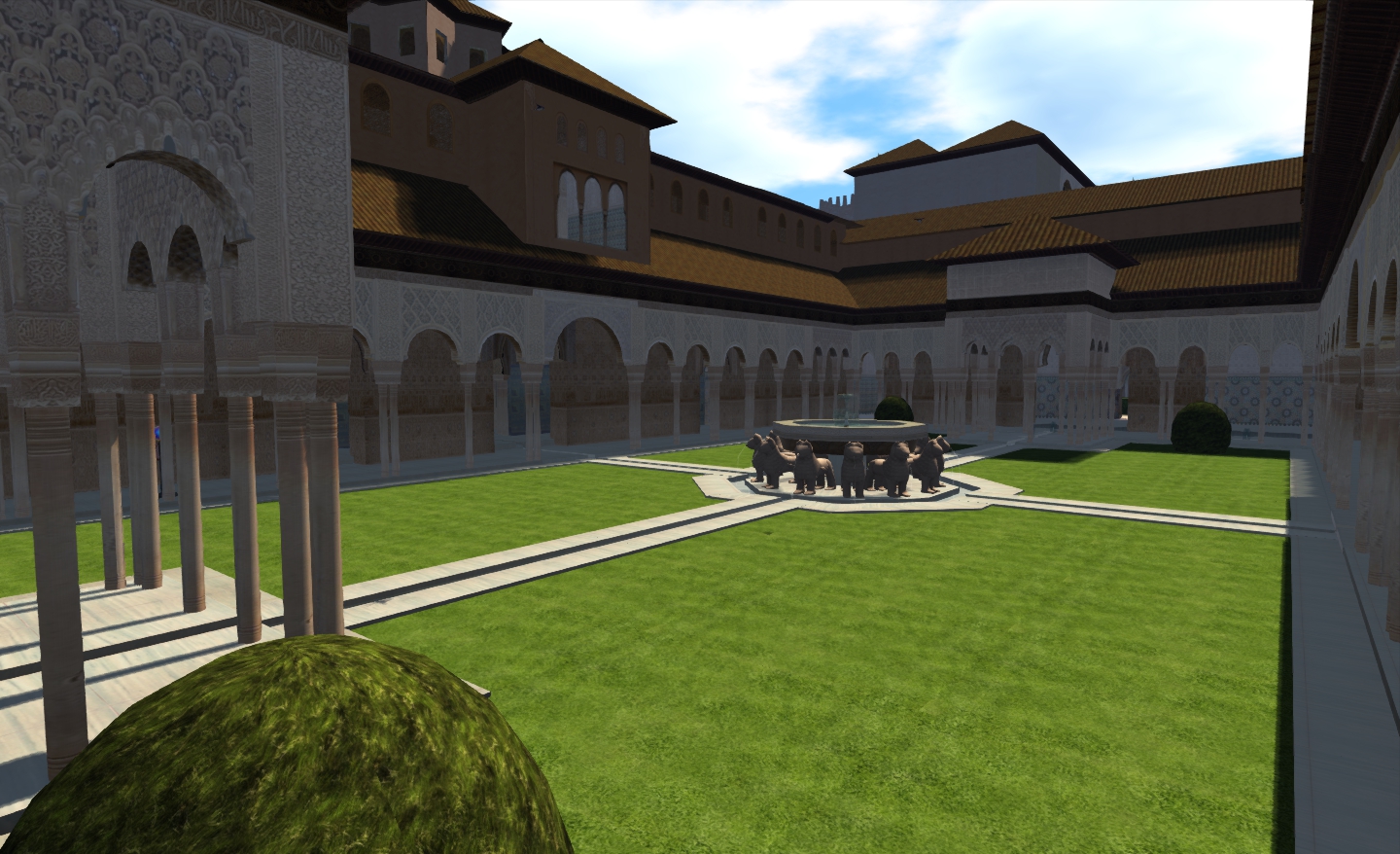
Patio de los Leones, Alhambra
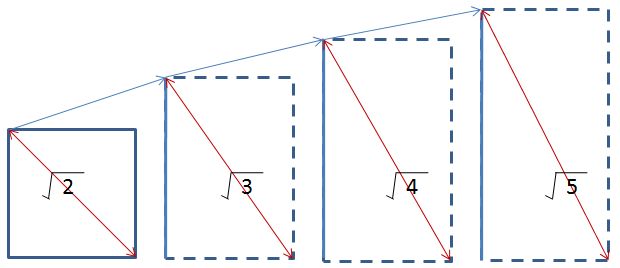
While there are some doubts that Alhambra’s growth beyond the original expansion started by Ibn Nasr was seen as a part of some over-arching plan for the citadel, the original royal complex was exquisitely designed over successive generations using a geometric progression based on a simple Pythagorean principle to achieve the stunning and harmonious design evident in the complex as a whole. The progression was based on the relationship between the length of a side in a square with that of its diagonal, and is elegant in its simplixity and magical in its meaning.
To explain: take a square and then measure the diagonal between two corners. This measurement becomes the long side of a rectangle with the same base length as the original square. Now take the diagonal of the rectangle and use that as the long side of another rectangle, again with the same base length as the original square. Now take the diagonal of that rectangle, and make it the length of the long side of a third rectangle.
When you do this, you get two intriguing results: the first is that the diagonals of all four progress through the square roots of 2, 3, 4 and 5. The second is that the third rectangle is exactly twice the height of the original square.
The unique geometry of the Alhambra is clearly evident in the Patio de los Arrayanes and the Torre de Comares beyond.
This approach to building the Alhambra is repeated around the original royal complex, and is perhaps most notable in the Patio de los Arrayanes, where the Torre de Comares rises behind it, to form a perfect geometrical and symmetrical design that is reflected perfectly in the water of the Patio’s infinity mirror. It lends the Patio an even greater feeling of sitting in harmony with nature.
The use of this progression is in evidence elsewhere within the royal complex, both in the buildings and in the layout of the courtyards and gardens. Similar geometry is also evidence in varying forms within the ornate wall coverings and carvings.
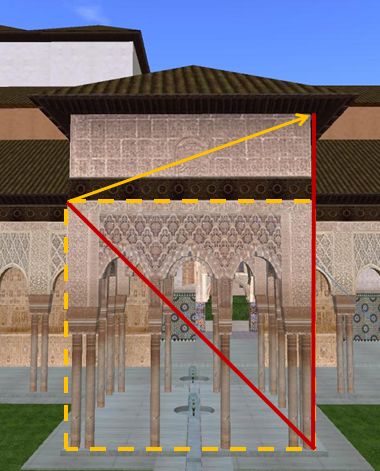
Patio de los Leones and the geometry of the Alhambra
It is also something that has been captured in some measure in the Second Life reproduction.
Take the Patio de los Leones, for example (right). Here the progression using the square and rectangle can clearly be seen. The lower section of the pavilion (up to the bass-relief) is the square. The diagonal of this square gives the elevation of the wall to the eaves of the pavilion. It’s a very subtle nod to the original, and it is sad in some respects that the nature of Second Life, where scale is compromised by things like the average height of avatars (7+ feet) and the default placement of the camera, that this ratio / progression isn’t always obvious or achievable throughout the build.
Alpha Point and Omega Point are two stunning builds in Second Life created by Masoon Ringo and Sweetlemon Jewell. Occupying a full sim and a Homestead sim, they form a marvellous build that combines fantasy and science-fiction in a way that simply demands exploration. Just make sure you give yourself plenty of time to do so; there is much to see – and much that can be so easily missed if you rush things.
I was introduced to the regions by Himitu Twine, who spends a good deal of time at both, wandering and exploring – and after the first time I joined her at them, I could well understand why. The combined build is simply glorious. Nor is it entirely static; Omega Point has altered over time, and I’ve no idea as to how permanent the current layout is. So, if you’re reading this piece six months after it is written, don’t be surprised if you follow the SLurls and find things have changed; it simply means you have a new experience to enjoy and will still have much to see and discover.
Alpha and Omega Points
Before you do pay a visit, make sure you turn your draw distance up as far as you comfortably can in order to get the fullest impact of the build; I recommend a setting of around 300m. Also, like a lot of regions nowadays, both Alpha Point and Omega Point have their own Windlight presets, and I recommend you keep to them after you’ve arrived.
The current teleport co-ordinates are such that whether you travel to Alpha Point or Omega point, you arrive at more-or-less the same place: an arrivals area that spans the boundary between the sims, high up and central to the build as a whole. While a marker clearly defines the sim boundary itself, I suggest you wait until things rez before moving around too much, least you find yourself bouncing off the boundary itself (although crossing between the sims, providing you do so at walking pace, is generally very smooth).
Once rezzed, cam out a little and orbit around your position. What appears to be a spired city, with trees and waterways below and a storm-laden sky above surrounds you, and you get the first indication of the complexity of the place. But don’t go camming too far out and peering into windows and doorways – you’ll simply spoil what is to come. This is a place that is best discovered through exploration.
The arrivals areas themselves have a series of teleport panels to get you to many of the points of interest and beauty in the build. At Alpha Point there are also a couple of flying options you can use to get around. However, I do suggest you ignore both flying and teleports to start with.
Teleport arrivals: Alpha (l) and Omega (r)
The arrival areas also have stairs and walkways leading from them, and if you really want to experience the build, then you should really start by using Shanks’ pony: take the stairs and start your explorations on foot.
At the time this article was written, the stairs from the Omega Point arrival area lead down to a lower level from which you could make your way to the huge central tower, crossing a gargoyle-lined bridge, or you could carry on down even further to other walkways, landings and stairways until, eventually, you reach the ground. From here, it is possible to wander among trees and fallen sections of the build, long forgotten and half-buried that point to a story yet to be told about the passage of time in this place. There is much to be discovered while down among the trees, so don’t be afraid to wander wherever you will.
“Climb the stairs, Jim!” – yes, that’s me at the top!
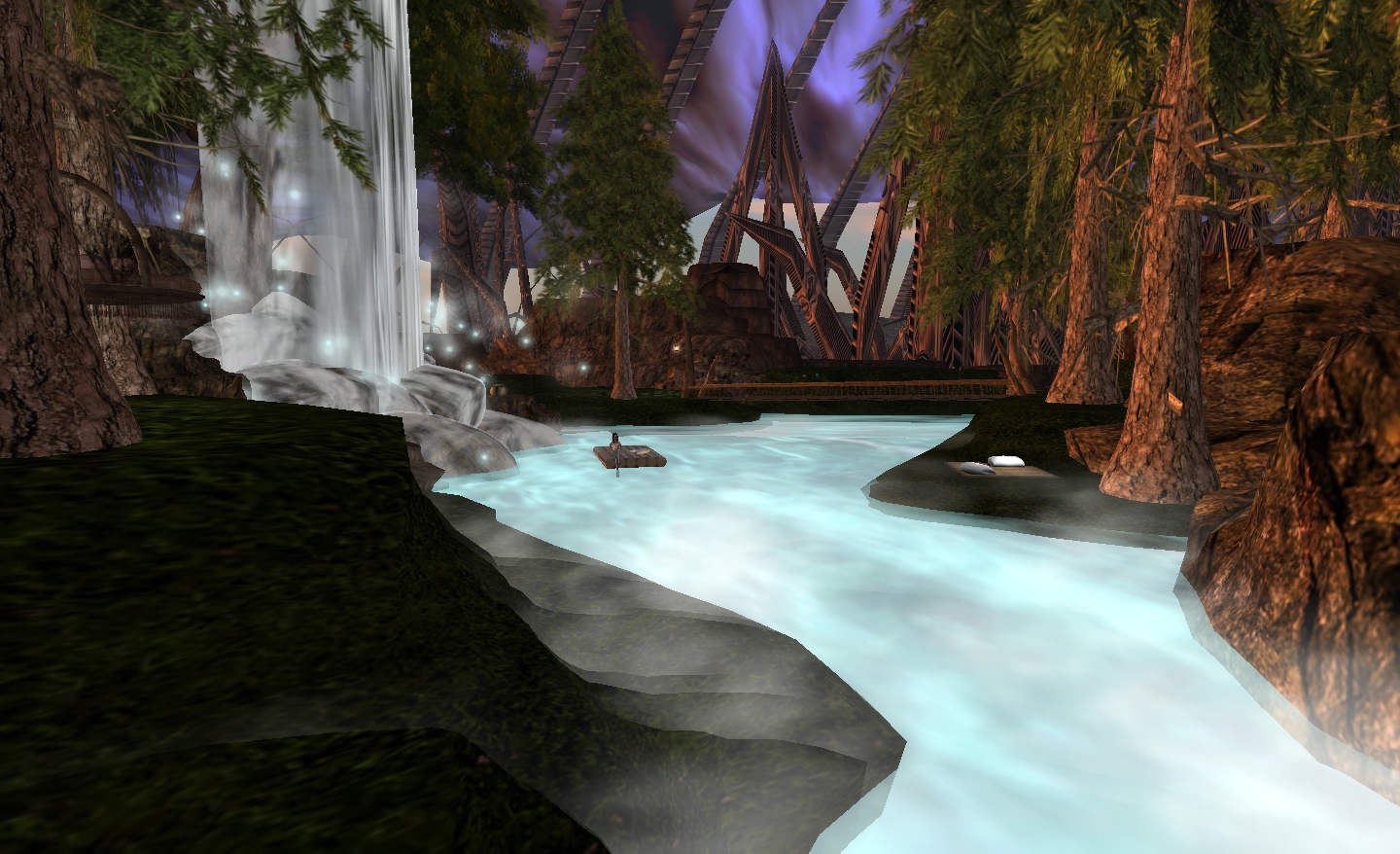
Take the long staircase down from the Alpha Point arrivals area, and you’ll come to a walkway that leads the way around a stunning view of a waterfall. Follow the walkway further, and you’ll pass back under the waterfall, and so enter the labyrinthine lower levels of the build. Here hang paintings and images high up along tall walls, each with a story of its own. Here too, are stairways leading both up and down…
Sims extensions – cleverly used (click to enlarge)
One of the things I love about this build is the imaginative use of off-sim phantom prims to create an even more fantastical realm. In places, it’s as if the build never actually ends; it simply continues beyond our reach, down a hall, along a path or around a corner. It’s so tantalising; the effect engages the imagination and leaves one with a sense of “if only”; if only we could walk around that distant corner and slip under that shadowed archway, or reach those distant doors! What would we find, what wonders would await us – what stories would we have to tell? Lying beyond our reach, these parts of the build demand we fill their hidden promise with people, places – and creatures…
Never knowing quite where you are going to end up is another reason I like visiting; follow a route down into the bowls of the build, and it is quite possible that if you take enough stairs and turn enough corners, you’ll find that the way you thought lead back to where you came from has actually lead you somewhere else entirely. Just do be careful where you do walk, however, some of the walkways appear to lead you towards a destination, only to end abruptly, as if a section has fallen away; whether through age or other reason is up to you to decide.
Flyers – a great way to get around
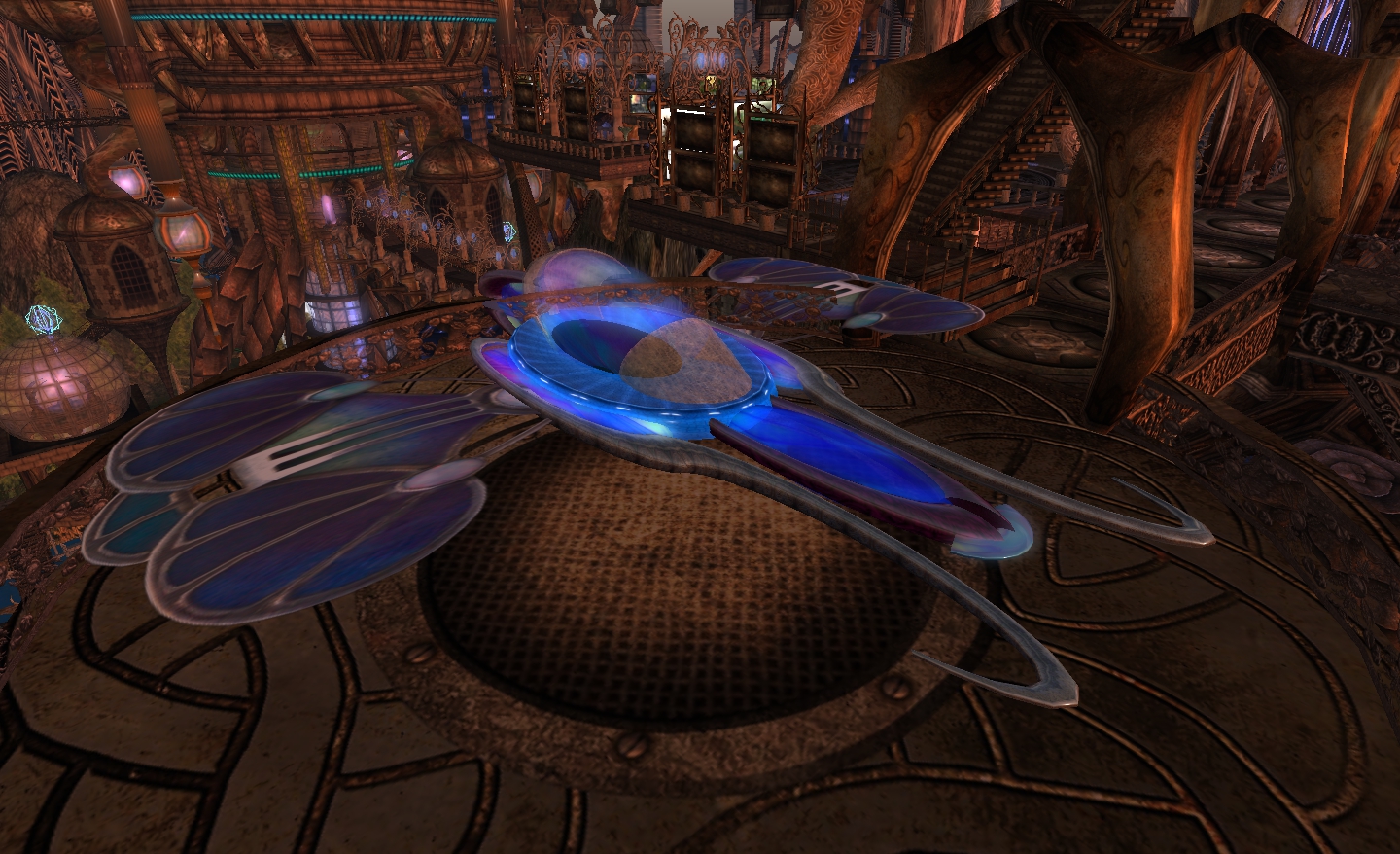
Should you tire of walking, but still have no wish to use the teleports, you can opt to take one of the flying options mentions earlier (so much more fun than free-flying on your own!). Find them back on either side of the Alpha Point arrivals area and teleports.
You can choose from a flying bubble or a craft that resembles a dragonfly for your aerial excursion. Each carries up to two people, allowing a friend to share the experience with you. Full instructions are provided via hovertext, and the usual keyboard controls can be used to control direction / height. Both craft are rez-on-demand from the master version, and will de-rez when you stand up from them. They are certainly a great way to see the build from above, and both perfectly match the theme and design of the place. While crossing between the sims is very smooth for the most part, it’s worthwhile keeping an eye on your co-ordinates and taking things gently as you do reach the boundary between the two.
Romance or solitude also await those who seek them
Nor is the build short on romance. You can dance the time away in a ballroom or among the trees or beside the tumbling waters of a fall; you can cuddle quietly in one of many sofas and seats to be found throughout the build, or amidst the trees and grass of a floating garden; you can spend time admiring a waterfall, sitting on the banks of a river or sharing a raft as the water cascades down from high above…
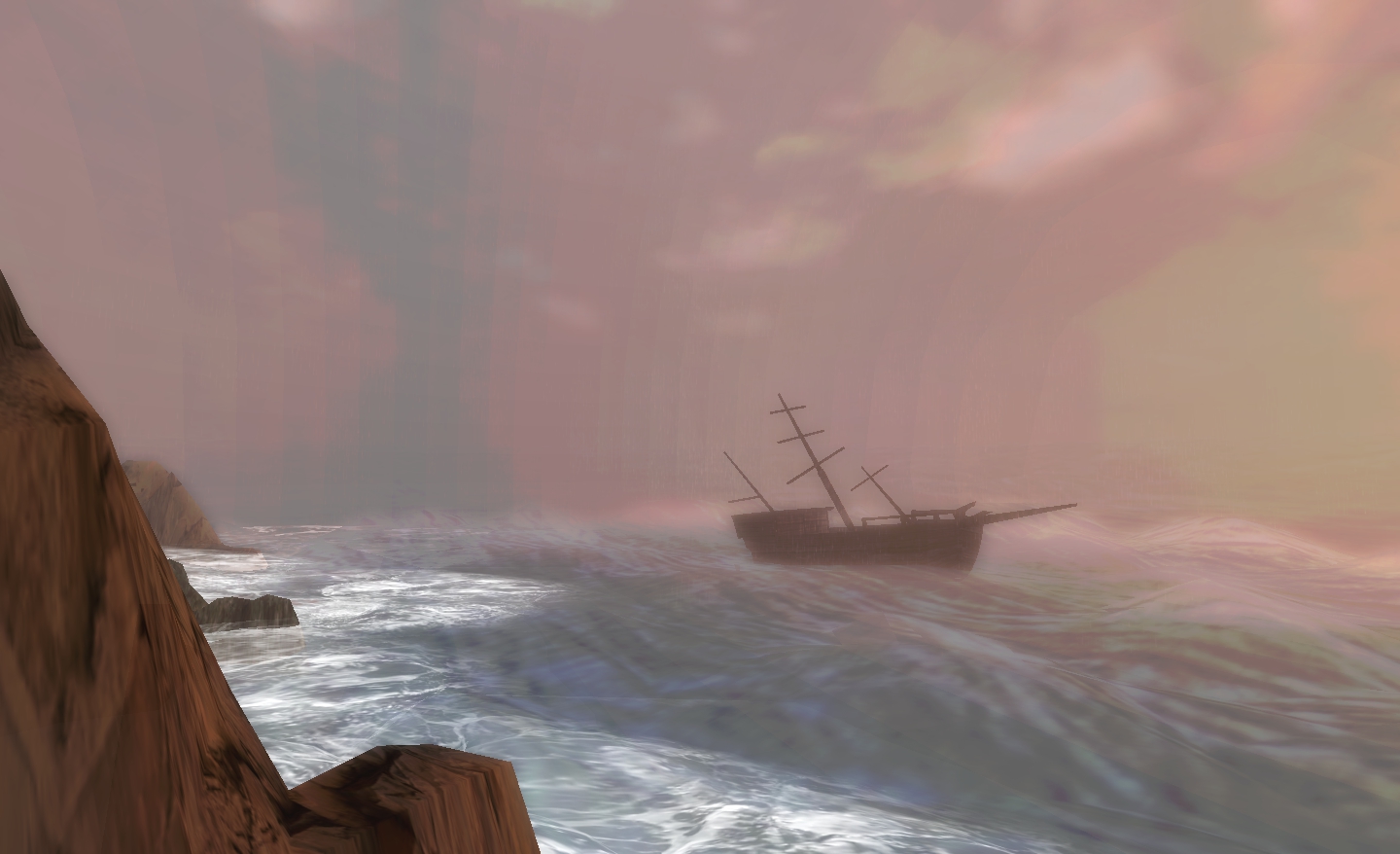
There are also stories to be found as well, if you take the time to seek them – or at least, the hints of stories to be told – such as that of the storm and the shipwreck.
The wreck and the waves
Whither sailed the ship before the storm caught her and tossed her toward the rocks? What was her cargo? Did anyone from the shore witness her sad fate – and what of her crew? Did they live to tell of her loss, or did they perish in the unforgiving arms of the sea?
The start of the story is there for you to see – but how it should end is down to your imagination, and your imagination alone – but you’ll have to find it by exploring in order to settle on your own tale!
Even with the flyer options, however, there are some places here that are best reached via teleport. One of them is the fantastic “Village to Heaven”.
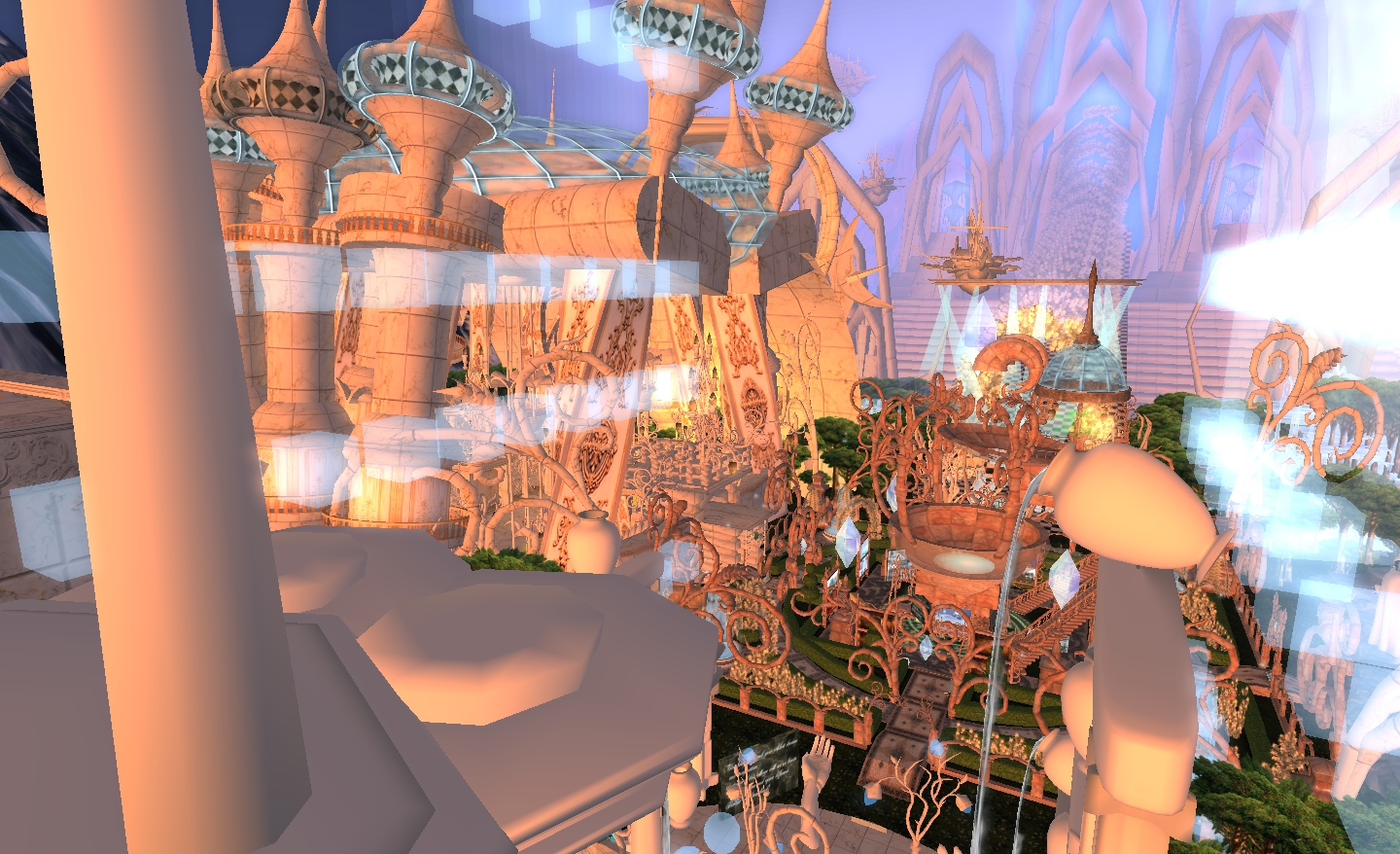
Set high in the sky and surrounded by perilous mountain peaks, this is another stunning build, rendered in ivory, marble and ice blue, with gleaming cloud-ships sailing by, and lush woodlands below.
“Village to Heaven”
The scale and attention to detail here is equally as stunning as the build on the ground, including the use of phantom prims to extend the beautiful fantasy of the place beyond the limitations of the sim boundary, again giving the illusion of places we cannot visit and stories we cannot witness.
Take the path from the teleport, for example, and follow it through the doors leading into a huge amphitheatre – a feast for the eyes in itself – then cross to the other side and open the second set of doors. Just where does the path, sloping upwards and guarded by pairs of white-cloaked statues, lead? What lies beyond the gilded doors at the far end of the climb? You can never know for sure, as they lie beyond the edge of the sim – but as you walk as far as you can towards them, you can be sure your imagination will be asking questions as to what might be there, and who the robed statues really represent…
Another stunning use of a custom sim extension – where exactly does the sim end? Walk the path and find out…
Teleports are available here as well, but you should take the time to explore on foot, there is so much to see. The Village comprises parts representing the four elements: Air, Water, Earth and Fire – and I found that Air and Water in particular put me in mind of Tolkien’s Imladris – and I expected to hear the soft lament of elves if I turned on my sound.
Cloud ships
The key here is, again, to take your time with your explorations. When you have seen all you wish to see, look around once more. The chances are there is a path or stair or doorway you may otherwise miss.
When you are satisfied with all you’ve seen, return to the teleport point and climb the stone stairs. These lead up to the a Fall Pod platform. Here, every few seconds a ball will drop and roll towards a tunnel-like chute. Grab one quick with a right-click and SIT, and take a ride back down to the world below. It will reveal things that have so far escaped your attention as you return to the Alpha Point arrival area.
If there is one problem with this build, it is that when it comes to reviewing it, there is simply too much to see. This article is already around the 2000 word mark, and I’ve barely scratched the surface of the place. To try to capture everything in words and images would take a novella. But then, frankly, words and images alone do not do Alpha Point and Omega Point any justice. This is not something to be read about and looked at via static pictures; to do so would be like convincing yourself you’ve watched The Fellowship of the Ring on the basis of seeing and reading the film poster.
To really appreciate this build, it has to be visited; it is something that should be experienced, explored, enjoyed – and savoured – and I urge you to do just that. But be warned: once you have visited the Alpha and Omega of Second Life, you are likely to find yourself coming back time and again. The build is magnetic, inspiring…
…Addictive.
Omega Point
To further whet your appetite just a little more, here’s a machinina video JJCCC Coronet produced just over a year ago, showing how Omega Point looked back then.










 Inara Pey: Living in a Modemworld