Comet Siding Spring’s passage through the solar system 2014
In October 2014, I wrote about comet Sliding Spring and it’s close approach to Mars as it swung through the solar system.
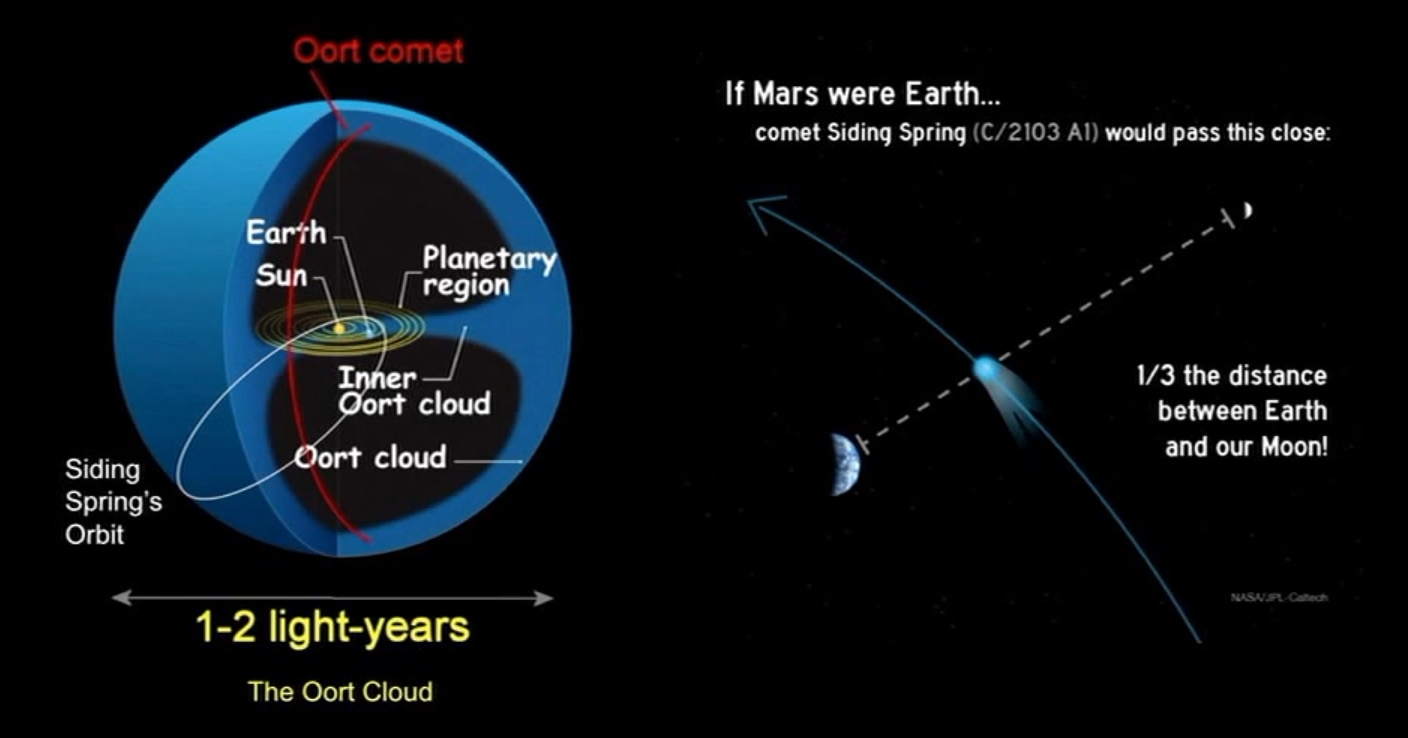
The comet had been identified as coming from the Oort cloud (or the Öpik–Oort cloud, to give proper recognition both astronomers who initially and independently postulated its existence), a spherical cloud of debris left-over from the creation of the solar system, occupying a huge area starting some 2,000-5,000 AU (2,000 to 5,000 times the distance from the Earth to the Sun) and extending out to around 50-100,000 AU – or about one light year away.
There is nothing odd about comets from the Oort cloud per se, but Sliding Spring appeared to be making its very first journey into the inner solar system, and so astronomers were keen to try to study it as best they could. Given the close pass at Mars, the vehicles on and orbiting that planet stood to have something of a grandstand view of things – providing certain precautions were taken, as I noted at the time.
An artist’s impression of MAVEN in orbit around Mars
Now data released by NASA shows that the comet’s flight past Mars did result in something very unusual: the comet’s tail, which brushed the Martian atmosphere, resulted in a “rain of metal” over the planet.
The data was obtained by NASA’s Mars Atmosphere and Volatile EvolutioN Mission (MAVEN), which at the time of the comet’s passage was so recent an arrival at Mars, that all its instruments hadn’t been fully commissioned. Hence, in part, the delay in releasing the data – NASA wanted to be sure MAVEN was recording things accurately.
According to MAVEN, the direct detection of sodium, magnesium, aluminium, chromium, nickel, copper, zinc, iron and other metals high in the Martian atmosphere can be linked directly to material sloughing off of the comet as it passed.
“This must have been a mind-blowing meteor shower,” said Nick Schneider of the Laboratory of Atmospheric and Space Physics at the University of Colorado, commenting on the data returned by the orbiter. Such is the strength of the signal of magnesium and iron measurements, the hourly meteor rate overhead on Mars must have been tens of thousands of “shooting stars” per hour over a period of many hours.
An artist’s impression of meteors resulting from comet Siding Spring in the sky over NASA’s MSL Curiosity rover
“I’m not sure anyone alive has ever seen that,” Schneider added, “and the closest thing in human history might the the 1833 Leonids shower.” The metal ions were the remains of pebbles and other pieces shed from the comet that burned up, or “ablated” into individual atoms as they struck the Martian atmosphere at 56 kilometres per second (125,000 miles per hour).
What is particularly important about the event is that as scientists know the source of the dust particles, it’s speed, and key information about Mars’ upper atmosphere, it is possible to learn more about Mars’ ionosphere, the comet’s composition, and even the workings of Earth’s ionosphere when it is hit by comet or asteroid debris.
Impact Glass
There is glass on Mars, and it might just be the ideal place in which to find any evidence of past microbial life.
The type of glass in question is referred to as “impact glass”, and is formed as a result of the heat generated by the impact of a meteorite melts the surrounding rock into glass. when a meteorite strikes the surface of a planet or moon, melting the surrounding rock into glass, preserving and organic matter that existed on or in the rock prior to the meteorite impact occurring.
In 2014, a research team examining impact glass formed millions of years ago as a result of meteorite strikes in Antarctica form found organic molecules and plant matter within the glass. Their work spurred a group of planetary science graduates at Brown University, Rhode Island, to simulate the spectral composition of possible Martian impact glass by using chemicals, compounds and powders matching those known to compose the surface material on Mars, and then melting the mix at high temperatures to form glass, which they then subjected to spectrographic analysis.
The team then compared the results of their analysis with spectral analyses of the surface of Mars carried out by the Imaging Spectrometer aboard NASA’s Mars Reconnaissance Orbiter (MRO) – and found a very similar spectral signature in areas where such impact glass would be expected to form, such as around the central peaks of craters caused by meteorite impacts.
A spectrographic image of the central peak of the Alga Crater impact zone, taken by MRO. The green colours indicate the presence of impact glass
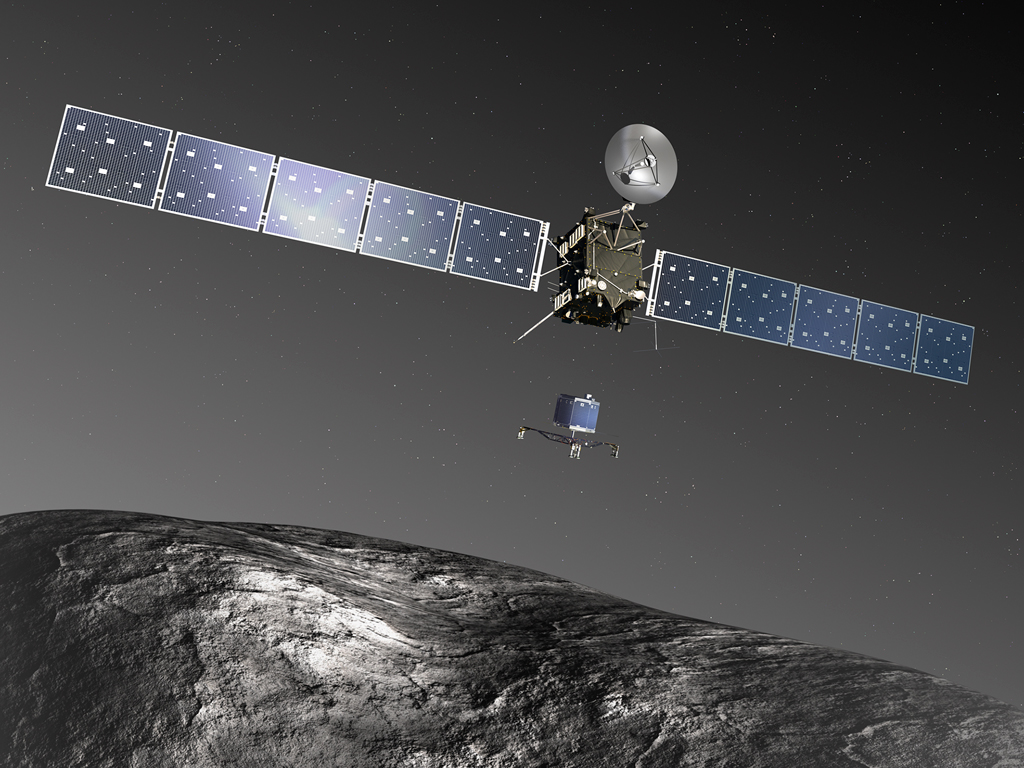
November 12th, 2015: Philae departs Rosetta en route for the surface of comet 67P/C-G (image courtesy of ESA)
ESA’s Philae lander, which as I reported a week ago, resumed contact with Earth via its “Parent”, Rosetta, after seven months in hibernation, continues to return data to Earth from comet 67P/Churyumov–Gerasimenko (67P/C-G) as it continues towards the Sun.
Friday, June 19th, marked the latest transmission from Philae, which is about the size of a domestic washing machine, bringing the total of communications with mission control in Germany to 3 since the lander managed to re-establish its link with Rosetta.
Communications are sporadic because it is still not entirely clear where Philae is sitting on the comet, having bounced across the surface following its initial touch-down in November 2014. This, and Rosetta’s science-focused orbit around the comet means that there can be extended periods of several days between the times when both spacecraft and lander are suitably aligned to allow communications to take place.
The Friday communication lasted 19 minutes, and allowed the lander to return a further 185 packets of data to Earth. The data gave additional confirmation that Philae is in good health and in an environment which means it should be quite comfortable for a good while – thus increasing the chances of it resuming its science activities.
“Among other things, we have received updated status information,” Michael Maibaum, a systems engineer at the DLR Lander Control Centre in Cologne, reported following the Friday contact. “At present, the lander is operating at a temperature of zero degrees Celsius, which means that the battery is now warm enough to store energy. This means that Philae will also be able to work during the comet’s night, regardless of solar illumination.”
The three communications so far received mean that the mission team now have sufficient data to be able to more accurately position Rosetta so that it can continue with its primary science mission while being better placed to improve radio visibility between it and the lander’s estimated location. The first set of commands for the spacecraft to start adjusting its orbit were uploaded on Wednesday, June 17th, and and further set of instructions were uploaded on Saturday, June 20th. The aim is to close the distance between Rosetta and the comet to 177 kilometres within an orbit that will allow the orbiter to be above Philae’s horizon more regularly than is currently the case.
Pluto’s Gentle Fade In
NASA’s New Horizons mission to the Pluto-Charon system is now less than a month from its point of closest approach, which will occur on July 14th, 2015. As the fast-moving spacecraft closes on the two planetoids, the images it is returning to Earth of Pluto are starting to show tantalising splotches of dark across the planetoid’s surface, the first hints of landforms.
Pluto slowly starts to unmask itself as New horizons approaches (image: NASA / APL)
The pictures are still nowhere near being as clear as they should be in the days immediately prior to and following the point of closest approach, but they are still nevertheless interesting; in April 2015, New Horizons images what appears to be a polar ice cap on Pluto, so scientists are curious to what else might be revealed.
At the time of closest approach, New Horizons should be within 10,000 kilometres (6,200 miles) of Pluto and around 27,000 kilometres (17,000 miles) of Charon. The fly-by of Pluto should allow the main telescope camera system on the vehicle to take selected high-resolution images of Pluto at a scale of 50 metres / pixel. It is hoped that the average resolution of daylight images captured of Pluto will be around 1.6 km (1 mile) resolution, and will allow the composition of 4-colour maps of the surface.
From around 3.2 days before closest approach, long-range imaging will be used to map both worlds to a resolution of around 40 kilometres (25 miles). New Horizons will also attempt to gather data on the nature of any atmosphere present on Pluto and seek evidence of any cryovolcanism which might be occurring or surface feature changes which might be attributable to snowfall or similar.
Titan: Even More In Common
An infographic released by NASA in June 2014 to mark Cassni’s ten years in operation around Saturn – click for full size (NASA)
There are only two places in our solar system known of have rainfall, rivers and oceans, as well as a thick atmosphere, rocky ground and plate tectonics. They are Earth and Saturn’s huge moon, Titan. Now the joint ESA / NASA Cassini mission has revealed Titan shares something else with Earth: polar “winds” that suck gasses out of its atmosphere and into space.
Titan’s atmosphere has around a 50% higher surface pressure than Earth’s, and is comprised mainly of nitrogen and methane, and is rich in hydrocarbons, which also exist in lakes, reivers and seas on the surface of the planet.
Several years ago Cassini, which has been orbiting in orbit around Saturn for over a decade, revealed that around seven tonnes of hydrocarbons and nitriles were being lost every day from the upper layers of Titan’s atmosphere, but the mechanism causing the loss remained unknown until CAPS, the instrument which first recorded the loss recorded the “wind” in action.
Essentially, sunlight striking the upper layers of Titan’s atmosphere ejects negatively charged electrons out of the hydrocarbon and nitrile molecules resting there. These electrons are then drawn away along Saturn’s magnetic field, generating their own electrical field strong enough to “pull” the positively charged particles left behind by the formation of the original electrons out of the atmosphere along with them.
On Earth, this process charges particles in the atmosphere and draws them up along the planet’s magnetic field, where they can escape at the poles, and the same thing is happening on Titan. The discovery has lead to speculation that similar processes might be at work on Mars and Venus.
In this false-colour image, lakes and “sea” of hydrocarbons can be seen scattered across the north polar region of Titan (the white areas indicate parts of the moon’s surface which had not been imaged at the time this mosaic was constructed (image: NASA)
The joint ESA / NASA Dawn mission to study two of the solar system’s three “protoplanets” located in the asteroid belt between the orbits of Mars and Jupiter, continues to intrigue scientists.
Launched in September 2007, and costing US $446 million, Dawn is part of a broader effort to better understand the origins of the solar system and how the planets actually formed; all of which might give us greater understanding of how life arose here on Earth.
The mission has been relatively low-key when compared to the likes of NASA’s MSL rover on Mars or Europe’s Rosetta mission to comet 67P/C-G and NASA’s other mission to tiny world. New Horizons, but the Dawn spacecraft and mission are quite remarkable. The little spacecraft is use ion propulsion to enter orbit around a planetary body and is the first to orbit a dwarf planet and, since its arrival in orbit around Ceres, the first spacecraft from Earth to visit that tiny dwarf planet and the first mission to orbit two separate extraterrestrial bodies.
Dawn arrived at Ceres in March 2015, after a 2.5 year transit flight from Vesta, its first destination, where it spent 14 months in orbit following its arrival there in July 2011. Because of their relative size – Ceres accounts for around one-third of the total mass of the asteroid belt – both of these airless, rocky bodies are regarded as dwarf planets, rather than “simple” asteroids. However, they are both very different bodies to one another.
Dawn mission (NASA / JPL) – click for full size
With a diameter of 525 kilometres (326 miles), Vesta is the smaller of these two worldlets, and is technically regarded as water-poor achondritic asteroid comprising a tenth of the mass of the asteroid belt. Its density is lower than the four inner planets of the solar system but higher than most of the moons and asteroids.
A June 6th image of the bright spots within a crater on Ceres, captured by Dawn on June 6th, 2015, from a distance of 4,400 kilometres / 2,700 miles (NASA / JPL) – click for full size
Ceres, with a diameter of 950 kilometres (590 miles), is just 2.5 times smaller than distant Pluto, the target of the New Horizons mission. Its spectral characteristics suggest a composition similar to that of a water-rich carbonaceous chondrite. Like most of the material within the asteroid belt, it formed very early in the history of the Solar System, thereby retaining a record of events and processes from the time of the formation of the terrestrial planets.
Since arriving in orbit around Ceres, Dawn has returned some intriguing images of apparent bright spots within a crater. These were first seen in late 2014, as Dawn made its initial approach to Ceres, and have since been imaged on numerous occasions, and have been tracked as Ceres rotates, eliminating them as being imaging artefacts. Studies of much lower resolution images of Ceres taken by the Hubble Space Telescope also reveal these bright spots – although such is the distance of Ceres from Hubble that where they do appear in HST pictures, they are little more than a single bright blob.
The thinking on the bright areas are that they are water ice or possibly frozen salt deposits – although they could be something more exotic. Over the last two months, Dawn has been able to image the bright areas, which lie in a crater some 92 kilometres (57 miles) across, situation some 19 degrees above Ceres’ equator. On June 6th, 2015, Dawn returned the best images yet of the bright spots, and these have been added to an animation made up of multiple images of Ceres, showing it rotating about its axis.
At the end of June, Dawn will commence a series of manoeuvres which will gently lower its orbit over the period of 6 weeks, allowing it to get much more detailed images of the surface of Ceres and these strange spots. As the images will also be captured from multiple angles, scientists hope they’ll provide sufficient information for the composition of the bright spots to be understood.
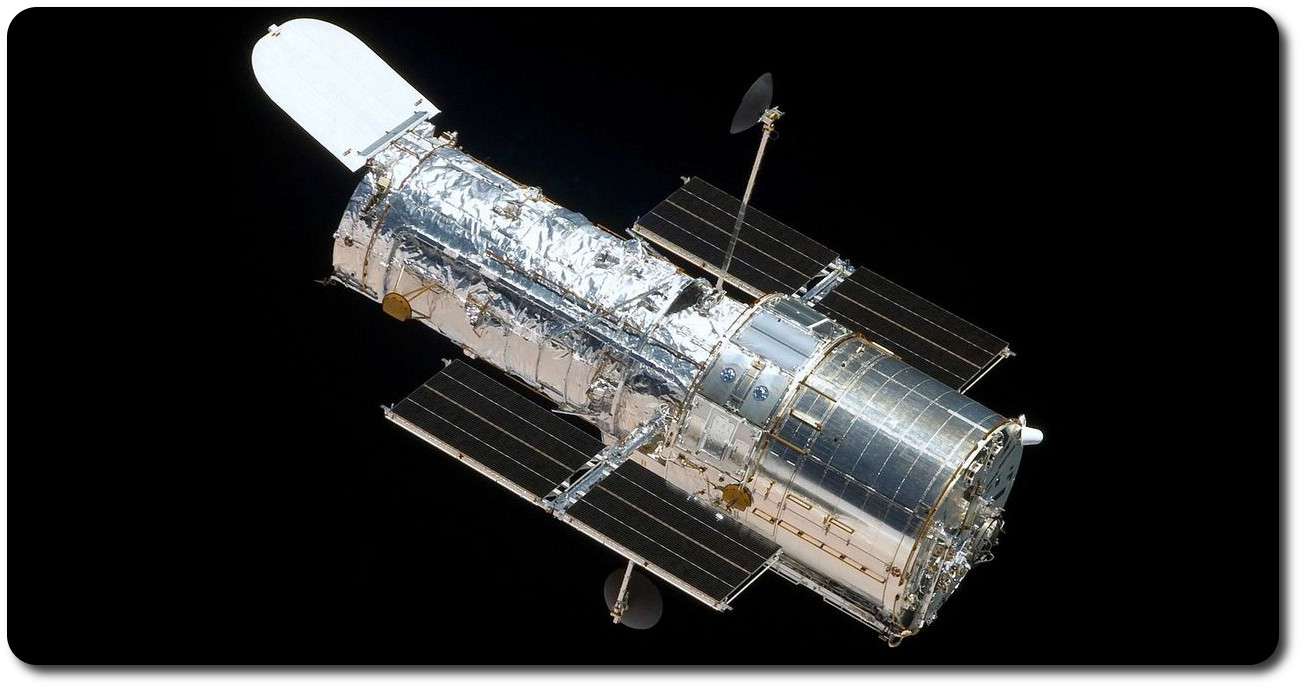
The Hubble Space Telescope (HST) as seen from the departing space shuttle Atlantis, flying STS-125, the final HST Servicing Mission, in 2009. This mission completely overhauled the space station in recognition of the fact that it is unlikely to ever be refurbished again
One of the most famous – if not the most famous – space science instruments celebrated 25 years of orbital operations in April 2015.
There can be few people with access to television or media of any description who have not at some point in their lives heard of the NASA / ESA Hubble Space Telescope. Since its launch on April 24th, 1990, and after initial teething problems which required it be fitted with the space equivalent of a pair of spectacles, the Hubble Space Telescope – also referred to as HST, or simply “Hubble” – has brought us some of the most stunning images of the planets of our solar system and deep space ever seen, giving us unique insights into the rest of the solar system, the galaxy in which we reside and the universe beyond.
The major advantage of the Hubble Space Telescope is that it operates above the distorting effect of the majority of the Earth atmosphere. Such is the benefits of such a location, that space telescopes were first proposed as early as 1923, and Hubble itself has a history stretching back as far as 1946, when astronomer Lyman Spitzer wrote Astronomical Advantages of an Extraterrestrial Observatory. For almost 20 years he continued to push the idea as the space programme came into existence until, in 1962, the US National Academy of Sciences took up the call and with three years, Spitzer had been appointed to chair a committee to define the scientific objectives for such a telescope. It was this work that gave birth to the Large Orbiting / Space Telescope in the 1970s, which became Hubble in the 1980s.
Cutaway of the Hubble Space Telescope showing the major components and sections
Named for the US astronomer Edwin Hubble, regarded as one of the most important observational cosmologists of the 20th century, the HST faced some unique challenges even before it was launched. First and foremost, in order to have as long an operational life as possible, it was designed to be serviced by astronauts, who could replace systems, fix failures, upgrade components, etc. Unfortunately, this also meant that Hubble had to be placed in a relatively low Earth orbit, resulting in further challenges.
Firstly, a low Earth orbit meant the telescope would spend half its time in bright sunlight, making observations in that part of its orbit next to impossible. It also meant an aperture door had to be fitted over the open end of the telescope, which could be closed to avoid the risk of direct sunlight falling onto the telescope’s optics and potentially damaging its science instruments.
April 25th, 1990. With its solar power panels deployed and forward aperture door closed, the space shuttle Discovery gently releases the Hubble Space Telescope at the start of its 25+ year mission
More particularly, an orbit around the Earth meant that Hubble would be passing from daylight into night every 48 minutes – and undergoing very wide swings in temperature from extremely hot to very, very cold. These not only would these cause significant heating and cooling issues for the more sensitive instruments on the telescope, they could also lead to expansion and contraction in parts of the telescope’s structure, which in turn could cause small amounts of vibration / movement when it was required to be an ultra-stable platform for space observations.
Nevertheless, despite the technical and engineering challenges the project faced, by the mid-1980s, Hubble was ready, and its launch was scheduled for October 1986. And then fate intervened, in the form of the tragic Challenger disaster of January 1986. This set back the US manned space programme by over two years, and resulted in Hubble’s launch being delayed until the 24th April 1990, when the space shuttle Discovery lifted off from Launch complex 39B at the Kennedy Space Centre on mission STS-31, and the following day successfully deployed the telescope in orbit. All seemed well with the telescope as it underwent on-orbit commissioning over the next couple of weeks; then a series of deep space test images were taken – and indicated a serious flaw in the telescope’s imaging capabilities.
Investigations were begun, and the problem was eventually traced to a error in the telescope’s primary mirror. The HST’s optics are a classic Cassegrain reflector, common to the majority of large professional telescopes, which comprises a very large primary mirror – in the case of Hubble some 2.4 metres (7 ft) across – and a smaller focusing mirror. Both have to be made to exacting tolerances through a process of grinding the reflective surfaces to their required shapes, and in the case of Hubble, the primary mirror had been ground to the wrong shape – by just 2.2 nanometres (a nanometre being one billionth of a metre).
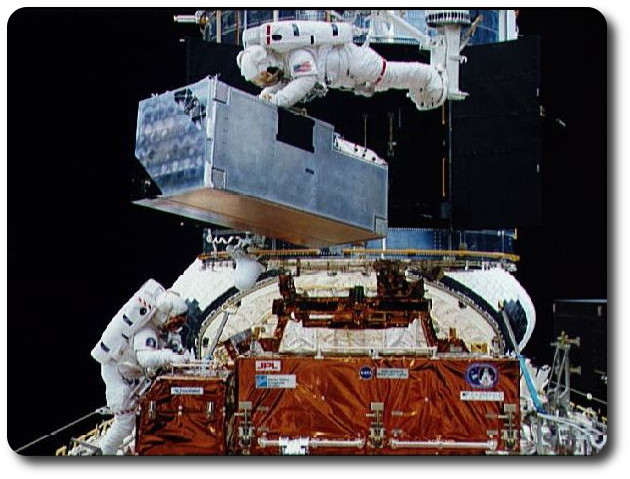
December 8th, 1993, astronaut Kathryn C. Thornton (top of this image) holds on to the COSTAR package as the shuttle Endeavour’s robot arm slowly lifts her – and it – clear of its cradle in the shuttle’s payload bay, ready for installation into Hubble, which can be seen anchored in the shuttle’s bay behind her with the instrument bay doors open
Though tiny, the error was enough to seriously impact Hubble’s ability to carry out cosmological studies, although imaging of very bright objects (such as the planets in the solar system) was still possible. Indeed, and despite being the butt of media jokes and labelled a US $2.5 billion “white elephant”, from 1990 through 1993, Hubble still performed some remarkable work.
However, in 1993, the space shuttle Endeavour lifted-off on mission STS-61, the first of five planned Hubble Servicing Missions. While the huge primary mirror could not be repaired or replaced, the astronauts aboard Endeavour were, among a much broader series of upgrades for the telescope, able to replace one science package on the telescope with a series of corrective optics called COSTAR, and upgrade the telescope’s existing Wide Field Planetary Camera with a more refined version. Intended to counter-act the flaw in the mirror, these upgrades were the equivalent of giving Hubble a pair of glasses – and the results were spectacular.
Before and after – to images of the spiral galaxy M100, located approximately 55 million light years from Earth. On the left: an image taken by Hubble on November 27th, 1993, just before the first servicing mission. On the right, and image taken by Hubble on December 31st, 1993, after the installation of the corrective optics and camera system
Since that first operation, Hubble has been serviced four more times between 1997 and 2009, all of which have continued to keep it in good operational order, replacing things like the gyroscope packages that both keep it stable and allow it to be turned to face targets selected for observation, and have significantly updated the science packages it carries, massively increasing its research capabilities.
These missions also served a secondary purpose; while well above the bulk of the Earth’s atmosphere, Hubble still orbits within the second highest layer of the atmosphere, the thermosphere. Although exceedingly tenuous, the thermosphere nevertheless exerts minute, but cumulative drag on objects such as HST and the International Space Station, slowly reducing their orbits. To counter this, the servicing missions flown to HST allowed the space shuttle to gently “lift” Hubble back “up” to its optimal orbit.
True colour images of the star cluster Pismis 24 at the heart of nebula NGC 6357, around 8,000 light years from Earth (image: NASA / ESA and Jesœs Maz Apellÿniz, Instituto de astrofsica de Andaluca, Spain)
In the 25 years of operations, Hubble has contributed to some major scientific discoveries, assisted in resolving some major astronomical issues, witnessed some remarkable solar events, and has raised new cosmological questions. And, of course, it has brought us some of the most stunning images of our galaxy and the universe beyond it, forever changing our perception of the place in which we live.
In honour of it’s namesake, one of the primary elements of Hubble’s mission was to measure the distances to Cepheid variable stars which, because of its position in space, it could do with far greater accuracy than ever before achieved. These observations helped constrain the value of the Hubble constant, used to define the rate at which the universe is expanding (thus helping to more accurately determine the age of the universe).
Prior to HST’s work, estimates of the Hubble constant typically had errors of up to 50%; HST was able to produce measurements with an accuracy of ±10%, which have since been verified using other techniques.
As well as helping to more accurately pin down the age of the universe, Hubble also helped establish the Lambda Cold Dark Matter (“ΛCDM”) model as the “standard” model of Big Bang cosmology, by providing evidence that, rather than slowing down due to the influence of gravity (which would eventually lead to the universe contracting once more into the Big Crunch), the rate of expansion of the universe is actually accelerating, most likely due to the influence of so-called dark energy.
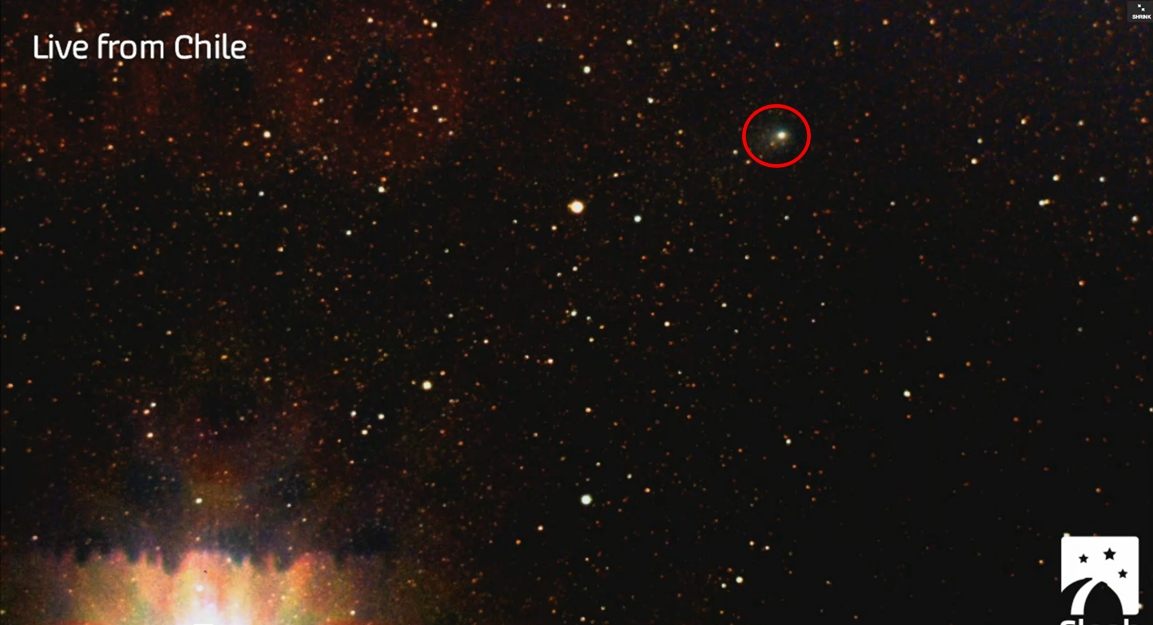
Siding Spring (circled) passing Mars (the glowing object, bottom left) as seen via the SLOOH telescope at the Pontificia Universidad Católica De Chile (PUC) – image via SLOOH live feed, October 19th, 2014
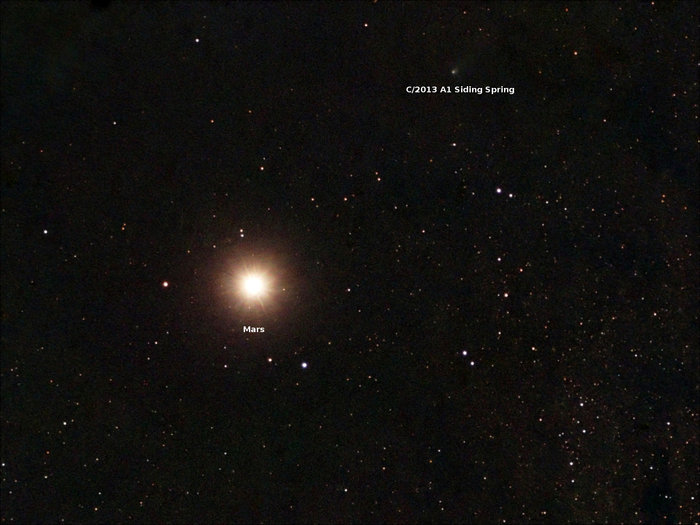
It’s now a week since Siding Spring passed by Mars as it hurtled through the inner solar system for what might be the very first time. As I reported on the day of the comet’s flyby, C/2013 A1 – to give the comet its official designation – passed by Mars at a distance of around 136,000km (85,000 miles) and at a speed of some 56 kilometres (35 miles) per second. Since then, the comet reached perihelion – the point of its closest approach to the Sun (Saturday, October 25th, 2014), and it is now on its way back out of the solar system, travelling “up” and out of the plane of the ecliptic as it does so.
It will not be back this way for at least a million years.
Despite some getting their knickers in something of a knot over video footage apparently showing an “explosion”/ “electromagnetic pulse” in the Martian atmosphere around the time of the comet’s closest approach to Mars. In particular, the video footage – some 75 images captured by amateur astronomer Fritz Helmut Hemmerich M.D., captured between 21:00 and 22:00 UT on October 19th, from an altitude of some 1200 metres in Tenerife, have had proponents of the “electric universe” theory (aka Plasma Cosmology) in something of a tizzy.
Quite what caused the artefact in Dr. Hemmerich’s images is unclear – but lens flare cannot be entirely ruled-out. Given that within hours of the comment’s passage the various orbital vehicles around Mars started popping-up and reporting their status, it would appear highly unlikely that the artefact was anything to do with some kind of massive electrical discharge within the Martian atmosphere, simply because it is not unreasonable to suppose had this been the case, it would have adversely affected at least some of the craft.
Siding Spring passing Mars, October 19th, 2014 (image: Scott Ferguson, Florida, USA)
As it is, all of NASA’s vehicles reported absolutely no ill effects from the comet’s passage or as a result of the period of “peak dust flux” when they were expected to be at the greatest risk from the passage of very high velocity dust particles (travelling at tens of kilometres per second), and all were back in full operation within hours of the comet’s passage past Mars, as were both India’s MOM and Europe’s Mars Express. NASA’s Mars Reconnaissance Orbiter (MRO) in particular remained in contact with Earth throughout the time the comet passed by Mars and reported nothing to suggest the Tenerife images were showing anything of major significance occurring around Mars at the time of the flyby.
Currently, all of NASA’s orbital assets are continuing to study the comet and how dust and debris ejected from it has affected the Martian atmosphere, although it is expected to be several more days before the data being returned has been analysed and assessed.
In the meantime, on Friday, October 24th, and in a timely move, the European Space Agency reminded the world of another cometary encounter that is taking place. This was via the public premier of Ambition, a short film by Tomek Bagiński, starring Aidan Gillen (“Petyr Baelish” in Game of Thrones) and Aisling Franciosi (“Katie” in The Fall).
The film takes a unique look at the decade-long Rosetta mission, which is only now commencing its primary mission to observe a comet at very close quarters, including landing a robot vehicle on the surface of the comet on November 12th, 2014.
Sunday October 19th marked the culmination of what is regarded as one of the most unique astronomical events to take place in human history – so unique, some commentators believe it may only happen once every million years or so: the opportunity to study something which may have existed before the Earth was created.
For the last several months, comet Siding Spring has been under observation as it hurtles through the solar system at an acute angle relative to the plane of the ecliptic – the imaginary line along which the planets orbit, and on Sunday October 19th, it made its closest approach to Mars, passing just in front of the planet relative to the Sun.
Siding Spring was first identified by Australian astronomer Rob McNaught, and bears the name of his observatory as a result, although officially it is catalogued as C/2013 A1. Since then, it has been under observation from a veritable armada of international space craft, and its passage past Mars presents further unique opportunities for observation and data-gathering.
Siding spring is a comet originating in the Oort cloud, and believed to be making perhaps its first foray into the inner solar system, passing inside the orbit of Jupiter
The comet has been identified as coming from the Oort cloud (or the Öpik–Oort cloud, to give proper recognition both astronomers who initially and independently postulated its existence). This is a spherical cloud of debris left-over from the creation of the solar system, occupying a huge area starting some 2,000-5,000 AU (2,000 to 5,000 times the distance from the Earth to the Sun) and extending out to around 50-100,000 AU – or about one light year away. Thus, Siding Spring represents some of the material “left-over” from the formation of the solar system 4.6 billion years ago – older than the Earth itself. In fact, such is the distance of the Oort cloud from the Sun, that some postulate the much of the material within it may actually come from stars which shared the same “stellar nursery” as the Sun.
There is nothing unique per se about comets coming from the Oort cloud – it is one of two places from which all comets originate, the other being the Kuiper belt (or Edgeworth–Kuiper belt, as it is also known in recognition of the two astronomers to postulate its existence in the form we now know it has). A disk of material also from the early history of the solar system, the Kuiper belt orbits the Sun at a distance of around 30-50 AU, and gives rise to “periodic” comets. These are comets which circle the Sun in periods of up to 200 years. Two of the most famous Kuiper belt comets are comet Halley, with it 76-year orbit, and comet Shoemaker-Levy 9, which broke-up during a close approach to Jupiter in 1992 prior to colliding with the gas giant in 1994.
Siding Springs passage through the solar system
What makes Siding Spring of interest to astronomers is that this is probably the first time in its long, cold history it has ever come inside the orbit of Jupiter since it was first nudged out of the Oort cloud. This led Dr Michael Brown, an astronomer at Monash University, to describe the comet as “essentially a refrigerator of pristine parts of the creation of the solar system. The particles it gives off are effectively opening up the door of the fridge so we can see what the solar system was like 4.6 billion years ago.”
John Grunsfeld, former astronaut and associate administrator for NASA’s Science Mission Directorate in Washington was equally enthused by the comet’s passage, referring to it as “a cosmic science gift that could potentially keep on giving.” Speaking at a press conference held earlier in the year to discuss NASA’s plans to observe Siding Spring, he continued, “The agency’s diverse science missions will be in full receive mode.” He went on, “This particular comet has never before entered the inner solar system, so it will provide a fresh source of clues to our solar system’s earliest days.”
The chance for scientific discovery notwithstanding, the comet’s path was initially a cause for concern, at least in terms of Mars’ future. Early attempts to track the comet’s likely route “up” through the solar system suggested that rather than passing the Red Planet, Siding Spring would in fact smash into it.
Had the comet struck, estimates suggest it would have created a crater between 10 and 15km in diameter, depending on the actual size of the comet’s nucleus, thought to be between 700m and 1km across. While that is certainly enough to result in quite an extraordinary bang and some severe changes in the Martian atmosphere (not to mention the sizable dent it would make in the planet’s surface), Mars has actually withstood much larger impacts in its time.
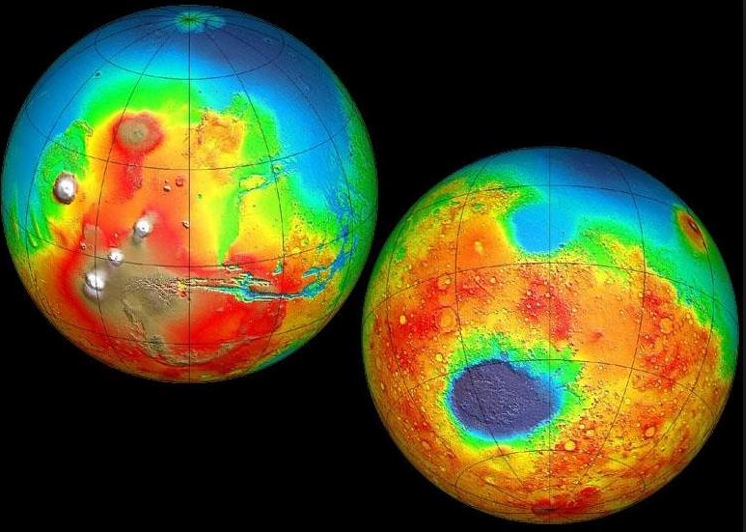
Take Hellas Basin, for example. It is the largest visible crater in the solar system, some 2,300km (1,440 miles) across, and with an ejecta ring some 7,000km (4,375 miles) across. It is believed to have been created by the impact of an asteroid some 400km (250 miles) in diameter.
The Hellas Basin, shown in purple in the image of the right, above. Deeper than Mount Everest is tall, the depression was likely caused by the impact of an asteroid some 400km across. The impact also resulted in the Tharsis Bulge on the opposite side of the planet, and shown in red in the image on the left, topped by the three massive Tharsis volcanoes, and split by the 5,000km length of the Vallis Marineris
As Grunsfeld noted, such is the scientific opportunity presented by the comet, that NASA has put a significant number of assets in the front line of tracking and observing Siding Spring. These include the Hubble Space Telescope, the Spitzer infra-red space telescope, the WISE infra-red space telescope, the Chandra X-ray observatory, the Kepler orbital observatory (used in the search for Earth-sized extra-solar planets) and more, as well a host of ground-based observatories.
Foremost in the front line, by dint of the comet’s close passage past Mars, are NASA’s orbital and surface vehicles there. Curiosity, Opportunity, the Mars Reconnaissance Orbiter (MRO), Mars Odyssey and MAVEN, together with Europe’s Mars Express and India’s MOM, are all watching the comet, although for the orbiting spacecraft, this comes with a degree of risk.
Siding Spring has been, and is, under observation by an armada of science probes and also from observatories on Earth – including these from NASA








 Inara Pey: Living in a Modemworld