An Accidental No Exit in Second Life

Nitroglobus Roof Gallery: Milena Carbone – No Exit

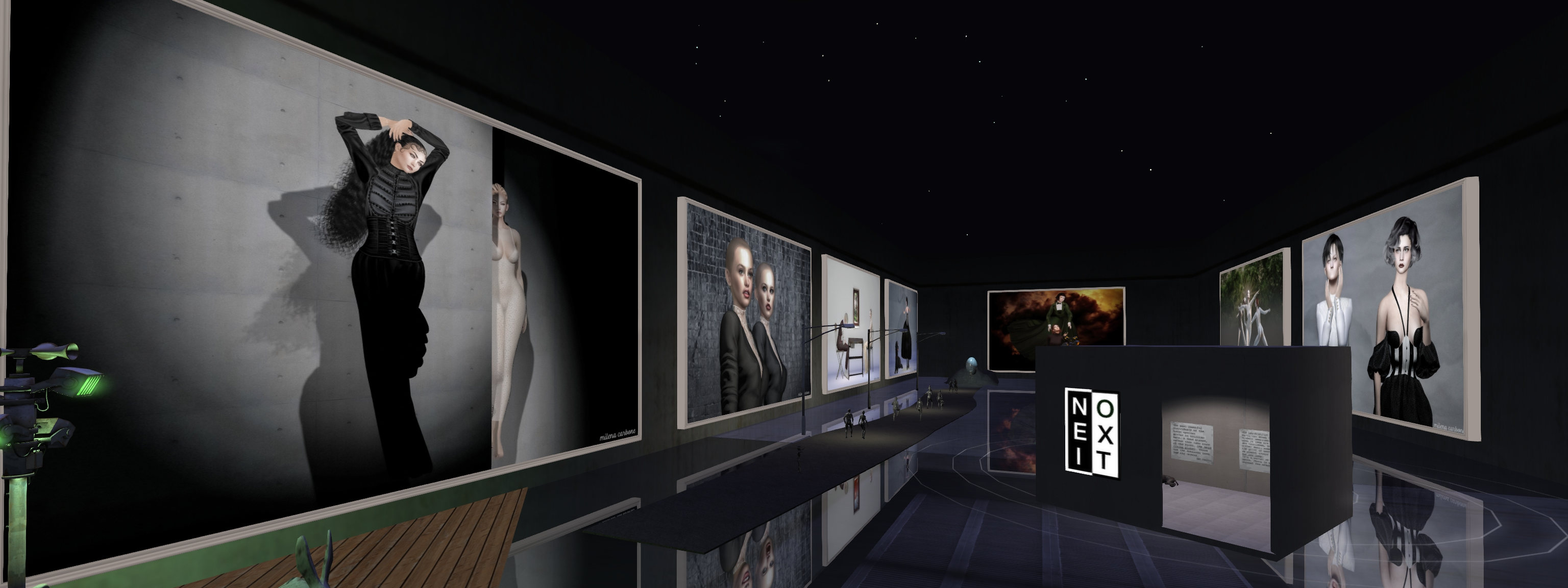
No Exit is the title of the latest 2D art exhibition hosted by Dido Haas at her Nitroglobus Roof Gallery. It features the images and words of Milena Carbone, and is very much something of an “accidental” exhibition which still nevertheless offers food for thought – something Milena is prone to do with her art.

I’ll let Dido explain why No Exit might be considered an “accidental” exhibit:

[Milena] initially intended to work on a totally different project. However, this was cancelled due to her RL work as well as to her lack of motivation. So the images shown at the walls of the gallery this month were not created for an exhibition. Instead they were taken from the stream of images which Milena regularly produces for herself.
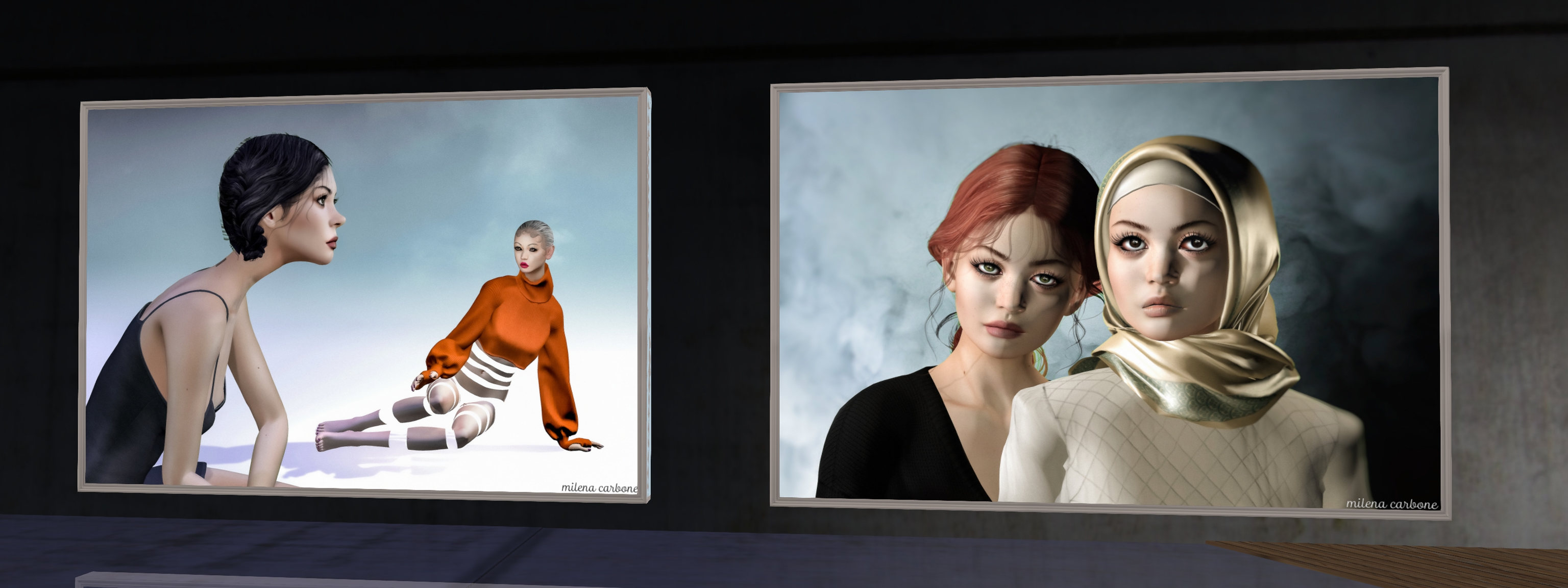
I made the selection and pointed out to Milena that there were always two characters in each image, .which made Milena think of the French philosopher Jean-Paul Sartre’s play “No exit” (“Huis clos” in French). And voila the title for this exhibition was born.

– Dido Haas, explaining the origins of No Exit

The connection between Satre and images is important to understand, because – as if so often the case with Milena’s work, there is a philosophical theme running through No Exit that invites consideration and, by nature of the framing of the play’s own central theme.

The title of the play actual comes from the French legal term “in camera”, denoting a private discussion behind closed doors; within it, three deceased people find themselves trapped in a room with no exit, doomed to face eternity with only one another’s company. Thus they are faced with Satre’s truth that “hell is other people” (L’enfer, c’est les autres), itself a reflection of his fascination with existentialism (perhaps most notably through L’Être et le néant), and of the internal struggle that arises when forced to view oneself from both the point of view (that is solely from how they see you in a particular moment) and the perspective (i.e. how they perceive you and your actions within the broader context of their own cultural and societal influences and personal biases / experiences) of another consciousness.
Nitroglobus Roof Gallery: Milena Carbone – No Exit

However, before delving into these deeper themes,  I would emphasise that these are images that can be seen and appreciated entirely in their own right and free from any more layer thinking. In fact, I would say they should be seen in this manner before being contextualised within the broader scope of theme and Satre’s world of ontological thinking; there is a beautiful minimalism to every piece that renders it fully as moment of narrative, encouraging us to freely construct a story around it, or to simply appreciate its form, tone, framing and expression.

When Milena’s theme and Satre’s ideas are taken into consideration, these are images that taken on an entirely new depth. Take, for example, XXI Century. On the surface, a simple image of two women with different cultural heritages posing for a photograph – be they friends or relatives, it makes no difference. But, add the title of the piece into the equation, together with the fact one of the women is wearing an al-amira, and a more complex narrative emerges, that invokes thoughts of the manner in which during the first 21 years of the 21st century has continued to see the impact of “otherism” – the ostracising of those whose dress, system of belief and place of origin mark them as “different” and thus not to be trusted or allowed. It’s a negative attitude that has gripped many to the point of being without any exit; yet, were they to step outside of the strictures of peer / societal pressure, then the reality that we are all of one, single unique race would become that much harder to ignore.

Elsewhere, the questioning of self, and other others see is more direct (e.g. within Difference, Asymmetry, and The Invitation (the latter’s use of Black and white being particularly effective in bringing for the idea of differencing outlooks / perspectives that challenge our own). Whilst 7 Billion Bullets most clearly questions our entire attitude towards the preciousness of an individual life.

Nitroglobus Roof Gallery: Milena Carbone – No Exit

This image also leans itself to the central cube that sits between the two arms of the exhibition hall. Apparently open from the outside, in stepping in, it becomes a closed room with no exit – a physical representation of the room from Huis clos. Here we are forced to confront the fact that we are all essentially locked in rooms of self – everything we see or experience generates our world-view, making us all, in essence selfish; the imprint of those around us, through their thoughts and actions, rightly or wrongly, shaping our own views and outlooks, thus trapping us in our own hell of thought and convictions.

The words here carry both a startling reality of creating our own hell and – conversely – of allowing ourselves to become trapped in thinking that encourages us to retain that hell. The former is most succinctly stated through the commentary that global ammunition production means that each year, sufficient bullets are produced to wipe out all of humanity. Whether or not one is rooted in “the right to bear arms”, this is a grotesque factoid.; how much better might it be if the money poured into arms and ammunition were to be devoted to green sources of energy, improved food production, medicine and education?

Conversely, the fact that we are trapped within this one world is not an argument against attempting to expand elsewhere. For one thing, we are a naturally expansive race – and right now, we have nowhere else to go – a point of increasing concern given Earth’s finite resources. More to the point, space has more than anything else, given us the means to truly understand the fragility of this world and to actually start to take constructive (if limited) action to curtail damaging activities. For 60+ years, we have simply failed to more properly respond to what as been revealed, trapped as we have become in a materialistic, selfish need to have with no apparent exit – and pointing the finger of blame to a billionaire or two isn’t going to change (much less reverse) that; we – you, me, Milena, et al, are equally as guilty.

Milena is, I understand, absent from Second Life due to those physical world commitments mentioned above, and is liable to remain so for a while. As such, whether or not you are drawn to the philosophical / ontological expressions found with No Exit, or if you would simply like to again experience the attractiveness of her art for its own sake, this is an exhibition well worth witnessing.

Nitroglobus Roof Gallery: Milena Carbone – No Exit

SLURL DETAILS

Men in Focus Movember 2021 exhibition in Second Life

Men in Focus Movember 2021: OSO

The 2021 Movember art exhibition at the Men in Focus Gallery curated by JMB Balogh, open on November 1st, once again sponsored by the Men in Motion dance troupe. As with previous years, the exhibition is primarily in support of the Movember Foundation, the leading charity changing the face of men’s health, with the secondary aim of promoting and featuring photography by male Second Life artists.

For 2021, the gallery is displaying the talents of four invited 2D artists – Ethan Lane, Looker Lumet, OSO (akash25g Resident), and Akim Alonzo, whose images are displayed together with works by members of the Men in Motion Dance Troupe and 3D sculptures and pieces by Mistero Hifeng, Silas Merlin, Harry Cover (Impossibleisnotfrench) and Jⓞhan Lionheart (AndreJohan).

Men in Focus Movember 2021: Ethan Lane

The owner and designer of Tulum Reserve, a publicly-accessible region, Ethan Lane specialises in avatar studies, producing single frame stories with his images designed to give flight to the imagination of those viewing them. As an explorer and photographer, he is constantly seeking new themes to incorporate into his images and new or different styles by which he can bring them to life, whilst unabashedly admitting much of his own dreaming (and what he calls his geekiness) is bound within all of his pieces.

Looker Lumet is a Belgian photographer-hobbyist who discovered Second Life photography in 2007. That discovery led him into the world of digital editing and photo-manipulation, and he notes that more than a decade on, he is still honing his post-processing skills and continuing to learn about the tools at his disposal. Through the skills he has acquired, he attempts to present his images as realistically as possible, noting that many of the technical and other improvements that have been made to the platform naturally encourage photographer to move in this direction.

Men in Focus Movember 2021: Looker Lumet

“Art is always a way to express oneself when words fail and that’s the beauty of it,” OSO (akash25g Resident) says of his work and photography and art as a whole. Hailing from India, OSO has the misfortune of having witnessed many unpleasant things in life, a fact that has given him the desire to travel in a world that is free from hate and greed, and where love and care can be freely expressed – an attitude that sharply informs his photography, as can those things in life that have impacted him. His work is intense in narrative, beauty, metaphor and mood as can be particularly witnessed through his Flickr stream.

Hailing from Italy, Akim Alonzo is both a creative photographer and digital artist and the curator of the Itakos Project Gallery, which ran from 2017, when initially leveraged facilities provided by the former Linden Endowment for the Artist (LEA) grant system to display art by those artists in Second Life who might not be confident enough to apply for a grant in their own, through until 2021. Akim made the decision to close the gallery in order to focus his efforts on a new project, details of which are to be announced in the near future. as Akim has a new project in mind. In the meantime, the Itakos Project website remains as an archive of the exhibitions hosted by the project.

Men in Focus Movember 2021: Akim Alonzo

The upper floor of the gallery displays work by three members of the Men in Motion dance troupe – photographer and dance choreographer Antonio Atovio, Men In Motion founder Sebastain Bourne, who marks his work with as little post-processing as possible to give it a natural edge; and Quient, who came to SL as an explorer who used the platform to help educate his daughter, taking her on visits to in-world galleries and museums, before himself becoming enraptured with dance in SL and the opportunities for photography.

Located throughout the gallery’s floor are pieces by the 3D artists exhibiting at the gallery, none of whom need any introduction, their work being familiar across Second Life. All four never fail to engage their audience be it through pieces that combine the near-classical with the modern (Jⓞhan Lionheart (AndreJohan)), or those that engage the emotions (Mistero Hifeng) or offer the potential for narrative (Silas Merlin) or are simply and quite wonderfully quirky (Harry Cover),

Men in Focus Movember 2021: Troupe photographers

About the Movember Foundation

The Movember Foundation is a multinational charity raising awareness of, and money for, men’s health and welfare, with a focus on cancer, mental health and suicide prevention. Its titular and widely known campaign is Movember, which encourages men to grow moustaches during the month of November. The foundation partners annually with the Distinguished Gentleman’s Ride to also raise money for men’s health.

Founded in 2003, in Melbourne, Australia by Adam Garone, Travis Garone, Luke Slattery, and Justin Coghlan, the organisation attained registered charity status in 2006, and has raised approximately US $700m in charitable donations. These funds have been used to fund more than 800 programmes focusing on prostate cancer, testicular cancer, poor mental health, men’s health awareness and healthy lifestyles. It is active in 21 countries and has a global workforce of 130 people. In addition, Movember coincides with International Men’s Day (November 19th), which among its aims, shares the goal of promoting the health and well-being of men and boys.

SLurl and URLs

Bryn Oh’s Brittle Epoch in Second Life

Bryn Oh: The Brittle Epoch

Opening on November 1st at her arts region Immersiva, is Bryn Oh’s latest work, entitled The Brittle Epoch, an installation that has been several months in development.

Whilst it can be viewed as an installation in its own right, The Brittle Epoch forms the second part of Bryn’s Hand trilogy, and so a degree of context with that story is extremely beneficial for visitors. In addition, the Hand trilogy are themselves contained within a universe and timeline that frames and encompasses all of Bryn’s core works, a point those who are not so familiar with her work may unaware. To this end, the landing point for The Brittle Epoch includes a number of reference resources, as do the notes for the installation; for convenience, I’ve gathered the core of these at the end of this article.

However, if you have not previously visited Hand, I would strongly urge you to do so before entering The Brittle Epoch -you can find it on Bryn’s adjoining region courtesy of a grant Bryn received from the Ontario Arts Council.

Hand is the story of a time when society transitioned to living and working in the virtual space. In this society people housed their bodies in inexpensive pods hooked up to food cannisters. They discarded their houses and furniture as they were no longer needed. They evolved past their physical bodies and lived digitally as the person they wanted to be. Overseeing all of this is a singularity AI named Milkdrop, first seen in the Singularity of Kumiko, though only now revealed to be an AI.

– Bryn Oh on Hand

Bryn Oh: The Brittle Epoch

To help understand the overall context / chronology of the narrative flow of Bryn’s installations, the landing point at The Brittle Epoch offers a timeline of core events, together with the various installations and pieces Bryn has created over the course of the last decade or so. For those of us who are admitted “Brynists” (so to speak), it is worthwhile pausing to consider this before moving on to the start point proper.

As an experiential installation, The Brittle Epoch is interactive, as with Hand and other elements of Bryn’s work. Once within the installation itself, be sure to mouse over and touch items, as many can either provide additional information or offer an object. It is also essential you have local sounds enabled, as sounds are used both immersively and narratively. Finally, in terms of general set-up, the installation is also best experienced under its default environmental settings (World → Environments → Use Shared Environment) and with Shadows enabled (Preferences → Graphics make sure Advanced Lighting Model is checked, and then select Sun + Moon or Sun + Moon / Projectors from the Shadows drop-down  – both will give the required lighting).

Bryn Oh: The Brittle Epoch

Again, as with many of Bryn’s pieces, a HUD forms a central element. If you are not a member of the Bryn Oh Experience, you’ll be asked to join in order to receive it. When attached to your screen (this happens as you pass through / touch the doorway to be teleported to the first scene in the story), the HUD will provide an unfolding narrative as you progress through the installation – instructions on its use will be displayed in local chat.

The focus of this installation is the character of Flutter, the girl first introduced to audience in Hand and one of the children left out of the VR “nirvana” entered into by adults, leaving them forced to fend for themselves. She, together with her friends, will lead you through the installation as they embark on a journey from the heart of the city featured in Hand to the suburbs – a place very, very, different in nature, being caught in the midst of a hard winter suggestive of a new ice age that is befalling the world. As such, we follow them into an airship for the trip out to the ‘burbs, and then through the deserted homes that lie there – and beyond.

Bryn Oh: The Brittle Epoch

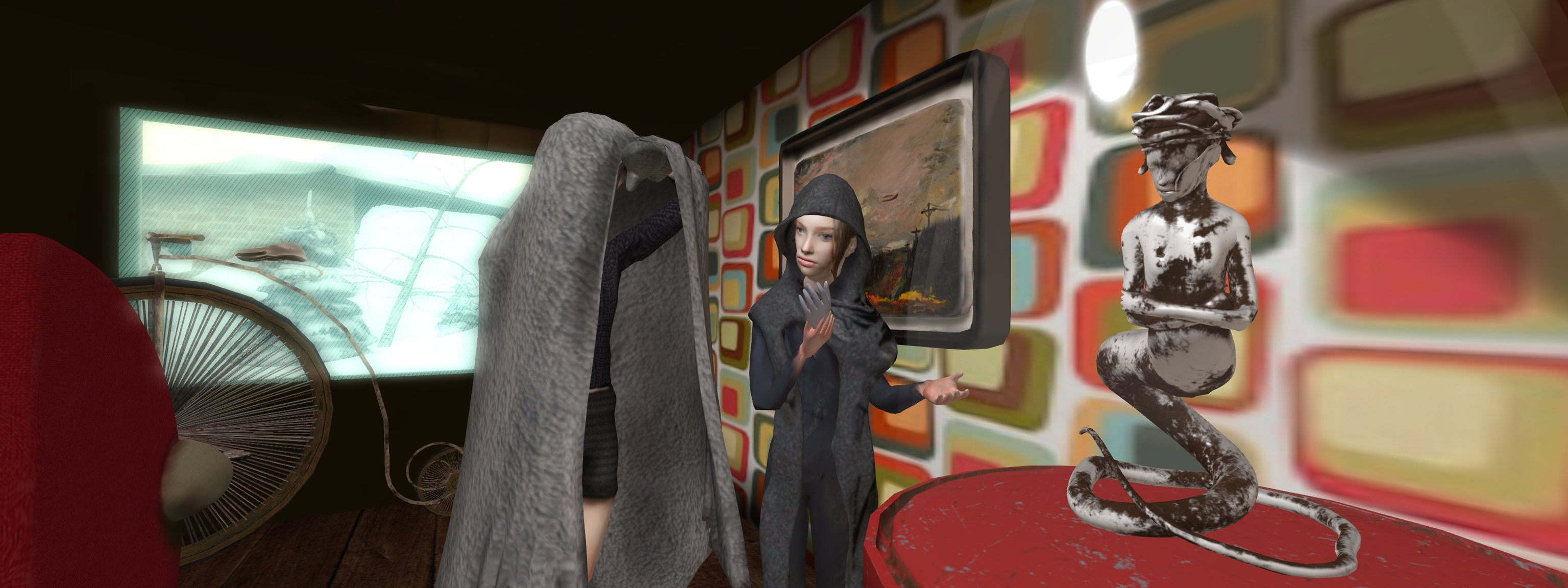
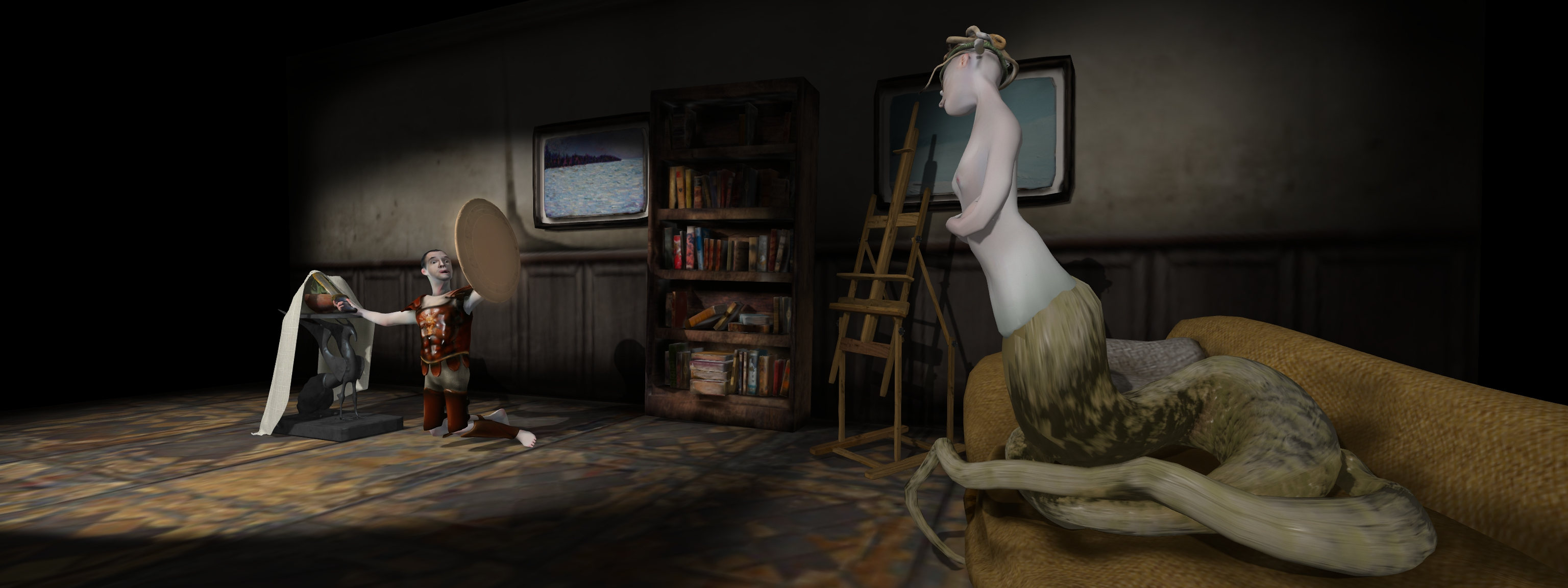
Here you need to keep an eye on the butterfly icon / listen for the tones so you witness the unfolding story – and be sure to touch the green button when you get to the Medusa, to follow a story-within-the story (and click the black balls before the glowing doors to progress on through this story, which on its conclusion will return you to the snowbound suburbs, allowing you to continue your journey through the story.

I do not wish to give too much of the story away here to avoid spoiling it as it unfolds through its sixteen scenes, so that you might follow and experience it for yourself. What I will say is, that as The Brittle Epoch is bringing Bryn’s larger, decade-spanning story to its conclusion, so too does it reacquaint us with a number of Bryn’s characters from previous works, including Lady Carmagnolle, Rabbicorn and the Daughter of Gears, and others, There is also a lot that might be extracted in terms of familiar mythologies and tales, and enough discrete elements that can also engage our own imaginations, allowing us to add our own twists to the story – a habit I’ve tended to have with several of Bryn’s installations!

Bryn Oh: The Brittle Epoch

The concluding part of the story will be unveiled in due course. However, in the meantime, I would note that Bryn’s work – in particular The Singularity of Kumiko, Hand, and The Brittle Epoch, form part of a course being taught by Carolyn Steele of York University, Toronto, and I hope to cover more of this in the near future with both Dr. Steele and Bryn.

SLurl and Additional Links

As noted, Bryn’s installations all take place within the same over-arching universe, and thus share degrees of connectedness. As such, for those possibly unfamiliar with her work, or who wish to re-acquaint themselves with her themes and idea, I recommend the following resources:

Artistic Sensuality in Second Life

Art Korner: Izabela Navarathna – Sensuality

Update, June 27th, 2022: Art Korner has Closed.

Words have a habit of evolving over time. Take “sensuality” as an example. Within the English language, it has its roots in the 14th Century Old French sensualite (“the five senses”), which in turn lies rooted in the Late Latin Sensualitatem (nominative sensualitas) “capacity for sensation,” or  “endowed with feeling.” As used in the 14th Century, the term was oft used as a sign of “spirituality”, describing the ability to sense or perceive the meaning of Holy Scripture. Two hundred years later, however, “sensuality” was largely frowned upon by the religious, who saw it as a direct reference to our baser animal instincts and lusts of the flesh.

Today, we tend to use the word to express the the idea of enjoyment of the innocently pleasurable to give it an edge of “naughtiness” (“the sensually smooth dark chocolate”; ” the rich, sensual aroma from the blend of oils…”, etc.), as well as in reference to the lascivious and suggestive – particularly in reference to the female form. The latter use is perhaps most noticeable within the world of photography and advertising, where images – generally in monochrome – are used to encourage desire without actually being in sexually explicit it is the suggestion of want might happen or might just have happened, that is used to taunt our senses and emotions.

All of which forms a lengthy introduction to a collection of 32 images by Second Life photographer Izabela Navarathna entitled Sensuality, which is currently open through until November 15th, 2021 at Frank Atisso’s Art Korner Gallery.

Art Korner: Izabela Navarathna – Sensuality

This is a veritable tour de force of photographic depictions of sensuality that at first appears to be lifted from that monochrome world of suggestive advertising – but which is actually far more, offering as it does multiple takes on the idea of sensuality. And whilst the the use of monochrome might suggest an intent to emulate such advertising images, it is actually because since her entered the world of Second Life photography, Izabela has specialised in black-and white avatar studies, believing – and I would agree with her – that they convey a greater depth of emotional content.

Within them, we can find the full range of interpretations of sensuality from the clear pleasures of the flesh evoking by touch, closeness and – yes – the suggestion of sexual activity (which carries with it a discomforting frisson as we are cast also into the role of voyeur), through to pieces that might be considers personal takes on the “classical” suggestions of female sensuality, and the use of an image to engage our senses in response, through to a reminder that sensuality can be experienced in multiple ways, some simple others through our need to simply indulge ourselves, with many (if not all) of the pieces containing a subtle twist or layering of meaning.

The clearest examples of sensuality as experienced through physical pleasures are those featuring both man and woman together. But then there are images such as Wings, Hand in Hand and Back all of which present suggestions of sensual, sexual bondage – the placement of hands and arms behind back, the collar around the neck, together with an innocent twist through their titles. Elsewhere, Cherry, presents a classical image of the sensual / sexual: a ripe fruit caressed by pouting lips as they hold it almost teasingly; whilst the use of nude and semi-nude images present the that subtle projection of sexuality, the desire to be able to touch without tipping into raw nudity: it is the suggestion, rather than the exposure, giving them a sensual twist.

And then there are the likes of I Wait To See You Smiling, My Body Is My Temple, and Rose, all of which offer their own takes of the use of a partially-shadowed face, camera angle and / or single item – a hat, the cigarette, a rose, to evoke a system of sensual mystery and desire.

In this respect, I could wax on about individual images, but these are pieces that deserve to be witnessed first-hand and their richness experienced, they are a genuine and skilled demonstration of the art of photography, the ability to evoke an idea and / or sensation merged with a narrative skill that is utterly superb; Izabella has a unique ability to visually encourage the imagination in one direction, then pull the emotions in another, just be her consideration of the title she gives a piece.

Just take La Llorona (which, of all the pieces in the collection, for me is the most utterly captivating). Within it there are all the familiar suggestions of sensuality: the woman in the bath; pouted lips, lowered eyes, the symbolic cigarette held between languid fingers, the presence of the decanter indicating a rich liqueur / liquor awaiting consumption. All speak to sensuality (and a hint of sexuality).  But then take the title of the piece into consideration, and the emotional narrative is utterly transformed, and with it our perception of what each element in the image is actually saying.

Art Korner: Izabela Navarathna – Sensuality

Most of all, however, is the manner in which this collection offers a stunning demonstration of Izabella’s skills as a photographer, storyteller, and sensualist (in the most positive sense of the word) through her choice of pose, camera angle and lighting, followed by cropping and finish. to produce imaginative images that weave subtle narratives through perfectly framed images.

A truly engaging exhibition, offering much to appreciate and admire.

SLURL DETAILS

Dido’s Minimal art in Second Life

Nitroglobus Roof Gallery: Dido Haas – Minimal

Dido Haas has slipped back into the smaller exhibition hall of her Nitroglobus Roof Gallery – a place I’ve taken to calling “Dido’s Space”, as it was used to be reserved for her personal art selections prior to her offering it as a space other artists might use. On display is a selection of eight images Dido is exhibiting under the title of Minimal.

All of the images are, as Dido notes herself, a step away from her usual style of work on a number of levels. Noted for her elegant, posed avatar studies and art that offers a clear narrative or sentiment to entice the audience into it, Dido’s work also tends to carry with it a delicate hand with post-processing to offer works that are richly finished in terms of their photogenic depth.

With this selection, however, Dido present pieces that are lighter in the touch of post-processing (if used at all) that is minimal in its finish, thus giving us the first reflection of the exhibition’s title. Further reflections of the theme are found in the way each piece is minimal in terms of its setting and framing, together with the fact that the props, etc. used by Dido all come by way of the Minimal in-world brand. Finally, there is the placement of Dido’s avatar; for those of us familiar with her exceptional still life and avatar studies, the majority of the pieces within Minimal reduce her avatar’s presence to a minimum, encouraging use to consider the scene as a whole.

Nitroglobus Roof Gallery: Dido Haas – Minimal

And this is where the final take on the idea of the “minimal” theme can be found: each and every piece is of such a nominal nature that, a Dido herself states:

The images … depict several scenes which make you wonder ‘what is happening there’? Use your imagination and make up your own story. 

In other words, these are pieces framed without overt commentary by the artists (other than the title), leaving the audience totally free to consider each piece, thus making them pictures that should be viewed as much by our imaginations as they should be by the eye of arts appreciation.

Take Telephone Booth for example – what brought the woman to the public telephone? Is it an innocent chain of events – such as being in a remote coastal area where cell ‘phone coverage is poor; or is due to more clandestine reasons – such as trying to avoid any record of the call appearing on her ‘phones records? Is her call to a loved one or is there something more to the call? Indeed, is she even making a call – or was it chance that she was passing when the ‘phone oddly rang; or is she even interested in it at all? It sits on the hook, and her attitude suggests she has no interest in it. Is the booth a means of escape, a place to hide  – and if so, from whom or what?  So many potentials for what may have happened  – or what may follow, as each image need not be the end of its narrative, but the beginning or even the middle.

Nitroglobus Roof Gallery: Dido Haas – Minimal

Intriguing and cosy in size, Minimal is an engaging experiment by Dido, one that exposes a different side to her work, one I certainly hope to see more of.

SLURL DETAILS

Mareea’s pastels at Konect Art in Second Life

Konect Art Gallery: Mareena Farrasco

Until I remembered the invite sitting in my inventory, I hadn’t realised it’s been over a year since my last write-up on art exhibitions at Konect Art Gallery, operated and curated by Gonzalo Osuna (Jon Rain). Why this should be the case, I’m not sure – but in that time, the gallery has relocated and downsized a wee bit. Nevertheless, a return visit was most welcome, as was the reason for making it – to see a further exhibition of Mareea Farrasco’s art, which is a couple of weeks into its exhibition time at the Gallery.

Mareea is an exceptional Second Life artist who has a talent for taking the pictures she captures in-world and turning them in elegant digital paintings through a gentle and considered use of post-processing. Her work encompasses portraiture, landscapes, and still life that can represent an image reflecting a moment in time, or offer the suggestion of a large narrative for the observer to create / interpret, and can even touch upon the metaphorical in tone and meaning.

Konect Art Gallery: Mareena Farrasco

Miscellaneous is a selection of 16 images that between them incorporate all of the above, and which also highlight other aspects of Mareea’s work I so appreciate. These include the way in which she can bring a sky to life in a landscape image, for example, to give it depth and mood; her eye for angle and depth of field; her ability to bring forth the subtle richness of colours present within nature without any sense of them being overblown.

Most clearly in this selection is Mareea’s love of pastels to cast a story and / or mood. Within the landscape pieces the soft colours speak to the calmness and beauty of a late summer field or the quiet of an autumn’s evening; meanwhile, her use of greyscale and blue tints provide a sense of winter and of a sea storm angrily reaching the shore. Then there is the use of soft focus / depth of field to draw the eye to a specific aspect of an image, in one place particularly married perfectly with a minimalist view (Bon Voyage) so as to offer an entire story through just a pair of walking boots, a shoulder bag and a hat.

Konect Art Gallery: Mareena Farrasco

Where deeper shades / colours are in evidence,, these again frame stories the mind is free to interpret, and metaphors of expression that can hold our attention, the colours offering a richness of expression without overwhelming the eye.

Poised, captivating and suitable for gracing any SL home, Miscellaneous is a rich sampling of art is an engaging exhibition that should be running for at least (I believe) the next couple of weeks.

SLurl Details