Kimmy LittleBoots is a highly regarded second Life photographer whose work graces many Flickr groups – and is often selected as a banner image for those groups. Specialising in avatar studies, she works in both colour and black-and-white, covering a broad spectrum of moods and settings, from the seemingly every day through to the sensual, to emotive self-studies.
Throughout February 2018, a small sampling of Kimmy’s work can be viewed at Artful Expressions gallery, curated by Sorcha Tyles. Simply entitled An Exhibition in Black and White, it features seven studies, each one of which embodies a specific feeling or condition in a beautifully evocative manner – a mouseover or right-click for Edit will reveal the title of each.
Each of the pieces on display is worth an essay in its own right; there is a richness of expression and depth of sentiment in each which is captivating. So much so that I found myself repeatedly drawn back to each image time and again, repeatedly drawn into its story.
In this, the use of black and white photographs is a masterful stroke. Being monochrome, the images are from the outset more easily seen as a whole statement. Yes, we are obviously drawn to the central figure in each, but as there are no strong colours either in the background or off to one side or the other, so we are not distracted into focusing on them. Instead, we are encouraged to see each picture as a whole, to appreciate the balance between figure and setting more evenly, taking in everything as a single expression of mood, thought, or condition. Thus, each image is brought to life far more effectively than had each been rendered in colour, drawing us ever more deeply into each one.
Exhibition in Black and White really does speaks for itself, although I’d perhaps suggest a title plaque for each would be of benefit, given how closely image and title are linked. For those with an interest in avatar studies and SL photography, it is an exhibition not to be missed, and I strongly encourage a visit to Artful Expressions to witness it. And while there, do take time to explore the gallery’s garden, which now features a cosy little beach side café offering a quiet corner in which to relax.
DiXmiX Gallery, curated by Dixmix Source, currently featured three exhibitions of art respectively by Titus Palmira, Gaus (Cicciuzzo Gausman) and Burk Bode. While all three are entirely individual in nature, two of them might also be seen as overlapping a little, if not in theme, then in broad approach.
The longest running of the three – and potentially due to end soon – is Dark Underbelly by Titus Palmira. Occupying the upper White Gallery level, it presents some twelve self-studies designed to convey very focused feelings, as indicated by their respective titles. As might be suspected from the exhibition’s title, some of these feelings sway towards the darker side of our personality: self disapproval, inner demons, anger, with confusion and uncertainty sitting more to the edge of such darker emotions. Others within the selected images express something of the darker side of life – voyeurism, staking and hiding behind masks.
Most of the images are presented in monochrome; this makes the conveyance of their emotion more effective than had they been in colour. Conversely,where colour is present, our emotional response is also deepened by the strong contrast the colour presents to the surrounding monochrome images. So with Ugly On The Inside, for example, there is a sense of recoiling away from the image, a reaction which may not have been felt were it one among many colour images or, conversely, presented in monochrome alongside the rest. Similarly, the use of colour in Confusion (a Default State), evokes a greater sense of identification with a confused state of mind.
Humour also pays a part here as well – as seen in Before My Morning Coffee. But the truth is that all of the twelve images are so perfectly framed and presented, each one carries more than a spark of identification for the observer; I’ve little doubt anyone looking upon many of these images will fail to feel a tingling of subjective recognition, and inner nod of, “Yes, I’ve felt this…” Whilst elsewhere, we can objectively appreciate the mood and feeling each image expresses. For me, both subject response and objective appreciation come together in Don’t Tell Me the Moon is Shining (above) – a fabulous piece evoking something we have perhaps all felt: that moment of calm before our anger explodes in a destructive burst of temper.
We’re all likely familiar with the expression “the eyes are the windows of the soul”. Where it originates from is unimportant, but it perhaps has its roots in an observation by Marcus Tullius Cicero, Imago animi Vultus est, indices oculi eius intentio (literally, “the countenance (face) is the portrait of the soul, and the eyes mark its intentions”) – and it is this more rounded expression which I would suggest applies to the second of the exhibitions reviewed here: Le regard de l’âme (literally, “the soul’s gaze”), by Gaus, and displayed in the ground floor Black Gallery.
On the one hand – and most simply – the faces of our avatars are their most expressive element – just as our faces are in the physical world. Through the care we put into crafting them, shaping mouth, chin, nose, ears, and eyes, we imbue our avatars with an identity – perhaps the closest things they have to a “soul”. Thus, on the one hand, Le regard de l’âme offers an opportunity to reflect upon the sixteen head-and-shoulder portraits presented within it, and what they say about the avatars presented.
But I would also argue that there is something deeper here. The very care we put into crafting our avatars, and particularly their faces, become reflective of who we, the people behind them, are. This may be wholly conscious: a desire to give our avatar a look mirroring our own, or to express an aspect of our personality; but even when creating visually divorced from who we are, making it a representation of who we would like to be, still reflects some of who we in fact are. Thus, the faces of our avatars become something deeper: a portrait of ourselves; and it is this essence of self which is perhaps captured within this images.
With Shameless, presented across the ground floor and mezzanine levels of the Grey Gallery, Burk Bode offers an exhibition of black-and-white images which steps well clear of the ideas of identity present within Dark Underbelly and Le regard de l’âme. Instead, he offers a series of images best noted as being NSFW, given their depiction of sexual acts.
This is a very in-your-face exhibition (literally, given it occupies the gallery space adjacent to the main entrance) in which the observer is clearly cast into the role of voyeur. Indeed, given the subtitle of the exhibition, They are watching us, there is a suggestion that our very presence may have triggered at least some of the acts portrayed; in others, the lean is perhaps more towards exhibitionism and the thrill / risk of performing sexual acts in public.
Sex is at best a difficult topic for discussions, as reactions to it tend to be far more subjective and perhaps shaped by preconceptions. As such, I’ll leave it to readers to visit Shameless to form their own impressions.
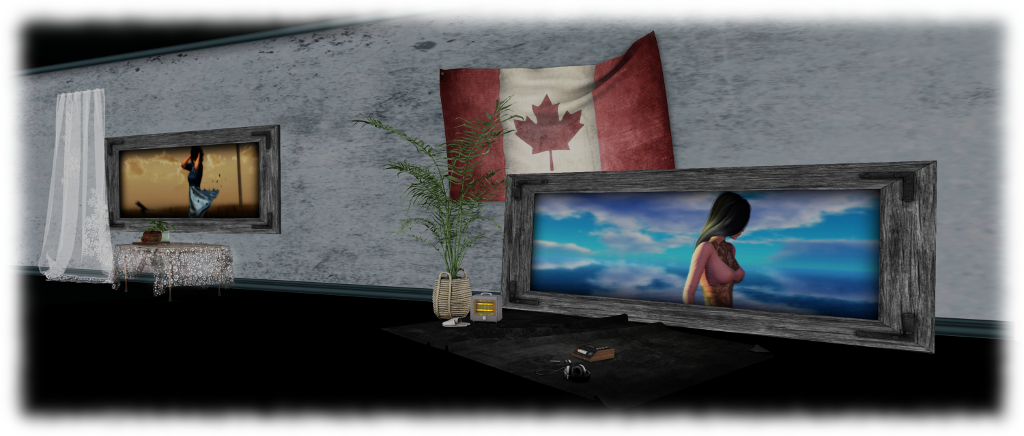
Now available on the ground level at Club LA and Gallery, curated by Fuyuko ‘冬子’ Amano (Wintergeist), are two small exhibitions of art and photography available for public appreciation, and which together demonstrate the broad canvas of art in Second Life. To one side of this boutique-style gallery with its own garden space behind it, is an exhibition of Second Life photography by Liz Winterstorm (TinLiz); on the other are reproductions of physical world art by Vangogh Rembranch.
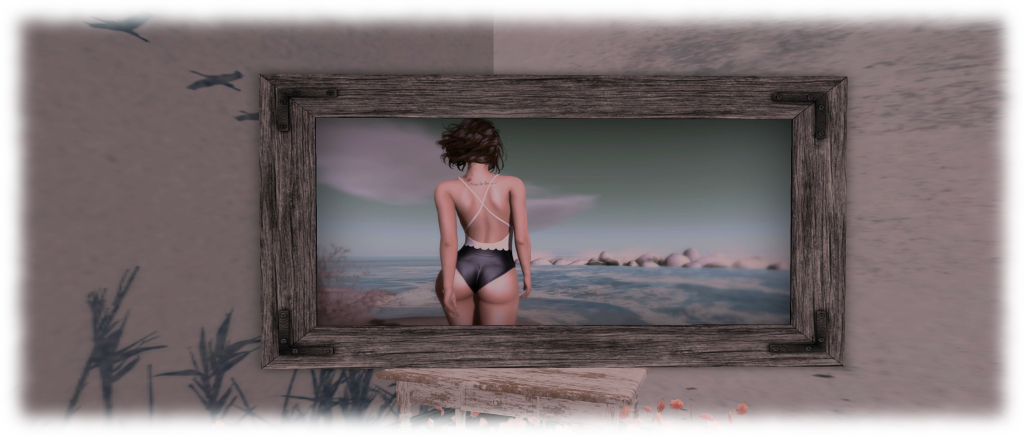
Officially opening at 12:00 noon on Saturday, February 3rd 2018, the exhibition by Liz Winterstorm presents six avatar studies taken from around Second Life. Set within a display area modelled to enhance the pieces with props, this is something of an autobiographical exhibition, with Liz noting that (like many) when she came into SL, she went through the usual round of shopping, spending time with friends, trying new looks, having fun, but without any real sense of purpose to her in-world time. At least until she discovered photography.
As her creativity evolved and her confidence grew, so did her connection with her avatar. “She depicts a part of me that I’ve never really shown anyone,” Liz notes. “In the world of Second Life, when a person can be anyone they want to be, it’s given me the freedom to be the truest form of myself. And I’m very thankful to have this creative outlet, it’s made me look at myself differently and with that has come knowledge and strength. ”
And so it is that while small in number, the images she offers at Club LA and Gallery offer a rich insight into a person who embraces her creativity and who enjoys natural settings, finding them to be perhaps reflective of her moods and thoughts. Each brings together colour, tone, framing, perspective and proportion both naturally and perfectly; which in each there is a suggestion of someone who, while not lonely or afraid of company, enjoys the freedom of being on her own, and the opportunities for private expression it brings. Similarly, the props offered in the exhibition space reflects more of Liz’s creativity; framing the pieces at they do, they heighten appreciation of the images by suggesting not so much viewing photographs, but that we are new friends, invited to share a few quiet and personal moments with Liz.
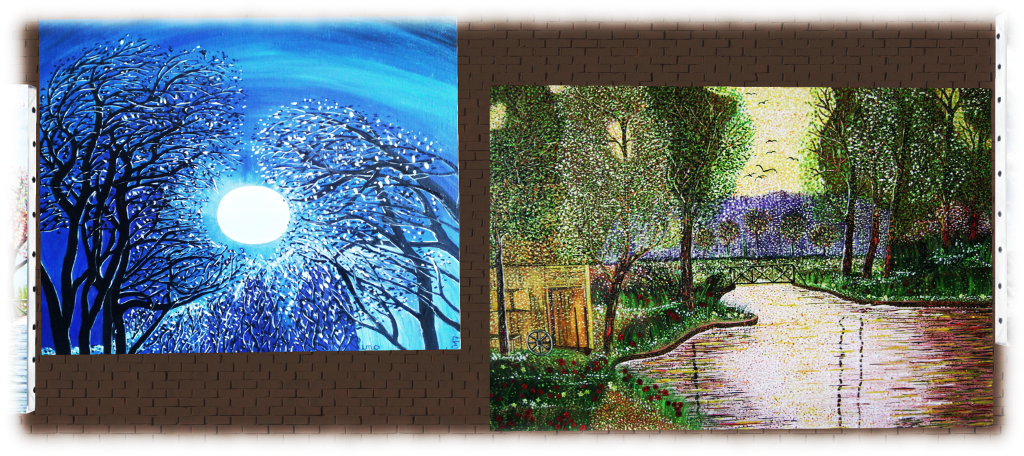
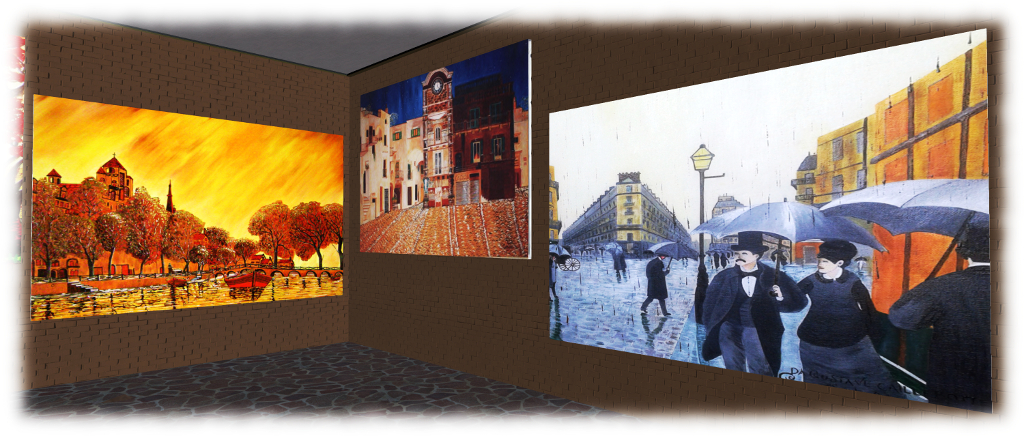
Italian artist Vangogh Rembranch, by contrast, presents nine reproductions of his physical world art, the majority of which are presented in strong, bold colours, and within an open display area bereft of furnishings or set design which serves to emphasise their boldness. Self-taught, and as his name might suggest, Vangogh is strongly influenced by the art of Vincent Van Gogh, and this is marvellously reflected in the pieces exhibited at Club LA and Gallery. He is also known for his skill in reproducing works by some of the great Impressionists.
Eight of the painting presented here appear to be originals by Vangogh, representing – I believe – scenes from around the Apulia (Puglia) region of Italy – which many might know as being popularly referred to as the “heel” of Italy’s boot. These are all strikingly evocative of Vincent Van Gogh’s art without being derivative. The use of colour, the style and composition all echo Van Gogh, while the subject matter is unique and individual. Among these is one in particular that caught my eye: Vento di luna (“Moon Wind”); with its cold blue tones, to the sky, the white dots of leaves and the shape of the trees are all reminiscent of The Starry Night.
The last image in the series demonstrates Vangogh’s ability to reproduce the work of Impressionist painters. It is a representation of Rue de Paris, Temps de Pluie (“Paris Street; Rainy Day”) by Gustave Caillebotte. Originally painted in oil in 1877, it is Caillebotte’s most famous work, and Vangogh reproduces it here in detail; but again, rather than being a direct copy, Vangogh offers something of an interpretive approach to his version, which he calls Giorno di Pioggia a Parigi (“Rainy Day in Paris”).
Together these two exhibits offer and interesting pairing. One, as noted, presents in-world photography and the other, physical world painting uploaded to Second Life. They are both strongly contrasting in art, presentation and style, whilst also being complementary – one naturally draws visitor to the other, and encourages consideration of both.
Now open at Nitroglobus Roof Gallery, curated by Dido Haas, is Fading, a selection of art by Cold Frog. Cold is a long-time Second Life artist, but time and health is placing limits on her ability to produce new pieces. So, as Dido notes in her introduction to the exhibition, Fading is something of a retrospective of Cold’s past work, rather than being an introduction of new pieces. The title also perhaps stands as reflection of Cold’s situation, as Dido also notes: Cold is sadly finding her own sight is fading.
There is a strong sense of melancholy about many of the pieces offered in this exhibition, again perhaps in keeping with the title, although the subject of death has often been evident in her work, as has suicide; both either directly or through intimation – the splash of blood here, a skull there or perhaps a repose or reference in a title.
This might cause some to think of Fading as a dark and dour exhibit, but I would argue the reverse. Yes – again as Dido notes – death and suicide are serious subjects, but there is a depth and sensitivity layered within Cold’s pieces that draws one into them. There is also, in some, a little sense of playfulness, as if she is quietly saying, “OK, let’s not get too heavy with this. We’re still alive.”
This more light-hearted aspect can, for example, be seen in Sending a Tweet from My Grave, a piece both rich in its imagery, particularly in Cold’s hair, and playing on the idea of tweeting. There is also a certain darkness to the piece; a question, perhaps of how will we be remembered – by others after our passing. Will we have a place in their thoughts, or will memory be fleeting, a flash of remembrance equivalent to a 280-character line of text. Across from it, 40 Days of Isolation is again rich in meaning, and may well reveal itself to different people in different ways; however, to me there is a subtext on the subjects of loneliness, depression and conditions which might lead to suicide.
For me, the most poignant of the images displayed at Nitroglobus appear to be somewhat self-referential: Losing Parts (seen above centre, alongside 40 Days of Isolation), Even Lost My Shadow and the titular Fading (seen directly above). All three seem to point towards Cold’s own circumstances, and while they might be regarded as melancholic, all three are beautifully rendered, allowing them to stand apart of any deeper or more personal meaning. I admit to being particularly drawn to Fading and Even lost My Shadow, while the way both are partially faded speaks to Cold’s situation, so to does the approach present a pair of hauntingly beautiful pieces, their beauty heightened by the muted tones.
Nuanced, rich in detail, presenting several approaches to art and photography, Fading is another exhibition featuring work by a gifted SL artist and which further demonstrates why Nitroglobus is one of the leading galleries in Second Life, and Dido one of the most gifted curators of fine art in SL.
Chic Aeon has re-opened her Machinima Open Studio Project (MOSP) for machinima makers and photographers. First seen in 2012, MOSP has been through a number of iterations – as my past posts on the project will hopefully show. Offering indoor and outdoor film sets, studio facilities for filming shows and the like.
In this latest iteration, which is still under development, MOSP opened its doors in mid-January, offering – as a start – a ground-level location, based on her installation A Steamy Mystery at Terradale, with some additional element, and a city setting up in the sky, someone reminiscent of the original city setting from MOSP’s original iteration.
It is at this latter location that people first arrive. This offers outdoor night setting with a parking lot, façades for tower blocks, backed by surrounding backdrops of city high-rises seen against a misty night sky; so using the local windlight or setting your viewer to a cloud night setting is recommended for a visit, although with careful filming, daylight settings should work on the space as well.
The landing point faces a resource centre, which includes teleports to other set locations (again, only the ground level being open at the time of my visit although others provide hints as to what is coming). not far from this is a series of small stage sets, one of which is outfitted as a photography studio with backgrounds and green screen as well as pose balls. There is also a classroom / meeting area. Further afield, but still within the surrounding high-rises are further lots, apparently awaiting building-out. With cars parked around the lot, the building shells and the entrance to a subway station, the setting offers a fairly simple location for filming, which I assume will be added to over time.
“This all new build offers full sim-sized environments for ease of shooting and continuity,” Chic says of the facility. “There is flow. There are surprises and plenty of details. Builds have been optimized for LOD2 to ease the drain on computer systems and let those with mid-level machines still turn on shadows or depth of field when needed.”
For those needing an outdoor small-town style of location for filming, the ground level “Terradale” set might fit the bill. “Obvious steampunk references have disappeared,” Chic states, “and many new buildings have been added. Structures are clustered for better filming and photography and ‘clutter’ has been added to private areas for a more realistic feel.” There is also an information centre inside one of the buildings, again offering teleports between the different stage / set levels.
Chic also notes, “While the infrastructure and many of the furnishings and props have been made by myself, the work of other content creators is also featured. Artist buildings are noted with name plaques; gacha collections with buildings have markers. If in doubt, right-click and inspect to note who to thank for bringing this sim to life.”
In previous designs, MOSP gradually developed a wide range of film sets and opportunities, from rural to city through outdoor settings to sci-fi, so it will be interesting to see how this iteration is developed and what additional resources are provided. In the meantime, the current facilities are open for people to use, and specific enquiries or questions should be directed to Chic Aeon.
Bryn Oh is currently working on a new immersive installation to succeed Hand, which closed in late 2017, and about which you can read more here. While the new installation is under development, she has opened two single-scene poems, Lady Carmagnolle and 26 Tines, both of which can be found on Bryn’s home region of Immersiva.
“A carmagnolle is one of the very earliest full metal diving suits,” Bryn says in explaining the first of these scene poems. “Monstrosities of protection that allowed people to explore the depths.” In fact, it was the first properly anthropomorphic design for an atmospheric diving suit (ADS), designed in 1882 by the Carmagnolle brothers. It features a distinctive metal helmet with multiple small glass ports to provide a view outside for the wearer.
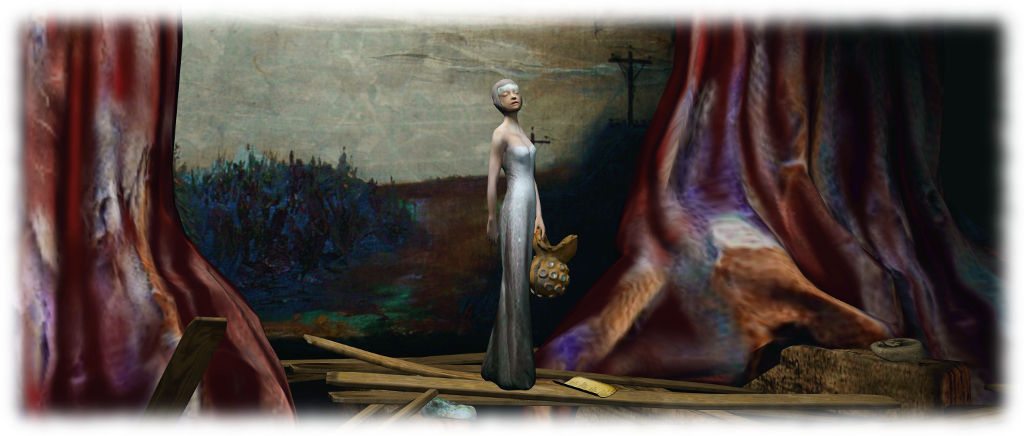
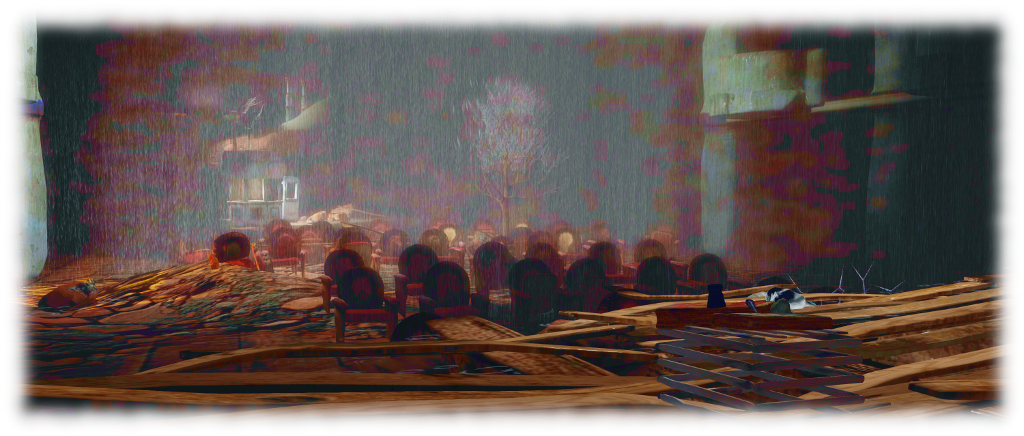
In Lady Carmagnolle, the titular lady of the piece stands alone on a deserted stage in a broken-down theatre, the helmet of the carmagnolle suit in one hand, a rock in the other, a face drawn upon it. “She imagines the rocks to be injured birds who she cares for,” Bryn states, “When it rains the ink washes away leaving a simple stone. When Lady Carmagnolle looks to find these rocks and instead finds them gone, she wistfully imagines that they have grown back their wings and returned to the sky, finding others to fly with. In her loneliness this is her most beautiful dream.”
It’s a sad tale, accompanied by a sad poem and sent within the haunting setting of the tumble-down theatre, where the rain falls as Lady Carmagnolle’s only audience.
26 Tines, on the other hand, is something of a love story, again accompanied by a poem. “The laboratory is silent, the scientists gone, we have seven hours, before the dawn,” so reads the first stanza of the poem. It directly refers to the emotional bond between two robots within a research facility, a bond where – even were they both human – words would be inadequate to express their feelings.
So instead, when the working day has come to an end, and the humans have left this secretive, underground bunker of a laboratory, the maintenance robot pauses in its tasks of cleaning up. Instead, it sits down with its tiny kindred, and the two connect via cable. In this way, they bypass clumsy language and exchange their feelings and emotions directly one to another via the 26 tines of wire contained within the cable connecting them.
Thus it is, the two robots pass the time until morning comes and the daily routine intrudes, scientists returning to their lair to resume their work. Separated, the robots are left with the intimate memories of dancing together through the nights, the sublime delight of sharing their time, their feelings, so intimately for seven short hours each day – and the knowledge that in the night to come, they can be together once more.
Like Lady Carmagnolle, Bryn’s 26 Tines is haunting in theme, but with a slightly dark, science fiction turn. Both are easy to visit, but offer layered meaning and a richness of pathos, loneliness and devotion.






 Inara Pey: Living in a Modemworld