Nativo in Second Life

DaphneArts: Nativo

Nativo, featuring the art, words and voice of Italian physical world artist Stefano Mingione, and which has been open for that last month at DaphneArts, is the latest in a series of installations presenting a broad canvas of artistic expression which can combine multiple approaches into a single installation / expression of ideas which are intended to be viewed as a whole, rather than just as individual elements, be they drawing, sculptures or poems.

An artist working in a range of media – drawings, paintings, sculptures, digital media, written word – Mingione tends to identify himself more thematically, through his focus on the dualities present in life. Birth and death, happiness and despair, hope and fear, youth and age; and this is very much in evident in Nativo.

DaphneArts: Nativo

The exhibition space is split into two parts – although together they form a whole. The main exhibition area, where  visitors first arrive, forms a cylindrical hall in which eleven draws are displayed. Some appear to have religious connotations, offered through titles such as Santissima Trinità (Holy Trinity) or La Caduta dell’Angelo (The Fall of An Angel), or through their subject matter – as with  Padre Perché Io Disegno (Father Because I Draw).

However, religious overtones – entirely in keeping with the idea of duality in life, expressing both the earthly and spiritual – are only part of what these images have to offer.  Collectively, they provide an expression of thinking about left, death and all that lies between in a manner – to my eye at least – not that far removed from the art of Hieronymus Bosch, another artist who pondered (agonised over?) dualities through his work (and even through his patronage).

DaphneArts: Nativo

A single walkway extends back from this cylindrical room. It offers a way to where a grand sculpture of an old man, curled foetal-like, hangs in the air. It is a further embodiment of the theme of duality: the aged man appearing foetus-like in the darkness. Positioned before the sculpture is a chair and “play” symbol. Visitors are encouraged to sit in former and click on the latter – which will allow them to hear three of Mingione’s poems – Amico, Nativo and Vecchio – narrated by the artist himself in Italian, and presented with both text subtitles and a series of sculptures representing each one. These are very much the heart of the exhibit, richly evocative, and deserve special consideration which may require each to be listened to and watch more than once.

Interpretation of Nativo is deeply subjective. I found it by turns fascinating and also a little pretentious – and ultimately captivating.

SLurl Detail

DaphneArts (Isle of Seduction, rated: Adult)

Melusina’s minimalism in Second Life

DiXmiX Gallery: Melusina Parkin

Less is More is the title of an exhibition of Second Life photography by Melusina Parkin, featured at the basement Womb exhibition space at DiXmiX Gallery and which opened on February 20th, 2018.

As an aphorism, the phrase is most readily associated with the German-America architect, Ludwig Mies van der Rohe, regarded as one of the pioneers of 20th Century modernist architecture, although he appears to have lifted the expression from Robert Browning’s 1855 poem Andrea del Sarto  (also called The Faultless Painter). Van der Rohe used the term to define a form of architecture with a minimal structural framework that could suggest free-flowing open spaces, and which could explore the relationship between people, shelter, and nature.  Given Melu’s own unique approach to photography which very much encompasses the refined, minimalist use of structure balanced against the idea of natural,open space, the aphorism is an ideal title under which to exhibit some of her work. 

DiXmiX Gallery: Melusina Parkin

In all, 18 photographs are displayed in the Womb’s three halls – you can find it by entering the main DiXmiX gallery and making your way to the Black Gallery, where the entrance to the Womb resides. Primarily rendered in soft tones, all of the pieces perfectly exemplify the idea of minimal structure, both in terms of framing – most of the pictures carry an intentional off-centre focus – and in terms of content – the physical structures within the images are minimally presented against a broader backdrop suggestive of open space, whether offered by open water, cloudy sky or a blank wall. 

Also evident in these images, and in keeping with van der Rohe, is another of the architect’s adopted aphorisms: God is in the details. Yes, the over-arching aim of this type of photography is to present something that carries within in minimal structure and balances that structure against the use of space; however, this is something that just “happens”. It requires a measured eye and a flair for making what is actually a painstaking study of places and environments look so naturally easy.

DiXmiX Gallery: Melusina Parkin

Thus, while they might all look effortless in execution, considered study of each of them reveals the care and thought that went into bringing each of them to life. Even the way they have been paired within the three sets of images: views, interiors and bodies, should be considered; Melusina’s attention to detail is evident through this exhibition.So much so, in fact, that I couldn’t help but wonder if with some of the selected images, she’s not also offering a tip of the hat directly to van der Rohe. Looking at two of the images in Bodies (centre image of this article), I found myself thinking about his Farnsworth House design, and its original occupant, Dr. Edith Farnsworth.

Another excellent exhibition from one of my favourite artists in Second Life.

SLurl Details

The Art Garden Gallery in Second Life

Art Garden Gallery

There are many galleries across Second Life. Some specialise in exhibiting photography and art created within Second Life; others focus on exhibiting the physical world work of artists who have come to Second Life for both social activities and as a means to reach a broader audience for their art. Indeed, such is the number of galleries, that reporting on all of them is a difficult task – but I enjoy hopping around SL looking for the smaller art spaces and discovering the work of artists between new to me and familiar.

One such gallery space, offering ensemble and mixed exhibits is the Art Garden Gallery operated by Fanny FooFoo Miklos (Sloane Cerise) and her partner Thorne Miklos. Located in the sky over the mainland, the gallery is – as its name suggests – presented as a garden environment; in this case a walled garden under a night-time sky.  The landing point is towards the centre of the garden space, with the art displayed on the outer stone walls.

Art Garden Gallery

At the time of my visit, most of the art on display represented physical world pieces by a broad range of artists, including Kaly Iali, Persia Silverblade, Toysoldier Thor, SaraMarie Paul, Shmoo Snook, JudiLynn India, Asmita Duranjaya, Dulcis Taurig, to name a handful. Given such a broad cross-section of artists, it should come as no surprise the art itself was broad in terms of content, style and approach. Some offered studies of flowers, others present landscapes or representations of landscapes, and others are far more abstract in nature. Thus, the gallery offers an eclectic and attractive mix of art for the visitor’s enjoyment.

If I have a complaint at all, is the lack of artist information outside of plaques bearing the name of each piece and the artist’s name. Given that there are so many artists in Second Life, and the ease with which information givers can be set-up, it would be nice to see settings like this do a little more to help inform visitors about the artists behind the works on display; doing so can add further depth to an exhibition.

Art Garden Gallery

At the western end of the gallery space is the Miklos Centre, a smaller space for what appears to be more themed art displays. Again, at the time of my visit, this smaller, enclosed area was home to a display of art and poetry entitled Telephone Walkers. On offer are seven pieces of art and seven poems on the subject of telephone poles. Four of the pictures were produced within Second Life, with the remaining three – by photographer Nils Urqhart and artist David E. Weiner – are of physical world locations. All feature telephone pole – or overhead power lines – either as something of a focal point – as with Ziki Questi’s Bonne Chance 3 and Furillen 1, in orders they are part of the overall image framing, as with In Every Life by Wintergeist and Old Stone Wall by Nordica Torok, while for the rest the poles are almost incidental.

The poems offer a broad range of perspectives on telephone poles,  and combined with the seven images – the numbers are more for balance than any attempt at pairing of specific images with poems – poems and pictures back for a very effective exhibition. I admit to finding Telephone Walkers more engaging than the main gallery space exhibition, partly because it is more contained and focused (and includes work by artists I greatly admire), but also because the poetry draws the visitor into each of the pieces, offering each multiple narratives to be enjoyed.

Art Garden Gallery – Telephone Walkers

I’m not certain how frequently exhibitions change at the rt Garden Gallery, but for those who enjoy visits to smaller, more boutique style galleries which can offer ensemble exhibitions, I recommend a visit.

SLurl Details

From the Worlds to the World in Second Life

From Worlds to the World – Giovanna Cerise

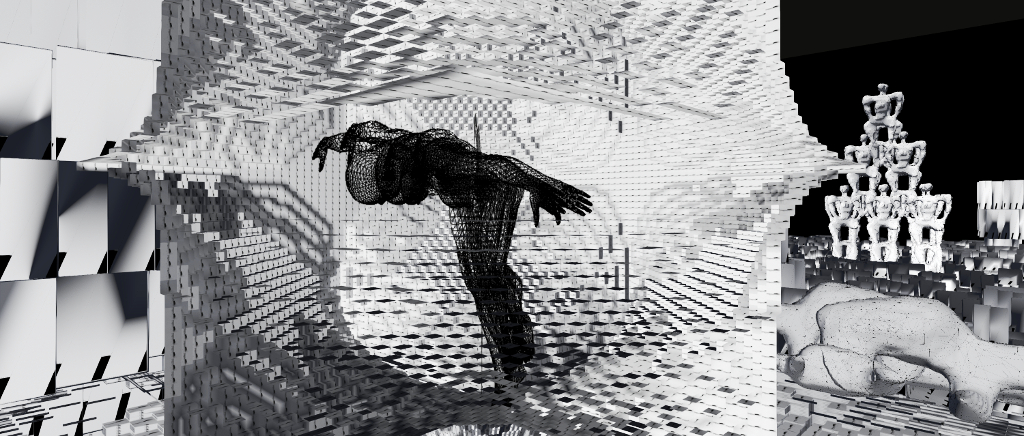
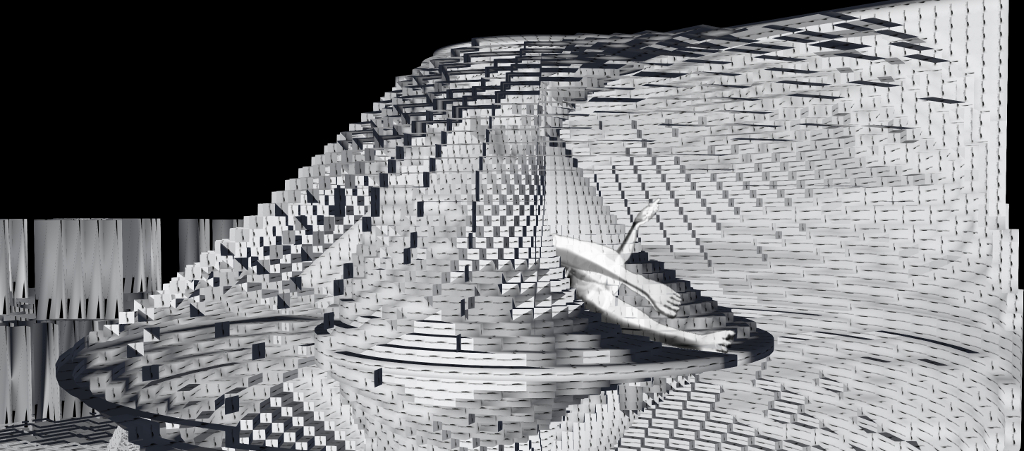
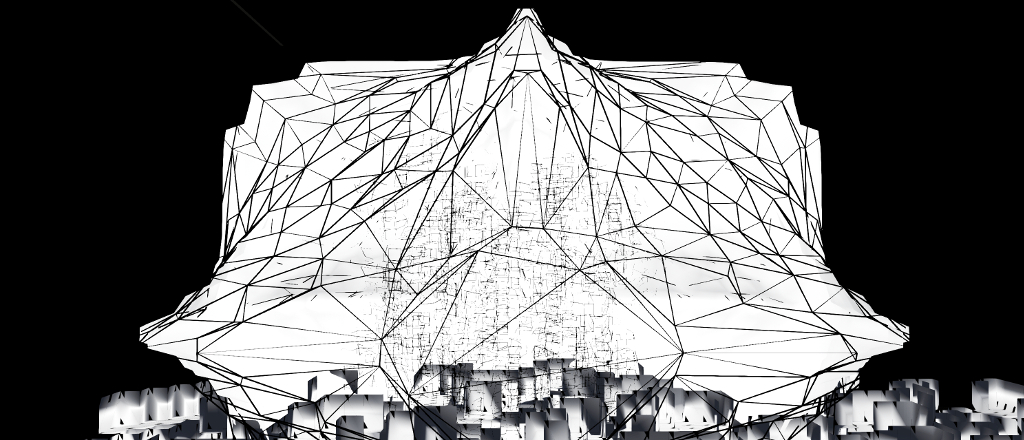
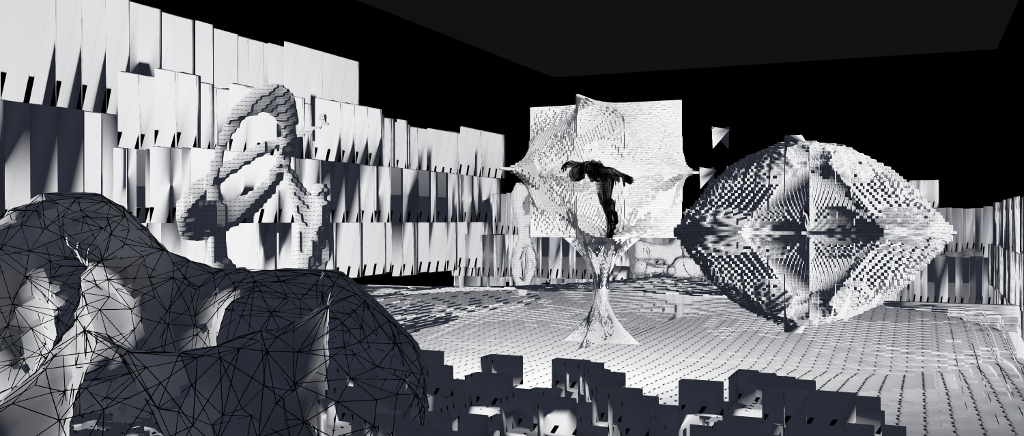
From the Worlds to the World is a new installation by Giovanna Cerise at the R&D Gallery, Diotima, in Second Life. Occupying the entire gallery space, this is a complex installation to unravel, incorporating as it does elements of post-modernism, philosophy, logical progression, nature, geometry – whilst also, perhaps, promoting a discussion on what is the role of past and present in influencing the future.

Produced entirely in black-and-white, this is perhaps a stark piece, but there is a natural symmetry to it. Set against a black surround, the white forms within the installation are made up of geometric elements denoted by fine black lines – geometry being both a basic expression of both nature and intelligence. In all, the installation comprises three parts, perhaps analogous to the concepts of past, present and future, and which represent the evolution of intelligence.

From the Worlds to the World – Giovanna Cerise

“The first part of the installation can be seen as an archetype of nature, now incorporated and reduced to its geometries,” Giovanna states in introducing the work. Given the overall framework of the installation, I’d venture the opinion that in this instance archetype is being used to reference Jungian archetypes – universal, archaic patterns and images from the collective unconscious which form inherited potentials, which are transformed once they enter consciousness and are given particular expression by individuals and their cultures – and the idea that as universal patterns within the collective unconscious, they exist as a kind of primordial suspension, without individual structure and form.

Thus, in this first second of the installation, we are confronted with a chaotic form, uneven, broken, but with its geometry holding the promise of potential, of becoming individually / culturally and collectivity more.

From the Worlds to the World – Giovanna Cerise

From this the installation progresses through and initial shape and patterns in which human forms can be seen – a reference, it would seem to the rise of intelligence and self. A time when we shape and drive the world around us, while being both apart from it (humanity over nature?), yet wholly constrained by it – as evidenced by the shapes rising and folding out of, so to speak, the same geometric forms as seen in the initial part of the installation.

Beyond these lies the future: a place where individually no longer exists per se, and the identical reigns. A point at which intelligence has homogenised, There is no need for bodies nor the baser needs of humanity. Life has again become unified, archetypes woven together through their universality. A time has been reached where individuality or culture are no longer required. Nor is there need for dialectical discussion or reasoning; all that is required is uniformity and experiential growth and perfection of the whole.

From the Worlds to the World – Giovanna Cerise

As a representation discussion of the evolution of intelligence, From the Worlds to the World (“worlds” and “world” perhaps again a reference from separate cultural environments and attitudes to the single, homogeneous “whole”) is – as noted – a complex piece. While it may well point to a time where dialectical discourse is no longer required, it nevertheless encourages it, just as it also promotes more philosophical consideration of our own development and growth. Are we really to rise from the “primordial” homogeneity of initial instinctual intelligence to a point where the potential of the individual (be it person or cultural) is to be only a span of time before we are once again absorbed into a single whole once again, uniform of thought and goal?

These latter elements: the opportunity for considered thought and discussion make  – for those willing to dwell on interpreting the installation – From the Worlds to the World an ideal opportunity for a shared visit.

Je n’aime pas in Second Life

DaphneArt: Je n’aime pas

Je n’aime pas (“I do not like”), is the name of a collaborative art installation by Hern Worsley and Nur Moo which opened on Friday, February 9th, 2018 (with a second opening event planned for Saturday, February 10th, 2018 from 16:00 SLT) at DaphneArts, curated by Angelika Corral and Sheldon B.

Described as a conceptual piece, the installation features a build over three levels by musician, builder and artist Hern, within which a series of images by photographer Nur Moo are displayed. Mur is described as having returned to Second Life in the notes accompanying the installation, and I gather Je n’aime pas is something of a celebration of this fact.

DaphneArt: Je n’aime pas

Visits begin inside a building within the installation, on its lowest level. Before proceeding, make sure to observe the viewing instructions displayed in the dialogue box in the top right corner of your screen. In particular, make sure you have your viewer’s Advanced Lighting Model (ALM) enabled via Preferences > Graphics or you risk missing details. There is art on the walls inside the building – but frankly, I’m not sure if the photography is Nur’s or Hern’s or someone else’s.

A set of white arrows line the floor outside, encouraging people to step out into the larger structure. This exudes a modern approach to architecture: great steel beams, arms pentagonal floor sections, and great glass panels. Some are designed by Hern, some are from other creators he has used in building the installation. Central to this is a huge mesh vase, while from the walls hang panels with animated images.

DaphneArt: Je n’aime pas

At the foot of the vase sculpture sits a teleport on an easel that leads up to the middle level. this is where having ALM becomes particularly important. Without it, none of the images projected onto the flat wall panels, the greeble boards, cubes and floor will not be visible. Two more teleport boards sit on easels in the centre of this floor: one up, one down. Go up, and you become part of the installation yourself, courtesy of a trampoline.

This is a difficult installation to quantify. In some ways it likely to be reflective of its name for some; for others it may well be a curious mystery. Conceptual art  is art in which the idea(s) involved in the work take precedence over any traditional aesthetic. As such, this is an installation that needs to be considered as a whole, and not so much as a sum of its parts. given this, how we consider  Je n’aime pas is down to individual interpretation – and I’ll leave this to you to determine.

SLurl Details

50 cats in Second Life

Cica Ghost: 50 Cats

Cica Ghost opened her new installation 50 Cats early in February 2018. Following on from Bird People, which presented something of a conundrum (see here for more), this is an altogether more light-hearted piece, offering a little tongue-in-cheek fun.

As a strap-line, the installation uses a quote by novelist and short story writer Bobbie Ann Mason, One day I was counting the cats and I absent-mindedly counted myself. It’s from her first published novel from 1982, Shiloh and Other Stories, although beyond the reference to counting cats, this doesn’t appear to have a deeper meaning for the installation – or at least, not one I could fathom.

Cica Ghost: 50 Cats

A visit begins in the south-west corner of a sandy island. Almost entirely devoid of trees, this little island has a ring of houses, tall and thin with pitched roofs, surrounding its lone hill. It is atop the hill, with its wooden fence crown, that the cats can be found. And there really are fifty of them.

They are standing, sitting, lying down, rolling on the ground, chasing butterflies, watching one another, washing – doing all the things cats do. Some look happy, many look a little nervous, some have a look of pathos in their eyes, as if asking to be taken home and shown a little love. None of them show the slightest interest ion the two trees in their garden nor the dustbins occupying a corner, despite the latter oft being associated with stray cats. For human visitors however, a click on the lid of one of the bins might generate interest and raise a chuckle.

Cica Ghost: 50 Cats

In a similar nature to the dustbins, there are a number of “bunny cars” – some of which can be touched for animations as well. These are also fun to play with, and grab the attention. Also to be found on the fence and on some of the buildings are Cica’s little cartoon stick people. And do keep an eye out for the mice; they are as captivating as the cats.

50 Cats is a wonderfully light-hearted build offers fun and smiles. For those who love cats, and wish to respond to the heartfelt looks of wanting to be taken home an loved, each one is available for sale. Just right-click to buy a copy; all can be resized to suit personal needs.


SLurl Details

  • 50 Cats (Pillow Rock, rated: Moderate)