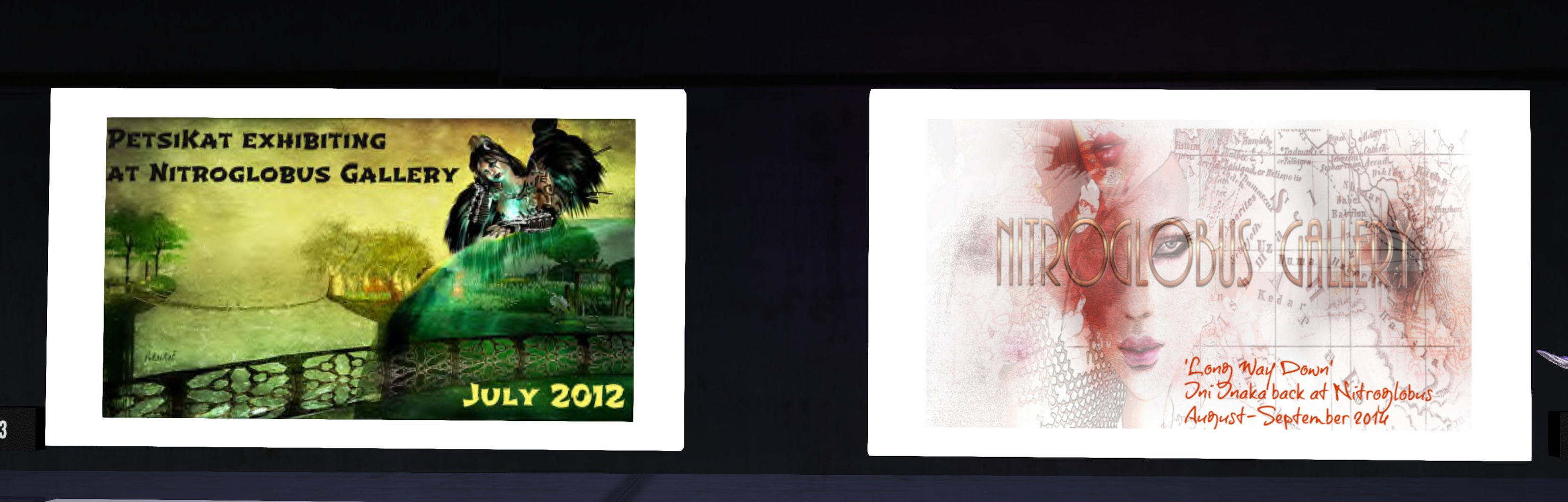
Celebrating a decade of art at Nitroglobus in Second Life

Nitroglobus: celebrating 10 years

In April 2012, Nitro Fireguard and Dido Haas opened the doors of the Nitroglobus art gallery in Second Life. To be sure, it wasn’t the first gallery to open in SL nor would it be the last – but it is one of the most enduring; consistently the home of some of the most remarkable exhibitions of virtual art in Second Life.

From the moment the original Nitroglobus opened, it was clear that Dido and Nitro were prepared to encourage those invited to exhibit to push their personal boundaries. I doubt there has not been a single exhibition within the gallery’s halls with their trademark “reflective floors” (under which the displayed art is “mirrored”) that hasn’t failed to engage and excite. However, the gallery’s life almost came to an abrupt end when Nitro passed away, as Dido notes.

Nitro was a very creative person and when he died in November 2015, I was devastated and didn’t want to continue …
However, friends convinced me to continue and in January 2016 I have the first exhibition at Nitroglobus Hall … A year later I moved to the present building, Nitroglobus Roof Gallery, situated above my SL home.

– Dido Haas

There cannot be many involved in the SL arts community who cannot be grateful that Dido came to this decision. In the years since, Dido has worked hard to ensure that it remains at the forefront of artistic expression within Second Life.

I don’t know how she does it, but Dido has a gift in being able to both continue the gallery’s reputation for encouraging artists to push their personal boundaries and to also encourage those who have never exhibited in Second Life to take the plunge and do so; something that cannot be easy if they are aware of even a tiny portion of the gallery’s stellar history of art exhibits.

Nitroglobus: celebrating 10 years

In this, I confess to being in awe of Dido’s innate ability to encourage and promote talent, and can honestly say that the month exhibitions at Nitroglobus are something I look forward to with great anticipation. I’m also honoured by the fact that over the last several years I have come to know Dido – herself a gifted photographer-artist who doesn’t exhibit her own work nearly enough – personally. And I can say heart-on-heart that she is one of the kindest, warmest, friendliest, caring and warm souls it has been my privilege to get to know through Second Life. I genuinely and deeply admire her for her talent, and cherish her as a friend,

To mark the gallery’s 10th anniversary, Dido is hosting a celebratory party within what I like to call Dido’s Space within the gallery. Starting at 12:00 noon SLT on Tuesday, April 19th, the part will feature music by Bsukmet Stormcrow and particle effects by Venus Adored, with the walls of a space decorated with slideshows of many of the unique and engaging posters created to promote the exhibitions Nitroglobus and Nitroglobus Roof Gallery have hosted across the last ten years, together with 3D elements from artists who have displayed at the gallery and a piece by Nitro himself and which will hopefully remain in place for a while after the celebrations.

Nitroglobus: celebrating 10 years

Those who might be unfamiliar with the extraordinary exhibitions that have formed the gallery’s distinguished history might like to avail themselves of the section of this blog devoted to Nitroglobus; I have sadly not been able to cover every exhibition at the gallery, but I hope the selection offered here will encourage those who browse it and who do regularly visit Nitroglobus to do so going forward.

Congratulations to Dido and the gallery on reaching 10 years, and many there be many more to come!

SLurl Details

Elfi’s Status Menti at Nitroglobus in Second Life

Nitroglobus Roof Gallery: Elfi Siemens – Status Menti

The April 2022 exhibition hosted in the main hall of the Nitroglobus Roof Gallery, operated by Dido Haas, features the work of Elfi Siemens within a collection she has called Status Menti. It is a richly metaphorical examination of self, as the artist notes:

We all have those dark, sinister places inside our minds: Areas where the sun does NOT shine all the time. And oh, how hard we try to hide them from the world around us!
Status Menti / State Of Mind is an emotional trip through my personal darkness – and who knows, maybe you will find parts of your own inner twilight zone in those images painted with shadows.

– Elfi Siemens

Nitroglobus Roof Gallery: Elfi Siemens – Status Menti

Thus, through the fourteen images presented at Nitroglobus, we are invited to tour elements of Elfi’s Country of the Mind, to use a term coined in fiction by Greg Bear to describe a means of visually exploring a person’s psychology. True, Greg – notably through his novel Queen of Angels (1990) – used a form of virtual reality to allow a character to directly interact with another’s psychology / subconscious, but the fact that we are viewing Elfi’s work through a virtual medium – Second Life – does allow for a foundational link between Bear’s fiction technique and our explorations of the art present here.

More particularly, the subject matter projected through the fourteen images allows us the ability – as Elfi notes – to witness and explore the more shadowed aspects of her psyche, to join her on a journey through her thoughts and fears, reflection and projections.

What is particularly engaging about the fourteen pieces Elfi has presented is the sheer diversity of presentation and symbolism. From monochrome to colour through varying degrees of hue and tone, from the direct portrait through to framed story, in the use of surrealist through to the abstracted, each piece is unique to itself, yet retains strands of identity, self-doubt / self awareness that binds it to the rest, and the idea of exploring one’s subconscious.

Nitroglobus Roof Gallery: Elfi Siemens – Status Menti

Some of the imagery is both powerfully clear and also marvellously layered – just take Madness, Cornered, Who Am I Today? and Decisions as examples; elsewhere it is more nuanced – as with Time (complete with a subtle borrowing from Dali), for example. Then there is the use of motif, notably that of the heart (which also appears within the one 3D piece Elfi has included in the exhibition), and the layering of its use.

Of course, one might question as to had genuine a story of self we are on, by virtue of these fact that, like it or not, these are images that have been consciously constructed and thus subject to the influence of the artist’s mind rather then being pure observations of what lies beneath. However, whether this matters or not is down to the individual witnessing the pieces offered; at the end of the day, the artist set out to offer an insight into her thoughts and moods – so even if the results are influenced by conscious thought, they nevertheless still sit as windows to what lies within.

Nitroglobus Roof Gallery: Elfi Siemens – Status Menti

Thus, Status Menti sits as a valid exploration of self / self-doubt and the darker thoughts that are a necessary part of out psyche. While, for those who wish to appreciate art for its own sake, they also sit as a set of rich images to enjoy, each on its own merit.

SLURL DETAILS

Admiring Adwehe’s Crescent Moon in Second Life

Nitroglobus Roof Gallery: Adwehe – Crescent Moon

Monday, February 14th, 2022 saw the opening of Crescent Moon, the latest exhibition Dido Haas is hosting at her Nitroglobus Roof Gallery in Second Life. Presenting the work of Adwehe, this is an exhibition that mixes 2D and 3D art together with a custom EEP setting for the gallery which really should be used (menu → World → Environment → make sure Use Shared Environment is set) if the exhibit is to be properly appreciated.

When the EEP is set, visitors will see that a crescent Moon dominates the sky along one arm of the Gallery; but this is no mere play on the title of the exhibition, there is a purpose in including this huge waxing crescent Moon and making it as much a visual element of the exhibition as any of the images and sculptures Adwehe has on display.

Nitroglobus Roof Gallery: Adwehe – Crescent Moon

Perhaps the best way to sum up the theme of Crescent Moon would be to use a word that has become a common subject within the world of Second Life art: “identity”. However, this is also too simplistic a term when applied here; Crescent Moon is a multi-faceted exploration of interlocking themes: an exploration of self, identity, the relationship between human and avatar; questions of “godhood” and creation and artistic discovery.

As Adwehe notes, the Moon has a special attraction for humans down the ages and around the world. It has been a focus of worship, a reminder of our small place within the cosmos, encouraging our ancestors to see it as the seat of one deity or another. It is also something we only see thanks to the sunlight it reflects – reminding us the Sun is very much the source of life on Earth – whilst that reflected light causing us to see the world around us differently to how we perceive it by the direct light of day; a world both illuminated, yet distorted.

Nitroglobus Roof Gallery: Adwehe – Crescent Moon

And like the Sun and Moon were once seen as seats of goods, so we can, in sitting behind our screens, become gods in our own right: we can create and destroy at will, whilst our avatars sit as the projection of “self”, but one perhaps distorted. They are not us but projections or who we are – or more correctly, what we want to present of ourselves – through the medium of photons – the same atoms of light that give us life – but organised into a form that is not truly “us”.

Thus we have the opportunity to explore, to experiment, be it through self-expression, through that ability to create with prim, texture, particle, and mesh – and for the artist to do both, through experiments at colour and art from, physical and digital, camera and canvas, Opportunities that both reflect on our inner natures and also to play back into ideas of creation, godhood and primality.  All of this is richly explored within Crescent Moon. Within the images we have a captivating mix of painting and photography; they speak to the artist’s acknowledged experimentation with her work in preparing for this exhibition.

Nitroglobus Roof Gallery: Adwehe – Crescent Moon

But there is something more within them as well. The colours used in many of them are primal in tone: red, blue, black, green; colours that appear to have been painted on Adwehe’s avatar as much as the canvas. This gives the colour images a primal element, something added to by the fact that the character in them – and most of the more monochrome images – is dancing, something that might be seen as an act of worship – or given the Moon’s association with the female gender, perhaps they might also be seen as a celebration of femininity and woman as the source of life. Through these primal / feminine themes, we have a further intertwining of ideas of identity, exploration of self and place both as modern explorers of coming to terms with a new digital realm, giving birth to new means of expression and creation, whilst also presenting an echo of our ancient ancestors as they faced a new and strange realm of the world we have long-since tamed – or is that conquered?

This expressiveness of art, dance, and exploration of our sense of self and place extends into the sculptures Adwehe also presents. With regards to these sculptures, I particularly like the way they both embody the themes of the exhibition and moods expressed by the images and even gently enfold JadeYu Fhang’s KHAOS, a regular piece Dido has on display at Nitroglobus, perfectly into Crescent Moon.

Nitroglobus Roof Gallery: Adwehe – Crescent Moon

This is an exhibition that mixes so much into it: 2D and 3D art; primal body painting and modern abstractionism; contrasts of humanity and godhood; reflections of our modern mastery of the technology to create worlds of our own, and of our need to find comfort in what could be a strange and something frightening physical world through the worship of what appeared to be two great constants of life: the Sun and the Moon. It is also an exploration of self and mood as we join the artists in her experiments with light, colour, image and object.

SLurl Details

Moki’s Mindscapes at Nitroglobus in Second Life

Nitroglobus Roof Gallery: Moki Yuitza – Mindscapes

For the opening exhibition of 2022 at her Nitroglobus Roof Gallery, Dido Haas brings us Mindscapes, a celebration of the humble prim by Moki Yuitza. Featuring both 2D and 3D elements, this is an engaging, joyous exhibition, which is best introduced by Moki herself:

SL is a virtual world in which everything is possible; space is a mathematical/mental construction in which anything we can conceive can be realised. When I was young, I loved building everything that popped into my head with coloured bricks, and here in SL I used the same basic bricks which were available to give substance to my mental spaces; landscapes, formed just with simple prims in which we as avatars, giving it body and dimension [because] one is meaningless without the other.

– Moki Yuitza on Mindscapes

Mindscapes can be very broadly split into two parts. On, over, and under the transparent floor is the 3D element: prims ranging from the relatively small to the extremely large, some apparently jumbled together, others arranged to form patterns and objects or stacked into columns. Around the walls, meanwhile, is a series of 2D images by Moki, presented in the traditional large format used at Nitroglobus.

Nitroglobus Roof Gallery: Moki Yuitza – Mindscapes

The latter most clearly offer a visual representation of our avatar-based relationship with prims. Offered as primarily black-and-while / monochrome pieces, the 2D elements used the shapes and forms present within several of the 3D pieces within the gallery to present intriguing landscapes, rooms and situations from the seemingly simple – giant pyramids being looked upon by a couple of avatars -, through to almost alien landscapes filled with what might be giant spores or pollen, or spaces that seem to comprise random shards of light and dark through which two tiny avatars dance.

Colour plays a minimal role in these pieces, but where it is used, it is to great effect, emphasising the avatars through arms, hands, feet (and in one shot, the avatars directly). By using colour in this way, Moki both draws attention to the avatars, even if largely unseen, and thus the relationship we have with them when bringing this virtual world to life, whilst also equally emphasising the life and vitality we give to our avatars.

Nitroglobus Roof Gallery: Moki Yuitza – Mindscapes

Through many of the images and the 3D elements, Moki also celebrates the mathematical dimension of shapes and space, a further outworking of the aspects of Second Life, design and art she notes within her introduction to Mindscapes.

Moki has a long and deservedly recognised reputation for producing installations and art that is richly expressive, engaging and thought-provoking. With Mindscapes she offers all of this and an exhibition that simply offers – as noted – a joyful celebration of the magic to be found within the humble prim.

Nitroglobus Roof Gallery: Moki Yuitza – Mindscapes

SLURL DETAILS


Art and Virtual Identity in Second Life

Nitroglobus Roof Gallery: Margherita Hax, Virtual Identity

To round out what has been another year of totally flawless exhibitions at Nitroglobus Roof Gallery, Dido Haas has invited Margherita Hax to present the first ever gallery exhibition of her SL photography, which will be up through the month of December.

Entitled Virtual Identity, this is a fascinating series of black-and-white avatar studies that are in and of themselves, a demonstration of the art of photography in its truest. From framing through the use of focus, depth of field, filters, cropping, to post-processing, these are images that are visually engaging. Within them, can be found both single-frame narratives and threads of broader stories and themes.

While the title of this exhibition suggests a focus purely on a matter of the “real” and “virtual” identity dichotomy, it does so from a broader perspective than we might normally view it:  purely from how an individual presents themselves through their avatar, actions and words to create a character. While this is part of Virtual Identity, so to is the other – oft overlooked  – aspect of identity: how we overlay what we see through projection, being overly focused on our own emotions and even idolatry. In doing so, it also touches on subjects such as honesty and filtering.

Nitroglobus Roof Gallery: Margherita Hax, Virtual Identity

Within Second Life, much has been made about the freedom of expression we have: one to another, the majority of us are very much anonymous, with complete agency over how we choose to present ourselves via our avatar’s appearance and – more intrinsically –  what we chose to reveal of our actual natures and selves. Many commentators have seen this as something that leans very much towards the beneficial, with a  quote by Oscar Wilde often being used to underline this point:

Man is least himself when he talks in his own person. Give him a mask, and he will tell you the truth.

– Oscar Wilde, The Critic as Artist (1891)

However, as a truism, this quote is actually a double-edged sword; whilst broadly taken as a being a “good” thing for our freedom of expression in Second Life; Wilde’s words also underline the fact that that very anonymity can be used to detriment; not only in the more obvious ways we all think of, but also in one-to-one interactions and relationships, in that the likes of avatar appearance and the use of text make it both next to impossible to judge intent. Thus, within it lies a paradox, as Margherita notes:

I have always felt the fascination of this paradoxical combination of emotions which, although limited and contained by an important filter in one sense, flow even stronger into the other. Thus, suspended from judging what is true or fake, in my photos, through portraits, gazes, stories and attitudes, I try to show and narrate emotions, lifestyle, relationships and (why not) love in 3D.

Through a central story – told down one arm of the gallery, and more individual pieces down the other, Margherita tells both the story of a Second Life relationship from beginning to end, whilst also opening up questions of what level of reality that can be found purely through a screen / text relationship. Both are somewhat linked through the use of mythological figures: Narcissus, Eros and Athena.

Nitroglobus Roof Gallery: Margherita Hax, Virtual Identity

In particular, the former is used in an emphasis of what the artist calls “fake love”. It actually sits well with Projections, the two underlining how projecting our own needs / wants / desires into a relationship as a result of what we see is something that can result in heartache and hurt, regardless of any intent on the part of the other within the relationship. Eros, meanwhile, is used as a symbol of true love, and in the process perhaps offers a pairing with Athena and PinkPower in expressing the natural outflow of emotion and contentment that can be brought to the fore when our real personalities and heartfelt feelings are brought to the fore, and honesty forms the basis of our interactions with one another.

By using different avatars throughout, Margherita offers a reminder of how the two sides of identity and its role in a relationship and who we are. That something as simple as a change in appearance  – from skin tone through to gender – can completely alter perceptions, responses and personal outlook. This further underlines her central tenet of Margherita’s description of the exhibition: that when we are reliant purely on a single filter, emotions and projection also become singular; something that can be, depending on the intent of both parties, potentially harmful  – or actually unifying.

Remarkable in its power, this is an exhibition that offers multiple opportunities for discussion, there is simply so much wrapped within the images and the themes. As individual pieces, the images at Nitroglobus are all inspiring in their presentation and depth; by using the west-east arm of the gallery to focus on a core story of love (and regret), and the north-south arm for more “individual” pieces that can also help to underline the motifs and emotions of the other arm, Margherita offers an exhibition of two intertwined halves that might be said to present a metaphor that again underlines her idea of paradox.

Nitroglobus Roof Gallery: Margherita Hax, Virtual Identity

As this is the end of the year, and  – as I’ve noted – another superb series of exhibitions at Nitroglobus, I’d like to close with a personal note with regards to Dido herself. Her approach to the exhibitions she hosts – invitation, collaboration, encouragement, the use of additional 3D to offer contrast or emphasis, her sheer enthusiasm for art, makes any visit to Nitroglobus a consistent delight and an absolute pleasure to write about in these pages.

SLURL DETAILS

An Accidental No Exit in Second Life

Nitroglobus Roof Gallery: Milena Carbone – No Exit

No Exit is the title of the latest 2D art exhibition hosted by Dido Haas at her Nitroglobus Roof Gallery. It features the images and words of Milena Carbone, and is very much something of an “accidental” exhibition which still nevertheless offers food for thought – something Milena is prone to do with her art.

I’ll let Dido explain why No Exit might be considered an “accidental” exhibit:

[Milena] initially intended to work on a totally different project. However, this was cancelled due to her RL work as well as to her lack of motivation. So the images shown at the walls of the gallery this month were not created for an exhibition. Instead they were taken from the stream of images which Milena regularly produces for herself.
I made the selection and pointed out to Milena that there were always two characters in each image, .which made Milena think of the French philosopher Jean-Paul Sartre’s play “No exit” (“Huis clos” in French). And voila the title for this exhibition was born.

– Dido Haas, explaining the origins of No Exit

The connection between Satre and images is important to understand, because – as if so often the case with Milena’s work, there is a philosophical theme running through No Exit that invites consideration and, by nature of the framing of the play’s own central theme.

The title of the play actual comes from the French legal term “in camera”, denoting a private discussion behind closed doors; within it, three deceased people find themselves trapped in a room with no exit, doomed to face eternity with only one another’s company. Thus they are faced with Satre’s truth that “hell is other people” (L’enfer, c’est les autres), itself a reflection of his fascination with existentialism (perhaps most notably through L’Être et le néant), and of the internal struggle that arises when forced to view oneself from both the point of view (that is solely from how they see you in a particular moment) and the perspective (i.e. how they perceive you and your actions within the broader context of their own cultural and societal influences and personal biases / experiences) of another consciousness.

Nitroglobus Roof Gallery: Milena Carbone – No Exit

However, before delving into these deeper themes,  I would emphasise that these are images that can be seen and appreciated entirely in their own right and free from any more layer thinking. In fact, I would say they should be seen in this manner before being contextualised within the broader scope of theme and Satre’s world of ontological thinking; there is a beautiful minimalism to every piece that renders it fully as moment of narrative, encouraging us to freely construct a story around it, or to simply appreciate its form, tone, framing and expression.

When Milena’s theme and Satre’s ideas are taken into consideration, these are images that taken on an entirely new depth. Take, for example, XXI Century. On the surface, a simple image of two women with different cultural heritages posing for a photograph – be they friends or relatives, it makes no difference. But, add the title of the piece into the equation, together with the fact one of the women is wearing an al-amira, and a more complex narrative emerges, that invokes thoughts of the manner in which during the first 21 years of the 21st century has continued to see the impact of “otherism” – the ostracising of those whose dress, system of belief and place of origin mark them as “different” and thus not to be trusted or allowed. It’s a negative attitude that has gripped many to the point of being without any exit; yet, were they to step outside of the strictures of peer / societal pressure, then the reality that we are all of one, single unique race would become that much harder to ignore.

Elsewhere, the questioning of self, and other others see is more direct (e.g. within Difference, Asymmetry, and The Invitation (the latter’s use of Black and white being particularly effective in bringing for the idea of differencing outlooks / perspectives that challenge our own). Whilst 7 Billion Bullets most clearly questions our entire attitude towards the preciousness of an individual life.

Nitroglobus Roof Gallery: Milena Carbone – No Exit

This image also leans itself to the central cube that sits between the two arms of the exhibition hall. Apparently open from the outside, in stepping in, it becomes a closed room with no exit – a physical representation of the room from Huis clos. Here we are forced to confront the fact that we are all essentially locked in rooms of self – everything we see or experience generates our world-view, making us all, in essence selfish; the imprint of those around us, through their thoughts and actions, rightly or wrongly, shaping our own views and outlooks, thus trapping us in our own hell of thought and convictions.

The words here carry both a startling reality of creating our own hell and – conversely – of allowing ourselves to become trapped in thinking that encourages us to retain that hell. The former is most succinctly stated through the commentary that global ammunition production means that each year, sufficient bullets are produced to wipe out all of humanity. Whether or not one is rooted in “the right to bear arms”, this is a grotesque factoid.; how much better might it be if the money poured into arms and ammunition were to be devoted to green sources of energy, improved food production, medicine and education?

Conversely, the fact that we are trapped within this one world is not an argument against attempting to expand elsewhere. For one thing, we are a naturally expansive race – and right now, we have nowhere else to go – a point of increasing concern given Earth’s finite resources. More to the point, space has more than anything else, given us the means to truly understand the fragility of this world and to actually start to take constructive (if limited) action to curtail damaging activities. For 60+ years, we have simply failed to more properly respond to what as been revealed, trapped as we have become in a materialistic, selfish need to have with no apparent exit – and pointing the finger of blame to a billionaire or two isn’t going to change (much less reverse) that; we – you, me, Milena, et al, are equally as guilty.

Milena is, I understand, absent from Second Life due to those physical world commitments mentioned above, and is liable to remain so for a while. As such, whether or not you are drawn to the philosophical / ontological expressions found with No Exit, or if you would simply like to again experience the attractiveness of her art for its own sake, this is an exhibition well worth witnessing.

Nitroglobus Roof Gallery: Milena Carbone – No Exit

SLURL DETAILS