Second Life accounts can new be created directly through SL Mobile
On Tuesday, February 4th, 2025, the SL Mobile app updated to version 2025.01.542 (Android) / 0.5.533 (iOS). Chief among the enhancement included is the promised Create Account options, together with the ability to delete an account (if you really want to).
Account Creation
The Create Account workflow is similar to that found when signing-up to Second Life via the official Second Life website, but laid out in a manner suitable for smaller screens, and the key points aspects are:
Account creation is initiated directly from the SL Mobile log-in splash screen, which now has a Create Account option directly under the account credentials fields.
Tapping this option takes the user to the Account Creation screen where a user name, password, email address, date of birth, etc., can be entered.
As per the web sign-up process the e-mail account must be verified within 24 hours by replying to the message that has been sent to it.
This page also requires the acceptance of the Terms of Service and Second Life Terms of Service – again, just like the web-oriented sign-up, and which are presented to links to read both.
There is also an option to opt-in to the receipt of emails, etc., from the Lab, and a requirement to check a Capcha box.
Initial steps in account creation via SL Mobile: the splash screen option (l) and the sign-up page ((c) and (r)
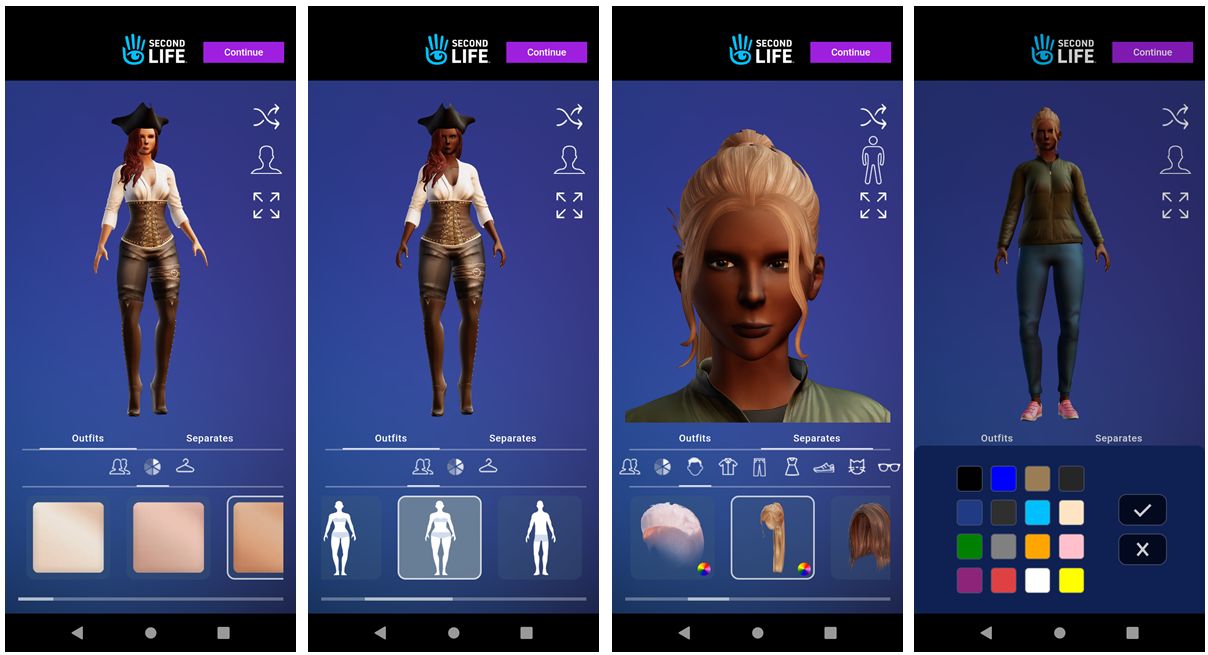
Once completed, the form is processed and the user moves on to avatar selection – gender, facial appearance, hair style, outfit selection / clothing selection, etc, again much as the web sign-up process operates.
This section uses sliders and tap options to move between selections and to make specific choices (e.g. skin, clothing hair colours, style on clothing, footwear, etc.).
Once that avatar shale, gender, skin, clothing, etc., have by set to the user’s satisfaction, tapping the Continue button at the top of the screen will complete the avatar selection process and take the used back the the SL Mobile logging splash screen, complete with their user name entered in the top field.
The avatar selection process through SL Mobile flows much the same workflow as seen when signing-up via the SL website
The new account password can then be entered, and the account logged-in, delivering the avatar to Campwich Forest, the default arrival location for those joining via SL Mobile.
Account Deletion
It is now possible to delete an account directly from the SL Mobile app, should you wish:
Display the app’s menu.
Tap Help
Tap the Delete Account option and follow the required steps. Options to progress through the deletion request process will become enabled as required fields are completed.
It is now possible to delete accounts through SL Mobile, with options to progress becoming enabled as required fields are updated by the user
Additional Updates
The new Bone Attachment Developer Tools option (requires restart)
A fix for the formatting issues with off-line Group notices.
A new setting in Developer tools – Bone Attachment Point Handling.
This is off by default – so no behaviour change from previous versions of the app.
When enabled, can improve avatar mesh appearance handling – although a restart is required after changing the setting to see the results.
Warning: this option might also cause new problems! If you see anything untoward as a result of enabling – please provide feedback to the Lab.
More debug information relating to rigged meshes is sent for developers to use.
Personal Feedback
My own experience of the sign-up process was – painful, with the first page of the sign-up process repeatedly causing SL Mobile to repeatedly freeze.
I have no idea where the problem lay (my hardware – Android 13, with Octa-core (2×1.6 GHz Cortex-A75 & 6×1.6 GHz Cortex-A55) CPU; Mali-G57 MP1; 8Gb primary RAM + 8Gb from 256Gb internal storage -; my wi-fi or something within the app and how it was processing the sign-up page (the avatar selection / customisation process was a lot smoother). Hopefully, this is not a common problem, as adding account creation to SL mobile is a good move for obvious reasons.
As a general note to the Lab, I would suggest placing an avatar mover at the default landing point at Campwich Forest. My test avatar arrived among a group of 12 so tightly packed together no-one could move without slamming into one another (and getting stuck, as push did not appear to be working).
By contrast, account deletion was straight-forward (bye-bye test account!), but I did not experiment with the new Bone Attachment option, as I’ve not noted any issues with the rigged meshes I routinely wear, so see no reason to toggle the setting.
Update, March 27th: Dreamer’s Landing is being overhauled and is currently closed.
Co-founded by Ⱥvalon Bouvier and Fire (Fire3850), I first dropped into Dreamer’s Landing in mid-December 2024, drawn by the concept of a setting which brings together both those new to Second Life and those engaged with the platform in order to foment a sense of community, learning, encouragement and support, in which new users gain a better foothold in-world, from being able to find a free home through to having the opportunities for direct mentorship and to engage in social events – users can even apply for jobs within the setting.
At the time of my first visit, there was still work going on setting-up parts of the region, so I had intended to hop back again at the start of the New Year and take a detailed look at Dreamer’s Landing; unfortunately, things being what they were, I didn’t manage to do so until later January – so my apologies to Fire, Avalon and their team for the delay in getting this article put together.
Our mission at Dreamer’s Landing is to provide housing, mentorship and community to new and experienced SL members, where everyone contributes and respects the people within the community. We do this by attracting seasoned residents who want to create community and mentoring.
– Dreamer’s Landing Mission Statement
Dreamer’s Landing, restaurant – February 2025
Occupying a Full private region utilising the Land Capacity bonus offered by Linden Lab, Dreamer’s Landing is not currently a part of the Lab’s Community Gateway programme, as re-launched in 2017. This is primarily because it is more a “next step” community for new users rather than a place for leaping in from sign-up and getting started; however, it does have links with several community gateways, including the Lab’s own welcome hub, where such on-boarding does occur. By keeping a little apart from the usual mix of on-boarding, focused learning (mixing self-learning with mentor support) found within “traditional” Community Gateways, Dreamer’s Landing is able to focus more on personalised support built around the overall sense of community.
In addition, Members of the team may have their own homes within the community and are very much a part of social activities; thus, the sense of friendship and community is further fostered, and this helps lower any embarrassment newer users might otherwise feel when it comes to asking questions / seeking assistance. Within this, Dreamer’s Landing wraps within itself the concept of paying forward; new users obtaining a home within the region are asked to give a little back to the community in support of others, as Avalon noted to me.
We have about 12 mentors at the moment who are volunteering to spend time with our new residents, and we have onboarded 14 new residents so far, hopefully giving them all a lift up to their new life in SL. Part of the project is that we encourage new users to give back by becoming greeters at the Landing Point or by contributing directly to the rest of the community here. We also try to encourage them to discover things they’d like to do in-world.
– Avalon Bouvier, co-founder, Dreamer’s Landing
Dreamer’s Landing, February 2025
The Landing Point is located on the ground level of the region, which has been attractively laid out in a style of 18th and 19th century French metropolitan architecture, with some Greco-Romano touches. A region surround offers a sense of greater space, whilst the region as a whole mixes community spaces, a small business district, gardens, and residential rentals, all brought together by cobbled avenues and boulevards. As well as the gardens and parks, copses of trees and the waterway cutting through the region help to avoid any sense of the setting being overcrowded.
The residential properties here are kept to the outer edges of the region to offer those renting them with a sense of personal space. If I understand things correctly, these units – taking the form of large classical French townhouses as might be found in Paris – are available to volunteer mentors and new users who wish to remain a part of the community.
The Landing Point sits within the small business district with boutique-style shops focused on fashion, couture and avatar customisation, together with gallery spaces to introduce newcomers to SL’s art scene, and similar. It is rounded-off by the local café, which joins with the dancing / music / games square towards the centre of the setting, the restaurant to east with its outdoor terrace / dance area build over the waters of a small cove, and the pool, spa and beach to the south-west as the major event and activity spaces.
Dreamer’s Landing – new user homes, February 2025
Getting around the ground level is easy enough on foot, but the various areas are also linked by the Dreamer’s Landing teleport system which also provides access to the region’s sky platforms. These include:
The Education Centre – where classroom lessons can be obtained for those who prefer them, together with self-help guides (touch the bookcases), and residents can apply for volunteer and paid jobs within the community (ads for these can also be found on the ground level). This level also includes the Dreamer’s Landing passport centre and a gifts centre to help new users to get started.
The Sandbox – where community members can unpack boxed items they have obtained, practice building, etc., and where community paintball games might be held.
The Walk-in Closet – offering space for users to sort their inventory, try outfits, learn about (and purchase) web-based inventory management systems, change their appearance / adjust the positioning of non-rigged attachments and try them out with various poses, etc., with with the assistance of others or in private changing facilities if they prefer.
Dreamer’s Landing – Education Centre, February 2025
And of course there is the new user free housing. This takes the form a chalet-style housing spread over a sky platform with light landscaping, with personal touches added by the Dreamer’s Landing team, such as a sign welcoming incoming users to their new home and small outdoor community spaces as well.
We currently have 24 free homes for new residents, with about half occupied. Each house is supplied with furnishings and décor, and have an additional 50 LI for personal use. However, if someone wants to have the supplied furniture removed, they can, and that will give them up to 100 LI for personal use. Houses are generally supplied for a two-month period to help people get started, although this might on occasion be extended according to circumstance.
– Fire3850, co-founder, Dreamer’s Landing
Dreamer’s Landing – new user homes, February 2025
From my multiple visits to Dreamer’s Landing, I can personally attest to the friendliness and helpfulness of the folk at Dreamer’s Landing – both established and those who are more recent to Second Life and have volunteered to help within the community. If you know of any recent arrivals to Second Life who are looking for somewhere they might initially treat as home and be among a helpful community – be sure to direct them towards Dreamer’s Landing. Further information on the community – including the schedule of events and entertainment – can be found at the Dreamer’s Landing website.
Logos representative only and should not be seen as an endorsement / preference / recommendation
Updates from the week through to Sunday, February 2nd, 2025
This summary is generally published every Monday, and is a list of SL viewer / client releases (official and TPV) made during the previous week. When reading it, please note:
It is based on my Current Viewer Releases Page, a list of all Second Life viewers and clients that are in popular use (and of which I am aware), and which are recognised as adhering to the TPV Policy. This page includes comprehensive links to download pages, blog notes, release notes, etc., as well as links to any / all reviews of specific viewers / clients made within this blog.
By its nature, this summary presented here will always be in arrears, please refer to the Current Viewer Release Page for more up-to-date information.
Note that for purposes of length, TPV test viewers, preview / beta viewers / nightly builds are generally not recorded in these summaries.
Official LL Viewers
Release viewer: version 7.1.11.12363455226. formerly the ExtraFPS RC, dated December 17, promoted December 19 – No change.
Release Candidate: Forever FPS, version 7.1.12.12999043440, February 4, 2025.
Premium Plus Thousand Islands Linden Homes theme – Tiki style units
The newest Linden Homes theme – this one again for Premium Plus subscribers – was launched on Monday, February 3rd, 2025. Entitled Thousand Islands, it comprises the tiki-style homes – which topped-out the list of requested Linden Homes styles – and, for the first time for any Linden Home theme, underwater Grotto Homes.
Set around tropically-styled islands, both themes occupy and same shallow waters, the tiki homes sitting on rafts and the grotto homes scattered across the sandy bottom of the seas, marked by their own floating platforms. As common with Linden Homes, each type come in different styles – six for Tiki, two for Grotto.
Premium Plus Thousand Islands Linden Homes theme – Ohana Tiki Home
The Tiki comprise:
Luau – two circular interconnected rooms, a circular pool with a surrounding deck, and a covered deck with an upper level curricular room reached via an external spiral staircase.
Ohana – a total of five interconnected circular lower-level rooms, two with upper level connected rooms reached via an interior stairway, with the larger having a balcony. A kidney-shaped pool with large deck area fronts the design with a smaller deck to the rear.
Premium Plus Thousand Islands Linden Homes theme – Puka Tiki Home
Puka – a suite of three interconnected circular rooms with a wrap-around deck outside, fronted by a circular pool.
Lanai – A rectangular multi-room structure built around three sides of a swimming pool, with covered front walkway / deck and an exposed deck.
Premium Plus Thousand Islands Linden Homes theme – Liani Tiki Home
Makai – a main room and two (bedroom?) wings to either side, all built around a raised deck fronted by a lower deck with swimming pool, and two smaller decks to the rear.
Hula – circular in from with a single round roof over a central room with glass floor section (which can be “shuttered” with wood), fronted by a covered deck to the front and flanked to either side and the rear by three rooms, each with access to a narrow wrap-around deck.
Premium Plus Thousand Islands Linden Homes theme – Puka Tiki Home
The Grotto homes come is two similar styles: the Scallop and the Abalone, each taking the form of a large hollowed rock cut through with glazed window openings, fronts doors and interiors with self-like levels and spaces.
All of the new styles can be previewed at the BelliHub Linden home Demo area, and on first looks, the tiki styles are attractive, with the Ohana giving the greatest amount of internal space, albeit at the cost of mooring space of any boat you might want to leave rezzed out. By contrast, Lanai and Makai offer perhaps the easiest in direct mooring. The inclusion of swimming pools with most of the Tiki designs is a nice touch – although the pools with the Luau, Makai, Ohana styles could benefit from steps/ ladders for getting out of them, rather than having to rely on jumping / flying.
Premium Plus Thousand Islands Linden Homes theme – Abalone (l) and Scallop (r) Grotto homes
The release of the Thousand Islands theme came with a blog post announcing it to be part of a Month of Surprises for Members – those with a Plus, Premium or Premium Plus subscription to Second Life. This being the case, members should keep their eyes on the official blog through the rest of February.
Between the Clouds, February 2025 – click any image for full size
Over the years I’ve covered many of region settings designed by Bella (BellaSwan Blackheart), and have always enjoyed my time exploring them and taking photos. So when I saw via Bella’s Second Life profile that she now has a place called Between the Clouds, I was curious to see what it might be all about.
Sitting within a Full region split into 16 4096 sq metre parcels – something which, as a by-the-by, I haven’t dropped into in a very long time – Between the Clouds is much smaller than Bella’s other settings. As a result, and upon arrival, the setting might be mistaken as a sky build mostly comprising building shells and – other than upper portion of a tower block apparently thumbing its nose at gravity – little else. But first impressions often deceive, and such is the case here: there is a lot going on and waiting to be discovered.
Between the Clouds, February 2025
Welcome to this little hideaway high upon the sky and discover the hidden spots this place has to offer. Feel free to enter the buildings that are accessible and hang out wherever you want. No nudity or any sexual activities please!
– Between the Clouds About Land description
Take, for example that floating tower block roof area; it forms the setting’s Landing Point, and the rooftop on which people arrive is speckled by colourful paper cranes whilst the roof over the elevator winch room has been imaginatively turned into a little swimming pool.
Between the Clouds, February 2025
The stairs alongside the winch room lead down to the rest of the remnants of the tower – including the upper doors of an elevator shaft. However, given the rest of the building is not longer there, trying to call for the elevator might be a little difficult. Instead, the stairways offers the most immediate route down – but do beware of the last step, it’s a big one (although a paddling pool has thoughtfully been provided to enable incoming bodies to splash down 😀 ).
Further progress to the setting’s street level requires a further leap of faith. Or at least a leap; one which will drop you down into a grassy courtyard with little businesses tucked into it – although most of these appear to have been shuttered and to have seen better days.
Between the Clouds, February 2025
Two routes out of this courtyard are offered; a narrow alley link through to a much larger square, again overgrown with grass and around which various businesses are arrayed on the ground floors of stubby apartment blocks, one of which appears to have never been completed. The second route away from the courtyard is via stairs leading between more squat buildings. However, this doesn’t go too far – but it down offer a route to a couple more of the little spaces set aside throughout the setting for people to sit an pass the time.
What then of all the little details I mentioned? Well, these take many forms – find the right door, and you can take the stairs up to a trio of small apartments being put to various uses, for example. Another door offers a similar upwards climb ending in the rather unsettling sight of a couple of hazmat-suited figures in heavy gas masks apparently observing the square from behind the gaping maws of frameless windows, one of which has an equally not-too-reassuring sign reading FALLOUT SHELTER beneath it. This little tableau, together with the office space in the same building where a monitor screen warns NO SIGNAL PLEASE STAND BY, possibly offer the makings of a narrative for the setting – but I’ll leave you to work out what form any story might take.
Between the Clouds, February 2025
Also in the large square is a sturdy builder’s scaffold; but while there are building blocks on and under it, it now appears to be in support of a stone statue and fountain, adding another mystery to the setting – a mystery furthered by the apparent hints of habitation which suggest whoever lived here may have rapidly departed: bicycles sit in a rack or propped against walls along with a deserted moped; underwear hangs on a washing line; slippers await feet by an armchair and, most intriguingly of all, a pair of glasses holding paper papers with scribbled sketches and partner by an old cell phone and a stagnant cup of tea, as if suddenly abandoned.
Not that the place is entirely devoid of life; beside the two strange figures up in the apartment building, this is a place rich in bird song and the cooing of pigeons; there’s even a big dog apparently awaiting the return of its owner, who appears to have left some handwritten cards and little bear (perhaps a toy for the dog?) on the bench – and I’ll leave you to find the other dog 🙂 . Then there are the setting’s cats; around a dozen of them are scattered around, some keeping an eye on things, other catching up on their sleep – and one taking on the role of an unusual star of a television!
Between the Clouds, February 2025
Deceptively engaging, Between the Clouds is one of those locations which demonstrates you don’t have to have a complete region in which to allow your imagine loose; small can be equally as a captivating and photogenic.
NASA’s SLS, Blue Origin’s New Glenn and SpaceX’s Starship / Super Heavy. Credit: NASA, Blue Origin and SpaceX
NASA’s Project Artemis, which plans to return humans to the Moon, is being increasingly strained under the weight of multiple opinions and as a result of on-going delays.
In December, NASA confirmed it is pushing back the next mission in the programme, Artemis 2 – intended to fly a crew of 4 around the Moon and back to Earth – back to April 2026, with the first lunar landing now not occurring until at least mid-2027 (see: Space Sunday: of Artemis and Administrators). More recently, the agency has attempted to walk back on the Artemis 2 mission date by saying April 2026 is the “at the latest” target, but efforts are focused on trying to offer a “work to” date which could be somewhat sooner.
In the interim, here have been calls from several different points on the compass calling for the abandonment of the current technology route for Artemis – the Space Launch System and Orion – and replace them with “something better”. Others are calling for “alternatives” to be used in place of the Space Launch System, which is regarded as the most crippling element of the Artemis programme on the basis of costs – critics citing its US $4 billion per launch cost and thus pointing to “cheaper” alternatives.
For example, claims have been made that Artemis 2 could still go ahead “simply” by substituting Blue Origin’s New Glenn as the Orion launch vehicle, and having Orion rendezvous and mate with a ULA Centaur upper stage placed in orbit by that company’s Vulcan launch vehicle (Centaur being the Vulcan upper stage), and using the Centaur to boost Orion on its way to the Moon. However, such a claim simply does not stand up to any reasonable examination due to the number and extend of changes that would be required, including:
Significant alterations to New Glenn’s upper stage to handle Orion’s larger diameter, including an entirely new vehicle mount and new fairings to enclose Orion’s European Service Module (ESM).
Alterations to the vehicles aerodynamics as a result of the above modifications in order to maintain stability during launch and ascent.
A complete re-working of the Orion launch abort system (LAS), which has been designed specifically to work with SLS.
Significant upgrades and alterations to the New Glenn launch facilities at Space Launch Complex 36, Canaveral Space Force Station, in order to support Orion and its systems while on the pad.
As New Glenn is designed to have its payload integrated horizontally, and Orion is designed to be integrated into SLS vertically, it is likely significant changes would have to be made to either Blue Origin’s payload integration workflow / systems and / or Orion to accommodate mating both on a horizontal basis.
Among other things, Blue Origin’s New Glenn is designed for horizontal vehicle integration and transport to the launch pad; NASA’s Orion is designed for vertical integration / transport to the launch pad. Credit: Blue Origin
None of these issues are insurmountable, but the idea that they could be implemented in a manner that would allow Artemis 2 to go ahead in anything like the current time scales NASA is looking at, or without delaying Artemis as a whole, is frankly ludicrous. Nor do the problems end there.
With a combined mass of 26.5 tonnes, Orion and its ESM are too heavy for New Glenn to boost directly to the Moon – hence the suggested use of the Vulcan Centaur upper stage. However, this would require on-orbit rendezvous and docking between Orion and Centaur, something for which neither is designed – so the idea simply added another level of complexity to missions, which in turn will require even more expenditure (with NASA undoubtedly footing the bill) and additional delays while the vehicles are modified and tested.
Finally, and in the case of Artemis 2, the fact remains that the delay to that mission doesn’t lie with SLS – it is because of concerns over Orion’s heat shield, with NASA wanting to delay the mission so that additional studies can be carried out around optimising the capsule’s re-entry profile to minimise the kind of excessive ablation (aka “char loss”) seen in the initial SLS / Orion flight.
As to “replacing” the entire hardware roster – something the SpaceX CEO has called for – the answer has to be – with what? People will point to that company’s Starship / Super Heavy, but the fact is, that system has yet to achieve a single orbit of Earth – and is a very long way for being certified for (or capable of) carrying humans. A more viable solution might be to utilise Dragon XL and Falcon Heavy; NASA already see this combination as viable for resupply missions to the proposed Lunar Gateway station. But Dragon XL isn’t designed to carry humans and Falcon Heavy isn’t certified for crewed launches; so again, a switch could lead to protracted delays to Artemis and even more expenditure – which might well benefit SpaceX financially, but on its own will do little to move Artemis forward.
Dragon XL: an uncrewed cargo vehicle NASA has requested from SpaceX to deliver cargo to to the Lunar Gateway station. Credit: SpaceX
Hence why the Companies involved in the current Artemis lunar exploration campaign are urging the new administration and their prospective new NASA Administrator not to rock the boat, arguing the current architecture still offers the fastest way of getting humans back to the Moon from the United States. The simple fact is, that while there is nothing wrong with developing alternatives to SLS / Orion for future use; if NASA (and more importantly, the US government) want to reach the Moon without becoming serious stalled for years beyond the current delays, SLS / Orion remains, at this point in time, the most practical path to doing so.
2024 YR4Sparks Planetary Defence Response – But There’s No Need to Panic
Estimated to be somewhere in the region of 50-60 metres across, 2024 YR4 is an Earth-crossing Apollo-type asteroid discovered on December 27th, 2024 and which – as of February 2nd, 2025 has a 1 in 71 (1.4%) chance of entering Earth’ atmosphere in December 2032.
A stony S-type or L-type asteroid was spotted just two days after it has passed just 828,000 km from Earth. It is now moving away from Earth and will make its next close approach in June 2028. The overall threat of the asteroid striking Earth is subject to further refinement. However, on January 29th, 2025, the International Asteroid Warning Network (IAWN) issued a warning that if the asteroid does impact Earth, possible impact sites include over the eastern Pacific Ocean, northern South America, the Atlantic Ocean, Africa, the Arabian Sea, and South Asia.
Asteroid 2024 YR4 imaged by an Earth-based observatory on January 27th, 2025, illustrating the difficulty in observing it – even with a large telescope, the asteroid is almost indistinguishable from far more distant star unless its motion on successive observations is recorded. Credit: NASA
However, it is highly likely that as more observations are made utilising both ground- and space-based observatories and capabilities, the risk of impact will decline, not increase: hence the IAWN issuing a “first step” planetary defence response; they want as many eyes on the asteroid as it retreats from Earth so that the asteroid’s orbit around the Sun and how it might be influenced over time can be more precisely calculated. In this it is also estimated that rather than impacting in 2032, the asteroid will come to within approx. 277,000 km of Earth – which is still closer than the orbit of the Moon.
Were the asteroid to impact, it would do so at a 17.32 kilometres per second. Given its size and composition (both similar to the asteroid which likely caused the Tunguska event of 1908), any such impact would most likely result in an air burst of between 7 and 8 megatons rather than the asteroid actually striking the surface of the planet, likely resulting in a radius of destruction of some 50 km.
The project corridor of impact were asteroid 2024 YR4 to impact Earth in 2032
With the asteroid retreating from Earth, opportunities for gathering detailed data are limited, but will improve once more during the 2028 close approach, when the risk of impact in 2032 can be more accurately refined. Should the risk of impact then or in a further close approach remain, then a DART-style mission could be sent to prevent the impact.
“Life Here Began Out There”
Battlestar Galactica fans may well recognise the above quote, but the question as to whether life on Earth may have had a kick-start from beyond the planet has long been a tantalising one. In 2016, NASA launched OSIRIS-REx, a mission to recover samples from the asteroid 101955 Bennu. As I’ve previously covered, those samples were returned to Earth in September 2023 and have been undergoing study.
Two teams studying the samples have found that not only do the pristine building blocks for life, they also contain the salty remains of an ancient water world. In particular the sodium-rich minerals contain amino acids, nitrogen in the form of ammonia and even parts of the genetic code. Meanwhile, the salts found within the examined samples are very similar to those found within the ancient lakebeds of the Mojave and Sahara deserts.
This image provided by NASA shows a top-down view of the OSIRIS-REx Touch-and-Go-Sample-Acquisition-Mechanism (TAGSAM) head with the lid removed, revealing the remainder of the asteroid sample inside. Credit: NASA
Combining the ingredients of life – the minerals with their amino acids, etc., – with and environment of sodium-rich water, as suggested by the salty deposits in the sample, is regarded as “the pathway to life”, and the organic materials also found within the sample appear to support this. They further lend credence to the idea that Bennu was once a part of a much larger body which contained liquid water within it, but which was shattered through impacts, evaporating the liquids and leaving remnants like Bennu containing evidence of the basic building blocks of life. If this happened with Bennu’s parent object, it potentially happened with other bodies in the early solar system, and it is possible that fragments from those incidents found their way to Earth to help kick-start life.
Most of the Bennu sample is being preserved for comparison with samples with future missions, but the published result from these studies have led to a renewal of calls for a mission to collect samples from the icy dwarf planet of Ceres, visited by NASA’s Dawn mission, entering orbit there in March 2015, and where it remains, inoperative, to this day. During its study of Ceres, the mission’s spacecraft revealed the dwarf has a surface of hydrated minerals on its surface and likely has channels of brine flowing through its mantle which could hold further clues on the origins of life.
Starliner Update
NASA’s Aerospace Safety Advisory Panel (ASAP) provided something of an update on the status of investigations into the reported issues affecting Boeing’s CST-100 Starliner vehicle, following the problems experience with the propulsion units on the vehicle’s service module during the Crew Flight Test in mid-2024.
Although largely successful, the latter left significant question marks over the reliability of the vehicle’s thruster systems, and saw NASA exercise significant caution in not allowing the test crew of Barry Wilmore and Sunita Williams to return to Earth aboard the vehicle, although the Calypso capsule did ultimately return to Earth safely in September 2024.
The Boeing Starliner, comprising capsule Calypso and an expendable service module (the propulsion units of which lead to problems) docked at the ISS during the Crew Flight Test, June, 2024
Most notably, the ASAP update indicated that the capsule has been cleared, and a number of issues reports relating to the service module have now been closed. However, it also indicated the issues related to the service module’s thrusters – the primary cause of problems during the crew test flight – remain open and subject to both further testing campaigns. In this, the update was frustrating, in that beyond general statements of progress, specifics were not provided, and both NASA and Boeing have remained tight-lipped on the subject of the propulsion system since the Crew Flight Test.
As a result – whilst positive for the Starliner capsule units, the update does little to update on how or when the system will next fly; in October 2024, NASA indicated it was keeping the door open to a possible Starliner launch in 2025 – although whether or not this will be another test flight (either crewed or uncrewed) or an all-up 6-month crew rotation flight has yet to be finalised, and following the ASAP update, NASA indicated a possible flight was still on the cards, although it is not clear how any such flight would slot into the current ISS launch manifest.









 Inara Pey: Living in a Modemworld