For June 2025, Cica Ghost brings us Unicorns and Candies; a realm offering a sense of childhood dreams, creatures of wonder and bright, happy colours. It perfectly encapsulates everything found within the accompanying quote from Roald Dahl:
Those who don’t believe in magic will never find it.
Cica Ghost: Unicorns and Candies, June 2025
This is a quote which challenges us to maintain a sense of wonder and to approach life with a childlike curiosity, while expressing the idea that magic is not just about casting spells or supernatural occurrences, but about a sense of wonder, imagination, and the belief that extraordinary things can happen; that magic can come to all of us in many forms – a beautiful moment, a surprising discovery, or the realization of a dream. All we need is to be open to it; if we allow adult cynicism take over or become too rigid in our thinking, we can so easily miss out on the joy and wonder that life has to offer, in whatever form it might take.
All of the above is perfectly encapsulated in Cica’s build. It is an expression of childhood imaginings and dreams; a place where unicorns can be found, and dinosaurs and snails converse together and stars fallen from the skies walk hand-in-hand or sit in contentment, where houses are sewn and trees look like strange candy-topped lollypops. It’s a place made for smiling and fun, where you can climb and walk, dance or sit, and which can quite unexpectedly put a bounce in your stride!
Cica Ghost: Unicorns and Candies, June 2025
Just as Dahl’s words inspire us to keep our imagination alive and to retain that child-like curiosity and wonder, so Cica’s installations constantly offer us the chance to do so. They allow us to escape the demands of the everyday and instead, to explore the extraordinary, have fun, to delight in what we see and experience – and to find the magic of a smile or a laugh. To never lose sight of the doorway to the extraordinary our imaginations offer.
So go see Unicorns and Candies. Dance, sit, find the the magic, the unexpected and enjoy.
Space Epoch’s Yuanxingzhe-1 (YXZ-1 or Hiker-1) verification test article rocket hovers over the sea before splash-down, May 28, 2025. Credit: Space Epoch
China is continuing to expand its space endeavours on both the public and private fronts – drawing some flak from SpaceX fans in the process.
On Wednesday, May 28th, a Long March 3B rocket lifted-off from the Xichang Satellite Launch Centre, southwest China at 17:31 UTC, carrying aloft the Tianwen-2 explorer, bound for 469219 Kamoʻoalewa (2016 HO3), an Apollo class, near-Earth object (NEO) and quasi-satellite of this planet.
A sample-return mission, Tianwen-2 is due to rendezvous with the 40-100 metre diameter asteroid in July 2026. It will spend some 7 months examining it and attempt to collect samples from its surface and sub-surface, using both touch-and-go (dropping briefly onto the asteroid in an attempt to gather samples before being pushed away using spring tension in the sample arm), and anchor-and-attach (literally hooking itself onto the asteroid). Departing the asteroid in April 2027, Tianwen-2 will then swing by Earth, dropping off gathered samples in a re-entry capsule in November of that year. In all, it is hoped that around 100 grams of material will be gathered from the surface and sub-surface environments of the asteroid. An interesting aspect of the mission is that Tianwen-2 will attempt to deploy a nano-rover onto the surface of 469219 Kamoʻoalewa, and place a nano-satellite in orbit around it.
An artist’s rendering of Tianwen-2. Credit: Najing University via Weibo
The aim of the mission is to gain insight into 469219 Kamoʻoalewa, and either answer questions as to whether or not it is actually a chunk of the Moon blasted clear following an asteroid impact or, if not, it is hoped the mission will provide insight into the nature and characteristics of NEOs (particularly whether they also contain organic molecules), and allow comparative studies between the samples returns and those from Hayabush2 and OSIRIS-REx, furthering our understanding of asteroids and the role in the early solar system.
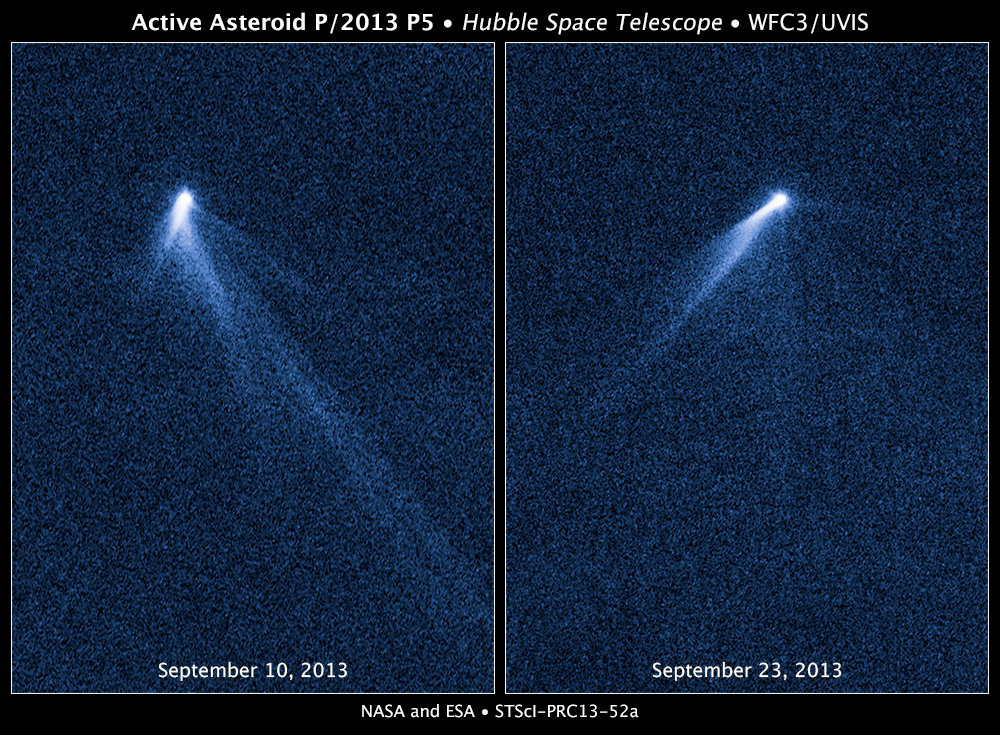
Returning the samples to earth will not be the end of Tianwen-2’s mission. Using Earth’s gravity after releasing the sample return capsule the vehicle to push itself onto a rendezvous 311P /PANSTARRS (aka P/2013 P5), which it will reach in 2031. This is an unusual object called an active asteroid – an object with an asteroid-like orbit, but exhibiting comet-like visual characteristics (such as having a tail). Estimated to be 240 metres across and with a sidereal period of 3.24 years, it was first located in 2013, and attracted attention due to its fuzzy, smudged appearance in initial images. Later that year, the Hubble Space Telescope revealed that the fuzziness was due to it having around 6 individual tails. These are thought to be the result of the asteroid is either spinning so fast, lose surface material is being thrown off of it, or that a series of “impulsive dust-ejection events” of unknown origin gave rise to a cloud of debris around the asteroid, which were then formed into the tails by solar radiation pressure.
Rather than just making a fly-by of 311P /PANSTARRS, the plan is for Tianwen-2 to use its solar-eclectic propulsion system to decelerate as it approaches the asteroid so that it can enter orbit and study it at length.
Asteroid 311P /PANSTARRS (P/2013 P5) revealing is multiple tails as revealed by the Hubble Space Telescope. Credit: NASA / ESA
Also on May 28th, the private-venture launch company, Space Epoch, became the first Chinese company to make a sea-based vertical launch of a reusable rocket element and successfully recover it in a controlled splash-down.
The Yuanxingzhe-1 (YXZ-1 – also referred to a “Hiker 1”) is designed to be a reusable booster some 64 metres tall and capable for delivering 6.5 tonnes to a Sun-synchronous orbit (SSO). For the May 28th, flight, a test article standing 26.8 metres tall and using a single Longyun methane-liquid oxygen (methlox) motor and massing 57 tonnes, lifted-off from the sea-based Haiyang spaceport, Shandong province, at 20:40 UTC, climbing to an altitude of 2.5 km. The motor brought the vehicle to a hover before shutting down, allowing the vehicle to fall back towards the sea using four grid fins to maintain its vertical orientation. After a free descent, the motor then re-lit, slowing the vehicle and bringing it to a safe hover just a metre or so above the water. It then shut down, allowing the vehicle to gently enter the water and topple onto its side and await recovery. In all, the 125-second flight verified the broad operational parameters of the full-size Hiker-1, which will also splash-down at the end of its flights, rather than trying to land or be caught out of the air.
The flight, defined by Space Epoch as “100% successful”, immediately came under attack by SpaceX fans. The latter claimed China was merely “copying” SpaceX rather than innovating, particularly through the use of stainless steel in vehicle construction and methlox propellants, together the the use of four grid fins on the rocket for steerage / stability – as if SpaceX had any sole claim to these capabilities (they have not even patented the use of grid fins for rocket attitude control in an atmosphere).
A similar “they’re just copying!” came on May 29th, when another Chinese start-up, Astronstone, announced it has received sufficient initial funding to push ahead with its design for a reusable launch vehicle. Called the AS-1, this is intended to deliver up to 10 tonnes to low-Earth orbit (LEO) when being reused and up to 15.7 tonnes in fully expendable mode. It is to utilise methlox propulsion, stainless steel construction, grid fins for descent control and is to be designed to boost-back to its launch facilities and captured by “chopsticks” mounted on the launch tower.
A Render of an Astronstone AS-1 (with payload attached!) “caught” within the “chopsticks” of its launch tower. Credit: Astronstone
In this, Astronstone is not shy about taking a leaf from the SpaceX book; the only difference is that of scale: AS-1 will be a modest 70 metres tall with a 4.2 metres main diameter (roughly the height of SpaceX Super Heavy, with half the diameter), while its 10-tonne reusable payload lift capacity is well in keeping with most modern commercial launch requirements. If successful, the company plan on offering the AS-2, capable of around two or three times the payload capacity of AS-1.
Earlier in May 2025, I covered the threats to NASA’s budget under cuts being considered by the Trump administration (see: Space Sunday: of budgets and proposed cuts and Space Sunday: more NASA budgets threats). At the time, the concerns were based on a so-called “skinny” budget document released by the administration, which outlined where the cuts would fall.
On May 31st, 2025, the administration quietly published a more detailed version of its federal budget proposal. This solidifies many of the threats to NASA’s mission. It confirms the intent to slash NASA’s budget by 24%, with the majority of the cuts coming within NASA’s space science, Earth sciences, aeronautic and education areas. In real terms, and adjusted for inflation, it sees the agency’s budget reduced to levels not seen since 1961, with the potential for 5,500 job losses and possible centre closures.
The science budget zeros-out 41 in-development or in-progress science missions. These Include:
Many NASA Earth science programmes and missions, current and future, including the decadal survey Earth System Observatory missions; cancellation of most venture-class Earth science missions; and potentially impacts to the “cyclone watching” CGNSS network currently in operation.
The in-development DAVINCI and VERITAS missions to Venus, and the Mars Sample Return Mission (MSR – not helped by NASA repeatedly shooting itself in the foot where this is concerned).
The operational Mars Odyssey and MAVEN Mars orbiters (ending two valuable missions and limiting relay communications with other Mars missions); the New Horizons mission; OSIRIS-APEX – a mission extension to the highly-successful OSIRIS-REx, and intended to provide information on the Earth orbit crossing asteroid (and potential future impactor) 99942 Apophis.
The Chandra X-Ray Observatory: earmarked for cancellation under the Trump 2026 budget. Credit: NASA
The budget additional calls for an effective crippling of NASA’s biological and physical sciences, reducing its budget to just US $25 million from US $87 million, and ending cooperation with the European Space Agency on Venus and Mars missions. While the flagship Nancy Grace Roman Telescope survives cancellation, it receives just half its requested budget – US $156.6million – potentially impacting its ability to be launched in 2026.
In terms of human spaceflight, the Trump administration is apparently initiating a “bold mission of planting the American flag on Mars”, which sees some 6.38% of NASA’s total budget being steered into Mars-centric initiatives:
US $864 million for a “Commercial Moon to Mars (M2M) Infrastructure and Transportation Program” (which as side-note, will replace SLS / Orion after Artemis 3 – assuming any such system is actually flying by then).
A total of US $400 million to be put into a “near-term entry, descent, and landing demonstration for a human-class Mars lander”, and commercial payload deliveries to Mars.
Some of this will be offset by the cancellation of the Lunar Gateway boondoggle; however, it is hard not to see hints of the influence of the SpaceX CEO in these matters. He has been vocal in his opposition to anything other than his “grand vision” of colonising Mars, and these budget allocations, particularly the US $400 million appear to be directly tailored to SpaceX’s benefit, the company apparently prioritising landing a “human-class lander” as soon as possible, and then moving directly to cargo deliveries.
Isaacman Out
The budget details came alongside the shock announcement that the White House has withdrawn entrepreneur Jared Isaacman at its nominee to lead NASA.
Isaacman’s nomination caused mixed reactions when first announced. Whilst the majority were positive, there were also concerns over his ties to the SpaceX CEO, and the latter’s views on NASA’s future direction. During his Senate confirmation hearings, Isaacman handled the latter concerns directly, and indicated his own opposition to some of the proposals in the Trump NASA 2026 budget. As such, it was widely anticipated the Senate would confirm his appointment on June 3rd, 2025.
Jared Isaacman during his Senate confirmation hearing. Credit: Associated Press
No reason has been given by the White House for withdrawing his nomination. Some have speculated it is as a result of the recent rift between the President and the SpaceX CEO, with whom Isaacman has a strong association. Also, Isaacman’s confirmation hearing also revealed he has been a past financial supporter of the Democratic Party – something hardly likely to endear him to the White House incumbent. In a statement on the withdrawal, White House assistant press secretary Liz Houston would only say:
The Administrator of NASA will help lead humanity into space and execute President Trump’s bold mission of planting the American flag on the planet Mars. It’s essential that the next leader of NASA is in complete alignment with President Trump’s America First agenda and a replacement will be announced directly by President Trump soon.
Again, the emphasis on Mars here is loud enough to be almost deafening – and in line with the goals of the SpaceX CEO. This is not to say the the latter will now be the likely pick to head-up NASA; it is highly unlikely he would survive Senate hearings even if nominated. However, it does perhaps indicate his push for having NASA effectively abandon the International Space Station and the Artemis programme in favour of Mars have been taken to heart by a President who is all about being “first” in everything.
Thus far, all of the Trump administration proposals for NASA’s budget have been met with widespread condemnation from the aerospace, science and educations sectors in the US. Many are hoping that Congress will stop this tear-down of NASA dead in its tracks when the budget comes before the Capitol later in the year. As to Isaacman being removed as nominee, this has been received with dismay and upset within the US space industry, and leaves NASA in a continuing state of limbo.
Starship IFT9: Up and Bang Again1
On Tuesday May 27th, 2025, SpaceX once again attempted to carry out their 9th integrated flight test (IFT-9) of their Starship / Super Heavy combination in the hope of getting the former into sub-orbital space to carry out a series of tests, and use the latter as a test article during its descent back to the Gulf of Mexico. As such, the flight had a number of distinct goals for both the booster and the starship vehicle.
Booster (√ = success; Χ = failure):
Re-fly a Super Heavy for the first time – the unit used in the January 2025 test article flight (with just 4 of its 33 Raptor 2 motors replaced) (√).
Attempt a new “rollover” manoeuvre after starship separation (√).
Test a new high angle of attack re-entry into the lower atmosphere in an attempt to use atmospheric drag to reduce velocity and reduce the need to carry propellants for propulsive braking (Χ).
Carry out an updated engine braking burn (Χ).
Splash-down in the Gulf of Mexico (Χ).
Starship (√ = success; Χ = failure):
Reach a sub-orbital trajectory (√).
Deploy a set of 8 Starlink satellite simulators, testing the payload bay slot in the process (Χ).
Carry out the re-start of a sea-level Raptor engine to test de-orbit burn capabilities (Χ).
Make a successful re-entry into the atmosphere and test updates made to the thermal protection system and to hopefully reduce burn-through on the fore-and-aft aerodynamic flaps (Χ).
Splash-down in the Indian Ocean (Χ).
SpaceX IFT-9: lift-off of the Starship / Super Heavy combination, Boca Chica, Texas, 23:37 UTC (19:37 local time). Credit: SpaceX
Lift-off was at 23:37 UTC, from the SpaceX Starbase City facilities in Texas, and proceeded to a successful staging. The booster then performed its intended roll-over and carried out a good boost-back burn. It was lost 6 minutes 20 seconds after launch, as 13 of the engines were due to fire at the start of their braking burn.
The starship vehicle continued on to its sub-orbital trajectory and successfully shut-down its motors. The deployment of the payload simulators was due at 18 minutes into the flight, but was abandoned when the deployment slot door again failed. By 30 minutes into the flight the vehicle was pitching / rolling wildly, and SpaceX confirmed they had lost all attitude control, likely the result of a propellant system leak. The vehicle subsequently made an uncontrolled re-entry over the Indian Ocean 46 minutes after launch and largely burned-up.
With the six engines of the starship vehicle burning brightly “beneath” it (actually at a higher altitude), and with its own three steerable motors firing, the Super Heavy booster is seen entering its new “roll-over” manoeuvre, aligning itself for its boost-back burn of 13 motors. Credit: SpaceX
Whilst subject to confirmation, the propellant leak potentially hints at a vulnerability in the starship design. Most space vehicles utilise hypergolic thrusters for attitude control and fine manoeuvring. Independent of the main propulsion system, these avoid the need for complicated propellant bumps, etc.. However, the propellants are high toxic, and such systems do add mass to a vehicle. By contrast, SpaceX effectively pumps boil-off gases from the main propellant tanks around the vehicle to so-called “cold thrusters” and their own small tanks. Doing so removes the need for the majority of the mass (and engineering space) used by hypergolic thruster systems and avoids the complications of handling toxic materials during vehicle refurbishment between flights. However, the plumbing used to deliver the gases around Starship and Super Heavy is all interconnected; thus – and possibly as demonstrated with IFT-9 – there is a risk of a single leak impacting multiple attitude control thrusters.
Both the booster and the starship came down within their designated hazard zones; however, the flight will be subject to an FAA-required mishap investigation.
With apologies to the estate of J.R.R. Tolkien and Bilbo Baggins, Esq., formerly of The Shire
Luna Sea, May 2025 – click any image for full size
Yoyo Collas – he of Borkum fame (which I last covered at the start of the year) – is now back with a new Homestead region design in the form of the rugged, mysterious islands of Luna Sea, assisted in his work this time by AmyDenise.
These low-lying islands, sitting under a misted sky marked by a recently-risen Sun, are home to a plethora of wildlife, and form an interesting and interconnected trio. Between them they are rich in detail, colour and opportunities for exploration, relaxation and photography.
Luna Sea, May 2025
The Landing Point sits on the largest of the three islands, a long finger of west-pointing rock where hardy grass, shrubs and a few headstrong trees with their back bent as if twisted by ocean winds over the years, have gained a toe-hold.
The ground gives the suggestion of a possible volcanic origin, which together with some of the mammals present – notably the walrus and grey seals – suggesting the islands could be a remote part of the High Arctic Large Igneous Province; not that anywhere in SL has to be based or inspired on any actual physical world location, this is just a game I like to play in the hope of additional sparking imaginations. A colony of eared seals has also come ashore close by the Landing Point, further suggesting a north Atlantic vibe to the islands (although eared seals can in fairness be found the world over).
Luna Sea, May 2025
This island is dominated by three structures. Two are built out over the waters between it and the southern island, and the third –and largest – raises itself over the island’s high point on study legs – although “high point” is here a relative term, it being little more that a hump of rock at towards the island’s eastern end and sitting just a little above the island’s general elevation.
Reached via stairs leading up to a central covered deck, this large unit forms a comfortable home sturdily built in steel and wood, the decks available on three sides offering commanding views to the west, north and east. It does not appear to be a private residence, but open for visitors to enjoy, the décor perfectly put together by AmyDenise.
Luna Sea, May 2025
The two buildings built out over the water share a common deck. They stand as a pair of artist’s studios and the local café offering refreshments on the seaward part of their shared deck; just be prepared to share your nibbles with the local kitties! This deck also offers sheltered moorings for boats visiting the island. In addition, a large fishing trawler sits alongside, whilst pedal boats are tied-up below one of the studio units. Access to the majority of these moorings from the eastern ends of the island is prevented courtesy of the pier bridge connecting to the second largest island – although this pier can (and does) also offer places where boats can be brought alongside and moored.
Roughly half the size of the main island, the second isle is more of a bump of granite shingle rising from the surrounding waters. Again, shrubs and grass cling to it, together with a single tree. However, its most striking feature takes the form of two large huts.
Luna Sea, May 2025
These look as if some giant hand has taken the hull of a wooden ship and planted it keel-side up on the island, before using a cleaver to slice it neatly into two halves, then moving them apart. They are set as a surfer’s retreat and workshop, and thus suggest a further geographical influence for (and mystery to) these islands. A further geographical mix is added by the presence of several giant turtles, monitor lizards and red-crowned crane (whose height strongly suggests they will brook no argument from mere humans!).
The third island lies to the north side of the region, barely off the coast of the main island. So close, in fact, it is connected by a short, low wooden bridge passing over a narrow neck of shallow wetland, suggesting that it one time the two were once a singular landmass. Further shallows lie to the west, extending both to the main island and out to where a trio of massive wind turbines stand as sentinels watching over the setting. With nets staked out across their length and breadth ready to herd fish into their various traps, the nets have become a feeding ground for egrets, seagulls and heron.
Luna Sea, May 2025
Largely comprising igneous shingle, this smallest of the three islands has a single blunt thumb of a thumb-tip of rock poking upwards, capped by the most extraordinary structure. Resembling a recently-landed space vehicle, it is reached via step hammered into the rock on which it stands, its upper level marked by four large, leaf-like hatchways folded back to reveal its interior. Here can be found a celebration of the island’s most mysterious inhabitant, and the one which perhaps brings visitors to the islands’ shores: actias luna, the luna moth (aka the American moon moth).
A mysterious silence reigns on a remote, mist-shrouded island of black sand and jagged rocks. Sharp cliffs rise from the sea like ancient sentinels, and strange, silvery plants grow among glittering lava rocks. This is where the Luna Moth lives—a rare, luminous creature with moon-coloured wings that only appears at night. Its silent flight seems to pierce time and space, as if guarding the dreams of the island itself.
– Yoyo Collas’ description of Luna Sea
Luna Sea, May 2025
This is not the only place these North American moths might be found; at least one pair are hiding in plain sight on one of the islands. However, I’ll leave it to you to find them and the little family of meerkats which has also made the islands its home 🙂 .
Beautifully conceived and executed, Luna Sea is a highly rewarding visit – so do be sure to hop over and explore!
The Annex, Nitroglobus Roof Gallery, May 2025: YO – Love is a Stranger
Having opened on May 12th, 2025 for a (roughly) two-month run, Love is a Stranger is an evocative exhibition of black and white photography by – YO – (yoasa) being hosted by Dido Haas within the Annex of Nitroglobus Roof Gallery. Dido notes that the first time she came across YO’s work, she was immediately drawn to it, such was the emotive – almost physical – strength with the images. Given this is also my first exposure to YO’s work, I can understand why she felt so drawn; working in monochrome brings a depth of raw humanity to their work, carrying within it a persistence of passion that is enthralling.
Colour brings joy to the eyes – but black & white reaches the heart.
Yo(asa)
The title of the the exhibition – which features eighteen marvellously composed and processed pieces – is taken from the song of the same name by Annie Lennox and Dave Stewart, aka Eurythmics, and which formed the opening track of their second album Sweet Dreams (Are Made of This).
The Annex, Nitroglobus Roof Gallery, May 2025: YO – Love is a Stranger
The lyrics, penned by Lennox, sought encapsulate the dichotomic relationship of love and hatred – so often two sides of the same coin – by putting opposites together, expressing how one can lift you up, lead you forward, whilst the other is just awaiting the opportunity to cut you down through doubt, confusion, and more; and where one can be so glamourous and appealing, with the other lurking just beneath with cruelty and unkindness; the promise of both, when taken together, equally rich and false.
To be honest, with one or two exceptions, I did not see many parallels between Lennox’s intent and the images YO presents – and if they are present, the failure to see them is purely mine, and not that of the artist. What I did find, however, are images that are simply breath-taking in their emotive depth and resonance; pieces beautifully focused and framed as an ode to the fickleness of love itself.
The Annex, Nitroglobus Roof Gallery, May 2025: YO – Love is a Stranger
Each picture is a masterpiece of visual storytelling, conveying a richness of desire, loneliness, loss, need, innocence, uncertainty. These are all emotions common to love. We all want to be loved, to be in love, and feel the same in return: to feel wanted cherished, desired. Yet love itself is mercurial; even in the midst of all the the sense of fulfilment, of finding that desire and cherishment in the eyes and arms of another, so too can it all too easily give forth doubts, take away the comfort as easily as it provides. It can turn thoughts of certainty and contentment into those of incertitude, and feelings of warmth to those of uncertainty.
Thus, we become alone in thought and trapped contradictions, literally and figuratively wandering; driven, perhaps to feel the very world around us is alien or as if the feelings that at first lifted us, made us feel a part of something so easily turn to feel apart from everything; standing outside and looking in. We have discovered that love itself has turned from welcoming friend to a complete stranger.
The Annex, Nitroglobus Roof Gallery, May 2025: YO – Love is a Stranger
All of this is conveyed within YO’s images, and quite powerfully and evocatively so. It is, in short: an absolutely exquisite collection.
The following notes were taken from the Tuesday, May 27th, 2025 Simulator User Group (SUG) meeting. They form a summary of the items discussed, and are not intended to be a full transcript. The notes were taken from my chat log of the meeting. No video this week.
Meeting Overview
The Simulator User Group (also referred to by its older name of Server User Group) exists to provide an opportunity for discussion about simulator technology, bugs, and feature ideas.
Meetings are open to anyone with a concern / interest in the above topics, and form one of a series of regular / semi-regular User Group meetings conducted by Linden Lab.
Dates and times of all current meetings can be found on the Second Life Public Calendar, and descriptions of meetings are defined on the SL wiki.
Simulator Deployments
There are no planned deployments to any channels this week, only restarts.
The team has been working on a lot of backend work getting things rebuilt for a more modern artifact management solution (think: rebuilding docker containers, libraries, etc.) –this is ongoing work. We also are doing more invisible work updating hardware to a newer configuration.
– Signal Linden
SL Viewer Updates
Default viewer: 2025.03 7.1.13.14343205944, issued April 9th and promoted April 15.
A question on whether or not a viewer should expose the channel llDialog is operating on, or whether that is private information. Short answer: no it is not private; it’s in the viewer.
A debate as to how many regions run on a simulator and how many simulators run on a server, after a claim was made it is not 1:1:1.
Leviathan Linden: SL runs one Region per Simulator process. The actual Server (machine) runs multiple Simulators.
Monty Linden: the old 1/core vs 4/core is long gone – departed with uplift.
Confusion was voiced about region crossings and the idea that an avatar’s inventory is “handed over” between regions. This is not the case; only object inventory (scripts in your attachments) is transferred.
The confusion may have arisen by conflating issues of inventory size causing issues at log-in (which the Lab has been investigating) with the idea that the same is true for region crossings.
WebRTC “switch on” is still being held – currently because it still needs some bugs fixed; LL is looking to get the infrastructure sorted for a wider deployment across regions and is also looking at performance optimisations (as well as the issue of around 21% of Firestorm users not running a WebRTC capable version of that viewer).
A lot of general chit-chat about myths, frame rates, PBR and its impact on older hardware, why the avatar count in the Destination Guide tend not to match the actual count in the region (because people can come and go quickly / time is required for the simulator to forward the information to the relevant service handling the DG and for it to be processed and displayed; updates to the DG are not real-time), and science fiction series (sorry, you had to be there).
† The header images included in these summaries are not intended to represent anything discussed at the meetings; they are simply here to avoid a repeated image of a rooftop of people every week. They are taken from my list of region visits, with a link to the post for those interested.
Caerleone Manor, May 2025 – click any image for full size
Dear Inara,
I’m writing to warmly invite you to visit Caerleone Manor, a recently completed destination in Second Life inspired by the elegance and cultural richness of 18th–19th century grand estates. The region features formal gardens, a grand ballroom, intimate salons, equestrian trails, and curated event spaces — all designed with immersive detail and historical ambiance in mind.
This was the opening to a personal invitation I received from Sethos Lionheart to visit his – frankly – stunning Full region design celebrating a bygone era of grand estates and magnificent homes. It was an invitation I was delighted to take up at the earliest opportunity for two reasons – beyond the extreme grace with which it was written, that is. The first being that I am a lover of what we in the UK call stately homes and thoroughly enjoy visiting them and appreciating their history. The second being that I have admired Sethos’ region designs, having written about them in the past – but to my shame, I’d actually lost track of his work.
Caerleone Manor, May 2025
As noted in the extract from Sethos’ invitation, Caerleone Manor (Lionheart(?) Manor) seeks to evoke the grand estates to be found across much of Europe in the 18th and 19th centuries (although its style perhaps suggests a strong French architectural influence). It’s not the first such region design to do so (perhaps the multi-region Angel Manor stands as the most famous example), but it is undoubtedly one of the best, and in being set within a single region, offers one of the most concise and visually engaging demonstrations of how a slice of physical and cultural history can be immersively brought into Second Life for the appreciation of many.
What is particularly impressive about Caerleone Manor is the fact that it brings together all the major aspects we find within a stately home held by a single family over several generations, all without ever feeling cramped or overcrowded. Building are all neatly spaced apart, giving lots of room for the gardens to breathe; the gardens themselves follow the familiar lines of such formal spaces, utilising geometry to present a sense of balance and harmony. Part of the estate – notably the chapel and family burial area – given the estate a sense of established history; while the house itself speaks to potential generational occupancy – or at least, it plays host to a richness of family history.
Caerleone Manor, May 2025
In fact, this sense of familial history and the passage of time might be seen as existing within the buildings of the estate. Located to the rear of the main house, and elevated to offer a similar sense of command over the gardens, is the grand ballroom. It offers a different, and possibly later-era, architectural design compared to the house and its stables, suggesting it was built some time after them (the cocktail bar up on the gallery is certainly of a more recent vintage!). There is also an outdoor pool and terrace which might be a more recent addition to the estate.
The pool terrace offers one of a number of routes to a long ribbon of beach – passing by way of a magnificent folly. At the northern end of this beach is a further element which might conceivably been added well after the construction of the original house and outbuildings, in the form of an iron and stone (concrete?) pier with a distinctly late-Victorian lean. Such elements give a huge sense of the estate as a living entity, generations beyond the first placing their mark upon it in some way, large or small, living or sleeping within their burial houses.
Caerleone Manor, May 2025
While there is no grand approach to Caerleone Manor that is often in keeping with such great estates – the long drive being intended to focus the eye and awe of visitors on the grandeur of the house sitting at its end -, the house does offer grounds beyond the immediate buildings and gardens, again in keeping with such grand estates. These grounds can be explored by following the paved road that loops out from the carriage house to pass before the gates of the main estate (and the Landing Point) before then looping around the east side of the main estate and making a return. The road can be followed on foot or on horseback – a steed can be rezzed from the courtyard doors of the stables.
There is so much attention to detail outside of the main house that time should be spent exploring the paths and outer buildings; I particularly likes the two pavilions flanking the main garden and sitting between the main house and ballroom. The mottos inscribed over their entrances beautifully speak to life as they reveal the intended use.
Caerleone Manor, May 2025
Also within the grounds is a little kitchen farm, complete with hives for honey, chickens for eggs (and poultry for the table!), sheep (likely also destined for the dining table by way of the butcher’s cleaver) and a hutch of rabbits (which probably weren’t kept for petting by the children!). Also within the grounds is a feature oft found among grand homes: a hedge maze, this one offering those finding their way to its heart the opportunity for a dance – so taking a partner when following its paths are encouraged!
The House itself is beautifully furnished and rich in décor. The reception rooms and salons on the ground floor offer just the right mix of comfort and ostentatious design often found in these houses (take the monkeys holding up the room lights in the dining room!) without spilling over into gauche. The walls and ceilings feature beautiful panelling and decoration to give them a suitable Rococo sensibility.
Caerleone Manor, May 2025
The paintings and wall hangings all speak to the core period represented by the house, and more besides. In regard to the former, works by French artists Jean-Honoré Fragonard and François Boucher, together with pieces by Giovanni Paolo Panini – notably his Departure of the Duc de Choiseul from the Piazza di San Pietro (1754, and now displayed within the Staatliche Museen, Berlin) and View of the Campidoglio (1750) are to be found on walls. Meanwhile, carefully hung tapestries speak to much earlier periods, their presence suggestive of commemorating family history, whilst Auguste Bonheur adds a further Victorian era touch, although the precise time frame for the house’s presence to remain fluid within Sethos’ stated 18th-19th century intent.
As well as being historically relevant, I found the mixing of French and Italian artists, together with the statue of Napoleon Bonaparte to be found within the gardens as a reason for thinking the house is of French origin. Taken together, they brought to mind Napoleon’s foray into Italy (1796/7) with its associated territorial gains for France, and which came just prior to his ascendancy to the position of Emperor (1799). However, this is my personal view, and not anything which may have been intended by Sethos; so take it with a grain or two of salt 🙂 .
Caerleone Manor, May 2025
Like stately homes in the modern era, Caerleone Manor does not only stand as a monumental to bygone eras; it also hosts events and gatherings. These will commence on June 9th, 2025, with the Grand Opening of the house and its gardens estate, featuring the music of Jess Blues and an exhibition of art by Hermes Kondor. Information on the Grand Opening and other forthcoming events can be found on the website accompanying the Manor. Meanwhile, the wrought iron conservatory in the ground appears is if it might be suitable for weddings.
With more to be discovered than I’ve covered here (including the opportunity to rest in the woods!), Caerleone Manor is a genuine delight and feast for the eyes of the detail-oriented. Or to put it another way: a must-see destination for Second Life explorers!




 Inara Pey: Living in a Modemworld