Idrial Difference (Idrial Ghost) is the owner of, and creator for, _-FAS-_, the store of plants & fantasy avatar attachments inspired by nature. He is also a 2D and 3D artist, and his most recent exhibition recently opened at The Glinka Gallery, operated and curated by Wolfgang Glinka.
Lockdown Botanica is a series of images from the physical world he produced during 2020’s first pandemic lockdown period, mixed with some of his 3D mesh creations.
As the title of the exhibition might suggest, the images presented within the exhibit are all of plants, flowers, leaves, fruit and – with one piece – birds. All are beautifully presented in soft watercolours, with the majority of the pieces focused on a single fruit or flower that is presented against a pure white background that encourages the eye to focus purely on the shape and colour of the subject without any distraction.
The Glinka Gallery: Lockdown Botanica
This approach elevates each piece from being a simple painting of a fruit or flower to being akin to a portrait as engaging as any portrait of a person or avatar, with the subtleties of form and colour playing as important a part in defining each subject as readily as the lines and expression on a face in a human portrait.
The two exceptions to this approach are Grapes Portrait, and Garden Tales. Both are again offered with plain white backgrounds, directing the eye and mind to focus on their subjects, the small grouping of the former giving a suggestion of life through its familiar depiction of grapes, the latter clearly suggestive of life and vitality through the presence of the two Cyanistes caeruleus.
Whwn viewing these pieces, with their lone focus on a specific item, rather than depicting each as sprays of flowers in a vase or a selection of fruits in a bowl, that brings to mind thoughts of the lockdown in which they were created. There is a sense of isolation and separation about each piece that is reflective of the sense of being separated from friends and family. Again, in this, both Grapes Portrait and Garden Tales stand a little apart, offering a view of times in the future when we will again be able to gather together with friends (Grapes Portrait) or spend time with someone we hold particularly close, but have been unable to see (Garden Tales).
The Glinka Gallery: Lockdown Botanica
Rounded out by 3D cacti, water lilies, tree stumps and more (make sure you touch the eggplant for a gift), Lockdown Botanica is an engaging exhibition by a creator and artist.
In 2019, we made our first visit to Amrum, the Homestead region presented for public enjoyment by Sunrise (Sunrise Avalanche) – see Amrum in Second Life. A lot has happened since then – most notably the fact that Armum has relocated, and has undergone at least one makeover. Back in 2019, our first visit to the region came at the suggestion of Shawn Shakespeare (SkinnyNilla), so there is a certain serendipity in the fact a return visit in January 2021 also came after Shawn nudged me about it.
Sympathetic, charming, cosy and photogenic island…with many hideaways…time for feelings…dancing…time for two…waves..lonely beaches…riding….dreaming…meeting with friends…talking….
– from Arum’s About Land description
Amrum, January 2021
The current iteration of Armum contains a number of echoes of the version we visited just under two years ago: it retains its Adult region rating and the hint of BDSM activities (although not in a manner liable to put people off visiting), whilst the overall look of the setting retains the idyllic feel of a near-tropical region. Its open spaces means it remains welcoming to those who want to wear a horse and take a ride around the island.
The landing point lies towards the middle of the region and immediately reveals its sandy, open nature. The entire island is low-lying, the sand broken by scrub grasses, shrubs and relatively young Terminalia catappa, aka sea (or beach) almond. From the landing point, visitors are free to roam where they will.
Amrum, January 2021
The two main buildings on the island make for obvious destinations, each being a short walk from the landing point. The nerarer (and larger) is clearly visible to the north, and forms a large blockhouse style building. Flat-roofed and relatively high-ceilinged, its interior offers a cool relief from the outdoor warmth, the three rooms it provides simply furnished whilst still presenting a cosy retreat in which to enjoy the company of others, with further seating available on the outside deck that separates the house from a rectangular outdoor swimming pool.
To the south-east, the second house sits partially screened from the landing point by a line of sea almonds. It occupies roughly the same footprint as the first house, but offers more interior space that, thanks to the interior windows between the rooms, has a very open, airy feel. It is also somewhat more cosily furnished – although BDSM items form a more obvious part of is décor together with noticeably items and images.
Amrum, January 2021
This second house additionally shares the south-eastern end of the island with a single-room cabin that sits as a sauna / bath house, whilst the shallow cove they both face makes for a little private beach bracketed by rocky outcrops extending into the water.
Further around the west side of the island, and again a short walk from the landing point, sits a trio of little beach houses that each offer a place to relax, while further still along the sweep of coastal sands and facing due west, sits another single-room cabin with an open deck for music and dancing sitting alongside it.
Amrum, January 2021
The buildings and decks are not the only places to sit; there are numerous outdoor opportunities as well – beach chairs, hammocks, and off-shore folly on its own sand bank, blankets, and so on, some of which are watched over by the local sheep. All offer opportunities for people to relax and unwind within the island’s boundaries. There are also various details to be found, indoors and out, that further help retain Amrum’s reputation as a photogenic spot, with the entire setting nicely rounded-out by a suitable sound scape.
Logos representative only and should not be seen as an endorsement / preference / recommendation
Updates for the week ending Sunday, January 17th
This summary is generally published every Monday, and is a list of SL viewer / client releases (official and TPV) made during the previous week. When reading it, please note:
It is based on my Current Viewer Releases Page, a list of all Second Life viewers and clients that are in popular use (and of which I am aware), and which are recognised as adhering to the TPV Policy. This page includes comprehensive links to download pages, blog notes, release notes, etc., as well as links to any / all reviews of specific viewers / clients made within this blog.
By its nature, this summary presented here will always be in arrears, please refer to the Current Viewer Release Page for more up-to-date information.
Note that for purposes of length, TPV test viewers, preview / beta viewers / nightly builds are generally not recorded in these summaries.
Official LL Viewers
Current release viewer version 6.4.11.551711, formerly Cachaça Maintenance RC viewer promoted on November 12th – No Change.
Release channel cohorts:
No updates.
Project viewers:
Love Me Render (LMR) 5 project viewer, version 6.4.12.553511, issued on January 7th, 2021.
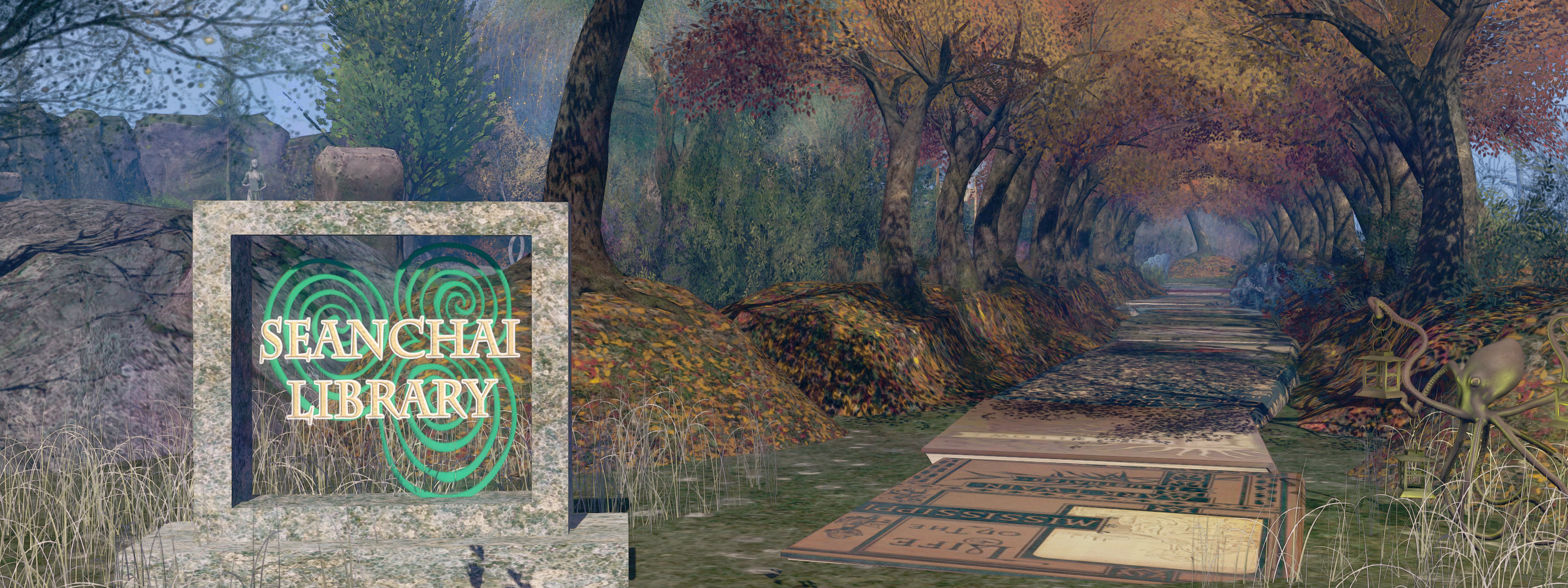
It’s time to highlight another week of storytelling in Voice by the staff and volunteers at the Seanchai Library. As always, all times SLT, and events are held at the Library’s home in Nowhereville, unless otherwise indicated. Note that the schedule below may be subject to change during the week, please refer to the Seanchai Library website for the latest information through the week.
Monday, January 18th, 19:00: The Dark Bright Water
Gyro Muggins reads Patricia Wrightson’s second novel charting the life of Wirrun of the Inlanders.
First encountered in The Ice Is Coming, when Wirrun set out on a quest to overcome the rise of the ancient enemy of Australia, the ice-bearded Ninya, the young janitor now has a reputation as a Hero among the Inlanders (Wrightson’s fantasy view of the Australian Aboriginals). It’s not a title he appreciates; he would much rather just get back to his janitorial work.
But the spirits of the land are restless: Yunggamurra, a river spirit is lost, so uses her siren-like powers of song to draw to herself those who might might take her home. Her singing come to Wirrun’s ears, and those of an elderly aboriginal emissary, and he realises he must journey to the very heartlands of Australia to better understand what he is feeling.
This he does, with the old emissary and his friend Ularra. Once there, he discovers that a storm is indeed rising within the domain of the spirits, and he is uniquely placed to both find Yunggamurra and prevent the coming storm. And so his new adventure begins.
Scattered among poor, desolate farms, the clans of the Uplands possess gifts. Wondrous gifts: the ability—with a glance, a gesture, a word—to summon animals, bring forth fire, move the land. Fearsome gifts: They can twist a limb, chain a mind, inflict a wasting illness.
The Uplanders live in constant fear that one family might unleash its gift against another. Two young people, friends since childhood, decide not to use their gifts. One, a girl, refuses to bring animals to their death in the hunt. The other, a boy, wears a blindfold lest his eyes and his anger kill.
In this beautifully crafted story, Ursula K. Le Guin writes of the proud cruelty of power, of how hard it is to grow up, and of how much harder still it is to find, in the world’s darkness, gifts of light.
With Willow Moonfire.
Wednesday, January 20th 19:00: In Walt We Trust
More from Craig Johnson’s Sheriff Longmire Series with Kayden Oconnell and Caledonia Skytower.
The Green Run hot fire test: the four RS-25D engines on the SLS-1 core stage running close to full power in the Stennis test stand, January 16th, 2021. Credit: NASASaturday, January 16th saw NASA attempt the Green Run Hot Fire Test of the first Space Launch System (SLS) core stage.
For those who might be unaware of it, the SLS is NASA’s next-generation heavy-lift rocket designed to undertake a range of missions, with the primary focus being the US Artemis programme to return humans to the Moon. Once operational it will be the most powerful launch vehicle commissioned by NASA.
The Hot Fire test formed the final phase of the Green Run test programme, a series of tests vital to clearing the core stage of the rocket ready for it maiden – and only – flight, planned for the end of 2021. The “Green Run” title refers to the fact the test would be the first time all of the components and systems of a core stage would be operated in unison, just as they would in the lead-up to and launch of an SLS rocket.
As such, the Green Run actually comprises a sequence of tests numbered 1 through 8 – each designed to test different aspects of the core stage, gradually bringing everything together as a unified whole and culminating in the hot fire test.
The Green Run test sequence for the first SLS core stage. Credit: NASA
All of the test sequences have been carried out at the historic B-2 Test Stand at NASA’s Stennis Space Centre, Mississippi, and while some issues were encountered along the way, both technical and due to the weather, so eating into the “reserve time” available for getting the first SLS vehicle assembled and onto the launch pad, by Saturday January 16th, all of them – including critical fuel loading and unloading (700,000 gallons of liquid hydrogen and liquid oxygen) test – have been completed and signed-off, allowing the hot fire test to go ahead.
Planned for a 8-minute duration – this being the total time the core stage would be expected to operate its engines during a launch – the test commenced at 22:27 GMT, after some last minute minor technical delays put the count-down on a lengthy hold. Ignition saw the four RS-25D engines ignite milliseconds apart from one another in the sequence 1,3,4 and 2, quickly building up to a combined thrust of just under 726,000 kg – somewhat less than the maximum thrust of 900,000 kg they will reach in an actual launch, but sufficient for the purposes of the test.
Ahead of the test, thousands of gallons of water pour through the flame pit beneath the test stand – water is used as suppression system to absorb the sound from the engines, preventing it from being reflected back onto the vehicle, where sound concussions might damage it. Credit: NASA
The long duration of the test had been intended to allow a comprehensive test of things like engine throttling down / up and gimballing (swinging) the motors in a manner that would provide steering in a flight. However, 67.7 seconds into the test something – at the time of writing, NASA has yet to specify what – triggered the core stage’s automated safety systems, initiating a rapid and safe shut-down of the engines.
The RS-25 is one of the most powerful and advanced rocket engines in the world. Originally built for the shuttle, it is finding new life with SLS – a total of 16 former shuttle variants of the motor will be used to power the first four SLS launches. The four motors for this first core stage already have a distinguished flight career between them, having previously be used on a Hubble Space Telescope servicing missions, the mission that saw John Glenn return to space (STS-95 in 1998), and on the final space shuttle flight, STS-135 featuring the shuttle orbiter vehicle Atlantis (thus offering a direct link between the last flight of the Space Transportation System and the first launch of the Space Launch System). In addition, between them the four engines made six flights to the International Space Station prior to the end of the shuttle programme in 2011.
Four clean burns: the four RS-25D engines under thrust. Credit: NASA
Once those first 16 motors have been used, SLS will be powered by a new generation of RS-25 motor, built using the very latest technologies including components created using 3D printing which we decrease the complexity of the engines.
Despite the hot fire test lasting less than 68 seconds, managers and engineers monitoring the test were confident that they had gathered sufficient data to classify the run as a success, although it is not yet clear if a further test will be required, or whether the core stage can be dismounted from the test stand – originally built to test the core stage of NASA’s Saturn V rocket – and shipped to Kennedy Space Centre for integration with the rest of the vehicle.
All four RS-25 engines ignited successfully, but the test was stopped early after about a minute. At this point, the test was fully automated. During the firing, the onboard software acted appropriately and initiated a safe shut-down of the engines. During the test, the propellant tanks were pressurised, and this data will be valuable as the team plans the path forward.
In [the] coming days, engineers will continue to analyse data and will inspect the core stage and its four RS-25 engines to determine the next steps.
– NASA statement following the test
Future core stages won’t go through a similar Green Run; these tests were only required for the first core stage to confirm its design and gather vital data on its behaviour during its required operations. Instead, they will generally be fabricated at NASA’s Michoud Assembly Facility, New Orleans and then shipped directly to Kennedy Space Centre for vehicle integration with the rest of their launch elements in the famous cube-like Vehicle Assembly Building, used for the “stacking” of every Saturn rocket (both the 1B and V) and every shuttle system.
Once integrated with its upper stage, solid rocket boosters and payload, the stage will participate in the Artemis 1 mission to send an uncrewed Orion vehicle to, around, and back from, the Moon at the end of 2021.
The Edge is Kultivate Magazine’s gallery space specialising in black-and-white photography exhibitions, generally hosting ensemble art displays by artists responding to calls for artists that are periodically announced by the Kultivate team.
Sunday, January 17th marks the first such exhibition at the gallery for 2021, featuring artists Jessamine2108, Maaddi, Eucalyptus Carroll, Johannes Huntsman, Moora McMillan, Blues Rocker, Tempest Rosca, Jamee Sandalwood, Veruca Tammas, Vita Theas and Myra Wildmist.
Kultivate The Edge: Veruca TammasAs tends to be the case with ensemble exhibitions, the art is wide-ranging in subject matter, featuring avatar studies, reflections on SL art, landscapes, and more. The majority of the artists are familiar to me, and and individuals whose work I always appreciate seeing – although I admit that both Maaddi and Moora are two artists whose work I cannot recall having previously witnessed – and I admit that I found the three pieces presented by Moora attractive in both their subject matter and presentation; Path Near the Sea in particular.
One of the aspects of monochrome photography I particularly like is the matter in which it can add a depth of life to a image, often more so than if the image had been produced in colour. In the latter the subtleties within an image can sometimes be overlooked as the eye is drawn to admire the way colours have been used or blended; within a monochrome piece, the use of light and dark, whilst obviously presenting contrasts, tends to allow those subtleties to be gently teased to the fore.
Kultivate The Edge: Jamee Sandalwood
This is certainly the case with the majority of the images here, so much so that singling any out is a little unfair, however, I do admit to fining Jamee’s and Tempest’s pieces to particularly demonstrate this. The central image of Tempest’s trio for example, appears to have been pulled from the physical world; had it been in colour, there is a genuine possibility that even allowing for post-processing, its avatarian origins would be apparent.
The one exception to the general themes offered through this exhibition is from Johannes Huntsman. John is an artist who never fails to impress as he constantly seeks to broaden both his art and his technique. Here he presents four pieces that he has simply called his Geometric Collection, but which carry within them a strong vein of cubism with a measure of abstraction, making them an engaging selection which – and in difference to my comments above regarding the power of monochrome images – would be as engaging were they in colour; so much so, that I look forward to seeing more of John’s experiments in this style of art.
Kultivate The Edge: Johannes Huntsman
But really, all the artists in this ensemble deserve recognition for the pieces they have selected for this exhibition – as you’ll be able to see for yourself in the coming month, or indeed at the formal opening of the exhibition, which takes place at 13:00 SLT on Sunday, January 17th, within the gallery.





 Inara Pey: Living in a Modemworld