Hermes Kondor’s homage to the the sea in Second life

Vibes Gallery: Hermes Kondor – It’s All About the Sea

I first encountered the physical world photography of Hermes Kondor back in 2020, when he presented a magnificent select of photographs centred on the Tejo Power Station, Lisbon, Portugal, one of the country’s great heritage centres and home to the Electricity Museum (see: The beauty of steam machines in Second Life).

I was, to say the least, immediately smitten by his work: his use of lighting, colour, composition, together with an avoidance of post-processing, these were images inherently and natural captivating. As such, while his focus within Second Life since that time has been establishing the Kondor Arts Centre as a multi-facet arts hub, I have always been excited when I learn that he is exhibiting his own work in-world.

And so, while I could not make the opening at Eviana Raider’s Vibes Gallery, I was keen to hop over and visit It’s All About the Sea as soon as life offered me the time to fully immerse myself in Hermes’ latest exhibition.

Vibes Gallery: Hermes Kondor – It’s All About the Sea

For almost our entire history, humankind has had a relationship with the sea. It has been a source of food, a vast spread of blue that has called us to try to reach across its far horizon to touch whatever might lay beyond; it has romanced us with its mysteries and terrified us with it power, It has challenged our urge to conquer and master – if ever we could master so powerful and capricious a force. But, we have also sailed the seas of the world, and learned to harness their power; we have received their bounty and sought to use their power and beauty as a means to partake of sport.

All of this is very much captured in this exhibition, which Hermes has cleverly split into three individual sections within the gallery’s three halls, allowing him to bring forth specific elements of our relationship with the sea.

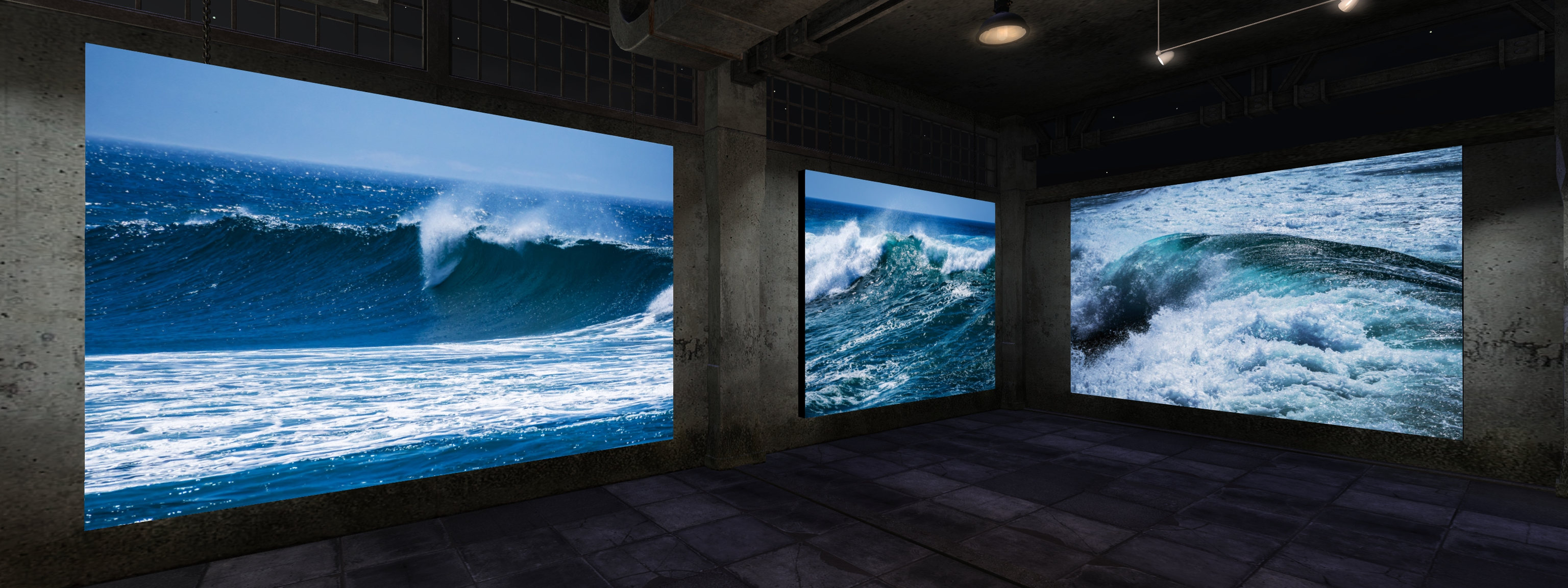
Within hall 7, Hermes presents Sea & Waves, a magnificent series of 11 photographs focused on the rolling power of breakers and whitecaps as they hurl themselves through the coastal shallows to batter and strike the shore. These are the kind of waves that are fearsome yet fascinating; the directly represent the sheer power the sea holds – and in a way, it’s anger at land’s temerity in trying to confront it and stem its ebb and flow; an action which is at times foolhardy: as the fine grains of sand that form the beaches of our coastlines and island reminds us, the sea is both patient and relentless, and given time, she will wear land down.

Vibes Gallery: Hermes Kondor – It’s All About the Sea

In some of these images we can see beyond the curl of wave and sweep of foam to a glittering expanse of ocean stretching out to hazy horizons of the kind that have called to us throughout time to reach towards and beyond. These views are further underscored by the opening stanza of Emily Dickenson’s And if the Sea Should Part underscores the inherent challenge offered by these waves and those far horizons.

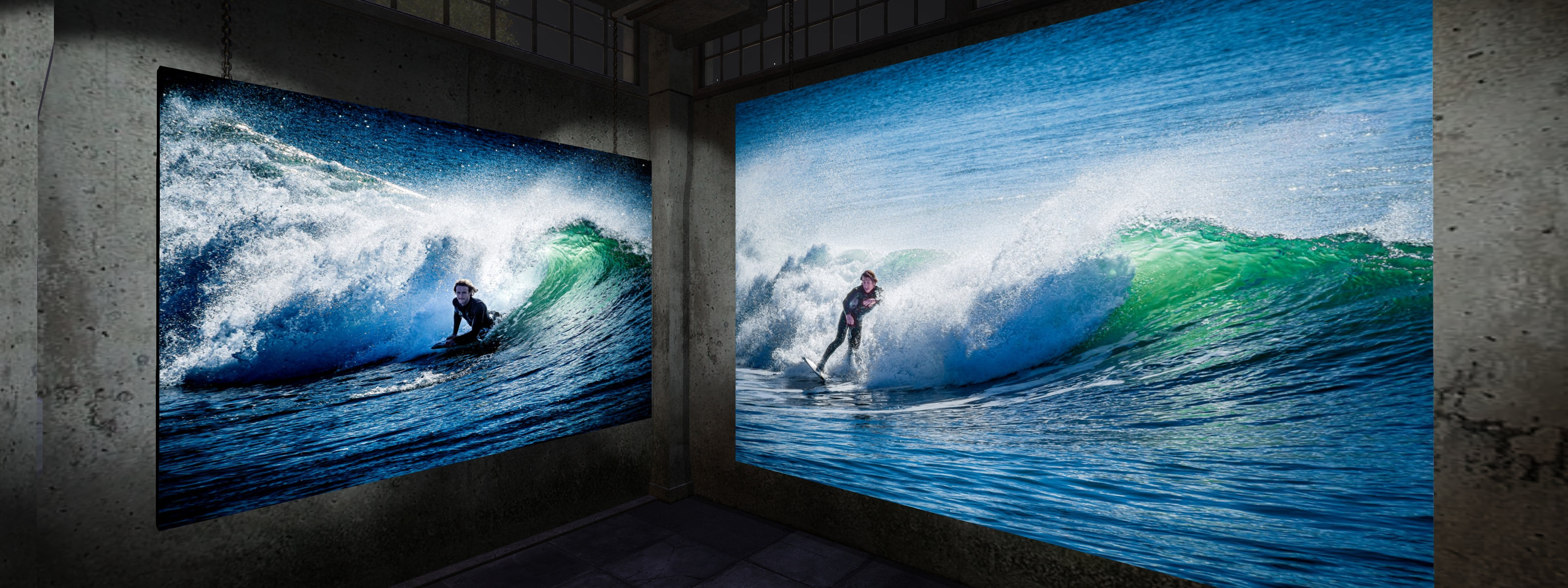
In Hall 8, reached via a connecting walkway, the study of waves and the idea of challenge continue, but are presented in an entirely different manner. Here, within a further eleven images, we are presented with Surfer, simply stunning images of surfers taking on and using the power of waves, riding them from initial roll through to where the water repeatedly kisses the shore before retreating once more to re-gather its strength. Thus, through these images, Hermes carries us to a place where our relationship with the sea is bound within the sporting challenge of trying to master its power and demonstrate skill and artistry within its rolling thunder; a love affair between Man and wave that is again carefully amplified through the words of Fernando Pessoa.
Vibes Gallery: Hermes Kondor – It’s All About the Sea

The images in Halls 7 and 8 are utterly captivating not only for their subject matter, but in the sheer skill Hermes has used in taking them. The clarity with which he has captured roiling white anger of wave crests as they curl over deep blue-green troughs; and retained the natural blue-green colour of the troughs themselves that call forth thoughts of the depths of the oceans is just stunning, as is the clarity with which Hermes has caught the faces of the surfers. Nor is that all; looking at these pictures one cannot help but hear the roaring boom of the sea’s coastal voice and feel the fine spray of salt carried from wave tops to shore on the accompanying winds.

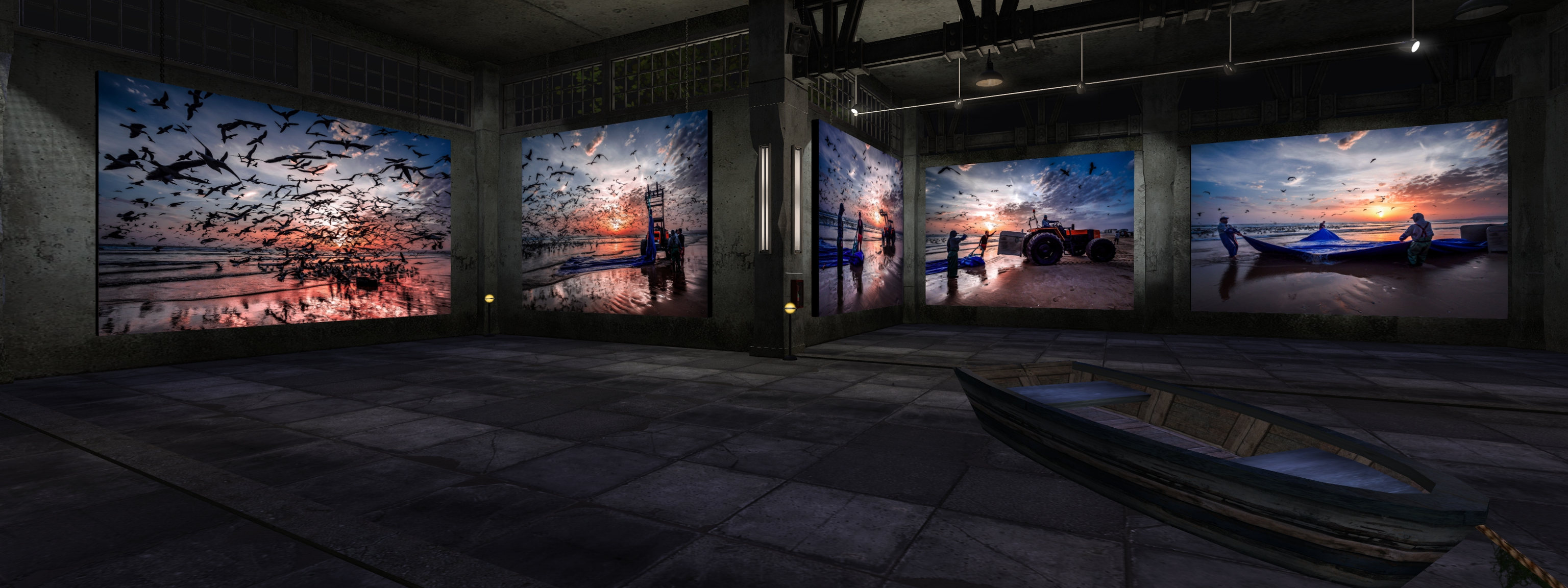
Across the courtyard in Hall 9, is a series of 15 images that are again utterly masterful in their framing, colour and focus. Beach Workers differs somewhat from Sea & Waves and Surfers, as there is very much a narrative flow to the 15 pieces within it; a story of the sea and its place in our lives as a source of livelihood and of sustenance – and not just for humans. To the left, on entering the hall are five images depicting the life and work of coastal fishermen, taking to the sea against the rolling and split of early-morning waves to cast their nets to seek whatever bounty the waters below might yield, before returning as the Sun lowers itself towards the horizon, and the work of taking the catch and clearing / drying the nets begins.
Vibes Gallery: Hermes Kondor – It’s All About the Sea

This is a story that continues through the five images to the right of the hall’s entrance, where the work gains interlopers in the form of gulls and seabirds, perhaps alerted by the commotion on the beach and the scent of fish carried in the breeze, and who have arrived to see what they might get away with helping themselves to. Both of these arms of the gallery then give way to the final five images to the rear, where the fishermen and their wives, their work now done for the day, have mostly retreated from the sands to leave them free for the birds to claim, together with whatever thy might find forgotten or ignored by the fisher folk.

Each and every one of these images is utterly extraordinary in the depth of life it contains, be it aboard the little boats, pushed from the sands and riding their way over the incoming breakers or the swirling, fluttering masses of gulls wheeling in to seek their share of food. Within each picture again, not only is there a beauty of an individual scene, there is a rich suggestion of sound and smell that lifts each one from the level of a “mere” picture to a complete experience / story of life.

Vibes Gallery: Hermes Kondor – It’s All About the Sea

With its three interwoven but unique elements, It’s All About the Sea is not only a magnificent celebration of the sea and our relationship with it; it is a triumphal tour de force of the eye and hand of a truly gifted photographer and an exhibition not to be missed.

SLurl Details

2022 CCUG meeting week #4 summary

Grauland, January 2022 – blog post
The following notes were taken from my audio recording and chat log of the Content Creation User Group (CCUG) meeting held on Thursday, January 27th 2022 at 13:00 SLT. These meetings are chaired by Vir Linden, and meeting dates can be obtained from the SL Public Calendar.

Available Viewers

  • The Performance Improvements project viewer updated to version 6.6.0.567604, on Wednesday, January 26th.

The rest of the official viewers remain thus:

  • Release viewer: version version 6.5.2.567427 – Mac Voice hotfix viewer, January 13 – no change.
  • Release channel cohorts (please see my notes on manually installing RC viewer versions if you wish to install any release candidate(s) yourself).
    • Maintenance RC viewer, version 6.5.3.567451, issued on January 20th, combining the Jenever and Koaliang Maintenance viewers.
    • The Tracy Integration RC viewer version 6.4.23.563771 (dated Friday, November 5) issued Tuesday, November 9.
  • Project viewers:
    • Mesh Optimizer project viewer, version 6.5.2.566858, dated January 5, issued after January 10.
    • Performance Floater project viewer, version 6.4.23.562625, issued September 2.
    • Legacy Profiles viewer, version 6.4.11.550519, dated October 26, 2020.
    • Copy / Paste viewer, version 6.3.5.533365, dated December 9, 2019.

General Viewer Notes

  • The Maintenance J+K RC viewer remains the most likely RC to move to de facto release status.

Fix for Long-Standing Animations Bug-11194

BUG-11194 “First frame of uploaded animations is triplicated” has been a long-standing issue (with workarounds) for uploaded BVH animations.

  • Aech Linden (a further transferee from High Fidelity) has been looking at the issue and developing a fix, although it involve a behavioural change for newly-uploaded
  • The explanation was garbled due to an network issue, but it appears the crux of the matter has been due to the way SL handles .BVH animations at upload, there have been two extra frame intervals added to the animation run-time, leading to errors in playback.
  • The fix is to remove the addition of these frame intervals (which occur at the start of the animation with zero interpolation.
    • There is a concern from the Lab that doing it unannounced could cause problems for new BVH uploads that include any workaround in anticipation of hitting the bug. Hence the heads-up on the change.
    • It was noted that a lot of pose stands BVN animations of just one frame, and the proposed fix might result in these giving “random” results from  a pose when new .BVH files are uploaded and placed in them by creators (particularly those using the in-world Anypose tool).
    • The fix will only impact new BVH animations uploaded to SL; it will not affect existing BH animations that have been uploaded.
  • The general feeling at the meeting was that most animators in SL use .ANIM rather than .BVH.
  • Given some of the confusion around the use of .BVH files, it is possible this change will be subject to a project viewer offered up for animators to poke at and provide feedback.

Animation Priorities and Capabilities

  • The ability to set the animation at run-time (rather than relying on the priority set aby the creator) to allow uses to adjust priorities between the animations that are using to avoid conflicts. Nothing is currently planned on this by the Lab, but it has been noted as a reasonable request.
  • It was noted that Firestorm has added the priority and other animation information the the animation playback floater.
Additional animation information Firestorm added to the animation playback floater
  • The core of the discussion focused on options for enabling animation priority changes (and other changes – such as animation speed) were discussed.
  • Changing the animation speed brings with it its own problems, so was tabled.
  • For priority, a manual capability + scripted capabilities were discussed, together with the potential to have options defined by list parameters supplied via the simulator.
  • No conclusions were drawn as to what might be attempted in the future (the animation system is not subject to any planned work) – although it was acknowledged that allowing the animation priority to be displayed by the viewer a-la Firestorm, should be a relatively simple change, were LL to opt for it.

In-World Build Tools

  • There have been numerous requests for the in-world build tools to be updated / improved. Currently, there is no project for this work, but it is something about which feedback was sought.
  • The request was specifically couched in terms of “limited but powerful” updates – so nothing along the lines of implementing a blender-like toolset within the viewer.
  • Feedback included, but was not limited to:
    • A “snap to” option in the existing build tools. (e.g. so a bookcase could be “snapped” against a room wall without having to be manually positioned).
    • The ability for reactors to offer “snap together” kits users can put together (and presumably mod as they go). This would be a more major capability with the ability to define connection points between items.
    • Options to amending particle and prim text properties directly (+ pivot points).
    • More complex asset items that allow “holes” for windows / doors.
    • A visual node system for in-world to allow people to code anything “super quick” (e.g. elements that contain scripted behaviours that can be put together / used in objects, rather than having to write text scripts).
    • Terrain as a prim (the prim is a heightmap texture when used).
    • A form of EEP setting that can be used as a backdrop / “surround” around skyboxes (like a cityscape or mountains in the distance) rather than having to use massive textured sculpties.
  • Support for Marvelous Designer (MD) clothing manipulation (as used by Sansar) was suggested. However, Runitai Linden, who worked on the MD implementation for Sansar described it as technically “not a great fit” for integration into Second Life on the grounds it didn’t work well in a 2D view using a mouse.
  • There has been some talk in LL about hidden surface removal on avatars (e.g. if a part of the body is covered by clothing, remove it rather than expecting it to be manually alpha’d out). However, there are complexities in doing this that may not end up as a “win” if some kind of ability were to be implemented.

In Brief

  • Custom pivot points (note: this was apparently subject to a lengthy discussion at the previous CCUG meeting, which I was unable to attend, so some context from these notes may be missing).
    • Rider linden has been working on simulator support for custom pivot points in avatar meshes. There is still some work to be dome, so there is no time frame when this work may surface on Agni.
    • Custom pivots can be set (and accepted) both at mesh upload or via LSL.
  • The latter part of the meeting was a technical discussion on the avatar skeleton, the morph skeleton, blend shapes, options for overhauling the avatar system, none of which are current projects.
  • Runitai did indicate LL is thinking about is replacing / augmenting the entire avatar imposter system – which is not particularly performant as it can cause viewer frame spikes when someone is camming around and causing avatars in their view to imposter, etc.  This would see avatars + their entire outfit that would be impostered undergo  hidden surface removal and have all attached meshes and materials baked into one meh material which would then be decimated down to as few draw calls and triangles as possible and then render that rather than an imposter.
  • It was confirmed in the meeting that PBR is to be a project, but no time frames on when it will reach a point of visibility.

An elven Perpetuity in Second Life

Perpetuity, January 2022 – click any image for full size

I’m starting this piece with an apology; back on July 2021, I visited Perpetuity, a Full region designed by Tamara Sierota and Camis Sierota (Camis Lee) – see In Perpetuity in Second Life. Following that piece, and in November 2021, Tamara e-mailed me with an invite to make a return visit to the region, which had been redressed for winter and – of particular interest to me, as she noted – carries an elven theme as well.

Unfortunately, I completely missed the e-mail and invite, only stumbling across it when catching up on some overdue filing and sorting. Ergo, I’m only now getting to writing about Perpetuity in its winter guise, and therefore offer apologies to Tamara and Camis for my tardiness in doing so.

Perpetuity, January 2022

To be honest, I do regret not having visited sooner; as someone with a deep love of Tolkien’s mythology and tales (from The Hobbit through to Unfinished Tales as well as Tree and Leaf, The Adventures of Tom Bombadil and so on), I was captivated by the setting from the moment I arrived at the landing point on the east side of the region. Not that this is a place that is “exclusively Tolkien”, so to speak – as a fantasy / elven setting, it casts its net wide; so it should appeal to those who many not be as enamoured with Tolkien’s writings but who enjoy winter and / or fantasy settings in general.

Certainly, the fact that this is a winter setting is a part of the setting’s magic. Possibly because of Tolkien (or fables in general), it’s likely that most of us associate elves with warmth, the greenery of woodlands in the spring and summer, etc. So in presenting a clear elven theme that sits within a wintery shell of ice, frost and snow-capped mountains, perpetuity carries us to another realm entirely; one that realm captures and holds the eye and the imagination.

Perpetuity, January 2022

Sitting on what at first might look to be a headland extending outwards into and semi-frozen waters of a mountainous coastline (to the west the land doesn’t quite merge with the off-region mountains, but lies close enough to give that impression), this iteration of Perpetuity sits as place that, but for the time of year, would be rich in the colours of woods and trees. Throughout the setting, can be found great twisted trunks of trees which in warmer months would hold aloft canopies of leaves to shade the broad paths that pass under them and offer places of rest away from the brightness and warmth of a summer’s Sun. Similarly, scattered across the region and along its edge stand copses and strands of birch and other trees that, when heavy with leaf, would draw curtains of greenery around the setting and between its buildings as if to drape them is a sense of privacy and natural separation of the world beyond.

Winter Magic – A place for quiet moments and photography with areas to bring your partner or to come alone and relax surrounded by nature in all it’s beauty.

– Perpetuity’s About Land description, January 2022

Perpetuity, January 2022

However, caught in the depths of winter as they are, these trees lie wrapped in coats of frost, their bare branches still raised aloft and splayed towards the sky, but only able to cast spindly shadows over path, terrace and courtyard, the stones of which all lay dusted with snow. Linked by stairs and bridge, these broad paths make circumnavigation of the island easy, naturally carrying visitors from place to place, and building to building, revealing all whilst also retaining some secrets that lie waiting to be found.

Watched over by the slender spires of a graceful castle that rise from the top of that high central mesa, the majority of the buildings lying within the setting are all of a distinctly elven look; the only potential exception being the more blocky, angular form of a more formidable castle to the north-west.

Perpetuity, January 2022

Furnished throughout, these are buildings that speak to a close-knit community, presenting living spaces, places for gathering (indoors and out) and places of ceremony and / or magic. As might be expected from an elven enclave, both art and music are represented here, and the entire design of the setting carries within it a natural sense of peace. Even the most casual glance around will reveal that considerable care has been put into ensuring this sense of harmony flows throughout, complete with touches here and there that help to both anchor it somewhat in Tolkien’s mythology whilst at the same time, naturally separating the two.

Take, for example, the presence of the Argonath. In Tolkien’s original tale, these huge statues represented Isildur and Anárion, the sons of Elendil, but within Peter’s Jackson’s 2001 The Lord of the Rings: The Fellowship of the Ring, Anárion was replaced by Elendil, who is also represented here (indicated by the fact he is holding the blade Narsil in his right hand). Thus, these statues offer a direct link with Tolkien’s tales, particularly calling reference to the Last Alliance of Elves and Men as symbolised by Elendil’s presence.

Perpetuity, January 2022

However, floating above and a short distance from them is a flying ship that removes this setting entirely from anything Tolkien presented in her core myths, allowing this iteration of Perpetuity to both acknowledge Tolkien’s influence on our thinking around elven folk and stand independently from it is a realm with its own history.

But whether you are a lover of fantasy or not, this is a setting that is beautifully considered and executed; a place that is a genuine joy to explore and photograph (join the local group for rezzing rights, if required – a help support Perpetuity in the process). For those who do wish to visit and witness this iteration of the region’s design, I understand from Tamara that it will remain available through most of February, after which the region is liable to be redressed for spring.

Perpetuity, January 2022

SLurl Details

Terrygold’s Rain in Second Life

Terrygold: Rain – January 2022

Rain.

I always wait for the rain, that thin, cold, bright … pleasant rain.
I remember that day on the path in the birch forest. The rain
was falling light, cold, illuminated by sunbeams, a light mist
rising from the ground. Motionless to admire, my memories 
were born then among white clouds, white cloud of sheets.

With these words, Terrygold introduces us to her January 2022 art exhibition Rain. In some respects, it is another personal exhibit that follows on from Empty Chairs (see: Terrygold’s Empty Chairs: remembrance in Second Life), offering a story that touches on both Terrygold’s art and life.

Terrygold: Rain – January 2022

From the above introduction, we are led along a passage suggestive of that path through the birch woods. It leads us past elements that add depth and presence to itself, delivering us to places where a story unfolds through images and words. As with Empty Chairs a part of the theme here circles around the fact of loss; unlike Empty Chairs, however, Rain doesn’t just encompass the impact of the permanent loss of those around us – although it certainly starts that way.

Rather, Rain provokes us into considering how a personal loss can shape us; isolating us as we respond to the loneliness it imbues by rejecting the contact and affection of others; how the pain of loss causes a retreat that  – whilst we may not be conscious of it as the time – results in an experience of further loss.

Terrygold: Rain – January 2022
At the same time, also wrapped within this is an exploration of time and how it, too, influences and changes us; the fact that of everything in life, time is our one constant companion. It marks the steps of our lives, the changes we experience. From the loss of those we love, through our other growth from childhood through to adulthood, it marks our desire to escape, whilst also offering what can be a warm / cold memory of those childhood years.

This is a poignant, personal journey, exquisitely frame in terms of setting, props and Terrygold’s images, marvellous self portraits  that express the emotions and feelings captured within the words and setting. These are pieces of extraordinary minimalism, extraordinary creativity and framing, and extraordinary depth.

Terrygold: Rain – January 2022
I love to take pictures by creating my own photographic set and using exclusively tools that Second Life provides without any kind of external editing.

– Terrygold describing her art

But to think the monochrome nature at forms the main aspect of Rain is a walk through loneliness or depression would be a mistake. There is a narrative here that brings together the ideas of loss, time and growth, that brings us towards acceptance and peace / understanding; self-recognition that – if I might barrow from T.S. Eliot –  times past and times present combine to paint our path into the future.

This latter aspect is beautifully illustrated in the final area within Rain, where the wild grass of the floor bursts forth in colours that are also reflected in the final set of Terrygold’s pictures. They bring with us the suggestion of warmth and comfort, a realisation that while we may still feel the coldness of loss and the rain of tears, there is still much in live that can bring warmth and colour.

Terrygold: Rain – January 2022

Perfectly designed and executed, Rain is another fascinating walk through the art and mind of a talented artist and photographer.

SLurl Details

2022 Land & Concierge meetings – week 4

The Concierge and Land User Group meeting area

The Concierge & Land user group meeting is generally held on the 4th Wednesday of the month “intended for discussion & education of SL topics such as current known issues and bugs, project viewers and new features, and general Mainland issues.” Attending the Wednesday, 26th January, 2022 meeting from the Lab were Wendi, Izzy and Vix Linden.

Please note, this is a summary, not a full transcript – so only those topics related to SL services, etc., managed / provided by the Lab on which there is general discussion and feedback from the Lab staff at the meeting are recorded below. For general audience comments, non-LL topics (such as TPVs) please refer to the video by Pantera embedded at the end of this article, and my thanks to her as always for recording the meetings.

2021 Review of the Year

[Video: 2:55-6:12]

Vix Linden raised the Lab’s December 2021 blog post looking back at 2021 and ahead to 2022.

  • Highlighted the upcoming new features – avatar expressiveness, Premium Plus, Mobile solution new user avatar customisation, script improvements, etc.
  • Noted that there are no ETAs for any of the work (although improvements in scripts running on simulators has been an improvement due to the recent tool update), as it is all either in progress or in the planning stages.
  • Pointed to the fact that with the Uplift transitional work completed, 2021 allows LL to focus on bedding-in services on AWS and starting to offer performance improvements.

High Fidelity Spatial Audio and Vivox

[Video: 6:34-8:52]

  • Following the announcement that High Fidelity Inc, has invested in Linden Research (money, skills sets and patents) there was speculation  – emphasis intentional, as some of it has been on this blog – that High Fidelity’s spatial audio might at some future point be integrated into Second Life.
  • In response to questions on this, the general feedback from the Lindens at the meeting was that this currently isn’t being planned or discussion in-house, and that as such, voice will remain on Vivox for at least the foreseeable future.

Simulator Updates

[Video: 20:44-23:03]

  • Vix re-iterated that the script performance improvements currently being seen is part of an overall “re-tooling” project that has been underway for some time that has involved changes to the hardware configurations used by the simhost servers and changes to the simulator code to better leverage the AWS servers and their supporting infrastructure.
  • In short: lower script time in the simulator stats (CTRL-SHIFT-1) – so 5ms instead of 15ms = script run improvements.
  • As noted via the official blog post on the subject and via my weekly Simulator User Group summaries, this change should manifest in better script run times and improved overall performance within a region.
  • A cautionary note with this is that with these improvements may come increased throttling elsewhere within the code (e.g. such as with, but not limited to, remote services accessed via llHTTPRequest), or where regions were already until a heavy script load.
  • Also referenced the deprecation of various older protocols (e.g. 1.0 and TLS 1.1, libopenmetaverse).

In Brief

  • [11:52-12:33] The research questionnaire referenced in this official blog post were mentioned, and the fact that the e-mails containing it (for those who receive them) will be coming from  research@secondlife.com, which is a legitimate Lab e-mail address. It was also stressed that the Lab will never request user divulge things like account passwords within this type of e-mail contact.
  • [16:22-16:50] Mention is made of the Tilia Inc., / Unity partnership announced on Wednesday, January 26th that will see Unity make Tilia’s services available to their community of developers – see the official press release and my own blog post for more.
  • [17:50-20:00] background was given to the Lab’s approach to employing outside of the United States, having offices elsewhere in the world, etc. The comments were predicated on some noting that Tilia Inc., (a wholly-owned subsidiary of Linden Research) has / has had a registered office in the UK since 2017. This segued into a discussion of LL providing 24/7 coverage by staff and the cost of doing so.
  • [31:07-32:10] A re-iteration to the changes made of off-line e-mail notification preferences (also see: Lab announces change to e-mail preferences for Group notices), and which came into effect from December 15th, 2021 – with a note that future options to control receipt of certain notifications via e-mail might be added at some point in the future.
    • There have been some reports that altering the settings can prevent the receipt of all off-line notifications via e-mail – which may well be confusion over setting the check boxes;  a request was made for people to double-check their settings (links in both blog posts above) if they are encountering problems in receiving off-line notifications.
  • [35:19-36:30] A reminder that the Valentines Shop and Hop event is on the horizon (Wednesday, February 2nd through Tuesday, February 15th, 2022), and that there will likely be the usual Valentines themed Last Names, the Hug a Linden, etc., activities, and so on.
  • [37:52-42:05] There are currently no known plans to extended the region / parcel ban list to support large numbers of names – those feeling it needs to be extended are asked to file a feature request jira.
    • Izzy Linden also indicated he has submitted an internal request to have listed automatically updated on the basis of account status (e.g. for accounts flagged as Closed are automatically removed from ban lists).
    • Izzy also warned about the “airlock” issue (as Izzy calls it) that could accidentally exclude people from region / parcel access (wherein there are allow / ban lists at both the region level and the parcel level, both of which have to be checked, but before the check is complete, users on slower connections time-out on their attempt to reach the region / parcel and so cannot reach it).
  • [54:50-56:40] In response to a question on the general mood at the Lab in the wake of recent changes / announcement, all they Lindens at the meeting indicated that they are personally “very charged” (positive) towards the direction in which SL is moving (including the move to AWS and what is being planned / implemented).

Philip Rosedale talks Second Life and the metaverse

On Tuesday, January 25th, Philip Rosedale held a Twitter Spaces event (also relayed in-world in Second Life and to other virtual spaces) to discuss “the metaverse” and Second Life and to answer questions from SL users / interested parties. He was joined from time-to-time by various guests notably Avi Bar-Zeev¹ who added their own thoughts.

The conversation was wide-ranging, extended over some 100 minutes. What follows here is an attempt at a summary of the key areas of discussion in terms of comments from Both Philip Rosedale and Avi Bar-Zeev. Given the natural flow of the event, with subjects being raised and returned to, rather than being discussed sequentially, I have attempted to summarise the comments into bullet-point under topic headings. Where I have felt it worthwhile, I have included audio extracts of the actual comments made as well.

General Notes for This Summary

  • The full audio for the event is currently available via Twitter Spaces, where it will remain available for 30 days from the date of recording – Tuesday, January 25th, 2022.
  • For the most part, the bullet points refer to comments made by Philip Rosedale. Those by Avi Bar-Zeev are intentionally under a sub-heading for easier identification.
  • Where provided, audio extracts below have been edited to remove pauses, repetition, non-relevant asides, etc., in an attempt to assist with understanding the flow of comments. Where this has been done, I have taken care to try to ensure none of the original context / meaning of the comments has been lost or in any way altered.

On His Role at Linden Lab

  • Reiterated that he is not back at the Lab in any form of a managerial role or full-time “at this time” [which I found a potentially interesting qualifier, if intended that way].
  • He is “delightedly” providing advice and attending meetings with Lab staff.

On Second Life’s History

  • Recalled SL’s modest beginnings as LindenWorld, and interactions with the first residents – such as Stellar Sunshine.

  • Noted that a challenge Second life has had throughout its history is that in allowing user-generated content (UGC) that interacts with the native controls / capabilities (such as the physics engine), it becomes increasingly hard to make substantive changes to the behaviours of those capabilities, lest they result in content becoming “broken”.
  • Also noted that SL was very much ahead of its time with things like its particle and water system (the latter of which allowed for splashes, etc., when object cross the water plane) had to be removed, because they were simply too computationally complex for either home computers to process in a timely manner or the available network bandwidth and server communications could transmit to other users in a timely fashion – with some of these problems still existing to this day.
  • Indicated that these are issues not confined just to SL:  they are lesson that need to be understood in building any user-driven virtual spaces.

On Moderating Virtual Spaces

  • Sees moderation of virtual spaces / virtual worlds as something that still needs to be fully addressed.
  • Believes the approaches to moderation taken by social media platforms and across the Internet as a whole are insufficient for immersive spaces utilising avatars – simply put, a single standard of rules applied from above by a single company will not work.
  • In particular sees a top-down approach to moderation troublesome for a number of reasons, including:
    • Those utilising Meta’s suggested approach of recording interactions so that in the event of a dispute / reported abuse, the last 10-15 minutes can be attached to an abuse report, could use the gathered data to also help drive any advert / content-based revenue generation model they might also use.
    • Top-down approaches risk utilising a “one size fits all” approach to disputes in order to minimise the costs involved in managing moderation activities, thus removing the opportunity for for subtlety of approach or taking into consideration the uniqueness of any given situation / group, potentially alienating groups or activities.
  • Instead, believes that there should be a more fluid approach to moderation more in keeping with the physical world, and adjusted by circumstance / situation, and that:
    • Companies need to look at how spaces within their platforms are used and what is deemed as acceptable behaviour by the people operating  / using them.
    • Enable the communities / groups using spaces to be able to self-moderate through the provision of the means for them to do so (e.g. provide their own guidelines backed by the ability for them to remove troublemakers).
    •  Recognise the fact that the majority of people will adjust their behaviour to suit the environment they are within and self-moderate according to expectations of that environment.
  • Toward the end of the session, notes that there is a risk associated with some aspects of decentralisation of moderation / control. Within Second Life, for example, decentralisation of land ownership brought with it issues of anti-social behaviour and griefing – ad farms, intentionally being abusive towards neighbours through the use of large billboards, sounds, etc., whilst making the land too expensive for it to be reasonably purchased.

From Avi Bar-Zeev

  • Avi Bar-Zeev

    Also notes that there is an inherent danger in how a company could use the recording / surveillance approach to moderation to profile users and to assist their ad / targeting revenue model.

  • However, he thinks the larger issue is that given the review of recordings associated with abuse reports that may be coming in by the thousand in a large-scale system is going to be human-intensive, then the use of AI systems to manage this process and minimise costs is likely inevitable. But:
    • How do we know the AI isn’t by its very nature, pre-disposed to “find bad behaviour”, and to do so without consideration of a wider context (pre Philip Rosedale’s warning).
    • How can we be sure AI programming is sufficient for a system to correctly recognise some behaviour types as being abusive.
    • Is dealing with incidents in retrospect and with limited supporting data (e.g. just 10 minutes of audio) actually the best method of handling incidents.
  • As such, also believes it is better to design systems wherein people are innately aware that they are dealing with other people across the screen from them, and so they self-moderate their behaviour (as most of us naturally do most of the time when engaging with others), and that there are ramifications if we then chose to be directly abusive towards others. In short, virtual spaces should “re-humanise” our interactions with others.

On Preferred Business Models for Virtual Spaces

  • The common practice for social platforms – YouTube, Facebook, each is the behavioural surveillance model noted above –  collecting data on user interests and activities, etc., and using that to push  content / adverts / etc., to users whilst also gathering an overall profile on them.
  • Sees the development of AI / intuitive algorithms in this space particularly dangerous as they grow increasingly capable of recording moods / states of mind / health conditions (particularly where facial / body tracking is utilised).
  • Much prefers the model offered by the likes of Second Life, where the emphasis is not on advertising revenues, content delivery for brands, etc., but rather entirely fee-based.
  • Notes that as it is, Second Life generates more revenue dollars per user per year than You Tube through its model, and probably than Facebook. As such, and with roughly one million active users, SL has proven the fee-based revenue model works, and it is fully scalable.

From Avi Bar-Zeev

  • Notes there has been criticism of some platforms that deal in virtual “land” than is really just vapourware.
  • Wanted to underscore the point that SL and platform like it do not fall into this category, because while the land is virtual, it is nevertheless underpinned by actual servers and infrastructure and support services that incur costs that are being met by the fees charged.

On Accessibility for Virtual Spaces

  • Points out that when people in Second Life talk about “accessibility”, it is invariably from the perspective of learning to do things within the platform – getting to grips with the viewer, walking, talking, building, etc., and the “steep learning curve”. However, would argue that the issue starts much earlier than that.
  • The real issue with accessibility is not what to do / how to do it, but in getting people comfortable with the idea of using avatars and virtual spaces.
  • Has personal experience of this through building both Second Life and High Fidelity² and notes that by-and-large a typical reaction of anyone being asked to sit down and try any virtual world / space for social interaction will likely express interest in the experience, but discomfort at the idea of making it a part of there daily interactions in the manner promoted by the likes of Meta, etc.
  • Ergo, the first step in accessibility is moving things to a point where people are comfortable within idea of using avatars and a virtual presence. Only when this has been addressed, and people are comfortable with the idea, can the wider issues of moderation, world-building, economics, etc., be tackled.
  • Believes the way to do this is to make avatars more visually expressive – which is itself a tough proposition [see, for one thing, the issue of the Uncanny Valley], and towards the end of the video expresses how this could be done by using webcams on laptops, mobile devices to capture facial expressions and have the back-end software then translate these onto avatar faces [an approach LL have indicated they plan to develop in 2022].

  • Does see spatial audio of the kind High Fidelity has been developing as a factor in enabling greater depth of interaction, particularly within groups of people, but really sees the ability to mimic facial expressions, gestures, etc., to provide that underpinning level of non-verbal communications as a core part of making avatar-based interactions more acceptable to a larger audience.
  • In terms of avatars, expressiveness, etc., does point out that avatars should not be equated necessarily to “digital twins”  – that your avatar must be a digital representation of Second Life, and his opinion is that this should preferably be true in future virtual worlds / spaces.
  • However [and assuming adoption of virtual spaces into the work medium] sees a possible issues over “class distinction” between those ability interact “in real life” in person or through mediums like Zoom, etc.,  and those interacting through the purely digital, which may have to be addressed.

On the Linden Dollar and Crypto-Currencies

  • Offers a background on the Linden Dollar and why it uniquely works as a virtual currency, presenting something of a mix between crypto and regulated fiat money.
  • Highlights some of the issues with current crypto and why it is presently not a good medium for virtual economies.

On Mobile – Second Life and in General

  • Second Life (and Facebook) arrived before the first of large-screen, images / graphics capabilities arrived on the market in the form of the iPhone. As such, SL was solely geared towards desktop systems, as there was no reason to even consider the idea of compact, powerful mobile devices.
  • Admires the way the Minecraft has made in-world building so intuitive on mobile, and believed that is something virtual worlds need to achieve.
  • Personally believes it is essential for virtual worlds to offer convenient access from multiple devices, noting that perhaps the biggest world-wide platform in this regard is probably Android.
  • Thus the question is one of what features can be included with a mobile solution, and which features should be included when compared to the more immersive “hands-on” capabilities.
  • Allowing for his status as an advisor, he can say that Linden Lab is actively working on mobile. [I try to provide updates on this when there is news, using the SL Mobile tag in this blog.]
  • Suggests that LL could possibly engage in some form of “smaller” acquisition³ or building on an open-source tool.

General Comments

  • In discussing the 20th anniversary of the rezzing of the first prim in LindenWorld – see: Happy 20th rezday to Second Life’s humble Prim!, noted that a good part of the magic of early virtual worlds was that of in-world, real-time building, including doing so collaboratively, and helped build a sense of social engagement and sharing which more recently platforms (or SL through mesh) have either never had or have perhaps lost.
  • In talking about the primitive system, drew a comparison with the current hype around NFTs, noting that (with the introduction of the permissions system) every prim in SL is unique in terms of its creator, data and time of creation, UUID and what subsequent owner might do with it (modify it, copy it, pass it on / sell it to someone else), all of which are indelibly recorded in its metadata.
  • Noted that if “the metaverse” is to be as influential on live and work, etc., as the world Wide Web, then it not only needs people, but content. In particular notes that at its peak growth, the WWW was adding 300,000 new pages of content a day (2012). Clearly, in terms of virtual spaces, an exponential growth rate is liable to prove too much for a single corporate entity to manage.
  • Re-iterates the view that in terms of VR headsets, it is not the weight, the nausea or (in the case of Second Life) potential issues around frame rates, etc., that is key to increasing general adoption by consumers. Rather, it is in making the use of such headsets more inherently “safe” and less anti-social in terms of using them in physical rooms / locations where others are present.

Footnotes

  1. Avi Bar-Zeev has been a pioneer, architect and advisor in Spatial Computing (AR/VR/MR/XR) for nearly 30 years, behind the scenes in the world’s largest tech companies and at large. In early 2010, he helped found and invent the HoloLens at Microsoft, developing the first prototypes, demos, patents, plans and UX concepts, sufficient to convince his leadership. At Bing, he built first prototypes for developer-facing aspects of AR, sometimes called the “AR cloud.” At Amazon, he helped create PrimeAir as well as Echo Frames. He most recently helped Apple advance its own undisclosed projects. In 1999-2001, he co-founded Keyhole, the company behind Google Earth, and helped define Second Life’s core technology (and created the code that gives us prims). Back in the 1990s, he worked on novel VR experiences for Disney, including “Aladdin’s Magic Carpet” VR Ride, the “Virtual Jungle Cruise” and “Cyberspace Mountain.”
  2. For those who may not be familiar with it, High Fidelity Inc was originally set-up to create a VR headset-centric, decentralised virtual spaces / virtual world platform. However, the company pivoted away from this in 2019/2020 with the realisation that consumer VR systems are these not yet a comfortable proposition for the majority of people.
  3. This should probably not be conflated with any idea of buying Lumiya (which has been a constantly-stated view by some users). so far as I’m aware, there is no line of contact between Linden Lab and Lumiya’s developer.