Onceagain Art Gallery: B&W Group Exhibit (l-to-r): etamae, Mariza Reifsnider, Madame Reve, Moki Yuitza, Whiskey Monday
Currently open (for a while longer, I hope, given its debut was August 11th, 2022), at Onceagain Art Gallery curated by Onceagain (Manoji Yachvili) is B&W Group Exhibit – the title of which pretty much speaks for itself, being an ensemble exhibition of black and white and monochrome photography featuring both Second Life landscapes and avatar studies.
And when I say ensemble, I really do mean it: a total of 24 artists have submitted at least one image for the collection. Some of those who have done so will doubtless be familiar to patrons of art in Second Life, and others may be less familiar names – although their art is no less engaging.
Onceagain Art Gallery: B&W Group Exhibit (l-to-r) :Manoji Yachvili, Zakk Bifrandt
Together they are: Apple Pippage, BlazeAme, Celestial Demon, Dane Albion, D’cuir, Etamae, Kika Yongho, Kunisaki Izumo, Lika Cameo, Nino Vita, Madame Reve, Manoji Yachvili, Mara Telling, Mariza Reifsnider, Mihalisk, Moki Yuitza, Nekonuko Nakamori, Opie, Terrygold, Scylla Rhiadra, Violette Rembrandt, Whiskey Monday, Yeya Zuta and Zakk Bifrandt.
Given this list, and breadth and depth of the images on display is impressive, with the restriction of having to remain with black and white (as the majority have, although there are a number of more monochrome pieces within the collection) adding to both the appearance and appeal of those where one is more accustomed to seeing the artist’s work in colour.
Onceagain Art Gallery: B&W Group Exhibit (l-to-r): Mara Telling, Ninoo Vita, nekonuko Nakamori
With 24 artists taking part, it is not surprising that the entire main gallery is given over to the exhibition – and in this it is especially well suited to the exhibition’s theme. The tonal quality of the gallery and its various rooms, coupled with the local environment setting leads an almost monochromic feel to the gallery, something further enhanced by the choice of décor placed within the various rooms, which heightens the feeling that the gallery is very much a part of the exhibit, rather than merely hosting it.
A further framing for the exhibition can be found on two of the gallery’s exterior walls, which feature quotes on the power of black and white photography from Ted Grant (1929-2020) – widely regarded as the father of Canadian photojournalism -, and Robert Frank (1924-2019), whilst the layout of the gallery, with its different rooms and levels (with access to the main hall down the stairs from the landing point, or to the upper level rooms via the catwalk, then using the internal stairs to visit the lower level) prevents the exhibition from every feeling “top heavy” from the sheer volume of piece on display.
Onceagain Art Gallery: B&W Group Exhibit (l-to-r): Terrygold, Manoji Yachivli, Violette Rembrandt and Apple pippage
As noted, I have no idea how much longer B&W Group Exhibit will remain open, so I would advise that if you should like to visit, you do so sooner rather than later, just in case!
Lavender Bay, September 2022 – click any image for full size
Shawn Shakespeare recently pointed me towards Lavender Bay, a Homestead region designed by Clifton Howlett, working with Camilla Lupono.
Cliff is formerly one of the creative hands that brought us the likes of Hidden Lake (more here), Hidden Bottle (which I wrote about here and here) and the celebrations of the Zamonia series of books by German comic creator and author, Walter Moers, The Empire of Dreaming Books (see here and here for more). Given this heritage, I was keen to see what might be found at Lavender Bay.
Lavender Bay, September 2022
Perhaps the easiest way to convey the setting is is quote from the About Land description / introductory note card available at the Lavender Bay Landing Point:
Welcome to Lavender Bay.
A SIM inspired by the Italian Tuscany. Make yourself at home and find your new favourite photo spot.
– From the introductory note card for Lavender Bay
Lavender Bay, September 2022
From this, it’s easy to guess that Lavender Bay is a place that is easy on the eye and engaging to the camera lens.
Located on the west side of the region on a small sandy headland, the landing point provides a keen senses of the region’s core theme – as a place of relaxation : several places to sit and takes things easy lay within in a few short paces away. Also close by is a boardwalk that climbs over the rocky south extent of the the headland and the bridge spanning a narrow gorge separating the headland from the rest of the region.
Lavender Bay, September 2022
The main part of the region offers exactly what its name suggests: a richness of lavender; some of which is being cultivated within a large field rolling away from a hilltop farm villa, some of which is growing wild lavender which climbs the remaining hills of the island, mixing its colours with wild flowers.
The easiest way to explore the region is to take the track that winds up to the villa from the bridge, and the path running down the hill from the villa, paralleling the lavender field before climbing the hill to the ruins of what might have once been the original farmhouse, from whence an old, broken cobbled path climbs the tallest hill on the island to the local windmill.
Lavender Bay, September 2022
Throughout all of this there is much to see, all of which is easy on the eye and presents multiple places to sit, relax and appreciate the region’s natural looks and beauty – and one or two places that offer the more unusual ways to sit (keep an eye out for the wooden chair being held aloft just off the coast by a single balloon.
Finished with a subtle soundscape, Lavender Bay is another place that requires little in the way of description and it speaks loudly for itself – so do be sure to hop over and appreciate it first-hand.
Puppetry demonstration via Linden Lab – see below. Demos video with the LL comment “We have some basic things working with a webcam and Second Life but there’s more to do before it’s as animated as we want.”
The following notes were taken from the Tuesday, August 30th, 2022 Simulator User Group (SUG) meeting. They form a summary of the items discussed and is not intended to be a full transcript. A video of the entire meeting is embedded at the end of the article for those wishing to review the meeting in full – my thanks to Pantera for recording it.
On Tuesday, August 30th, the simhosts on the Main SLS channel were updated with simulator version 574550. This release fixes an issue with some system textures being unavailable – notably the default water map being absent, resulting in totally flat glassy water or view-transparent mode having everything look solid..
On Wednesday, August 31st, all simhosts on the RC channels will be updated with simulator release 574611,which includes the above fixes + additional fixes (release notes pending at the the time of writing.
Available Official Viewers
On Tuesday, August 30th:
The Profiles viewer, 6.6.3.574158, was updated to de facto release status.
The Puppetry project viewer, version 6.6.3.574545, was issued – see below.
The remaining official viewers stay listed as:
Release channel cohorts:
Maintenance P (Preferences, Position and Paste) RC viewer version 6.6.3.573877 issued August 15.
Izarra Maintenance RC, version 6.6.3.573920, August 15.
Maintenance 3 RC viewer, version 6.6.3.573882, August 5.
Project viewers:
Love Me Render (LMR) 6 graphics improvements project viewer 6.6.2.573263, July 21.
Performance Floater project viewer, version 6.5.4.571296, May 10.
Previously referred to as “avatar expressiveness”, Puppetry is intended to provide a means by which avatars can mimic physical world actions by their owners through tools such as a webcam and using technologies like inverse kinematics and the LLSD Event API Plug-in (LEAP) system.
We are excited about Puppetry’s potential to change the way we interact inside Second Life. For example, using a webcam to track your face and hands could allow your avatar to mimic your face animations and finger movement, or more natural positioning of the avatar’s hands and feet against in-world objects might also be possible. Alternative hardware could be used to feed information into Second Life to animate your avatar – a game controller or mocap equipment. There’s a lot to explore and try, and we invite the Second Life community to be involved in exploring the direction of this feature.
– from the official blog post
Note that this capability is still very much experimental / in development and is not feature-complete. Also, the following should be noted:
The Puppetry viewer is very much experimental, and is required to view any puppetry animations – viewers without the supporting code will not show them.
The back-end support for the capability is only available on Aditi (the Beta grid) and within the following regions: Bunraku, Marionette, and Castelet.
No other special needs beyond the project viewer are required to “see” Puppetry animations. However, to use the capability to animate your own avatar and broadcast the results will take more work.
For further information, check out the documentation links below:
Again, please remember this is very much a “alpha” implementation of Puppetry:
Linden Lab is looking for feedback from the community in determining potential use cases and onward development.
The Lab will be hosting an open discussion on Puppetry on Thursday, September 8th, and 13:00PM SLT. This will take place at the Puppetry theatre in the Aditi region of Castelet.
Please refer to the video for further discussion on the capability.
Update, September 1st
The discussion on puppetry mentioned in the above articles will be the first such meeting, and if there is demand for it, there will be a similar meeting on Aditi on alternate Thursdays from September 8th onwards, to be held in the theatre on Aditi Castelet region.
These meetings will (initially) be very development focused rather than creator / user focused, given the overall status of the project.
It is advisable that attendees use the Puppetry project viewer when attending these meetings (available from the Alternate Viewers page), so that they might see any demonstration which may take place during meetings.
Logos representative only and should not be seen as an endorsement / preference / recommendation
Updates from the week through to Sunday, August 28th, 2022
This summary is generally published every Monday, and is a list of SL viewer / client releases (official and TPV) made during the previous week. When reading it, please note:
It is based on my Current Viewer Releases Page, a list of all Second Life viewers and clients that are in popular use (and of which I am aware), and which are recognised as adhering to the TPV Policy. This page includes comprehensive links to download pages, blog notes, release notes, etc., as well as links to any / all reviews of specific viewers / clients made within this blog.
By its nature, this summary presented here will always be in arrears, please refer to the Current Viewer Release Page for more up-to-date information.
Note that for purposes of length, TPV test viewers, preview / beta viewers / nightly builds are generally not recorded in these summaries.
Official LL Viewers
Release viewer: version 6.6.2.573358 – formerly the Maintenance 2 RC viewer, dated August 1, promoted August 4 – NEW.
Backlit by the setting Sun illuminating rainclouds, NASA’s Artemis-1 Space Launch System rocket sits on launch pad £9B at NASA’s Kennedy Space Centre, August 26th, 2022. Credit: ESA
If all continues on track, Monday, August 29th, 2022 will mark the start of America’s return to the Moon with crewed missions, just a few months shy of the 50th anniversary of the last crewed mission, Apollo 17 (December 7th-19th, 1972). It will come with the lift-off of the Artemis 1 mission, and the maiden flight of NASA’s new heavy lift launcher, the Space Launch System.
The mission will be – as most no doubtless know only too well – uncrewed, and the destination not the lunar surface, but cislunar space in what will be the most comprehensive test of the SLS rocket and the Orion Multi-Purpose Crew Vehicle (MPCV) ahead of crewed flights, which are due to commence with Artemis 2.
The final countdown for the launch commenced on Saturday, August 27th at launch pad 39B within the Kennedy Space Centre, Florida, and providing no significant hitches occur, it is due to terminate at 12:33 UTC on August 29th with the ignition of the booster’s four RS-25 shuttle-derived motors and two massive solid rocket boosters (also derived from those used in the space shuttle programme). At the time of writing this piece, and despite a thunderstorm leading to a lighting strike at the launch facility on the evening of August 27th, everything was on course for the launch, and the forecast indicated a 70% likelihood that the weather at Cape Canaveral and downrange from the launch pad would be good for the launch.
Artemis 1 SLS in Pad 39B at Kennedy Space Centre, imaged from orbit by one of the Maxar constellation of Earth-imaging satellites on August 25th, 2022. Credit: Maxar Technologies
However, all things are not guaranteed, and the mission has a slim 2-hour launch window in which to get off the pad. Should the launch have to be scrubbed for any reason, further launch windows will be available on September 2nd (2 hours), and September 5th (90 minutes).
There is a lot riding on this mission; while Orion has already flown once in space – eight years ago in the uncrewed Exploration Flight Test-1, launched atop a Delta IV Heavy rocket – this will be the first flight of the vehicle outside of directly orbiting the Earth; however, for SLS, the mission could very much be make-or-break. The vehicle has been beset by issues throughout its development programme (many of which amounted to either unforced errors or came as a result of the entire Artemis programme being unduly accelerated by the Trump Administration to achieve a crewed landing by 2024 rather than 2028, as originally planned. As such any major or catastrophic failure could have major repercussions for NASA and the US government space programme.
SLS has been more than two decades in development. It started life in the early 2000s as the Ares V under NASA’s Constellation programme. Instigated by the then NASA administrator Michael Griffin, Ares 5 was to be the heavy-lift launch vehicle intended to help return humans to the Moon and (eventually / primarily) help pave the way to Mars, working alongside the smaller Ares 1 crew launch vehicle and what was then called the Orion Crew Exploration Vehicle (CEV). I say “primarily”, because Griffin was a strong advocate of human missions to Mars and the Ares programme was actually named for (and pretty much lifted from) the Mars Direct humans-to-Mars concept first proposed by Robert Zubrin and David Baker in 1990.
Despite enormous strides made in the development of Ares 1 (the first of which actually few in 2009) and the Orion CEV, the Obama administration opted to scrap the constellation programme on the grounds of cost. While Ares 1 went away in its entirety, Orion and Ares V underwent a redesign process, the former having its capabilities increased, whist Ares V went back to the drawing board to later emerge as the SLS.
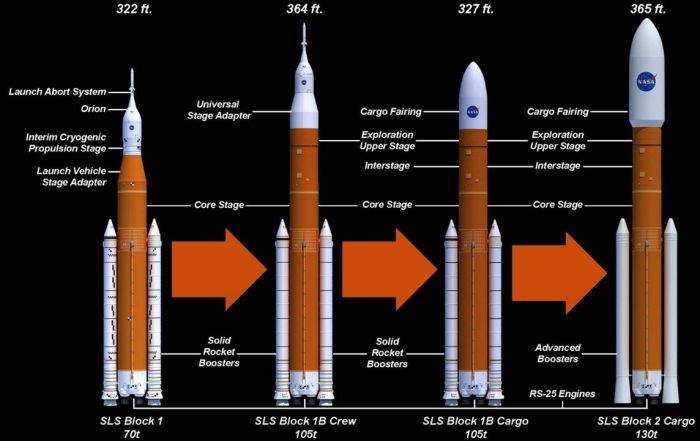
SLS development: on the left, the Block 1 with ICPS that will fly Artemis Mission 1-3. Centre left: the Black 1B EUS crew variant to flay Artemis 4-5(+). One the right, the proposed Block 1B and Block 2 cargo variants, that latter of which most closely resembles the Ares V Credit: NASA
The key differences between Ares V and SLS is the former was intended to be a heavy-lift cargo launcher, capable of delivering up to 168 tonnes to low-Earth orbit (LEO), up to 71 tonnes to lunar orbit and around 60 tonnes to Mars, with Ares 1 left to carry crews up to orbit. SLS, on the other hand is intended to be both a crewed and cargo launch vehicle, capable of delivering between 95 and 130 tonnes to LEO depending on the vehicle type, or some 46 tonnes to lunar orbit (Block 2 cargo) and 30-40 tonnes to Mars (Block 2 cargo).
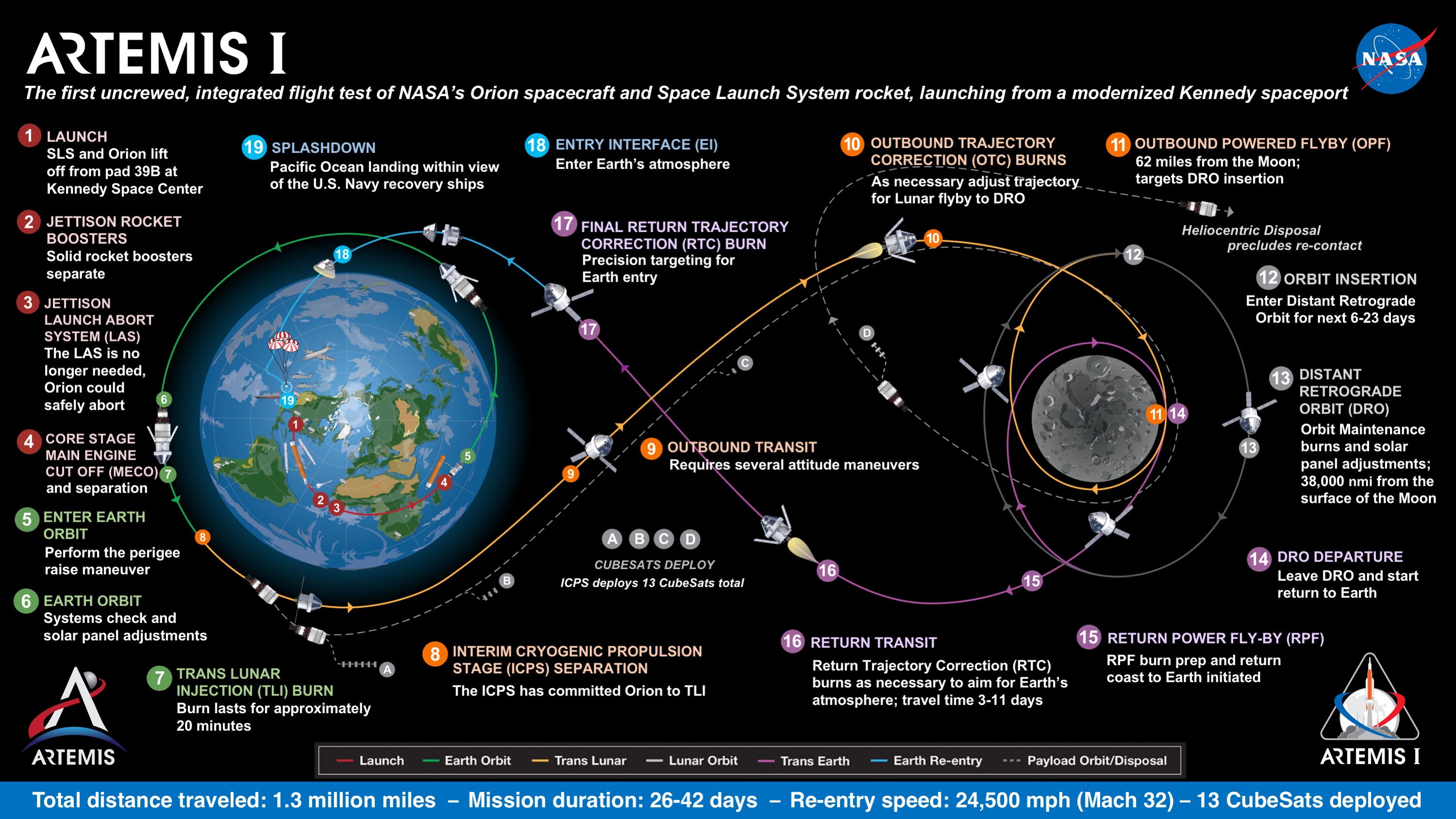
The primary objectives for Artemis 1 are to prove the SLS launch system’s Block 1 launch capabilities; achieve a distant retrograde orbit (DRO) around the Moon, and make a safe return to Earth with a successful atmospheric re-entry and splashdown by the Orion MPCV capsule. The overall mission duration is expected to be some 42 days.
This first flight – which will also mark the first use of the European-built Orion service module (Orion’s flight in 2014 didn’t require a service module) – is to be one of only three launches of the SLS Block 1 rocket. This uses what is called the Interim Cryogenic Propulsion Stage (ICPS) – essentially the upper stage of a Delta IV rocket. From Artemis 4 onwards, launches will use the more powerful Exploration Upper Stage (EUS) in what is termed the Block 1B SLS variant, and which will also be used in the Block 2 cargo variant (if this eventually flies).
The ICPS will be used to insert Orion into its trajectory to the Moon prior to separating from the capsule and its service module and performing one further crucial mission task. It will then pretty much parallel Orion to the Moon before using the latter’s gravity to slingshot itself away into a highly elliptical orbit of its own.
The flight of Artemis 1 as depicted in the mission’s Press Pack. The mission phase durations are variable to account for the different possible launch dates at the time the pack was published. Credit: NASA (click for full size)
As well as being used to check-out SLS and Orion, Artemis 1 has a number of science goals, and the Orion MPCV is not the only payload for the mission. Shortly after Orion separates from the ICPS, the latter – in that other crucial aspect of the mission mentioned above – will deploy multiple cubesats on trajectories to the Moon. These will carry out an range of scientific tasks, including:
Detecting, measuring, and comparing the impact of deep space radiation on living organisms (yeast in this instance) over long durations.
Studying the dynamic particles and magnetic fields that stream from the Sun and as a proof of concept for the feasibility of a network of stations to track space weather.
Imaging Earth’s plasmasphere to study the radiation environment around the Earth.
Searching for additional evidence of lunar water ice from a low lunar orbit.
Mapping hydrogen within craters near the lunar south pole, tracking depth and distribution of hydrogen-rich compounds like water over a 60-day, 141 lunar orbit mission.
Flying by the Moon to collect surface spectroscopy and thermograph and return the results to Earth for analysis.
In addition, some of the cubesat missions will be technology demonstrators, including a further solar sail demonstrator; using very small automated vehicles to operate in close proximity to large vehicles and image them / look for potential damage; using small, low thrust gas motors for trajectory control in the space between Earth and the Moon.
Nor is that all; Orion itself will be carrying a number of experiments within the capsule, with a focus on gaining a better understanding of the radiation regime between the Earth and Moon and within cislunar space.
The most evident of the onboard experiments is “Commander Moonikin Campos”, a mannequin dressed in the Orion Crew Survival System Suit. Sharing (OCSSS). Sharing same iconic orange colour as the survival suits used on shuttle missions, the OCSSS is a much more advanced version, designed to be worn continuously for periods of up to 6 days at a time (so whilst en route to the Moon, whilst in lunar orbit and during a return to Earth), to offer enhanced radiation protection for the wearer whilst aboard Orion. To this end the mannequin – named for Apollo 13 electrical subsystems engineer Arturo Campos, who played a major role in bringing that crew back to Earth alive – is equipped with a plethora of radiation sensors to test the effectiveness of the suit.
It’s time to highlight another week of storytelling in Voice by the staff and volunteers at the Seanchai Library – and this week previews the launch of a very special event.
As always, all times SLT, and events are held at the Library’s home in Nowhereville, unless otherwise indicated. Note that the schedule below may be subject to change during the week, please refer to the Seanchai Library website for the latest information through the week.
The are times when even Belgian ex-pat detective Hercule Poirot needs a break from his chosen vocation; so when the opportunity arises for him to enjoy a holiday in Devon at the Jolly Roger Hotel (inspired by the Burgh Island Hotel) located on a tidal island just off the south Devonshire coast, he looks forward to the chance of a little R&R.
Evil Under the Sun – a Seanchai Library special event
Whilst at the hotel, he encounters the other guests, notably Arlena Marshall who, desire being at the hotel with her husband Kenneth and step-daughter Linda, spends a lot of her time flirting with Patrick Redfern – much to the anger of Redfern’s wife, Christine and the disgust of her step-daughter. Also among the guests is Rosamund Darnley, who was once sweethearts with Kenneth Marshall.
Trying to keep himself apart from the intrigue, Poirot finds himself drawn into the middle of things and in need of his most particular deductive skills when Arlena Marshall is found dead on the sand of a secluded cove across the little island far from the hotel; a place where she apparently had a secret assignation…
Evil Under the Sun – a Seanchai Library special event
Join David Abbott, Corwyn Allen, Gloriana Maertens, Elrik Merlin, Kayden Oconnell, and Caledonia Skytower as they commence a reading of the 23rd adventure for Agatha’s Christie’s hero, first published in 1941, within the setting of the Jolly Roger Hotel. Should you wish, you can also enjoy the hotel’s grounds and facilities, partake of a little fun – and visit the cove which proved fatal for Arlena Marshall.
Monday, August 29th, 19:00: Remembering Ktahdn Vesuvino
Ktahdn Vesuvino: storyteller, music lover, traveller, warm-hearted companion, friend to charity – all this an more describes someone known to many and now lost to us all. A frequent weaver of tales at Seanchai Library, this will be a special evening of remembrance by all who knew him.
For all those who could not make Monday’s event, a further chance to remember Ktahdn and say their farewells.
19:00: The Last Cuentista
There lived a girl named Petra Peña, who wanted nothing more than to be a storyteller, like her abuelita.
But Petra’s world is ending. Earth has been destroyed by a comet, and only a few hundred scientists and their children – among them Petra and her family – have been chosen to journey to a new planet. They are the ones who must carry on the human race.
Hundreds of years later, Petra wakes to this new planet – and the discovery that she is the only person who remembers Earth. A sinister Collective has taken over the ship during its journey, bent on erasing the sins of humanity’s past. They have systematically purged the memories of all aboard – or purged them altogether.
Petra alone now carries the stories of our past, and with them, any hope for our future. Can she make them live again?
Caledonia Skytower read Donna Barba Higuera’s 2021 winner of the Newbery Medal and Pura Belpré Award.
Wednesday, August 31st 19:00: Seanchai Flicks
A special for Star Wars month as the Seanchai cinema space plays host to videos and throw popcorn around!
Thursday, September 1st, 19:00 More Monsters and Mythology






 There lived a girl named Petra Peña, who wanted nothing more than to be a storyteller, like her abuelita.
 Inara Pey: Living in a Modemworld