The following notes were taken from the Tuesday, October 11th, 2022 Simulator User Group (SUG) meeting. They form a summary of the items discussed and is not intended to be a full transcript. A video of the entire meeting is embedded at the end of the article for those wishing to review the meeting in full – my thanks to Pantera for recording it.
On Tuesday, October 11th, the Main SLS channel were restarted with no deployment, leaving them on simulator release 574921.
On Wednesday, October 12th, the simhosts on the RC channels should receive simulator release 575585.
This release should contain two new functions llGetObjectLinkKey (specified under llGetLinkKey) and llSHA256String.
In addition, a slight change to the simulator code may help with the issue of people’s on-line / off-line status not being properly reported. It is not an actual fix for the problem, but LL would like feedback as to whether people are seeing an improvement. See : BUG-232037 for more information on the issue.
Available Official Viewers
Release viewer: version 6.6.4.575022 – hotfix for Crash at ~LLModalDialog() – promoted September 15 – no change.
Maintenance 3 RC viewer, version 6.6.5.575257, September 23.
Maintenance P (Preferences, Position and Paste) RC viewer version 6.6.5.575055 September 19.
Project viewers:
Performance Floater / Auto-FPS project viewer, version 6.6.5.575378, October 4.
Puppetry project viewer, version 6.6.3.574545, issued on August 30.
Love Me Render (LMR) 6 graphics improvements project viewer 6.6.2.573263, July 21.
Local KVP / “Linkset Data”
From the server deployment thread:
Coming Soon. We have a new feature build on Aditi for a feature tentatively called Local KVP. This feature works similarly to Experience Key-Value store, but the data lives with the object that sends and receives the data. Only scripts in the same linkset will be able to read the data written with this feature. For more details, see the in-progress wiki pages [COMING SOON]. You can try out the new LSL functions related to this feature at the following Aditi Mainland regions:
We’re looking for feedback on this new feature including bugs and input on anything that might be missing or not work the way you’d expect. Please file a BUG Jira in all of those cases
To the above, Rider Linden added:
The data is stored on the root prim of a linkset and if you link two prims together (each containing LinksetData it will migrate the new non-root’s data up to the the root). The data is accessible to any script running in the linkset [but] it is not visible at all from outside the linkset.
This functionality was the focus of the majority of the meeting, with questions and suggestions coming from those attending. To avoid confusion through summarising questions / suggestions and replies, please refer to the video below, and also see also this forum thread.
Village de Roqueblanche, October 2022 – click any image for full size
On the advice of Shaun Shakespeare, I took a little trip to a corner of France here in Second Life, and found a setting rich in beauty and detail, offering a mix of public spaces and walks together with private residences.
Occupying a Full region utilising the private island land capacity bonus, Village de Roqueblanche is the work of Albane Claray (AlbaneClaray) and represents a corner of Provence, that region of France tucked between the Mediterranean Sea to the south and Italy to the east. Its location and topology offer a rich mix of climates and weather from the high slopes of the French Alps to the crystal waters of the Mediterranean.
Village de Roqueblanche, October 2022
I tried to reproduce a little corner of my country; a place with a Mediterranean feel very similar to Tuscany, Italy. It’s a land of many small villages nested in valleys or on hills, surrounded by lavender fields and vineyards and that so special light Van Gogh reproduced on his paintings. A village buried in my memories, a village where my childhood memories are asleep, stones worn by the rain, burned with sun…
Albane Claray
Journeys through the region start in the south-west corner and a square of an island separated from the rest of the region by a watery channel, a second channel separating the island from the neighbouring Homestead, also held by Albane, but which was under construction at the time of my visit – so I did not cross the bridge to avoid getting in the way of any building work going on.
Village de Roqueblanche, October 2022
The exact location of the landing point is, appropriately enough, right outside the local tourist office offering a little slice of Tuscan styling and overlooking one arm of the channel separating the island from the rest of the region. Above and behind the landing point sits the rest of the village, with houses and buildings arranged around two large squares. These have a Romanesque echo about them – something that is not entirely unnatural, given that Provence was the first Roman province established beyond the Alps, and its name is derived from the Roman name Provincia Romana.
A grand stone bridge spans the water to the western Homestead region, but to reach the rest of Village de Roqueblanche, it is necessary to leave the village on its eastern side and descend to where a small bridge gracefully arches across the water – the L’Auzon – to where a cart track winds its way through the rest of the landscape.
Village de Roqueblanche, October 2022
It is here that the private residences are located, so visitors should take care not to intrude. These houses are scattered to either side of the cart-tracks, but as each is marked by a large sign outside of the gates or steps leading to it, trespass is unlikely. Central to all of them is The Hamlet of the Mill.
Comprising a large farmhouse surrounded by tall walls and drystones which encompass a couple of the private residences, this is a place nevertheless open to the public, the farmhouse serves an a cosy restaurant visitors are welcome to visit; a place offering the first hint of the lavender Albane mentions whilst the wine served inside might have originated with the vines growing just outside of the surrounding walls.
Village de Roqueblanche, October 2022
This is a place where, no matter where you go, there is something to captivate the eye and offer opportunities for photography; a place that is a joy to wander and in which to pass the time.
My thanks to Shaun for the pointer and landmark, and to Albane for personally making me feel welcome.
The 22 ArtSpace: DeCarlo Maxim – The Art of Living in.adHD
Currently open at The 22 ArtSpace, the boutique gallery operated by Ricco Saenz and Randy Firebrand in Bellisseria, and running through until January 20th, 2022, is a fascinating selection of 14 photographs by DeCarlo Maxim (ReDDeE Hian), someone whose work I don’t think I’ve previously encountered.
Known in the physical world as DeCarlo Hoyte, and hailing from Montreal, Quebec, DeCarlo offers the fourteen pieces within the exhibition – entitled The Art of Living in.adHD – as a photo-essay in living with Attention-Deficit Hyperactivity Disorder (ADHD). As such, this is a very personal series – but one which is also very approachable – in which he takes a unique and engaging approach to his subject.
The 22 ArtSpace: DeCarlo Maxim – The Art of Living in.adHD
ADHD is a condition affecting behaviour; those suffering from it exhibit restlessness and difficulties in controlling behaviour, trouble concentrating or in staying focused, and may act on impulse. The disorder tends to be noticed at an early age, with diagnosis generally occurring when children are between 3 and 7 years of age (although it can be diagnosed much later); it tends to be triggered as a result of a significant change in circumstance – such as moving to a new house / neighbourhood or when starting school. For many, the symptoms tend to improve with age, but for around one-third of those afflicted, symptoms can continue through adolescence and adulthood.
As there is no single cause, ADHD is considered to be a result of an interplay between genetic (70%-80% according to the Journal of Learning Disabilities) and environmental factors, treatment tends to be highly individual and focuses on a range of potential one-to-one and / or group therapies and the possible use of medication.
Within The Art of Living in.adHD, DeCarlo offers a form of self-therapy whilst also offering us insight into his interactions with ADHD. However, he does so in a special way: rather than using his avatar, he offers photos taken in the physical world which utilise toy characters as their focus. In doing so, he achieves a number of things that really help draw the visitor into these pieces.
The 22 ArtSpace: DeCarlo Maxim – The Art of Living in.adHD
Firstly, by using little characters rather than his (or other) avatar(s), he avoid these pieces being taken as simple avatar studies in which looks, fashion and setting are the focus. The use of these little characters also subconsciously reminds us that ADHD does emerge as a childhood disorder, and can radically and lastingly impact the child’s trajectory through their young life. Finally, he can, as an adult, offer thoughts and insights into living with ADHD in the most subtle but direct means, sans the risk of character expression misleading the eye and mind.
Each piece carries with it an emotional content that in some is immediately and heart-rendingly apparent (e.g Always There, Lefted Out), and in others offers a sense of amusement and fun whilst still containing a deeper message (e.g. the I Am Grooot images, young Groot being a personification of ADHD behaviours, whilst always being repressively positive in his outlook on life).
The 22 ArtSpace: DeCarlo Maxim – The Art of Living in.adHDWhen viewing this exhibition, I do recommend you start on the ground-floor rooms, and after seeing Groot on the upstairs landing, go to the room immediately to the left of the top of the stairs (between Summer Dip and Self Reflecting), before moving to the room behind the stairs-top, which to me presents the two images that crown this exhibition in terms of their visual and emotive content.
Logos representative only and should not be seen as an endorsement / preference / recommendation
Updates from the week through to Sunday, October 9th, 2022
This summary is generally published every Monday, and is a list of SL viewer / client releases (official and TPV) made during the previous week. When reading it, please note:
It is based on my Current Viewer Releases Page, a list of all Second Life viewers and clients that are in popular use (and of which I am aware), and which are recognised as adhering to the TPV Policy. This page includes comprehensive links to download pages, blog notes, release notes, etc., as well as links to any / all reviews of specific viewers / clients made within this blog.
By its nature, this summary presented here will always be in arrears, please refer to the Current Viewer Release Page for more up-to-date information.
Note that for purposes of length, TPV test viewers, preview / beta viewers / nightly builds are generally not recorded in these summaries.
Official LL Viewers
Release viewer: version 6.6.4.575022 – hotfix for Crash at ~LLModalDialog() – promoted September 15 – no change.
Release channel cohorts::
No updates.
Project viewers:
Performance Floater / Auto-FPS project viewer updated to version 6.6.5.575378, on October 4th.
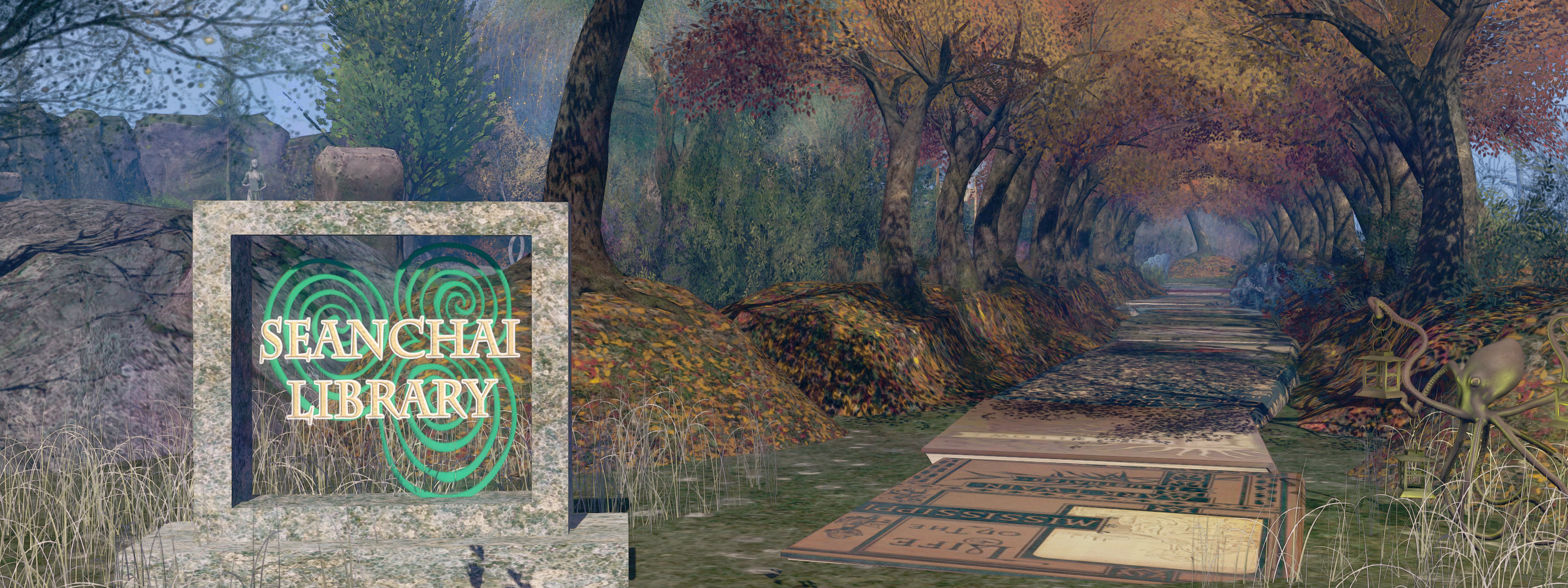
It’s time to highlight another week of storytelling in Voice by the staff and volunteers at the Seanchai Library – and this week previews the launch of a very special event.
As always, all times SLT, and events are held at the Library’s home in Nowhereville, unless otherwise indicated. Note that the schedule below may be subject to change during the week, please refer to the Seanchai Library website for the latest information through the week.
Two New York Police Department detectives investigate a series of suspicious deaths across New York City. These are revealed to be the work of a race of intelligent beings descended from canids, called the Wolfen.
The novel is told from the point of view of the human characters as well from the Wolfen themselves. The savage killing of two New York City policemen leads two detectives, a man and a woman bound together by a strange, tough passion, to hunt down the wolfen – once called werewolves.
Sophie has the great misfortune of being the eldest of three daughters, destined to fail miserably should she ever leave home to seek her fate. But when she unwittingly attracts the ire of the Witch of the Waste, Sophie finds herself under a horrid spell that transforms her into an old lady. Her only chance at breaking it lies in the ever-moving castle in the hills: the Wizard Howl’s castle.
To untangle the enchantment, Sophie must handle the heartless Howl, strike a bargain with a fire demon, and meet the Witch of the Waste head-on. Along the way, she discovers that there’s far more to Howl—and herself—than first meets the eye.
Caledonia Skytower reads Diana Wynne Jones novel.
Wednesday, October 12th, 19:00: Seanchai Flicks – Spooky Edition
It is no secret to my friends and regulars to this blog that I have something of a fascination with Fallingwater, the house American architect Frank Lloyd Wright designed for Edgar J. Kaufmann and his family in the mid-1930s.
Located in the in the Laurel Highlands of southwest Pennsylvania, the house is one of Wright’s most iconic designs, sitting as it does within woodland and partially built over a waterfall on Bear Run, a tributary of the the Youghiogheny River. It’s hard not to fall in love with it when seeing it for the first time in person or in picture or film, and I’ve reproduced it in-world for my own use on multiple occasions.
In this, I’m hardly alone; there have been a fair number over their years built with varying degrees of accuracy. However, none – my own included – come anywhere close to the original as does the Fallingwater build by Miltone Marquette. It is exquisitely detailed and painstakingly accurate; and thanks to a personal invitation from Miltone, I was able to pay a visit at the start of October 2022.
Fallingwater by Miltone Marquette – the Great Room is true to the original as seen in photographs from the Kaufmann era, with one or two added details from Miltone!
Miltone has a long personal association with Frank Lloyd Wright’s designs both in the physical world and in Second Life. In terms of the latter, he was one of the principal builder at the Frank Lloyd Wright Virtual Museum from its inception through until its unfortunate closure. his physical world interest reaches all the way back to his childhood, and has grown ever since.
Many years ago, my father would take the family on a Sunday drive around town and we stopped by the Dorothy Turkel house in Detroit; there was this reverence in Dad’s voice when he said, “This is a Frank Lloyd Wright house.”
In later years I discovered that a business associate was a big Wright-o-phile and took me around to some of the FLW houses in the area. I was hooked. Second life is a perfect place to explore Wright’s organic building concepts, and Fallingwater is the most perfect expression of those concepts; and while I build here to satisfy my own curiosity and interests, I do enjoy sharing my work with others.
– Miltone Marquette
With Fallingwater he has – like most who have sought to reproduce it virtually – focused on the main family house (the original property can be broadly divided into three structures: the family home, the Guest House sitting on the hill above and behind it, and the garages with staff bedrooms over, sitting perpendicular to the Guest House). In keeping with the original, the house is reached via the driveway as it passes over Bear Run on a single-track bridge to sweep around the house and under the car port alongside the front door, before (in the original) winding on up the hill and back on itself to reach the garages above.
Fallingwater by Miltone Marquette – the view from the bridge
Given Miltone and I worked from the same source material (albeit unknown to one another) and we both used the Erlanger scale in-world, our respective builds are very similar in terms of scale and size. However, when in comes to interior décor, Miltone has genuinely brought his build to life in a way I never have. His build is a house where every room is faithfully reproduced, from the Great Room through all of the bedrooms and bathrooms up to the uppermost balcony, and out through the kitchen and staff lounge and down into the basement rooms (the latter of which I never attempted to include).
All the furnishings have been reproduced to accurately represent their physical world counterparts, whilst the ornaments and fittings have been carefully selected to match those found in the house and on its terraces, as Miltone explained:
I would be remiss in not mentioning the decorative skills of SummerSails who studied photos and scoured SL for suitable furnishings. But I chose to use the dining chair design that Wright recommended, but which only got to be used in the Guest House; I much prefer Wright’s design over those purchased by Mrs. Kaufmann in Europe and used in the dining area. Also, the floor lamps are based on sketches left behind by Wright for lamps that the Kaufmanns never commissioned.
– Miltone Marquette
Fallingwater by Miltone Marquette – the master bedroom terrace
There are also some “non-canon” – so to speak – touches to be found in memory of Wright and of Miltone’s father. On the main landing, for example, a black-and-white photo of Wright at Taliesin (his home) can be found; whilst above the desk in the Great Room hangs a reproduction of a 2-cent postage stamp featuring Wright. This is a copy of a stamp Miltone discovered in his father’s footlocker, and so forms a nice memento – although Miltone prefers to describe it as being “so folks can get my 2 cents worth of FLW”!
Across the river from Fallingwater are two more of Miltone’s creations reproducing famous Wright houses / house styles. Sitting alongside the local highway where they are periodically passed by tour pods, these are the Robie House of Chicago, and the Jacobs House of Madison, Wisconsin; both are – like Fallingwater – US National Historic Landmarks.
The Frederick C. Robie House – generally referred to as the Robie House -, with its distinctive walls and roofs, is located on what is now the campus of the University of Chicago. It pre-dates Fallingwater, having been built between 1909 and 1910, and is today considered the finest example of Prairie School, the first architectural style of house considered uniquely American.
The Robie House by Miltone Marquette – also available for tours with Miltone
Meanwhile, the Jacobs House – also called the Jacobs First House, given Wright designed two houses for Herbert and Katherine Jacobs – is contemporaneous to Fallingwater, having been built in 1937. It is considered to be the first Usonian home Wright designed. Both it and the Robie House are again exquisitely detailed inside and out, and beautifully reflect their physical world namesakes.
In the physical world, the Robie and Jacobs houses are managed by the Frank Lloyd Wright Foundation whilst Fallingwater is in the care of the Western Pennsylvania Conservancy at the behest of Edgar Kaufmann Jr. Seeing all three requires planning, time and travel. Within Second Life they are all curated by Miltone as their creator, and visitors are able to tour all of them with considerably more ease. Should you wish to do so, please contact Miltone in-world via IM or note card, and he’ll work with you to arrange a mutually convenient time for a tour.
And just in case you need further convincing, I’ll leave you with a film by Suzie Anderton and available on her You Tube channel, which offers a taste of the beauty of Fallingwater in Second Life.
Again, if you would like to visit these iconic builds, please contact Miltone Marquette in-world.



 Sophie has the great misfortune of being the eldest of three daughters, destined to fail miserably should she ever leave home to seek her fate. But when she unwittingly attracts the ire of the Witch of the Waste, Sophie finds herself under a horrid spell that transforms her into an old lady. Her only chance at breaking it lies in the ever-moving castle in the hills: the Wizard Howl’s castle.


 Inara Pey: Living in a Modemworld