Logos representative only and should not be seen as an endorsement / preference / recommendation
Updates from the week through to Sunday, November 13th, 2022
This summary is generally published every Monday, and is a list of SL viewer / client releases (official and TPV) made during the previous week. When reading it, please note:
It is based on my Current Viewer Releases Page, a list of all Second Life viewers and clients that are in popular use (and of which I am aware), and which are recognised as adhering to the TPV Policy. This page includes comprehensive links to download pages, blog notes, release notes, etc., as well as links to any / all reviews of specific viewers / clients made within this blog.
By its nature, this summary presented here will always be in arrears, please refer to the Current Viewer Release Page for more up-to-date information.
Note that for purposes of length, TPV test viewers, preview / beta viewers / nightly builds are generally not recorded in these summaries.
Official LL Viewers
Release viewer: version 6.6.7.576223 – MFA and TOS hotfix viewer – November 1 – No change.
Currently open at Selen’s Gallery operated by Selen Love (Selen Minotaur) is an immersive multimedia installation by 9Volt Borkotron (with additional lighting support by Adwehe) entitled Sphereeletrik. It is actually one of three installations within the gallery’s spaces which between them feature the work of four artists (the other artists being Moya Patrick (Moya Janus), Livio Korobase and Bohemio Love (Bohemi0) – the latter two sharing the same exhibition space), and all of which opened on November 3rd, 2022. All of these exhibitions are worth of a visit, and can be reached via the main intra-exhibit teleport at the gallery’s main landing point, but here I want to focus solely on Sphereeletrik.
However, before I get down to discussing it in detail, there are a trio of points that need to be noted by those intending to drop into it if it is to be fully experienced:
Advanced Lighting Model should be enabled (Preferences → Graphics → make sure Advanced lighting Model is checked).
You should set your local environment to Midnight (to avoid media appearing washed-out).
You must enable MEDIA playback in the viewer (chick the movie camera icon in the top right of your viewer (v6) or in the media settings (v1.x) and accept the media stream. Failing to do so means you will not see the greater part of the installation.
Selen’s Gallery: 9Volt Borkotron – Sphereeletrik
The short form description of this installation is that it offers an enclosed space in which a variety of objects sit, hang or float. These range of sculptures to floating cubes and spheres to seating areas to exotic-looking plants. Some of these objects are static others are animated and may, like the walls, feature animated textures (in lieu of the media playback). Ramps slope and spiral into the upper reaches where – if you do not enable media – white prim faces appear to hang.
With media enabled, however, these faces, together with the walls and several other elements within the installation are transformed, becoming media surfaces on which patterns, images and colours are displayed and flow and dance – and not just randomly, as 9Volt explained to me:
It’s music I am streaming that generates the visuals. I created a server which uses a Fourier transform and other mathematical algorithms to measure the stream at 256 frequencies. The results are then displayed in real-time with the music in various ways, with the music offset just enough so it’s displaying exactly as the visuals appear for people in world. The data rate is about 320kbps – about the same as streaming an MP3 into SL, so it shouldn’t cause delay in viewer playback.
– 9Volt Borkotron
Selen’s Gallery: 9Volt Borkotron – Sphereeletrik
In addition to the external server handling the transforms and other calculations, the installation features an in-world script utilising sine wave controllers to count the prims and change some of their traits in iterative stages. This results in media played across some elements being staggered; for example, a pattern plating on one prim reaches a certain point in media playback, so it starts on the next, and on that playback reaching the same point, so the next starts, like a singing canon-in-the-round.
When taken as a whole, the results are – as noted – entrancing, and while walking around the installation is possible, I suggest sitting in one of the cushions and trying the installation in Mouselook and simply looking around at the different elements to see the play for media and patterns, images and colour and the way they chance over time in response to the music.
It’s likely that some of the latter may not be to everyone’s liking, as varied as it is (I’m admittedly not a great fan of EDM, which showed up on a couple of the tracks while I was visiting). However, there is a purpose to the mix of music within the installation (which incorporates instrumentals, pop songs, etc., as well), as 9Volt again noted to me during my visit:
My Gran, who was a music lover her whole life, was going deaf, so I thought that using images and light would allow her to appreciate her music using tunes she knows well, and letting her “see” the notes she could not hear, playing them back through SL and onto her TV screen. My hope is that this installation will give those in SL with hearing impairments a visual expression of music when otherwise they might only hear the bass parts of the music.
– 9Volt Borkotron
Selen’s Gallery: 9Volt Borkotron – Sphereeletrik
As a part of this, 9Volt is interested in gaining feedback from SL users with hearing impairments about this aspect of the installation, and in possibly working with them to further refine the technique to help those with hearing difficulties further enjoy music in alternate ways.
Intriguing as a concept, engaging as a visually immersive installation, and richly varied as a multimedia arts piece, Sphereeletrik makes for an engaging visit.
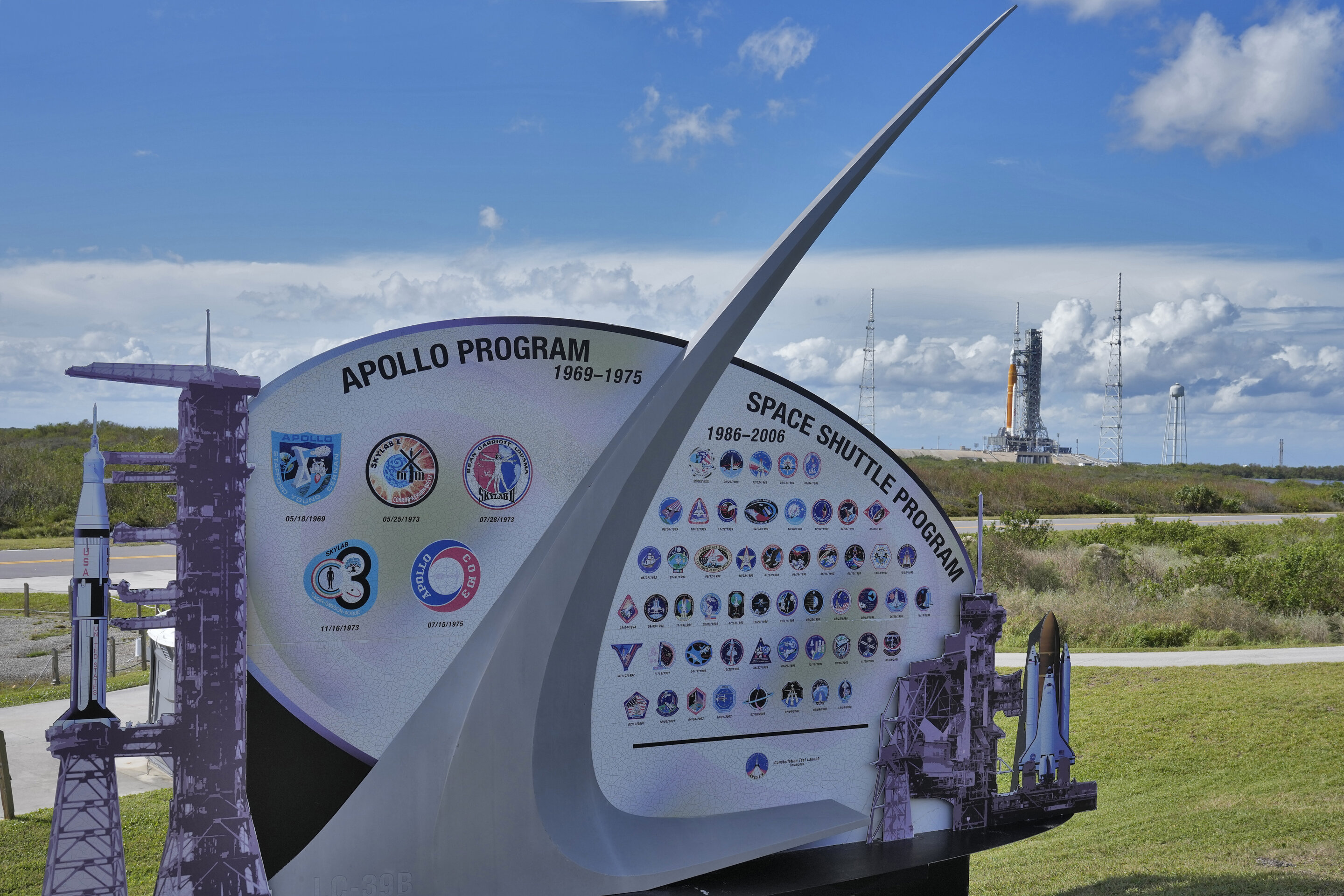
A shot from the viewing stand at Kennedy Space Centre showing Artemis 1 on Pad 39B, and in the foreground is a sign marking the 5 Apollo launches, 53 space shuttle launches and single Constellation launch undertaken from the complex. Credit: AP Photo/Chris O’Meara
NASA has confirmed that the first launch of its Space Launch system rocket will still go ahead on November 16th, 2022.
Concerns about the launch had been raised after the US space agency decided to leave the vehicle on the pad in the face of category 1 tropical storm Nicole, which made a Florida landfall south of Kennedy Space Centre on November 10th, with high winds and rain lashing the launch centre. However, in a statement made on November 1tth after the storm had passed, NASA stated the vehicle had suffered only minor damage – all of which will be rectified in time for the launch attempt to go ahead.
NASA was aware of the approaching storm ahead of returning the vehicle to Pad 39B on November 4th, but at the time, Nicole was an unnamed mild tropical storm with wind speeds measured at between 65-74 km/h, well below the threat level for the rocket and its launch systems. However, following roll-out to the pad, the storm rapidly strengthened, and the decision was taken to leave the rocket bolted to the launch pad rather than being caught on the move on the back of the crawler-transporter.
Overall, winds at the pad during the worst of the storm reached 132 km/h at 18 metres above the ground – just 5 km/h below the stress limit for the vehicle at that height. At the top of the tower, the wind was recorded at 160 km/h against an October 2021 stated maximum for rocket and launch tower of 172 km/h. These resulted in some damage being done to covers that would be detached during launch.
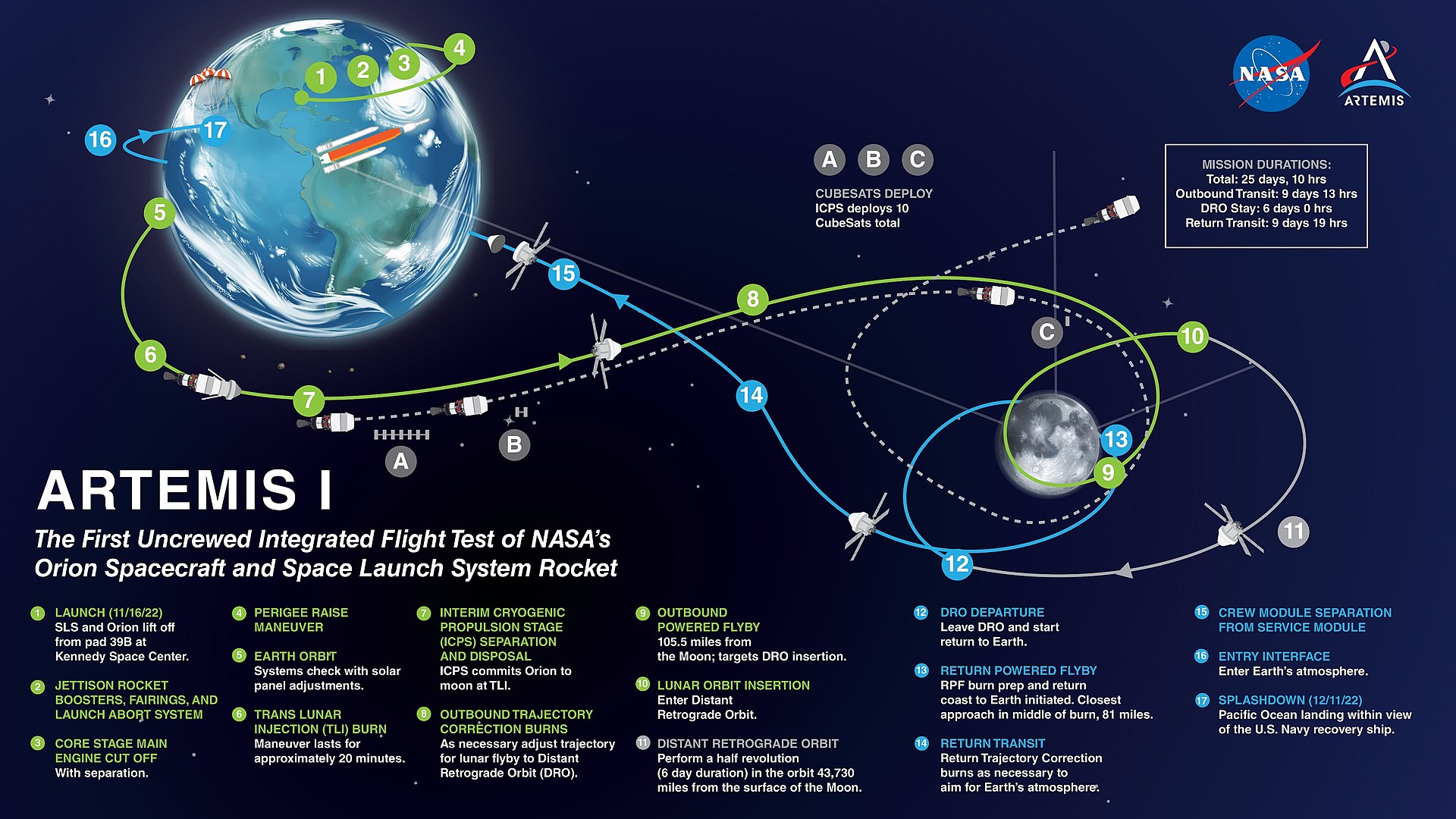
An updated infographic for the Artemis 1 flight. Credit: NASA
The November 16th launched of Artemis 1 is – as I’ve noted before – designed to send an uncrewed Orion vehicle on an extended flight to cislunar space utilising a distant retrograde orbit (DRO) around the Moon. It will last some 39 days and is designed to be the final uncrewed test flight of Orion (and the first Orion flight to use the European-built Service Module to supply the capsule with power and propulsion) as well as the first test flight of SLS itself.
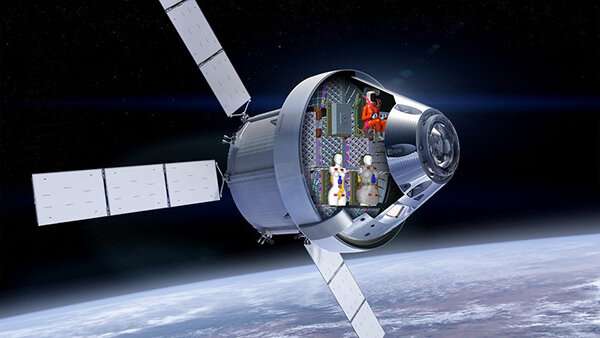
As well as testing the various vehicles and their systems for operation on missions to the Moon – and in preparation for sending humans onwards to Mars in the future – the Orion vehicle will also be carrying a set of sensor-laden mannequins dubbed “Moonikins”. As I’ve previously noted, two of these are part of research to better understand the radiation environment of space beyond the Earth’s protective magnetic field.
Despite the cavalier attitude shown towards it by the likes of SpaceX’s Elon Musk (radiation is “not that big a problem”), there is much we do not know about the impact of cosmic radiation on the human body – although there is growing evidence that long-terms exposure to GCRs and solar energetic particles (SEPs) can be extensively damaging – 60% of astronauts who have spent extended time on the ISS have developed herpes through the re-activation of naturally-occurring viruses in the human body such as the Epstein–Barr virus (EBV) as a likely result GCR / SEP exposure¹. These viruses can also give rise to serious medical conditions and (as well as the radiation itself) can also be responsible for various cancers².
This being the case, the “Moonikins” are constructed from materials that mimic human bone and tissue, as well as organs unique to adult females, such as breast tissue and ovaries, which are particularly susceptible to radiation damage. Equipped with over 6,000 sensors, the “Moonkins” are linked to a series of Earth-based computational 3D models which include cardiac and respiratory motions and can simulate any number of diseases. Overall, the aim is to gain a clearer understanding of the potential impact of high-energy radiation on human tissue, bone and organs that can hopefully help determine better means of mitigation – be it through recommendations on general exposure during things like space walks / lunar surface operations, or providing better primary and secondary radiation protection through the materials used in space vehicles and space suits.
An Artist’s rendering of the Artemis 1 Orion vehicle showing “Commander Moonikin Campos”, a full-body “Moonikin” designed to test the Orion Crew Survival System Suit (OCSSS), designed to be worn for up to 6 days and preserve the wearer’s life in the event of an issue with the vehicle’s primary life support systems, together with the two radiation research torsos “Helga” and “Zohar”. Credit: NASA / Lockheed Martin
In the meantime. those wishing to watch the launch of Artemis 1 can do so via NASA TV. The launch window opens at 06:04 UTC on Wednesday, November 2022 and lasts for 2 hours – although NASA is aiming to launch as close to the opening of the window as possible, with coverage of the launch preparations commencing some 24 hours in advance of the launch window opening.
Should the mission miss the November 16th launch window, there will be two further opportunities during the month. The first will open at 06:45 UTC on Saturday, November 19th, and the second on Friday, November 25th. Both will be “short form” missions of 25 days and between 26 and 28 days respectively. Should the mission miss those dates, there is an extended launch opportunity running from December 9th through 23rd (excluding December 10th, 14th, 18th and 23rd as currently stated by NASA), with windows then resuming in January 2023.
X-37B Returns Home
The US Space Force has ended the 6th flight of its orbital space plane, bringing the vehicle through re-entry and a rolling landing at NASA’s Kennedy Space Centre, Florida on Saturday November 12th, 2022. The landing brought to an end a mission of 908 days in space, the vehicle having launched on May 17th, 2020.
Officially called the Orbital Test Vehicle (OTV), the X-37B comprises two uncrewed vehicles of the same design, which together have completed six orbital missions for a combined time in space of 3,774.4 days (10.34 years). It was the first of these vehicles – OTV-1 – that completed this latest mission, itself slightly confusingly referred to as OTV-6, the first of these missions to be flown completely under the auspices of the United States Space Force, even if the vehicle carries the markings of the US Air Force.
The X-37B Orbital Test Vehicle 1 (OTV-1) sits on the runway at NASA’s Kennedy Space Centre following its landing on November. 12, 2022 to conclude the 908-day OTV-6 mission. Credit: U.S. Space Force
The exact function of the 8.92 metre long vehicle is rated as classified, leading it being labelled as a weapons platform. However, its primary cargoes thus far have been purely scientific in nature, with payloads being both military and civil in nature.
With this most recent flight, OTV-1 carried NASA’s Materials Exposure and Technology Innovation in Space, designed to further understand the effects of the space environment on different types of materials. It also carried an experiment to investigate the effects of long-duration space exposure on seeds. Past flights have carried both classified and unclassified tests of high-frequency communications and experimental propulsion systems, and one from the US Navy to convert sunlight directly into electrical energy.
A further first for this mission was the use of an expendable service module designed to both further extend the vehicle’s operational duration – the X-37B was originally designed to spend a maximum of 270 days at a time in space – and host additional experiments. This module was jettisoned from the vehicle prior to its return to Earth.
This mission highlights the Space Force’s focus on collaboration in space exploration and expanding low-cost access to space for our partners, within and outside of the Department of the Space Force.
– General Chance Saltzman, chief of space operations, USSF.
SpaceX Moving Towards Booster 7 Static Fire Tests
SpaceX has taken a further step towards a full static fire test of its Super Heavy booster as it continues to move towards the first orbital flight attempt of the Super Heavy / Starship combination.
As reported in my previous Space Sunday update, the company has been carrying out a series of cryogenic and pressurisation tests of both Booster 7 and Ship 24 – the pairing of booster and orbital vehicle to make this first attempt to reach orbit. These tests ended on Tuesday, November 8th, when Ship 24 was “unstacked” from the booster and moved to a sub-orbital test stand after its sibling, Ship 25, which had been undergoing its own propellant tanks cryogenic and pressurisations tests, being returned to the production facilities at Starbase Boca Chica, Texas, most likely to have its Raptor motors installed.
The “Mechazilla” arms on the SpaceX orbital launch tower start to lift Ship 24 clear of Booster 7 on Tuesday, November 8th, 2022. Credit: NasaSpaceFlight.com (not a NASA affiliate)
The removal of Ship 24 from Booster 7 leaves the way clear for the latter to undergo a further static fire engine test – part of the pre-requisites for any flight test. One such test has already been carried out with seven of the Booster’s 33 motors, and it is widely speculated that any forthcoming static fire test will involve around 14-15 of the booster’s motors, and could occur in the next week. A successful test should pave the way for a static fire of all of the vehicle’s motors, possibly before the end of November.
China Launches Tianzhou 5; Seeks to Launch More Long March 5 Vehicles
Following the successful rendezvous and docking of the Mengtian science module to their Tiangong space station, China has now furthered the operational campaign of the space station with the launch and rendezvous of the automated Tianzhou 5 re-supply vehicle.
The 10.6-metre long, 13.5-tonne (including 6.7 tonnes of cargo) vehicle departed the Wenchang Satellite Launch Centre, Hainan Province in on November 12th, lifted aloft by a Long March 7 booster. It was placed on a “fast rendezvous” track to the space station, reaching it just over 2 hours after launch. On arrival, it moved to dock with the rear axial docking port of the Tianhe-1 core module. That port had been occupied by the Tianzhou 4 re-supply vehicle since May 10th, 2022. However, that vehicle was detached from the station on November 9th under autonomous control and placed into an orbit in preparation for it to be safely de-orbited.
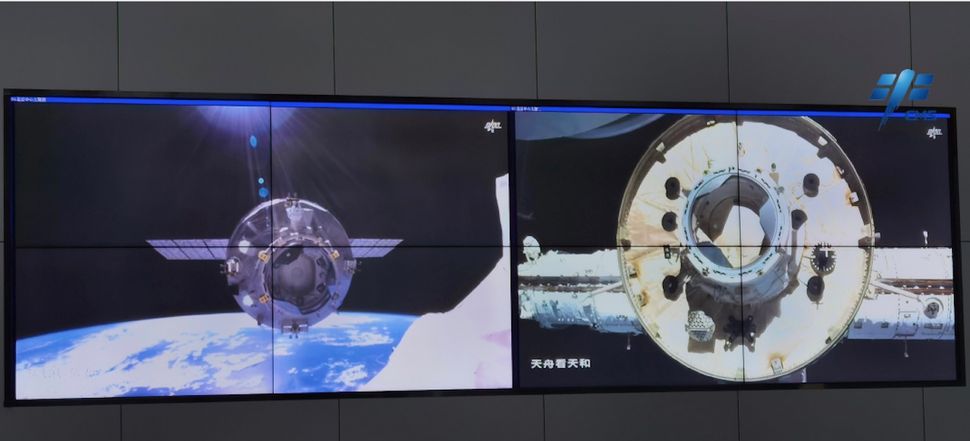
Images from China’s mission control showing pictures returned from Tiangong space station showing the Tianzhou 5 re-supply vehicle about to dock with the Tianhe-1 core module. Credit: CMSA
Tianzhou 5’s arrival at the station signals a further shift in Tiangong’s status as being “under construction” to being “operational”; it brings with it supplies for the upcoming Shenzhou 15 crew, who will flying to the station in December, and additional propellants for the station’s manoeuvring systems.
As I’ve recently covered, China has not made itself popular within the international community thanks to its unwillingness to manage the re-entries of the 21-tonne core stages of its Long March 5B booster. Most recently, the uncontrolled re-entry of such a core stage – the one used in the recent launch of the Mengtian space station module – saw cities and airspace across southern Europe and the Middle East on alert. This being the case, the news that China plans to step up the cadence of Long March 5B launches has raised some concerns.
In a statement made on November 11th, 2022, Liu Bing, director of the general design department at the China Academy of Launch Vehicle Technology (CALT), indicated that the Long March 5 booster will be transferred to “high density” launches. This means offering the vehicle to China’s emerging “private sector” space industry as a launch platform, and using it in high-volume “constellation” type launches of multiple satellites in one pass (as SpaceX does with its Starlink network).
To achieve this, the Long March 5B booster will likely be paired with the Yuanzheng-2 (YZ-2) upper stage. This may overcome the need for the core stage to achieve its own orbital velocity in lifting payloads, leaving it on a sub-orbital track to fall back into the ocean downrange from the launch site – although China has not, as yet, committed to this, and the YZ-2 tends to operate with varying levels of efficiency depending on the payload.
In the meantime, the next Long March 5B launch is due in late 2023, when the vehicle will be used to launch the free-flying Xuntian, the Chinese Survey Space Telescope (CSST), designed to operate alongside the Tiangong space station.
Monverdun, November 2022 – click any image for full size
November has rolled around once more, and in the northern hemisphere, winter is wrapping its arms slowly around us, prompting thoughts to turn towards thoughts of white Chirstmases, snowy holidays, skating, jingling bells, a chubby chappie with a bushy white beard (as he has become, courtesy of Haddon Sundblom), and more.
All of these “traditions” tend to come to the fore in Second Life as the end of the year rolls rapidly closer, with regions across the grid being re-dressed with snow and decorated trees to offer the opportunity for winter walks and /or romance, winter fun and photography. These regions take many forms, so much so that we are often spoiled for choice in terms of where to visit, what to see and do, so I’m getting this one in early, after taking the recommendation of my “sim sleuth”, Shawn Shakespeare.
Monverdun, November 2022
Monverdun is a Homestead region designed by yoyo Collas with the support of AmyDenise which offers, as the About Land description notes, a variety of winter / seasonal offerings liable to suit anyone, no matter what their wintertime preferences. And for me, that description is not wrong, as I’ll get too shortly.
Whilst describing itself as a “city”, the setting is really far more rural than that. Cut through from east to west by a broad river bordered on one side by a major road which does suggest it is a major artery leading to / from a major conurbation, and beyond which lie high snowy peaks suggesting this is a place sitting within a broad (and possibly formerly glacial) valley.
Monverdun, November 2022
Between the river and road and the mountain slopes, the landscape is largely wooded, the southern side of the setting dominated by a large country-style house. Across the frozen waters of the river are two former boathouses, now converted into riverside cabins with plenty of cosy warmth within them. Sitting between the two cabins is a large skating rink, blazing braziers and a hot chocolate kiosk offering the chance to warm both hands and insides for those who find the air and setting a little cold.
The rink – which offers the visitors the chance to skate – and cabins have attracted the attention of a string (or stud) or horses, the line of which passes behind them to stretch across the river and back through the woods near the country house. Okay, so maybe the rink and cabins aren’t the attraction for the horses; they are more likely moving to find pastures that are possibly easier to reach through the snow to be found on the north side of the region. However, their passage past the cabin and rink offers an additional sense of magic to both rink and cabins.
Monverdun, November 2022
However, these horses, making their way over the frozen water, form a rounded pointer back towards the large country house on the south side of the region suggesting they may have come from it – a suggestion possibly supported by the fact the house has stables along one wing. And it is this country house that actually attracted me to the region – although the reason for this is slightly convoluted and has little to do with Second Life.
This is because – a fair while ago now – the Christmas period for me was a time spent away from home at a country house hotel that offered a complete “non-Christmas, Christmas” – good company among friends, warm fires, wonderful meals, the opportunity to go to the local parish church services for those who wished, and most of all (as selfish as it might sound) the chance to just escape the rest of the world for a few days.
Monverdun, November 2022
Whilst that country house did not feature a Christmas market sitting before its main entrance, nor does it sit alongside a major road, there is something about the looks and styling of the house within Monverdun which carried me back to those days of Christmas getaways. For others, the region’s setting might offer different attractions and memories.
For example, with the hints of the 1940s in some of the traffic together the snow and lights, it’s not too hard to imagine Jimmy Stewart as George Bailey rushing along one side of the road, running back to town and home to face his future in It’s A Wonderful Life; while the hansom cab outside the gates leading to the country house offer a suggestion of Victorian Christmases (something not entirely unconnected to Capra’s 1946 film mentioned above).
Monverdun, November 2022
Richly photogenic and engaging Monverdun makes for a visit that will likely sit one’s imagination, offering much of the seasonal spirit without being overbearing.
Vibes Gallery: Like Blood, Like Fire, Like Passions in Second Life – Difficult Conundrum (l) and Dae Fangs (r)
Now open at Vibes Gallery, curated by Eviana Robbiani, is a further ensemble exhibition featuring the work of a dozen artists from across Second Life entitled Like Blood, Like Fire, Like Passions. It is an exhibition focused on the colour red, as the introductory notes for the exhibition explain:
Red is the colour of extremes. It’s the colour of passionate love, seduction, violence, danger, anger, and adventure. Our prehistoric ancestors saw red as the colour of fire and blood – energy and primal life forces – and most of red’s symbolism today arises from its powerful associations in the past.
A deep immersion in the magical sensuality of the colour red , which brushes vibrant images.
– from the introduction to Like Blood, like fire, like passions
Vibes Gallery: Like Blood, Like Fire, Like Passions in Second Life – Tutsy Navarathna
The participating artists comprise: Dae Fangs, Difficult Conundrum, Joanna Kitten and Peuxswau (Theatre 7); Dragonangelus, Exzoo McDonnel and Tutsy Navarathna (Theatre 8); and Amberly, Apple Roses, Jo Molinaro, Milhailsk Syros and The Base of Bad Ideas (Theatre 9).
Together, these are very different artists, some of whom I am familiar with, whilst the exhibition formed my first acquaintance with others, and whilst the number of pieces presented by each artist is variable, it cannot be denied that all of the pieces offered are striking in tone and content.
Vibes Gallery: Like Blood, Like Fire, Like Passions in Second Life – Amberly (l) and The Base of Bad Ideas (r)
Given the description of the exhibition, it should come as no surprise that the primary focus of most of the images is that of avatars; but the sheer richness and variance in the art – and the use of red within them is striking. As such, picking individual pieces or artists seems narrow-minded; but the fact is I have to admit I found myself heavily drawn to the work of Difficult Conundrum – one the artists whose work I had not encountered prior to this exhibition.
Offered as two sets of images – Tension, Back to You and Seeing Red, together with -08358 and Voyage – these piece are striking for their very different styles, with the formal presented as a trio of painting-like pieces which reflect a modern approach to physical world artistic statement.
Vibes Gallery: Like Blood, Like Fire, Like Passions in Second Life – Exzoo McDonnel (l) and Dragonangelus (r)
How well individual pieces reflect the central themes (passion, love, danger, anger, the representation of fire and blood) is a matter of personal responsiveness to the individual pieces, but again, I found myself drawn to those pieces with a more subtle suggestiveness / narrative within them – such as the images by Apple Roses and Amberly. But again, picking out individual pieces / artist within this exhibition would be unfair – all of the works offered are extraordinary in their sheer vibrancy and depth.
Puppetry demonstration via Linden Lab – see below. Demos video with the LL comment “We have some basic things working with a webcam and Second Life but there’s more to do before it’s as animated as we want.”
The following notes have been taken from chat logs and audio recording of the Thursday, November 10th Puppetry Project meetings held at the Castelet Puppetry Theatre on Aditi. These meetings are generally held on alternate weeks to the Content Creation User Group (CCUG), on same day / time (Thursdays at 13:00 SLT).
Notes in these summaries are not intended to be a full transcript of every meeting, but to highlight project progress / major topics of discussion.
Project Summary
Previously referred to as “avatar expressiveness”, Puppetry is intended to provide a means by which avatars can mimic physical world actions by their owners (e.g. head, hand, arm movements) through tools such as a webcam and using technologies like inverse kinematics (IK) and the LLSD Event API Plug-in (LEAP) system.
Note that facial expressions and finger movements are not currently enabled.
Most movement is in the 2D plain (e.g., hand movements from side-to-side but not forward / back), due to limitations with things like depth of field tracking through a webcam, which has yet to be addressed.
The back-end support for the capability is only available on Aditi (the Beta grid) and within the following regions: Bunraku, Marionette, and Castelet.
Puppetry requires the use of a dedicated viewer, the Project Puppetry viewer, available through the official Second Life Alternate Viewers page.
No other special needs beyond the project viewer are required to “see” Puppetry animations. However, to use the capability to animate your own avatar and broadcast the results, requires additional work – refer to the links below.
There is now a Puppetry Discord channel – those wishing to join it should contact members of LL’s puppetry team, e.g. Aura Linden, Simon Linden, Rider Linden, Leviathan Linden (not a full list of names at this time – my apologies to those involved whom I have missed).
Bugs, Feature Requests and Code Submissions
For those experimenting with Puppetry, Jiras (bug reports / fixes or feature requests) should be filed with “[Puppetry]” at the start of the Jira title.
The puppetry team is working on updating the viewer and LEAP plug-in, and an update to the project viewer is liable to be released in week #46.
This viewer includes:
The ability to move the avatar pelvis.
Ability to stretch other bones – although this is awaiting testing at the time of writing. However, the reference frame scale is that of the normal puppetry targets, so you would have to scale the data correctly; therefore additional work on this is required to provide a way for the plug-in to get the data necessary to know now to scale individual joint bones (e.g. change their parent-relative positions).
It still won’t be possible to clear puppetry target/config data, which remains on the teams “to do” list.
Aura Linden noted the new LEAP module it initialises on-demand rather than via instantiation (as with puppetry). LL will provide demos of using the new module.
Kincect v2 Support
Simon Linden has been working on an experimental plug-in taking inputs from a Kincect v2 device.
He describes the the code as being “pretty rough” and using only basic geometry, but it allows avatar elbows / arms to be moved around.
This work in part utilises the data syntax described in OPEN-366 “Simplify Puppetry Configuration Through LEAP”, the new protocol proposed by Leviathan Linden as per previous meeting notes.
The code is not ready to be pushed to a public branch as let, and doing so is somewhat dependent on feedback from developers /creators.
Avatar Constraints / Interactions
OPEN-368 “[Puppetry] [LEAP]: Location Constraints” – LL have indicated there is “much” within this Jira they would like to support “eventually”.
The feeling at the Lab is that constraints can “definitely” be improved – although what this may look like has yet to be properly determined. However, the general feeling is that there should be constraint data associated with a given skeleton, for example, so we’re not just imposing a human-centric model on the SL avatar.
A good portion of the meeting was given over to a general discussion of how best to handle puppetry and avatar animations – and the potential to need to move away from canned animations and provide a more direct means of avatar animation.
Avatar-object interactions are potentially complex issue (e.g. how can an avatar accurately take and hold an in-world object – say an apple) through puppetry? If the apple is a physical object, does it collide when held? Does it become an attachment? If the latter, how is this registered, together with hold is it properly released from the attachment system? etc.).
A suggestion for handling avatar’s handling objects is to have some for of temp-attach system or to use a key frame motion (KFM) system to match the position to the avatar’s hand, allowing the avatar can hold the object without directly “owning” it (thus also avoiding permission system issues).
Collisions also raise questions: avatar arms currently do not collide, and so would not under puppetry. So what about cases of simple interactions – flicking a light switch or similar. These are not “proper” collisions per se, but are rather event-triggered; how can this be managed if there is no actual collision between the scripted object and an avatar’s arm / hand to trigger the associated event?
In Brief
It has been suggested that a version number is included in puppetry-related messaging, so that changes to message formats are not read by versions of the viewer unable to do so, thus reducing the risk of crashes during development / testing.
It has been indicated that puppetry will eventually have LSL support for LEAP. Although what form this will take and how the simulator will track things is still TBD, as currently animations are entirely viewer-side and untracked by the simulator.
There is concern that understanding of the potential of the puppetry project isn’t being fully understood by creators (and others) as it is being seen more as a “VR thing” than an ability to much improve avatar animations and their supporting systems / constraints, including the IK system.
How to manage network latency also formed a core discussion, together with making better use of the Havok physics sub-licence to allow the viewer do a lot more of the work, and simply stream the results through the simulator to other viewers.







 Inara Pey: Living in a Modemworld