Aurelias, January 2023 – click any image for full size
For those wanting to obtain a touch of small-town winter might want to visit Aurelias, a Full region private estate held by Gorgeous Aurelia, and primarily designed by Sparkle (Sparkely Sugar).
Covered in a blanket of snow at the time of my visit, and sitting under a blue sky suggestive of a crisp winter’s day, this is a place offering a sense of old-world Americana, centred on a small town square where town houses mix easily with small businesses. The square itself – at least at the time of my visit – was still dressed for the holiday season, with snowmen, present boxes and Santa’s sleigh watched over by his little helpers.
Welcome to Aurelias, a place for all seasons. As you stroll along our shoreline, watch the seasons change and be enchanted by the beautiful scenery. Our lovely town is glistening with holiday cheer and humming with activity.
Aurelias About Land description
Aurelias, January 2023
It is within the town square that visitors arrive – and will be offered a teleport HUD by which to travel around and which provides links to additional information, such as the Aurelias website. Whether you need the HUD or not is debatable; the region is easy to explore on foot, although the HUD does form a handy aide-mémoire as to whether or not all of the points of interest have been visited.
These latter include St. Aurelias Church, sitting on a hill above the town to the north-west; the Bumble Bee Café and gas station to the south-west the artists’ retreat of the Conservatory, the standing stones overlooking two corners of the coastline, and more.
Aurelias, January 2023
All of them are easily reached by following trails and footpaths through the snow, bridges large and small offering the means to cross the local stream. As a part of the seasonal feel, the region includes a skating rink – a destination not noted within the HUD’s list of teleport locations, whilst the farm that is listed within it appeared to be absent as I explored.
Whilst this is a winter setting, there are signs that things are started to thaw, that spring is not far down the road; three are turning green and the blanket of snow is here and there holed by grass, moss and flower poking their way through in a promise of warmer times to come.
Aurelias, January 2023
This promise of warmer days is liable to see the beach running along the west coast become a lot more popular than at the time of my visit. Cut by the mouth of the region’s stream, the beach runs from below a large (and public) mansion up to where the local church sits.
Following the beach past the church will cause visitors to climb a slope and around the north side of the region to one of those islands of green and colour bursts from the snow. Located at the end of one of the town’s roads, this presents a covered area of broken and uneven cobbles sitting above a waterfall, the townward side of which offers a horse rezzer for those who would prefer to explore on horseback.
Aurelias, January 2023
Continue along the northern coast to its eastern extent and you’ll find the Rainy Café, a place that switches from winter to a sense of being in a tropical location. The snow gives way to grass and gardens sheltered from any off-shore storms by a reefs overlooked by a tall lighthouse sitting just off the coast.
As the name suggests, the café sits within a gentle fall of rain, its interior offers a dry retreat, the terrace just outside protected by the wall-height windows that hinge around their upper ends, and the eaves of the roof above them – although the decks beyond the terrace might suffer from a soaking should the rain decide to move!
Aurelias, January 2023
A charming location with plenty of opportunities for photography, Aurelias makes for a charming, easy visit – and I look forward to returning later in the year as the seasons change.
The greater portion of humanity’s history can, unfortunately, be told in terms of conflict and war. Whether driven by territorial desires, religious zealotry, political expediency, or inherent ethnic / racial divides, wars large and small, tribal, national or international have pockmarked the stories of successive civilisations. With the 21st century just into its 23rd year, we have already witnessed some 27 significant conflicts and wars around the globe – roughly twice the number seen within the first two decades of the 20th century.
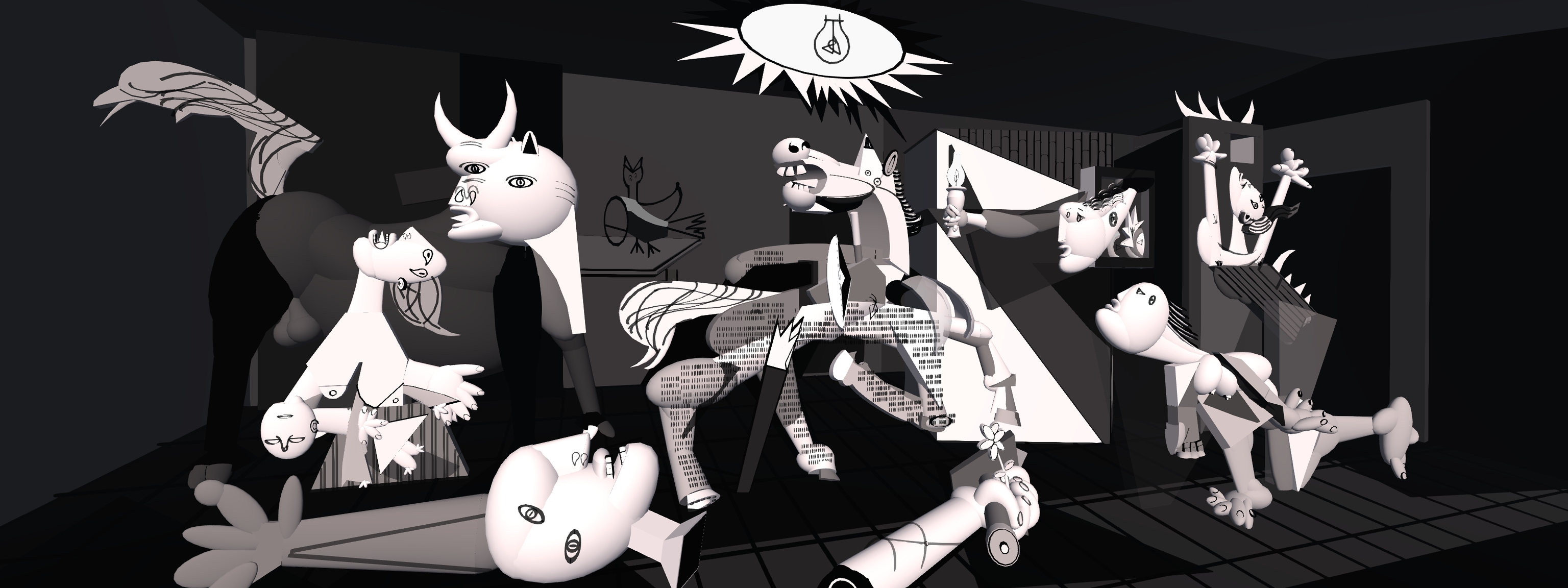
Little wonder then, that London Junkers has chosen as he latest installation – opening on Wednesday, January 11th, 2023 at 13:00 SLT – to bring back Guernica, his 3D reproduction of Pablo Picasso’s famous oil painting, regarded around the world by many through the years as the most moving and powerful anti-war painting in history.
For those unfamiliar with the painting, from mid-1936 through until late 1939, Spain was torn apart by a civil war between the then-Republican government (notably aided by Soviet Russia and by Mexico) and the Nationalists, lead by a group of generals who had failed to seize power in a coup d’état in mid-July 1936 and were aided by Fascist Germany and Italy.
London Junkers: Guernica – January 2023
As a part of that conflict, General Francisco Franco called upon the German Luftwaffe’s Condor Legion and the Italian Aviazione Legionaria to bomb the small – but to the Basques, historically and culturally significant – town of Guernica. Ostensibly, the raid was to deny retreating Republican army use of the town’s bridge to cross the Oka River. However, the use of incendiary bombs later the later raids carried out by the German Condor Legion and which set the town ablaze, does suggest the the bombing was intended to break the spirit of the Basque army.
The attack levelled almost all of the town, with it and the strafing of roads and streets by fighters was seen as a war crime. On hearing about the raid at his home in Paris, Pablo Picasso was horrified. Already been commissioned by the Republican government to produce a painting for the Spanish pavilion at the 1937 Paris International Exposition (and to raise funds for the Republican cause via exhibitions around the world), he decided to express his outrage at the murder of women and children – both of whom he saw as “the very perfection of mankind” – through a painting commemorating those lost.
London Junkers: Guernica – January 2023
In all, the painting – over 7.5 metres long and around 3.5 metres high – took Picasso 35 days to produce, and while it was the result of a commission by and for his nation’s Republican government, and he was himself an anti-fascist, and thus vehemently opposed to the likes of Franco, Hitler and Mussolini, he saw the painting as a means to express his overall abhorrence to the war and the effect the actions of both sides was having on his homeland.
The Spanish struggle is the fight of reaction against the people, against freedom. My whole life as an artist has been nothing more than a continuous struggle against reaction and the death of art. How could anybody think for a moment that I could be in agreement with reaction and death? … In the panel on which I am working, which I shall call Guernica, and in all my recent works of art, I clearly express my abhorrence of the military caste which has sunk Spain in an ocean of pain and death.
– Pablo Picasso
Interpreting the painting tends to be subjective; while there is clear symbolism throughout, some of which is clear – such as the woman on the left mourning the loss of her babe-in-arms; the woman with arms upraised to the right, the lick of flames both above and below her, the fallen, dismembered soldier -, so to is there symbolism (or metaphor) which is harder to discern. The presence of the bull and horse, for example; both animals have enormous significance in Spanish culture, and would appear to have significance here – but Picasso himself warned against reading too much into their presence other than, perhaps, as symbols of his nation.
London Junkers: Guernica – January 2023
But that said, the overall horror and destruction, the pain, death and sorrow that surround war is all too clearly evident throughout the piece. As such, when visiting London’s installation, I strongly recommend viewing it from far enough back so you can see all of the piece in a single frame such that it might be viewed as the original. From here all the nuances of the piece can be seen, such as the way the horse’s nose, nostrils and teeth offer a stylised human skull, for example. By moving / camming close helps to bring individual pieces within London’s interpretation of Picasso’s work, allowing us to ponder their meaning.
This symbolism also extends to the landing point / event stage for the installation. Sharing the same black / white / greyscale tones as the painting, this area features two Junkers dive bombers (not actually used in the Guernica raid, but utterly symbolic of the terror of warfare), swooping down on the stage. Between them, a dove – the symbol of peace – sits trapped within a sphere, a symbolism which speaks for itself. Above this sits the trunk of a tree, representative of both the line of Gernikako Arbola, or [oak] Tree of Guernica – a central facet of the Biscayan people (and by extension, Basques as a whole); and the third tree in the series (1858-2004), which miraculously survived the bombing of the town. Finally, two board on the stage provide, respectively, an introduction to the installation and London’s own indictment of war, in the form of a poem, might be read.
London Junkers: Guernica – January 2023
When writing about the original presentation of this installation in 2012, I noted it might be said that the bombing of Guernica washed away the last vestiges of the romanticism so often afforded war through word, verse and idealism. Sadly, it did not bring an end to war itself, as witnessed by the events that followed on the heels of the Spanish Civil War, and all the conflicts since, per the opening comments of this piece.
In this, and given all that is occurring within Ukraine in particular (and before it, Georgia), the return of Guernica to Second Life at this time helps reminds us that so long as we are driven by the need for power, for dominance (and dominion) over others and in elevating politics and / or religion above our fellow humans, the innocent will continue to suffer under the yoke of war.
The following notes were taken from the Tuesday, January 10th, 2023 Simulator User Group (SUG) meeting. They form a summary of the items discussed and is not intended to be a full transcript. A video of the entire meeting is embedded at the end of the article for those wishing to review the meeting in full – my thanks to Pantera for recording it.
Server Deployments
On Tuesday, January 10th 2023, the simhosts on the Main SLS channel were restarted with no deployment, leaving them on simulator version 576542.
On Wednesday, January 11th, 2023, the simhosts on the RC channels should see the deployment of the ability to to play 30-second sound clips and the new sound functions llLinkPlaySound, with llLinkStopSound llLinkAdjustSoundVolume and llLinkSoundRange which allow sounds in child prims of a linkset to be played without the need for a supporting script.
It is hoped that week #3 will see a deployment of an RC simulator update comprising custom HTTP headers (total space for headers will increase to 4k and the limit on the number of headers will be dropped), and new cryptographic signing utilities – potentially llHMAC (per BUG-233005) and llSignRSA and llVerifyRSA (per BUG-233009). These updates will be available for testing on the Juggly Puff region within Aditi (the beta grid) during the rest of week #2.
Available Official Viewers
This list reflects the current status of available official viewers at the start of 2023:
Release viewer: Maintenance P (Preferences, Position and Paste) RC viewer version 6.6.8.576863 Monday, December 12, 2022 – No change.
Maintenance (Q)uality RC viewer, version 6.6.9.577418, January 4, 2023.
Performance Floater / Auto-FPS RC viewer, version 6.6.9.577251, January 4, 2023.
Project viewers:
PBR Materials project viewer, version 7.0.0.577157, December 14, 2022.
This viewer will only function on the following Aditi (beta grid) regions: Materials1; Materials Adult and Rumpus Room 1 through 4.
Puppetry project viewer, version 6.6.8.576972, December 8, 2022.
In Brief
An update to Linkset Data to fix the sorting for LSDFindKeys is being targeted for a maintenance release in early February. Further LSD updates and fixes are being considered, but Rinder Linden would like to get this update out ASAP, rather than waiting to bundle it with other LSD updates.
BUG-232037 “Avatar Online / Offline Status Not Correctly Updating” – LL may have a fix available by earlier March.
BUG-233107 “Objects failing to render is happening more frequently of late” – is still believed to be an Interest List issue, although that code has not been directly touched in a while. One theory is the server is unsubscribing users from certain objects for reasons unknown (and which would impact entire linksets were the root to be unsubscribed). However, further investigation is required.
This issue leads to an extended discussion on passible causes and on the Interest List in general – please refer to the video below.
Grauland, January 2023 – click any image for full size
JimGarand is back with a new iteration of Grauland, and it is one that was bound to grab my attention sooner or later given it presents a sci-fi / Mars vibe in which a realm of potential touches might be found if the eye and the imagination are willing to have a little fun.
A visit commences on the ground level, a setting presenting what appears to be the surface of a Mars-like planet. It’s a place where a small human base has been established within – given the surrounding hills and central peak – what appears to be a complex crater somewhere on the planet. Whether it is Mars or somewhere else in up to you to decide (although I’m opting for the former, even if the clouds aren’t very Mars-like in their hue; but then with my interests, I would, wouldn’t I?!).
Grauland, January 2023
Whether you want to place it, this is a lonely, dry place, devoid of vegetation, the sky a colour suggestive that it is heavy in fine dust. The squat, utilitarian modules of the base sit on one side of the crater’s peak, what looks like a landing platform to one side one them – although this hasn’t prevented someone landing a small shuttle a little further from the entrance to the hab modules.
Across the crater floor from this, and hidden from view but the carter’s peak, two surface excursion vehicles appear to have found something interesting to examine (although admittedly, going by the barbecue and a couple Adirondack chairs set out alongside one of them, they might have just stopped off for a little home-cooked lunch!).
Grauland, January 2023
It’s is simple setting, offering a sense of magnificent desolation (if I might so quote, even if this is clearly not our Moon!), and ideal for sci-fi photography. However, the planetary surface is not the only point of interest in this setting. Sitting on the landing platform at the base camp is a teleport disk; it offers a choice of two destinations served by five options: a platform that is home to Jim’s M1 Poses store and an art gallery (each with its own teleport disk), and three options to deliver people to a space station.
The latter is a large, multi-level complex that clearly has its own gravity generators; it’s also a place where the imagination might have a little fun. The transporter platform sits over what might be the main control centre, a place with a strange mix of tech: in the centre are plasma-like information screens with touch keyboards; however, against the outer hull bulkheads are chunky stations with a distinct industrial edge to them, covered in solid coloured buttons you feel will give a very satisfying click when pressed – and might even stay depressed until again pressed, just so you know they are active.
Grauland, January 2023
Looking at these outer consoles, it’s not hard to imagine Lorne Green’s Commander Adama standing within this space. One the walls over them are image displays, one of which appears to be a one of the conceptual vehicles produced as a means of illustrating the (equally conceptual and speculative) Alcubierre Drive.
Beyond this, visitors find themselves in a medical bay where – if not Leonard McCoy in residence – one might not be surprised to find Dr. Phlox asking, “Now, What seems to be the problem?” Elsewhere, and after travelling by the internal elevators, it is possible to pass through a couple of biodomes which, whilst their growth might not be as luxuriant or their placement as exotic, might nevertheless result in mental images of Bruce Dern’s Freeman Lowell trying to teach Huey, Dewey and Louie the basics of how to care for the plants and animals within the domes of the Valley Forge.
Grauland, January 2023
Laid out along obviously vertical and horizontal lines (ah, the limitations of SL’s physics!) and in place looking like parts of it warehouse or hotel’s leisure facilities had been beamed wholesale into space, the station offers a lot to explore and some artistic oddities (take the, umm, bathroom, for example!). Some of these might bright to mind thoughts of other film franchises and their doom-laden theme by Jerry Goldsmith due to their dark corners and narrow confines, or the disappointment that the green lights of the machinery aren’t “moving back and forth without any purpose” (yes, I’m still playing spot-the-reference…).
And while this might sound like I’m taking the Michael out of the station, I’m not; it is an interesting place to explore whether or not you have a hidden sci-fi nerd lurking inside your head.
Grauland, January 2023
More to the point – at least for some – are the opportunities the station presents for playing with EEP settings to offer different outlooks and views. This is something I ended up doing – as seen in some of the images above, notably in the case of Saturn (and an intentional nod to the Silent Running vibe of the station’s biodomes) – courtesy of Stevie Davros’ EEP packs available via his Marketplace store (and which I reviewed back in December 2020).
Once the ground level and station have been visited, there remains the opportunity to visit the gallery / store level. Both can be reached via either the Gallery or Store options displayed by the ground level teleport disk or the three “transporter beams” active on the level above the space station’s control room. At the time of my visit, the gallery was featuring the avatar photography of Wiona (dx61005).
Grauland, January 2023
All told, another fascinating and engaging build from Jim.
Logos representative only and should not be seen as an endorsement / preference / recommendation
Updates from the week through to Sunday, January 8th, 2023
This summary is generally published every Monday, and is a list of SL viewer / client releases (official and TPV) made during the previous week. When reading it, please note:
It is based on my Current Viewer Releases Page, a list of all Second Life viewers and clients that are in popular use (and of which I am aware), and which are recognised as adhering to the TPV Policy. This page includes comprehensive links to download pages, blog notes, release notes, etc., as well as links to any / all reviews of specific viewers / clients made within this blog.
By its nature, this summary presented here will always be in arrears, please refer to the Current Viewer Release Page for more up-to-date information.
Note that for purposes of length, TPV test viewers, preview / beta viewers / nightly builds are generally not recorded in these summaries.
Official LL Viewers
Release viewer: Maintenance P (Preferences, Position and Paste) RC viewer version 6.6.8.576863 Monday, December 12.
Release channel cohorts:
Maintenance (Q)uality RC viewer updated to version 6.6.9.577418 on January 4, 2023.
Performance Floater / Auto-FPS RC viewer updated to version 6.6.9.577251 on January 4, 2023.
Cosmic Girl being readied to participate in the first space launch to commence from the United Kingdom
Virgin Orbit is – weather and systems permitting – due to make history on January 9th, 2023, with the first attempt to deliver a payload to orbit from UK soil (and Western Europe as a whole).
Clues that the launch – delayed from late 2022 due to final bureaucratic issues in the delay in a launch permit being issued by the UK’s Civil Aviation Authority (CAA) – first appeared on Wednesday, January 4th, 2023, when maritime navigation warnings were issue by the UK and the Republic of Ireland identifying a region of open sea close to both denoted as “hazardous operations area for rocket launching”, and keen-eye observers noted it was consistent with the airspace identified as the drop zone for Virgin Orbit’s LauncherOne rocket.
The formal announcement of the launch attempt, which confirmed the warnings had been issued in relation to it, was made on Friday, January 6th, 2023. This indicates that the mission – called Start Me Up – is due to get underway at 22:16 UTC, when Virgin Orbit’s 747 carrier aircraft Cosmic Girl will take off from Spaceport Cornwall (aka Newquay Airport), the LauncherOne rocket mounted under the port wing, inboard of both engines.
The aircraft will then climb to an altitude of 11,000 metres, turning out over the sea to reach the launch zone where LauncherOne will be released and Cosmic Girl will enter a climbing turn, allowing the rocket to ignite its motor and accelerate into a near-vertical ascent to orbit. On board the rocket will be a total of nine smallsats with a total combined mass of roughly 100 kg or one-third of the launchers payload capability when launching into a Sun-synchronous orbit (SSO – also referred to as polar orbit), or one-fifth its payload capacity when delivering payloads to low Earth orbit (LEO).
Highlights of a 2021 Virgin Orbit launch
As well as being the first payload-to-orbit and rocket launch originating out of the UK / Western Europe, the mission marks the first joint launch mission by the US National Reconnaissance Office (NRO) and the British Ministry of Defence (MOD), managed under the guidance of the UK’s Space Operations Centre. Their intent is to place two cubesats, Prometheus 2A and 2B, into orbit to test the ability of such shoebox-sized satellites to perform a range of tasks including communications, GPS navigation data relay, and image gathering.
Following the launch, Cosmic Girl will return to Spaceport Cornwall and, later in the month, make a return flight to Virgin Orbit’s main operations centre at the Mojave Air and Spaceport, California, where it will remain for the rest of 2023 carrying out at least seven further LauncherOne flights. It is currently unclear when the next such flight will take place from UK soil.
NASA 2023 Budget Causes Tensions (As Usual)
The NASA budget for fiscal year 2023 has been set at US 25.4 billion in the Congressional Omnibus Spending Bill signed-off during the final session of the 2022 Congress. On the surface, the Bill represents an apparent 5.6% increase in the agency’s spending over 2022, but comes in at less that the US $26 billion requested by the Biden Administration and initially matched by the US Senate. As such, it is a compromise between the proposed Senate budget and the somewhat lower House budget proposes for the agency.
In terms of the human Exploration programme, the budget sees a US $88 million decrease in spending on both for the Space Launch System and the Orion Multi-Purpose Crew Vehicle (MPCV), which is in line with NASA’s proposed spending on both vehicles.
This is more than offset by an increase of US $300 million in spending on the Human Landing System (HLS) required to transport crews between lunar orbit and the surface of the Moon. However, and of potential interest is the fact that none of this money is to be directed towards the use of the SpaceX HLS despite NASA indicating it was looking to exercise “Option B” on that programme for a second lunar landing beyond Artemis 3, the money instead being solely directed towards additional funding for a n additional (i.e. replacement, in the long term) HLS vehicle.
An artist’s rendering of the ascent vehicle of a sustainable lunar Human Landing System lifting-off from its descent stage base, carrying a departing crew back to the orbital Gateway station. Credit: NASA
No budget is (again)is directly provided for the Lunar Gateway station; however, the budget report specifies NASA shall, before the end of the first quarter 2023, provide a breakdown on how it proposes to spend the US $2.63 billion of funding defined as the Artemis Development Programme, which may offer a breakdown of proposes spending on the Gateway. In addition, part of this $2.63 billion may be used in the development if a “habitation systems programme office” to provide recommendations on the capabilities and technologies required to develop sustainable lunar surface habitats.
In terms of space sciences, the budget initially appears to offer an increase in spending over 2022. However, this again hides some harder realities. The total budget allowance for science missions is US $3.2 billion – some US $80 million more than 2022. However, the majority of this increase – as per the 5.6% total increase in NASA’s budget – will be absorbed in costs incurred as a result of the COVID pandemic (which also impacted the 2022 budget), coupled with cost increases linked to inflation.
This means that in practical terms, NASA’s science operations are under enormous pressure. While some relief has been gained through missions such as the Mars Sample Return mission being pushed back by two years (2026 to 2028), allowing their costs to be spread more, NASA is also having to juggle other missions.
The Psyche mission to rendezvous and examine the battered 16 Psyche asteroid – the heaviest known M-type asteroid and thought to the exposed iron core of a protoplanet, has received funding in the 2023 NAS budget after being delayed by the COVID pandemic, but at the expense of the VERITAS Venus mission, which will now not launch until at least 2032. Credit: NASA
As a result, the agency has already announced the VERITAS mission to Venus will now launch “no earlier” that 2032 rather than the planned 2029, to allow the Psyche asteroid mission to achieve its planned October 2023 launch date. Elsewhere, the triple Earth Observation Science missions of Terra, Aqua and Aura, thought to have their funding secured through what is effectively their 21st year of operations, have been asked to submit justifications for their continued funding through 2023 and beyond, despite the fact that, while all three satellites are running low in station-keeping propellants and are thus drifting slightly in their orbits, they continue to return excellent data on the global environment.
Some of the pressure on science budgets has caused both the Senate and the White House to try to intervene. In a joint letter to the Office of Management and Budget (OMB), they have requested an additional $150 million be provided each to NASA and the National Science Foundation (NSF) in order to support ground and space-based telescopes. If awarded. the NSF’s extra $150 million would go directly to continued funding of the prestigious Giant Magellan Telescope (GMT), the massive 25.5 metre diameter primary mirror optical telescope currently under construction at the Las Campanas Observatory facility, Chile.
An artist’s impression of the Giant Magellan Telescope (GTO), for which the White House and US Senate are seeking an additional US $150 million. Credit: GMTO Corporation
Overall, the 2023 budget is being championed as the 10th successive increase in NASA’s budget, lifting it from US 17.7 billion in 2014 to US $25.4 billion – an apparent increase of almost US $8 billion. However, when inflation alone is accounted for, this amounts to just a US $2.54 billion increase in the same period, the majority of which has been taken up by increases in labour, materials, and other costs.
Nor is this money devoted to just highly-visible projects and space missions; the NASA budget covers a broad range of science, aerospace and R&D programmes, as well as STEM activities, materials development, small business funding and grants (aerospace and science related), university research grants, and more. All of which mean that, in real terms and accounting for inflation, NASA – despite the greater demand being placed on it to develop ever more complex human space capabilities – continues to be a highly cost-effective government organisation.







 Inara Pey: Living in a Modemworld