Logos representative only and should not be seen as an endorsement / preference / recommendation
Updates from the week through to Sunday, April 16th, 2023
This summary is generally published every Monday, and is a list of SL viewer / client releases (official and TPV) made during the previous week. When reading it, please note:
It is based on my Current Viewer Releases Page, a list of all Second Life viewers and clients that are in popular use (and of which I am aware), and which are recognised as adhering to the TPV Policy. This page includes comprehensive links to download pages, blog notes, release notes, etc., as well as links to any / all reviews of specific viewers / clients made within this blog.
By its nature, this summary presented here will always be in arrears, please refer to the Current Viewer Release Page for more up-to-date information.
Note that for purposes of length, TPV test viewers, preview / beta viewers / nightly builds are generally not recorded in these summaries.
Official LL Viewers
Release viewer: Maintenance R viewer, version 6.6.10.579060, dated March 28, promoted March 30th – NO CHANGE.
glTF / PBR Materials project viewer, version 7.0.0.579401, April 10 – This viewer will only function on the following Aditi (beta grid) regions: Materials1; Materials Adult and Rumpus Room 1 through 4.
An artist’s impression of the European Space Agency’s JUpiter ICy moon Explorer (JUICE). Credit: ESA
What is widely regarded as one of the most important space missions yet undertaken has been successfully launched to much acclaim and excitement.
No, I’m not talking about the SpaceX Starship / Super Heavy orbital test flight – of which more anon – but that of the European Space Agency’s JUpiter ICy moons Explorer (JUICE) spacecraft, a 1.6 billion Euro (US $1.7 billion) mission designed to gain a more thorough understanding of Jupiter’s three major icy moons – Europa, Ganymede and Callisto.
JUICE started life in 2008 as part of a joint NASA/ESA mission which had the rather clunky name of Europa Jupiter System Mission – Laplace (EJSM-Laplace), a US $4.7 billion mission to study Jupiter’s moons with a focus on Europa, Ganymede and on Jupiter’s magnetosphere. The mission would have comprised at least two independent elements, NASA’s Jupiter Europa Orbiter (JEO) and ESA’s Jupiter Ganymede Orbiter (JGO), with the potential for involvement on the part of Japan and Russia.
By 2011, it was clear to ESA that NASA would not have the budget to fulfil its part of the mission by the 2020s, and the JGO element morphed into JUICE, which was selected for the agency’s first L-class mission in May 2012, with ESA being proven correct in regards to NASA’s involvement in EJSM-Laplace in 2015, when the US agency reformulated its plans into the Europa Clipper mission.
JUICE was launched on 14 April 2023 at 12:14:36 UTC on the penultimate flight of an Ariane 5. The launch has been delays by 24 hours due to weather concerns, but on the 14th, the launch vehicle lifted-off smoothly, the satellite successfully separating from the rocket’s upper stage some 26 minutes after launch prior to commencing an internal systems check, after which it was due to ‘phone home and say, “Hi there!”
This call came a little later than the mission plan had estimated at some 40 minutes after launch, but still within the overall expected time frame. Following confirmation from ground control, the 6-tonne space vehicle deployed its 27-metre spans of solar arrays, completing the task a little ahead of schedule, reporting the arrays to be fully deployed and active.
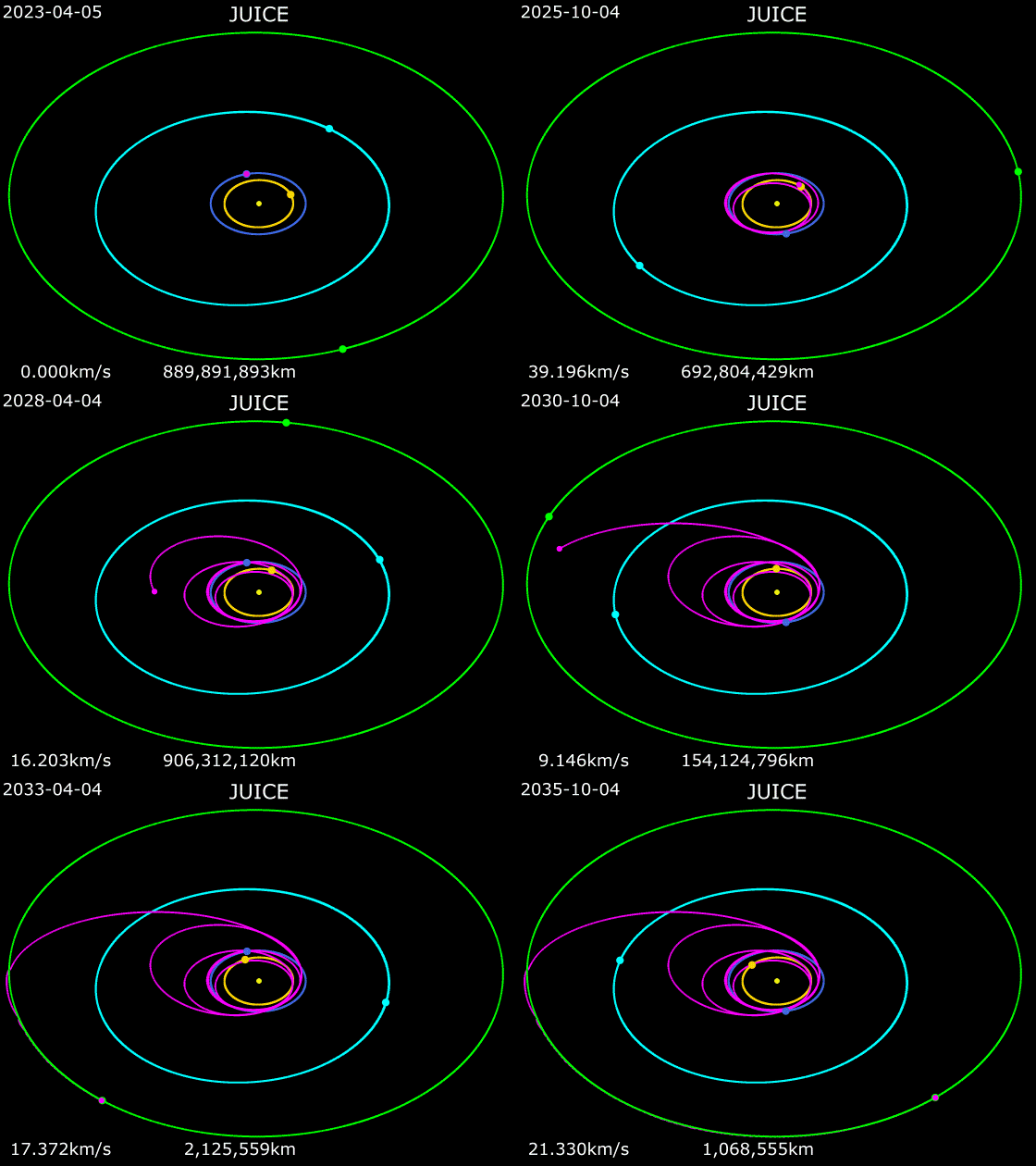
The deployment marks the start of a complex 8-year coast to Jupiter which includes four gravity-assists from the inner planets to both boost the spacecraft’s velocity and to help swing it onto the required trajectory required for a successful Jupiter rendezvous (and a possible fly-by of the asteroid 223 Rosa in October 2029). These flybys will comprise:
August 2024 – a return to Earth, using both the Moon and Earth to accelerate and adjust course. This will be the most accurate gravity assist manoeuvre ever carried out by an interplanetary vehicle.
August 2025 – a flyby of Venus whilst travelling around the Sun, again accelerating the spacecraft whilst angling it onto a trajectory that will see it swing by Earth
September 2026 a second flyby of Earth (confusingly called “Earth flyby I”, which will throw it out into the solar system almost as far as Mars before it swings back around the Sun.
January 2029 – a third flyby of Earth (“Earth flyby II”) which will slingshot JUICE on a two year journey to Jupiter, with the possible asteroid flyby along the way.
An animation of the Earth / Venus flybys JUICE will perform, and its flight to Jupiter. Credit: Phoenix7777
On arrival in the Jovian system, in July 2031, JUICE will first perform a flyby of Ganymede in preparation for Jupiter orbital insertion about 7.5 hours later. This will place the vehicle in an elongated orbit around the planet, allowing it to perform some 35 flybys of the target Moons. The orbit around the planet will gradually becoming more circular over time, and will have an inclination that will allow JUICE to also study Jupiter’s Polar Regions and its magnetosphere.
The flybys will allow JUICE to observe its targets over a 3.5 year span of time, with a major focus on Europa. However, in December 2034, the focus of the mission will shift as JUICE enters an extended, 5,000 km elliptical orbit around Ganymede. This will be rapidly circularised to 500 km in 2035, allowing the vehicle to carry out an in-depth study of Ganymede’s composition and magnetosphere.
It is anticipated that the vehicle’s fuel reserves will be depleted to a point where accurate guidance and manoeuvring cannot be maintained by the end of 2035, and the last remaining reserves will be used to impact the craft on Ganymede at the end of that year or possibly very early in 2036.
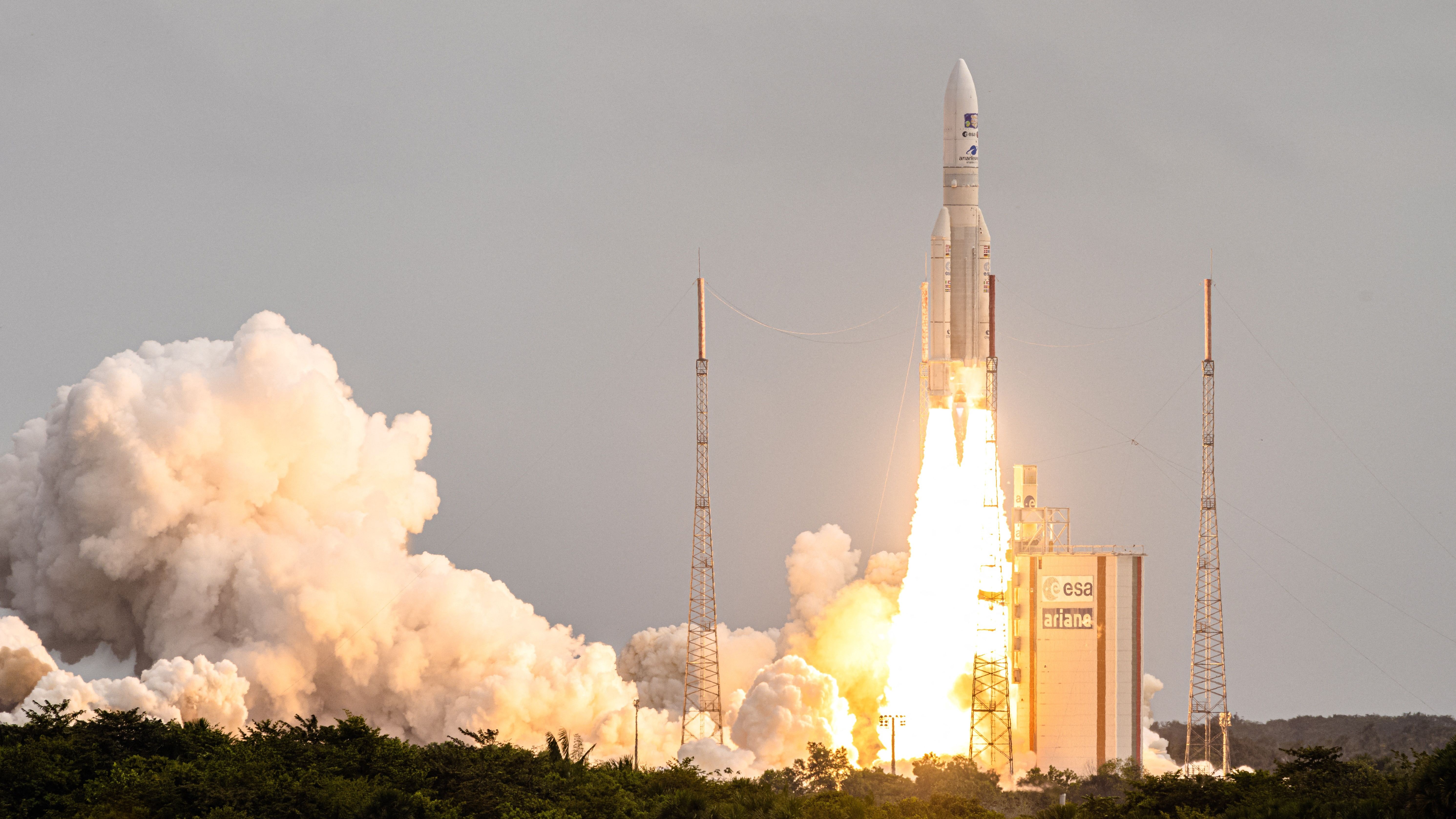
The Ariane 5 rocket carrying JUICE lifts-off from Europe’s Spaceport in Kourou, French Guiana, April 14th, 2023. Credit: JODY AMIET/AFP
The primary aim of the mission is to more fully characterise the overall surface and (particularly) sub-surface conditions on (notably) Europa and Ganymede, and also on Callisto. As regulars to this column (and to space exploration in general) will know, Europa is believed to have a surface crust of ice covering what could well be a deep liquid water ocean, heated and kept in a liquid (or near-liquid) state by the moon being constantly “flexed” by the gravitational influences of the other Galilean moons as they orbit Jupiter, and Jupiter itself.
With this in mind, JUICE will specifically study Europa to understand the formation of surface features and the composition of the non-water-ice material. In particular, it will attempt to gather information on any chemistry essential to life which may be present on Europa’s surface, including organic molecules, and it will carry out the first sub-surface soundings of the moon in order to try to determine the thickness of the icy crust over the most recently active regions of the moon, and attempt to gain a clearer understanding of what lay beneath it – such as liquid water or icy slush.
While further away from Jupiter and with a more one-side “pull” being exerted on them, it is believed that both Ganymede and Callisto might also have oceans of liquid water (or perhaps icy slush) under their surfaces, so the main science objects for these moons – with the particular emphasis on Ganymede comprise:
Characterisation of the ocean layers and detection of putative subsurface water reservoirs.
Topographical, geological and compositional mapping of the surface.
Study of the physical properties of the icy crusts.
Characterisation of the internal mass distribution, dynamics and evolution of the interiors.
Investigation of Ganymede’s tenuous atmosphere.
Study of Ganymede’s intrinsic magnetic field and its interactions with the Jovian magnetosphere.
In all, the information gathered on the three moons should help scientists better assess their potential as havens of basic life within any warm oceans which may exist within them.
I think this is something that Europe can be extremely proud of. This is a mission that is answering questions of science that are burning to all of us.
– Josef Aschbacher, ESA Director General
The launch was the sixth Ariane 5 flight to carry an ESA mission, a total that includes the December 2021 launch of NASA’s James Webb Space Telescope that features significant ESA contributions. It was the 116th Ariane 5 launch overall, dating back to 1996. However, it was also the last flagship mission launch for the ESA workhorse; after an upcoming launch of two communications satellites, for the French and German governments respectively, Ariane 5 will make way for its Ariane 6 successor, with the first launch of the new rocket – which has had a troubled development cycle – is due towards the end of 2023 or early 2024.
Sunnmøre, April 2023 – click any image for full size
Situated as the southernmost municipality of the county of Møre og Romsdal in north-west Norway, Sunnmøre (or South-Møre, if you prefer) – as with the county as a whole – is regarded as a region of outstanding natural beauty, its rugged and varied landscape being home to the UNESCO World Heritage Site of Geiranger Fjord.
While one of three districts within Møre og Romsdal, Sunnmøre accounts for over 50% of the county’s population – although this doesn’t mean it is exactly going to feel crowded; the total population for Møre is under 200,000, with the majority living within coastal towns like Ålesund (popn approx 53,000). This means that much of the county – and a lot of Sunnmøre is open countryside – is a place where people are free to enjoy friluftsliv.
Sunnmøre, April 2023
Pronounced (I’ve ben informed) free-loofts-liv, the terms translates as “open-air living”. Originally popularised by the Norwegian playwright and poet, Henrik Ibsen during the mid-1800s, friluftsliv was initially used to describe the value of spending time in remote locations for spiritual and physical wellbeing.
Today, the phrase is used more broadly by Scandinavians as a whole to cover just about everything from runs in the forest or riding a bicycle through the countryside, to joining friends at a lakeside sauna (often followed by a chilly dip in the water), to simply relaxing in a mountain hut or participating in a little glamping, through to more vigorous activities such as rock-climbing or cross-country skiing when the snow permits, and so on. It also still encompasses the ideas of wellbeing and health, and is closely linked to allmansrätten, the right to roam.
Sunnmøre, April 2023
Within Second Life, Emm Vintner (Emm Evergarden), of The Nature Collective fame, has brought a touch of Norwegian friluftsliv and a stylised touch of Sunnmøre to life with a Homestead Region design called – quite appropriately – Sunnmøre, which thanks to a pointer from Shawn Shakespeare, I recently enjoyed visiting.
Sitting as a clutch of islands protected within the mouth of a fjord opening out into the sea, Sunnmøre offers a setting rich in activities one might reasonably expect to enjoy whilst participating in a spot of friluftsliv. There are tracks and trails to walk / ride along (horses can be rezzed from the one hitched near the landing point ferry), kayaks are available for paddling through the channels and around the waters surrounding the islands, together with motorboats and inflatables – all of which ensure dry feet when trying to reach the smaller islands! For the more energetic / daring zip-line rides might be had from the top of the main island’s peak.
Sunnmøre, April 2023
For those seeking something more restful, opportunities are available for a little fishing, taking to the air in hot air balloons, or simply sitting and watching the world go by. And, of course, there are plenty of opportunities for photography, with lots of local wildlife to be found – and some rather acrobatic sheep! Signage at the landing point offers some instant directions to points of interest, and the ferry-as-a-landing-point gives a nice feel for having literally just arrived from somewhere on the mainland when visitors teleport in.
Environmental consciousness is very apparent within the island – hardly surprising, as Scandinavia tends to lead with way when it comes to the likes of wind and solar power and thing like ground- and air-source heat pump systems for heating. A trio of wind turbines look like they provide power to the islands – and probably the local lighthouse, whilst the research centre located on the largest island utilises solar power. Of course, this being a design by Emm, bees are also in evidence, although the chance of some fresh honey has drawn an inquisitive bear cub to them!
Sunnmøre, April 2023
If you want to extend their Nordic experience after exploring Sunnmøre can avail themselves of the signboard advertising Moon Lair Taste of Norway, located as it is alongside the Sunnmøre Tourist Centre. Doing so while spirit you away to Moon Lair – but I’ll leave that to a future visit and possible blog post!
As always with Emm’s work, Sunnmøre is well presented, and makes for an engaging and photogenic visit.
Puppetry demonstration via Linden Lab – see below. Demos video with the LL comment “We have some basic things working with a webcam and Second Life but there’s more to do before it’s as animated as we want.”
The following notes have been taken from chat logs and audio recording of the Thursday, March 23rd, 2023 Puppetry Project meetings held at the Castelet Puppetry Theatre on Aditi. These meetings are generally held on alternate weeks to the Content Creation User Group (CCUG), on same day / time (Thursdays at 13:00 SLT).
Notes in these summaries are not intended to be a full transcript of every meeting, but to highlight project progress / major topics of discussion.
Project Summary
General Project Description as Originally Conceived
LL’s renewed interest in puppetry was primarily instigated by Philip joining LL as official advisor, and so it really was about streaming mocap. That is what Philip was interested in and why we started looking at it again. However since Puppetry’s announcement what I’ve been hearing from many SL Residents is: what they really want from “puppetry” is more physicality of the avatar in-world: picking up objects, holding hands, higher fidelity collisions.
As a result, that is what I’ve been contemplating: how to improve the control and physicality of the the avatar. Can that be the new improved direction of the Puppetry project? How to do it?
Leviathan Linden
Previously referred to as “avatar expressiveness”, Puppetry is intended to provide a means by which avatars can mimic physical world actions by their owners (e.g. head, hand, arm movements) through tools such as a webcam and using technologies like inverse kinematics (IK) and the LLSD Event API Plug-in (LEAP) system.
Note that facial expressions and finger movements are not currently enabled.
Most movement is in the 2D plain (e.g., hand movements from side-to-side but not forward / back), due to limitations with things like depth of field tracking through a webcam, which has yet to be addressed.
The back-end support for the capability is only available on Aditi (the Beta grid) and within the following regions: Bunraku, Marionette, and Castelet.
Puppetry requires the use of a dedicated viewer, the Project Puppetry viewer, available through the official Second Life Alternate Viewers page.
No other special needs beyond the project viewer are required to “see” Puppetry animations. However, to use the capability to animate your own avatar and broadcast the results, requires additional work – refer to the links below.
There is a Puppetry Discord channel – those wishing to join it should contact members of LL’s puppetry team, e.g. Aura Linden, Simon Linden, Rider Linden, Leviathan Linden (not a full list of names at this time – my apologies to those involved whom I have missed).
Additional Work Not Originally In-Scope
Direct avatar / object / avatar-avatar interactions (“picking up” an apple; high-fives. etc.).
Animations streaming: allowing one viewer to run animations and have them sent via the simulator to all receiving viewers without any further processing of the animations by those viewers.
Enhanced LSL integration for animation control.
Adoption of better animation standards – possibly glTF.
Given the project is incorporating a lot of additional ideas, it is likely to evolve into a rolling development, with immediate targets for development / implementation decided as they are agreed upon, to be followed by future enhancements. As such, much of what goes into the meetings at present is general discussion and recommendations for consideration, rather than confirmed lines o development.
Bugs, Feature Requests and Code Submissions
For those experimenting with Puppetry, Jiras (bug reports / fixes or feature requests) should be filed with “[Puppetry]” at the start of the Jira title.
An updated version of the project viewer is still “close” – it is currently awaiting clearance by QA.
This will include the attachment point tracking discussed in previous meetings (e.g., a step towards being able to “pick things up” in SL. The simulator support for this is already in place on the Aditi Puppetry regions.
However when available it will not include:
LSL animation control as yet (which has yet to be added to the simulator code anyway. Rider Linden believes he has a good protocol for single avatar animation, but would rather work on it some more.
Any IK improvements, as Leviathan Linden is still working on these.
Any extended LEAP API functionality (the added features for getting world position/orientation, lookat position/orientation, camera position/orientation/target). This will be coming in a future viewer update.
Another thing in this release will be the change to llsd_binary for the LEAP messaging protocol. This will be in the release notes but to use it you will want to update to either 1.3.1 of llbase and/or 1.2.0 of llsd for python scripts. Messages from LEAP scripts to the viewer will still work with the older python libraries, but messages from the viewer to the script will not be parsed correctly.
Server-Side Work
The LSL function API has been published to the Content Creation Discord group (sorry, I’ve been asked by LL not to publish details on joining the server – if you are a content creator interested in joining it, please contact Vir Linden or attend a meeting (Content Creation / Puppetry and ask in person).
Getting attachment point positions has been given a throttle, in part to not make it trivial to use LSL to rip an animation, and in part to prevent the server doesn’t get overwhelmed. This latter rate of throttling is variable and can change as load increases/decreases. However, as Rider linden noted, there would always be some delay and some disagreement about the actual position of the attachment point between LSL and all the observing viewers. As such, function is not meant for a high-fidelity use. Collision volumes on the attachment points will be a better solution in this respect, but that is functionality which is still down the line.
General Notes
Leviathan Linden’s work for streaming the full avatar animation state has stalled, due to it essentially hijacking the main puppetry data channel to send everything, even when not running a puppetry script, through LEAP. As such, Leviathan thinks it needs to be moved to its own experimental viewer.
Simon Linden’s work on allowing animation uploads of new/different formats has been decoupled from the Puppetry project’s codebase, and is now being built on the main viewer branch, allowing it to move forward without dependencies on Puppetry.
OpenXR support as a LEAP plug-in is still seen as desirable, since it would allow support for a broader range of devices. However, it is seen as a little more “down the road”, as there is some core infrastructure that needs to finish being vetted prior to work starting on this.
My thanks to Jenna Huntsman for the chat transcript from the meeting, and you can see her video recording of the session here.
Kawaii City, February 2023 – blog post
The following notes were taken from m y audio recording and chat log transcript of the TPV Developer (TPVD) meeting held on Friday, April 14th 2023 at 13:00 SLT.Meeting Overview
The TPV Developer meeting provides an opportunity for discussion about the development of, and features for, the Second Life viewer, and for Linden Lab viewer developers and third-party viewer (TPV) / open-source code contributors to discuss general viewer development.
Maintenance T RC viewer, version 6.6.11.579154, April 6th.
Performance Floater / Auto FPS RC viewer updated to version 6.6.11.579238, April 4th.
Maintenance S RC viewer, version 6.6.11.579153, March 31st.
Project viewers:
PBR Materials project viewer, version 7.0.0.579401, April 11 – This viewer will only function on the following Aditi (beta grid) regions: Materials1; Materials Adult and Rumpus Room 1 through 4.
Puppetry project viewer, version 6.6.8.576972, December 8, 2022.
Future Viewer Notes
Inventory thumbnails viewer: work is progressing well, however as well as viewer changes and additions to the inventory database (the latter of which has been completed), it will require updates to the Avatar Inventory System (AIS) and a simulator update, so the will be no project or RC viewer until this back-end work has been done.
Work has resumed on providing emoji support in the viewer (Oh, joy.). This work is based on a contribution from the Catznip viewer.
The viewer has been updated, but is still at Project Viewer status.
A new dynamic exposure setting has been added to improve tone mapping.
Bug fixing work is continuing, and Brad Linden is working on getting PBR Materials to work more robustly over networks with heavy loads.
The hope is that the next viewer update will clear QA for release as an RC viewer, so that it will be available when the back-end / simulator support gets deployed to the Preflight simulator channel which Rider Linden hopes to achieve in week #16.
Making the PBR work more widely available by enabled Agni (Main grid) support and moving the viewer to RC status is seen as a key test of how will the Graphics Team has managed to both support the PBR rendering and maintain the broad look and feel of SL as it appears under the current rendering.
Genesis is working on an update which will include and expanded Preferences, together with the ability to search Preferences.
A general discussion on a third-party viewer (Rust) that is in development, but not ready for prime-time, server-side rendering and a ringing of the memory bell for the Pelican (IIRC streaming viewer LL toyed with back in around 2007). Please refer to the video, below.
Nitroglobus Roof Gallery: JadeYu Flang – Sans Titre
Now open at Nitroglobus Roof Gallery, curated by Dido Haas, is an engaging exhibition of 2D and 3D art by JadeYu Fhang. This doesn’t actually say a lot, because the fact is, JadeYu never fails to engage the grey matter with her art; her work is constantly evocative and provocative, brining forth a narrative with which to draw her audience in.
However, this exhibition comes with a slight difference in terms of a deliberate haziness of intent on the part of the artist, a haziness intended to further engage the observer’s eyes and minds.
Nitroglobus Roof Gallery: JadeYu Flang – Sans TitreThis haziness starts with the exhibit’s title: Sans Titre (“Untitled”, or if you prefer, “Without Title”), which as JadeYu notes, is an intentional step so as not to sway visitors with preconceptions ahead of arriving at the gallery and witnessing the work first hand. This haziness then continues through the works themselves, the intention being to leaving interpretation of at least the 2D elements to the eyes and thoughts of the beholder.
Which is not to say there is not a central theme running through this exhibition, or that it is in any way random in content or execution. Rather the reverse: the theme is made clear; however, the artist’s intent it more about using the theme as a basic framework with which to allow us to view the works and generate our own understandings of the drawings presented, rather than have the images serve to underscore the theme itself.
Nitroglobus Roof Gallery: JadeYu Flang – Sans Titre
This actually brings me to an awkward crux: how best to offer insight into Sans Titre without impinging my own (and ultimately subjective) description of that theme, and thus colouring your reaction to the images and 3D sculptures? As such, this review is a little more circumspect than my usual offerings relating to exhibitions at Nitroglobus, as I’d rather try to keep JadeYu’s desire to provide a framework of theme, rather than direct people to specifics – so I’ll minimise things by quoting her own words:
Let’s call it a matter of violence inside bodies, facial expressions (3D) leading to the intention of erasing the other person, as suggested in the images (2D). The papers around the women? These papers indicate words, insults and other ignominy which are thrown in women’s faces throughout their lifes. Words loaded with hatred and violence “the killing words”. Nothing is written on the papers… it’s up to you to imagine what could be there.
Why women?
They are like the symbol, the mirror of those who through a brutality, a destructive will seek to destroy. To destroy everything that in no way corresponds to fluidity and natural roundness. Flexibility and openness is not the order of the day, the preference is for the square shape and it must be respected, locking up any will to exist outside the frame.
– JadeYu Flang
Nitroglobus Roof Gallery: JadeYu Flang – Sans Titre
With those words to guide you, I’m go to say anything else, other than to say that – again as is usual with JadeYu’s work – San Titre is stunningly visual in both the 2D and 3D art presented. Instead, I’ll leave you to pay a visit and both witness and cogitate JadeYu’s work and the realities it explores, for yourself.







 Inara Pey: Living in a Modemworld