Kiku Art Gallery: Daikota Wind – 18 Images Inspired by Asian Films
I was drawn to the boutique-style Kiku Art Gallery, operated and curated by Rafael Nightshade and Suzanne Logan – who also operates the Amatsu Shima estate within which the gallery is located – for an engaging and fun exhibition with combines Second Life photography with another visual medium: Asian Cinema.
Occupying the South room of the gallery, is 18 Images Inspired by AsianFilms by Daikota Wind, which also carries this shorter title Asian Cinema. As both titles suggest, the focus of the exhibition is on cinematic productions of the Far East, which film-making is (as if it needs saying) as rich and genre-spanning as cinema in the west (or anywhere else in the world).
Kiku Art Gallery: Daikota Wind – 18 Images Inspired by Asian Films
When considering Asian cinema, thoughts are likely to focus on the likes of Chinese (/Hong Kong) and Japanese productions which have a long history of western exposure (and inevitable re-makes / re-interpretations), together with – more recently – that of South Korea. Due to the prolific output of these three powerhouses, they do dominate this exhibition, although Indonesia and Thailand also get very honourable mentions. However, rather than focusing on national output, this exhibition seeks to offer insight into the aforementioned genre-spanning nature of Asian film-making.
To achieve this, Daikota presents 18 images of films ranging from action to thriller, passing by way of comedy, drama, fantasy, post-apocalyptic, romance and more, each image inspired either by a scene from the film it represents or from the posters used to advertise it. Each image shares its space with a brief synopsis of the film’s storyline.
Kiku Art Gallery: Daikota Wind – 18 Images Inspired by Asian Films
The images themselves appear to have been subjected to minimal post-processing, adding to their connection with the film they represent, rather than suggesting how the artists interprets the film. The accompanying text offers a fair description of each film’s plot, together with some insights by Daikota giving each one more of a personal feel.
Some of the films – Infernal Affairs, Crouching Tiger, Hidden Dragon, Ju-On, to name three, but Daikota’s images and synopses give them a freshness and vitality which certainly increases the desire to go and watch them. Light and engaging, 18 Images Inspired by AsianFilms offers a worthwhile exploration of Daikota’s photography and the films of the far east.
Kiku Art Gallery: Daikota Wind – 18 Images Inspired by Asian Films
The Shambles, July 2023 – click any image for full size
I last visited The Shambles when it occupied a Homestead region and presented a steampunk-come-sci-fi theme (see: In The Shambles in Second Life). But that was a year ago (or, when put in purely Second Life terms – a decade ago!). A lot has happened in that time. For one thing, Tolia Crisp has relocated The Shambles to a Full private region; for another she has once again teamed with Dandy Warhlol (Terry Fotherington) to offer another engaging and photogenic region under the Frogmore banner.
At the time of my visit, The Shambles was open to members of the Frogmore group, who are also invited to participate in a landscape photo competition with a L$8,500 prize pool, including L$5,000 to the outright winner (+a 4-week free stay at Frogmore Cottage). Details on this competition are available through the Frogmore group, and it will remain available for entry by group members until August 4th, 2023. However, The Shambles itself will open to full public access on Saturday, July 15th, 2023, and will remain so through until Tolia closes it for a Halloween redressing – so this might be considered a little advanced promotion for the region.
The Shambles, July 2023
Those who have visited the core Frogmore regions will find much that is familiar within this iteration of The Shambles. It offers something of a continuation of the rugged coastal environment that mixes touches of England’s Cornwall and Devon with a stirring of European coastal areas, bound together with a touch of summer days perhaps made more bearable by the cooling influence of an light breeze drifting in from over the sea.
This is not to say that The Shambles doesn’t have its own personality or independent looks – it most certainly does. In fact, the overall styling contains more of a lean towards parts of Europe’s multi-faceted coastlines than it does the UK’s, and there is, as ever, plenty to see and discover whilst exploring.
To the west, the land is low-lying and formed by a deep inlet / bay complete with a broad sandy beach to one side, facing an headland which rises as a broad shoulder of rock protecting the inlet from the wilder elements, capped by a small fishing wharf suitable for trawlers at the head of the bay. This sits as one of two guardians watching over the entrance to the bay, the other being the (inevitable? – We SLers do so love them…) lighthouse.
A broad cobbled street parallels the beach, offering multiple points of interest whilst aged steps climb the eastern uplands as they rise to a roughly flat top before falling away sharply to the seas below again.
This highland area is home of a variety of locations, each one with its own charm and beauty. There’s the dirt track running past stables, the horses from which graze both in the field alongside it and the meadow above from which rises the head of a tumbling stream which steps its way down along the east side of the setting before using a waterfall to jump down to the sea on the north side.
The Shambles, July 2023
Or – and keeping to the north side of the region – there’s the campsite with its mix of caravans and tents. It’s a cramped but clearly popular location, although how the caravans got up there is a nice little enigma. Certainly, the same track as runs past the stables was used for the final leg of their journey, but its southern end ends in a rocky drop descended only by more aged stone steps and by more water tumbling from a small pair of pools.
Watched over by a tall bell tower, the southern end of the island seems to exude a sense of age, a careworn spit of land splitting the waters between open sea and narrow channel. Another fishing wharf sits on the narrow spit, itself crossed at several points by a variety of bridges, whilst its eastern end is guarded by two lighthouses, one of considerable age, the other perhaps one of the more recent structures on the island.
The Shambles, July 2023
All of which is just the start of a description for what is a genuinely captivating setting, rich in content, with many places to sit and pass the time or enjoy a drink or two. There’s also a bungee jump for the more adventurous, although this may be absent whilst the photo competition is running. As one would expect from the pairing or Tolia and Terry, there is a deep since of natural beauty throughout; a feeling that – as is the case in the physical world – the land was present long before people arrived, the wind, fresh water, sea and rain forming it into folds and turns, high points and lowlands, slopes and drops, humans have in turn used to their advanced in establishing a lasting presence here.
Needless to say, the entire setting is highly photogenic and those of the Frogmore group wishing to enter the competition should find lots here by which to create an entry, whilst those wishing to take avatar-centric photos which are not for the competition but purely for pleasure, can also join the Frogmore group for rezzing rights with props.
The Shambles, July 2023
Again, the region will be open to the general public from Saturday, July 15th, 2023, but those wishing earlier access can – again – join the Frogmore group. Enjoy.
The following notes were taken from the Tuesday, July 11th Simulator User Group (SUG) meeting. They form a summary of the items discussed and is not intended to be a full transcript. A video of the entire meeting is embedded at the end of the article for those wishing to review the meeting in full – my thanks to Pantera for recording it.
Meeting Overview
The Simulator User Group (also referred to by its older name of Server User Group) exists to provide an opportunity for discussion about simulator technology, bugs, and feature ideas.
They are open to anyone with a concern / interest in the above topics, and form one of a series of regular / semi-regular User Group meetings conducted by Linden Lab.
Dates and times of all current meetings can be found on the Second Life Public Calendar, and descriptions of meetings are defined on the SL wiki.
Server Deployments
No deployments are planned for the week, but all simhost channels will be restated on the Tuesday and Wednesday slots.
Upcoming Updates
One (or more) upcoming simulator code updates will include:
A fix for the bug on the simulators running the recent LSD additions (llLinksetDataCountFound() & llLinksetDataDeleteFound()) being unable to save scripts.
The changes to UUID generation on certain items (e.g. textures, notecards, materials (particularly the upcoming PBR Materials)) to reduce the amount of duplication. These changes will not impact UUIDs for objects rezzed in-world or made by the viewer. for further background, see my week 26 SUG meeting summary.
Viewer Updates
On Monday, July 10th, the Maintenance T RC viewer updated to version 6.6.13.580918.
The rest of the official viewer currently in the pipeline remains as:
Release viewer version 6.6.13.580794, formerly the Windows 32 + macOS pre-10.13 RC and dated June 30th and promoted on July 5.
glTF / PBR Materials viewer, version 7.0.0.580782, June 30.
Project viewers:
Second Life Project Inventory Extensions viewer, version 6.6.13.580808, July 6.
Emoji project viewer, version 6.6.13.580279, May 30.
Puppetry project viewer, version 6.6.12.579958, May 11.
PBR Materials
There continue to be a lot of questions as to when PBR will be deployed across the entire grid. In response to such questions at the SUG meeting, the following observations were made:
The server has to go through the full RC process still, once it is deemed ready for that. the messaging formats and api interfaces are expected to be stable, but if a showstopper bug is found that can change if needed to fix it.
– Brad Linden
I am about 80% confident the interface is complete and also about 80% confident that we have some server side changes to behaviour within the confines of the existing spec (things like: what can you do with reflection probes). Internally we’re answering questions like “can you kick a reflection probe like a soccer ball? Can you put a reflection probe as the root of your physical vehicle?”
– Maxidox Linden
It almost goes without saying that there are a lot of significant changes in the glTF server & viewer. It’s a case where it is much better to be safe than sorry.
– Rider Linden
In Brief
The Asset store is now standing at 2 petabytes.
BUG-233853 “Scripts failing to receive rapid touch_start events under LL viewer” had had been seen as fixed in The Maintenance T RC viewer. however, it has been reported the issue has still present, so the bug report has been re-opened.
Refer to the latter part of the video for:
A general discussion on bots.
A discussion on using estate_environment command to update EEP settings across an entire estate / the issues around updating Mainland on a continent-wide basis to overcome the current somewhat darker (than private regions) default environment (short form: it is hoped PBR with its updated environment settings will help matters).
† The header images included in these summaries are not intended to represent anything discussed at the meetings; they are simply here to avoid a repeated image of a rooftop of people every week. They are taken from my list of region visits, with a link to the post for those interested.
NovaOwl, July 2023: Ninae Trallis – Do You Believe?
Recently opened within the main gallery at NovaOwl Community Centre & Gallery operated by ULi Jansma, Ceakay Ballyhoo & Owl Dragonash, is what might be called a 3-part exhibition of avatar studies by photographer-artist Ninae Trallis. I say three parts, because there are three elements of equal import within Do You Believe? – the images themselves (together with their supporting 3D elements), the selection of music offered with each picture, and how both resonate individually and jointly with our emotions / imaginations.
Unlike most exhibitions I’ve visited within the main gallery at NovaOwl, Do You Believe occupies both the 3-room gallery space and the adjoining space which had, during part visits, been generally given over to a café / lounge space – and rightly so, as these are genuinely captivating images. Ninae is one of the few artists in SL who focuses on avatar studies whilst largely eschewing the use of post-processing to enhance her images. Instead, she uses framing, composition, environment and the viewer – Black Dragon in this case – for her work, relegating tools such as Photoshop to the role of small-scale touching-up.
NovaOwl, July 2023: Ninae Trallis – Do You Believe?
This gives her images a crisp richness and depth which is immediately engaging. Her use of lighting ensures most colours are softened to natural pastels, while her use of black and white gives a further sense of authenticity of live and vitality. Each image sits as a single-frame story, expanded upon through the use of the 3D elements placed before and around the images. What that story might be folds another of the three elements into the exhibition: our imagination.
Through the title we are offered a challenge – to believe in … something. Through the images we are offered hints of ideas, some obvious, some more subtle: to believe in love, fantasy, the existence of fae and / or faerie tales, our own ability to create, to trust in another – be it with secrets, or hearts or even our submission to them – and not to fear rejection; to believe in the power of nature and in things unseen.
NovaOwl, July 2023: Ninae Trallis – Do You Believe?
How we might opt to interpret individual images is given a further little tilt in that each image is accompanied by a piece of music (click the music notes found to the lower left or right of each picture – under under the middle of a couple! – to be offered a You Tube URL to the music in question. As Ninae notes, these pieces, which range from classical pieces through soundtracks through to rock and pop ballads, might be completely unrelated to the image in question – like many of us (myself included), Ninae listens to music whilst the creative juices flow – but then again, they might not (as hinted by her use of “sometimes” in the notes accompanying the exhibition).
Which of these might be the case is left open to personal interpretation – and while some might appear “obvious” in their influence on the production of the image they accompany, the lyrics, when listened to in full, might actually suggest otherwise. But discerning whether or not the choice of music for any given piece is intentional or simply the result of it being a piece Ninae likes independently of the image is actually irrelevant here. Each piece, whether Chopin, Lewis Capaldi, Hans Zimmer, original composition or cover version, echoes that challenge of the exhibit’s title, the music mixing with the images to set our imagination free to reflect, to travel where emotions might lead, to conjure feelings and ideas in which might believe, however transitory their existence in our minds and imaginings.
NovaOwl, July 2023: Ninae Trallis – Do You Believe?
Rich and eye-catching – and potentially containing a little in the way of personal revelation through the selection of music as much as the images themselves (which adds to its beauty and mystique, Do You Believe? is an engaging, gently layered exhibition.
Logos representative only and should not be seen as an endorsement / preference / recommendation
Updates from the week through to Sunday, July 9th, 2023
This summary is generally published every Monday, and is a list of SL viewer / client releases (official and TPV) made during the previous week. When reading it, please note:
It is based on my Current Viewer Releases Page, a list of all Second Life viewers and clients that are in popular use (and of which I am aware), and which are recognised as adhering to the TPV Policy. This page includes comprehensive links to download pages, blog notes, release notes, etc., as well as links to any / all reviews of specific viewers / clients made within this blog.
By its nature, this summary presented here will always be in arrears, please refer to the Current Viewer Release Page for more up-to-date information.
Note that for purposes of length, TPV test viewers, preview / beta viewers / nightly builds are generally not recorded in these summaries.
Official LL Viewers
Release viewer, version 6.6.13.580794, formerly the Windows 32 + macOS pre-10.13 RC, issued June 30, promoted July 5th.
V-261: the final launch of Ariane 5, July 5th, 2023, as it lifts two communications satellites to orbit from Europe’s Spaceport, Kourou in French Guiana. Credit: Arianespace.
It is perhaps the unsung hero of space launch capabilities. Whilst the media focuses on its darling Falcon 9 – a vehicle which, to be sure, is innovative, successful and highly flexible -, or reflects on Russia’s veritable (if sometimes troublesome) Soyuz family, Europe’s Ariane 5 has quietly gone about the business of lifting payloads to various orbits and a deep space missions for 28 years, barely coming to prominence in the news, unless in exceptional circumstances. Such as on the occasion of its final flight, as has been the case this past week. This is a shame, because the Ariane 5 project has been remarkably successful.
First flown in 1996 as the latest iteration of the Ariane family, the rocket’s history goes back to the 1970s, when an Anglo-French-German project was established to develop a new commercial launch vehicle for Western Europe. Christened “Ariane” – the French spelling of the mythological character Ariadne – the project became largely French-driven but within the auspices of the European Space Agency (ESA). The latter charged Airbus Defence and Space with the development of all Ariane vehicles and all related testing facilities, whilst CNES, the French national space agency, spun-up a commercial operation called Arianespace – in which they retain around a 32.5% stake – to handle production, operations, marketing and launches of the Ariane family, the latter being made out of Europe’s Spaceport, aka the Guiana Space Centre at Kourou in French Guiana.
Arianespace was the world’s first commercial launch provider, initially offering customer launches atop the evolving family of Ariane vehicles, commencing with Ariane 1 in 1979. Then, from 2003 through 2019, then partnership with Russia to provide medium-lift launch capabilities utilising the Soyuz-ST payload carrier under the Arianespace Soyuz programme, becoming the only facility to operate Soyuz vehicles outside of Russia (until the latter’s invasion of Ukraine brought the partnership to an end). In 2012, Arianespace further supplement its range of capabilities by adding the Italian-led Vega small payloads vehicle to their launch vehicle catalogue.
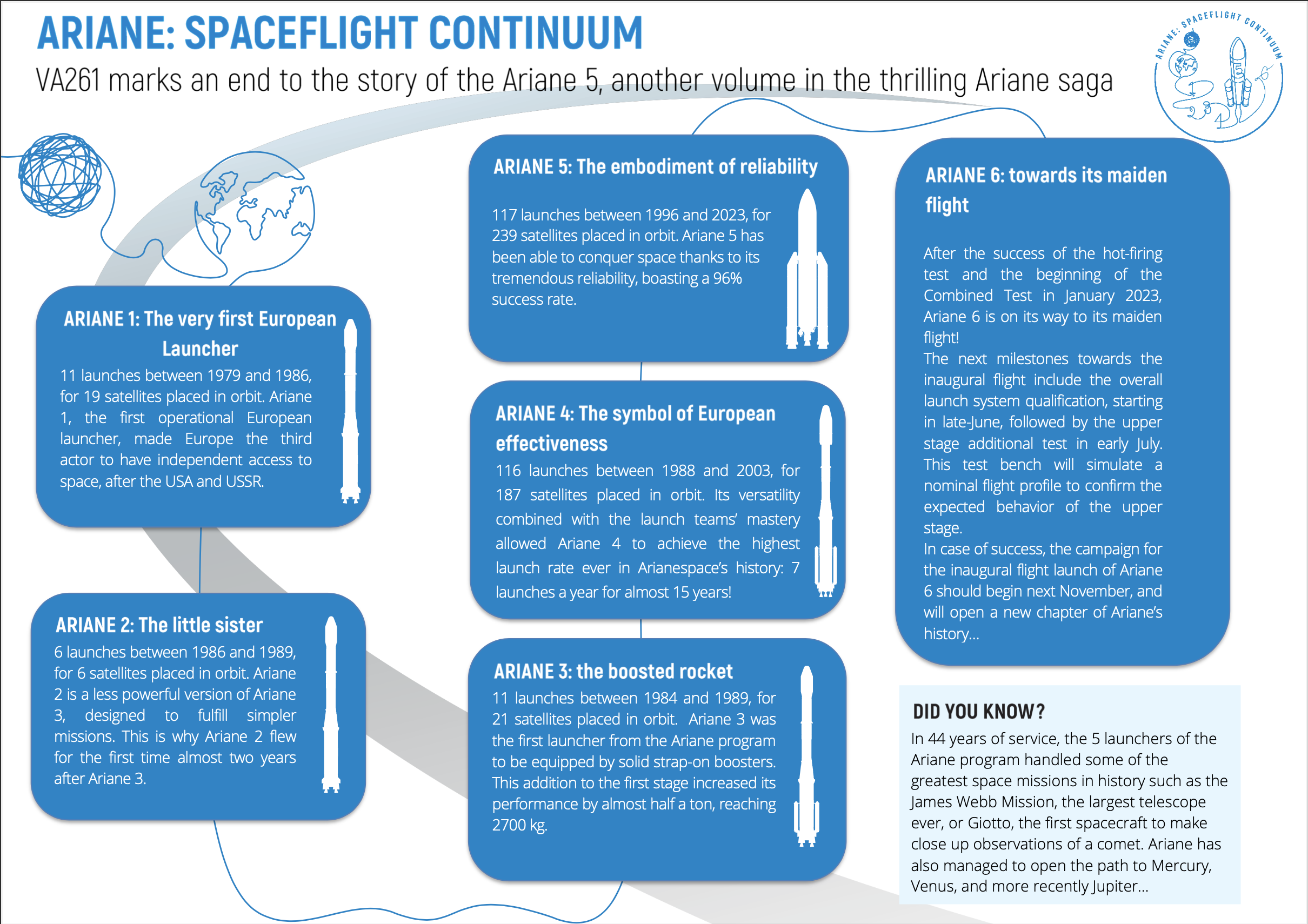
The Ariane launch vehicle family – an infographic released be Arianespace to mark the final launch of an Ariane 5. Credit: Arianespace
Ariane 5 was first launched in June 1996 in what was called the G(eneric) variant, capable of lifting 16 tonnes to low Earth orbit (LEO) or up to 6.95 tonnes to geosynchronous transfer orbit (GTO). Over the coming years, it iterated through four evolutions – G+, GS, ECA, and ES – each bringing about a range of performance and other improvements which raised the vehicle’s maximum lift capabilities to 21 tonnes of payload to LEO and 10.86 tonnes to GTO whilst also allowing Arianespace to lower launch fees to customers. In addition – and while it was never used in such a capacity – Ariane 5 is the only member of the Ariane family to be designed for crewed launches, in part being designed to carry the Hermes space plane to orbit (of which more below).
In all, Ariane 5 flew a total of 117 launches from 1996 onwards, suffering three partial and two complete failures to deliver payloads as intended, with an maximum launch cadence of 7 per year. Notable among these launches are:
December 10th, 1999: the X-ray Multi-Mirror Mission(XMM-Newton). Itself an oft-overlooked mission when compared to NASA’s Great Observatories programme, XMM-Newton was one of the four “cornerstone” missions of the Horizon 2000 chapter of ESA’s science missions.
Named for English physicist and astronomer Sir Isaac Newton, the spacecraft comprises 3 X-ray telescopes feeding a range of science instruments and imaging systems. Its primary mission is the study of interstellar X-ray sources in both narrow- and broad-range spectroscopy, and performing the first simultaneous imaging of objects in both X-ray and optical (visible + ultraviolet) wavelengths. The programme was initially funded for two years, but its most recent mission extension will see it funded through until the end of 2026 – with the potential (vehicle conditions allowing) – for it to be extended up to the launch of its “replacement” mission, the Advanced Telescope for High Energy Astrophysics (ATHENA), due to commence operations in 2035/6. As of May 2018, XMM had generated more than 5,600 research papers.
March 2nd 2004: Rosetta. Another Horizon 2000 “cornerstone” mission, Rosetta spent 10 years using the inner solar system to allow it to rendezvous with the nucleus of comet 67P/Churyumov–Gerasimenko – the first space vehicle to enter orbit around a comet following its arrival on August 6th, 2014.
For two years, the vehicle revealed an enormous amount about the comet, although it was perhaps overshadowed in the public consciousness by the adventures of the little Philae lander Rosetta dispatched to the surface of the comet, and which captured hearts and minds with its struggles.
November 12th, 2009, ESA’s Rosetta, launched via Ariane 5, approaches Earth for a final flyby before heading out into deep space for its rendezvous with comet. P67//Churyumov–Gerasimenko. Credit: ESA
May 14th, 2009: Herschel Space Observatory and Planck Observatory. These two ground-breaking missions were delivered to the Erath-Sun Lagrange L2 position (yes, the one also used by the James Webb Space Telescope – JWST -, and the one the Euclid mission will utilise where it arrives in an extended halo orbit around it in August 2023). Whilst separate missions, both spacecraft were launched on the same Ariane 5 booster and each utilised a service module built to a common design.
Initially planned for a 15-month primary mission, Planck – named for German physicist Max Planck – ran for just under 4.5 years, concluding in 2013 after on-board supplies of liquid helium were exhausted, and the primary instruments could longer be cooled to their required operating temperatures. As fuel remained for the craft’s manoeuvring thrusters, Planck was ordered to move away from the L2 position and into a heliocentric orbit, where its systems were decommissioned and the vehicle shut down.
The Herschel Space Observatory, meanwhile, operated for just over 4 years, and was the largest infrared telescope ever launched until the James Webb Space Telescope. It was yet another “cornerstone” mission for Horizon 2000, and was named for Sir William Herschel, the discoverer of the infrared spectrum. Its primary objectives comprised investigating clues for the formation of galaxies in the early universe, the nature of molecular chemistry across the universe, the interaction of star formation with the interstellar medium and, closer to home, the chemical composition of atmospheres and surfaces of planets, moons and comets within our solar system. In this regard, the observatory amassed more the 25,000 hours of science data used by 600 different science programmes.
October 20th, 2018: BepiColumbo. Undertaken by ESA and the Japan Aerospace Exploration Agency (JAXA), BepiColumbo is the overall mission title given to two vehicles and their transfer bus, all launched as a “stack” via Ariane 5, in a mission to carry out a comprehensive study Mercury, the innermost planet of the solar system. It is named after Italian scientist and mathematician Giuseppe “Bepi” Colombo.
Despite its orbit being relative close to Earth (when compared to the outer planets of the solar system that is), Mercury’s is one of the most technically complex to reach. “Bepi” Columbo calculated a vehicle could use a solar orbit and multiple fly-bys of the inner planets to reach Mercury in an energy-efficient manner – and it is this style of approach the mission is using to reach its destination. It has already completed five gravity assist manoeuvres (1 around Earth in 2020, two around Venus in 2020 and 2021 and 2 around Mercury in 2021 and 2022). A further fiver fly-bys of Mercury will occur in 2024/25 to bring the mission to its primary science orbit around the planet at the end of 2025.
An image captured by BepiColumbo on June 23rd, 2022 as the spacecraft flew past Mercury at a distance of 1,406km on its second major flyby of the mission. Between early 2024 and late 2025, the vehicle will use several more flybys to bounce itself int an extended orbit around Mercury and then into its primary science orbit. Credit: ESA / JAXA
At that time the vehicles will separate, the transfer bus, called the Mercury Transfer Module being discarded to allow the 1.1 tonne ESA-built Mercury Planetary Orbited (MPO) to commence what is expected to be at least one terrestrial year of operations studying the planet. During the initial phase of this mission, MPO will in turn deploy the Japanese-built Mio vehicle into its own orbit around Mercury, where it is also expected to operate for at least a terrestrial year.








 Inara Pey: Living in a Modemworld