Currently open through the end of 2023 within Akiko Kinoshi’s (A Kiko) Akijima events region are three exhibitions of art I have absolutely no hesitation in recommending to readers of this blog. All three are located within the same sky platform, and thus between them make for an excellent joint visit, whilst between them presenting very different selections of art.
Sisi Biederman is someone who really needs no introduction to established patrons of art in Second Life; she is one of the most accomplished and engaging digital mixed-media artists in SL, as well as a skilled artist working in more “traditional” mediums such as photography and acrylics. Her work is utterly unique and completely captivating, offering a richness of imagination, style and colour. Her subject matter tends to be wide-ranging, covering everything from the natural world through in-world settings to the fantastical and even touching on the abstract and the near-surreal.
Akijima, December 2023: Sisi Biedermann
For this exhibition she presents some of her favourite pieces produced in 2023, bringing together a mix of images visitors can literally trace by month / season, and which although primarily digital in form, wrap themselves around genres such as abstractionism, watercolour and expressionism. With a strong focus on floral scenes, also folded into the collection is at least one memory of a place Sisi appears to have visited (and which is among my personal list of favourite places around the global I’ve been fortunate enough to visit and witness), and perhaps hints of others as well. Vibrant and fairly pulsing with a sense of vitality, this is a superb selection with which to whet one’s appetite for witnessing more of Sisi’s work.
Another physical world artist who has established a deserved reputation of producing some of the most visually expressive art in Second Life is Milly Sharple, who is the second of the three artists at Akijima.
Akijima, December 2023: Milly Sharple
For those unfamiliar with Milly, she is a successful artist and photographer in the physical world whose work has not only sold on a global basis, but has also been used as book and CD cover art, within promotional pieces including posters for theatrical productions and has even be used on bank cards. In 2020 she was invited to do a collaboration representing the COVID pandemic with Salvador Dali’s protégé, Louis Markoya.
Within Second Life, Milly probably initially became recognised for her fractal art – being one of the first artists to introduce this particular art-form to Second Life audiences. For several years she was also responsible for the Timamoon Arts Community, which in its day, hosted over 40 resident artists and was regarded as one of the most successful and popular art communities on the grid.
Akijima, December 2023: Milly Sharple
Here Milly presents a glimpse of the breadth and depth of her digital work, only touching lightly on her SL fractal art “roots” (if I might use that term). To attempt to describe these pieces would serve no purpose; as the images accompanying this article hopefully show, Milly’s work transcends mere written description and should be seen first-hand
I first witnessed the work of Guille (Antoronta) whilst visiting the Annexe of the Limoncello gallery in 2021, which at the time was hosting his exhibition Unseen Beauty (see here). He is in fact the virtual incarnation of Antonio Guillén, a noted doctor in Biology and professor of Natural Sciences whose research projects have spanned the environment, microbiology and astrobiology.
Akijima, December 2023: Guille
And when I say “noted”, I mean precisely that; his work has been exhibited in such august centres as the National Museum of Natural Sciences, Madrid, and has garnered awards such as Spain’s National Prize for Scientific Photography and the Giner de los Ríos Prize, the country’s most prestigious educational award, whilst his project The Hidden Life of Water received the first world award at a Google Science Fair in 2012.
Within Second Life, Guille has sought to bring the incredible beauty and diversity of the microscopic world which inhabits all of us as much as we inhabit the visible world, through such exhibitions as Unseen Beauty and his 2022 exhibition Invisible Beauty (see here) and – whilst it has now apparently closed – through his former in-world education centre El Universo en una Gota de Agua – the universe in a drop of water.
At Akijima, Guille once again allows us to dive into this unseen universe of tiny life forms through a collection of images captured via CCD and microscope, allowing is to witness this unite world of algae, ciliates, amoebae and other micro-organisms in all their glory and (at times almost geometric) forms. Offered as a set of individual slideshow focused on a specific aspect of the microscopic, these are fabulous glimpses into a universe we otherwise rarely get to see; my only small regret being that unlike Guille’s past exhibitions, this one (for whatever reason) is sans any accompanying text for the pieces (which should not be taken as a critique of the exhibition or the artist, but as a purely personal observation).
Akijima, December 2023: Guille
None of the art presented by the Artists is offered for sale; this is a trio of exhibitions purely for the eye and mind to appreciate. However, if you are looking for art to hang in your Second Life home, the fourth building on the platform may also be worthy of a visit. This is home to the Second Free Museum, where are from numerous artists is available free-of-charge to anyone wishing to obtain copies.
Hillvale Beach, December 2023 – click any image for full size
Las Vegas is a place long renowned for its showmanship. Best known for The Strip with its casinos, bright lights, bling and the ratcheting rasp and chugging pings of one-arm bandits and slot machines, the Neon City has something of a Marmite touch to it: people either love it or hate it. Dubbed Sin City in the age of Prohibition, for a short time in its history the once sleepy little town on the rail route to California became a destination for something quite unexpected: the ability to witness first-hand the atomic bomb tests carried out by the US military.
For a period of 12 years through the 1950s and up to the Partial Test Ban Treaty (PTBT) of 1963, the US military detonated, on average, one nuclear bomb every three weeks at test grounds some 60-80 miles away from Las Vegas – timing them to take place when weather patterns would carry the fallout into the desert rather than towards the city.
Hillvale Beach, December 2023
In all, some 235 bombs and warheads of various sizes were detonated, and the Las Vegas Chamber of Commerce saw each of them as a means of further enticing people to visit the city and participate in what the New York Times once referred to as “the non-ancient but nonetheless honourable pastime of atom-bomb watching”. Calendars and community announcements would be published months in advance, hotels offers special deals and host “Bomb Parties” so people could drink and dance the night away and then pop outside to witness the distant flash lighting up the sky followed by the roiling mass of a mushroom cloud climbing into the heavens.
These were the heady years in which the future of America was seen as being driven by the awesome power of “atomics”, an age when people would soon be living in ultra-modern towns where everything would be powered by the miracle of nuclear fission, allowing it to become less a weapon system to be feared and more an unlimited, cheap, and an available-to-all source of energy.
Hillvale Beach, December 2023
This odd little period in US history when the raw power of nuclear fission was both feared and celebrated, forms the cornerstone of imagining for Hillvale Beach, a public /private Full region designed by Lauren Bentham as the latest in her on-going series of settings which are rightly recognised for their richness of character and ability to immerse visitors. It represents a town which came of age in the 1950s – possibly the result of it being located near some now long-forgotten off-shore weapons testing, but which has, as the Destination Guide description notes, has been bypassed by time to be left to rot slowly and darkly, forgotten and lost.
Thus on arrival, visitors are greeted by an environment rich in symbols and icons of the 1950s – the roadside family diner, the broad billboards promoting rosy new ways of living within new environments, the smiling, happy presence of the Atomic Boy giving the thumbs-up to a wonderful nuclear-powered future – and more.
Hillvale Beach, December 2023
However, none of this is pristine or shiny; Hillvale Beach is a place to which time has not been kind. Forgotten by most, it has slowly eroded and collapsed upon itself both physically and metaphorically, become what is essentially a carcass of a bygone era; a place where the sands are slowly reclaiming the roads, where amusement parks offer dangers more than thrills as they slowly collapse and surviving attractions appear more like grotesques than invitations for fun.
In this one might perhaps discern another story here; one darker still, whereby the decay and ruin of the town is not so much due to it being lost and forgotten as time marched ever forwards, but rather the result of one of those tests that once draw tourists and thrill-seekers here having gone horribly wrong, leaving only destruction in its wake. Hence why, perhaps, a faintly glowing cloud of material swirls over the roads and buildings and attractions, whilst the western sky is dominated by a nebula-like form that might so easily be the detonation of an air-burst weapon.
Hillvale Beach, December 2023It is in these twists of potential narrative that Hilldale Beach – like so many of Lauren’s designs – captivates when visiting. This is a setting which simply offers the imagination to take flight, to see within it what we will and got where whatever strands of story suggest themselves to us. And, of course, there is the inevitable attention to detail and considered placement of buildings, artefacts and items which is (again) Lauren’s hallmark, and which serves to further weave a sense that we are indeed travelling through a place extruded from the 1950s into our present-day.
From the advertising hoarding reminiscent of the period through to the inclusion of Betty Boop (whose original 1930s films enjoyed a resurgence in popularity after Paramount Pictures sold them for syndication on US television) passing by way of the assorted car designs and the subtle pointers to Las Vegas and its role as a destination for the Nuclear Tourist, Hillvale Beach is a thoroughly engaging and engrossing setting; a dystopian time capsule from some version of the 1950s, if you will. And whilst it offers bother rentals as well as public spaces, the former are neatly, naturally and clearly separated from the latter, allowing visitors to explore in the confidence that they will not unknowingly encroach on the privacy of local residents.
It shames me to think that despite us both having been active in Second Life for over a decade and a half, and given the fact I have visited on a number of occasions, I’ve yet to actually write about The Wastelands.
I have no excuse to offer on this, nor would I insult NeoBokrug Elytis, the community’s founder and curator, in trying to do so; the most I can offer is an apology to him and the community as a whole for not as yet having made the effort to blog about their work, and to offer here views of The Wastelands as seen through the eyes of another traveller (and more particularly – artist), whose meanderings through the 12 regions that make up this post-apocalyptic setting form an end-of-2023 exhibition at Frank Atisso’s Artsville Galleries.
Kitten (Joaannna Resident) is a Second Life artist-photographer whose landscape work I first encountered in 2022, although it wasn’t until later in that year that I blogged about it after catching Noir, a series of avatar-centric studies in celebration of the film noir genre both in terms of her approach to the pieces and the tone in which they were presented, and the fact that they offered an unfolding tale much in keeping with the genre (see A Kitten’s Noir World in Second Life).
Artsville Galleries, December 2023 – Kitten: Tales from the Wastelands
Within Tales from the Wastelands (presented in Gallery 3 at Artsville) Kitten once again takes this approach; starting with an introduction in her own words to both the exhibition and the setting (complete with a landmark giver for those wishing to make their own foray through The Wastelands), this is a series of 10 images which carry us through various aspects of the regions in a manner of a non-linear story.
Which is not to say this selection is in any way derivative of Kitten’s earlier work; it is not; within Noir the story was ever-present within each image, if open to interpretation as to what it might be. Tales, by contrast offers moments from a traveller’s story; scenes which are not quite vignettes, but which offer enough within themselves for our imaginations to paint a unique story around each one. As such, they can be shuffled together howsoever we prefer when viewing them, each scene / story standing in its own right as a complete piece – but at the same time, as freely shuffled as they might be, the 10 scenes remain joined through a subtle sense of narrative in that each represents a chapter in a broader story.
Artsville Galleries, December 2023 – Kitten: Tales from the Wastelands
Predominantly presented in Kitten’s trademark panoramic style, the 10 images are a tour de force not only in her ability to capture a story-in-a-frame, but also in her skill as a compositional artist; the framing of each piece is both natural and cropped to perfection; the use of both colour and black and white images demonstrating a measured and skilled ability to evoke feelings and emotions. The use of angle, depth of field and focus both masterfully drawing us into the scenes and stories as if we are in fact part of them whilst we remain separated by the fourth wall of the camera lens; thus a further sensation is invoked within us: the desire to follow in her footsteps and see this world of anarchy and danger, beauty and hope, for ourselves.
WQNC Shrine, December 2023 – click any image for full size
The last time I wrote about WQNC – formerly Wo Qui Non Coin – the series of region designs I’ve been dropping into every so often since 2021, I’d no sooner published than the setting had poofed away into the ether. So, having caught a Christmas Day invitation from Maasya, the brains behind the various WQNC builds, to pay a visit to the latest WQNC build, I’m hoping to get this article out so that there is enough time to visit between me publishing and the setting vanishing!
With each of his builds, Maasya presents some new and different in tone and theme for the last for people to explore, photograph and generally appreciate. With this design, he appears to have taken his inspiration from a combination of sources, notably the Mishima Taisha shrine (at least, going by his comments on the Twitter-circulated invitation to visit), and Japan’s rugged (and oft snowy at this time of year) uplands and mountains. The result is a setting with a genuine sense of coldness about its climate, together with a suggestion of mystery as it lies amidst tall trees and rocky outcrops.
WQNC Shrine, December 2023
The geographic sense of the location is that of a gathering of low islands set within a lake enclosed by tall peaks, isolating it somewhat from the world at large. Perhaps the islands had once been a single hump of rock rising from the lake, but over time – possibly aided by earthquakes – the water has split the mass with narrow channels to form a large island which cups its V-shaped form around two smaller, but equally predominantly flat-topped isles, the smaller of which remains physically connected to the largest by a heavy arch of stone the water has burrowed under.
Massya appears to offer two landing points for the setting – one of which may have been left-over from a prior build (as none are strictly enforced), so I’m going to go with the one supplied in his invitation to visit. This delivers visitors towards the south-east corner of the region, and a point where steps descend into the waters – or would descend into them were it not for the fact the lake’s surface is frozen – as if providing a place to draw into with boats, reinforcing the sense that this is an island retreat.
WQNC Shrine, December 2023
Snow has partially obscured the broad paved walkway leading away from the landing point, but such is the width of the path that even without the huge Torri gate straddling it, it is hard to miss. Sweeping across the island’s arm, the path meets with an equally broad bridge spanning the narrow channel separating the main island from the larger of its two siblings. Beyond the bridge, which is supported by what are clearly man-made additions to the banks of the channel, the path marches onwards, its route marked by lanterns, banners and further huge Torii gate standing guard above a set of steps climbing over a low lip of rock.
Prior to reaching the bridge, however, the path is joined by a smaller one as it emerges from a conga line of smaller Torri gates as they snake across the landscape, packed so closely together so as to almost for a tunnel under which the path runs. At their far end is the first of a number of smaller shrines awaiting discovery within the region. Its doors are closed, but they can be opened on touch to reveal an unexpected find inside, whilst the path continues onwards and to the left of the shrine, to march on to where a little sake stand affords those who need it with the opportunity to fortify their innards against the surrounding cold and warm their digital extremities in the heat being radiated by its bright stove.
WQNC Shrine, December 2023
Meanwhile, the main path crossing the landscape continues onwards from the second large Torri gate to reach a stone bridge and steps which respectively re-cross the channel separating the two larger islands and climb to the square of the temple / shrine proper. Three buildings occupy this space: a small, stove-warmed hut offering a place to sit out of the cold and similar in style to one sitting a little back from the main path as it makes its way to the square; a larger (and cosier) coffee house; and the main shrine itself.
The latter is still a relative small building, but very well presented in terms of the lighting used (non PBR-enabled users should make sure Advanced Lighting Model is active via Preferences → Graphic in order to fully appreciate the lighting here), and impressive in what lies within to receive visitors (it’s not Buddha or anyone like that!).
WQNC Shrine, December 2023
Two further paths lead away from the shrine’s square. The first offers a direct path over that arch of stone to reach the smallest of the three islands, and the Samurai-guarded little shrine that sits at the end of it. The second path is bounded by dry stone walls and lit again by lanterns as it passes through the surrounding trees before taking a sharp turn to the right to follow the island’s shoreline to where paving once again passes under red-painted Torri gates before arriving at a veritable field of katana blades, their tips spiked into the ground and stone, seeming to block the way between wall and icy waters and stand between those who walk the path and the shrine lying at its end.
Caught within a cold haze and snow falling from an overcast sky, the WQNC Shrine offers an engaging mix of ancient and modern, imbuing itself with a sense of both age and history. The dry stone walls suggest this is a place that has long be used down the years, even if the buildings found across the islands are not necessarily of a great age in themselves. Meanwhile, the stoves, seating and the like found within the various rest houses all point to very modern influences, whilst the main temple / shrine adds a futuristic twist to everything, thanks to the floating point-lights and the very sci-fi leaning cage lights and neon-edge lanterns, and the Omikuji racks present a nice traditional / seasonal touch given the time of year.
WQNC Shrine, December 2023
In other words, Massya again presents a place which makes for a worthwhile visit, but which is – again be warned – here for a limited period of time. So to avoid disappointment, best you visit sooner rather than later!
Logos representative only and should not be seen as an endorsement / preference / recommendation
Updates from the week through to Sunday, December 24th, 2023
This summary is generally published every Monday, and is a list of SL viewer / client releases (official and TPV) made during the previous week. When reading it, please note:
It is based on my Current Viewer Releases Page, a list of all Second Life viewers and clients that are in popular use (and of which I am aware), and which are recognised as adhering to the TPV Policy. This page includes comprehensive links to download pages, blog notes, release notes, etc., as well as links to any / all reviews of specific viewers / clients made within this blog.
By its nature, this summary presented here will always be in arrears, please refer to the Current Viewer Release Page for more up-to-date information.
Note that for purposes of length, TPV test viewers, preview / beta viewers / nightly builds are generally not recorded in these summaries.
Official LL Viewers
Release viewer: version 7.1.1.7039128750, formerly the Maintenance V(ersatility) RC viewer, issued December 1, promoted December 14 – displaying user-customized keybindings in chat – NO CHANGE.
For 60 years, NASA’s Deep Space Network (DSN) has been the means by which the agency has maintained contact with every mission it has sent beyond Earth’s orbit. As missions have become more and more sophisticated, so has the amount of data flowing to and from the DSN’s three major ground stations – one in California, one in Spain, and one in Australia, and so positioned so that between them they provide a full 360O coverage of space around Earth – has increased.
While the DSN does work in cooperation with similar facilities operated by other nations – notably the Japanese Deep Space Network and EASTRACK , the European Space Agency’s network – NASA has been facing practical limits on how much data the DSN can send and receive – even allowing for past moves to higher bandwidth radio transmissions to increase data flow volumes – without increasing the number, size and power of the radio dishes the network has at its disposal; something which would be a long and costly process to put in place.
So instead, the agency is now moving to laser-based optical communications. some of these have been trialled with communications between Earth and orbiting satellites and the International Space Station, but a new system currently in development called DSOC (“dee-sock”), for Deep Space Optical Communications, now promises to revolutionise NASA’s deep space communications.
I first mentioned DSOC back in October 2023 when covering the launch of the Psyche mission to send a robotic vehicle to study the asteroid 16 Psyche (see: Space Sunday: Psyche and an eclipse). As I noted in that piece, the mission spacecraft – also called Psyche, carries a proof-of-concept DSOC system for communicating with Earth, and that system would be tested during – and possibly well beyond – the first twelve month’s of the vehicle’s outward flight from Earth.
Optical communications are of extreme importance for deep space missions for a number of reasons. First and foremost, that allow for the use of much greater bandwidths, allowing a greater volume of data to be transmitted in the same time as used for conventional radio transmissions. Secondly, the tight focus of optical transmissions removes a lot of the signal attenuation experienced by radio frequency transmissions, whilst also increasing overall signal strength and security. Finally, optical systems don’t require large receiving dishes, etc., and so can be far more compact and lighter than radio systems, allowing spacecraft mass to be reduced.
The Psyche mission’s route to asteroid 16-Psyche, going by way of a Mars gravity assist (2026). The dotted lines show the two main periods for testing DSOC. Credit: NASA
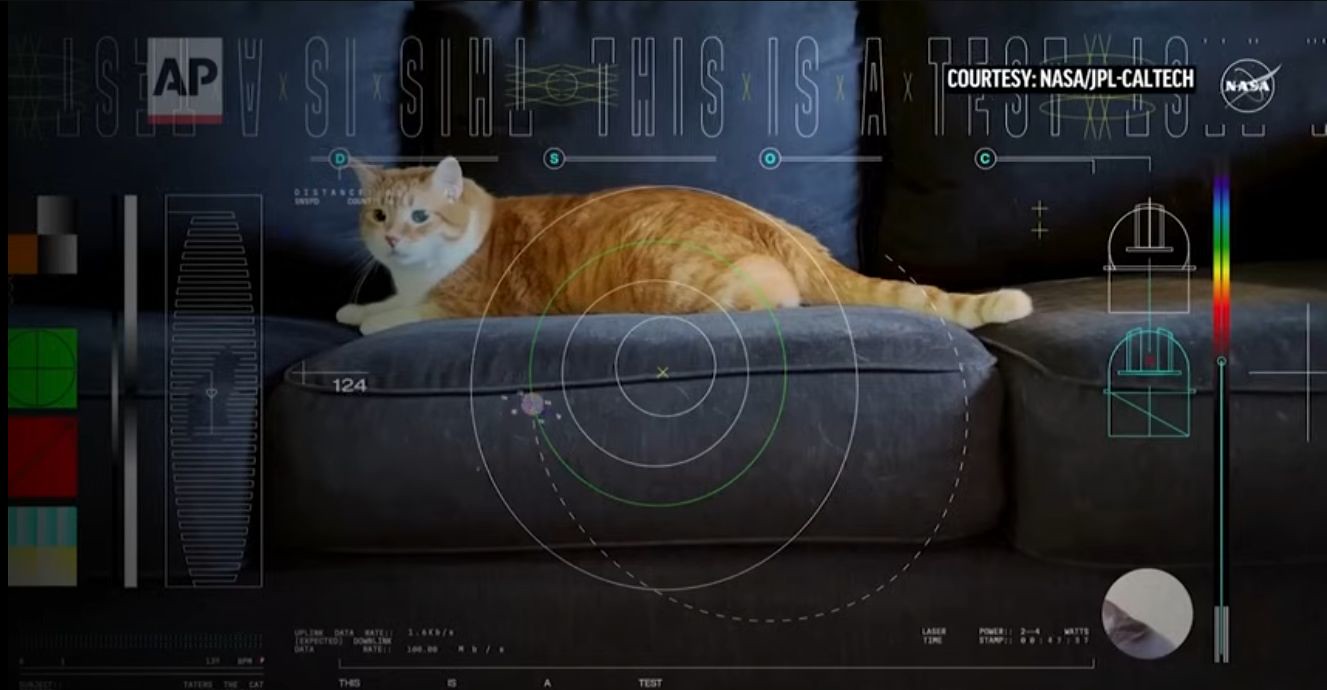
Testing of the Pysche mission’s DSOC proof-of-concept system recently started, and on December 22nd, 2023, it achieved a significant milestone by transmitting a pre-recorded 15-second high-definition video from the spacecraft to the Hale Telescope operated by the Palomar Observatory. On receipt, Palomar transmitted the video to to NASA’s Jet Propulsion Laboratory, Pasadena, where it was played in real time on the Internet. Transmitted across a distance of 31 million kilometres, the video was sent at a rate of 267 Mbps and took 101 seconds to reach Earth in its entirety.
And of course, being a video destined to be seen on the Internet, its subject was that of a cat; specifically a tabby called Taters, who was being entertained with a laser pointer toy.
Despite the light-hearted nature of the test, it underscores the potential for DSOC capabilities in future space missions. It shows that not only does the laser-based system transmit and receive far more data than can be achieved through conventional radio link in the same time period, it has the potential to bring “real time” (allowing for the inevitable lag on transmission times) video to things like rover missions on Mars, allowing mission planners and vehicle drivers to see terrain, etc., with greater continuity and clarity and faster than can be achieved through the recording, transmission, receipt and stitching together of multiple still images.
When it comes to human missions into deep space, capabilities like DSOC could become invaluable in helping crews on Mars (for example) maintain a sense of grater connection to family and friends on Earth simply because of the ability to see and record personal messages in high-definition video. To both these ends, the DSOC tests using the Psyche spacecraft could be extended all the way out to its rendezvous with Mars, allowing engineers to gather precise data on the capabilities and options for enhancing optical communications systems for use with robotic and crewed missions.
JWST Reveals a Dynamic Uranus
Learning aside the prepubescent titters mention of its name tends to give rise two in some quarters, Uranus is one of the most enigmatic planets within our solar system. A gas giant, Uranus is smaller than Saturn, but slightly larger than Neptune. It has mean diameter four times that of Earth, with a mass some 14.5 time greater than that of Earth.
Orbiting the Sun at an average distance of 20AU – 20 times that of the Earth’s average distance from the Sun – Uranus takes 84 terrestrial years to complete a single circuit around our star. To put this in context, it has not even completed three orbits since William Herschel first observed it in 1781 and was able to determine it to be a planet (or possibly – as he originally thought – a comet) rather than dismissing it as just another star, as those before him all the way back as far as Hipparchus had done.
Earth and Uranus to scale. Credit: NASA
But what makes Uranus curious is the fact that it is the only major planet (that is, excluding Pluto and the other dwarf planets) to have an extreme axial tilt – some 82.23º. The exact cause for this isn’t known for certain, but the most common theory is that very early in its history, Uranus was dealt a blow from a body of rock larger than Earth, knocking it over whilst causing the impacting body to break apart.
The upshot of this is a very – by our standards at least – unusual set of circumstances for the planet. These include the fact that in each 84-Earth-year orbit around the Sun, each of Uranus’ poles receives around 42 years of continuous sunlight, followed by 42 years of continuous darkness, and it is during the dozen(ish) terrestrial years of the equinoxes, when the Sun is facing the equator of Uranus, that the planet’s mid-latitudes experience a period of day–night cycles similar to those seen on most of the other planets. However, despite this – and because of a still-to-be-understand mechanism, the planet’s equatorial regions experience higher temperatures than are seen at its poles.
This mystery is deepened by the fact that Uranus is markedly colder than the other gas giants, but it has a low thermal flux, radiating little to no excess heat. Again, why this should by is unknown. One theory is that that force of the impact – if it was an impact – which tipped the planet over may have cause Uranus’ core to shed all of its primordial heat; another theory is that there may by one or more compositionally different layers within the planet’s mantle which cause convection flows which carry heat so far up towards the outer mantel and its boundary with the atmosphere before pushing the heat back down towards the core before it can be properly expelled.
The most widely-accepted view of the interior of Uranus. Credit: Frederik Beuk
Uranus, with its ring system and 27 known moons, all tilted in the same manner as the planet, has only ever been visited once by a vehicle from Earth, and that was Voyager 2, which came to within 81,500 km of the upper reaches of the planet’s atmosphere on January 24th, 1986 as it swung by the planet en-route to Neptune. At that time, Uranus appeared surprising bland and uninteresting, despite the fact is rotates around its axis once every 17 hours; in fact, the spacecraft only noted 10 features visible in the planet’s atmosphere as it passed, a marked contrast with the likes of Neptune, Saturn and Jupiter.
Since then, Uranus has been observed by the Hubble Space Telescope (HST), which allowed astronomers their first close-up glimpse of the planet’s north polar latitudes. HST’s imaging, largely in the visible and ultra-violet wavelengths did help to reveal a more dynamic thrust to Uranus’ atmospheric mechanisms, whilst further observations in the infra-red suggested that Uranus is every bit as dynamic as its gas giant siblings.
These latter findings have now been added to by the James Webb Space Telescope (JWST), which earlier in 2023 was commanded to turn its huge eye towards Uranus and have a good look. In doing so, JWST was able to image the planet’s slender series of rings – so dark they are hard to discern in the visible spectrum when images by telescopes – and several of the tiny moons which orbit Uranus and help shepherd those rings.
An enlarged image in the infra-red spectrum, as taken by the James Webb Space Telescope, shown the northern hemisphere of Uranus, complete with its ring system and several of its 27 moons (the blue-white dots around the planet and its rings), some of which help “shepherd” the rings and keep them in their position around the planet. These nine moons are (starting upper right, in the 2 o’clock position and progressing clockwise): Rosalind, Puck, Belinda, Desdemona, Cressida, Bianca, Portia, Juliet, and Perdita. Credit: NASA / ESA / CSA / STSci
In particular, Webb was able to capture the elusive Zeta Ring, the closest to the planet and so diffuse it has proven hard to image with any clarity. In addition, JWST caught multiple atmospheric formations, including the planet’s “polar cap”.
This cap – a collection of high-altitude weather formations rather than any ice cap of the type with which we’re familiar – tends to form during the solstices, when one or other the Uranus’ poles is pointing more-or-less directly towards the Sun – in this case, the summer solstice, which reaches its peak in 2028. Observing the development of this cap, as JWST has and will continue to do over the next few years, may help unlock some of the mysteries surrounding the dynamics of the planet’s atmosphere and weather. Beyond the bright disc of the polar region, JWST also imaged cloud formations suggesting both developing and on-going storms, the understanding of which might inform astronomers as to the planet’s heat flow mechanisms.
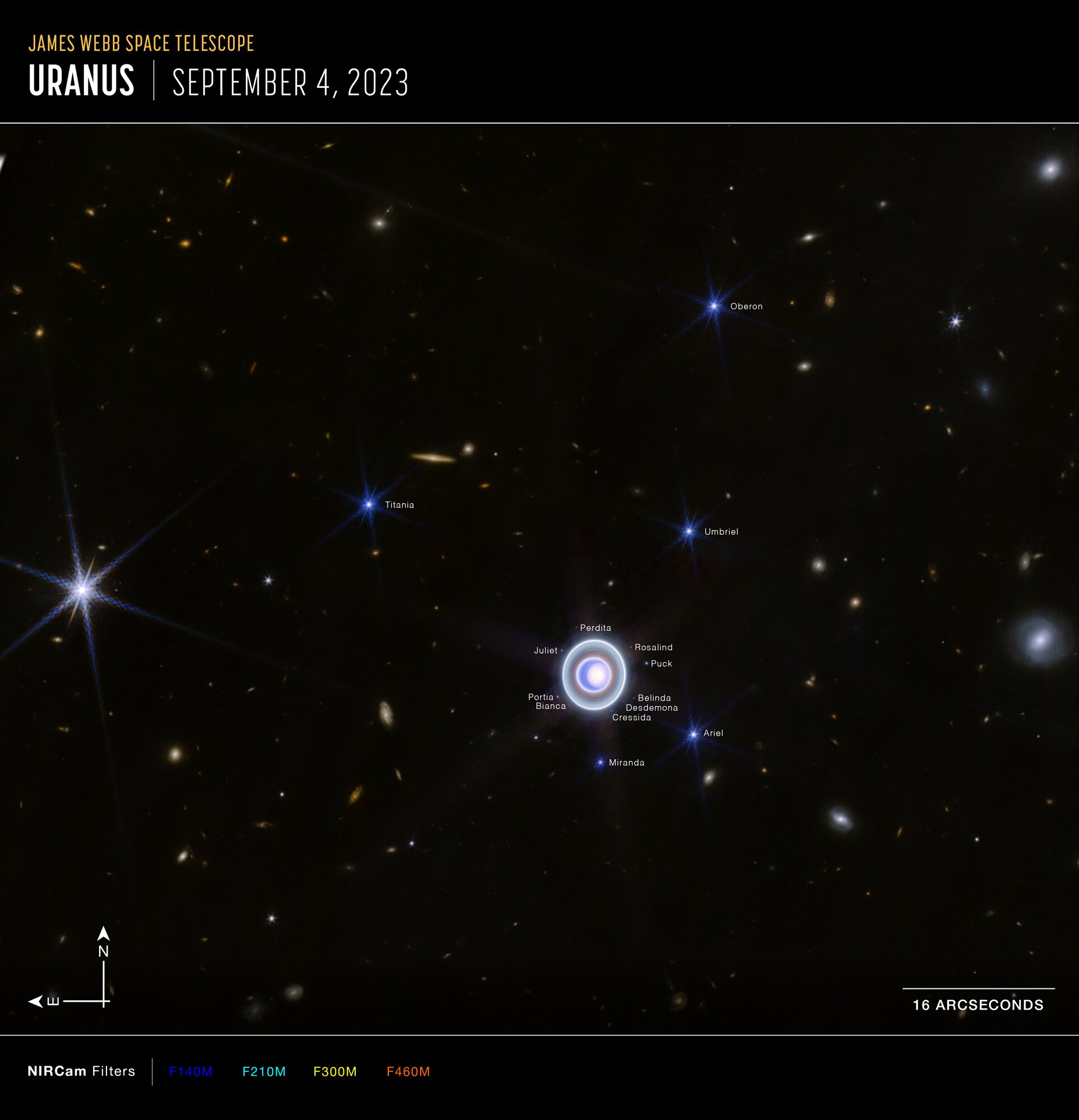
A wider-field view of Uranus, as captured by JWST in September 2023, with more of the planet’s moons annotated, and several galaxies far beyond our own also visible. Credit: NASA / ESA / CSA / STSci
Gaining a clearer view of the planet’s ring system is important for those who want to send a mission to study the planet and its moons at some point in the future. Interest in doing this is actually fairly high in some quarters, with no fewer than five orbital missions being proposed in just the last 15 years alone. However, having a clearer understanding of the composition and disposition of the Urainian ring system, particularly the inner rings like the Zeta Ring, is seen as vital to the success of any orbital mission.
Thus, Webb’s unparalleled infrared resolution and sensitivity is allowing astronomers to see Uranus its system with unparalleled clarity, helping them to better understand the planet, the challenges any future missions their might face and – perhaps most intriguingly of all – helping them understand how exoplanets which show similarities with Uranus and Neptune may have formed and how they work.





 Inara Pey: Living in a Modemworld