Soulstone, February 2024 – click any image for full size
I’m going to start by saying that by the time some read this, Soulstone will have taken on a new guise compared to what is seen here. The fault for this is mine entirely; this Full private region – held and designed by Valayra Asher (Valayra) – has been in its winter guise for some time, but things being what they are with life in general at the moment, it has taken me a while to get from taking photos and jotting down notes to actually getting something half-way decent written up.
So, my apologies for that!
Soulstone, February 2024
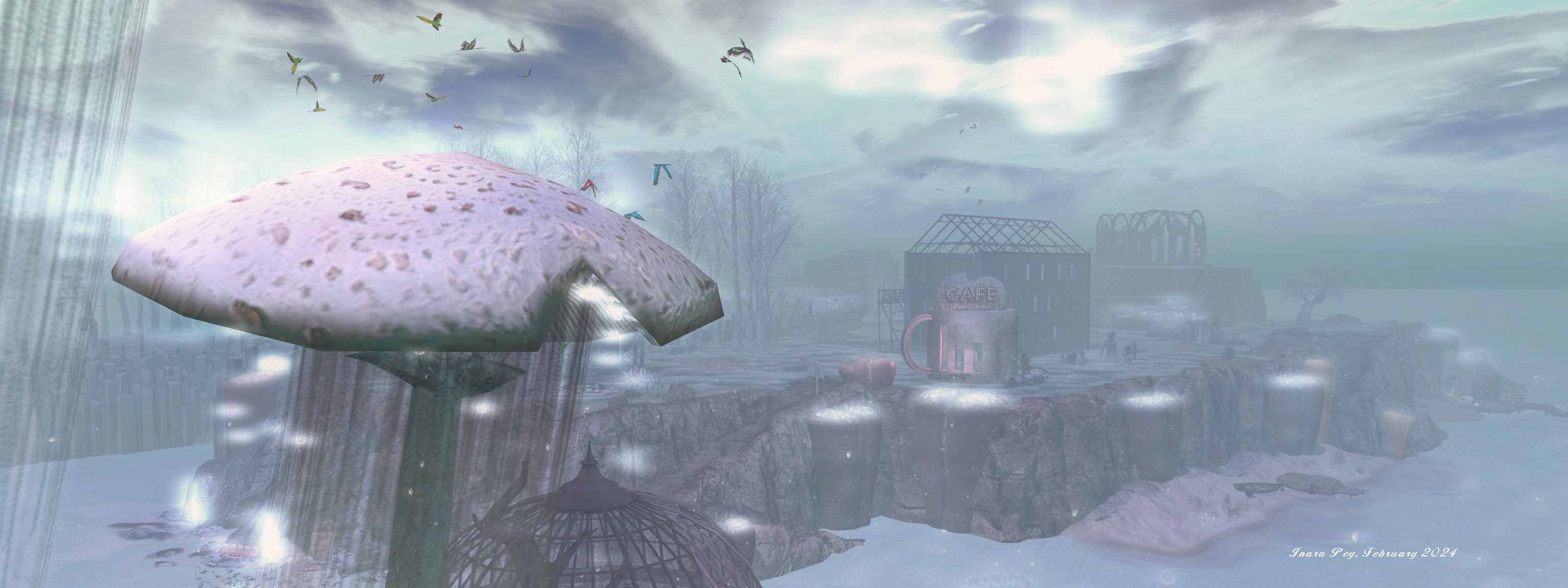
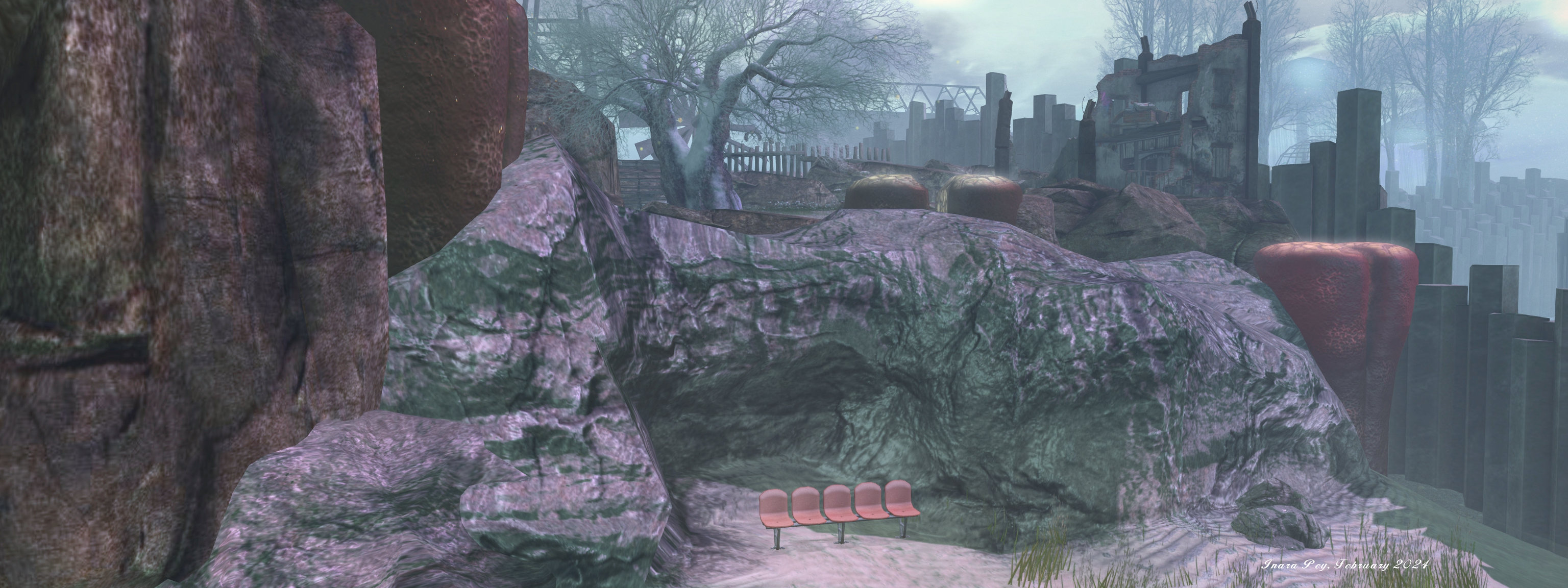
In its winter cloak, the region has presented an engaging mix of art, fantasy and a soupçon of science fiction. The landscape is split in two, thanks to a dogleg channel running through it, the sides of which suggest it may be artificial in nature, the walls formed by parallel lines of great basalt columns, one arm of which marches resolutely out to sea, leaving the land behind, to form a kind of breakwater.
Both of the islands are flat-topped, their remaining sides forms by natural rocky cliffs and slopes falling to the sea, with water flowing outwards from fissures here and there to cascade of the rocks below. Each island is home to a number of structures, but be aware that the small island with its well-appointed house and older lighthouse, appears to be a private residence, so please restrict explorations to the larger, L-shaped landscape.
Soulstone, February 2024
The landing point is located in a gazebo of cathedral-like proportions; and like a cathedral, it sits head and shoulders above the rest of the landscape thanks to the shoulder of rock on which it has been built. Within it might be found a cosy hideaway and a series of teleport boards which can carry visitors to the major points of interest around the island. However, I’d recommend to those who read this article and make it to Soulstone before it temporarily closes on February 15th for redressing in readiness for spring, that initial explorations are carried out on foot.
The landing point shares the island with a warehouse-like building either still under construction or lacking in repair (you decide!) and a number of other structures which should pique curiosity. The incomplete warehouse helps to set the artistic elements to be found within the setting, being home to sculptures by Bryn Oh and Rogue Falconer, with further statues outside by DRD with other by Mistero Hifeng awaiting discovery.
Soulstone, February 2024
The twists of sci-fi are humorously offered – H.R. Giger alien is collecting its order of cookies and hot chocolate from the café, pot-bellied “greys” have turned their flying saucer into a DJ hangout or are heading the local (and novel) swimming pool for a dip. There’s also a slight Orwellian slant in places as well, thanks to piles of television screens here and there keeping what seems to be a Big Brotherish watch on things.
There are several waterfront locations to be discovered as well. Some might require exclusive use of the teleport boards to reach, whilst others might be reached by stairways or paths hewn or worn into the rocky outer flanks of the island. One of the former passes through a most unique gorge: natural rock cliffs rising above the flat top of the island, the inner walls of side either bearing the façades of buildings as they escort the path down to the beach
Soulstone, February 2024
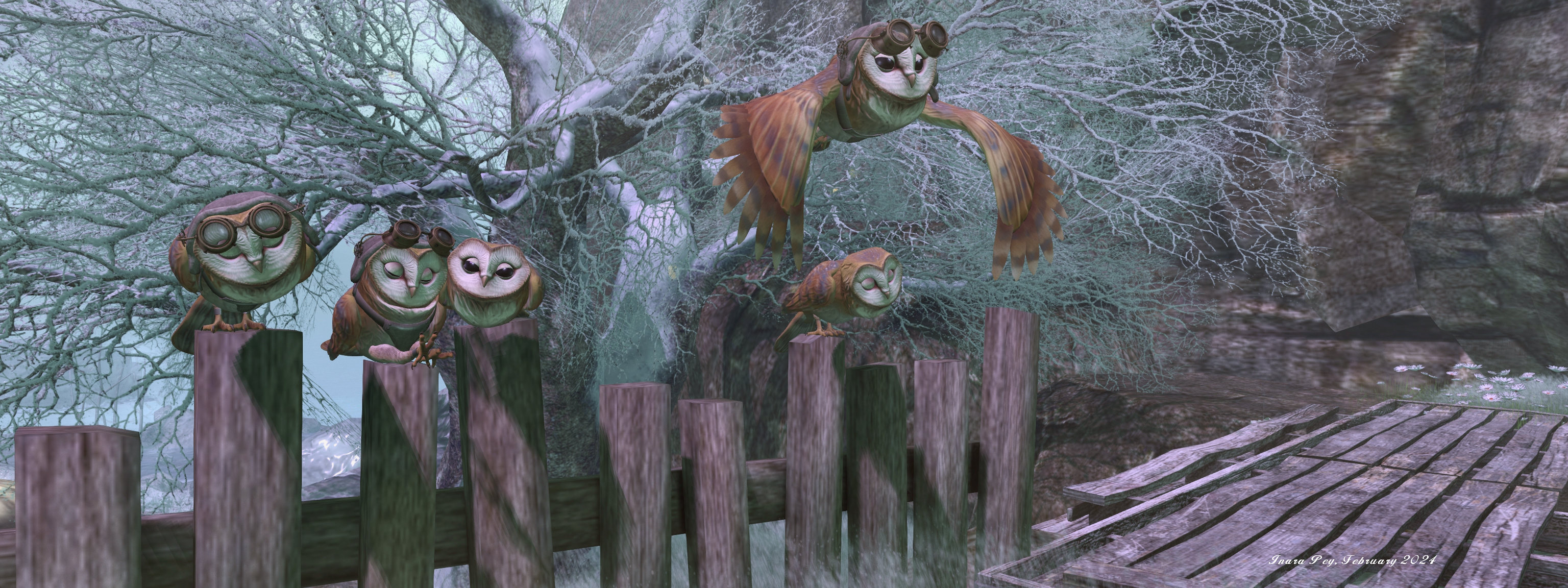
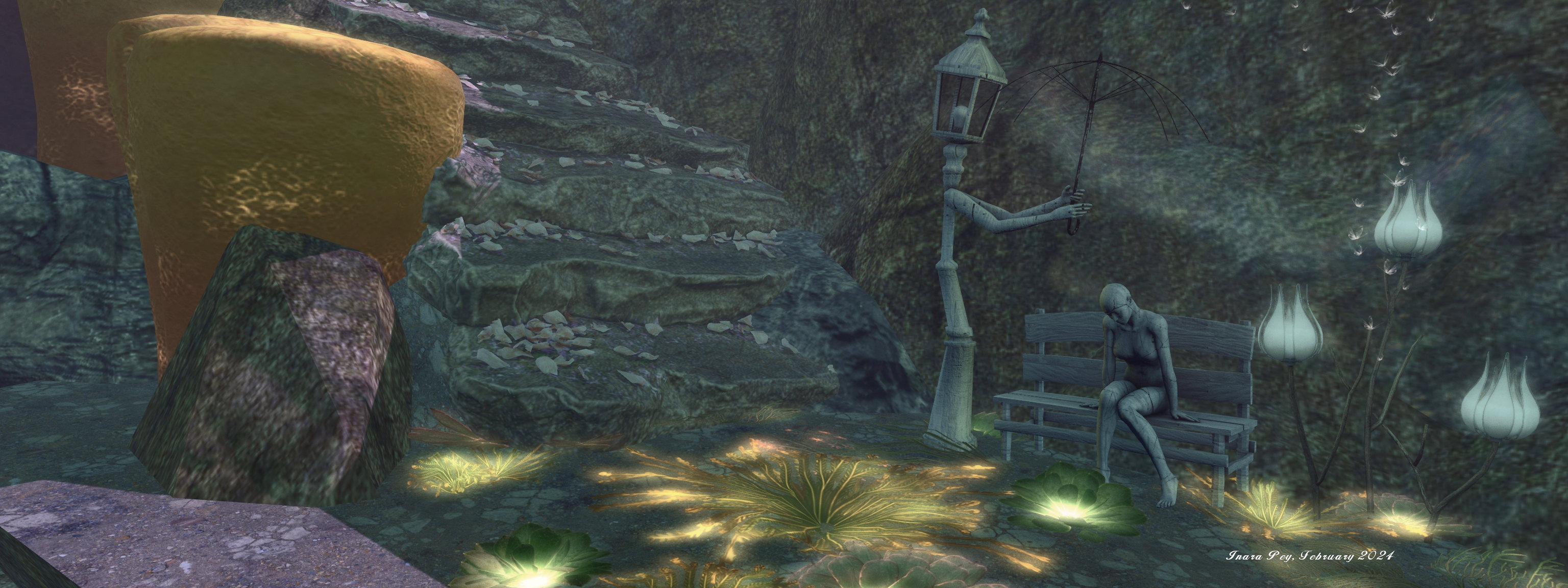
Throughout all of this are multiple places to sit – and also the remaining locations to be discovered by the teleport boards (which you should return to and try after an initial exploration of the large island, in order to ensure you get to see everything). There are also numerous little touches of detail scattered throughout, some quite unexpected – such as the owls or the bicycles neatly parked in their rack; others add to the mysterious air of the setting – but I’ll leave you to hope across and find them for yourselves.
Quietly unique and eminently artistic and photogenic, this iteration of Soulstone will be vanishing from Second Life come February 15th, as noted – so do please again accept my apologies for the lateness of this article and, of you are a keen SL explorer and have not see it already, be sure to make the most of the remaining 36-ish house before Valayra and her partner close it for the aforementioned redressing.
Logos representative only and should not be seen as an endorsement / preference / recommendation
Updates from the week through to Sunday, Febuary 11th, 2024
This summary is generally published every Monday, and is a list of SL viewer / client releases (official and TPV) made during the previous week. When reading it, please note:
It is based on my Current Viewer Releases Page, a list of all Second Life viewers and clients that are in popular use (and of which I am aware), and which are recognised as adhering to the TPV Policy. This page includes comprehensive links to download pages, blog notes, release notes, etc., as well as links to any / all reviews of specific viewers / clients made within this blog.
By its nature, this summary presented here will always be in arrears, please refer to the Current Viewer Release Page for more up-to-date information.
Note that for purposes of length, TPV test viewers, preview / beta viewers / nightly builds are generally not recorded in these summaries.
Official LL Viewers
Release viewer: version 7.1.2.7215179142, formerly the glTF PBR Materials Maintenance RC, issued December 15, promoted January 8th, 2024 – numerous bug fixes and improvements – NEW.
Maintenance-Y RC viewer (My Outfits folder improvements; ability to remove entries from landmark history) updated to version 7.1.3.7790341084, February 9, 2024.
IMAGOLand Galleries, February 2024: Mareea Farrasco: Les Colchiques
Wilhelm Albert Włodzimierz Apolinary Kostrowicki is unlikely to be a name familiar to many. Born in Rome in August 1880, he was of mixed Polish-Lithuanian and (it is thought, as his father was never positively identified) Italian heritage. However, he is exceptionally well-known under the name he adopted following his emigration to France whilst a teenager: Guillaume Apollinaire.
Regarded as one of the foremost poets of the early 20th century, Apollinaire was an impassioned defender of the emerging art movements of the first decades of the 20th, century – particularly cubism and surrealism, both of which he is responsible for naming as such (the latter in the preface to his play The Breasts of Tiresias, itself regarded as one of the first pieces of surrealist literature.
As a poet, Apollinaire was influenced by the Symbolist movement, and it was from this that he developed a style of poetry which eschewed punctuation and sought to reflect modern times and life in form. In doing so, he would express the view that art – visual or written – should not be rooted in any particular theory, but should be born of intuition and imagination, so as to be as close as possible to life, nature and the world around us.
IMAGOLand Galleries, February 2024: Mareea Farrasco: Les Colchiques
Both the influence of the symbolist movement and his own emerging style are perhaps best reflected in his 1913 volume of poems, Alcools. Within that volume is what is regarded as one of the most poignant poems written in his too-short life (Apollinaire died at the age of 38 due to complications from a wound received in 1916 whilst he was serving in the French infantry, and which left him weakened and vulnerable to the ravages of the 1918 Great Influenza Epidemic – aka the “Spanish flu” pandemic). That poem is Les Colchiques, which is the subject of an exhibition of digital art by Mareea Farrasco, which opened in February at her IMAGOLand Galleries in Second Life.
The poem presents a bucolic setting: cows grazing within a field as children come to play, before the cowherds come to take the cows home. It sounds idyllic – and can be taken as such. However, the overall framing of this three-stanza poem is also deeply layered, exploring ideas of the cyclic nature of life, mortality, beauty, and the passage of time. The opening stanza starts by referencing the fact that in their grazing, the cows are poisoning themselves as they are eating colchiques – aka Colchicum autumnale, the very toxic autumn crocus (although not a true crocus) – growing wild in the meadow. It then goes on to compare the colour of the flowers within the field with the eyes of the poet’s love, enfolding the idea that just as the poisonous nature of the plants lay hidden in their rich and lovely lilac colour, so too has the captivating beauty of the poet’s love come to poison his life by captivating and enthralling him.
IMAGOLand Galleries, February 2024: Mareea Farrasco: Les Colchiques
In the second and third stanzas we have the children coming to play in the field, and within the poet’s observations of them lie the idea that the girls within the group will one day be mothers, and their daughters will one day come to play in the fields, just as their mothers did before them, thus introducing the idea of life’s cyclical nature and the passage of time; at the same time, the fleeting nature of beauty is folded into the comparison of fluttering eyelids with flower petals being lost on the wind. Finally, the cows are drawn from the field by the singing of the herdsmen, the children having also departed, leaving only the deadly flowers – a subtle commentary on mortality and the transient nature of life.
Within her exhibition, Mareea presents images that travel through the literal forms present within the poem, perhaps emphasising the themes of love and childhood innocence within the stanzas a little more than their deeper interpretations. However, the richness of the poem’s metaphors are present within many of the pictures for those who seek them . Note how, for example, Les enfants de l’ecole viennent avec fracas focuses on young girls, thus reflecting the poem’s second stanza’s observation concerning mothers and daughters; similarly, whilst Et ma vie pour tes yeux lentement s’empoisonne might be drawn from the final line of the first stanza, the lowered eyelids of the parasol-carrying young woman perhaps reflects the second stanza’s views on time and the fleeting nature of beauty.
IMAGOLand Galleries, February 2024: Mareea Farrasco: Les Colchiques
Thus, and like the poem itself, these images, set within an environment designed to further reflect the more innocent and pastoral nature of the poem’s beauty, offer a simplicity and complexity of interpretation Apollinaire himself would have both recognised and appreciated.
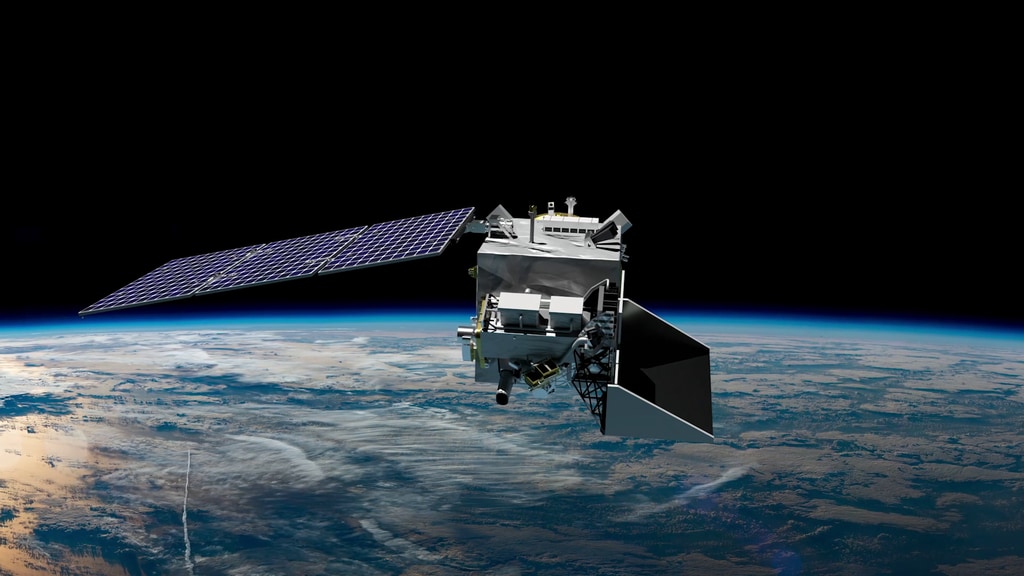
An artist’s rendering of the PACE Earth observation platform in orbit. Credit: NASA
On Thursday, February 10th, 2024, NASA launched a critical Earth observation satellite intended to study the world’s oceans and atmosphere in the face of increasing climate change.
PACE – the Plankton, Aerosol, Cloud, ocean Ecosystem remote sensing platform – is designed to operate in a geocentric, near-polar Sun-synchronous orbit, allowing it to observe all of Earth’s atmosphere and oceans over time. In doing so, it will study how the ocean and atmosphere exchange carbon dioxide and how microscopic particles (aerosols) in our atmosphere might fuel phytoplankton growth in the ocean. The data it accumulates will be used to identify the extent and duration of harmful algae blooms and extend NASA’s long-term observations of our changing climate.
Referred to as autotrophic (self-feeding), phytoplankton are present in both oceanic and freshwater ecosystems and play a key role in sustaining them – and in managing the planet’s carbon dioxide absorption and oxygen production. With the former, phytoplankton absorb carbon dioxide from the atmosphere and convert it into their cellular material, serving as the base of the global aquatic food web, a critical resource for countless species – including humans. In terms of the latter, phytoplankton are responsible for around half the planet’s natural oxygen production despite being around just 1% of the global plant biomass.
Phytoplankton can be imaged in a range of wavelengths (visible light, infra-red, ultraviolet, etc.), allowing colours to be used to assess their bloom size, drift, health, etc. In this 2016 image captured by the Visible Infrared Imaging Radiometer Suite (VIIRS) on the Suomi NPP satellite, the Southern Ocean phytoplankton bloom extending outwards from either side of the South American continent and down to the Antarctic Peninsula is clearly visible. Credit: NASA
Occupying the photic zone of oceans, where photosynthesis is possible, phytoplankton are crucially dependent on large quantities of nutrients, including nitrate, phosphate or silicic acid, iron, and also large amount of vitamin B. The availability of these nutrients is governed by a range of factors: the so-called ocean carbon biological pump; nutrients delivered into the photic zone via freshwater sources emptying into the oceans, natural organic decay, etc.
Both anthropogenic global warming and pollution are particularly harmful to phytoplankton; the former can lead to both changes in the vertical stratification of the water column and the supply of nutrients vital to phytoplankton. Similarly, increased acidity within ocean waters and currents can also adversely affect phytoplankton, up to an including causing biochemical and physical changes. In this, the colour changes exhibited by phytoplankton are considered important indicators of estuarine and coastal ecological condition and health.
Thus, the study of the global distribution and health of phytoplankton communities could profoundly advance our knowledge of the ocean’s role in the climate cycle, whilst at the same time providing real-time data on the negative effects of coastal and deep-water pollution and the impact of climate change and increasing temperatures on the world’s aquatic ecosystem.
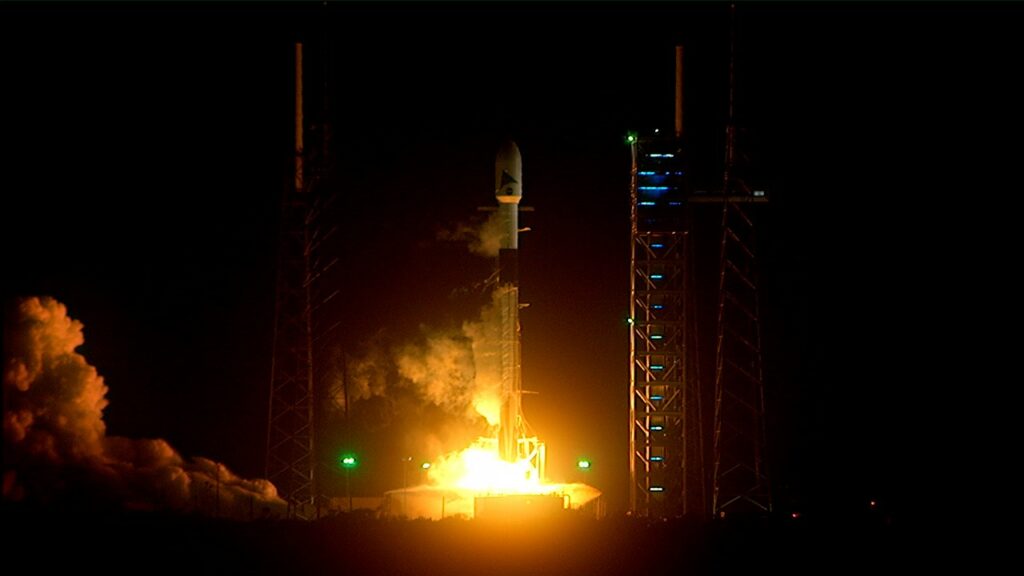
A SpaceX Falcon 9 rocket lifts-off from Cape Canaveral Space Force Station, Florida, carrying NASA’ PACE platform up to orbit. Credit: SpaceX
In this, PACE will operate in unison with the French-American Surface Water and Ocean Topography (SWOT) mission. Launched in 2022, SWOT is designed to make the first global survey of the Earth’s surface water, to observe the fine details of the ocean surface topography, and to measure how terrestrial surface water bodies change over time to allow a more complete picture of the impact of anthropogenic global warming and pollution on the planet’s aquatic biodiversity and life-giving water cycle.
“Death Star” Moon’s Underground Ocean
We’re becoming increasingly familiar with the solar system being potentially full of so-called “water worlds” – bodies that may be home to vast subsurface oceans. Jupiter’s Europa and Saturn’s Enceladus are perhaps the most well-known, with both showing visible signs of water vapour escaping in geyser plumes through cracks in their surfaces. However, there are other bodies scattered around the solar system where water could be present beneath their surfaces, if not in liquid form, then at least in either a semi-liquid icy slush or solid ice.
Now a team of French-led scientists believe they have another candidate for holding a sub-surface ocean: Saturn’s moon Mimas.
Mimas, moon of Saturn, compared roughly to scale to the original Death Star and from a similar viewing angle, helping to show why it is often compared to the fictional battle station. Credit: Jason Major
This tiny moon – officially designated Saturn I – is the smallest astronomical body yet found in our solar system known to be roughly rounded in shape due to its own gravity. However, Mimas – with a mean diameter of 396.4 km – is perhaps most famous for resembling the fictional Death Stars of the Star Wars franchise. This is because one face of the moon is dominated by a huge, shallow impact crater 139 kilometres across, which has an almost sinister resemblance to the depression housing the primary weapon found on the fictional doomsday space vehicle.
Discovered in 1789 by William Herschel – after whom the distinctive crater is named – Mimas is responsible for one of the largest gaps in Saturn’s complex ring system, the Cassini Division, and had long be thought to be primarily made up of water ice rather than rock, simply because of its relatively low density (1.15 g/cm³).
However, the research team, using data gathered by the NASA / ESA Cassini mission which studied Saturn and its complex system of moons and rings between July 1st, 2004 and September 15th, 2017 (Space Sunday: Cassini – a journey’s end), believe that Mimas most likely has a watery ocean which exists at around the freezing point of water where it is closest to the moon’s surface, whilst potentially being several degrees warmer at the sea floor.
“That’s no moon… No, wait – yes it is!” – Mimas (lower left) shown to scale with the Moon (upper left) and Earth. Credit: unknown.
Building models to account for the moon’s mass and motion, and which also incorporate data on potential core warming and tidal flexing due to the influence of Saturn and other bodies orbiting the planet, the research team concluded that it is likely the ocean on Mimas accounts for around 50% of its total volume, and reach up to around 30 or 20 km below the moon’s crust. This would put the total amount of water within the moon at around 1.2%-1.4% that of all the Earth’s oceans; a not inconsiderable volume, given Mimas’ tiny size.
What has excited planetary astronomers the most, though, is the suggestion that this ocean might only be around 15 million years old – too young to have influenced the moon’s surface, but old enough that – assuming the conditions within it were right – it might actually be home to basic life still in the earliest stages of development; not that actually studying that life would be in any way easy (if at all possible). Even so, Mimas has possibly revealed that even the tiniest bodies in our solar system, if given the right circumstances, could be home to bodies of liquid water and perhaps to the basics of life.
Second CLPS Lunar Mission Set for Valentine’s Day Launch
The second private mission to fly to the Moon under NASA’s Commercial Lunar Payload Services (CLPS) programme is set to launch on February 14th, 2024.
The 675 kg IM-1 lander, also known as a Nova-C lander and christened Odysseus by its makers, has been built by Intuitive Machines, a Texas-based start-up. It had originally been scheduled to be the first lunar lander to be launched under the CLPS programme, in October 2021. However, a series of slippages – one of which one of the losing parties (Deep Space Systems) for the CLPS contract unsuccessfully challenging the US $77 million award – led to the mission being pushed back several times, enabling the recent Astrobotic Peregrine Mission One to claim the title of the first successful CLPS mission launch (January 8th, 2024 and the maiden flight of the ULA Vulcan Centaur rocket).
Intuitive Machines’ IM-1 lunar lander Odysseus undergoing testing. The vehicle is due to launch on February 14t, 2024. Credit: Intuitive Machines
Intuitive machines, who will be using a SpaceX Falcon 9 rocket as their launch vehicle, are hoping for a better result than that of Astrobotic – as I reported at the time, whilst the launch of the latter mission was successful, the lander suffered a malfunction and never reached the Moon, instead eventually re-entering Earth’s atmosphere and burning up.
Odysseus will be carrying 12 payloads to the Moon – six provided by NASA and 6 privately-funded. Included in the latter are sculptures by artist Jeff Koons entitled Moon Phases, and are tied to his first foray into the rabbit hole of NFTs (and in the process potentially furthering his critics’ view that his work could be considered little more than cynical self-merchandising). However, its sculptures will form the first set of sculptures to reach the Moon since 1971, when Apollo 15 astronaut David Scott placed the 9-cm tall Fallen Astronaut by Belgian artist Paul Van Hoeydonck on the Moon alongside a plaque commemorating the astronauts and cosmonauts who have lost their lives in space missions up until that time.
Also aboard the lander is a system called EagleCAM, a camera system designed to gain the first ever “third-person” images of a vehicle landing on the Moon. It will attempt to achieve this by being ejected from the lander when it is 30 metres above the lunar surface. Falling ahead of the lander, it is hoped EagleCAM will arrive on the Moon in such a way that one of his lens will be pointing at the landing site, allowing it to record Odysseus’ arrival. Any images it does capture will be transmitted to the lander via a wi-fi connection for transfer to Earth.
Thew utterly unassuming EagleCAM by Embry-Riddle University. Credit: ERU
The NASA instruments include a laser retro-reflector array (LRA), designed to provide precise measurements of the distance between the Earth and the Moon using lasers fired from Earth. Six LRAs were left on the Moon by the Apollo missions, and three more have been placed by the two Soviet Lunokhod rover missions of the 1970s, and one by the Indian Vikram lander in 2023.
The lander also carries the Lunar Node-1 (LN-1) prototype for a radio navigation system NASA hopes to utilise on the Moon for precise geolocation (or should that be selenolocation?) and navigation. The idea is that every unit on the Moon – base camps, rovers, astronauts, landers – and incoming vehicles – will have such beacons, and will be able to use the signals from multiple beacons to precisely confirm their position relative to one another. In theory, such a system would allow an automated lander make a precise landing wherever it was required, or allow two rovers to rendezvous with one another without the need for mission controller Earthside to direct them. LN-1 would therefore provide a local radio navigation system, one of several options for surface vehicle and lander navigation being investigated by NASA.
Following its launch at 05:57 UTC on February 14th, Odysseus will make a 5-day cruise to the Moon and has a provisional landing date of February 19th, 2024. It is due to land at Malapert A, an impact crater near the southern limb of the Moon and once on the surface, it is expected to operate for some 14 days – as long as the Sun is above the horizon to provide it with energy.
The total cost of the mission to NASA has been US $118 million, including some US $40 million towards launch and operation costs associated with the Falcon 9 rocket.
Welcome to Volcano Central: A Stunning View of Io
On December 30th, 2023, the NASA Juno spacecraft (of the mission of the same name), which has been orbiting Jupiter since July 2016, returning a huge amount of data and images of the solar system’s largest planet and its retinue of moons, made its closest approach to Io, the most volcanically active place in the solar system.
At that time, the orbiter passed over the north hemisphere of Io at a distance of 1,500 km. In February 2024, the spacecraft made a second pass over Io, this time over the moon’s southern hemisphere, and these two passes have allowed the production of the sharpest images of the moon ever seen to date.
At the innermost of the four large Galilean Moons of Jupiter, Io is very slightly larger than our Moon, and has the highest density of any moon in the solar system. With some 400 active volcanoes being recorded on its surface, it is not only the most volcanically active place in the solar system – it is the most geologically active, courtesy of its surface being almost constantly re-shaped by volcanic outflows.
The cause on all this volcanism is primarily because Io is constantly being tidally flexed: on the one side, it has massive Jupiter pulling away at it and its molten core. On the other, it has the three other Galilean moons, each of which exerts its own pull on Io, and all of which periodically combine their forces to counter Jupiter. In addition, Io sits well inside Jupiter’s immensely powerful magnetic field, which also imposes tidal forces on the moon’s core, further causing it to flex and generate heat and energy.
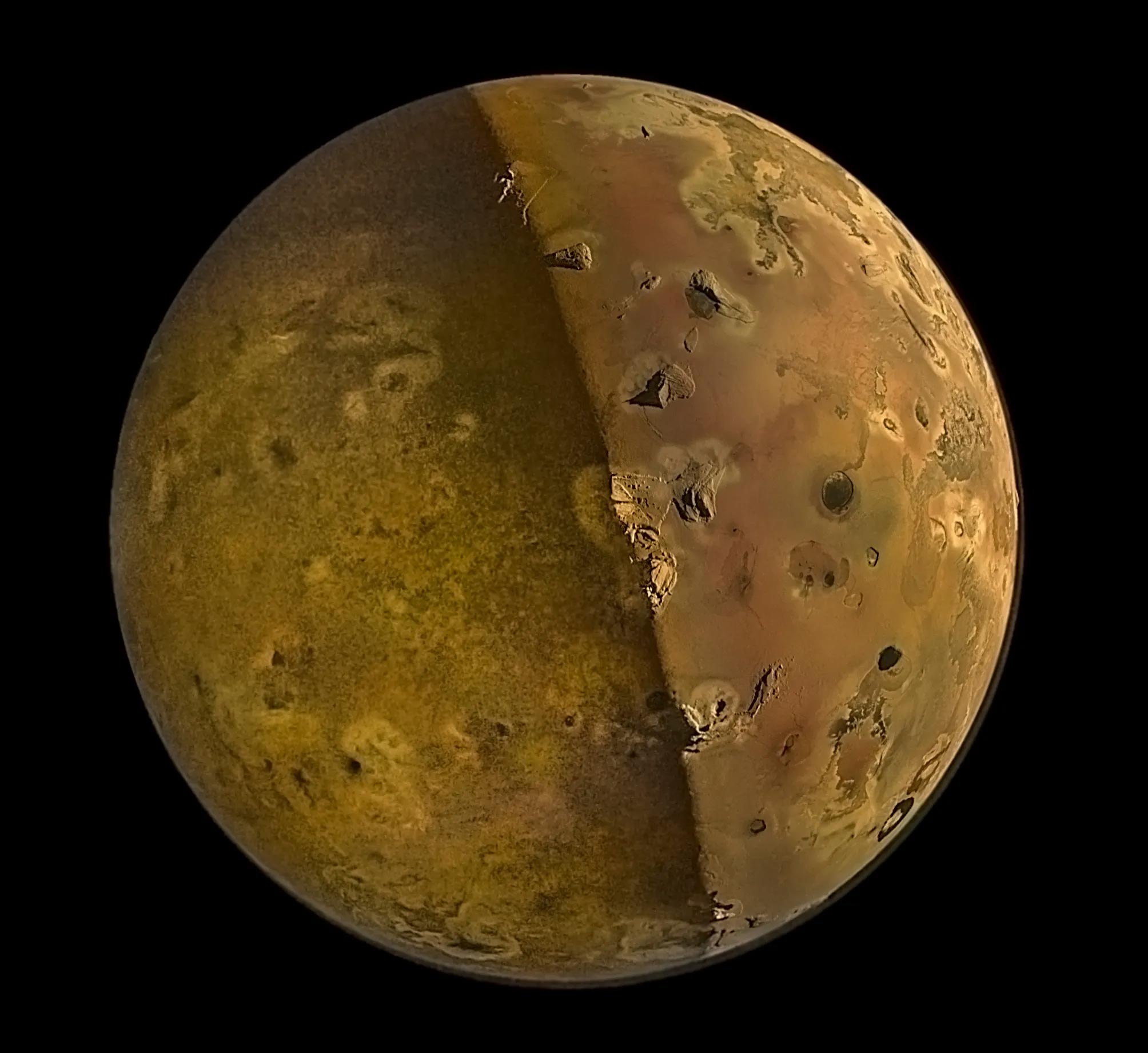
Jupiter’s moon Io, its night side (left) illuminated by reflected sunlight from Jupiter, or “Jupitershine.” Credits: original image data via NASA/JPL / MSSS. Image processing and image production: Emma Wälimäki
The images from the two recent passes over Io by Juno have been combined into a single true-colour mosaic, with the moon almost equally lit on two sides by direct sunlight and sunlight reflected onto it by Jupiter’s nearby bulk. The result is an image stunning in its clarity and depth of detail.
Many of Io’s volcanoes are visible, with at least one puffing out a plume of ejecta. On the sunward side of the moon (to the right) the light of the Sun is sufficient to reveal the moon’s hazy, mineral-rich atmosphere, whilst large parts of the surface appear bland and smooth due to the outflow of lava from multiple eruptions, and upon which volcanic island appear to be dotted.
A further impressive aspect of this image is that it was not created by NASA or anyone at Malin Space Science Systems (MSSS), who made and manage the mission’s JunoCAM imager. Instead, it was pieced together and processed by citizen-scientist Emma Wälimäki, using raw Juno images presented by NASA for public consumption, as a part of her involvement in the NASA citizen-science programme.
The following notes were taken from the Thursday, February 8th, 2024 Combat User Group meeting (also referred to as the Combat Committee User Group or CCUG, an abbreviation also used by the Content Creation User Group, and which I’ll not be using in these summaries to reduce the risk of confusion between the two). They form a summary of the items discussed, and are not intended to be a full transcript.
Meeting Overview
The Combat User Group exists as a forum to discuss improvements to the Linden Lab Combat System or LLCS to better support combat in Second Life.
The meetings are the result of a proposal document on improving the native damage system in SL, written by Rider Linden, and which is the focus for both the meeting and any work arising from them.
These meetings are conducted (as a rule):
By Rider Linden, with the support of Kyle Linden.
On alternating Thursdays (rotating with the Content Creation User Group) at 13:00 SLT. Meeting dates are recorded in the Second Life Public Calendar.
Initially in text, although voice might be included in the future depending on feedback from those attending.
Rider’s proposal has received broadly favourable feedback, particularly the following:
The new region / parcel additions (Damage Limit, Regeneration Speed, consequence of death (e.g. teleport victim home as per current LLCS or to a telehub / landing point or take no action).
The proposed new on_damage event (and notably the damage adjustment capability to account for intervening elements which may result in less severe damage being caused).
The new Region Combat Event Log (details still to be finalised).
The idea of having region / parcel controls that specifically relate to damage, spawn points, etc., were welcomed as they are seen as both allowing core combat elements to be more effectively curated and managed by those managing the region / parcel(s) where the combat is taking place, whilst the LSL events allow the maximum in flexibility for specific purposes.
This is seen as important, as it allows weapons creators to continue to choose how they wish to script the operation and capabilities of their weapons whilst allow combat operators precise what those weapons can do in terms of damage, etc., within their combat environments, rather than having to rely solely on the scripting within the weapon (or the combat system for which it has been developed).
Rider noted that:
Accessing and modifying the new region / parcel combat controls might be provided through llGetEnv.
The on_damage event is likely to be a difficult element of work, as it marks the first time an event only triggers after it has fired in all relevant scripts.
Comments and Requests
There as some difference in opinion in how much control should be exposed through the simulator, with some noting that implementing too many “combat rules” at the region / parcel level could prove counter-productive and restrictive if used to try to limit “cheating”, particularly given many / most combat environments have staff well versed in dealing with those trying the cheat. The countering view, as noted above was that better control at the region / parcel level potentially removed reliance of combat meter systems and the need for weapons geared for those systems.
Request: make the health / regeneration capabilities accessible to LSL for setting them, rather than being simulator-side additions (thus allowing for health / recovery pick-ups or boosts).
This is something that Rider hadn’t considered for the first pass of improvements, and something he might consider adding.
Request: add a region setting (and / or Edit / Build floater option) to check and enable avatar invulnerability when an avatar is sitting on a object such as a tank or other armoured vehicle, to eliminate the need for additional extra hitboxes using volume detect.
Rider noted that the proposed on_damage event would allow for this by allowing a function to be called to distribute a defined amount of damage (e.g. none) to the vehicle sitters. This would not only neutralise damage being passed on for armoured vehicles, it could be used to increase the amount of damage passed on (e.g. as a result of the vehicle “exploding”).
He further noted that an upcoming feature (contained within the Hearts & Flowers simulator maintenance update to let a scripter set a flag on a seat to make the avatar non-collide, which will also play into this as well.
Request: allow all the combat stuff to run even on non-damage land (but without TPing people home), to assist weapons / meter developers test their systems even if their in-world workspace is on a No Damage region.
This is unlikely to happen, as it opens the door to potential griefing within No Damage regions.
Request: allow alterations to avatar speed (e.g. limiting the avatar to walking pace if carrying a heavy / unwieldy weapon), perhaps linked to scripts in the item itself, tied to an experience.
Rider noted that avatar speed is something he would like to address at some point; however, it was left out of the current proposal so that it could remain focused on managing damage.
Request: allow manual / custom spawn points rather than teleporting the “dead” home /forcing people to reset that Home Position so as to remain in the combat region.
It was pointed out the proposal already has this in the ability to set teleport hubs / landing points – although how this might be managed so that opposing combatants are sent only to their own side’s spawn point might be open to question, unless they are defined by specific group or similar.
As an alternative, the suggestion was made to allow a scripted “respawn” prim, which when touched by an avatar automatically set their spawn point it to wherever the prim is located (thus allowing opposing sides to have their own spawn points, which could then be easily relocated as required. This is something Rider indicated he would add to the proposal.
It was also suggested that “killed” avatars should have some form of animation triggered on dying, rather than simply being teleported to a spawn point; a) Rider pointed out this is possible in the proposal; b) the suggestion resulted in a slightly off-tangent discussion over how such animations should be implemented.
Request: block the use of Mouselook (unclear why) – forcing visual parameters on users is not a popular idea within LL, as it could potentially impact ease of access to the platform for some.
Request: allow llGetHealth(key id) for anyone in the region, so you aren’t wasting a charge on someone who’s already at full health. Rider agreed this would be a good addition.
Request: allow a damage fall-off for weapons )e.g. a pistol’s ability to inflict damage would drop off over distance more than that of a rifle, while a long-range weapon (sniper rifle, for example) should have very little drop-off over distance.
One idea for this has already been written-up in the forum thread for the proposal.
Request: make the combat log readable in real-time via a chat channel, to help deal with issues around people trying to cheat or review disputes. This is actually Rider’s plan for implementing the log, as well as having it recorded.
Request: have to combat log automate some of the administration concerns (e.g. someone using a scripted means of “fast healing” or using a weapon that is inflicting unfair damage) and have it alert region / combat admins and/or force a re-spawn for the offending avatar, rather than waiting for human intervention based on reading the log.
Rider felt this is better dealt with via specific scripting, as it would be very hard to determine if someone is actually “cheating” in an given situation. Plus scripting would allow greater use-case refinements than a simulator-side set of parameters.
Request: to have something like “llVisualizeRay”, which allows a scripter to define a ribbon particle that traces along raycasts from a raycast weapon as visual “projectiles”, so the weapon does not need to rez actual projectiles – Rider asked that this be submitted in a detailed Canny feature request.
There were various thread going on through the meeting discussing armour and armour systems (such as LBA), damage calculations, etc. However, these were primarily being attendees at the meeting, rather than comments or requests directed at Rider Linden for consideration, as so fall outside the scope of these notes.
Monkey Island, February 2024 – click any image for full size
Gian (GiaArt Clip) is an artist, photographer and region designer whose work – in the form of Buddha Garden – I’ve covered twice within this blog (in February and December 2022, so is itself overdue for a return visit on my part!) and who has now presented us with a new setting to explore and enjoy in the form of Monkey Island, which I was recently able to visit.
Described as “an island in the Caribbean”, Monkey Island offers opportunities for exploration – including a treasure hunt -, photography, relaxing, and simply enjoying the setting with its mix of major and minor islands as they edge towards a theme of pirates whilst also offer a number of potential twists which take the mind in other directions.
Monkey Island, February 2024
The Landing Point is located on the largest of the islands, upon which sit a little village presenting an interesting mix of themes and places to visit. There is a small house, for example, which is neatly kept and carries with it a sense of refinement one might not usually associate with piratical leanings; paintings apparently from the European Renaissance period adorn the walls along with framed wooden fretwork; the kitchen area is well-cared for and the bed made with comfortable sheets, while behind a screen and offering a further twist, sits a bath complete with plumbing and shower head!
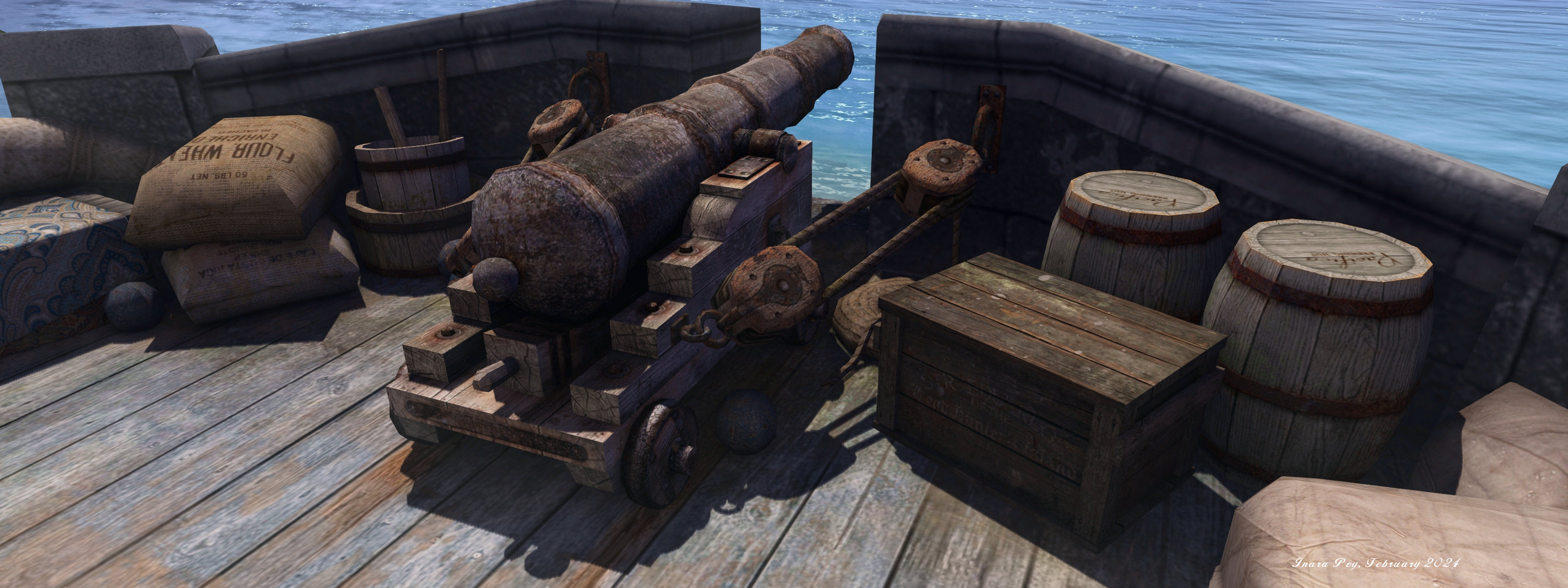
Meanwhile, the smithy next door harkens back more towards medieval times in terms of the majority of the weaponry and protection being made (although admittedly, there are canon and shot on the upper floor); and while the tavern has a look suited to almost any period, medieval, renaissance or the “golden age” of piracy (mid-17th through early 18th centuries), the meals being served would not necessarily look out-of-place in a modern gastro-pub.
Monkey Island, February 2024
This is not to criticise in any way; the mixing of themes and ideas works very well, serving to give the setting a sense of history and mystery. This continues up to the rocky nub forming the highest point on this island, where sits a little art gallery selling pieces by Gian, several of which offer a glimpse of the pirate era and one of its most famous sons – Edward Teach.
More direct hints that this is an enclave for pirates can also be found scattered around the place, both indoors and out, whilst those interested in the treasure hunt can obtain their first clue from the proprietress of the tavern (be sure to give the chimp playing outside a little pet). She’ll set hunters on a route of exploration through the village and elsewhere – but to succeed, patience and a code will be required – I will say no more!
Monkey Island, February 2024
A sandbar curls out from the village island, pointing towards the second of the setting’s large islands; a place which is probably going to attract the eye anyway. given its most obvious feature. Apparently carved our of the peak’s rock, this feature might will put some in mind of an island with another name; a place if not associated with monkeys, then certainly known for being the home of one titan of an ape.
The sandbar doesn’t actually connect to this second island, but it does offer protection for a small bay and wharves where a boat might be found to carry you across the water. But don’t be in a hurry to find the boat rezzer and set off over the water – there is much to find around and below the village; and a walk out along the sandbar (where many of the monkey that presumably give the islands their name also roam) is worth it, if only to better appreciate what lay its its far end.
Monkey Island, February 2024 – “Alas, Poor Yorrick! I knew him, Horatio…”
Sitting on the rocks which mark the end of the sandy finger at the end of the sand sits an oversized chimp atop of a pile of books. He appears to have been cast from bronze or similar, rather than being carved from the rock and is quite a striking figure as he holds in one hand a human skull he appears to be thoughtfully pondering. Looking at him, I was instantly put in mind of two things: the famous speech from Act 5, Scene 1 of Shakespeare’s The Tragedy of Hamlet, Prince of Denmark, and the infinite monkey theorem – and I’m sure I’ve not been alone in reacting this way!
Whether the placement of the chimp is intended to set thoughts wandering along such paths or not, I’ve no idea; but certainly the Hamlet-esque element is not entirely out-of-place, with its themes of death and burial: the pirate’s life tended to have violent ways and ends whilst including the idea of buried treasures; and it is fair to say that Edward Teach saw he head and body part ways following his death, so perhaps the chimp is contemplating the skull of a pirate more than a court jester…
Monkey Island, February 2024
As to the tall island itself, this offers much to explore and discover, with paths, wooden stairways, climbing ropes and zip lines presenting the means of getting around. One of the latter in fact crosses the water to one of the smaller islands as it sits in the lee of the mountain, a pirate ship anchored in its shallows, and if you seek the hidden treasure, you’ll need to take the ride down it to the little island as it holds the key (figuratively speaking) to the final part of the hunt – but again, I’ll leave you to find that out for yourself. All I will say here is that even if you’re not interested in unlocking the treasure, you will still most likely want to visit this little island and take the plunge to find its secrets.
One other thing I would note as a well in talking about the smaller islands, is that there is one is home to a small stone cottage with a round tower at one end. This might well look inviting to the curious, but it is in fact a private residence and not open to uninvited guests or wanderers, so do please keep that in mind when visiting.
Monkey Island, February 2024
Richly detailed, fun to explore and finished with a subtle, natural sound scape, Monkey Island is a fun place to visit with much to discover (I’ve not even mentioned the hidden grotto with its upright piano within until now, for example!). Recommended.












 Inara Pey: Living in a Modemworld