Bright Canopy: positive response forces change of direction

BC logoUpdate, September 4th: Please note there will be a Bright Canopy community meeting in-world in Second Life at 11:00 SLT on Saturday, September 5th, at the Bright Canopy island. All those wishing to catch-up on the latest situation for the service are invited to attend.

Saturday, August 29th saw Bright Canopy, the new cloud streaming service delivering Second life (and the viewer) directly to your web browser, officially launch.

Already extensively previewed by SL bloggers – you can catch my overview of the service here –  the launch was given a further boost when the Lab also blogged about it. announcement of the formal launch led to a huge amount of interest being shown in the service.

While there were the inevitable hiccups which tend to accompany such launches, it was the overall demand which perhaps caused the fledgling company the most problems. So much so, that Bright Canopy have been forced to revise their subscription model, and suspend the service while they do so.

The news of the change to the subscription model came via an e-mail to existing subscribers which was also posted to the Bright Canopy blog. Currently the plan is that:

  • From Sunday, September 6th, those signing-up to the service will be charged $17.00 a month for up to 20 hours of use. Additional time will be charged at $0.013 per minute
  • From now until 12:00 am on Sunday, September 6th, those who signed up for the service will be charged $7.00 for 20 hours, then at the $0.013 per minute
  • All existing subscriptions have been cancelled, and all existing users will need to subscribe to the new plan once the door is open to subscriptions once more.

Bright Canopy are the first to admit this is hardly an ideal situation, and the hope is that it will be an interim measure, until more favourable terms can be introduced in the future, once a few more things have been put in place.

Discussing the situation with me, Bill Glover, Bright Canopy’s founder said, “It’s been a whiplash weekend. We had more than 1000 sign-ups in just a few hours and that actually worked really well.”

However, there were some niggling issues as the launch progressed into the weekend. Transitioning those users who had been on the beta / pre-launch service raised a few problems, as did the migration for those users best served by it to Bright Canopy’s US East coast POP, which also came on-stream as a part of the launch. It was while working on these issues the alarms started ringing around unconstrained cost risks due to the volume of use, forcing  Bright Canopy to take action.

Bill Glover: remarkable response to Bright Canopy forced a re-think in approach

“The alarms required us to throttle down use,” Bill told me. “When the experience suffered long wait times, I pulled the plug [on accepting subscribers]. We’re not going to charge people unless we can be sure this is going to be there for them and they will get value for the money.”

The throttling also meant that over the launch weekend, users were limited to one hour’s in-world time before they were disconnected and had to re-log. To compensate people for this, Bright Canopy have indicated they’ll not be charging anyone for their time over the weekend of 29th / 30th of August.

To understand why the pricing structure change was required despite the good response, it is necessary to understand how Bright Canopy is provisioned. Currently, when logging-in to the service, users are hosted on individual servers, supplied by Amazon’s Spot Instance bidding system. The problems here are twofold.

On the one hand, using an entire server to host just one user isn’t terribly efficient; Frame, as Bright Canopy’s infrastructure partner, are already working to offer more efficient means of hosting without impacting individual user’s experiences with Bright Canopy. On the other, and as I’ve previously reported, Amazon’s Spot Instance mechanism, so long the most cost-effective means of obtaining server space, has become subject of bidding wars which have caused sudden and unpredictable spikes in service pricing.
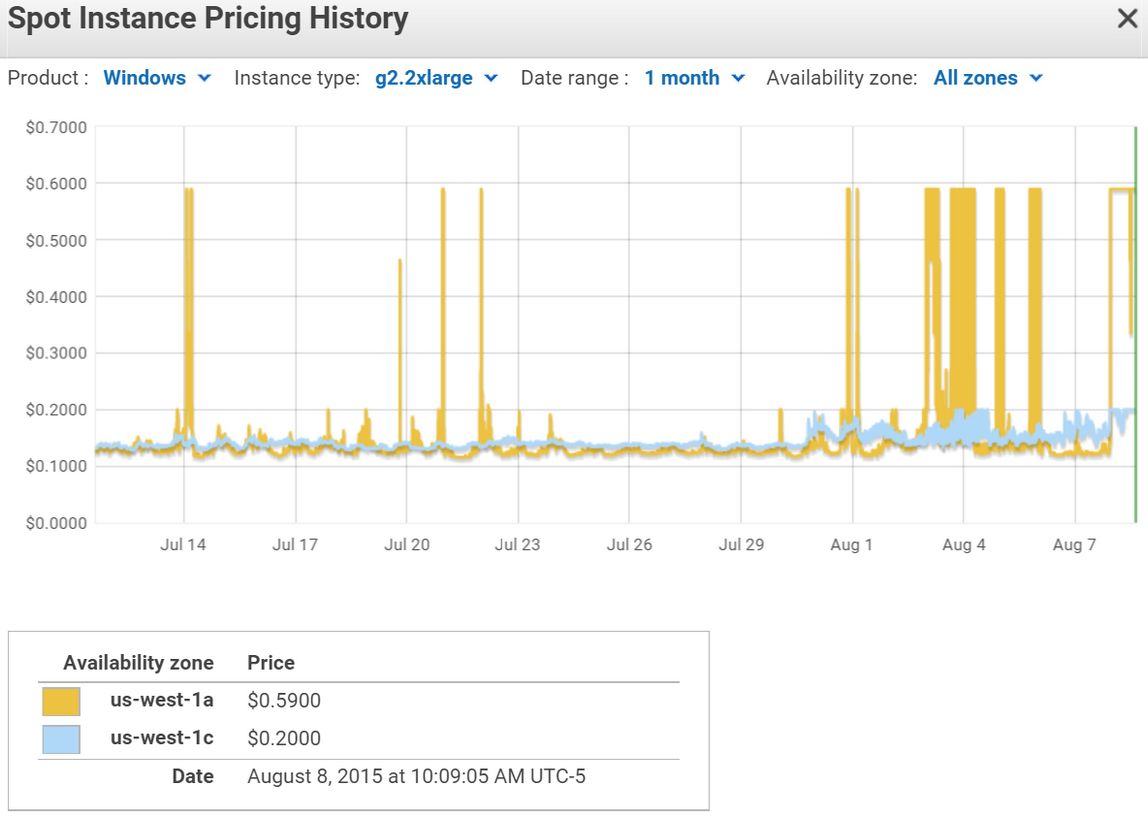
Spot Instance pricing with Amazon is making it difficult for Bright Canopy to firmly pin-down their monthly subscription price – click for full size
Volatility with Amazon’s Spot Instance pricing has caused huge fluctuations in pricing, making it had to predict how realistic fees charged by small start-ups like Bright Canopy are in meeting costs – click for full size

While Bright Canopy were aware of this, and developed contingencies they hoped would be sufficient to handle pricing fluctuations, etc., until such time as better hosting options were ready to roll, the sheer volume of demand for the service meant that these contingencies were burnt through in the course of the first weekend, thus prompting the current situation.

As noted earlier in this article, Bright Canopy hope the new plan will be an interim measure.  The problem here of course is that 20 hours + $0.013 a minute isn’t going to be that attractive an offering to users – something Bright Canopy is all too aware of. With many users spending tens of hours a week in-world, the additional costs could easily mount up, and so people are understandably going to be more focused on the potential for additional costs than on the potential for improved pricing down the road.

As a result of the overall situation, Bright Canopy have opted to keep the service suspended while discussions on the situation continue.

The announcement that Bright Canopy will remain down as they continue to try to work through the price / cost issues, as Tweeted and delivered via in-world message

“We are verifying and double verifying so that when we come up, we stay up,” Bill said to me as the announcement was sent out.

I’ll have more updates on this as further information becomes available / announcements are made.

A Bright Canopy set to open over Second Life and OpenSim

BC logoBright Canopy, the new streaming service, which allows users on low-end computers to access both Second Life and OpenSim has announced it will officially launch on Saturday, August 29th at a single monthly subscription price, which for the first 90 days (at least) will be $17.00 a month.

The service, which was established by SL users Bill Glover and his wife, Jeri (known in-world as Chaos Priestman and Beth Robbani respectively in-world),  arose directly as a result of the May 2015 closure of the SL Go streaming service provided by former on-line streaming games supplier, OnLive. What’s more, and on a personal note, I’m pleased to be able to say that this blog had a hand in bringing things about – although my involvement as a beta user hasn’t been as extensive as I’d hoped.

As a result of the cessation of SL Go as a result of OnLive’s decision to sell, I ruminated on the potential of the Lab running a streamed SL service through Amazon AppSstream. This caught Bill’s eye and imagination, prompting him to comment:

Let’s just do it ourselves! You really got me thinking. I’d can launch a service right now if I get enough folks for Beta.

Bill and Jeri Glover: heading the Bright Canopy team, and long-term Second Life users

Things further progressed when I wrote about Nebadon Izumi’s work in getting the viewer and OpenSim delivered over AppStream.  My article prompted Nikola Bozinovic, founder and CEO of Frame, a cloud-based service focused on delivering Windows applications to users,  to suggest his service could be used to deliver Second Life through the cloud.

Bill and Nikola quickly got their heads together, and within 24 hours, they had their own proof-of-concept running, delivering the official SL viewer over Frame via Amazon.

Bright Canopy streams SL and OpenSim directly to your web browser, offering those on low-specification computers to enjoy the full graphic richness of both platforms with (allowing for network vagaries) low latency
Bright Canopy streams SL and OpenSim directly to your web browser, offering those on low-specification computers to enjoy the full graphic richness of both platforms with (allowing for network vagaries) low latency – note the data, bottom left (via Bright Canopy)

Not long after that, and with the support of SL and OpenSim users, a small alpha test commenced, which expanded to an invite-only pre-launch beta, which again in turn gradually opened its doors wider and wider as time as progressed and issues dealt with.

Nikola Bozinovic, founder of Frame, who extended an invitation to try the service as a possible means of accessing Second Life (and other grids) from the cloud
Nikola Bozinovic, founder of Frame, who extended an invitation to try his service as a means of accessing Second Life (and other grids) from the cloud – and thus paved the way for Bright Canopy to deliver

While operating as independent companies, the synergy between Frame and Bright Canopy has been impressive, with the former working hard to ensure the latter can provide a scalable, robust service, as Bill has worked to ensure the viewer behaves itself when streamed and can support the services users expect – notably voice.

“Frame is excited to provide infrastructure support to make projects like Bright Canopy scale globally,” Nikola stated during the official launch announcement. “Bill has captured the imagination and the energy of the Second Life community. We’ve been impressed by the cooperative and open approach of the Bright Canopy team.”

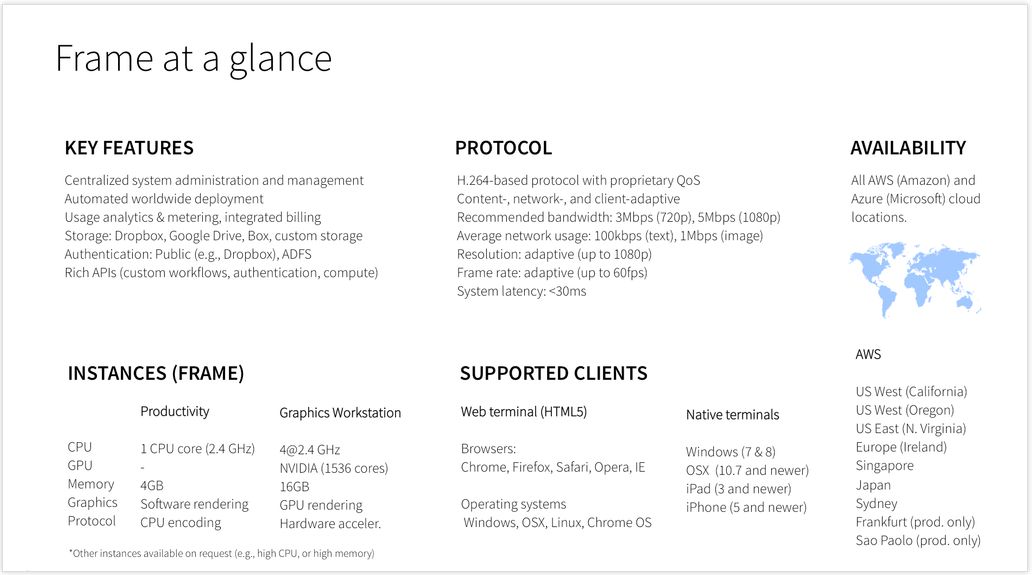
One of the core benefits of running with Frame, is the company has an established track record in delivering Windows applications over cloud services (indeed, in June 2015, Frame closed a further US $10 million round of funding, such is the scope of interest in their approach). This means they have the technical expertise to be able to help Bright Canopy scale over time, and to offer the kind of delivery speeds users expect (local network vagaries allowing). The company already has a global presence itself, notably utilising Amazon’s backbone, with points of presence across the United States, Europe, Asia and South America.

Initially, Bright Canopy ran using only Frame’s presence in California. Even so, and for many in the USA and Europe, results were impressive. Later, Dublin was added to the mix, offering greatly reduced latency to beta users in Europe.  With the launch on August 29th, Bright Canopy will additionally leverage Frame’s presence on the US East Coast to again enhance the service.

One of the key aspects of Bright Canopy being partnered with Frame is that the latter already has multiple points-of-presence with Amazon around the world - so Bright Canopy can leverage these as global demands requires. At launch, Bright Canopy runs out of California, serving the USA, and Dublin, serving Europe
One of the key aspects of Bright Canopy being partnered with Frame is that the latter already has multiple points-of-presence with Amazon around the world – so Bright Canopy can leverage these as global demands requires. At launch, Bright Canopy runs out of California, serving the USA, and Dublin, serving Europe

The new monthly pricing plan, which will completely replace the hourly plan used during the beta period, has initially been set at US $17.00 a month for the first 90 days. However, Bright Canopy warn that this may be subject to increase – although they hope very much to avoid this.

The problem here is that Bright Canopy is currently being provisioned via Amazon’s Spot Instances. Normally, these are the most cost-effective way to deliver a service, but they have lately been subject to an insane bidding war, resulting in massive price spikes.

This means that Bright Canopy need to watch the situation very carefully, as Bill explained in the launch announcement:

Our early bird price is going to be an experiment for 90 days. If you’ve been following the blog, you know we’ve seen price fluctuations on the back-end, and we still need to watch actual usage of the service. $17 is a sustainable price if the instance costs return to their typical, historical values. It is not a sustainable price with the current spike in instance price. We may need to get creative with how we split instances, or we may need to raise prices. We intend to remain transparent as always and will keep you posted. Our goal is to continue to maintain a sustainable, affordable service.

If a price increase is required, it will be announced when Bright Canopy have had an opportunity to assess the best way forward, and with sufficient time for users to determine how they’d like to proceed.

Continue reading “A Bright Canopy set to open over Second Life and OpenSim”

UKanDo goes VMM with a beta update

logoThe UKanDo viewer, maintained by Connor Monaron updated to version 3.7.28.34230 on May 11th.

As the version number suggests, this brings the viewer to parity with the Lab’s 3.7.28 code base, and specifically with the Viewer-Managed Marketplace (VMM) functionality.

For those who may not recognise VMM, and keeping things relatively brief, the aim of the project is to enable merchants to manage the creation and management of Marketplace product listing through the viewer, bypassing the need to use the Merchant Outbox (and have copies of items stored on the Marketplace inventory servers) or using Magic Boxes.

It does this by adding a new Marketplace Listing panel to to viewer, which will eventually replace the Merchant Outbox entirely, and by adding additional back-end and web functionality which allows merchants to carry out a number of tasks associated with their Marketplace listings from within the viewer, and by enabling products to be delivered to customers directly from the Lab’s asset servers, rather than having to store them as separate inventory on the Marketplace servers.

Rather than go into a detailed explanation of all the functionality here, if you haven’t come across VMM before, please read my notes from the initial testing in 2014.

The Merchant Listing Panel for VMM, as see in the UKanDo beta, with some of my migrated items
The Merchant Listing panel for VMM, as see in the UKanDo beta, with some of my migrated items

The key point here is that, at the time of writing, VMM is still very much undergoing beta testing, and the viewer-side code has yet to reach a release candidate status in the official viewer, so the 3.7.28 release of UKanDo is slightly ahead of the curve – the Lab prefer that TPVs don’t release code which the Lab themselves have not issues in release candidate form.

To this end, Connor has clearly indicated this 3.7.28 release is a beta version of UKanDo, and the earlier 3.7.27 update remains available as the full release.

It’s also worth pointing out that initially, the current VMM beta was by invitation, so if you want to try the functionality either using the UKanDo beta or the Lab’s own project viewer, you’ll have to apply to join the beta via the link towards the bottom of your Merchant Home Page on the Marketplace.

All that said, I’ve been driving the VMM version of UKanDo over the last couple of days, using it to gradually convert my own modest store on the Marketplace from Direct Delivery to VMM (as shown in the image above right, taken as I got started), and have found absolutely no issues with it – not that I was actually expecting any.  Everything works smoothly, and updates made via UKanDo are accurately reflected when checked in the official VMM project viewer.

For Merchants who prefer using UKanDo over the official viewer, and who would like to try-out VMM as the Lab moves it gradually towards full deployment (which could occur in June 2015), the 3.7.28 presents an opportunity to do so.

Note that as a VMM beta release, the 3.7.28 update does not contain any other functional or other updates compared to the UKanDo 3.7.27 release.

VMM allows merchants to carry out some Marketplace listing related tasks from within the viewer (subject to how they have web browsing set-up) - here I'm editing a listing associated with an item in my Merchant Listing Panel
VMM allows merchants to carry out some Marketplace listing related tasks from within the viewer (subject to how they have web browsing set-up) – here I’m editing a listing associated with an item in my Merchant Listing panel – click for full size, if required

 Related Links

OnLive: “so long, and thanks for all the fish” as SL Go ends

Even ideas around offering Sl Go as a Premium offering, while simple in concept, are potentially less-than-simple to implementSL Go has officially gone. The service ceased functioning on Friday, May 1st, after some considerable speculation on exactly when the service would stop.

As most, if not all, SL Go users are aware, notice that the service – along with OnLive’s other cloud services – would be coming to an end was given early in April, after OnLive decided to sell its portfolio of patents to Sony Computer Entertainment America. Way this came about is explained in a blog post from OnLive’s main investor (and former Chairman), Gary Lauder, and I also covered the reasons in a blog post of my own.

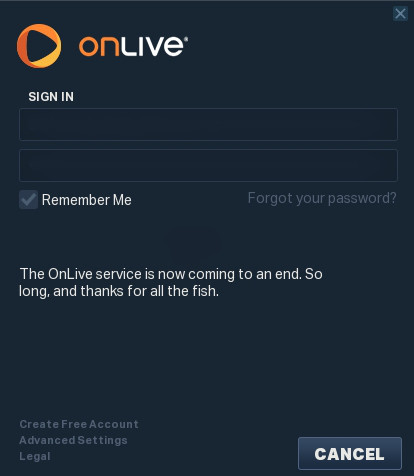
OnLive gave notification that their services had come to an end with a message borrowed from Douglas Adams, seen by users as they attempted to log-in via the OnLive clients

While it has originally be thought that SL Go would be popular as a means of access Second Life from tablets and while on the move in the physical world, it actually turned out that the service gained significant traction among those users accessing Second Life (and OpenSim, with the arrival of Firestorm as a supported viewer within SL Go), from low specification computers and laptop, as it enabled people to enjoy the full graphical richness of Second Life in a manner that would otherwise be beyond the capabilities of their hardware, and with few significant issues.

So what now for those people?

At the moment, the most likely alternative on the horizon is Bright Canopy, which will allow users to access Second Life and OpenSim through a conventional web browser. Again, as many people who have used SL Go know, Bright Canopy is currently undergoing beta testing, and it is hoped that a broader, invitation-only  pre-launch testing phases will be starting soon, with a formal launch to follow thereafter.

Like SL Go from OnLive, it is important to recognise that Bright Canopy is not endorsed by Linden Lab, but is effectively a third-party viewer service. As it is also being streamed (via Amazon G2 servers initially), there will obviously be a cost involved in using it, and prices have yet to be confirmed. Also, the service is likely to take time to grow – initially, it will be run using Amazon’s servers in the USA, although the plan is to leverage other data centres as time progresses (Bright Canopy is facilitated by Frame, who already use Amazon’s data centres on both the west and east coasts of the USA, plus Ireland, Australia, Singapore and Japan).

Those interested in learning more about Bright Canopy can sign-up for news on the official launch via the website, and and learn more about the service via the Bright Canopy blog.

In the meantime, and once again – as an SL go user myself, particularly when my main PC was in hospital for an extended period earlier this year, my thanks once again to Dennis, Jeff, Shae, Jersey, Robby and everyone else at OnLive involved in SL Go – including Jane Anderson in the US and Mark Bevan here in the UK – for striving to make it an outstanding service.

In the interests of disclosure, I am involved in providing support to Bright Canopy and in helping to administer the Bright Canopy blog. However, I am not officially involved in the management and operation of the company itself.

CasperTech cease Metabolt client development

Metabolt, the 3rd-party text-based client appears to have ceased development, this time possibly permanently.

Rumours that development work on the client had ceased first arose in late 2013, after an extended period which had seen no updates or releases. However, in February 2014, news circulated that CasperTech were set to take over the curation of the project and continue it in the spirit in which it had been started.

The updated METAbolt log-in / splash screen from February 2014, the first indication that Metabolt would be continuing after several months of what appeared to be suspended development.
The updated METAbolt log-in / splash screen from February 2014 gave the first indication that Metabolt would be continuing after several months of what appeared to be suspended development.

The announcement was followed in June 2014 with an update to the client – version 0.9.71.0. However, since then, there haven’t been any further releases, which had again left some wondering if the client was still being actively developed.

It now appears the reason for the more recent lack of releases may in part be due to a dispute between CasperTech and the original developer of Metabolt over the use of the client’s name. A dispute which has resulted CasperTech withdrawing from active development of the client, as a recent terse announcement on the Metabolt web page makes clear:

The recent CasperTech announcement

Obviously, whatever arrangement (if any) had originally been reached between CasperTech and the original developer on how the client might be continued under its original branding is a matter for the two parties concerned, and not something for idle speculation. However, given a disagreement has now arisen on the matter, then as the CasperTech announcement states, this would appear to be the end of the line for the client in its current form at this point in time.

As can be seen from the notice, CasperTech are intending to issue an alternative client in the near future, although no time frames appear to be available at the time of writing this article. I’ll of course provide a review of any new client from them once it does appear.

Could the Lab use Amazon AppStream to “replace” SL Go?

Sl Go proved itself very popular among SL users running low-end hardware
SL Go proved itself very popular among SL users running low-end hardware

On Thursday, April 2nd, it was announced that SL Go, the streaming service for accessing SL  provided by OnLive, is to shut-down on April 30th alongside OnLive’s other consumer services. The reason for this is because OnLive has sold the IP and patents associated with the services to Sony Computer Entertainment.

Since the news broke, there have been numerous calls made for Sony to maintain SL Go as a service, including  an on-line petition. However, as painful as it is, all such calls and petitions to  Sony are unlikely to succeed, as I explained in a recent blog post.

In that article, I also considered whether or not the Lab might invest time and effort in offering something that might fill the void. At the time, I thought the answer to this would most likely be “no”, as the Lab seem to have enough on its plate already with Second Life and its next generation platform.

But the more I think about it, the more I feel that the Lab should endeavour to offer some kind of “SL Go replacement”.

One potential means by which they might do so could be via Amazon AppStream.

Obviously, there are issues involved in providing such a service beyond the physical provisioning. Anything which requires some form of external hosting is going to incur costs, for example. However, the flip side to this is it’s fair to say the SL Go has demonstrated that if users believe they are getting a beneficial service, they are willing to pay for it, providing the price is not prohibitively high.

Certainly, there are a wide range of potential benefits to be had from such an endeavour, particularly if implemented through something like Amazon AppStream:

  • It offers an easily scaled means by which the Lab could provide an “SL streaming service” to users on low-end hardware and those on mobile devices – something long demanded by SL users
  • It could provide the means by which SL could be accessed through web browsers – again, a long-desired means of attracting new users to the platform who might otherwise be put off by having to download and install the viewer
  • It obviously means that those SL users on low-end systems can enjoy the full graphical richness of SL in the manner LL would like to see all users experience it
  • It could help those preferring to run older operating systems – such as Windows XP – to continue accessing SL even after they might otherwise be unable to even install the viewer
  • It might even help the Lab map and test options which might be beneficial for their nascent next generation platform.

While developing such a service might not necessarily be easy, the Lab isn’t entirely without any experience in this area. As I and many others have pointed out, in 2010 they did experimenting with streaming the viewer, using the Japanese company Gaikai (coincidentally purchased by Sony Computer Entertainment in 2012), which delivered the viewer to web browsers, as shown in the video below. If there is anything remaining of this work at the Lab, it might possible to put it to work through something like Amazon AppStream.

That said, there is a lot for the Lab to consider in attempting to fill the forthcoming void that will be left by SL Go. And while I would not be at all surprised to learn they are already doing so, they might still require some encouragement to take things beyond just considering options. Something which might encourage them, or at least demonstrate to them that there really could be a worthwhile demand for such a service, could be for users to politely speak up.

One way to do this might be to add your name to the existing petition – I would hope someone at the Lab is keeping an eye on it.

Another could well be to leave a positive and polite comment on the subject following this article, as (and all ego aside) I do know eyes at the Lab pass over this blog (just as they do many others).

There is no guarantee that Lab will move to provide some kind of “SL Go replacement”, but on the other hand, as someone once said, nothing ventured, nothing gained.