November 2025 SL Web User Group

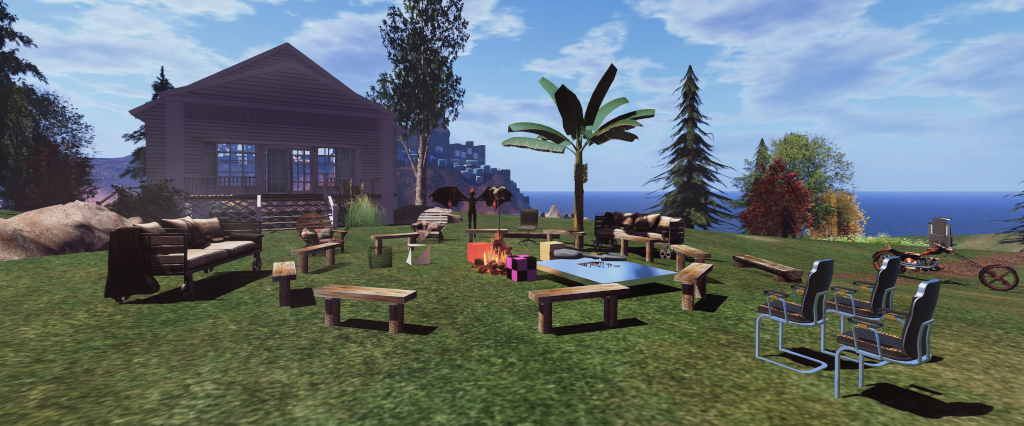
The Web User Group meeting venue, Denby

The following notes cover the key points from the Web User Group (WUG) meeting, held on Wednesday November 5th, 2025. These notes form a summary of the items discussed and is not intended to be a full transcript. The official video is embedded at the end of this summary.

Meeting Overview

  • The Web User Group exists to provide an opportunity for discussion on Second Life web properties and their related functionalities / features. This includes, but is not limited to: the Marketplace, pages surfaced through the secondlife.com dashboard; the available portals (land, support, etc), and the forums.
  • As a rule, these meetings are conducted:
    • On the first Wednesday of the month and 14:00 SLT.
    • In both Voice and text.
    • At this location.
  • Meetings are open to anyone with a concern / interest in the above topics, and form one of a series of regular / semi-regular User Group meetings conducted by Linden Lab.
  • Dates and times of all current meetings can be found on the Second Life Public Calendar, and descriptions of meetings are defined on the SL wiki.

Updates

  • Upgrades to Marketplace tech stack and adding resilience to systems in the case of external outages (as happened this summer with Elastic Search).
  • Further account security initiatives which will be rolling out soon, some of which should help prevent attempts at account take-overs.
  • The roll-out of the “No Stipend” Premium Plus subscription. See:
  • Marketplace PLE blip:
    • PLEs were not charged between October 6th through October 28th inclusive, although subscriptions were still active and running. This caused a batch charge to occur on October 28th, which proved difficult for merchants.
    • If any merchants believe they were charged more than once as a result of these issues, please raise a support ticket.
    • LL is now working on adding more logging to these systems to prevent similar situations in the future.
  • Quality of life updates:
    • A fix to correct viewer splash screen images being cut off.
    • A fix for a display bug were review font sizes were off.
  • Under-the-hood work including:
    • Completion of the Python library upgrade for internal services.
    • A Redis upgrade which should improve shopping cart contents persistence across sessions.

General Discussion

  • The question of Marketplace / CasperVend integration was once again raised. The short answer to this is:
    • Yes, the Lab would like to work on integration between Marketplace and the in-world shopping experience offered by CasperVend, but this requires working on some baseline tech and updates which have yet to be put in place.
    • The Lab is also keen to see a bi-directional unification of features between CasperVend and the Marketplace (e.g. features of CasperVend such as gift cards, better support for sales and discounts being extended to the MP, and features within the MP not found within CasperVend also being extended that way).
    • Currently there are no time frames as to when any of this work is likely to surface.
  • A request was made for merchants to be able to delete “negative” or “harassing” reviews (a problematic request as best, given it could open the door to the deletion of any “negative” review a merchant takes issue with, no matter how valid the actual critique).
    • It was pointed out that there are already the means to flag genuinely harassing, etc., viewers.
    • It was also indicated that a request had been put forward to make the names of reviewers active links, allowing others users to click and see all reviews by a given individual, thus allowing them to better judge the reviewer’s objectiveness.
  • The request to make Marketplace images clickable to display larger version / to zoom-in on them was again raised.
    • It was indicated that LL are considering implementing some form of image zoom capability / support for higher-resolution images on MP listings.
    • However, with the focus on quality of life improvements, bug fixes, etc., this work has yet to be prioritised.
    • This led to a further discussion on MP images encompassing their use by the visually impaired, how Amazon handles images, etc.
  • Kali Linden noted another capability that is being considered is that of a “Demo / Try Before You Buy” button within MP listings. However, (and again), how this might work and when it might actually be implemented is still open to question.
  • A discussion on listings & translations and sometimes listing being mis-translated, which rolled into a general discussion on the presentation of the Marketplace website (not making full use of the browser tab width), issues with people mistaking items in the Featured section on the MP homepage as “recommended” items, rather than paid advertising; new users being unable to easily differentiate between “modern” content (e.g. good mesh with (or without) PBR and older flexiprim or sculptie content or low-resolution skins etc.),  as by default, listings do not offer any indication of an item’s age (e.g. when first uploaded), etc.
  • A discussion on the Second Life dashboard and possible improvements. Suggestions included:
    • Making the Friends Online and Groups lists more usable (e.g. so that Friends and Groups can actually be managed from them rather than having to go in-world to do so)
    • Displaying Group notices within a section of the dashboard.
    • Making elements such as Friends Online pop-outs in their own browser frames.
    • Updating the Blogs section with the feeds from the SL Blogger Network feeds as well as including the official blogs.
    • Implementing a dark mode for the pages in line with other SL pages / portal (e.g. the Linden Homes pages and the Land portal).
    • Providing more in the way of dynamic / updated content to encourage engagement, together with more informative communications from the Lab.

Next Meeting

  • Wednesday, December 3rd, 2025.

October 2025 SL Mobile UG meeting summary

Campwich Forest grounds: location for the Monthly Mobile User Group (MMUG)
The following notes were taken from the Thursday, September 25th 2025 Monthly Mobile User Group (MMUG) meeting. These notes should not be taken as a full transcript of the meeting, which was largely held in Voice, but rather a summary of the key topics discussed.

The meeting was recorded by Pantera, and her video is embedded at the end of this summary – my thanks, as always to her in providing it.

Table of Contents

Meeting Purpose

  • The Mobile User Group provides a platform to share insights on recent mobile updates and upcoming features, and to receive feedback directly from users.
  • These meetings are conducted (as a rule):
    • The last Thursday of every month at 12:00 noon SLT.
    • In Voice and text.
    • At Campwich Forest.
  • Meetings are open to anyone with a concern / interest in the above topics, and form one of a series of regular / semi-regular User Group meetings conducted by Linden Lab.
  • Dates and times of all current meetings can be found on the Second Life Public Calendar, and descriptions of meetings are defined on the SL wiki.

Resources

Current Releases

SL Mobile (Beta) version 2025.1065 (A) / 0.1.1065 (iOS) – October 20.

Updates:

  • Fixed a bug with object loading
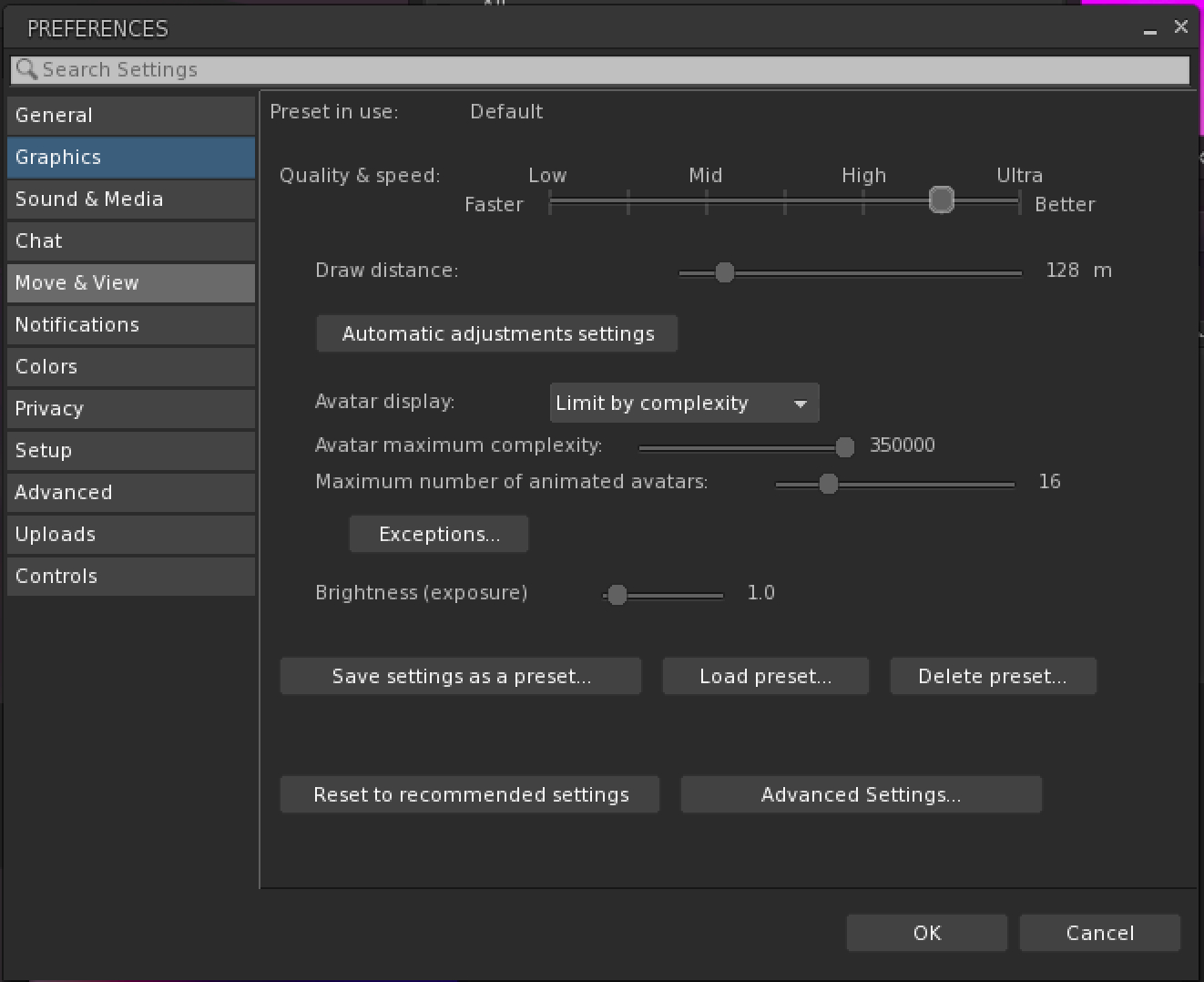
  • Added a new 25m draw distance option (Menu > Settings > General > Max Draw Distance) – default is 40m.
    • There have been some reports of this resetting to the default if 25m is set, and then another application is opened on a device. This is under investigation.
  • Improved framerate on lower-end devices
  • Rendering resolution now adjusted on the fly to keep things running smoothly. The app looks at your framerate over the last 10 seconds and automatically lower or raise resolution to maintain at least 20fps (or 80% of your framerate cap, whichever is higher). You might notice a short dip when loading new areas, but it quickly recovers.
  • Added a new “unloader framework” that decides which items should be temporarily removed if the system runs low on memory. Instead of deleting them, it safely suspends them so they can return once memory becomes available again.
  • A performance index now estimates your device’s power using real-world benchmarks. Default settings—like draw distance (how far you can see) and max avatars (how many avatars are shown) —automatically scale to fit your device’s capabilities.

Performance Updates

[Video: 2:06-5:58]

  • The initial October update (560) caused a performance regression on some Android devices, prompting further releases during the month with a focus on re-upping the performance on “lower-end Android devices” (although this in itself covers a wide spectrum of hardware and devices due to the way various devices might be configured by the manufacturer to prioritise things like battery life).
    • The biggest change in this regard is that the the rendering resolution is based on frame rate when initially loading a scene, the idea again being to speed-up the load time.
    • In addition, and again particularly with Android, changes were made to the number of rendering passes being made, together with some simplification within the shaders to again help boost performance.
    • Android testing indicated that these changes should hopefully see around a 20-25% performance boost for most of the affected hardware, which should help alleviate some of the pain users may have been feeling earlier in the month.
    • Those who did experience performance issues on the earlier October releases for Android are encouraged to try the October 20th release, and see if their issues have been resolved (and if not, to please provide feedback).
  • Additionally, changes have been made to how out-of-memory situations are handled.
    • Previously, if the app showed signs of running out of memory, it would attempt to start deleting content held in memory (but not necessarily seen on-screen) to try to stay ahead of the curve and prevent the entire app from crashing due to running out of memory.
    • However, any such content deleted from cache in this way was essentially “gone”; it could not be reloaded, even if the app had available memory to do so.
    • Changes at the start of October altered this behaviour to enable content to be automatically re-loaded, and this has all been synced-up withing the memory management code to make sure that content is reloaded as soon as there is memory available.

Upcoming Work: Texture Memory Use

[Video: 6:12-9:00]

  • For convenience “and a number of other factors” SL Mobile has been “pretty much” loading textures at one fixed resolution (with the exception of avatar textures). This means that the app does not take into consideration things like the size of an in-world object in order to determine a suitable texture resolution.
  • Work is now in-hand to switch-over to a new texture resolution mechanism which allows textures to be loaded at resolutions based on the surface area of an object (what LL is calling “variable textures”).
  • This also means larger objects will get more texture memory allocated to them, whilst very small objects (e.g. a ring, a button, etc.) will get loaded at the absolute lowest resolution.
  • The overall goal is to allocate available texture memory more efficiently than currently is the case, and allow for adjustments to texture memory to be made on the fly as an avatar / camera moves around a scene, with texture memory use changing as any particularly object gets re-sized larger or smaller within the scene.
  • Work on this has been in progress for the last couple of months, and is now a focus for the next beta release, and will be coming the Alpha version of the Mobile app for wider testing prior to release.
  • It is hoped that by carrying out this work, more memory will be made available for future use – such as
  • supporting PBR materials.

SL Mobile New Starter Experiences

[Video: 12:15-19:48]

  • Already available to those in the SL Mobile alpha programme are four new starter experiences, and soon to be released within the beta versions. Specifically developed in collaboration with various SL creators, these are intended to offer new users coming into SL via the Mobile app with high-quality experiences, intended to be “fast, social, photogenic, and touch-friendly” (that is, interactive).
  • The four experiences are:
    • Scaredycat’s Funhouse (by MadPea) – a gamified experience involving catching little kitties.
    • Midnight Pulse (by Bad Unicorn) – a nightclub-style experience.
    • Chronicles from the Backwaters (by Arcback / Altscape) – a “dark, gritty, interactive novel”.
    • The Mobile Learning Centre (by Second Life Studios) – designed to teach people how to move within and use the Mobile app.
  • These have been built as a result of insight gained during the continued development of SL Mobile (e.g.  because new users are looking for “snackable” experiences within the app to engage them), and have been informed by the manner in which people are using SL Mobile, together within its ouch-based UI, and things like the form factors of various mobile devices, and how people tend to use their mobile devices and apps in general (e.g. taking photos / selfies, creating shareable moments, etc.), and trying to lean into that kind of device usage.
  • New users coming into SL for the first time using SL Mobile will be able to select the experience that most interests them as a part of the join process.
  • Existing users will find the experiences can be accessed via the Lobby.
  • As these experiences become more widely available, the plan is to iterate upon them whilst also monitoring them for how they are used and the kind of metrics they produce in terms of engagement, re-use, popularity, etc.
  • The initial focus of this monitoring will be new user retention over the first 24 hours / first week, then expanding to look at month over month stickiness; if / when people make the move from Mobile to Desktop.
  • Alongside of this will be on-going monitoring of general performance within the different experiences and what improvements can be made to them / to SL Mobile as a whole.

Q&A Session

[Video 21:32-End]

  • Bring the Map to SL Mobile: while the web-based SL maps (maps.secondlife.com) have been made mobile device responsive, they have not been directly added to the SL Mobile app as yet as there is not a lot of utility in doing this at this point in time due to limited functionality within the web-based maps toolset.
  • Memory fragmentation:
    • Some users with multiple accounts (notably subscription accounts) have noticed decreasing SL Mobile loading performance when successively logging-on different accounts (e.g. working through the accounts each day to claim Streaks rewards).
    • This is caused in part by the way current versions of Unity work, which leaves small fragments of memory remaining marked as allocated unless an app is completed cleared from memory (swipe up) after use. These fragments then “break up” the larger pool of memory to eventually leave insufficient amounts of contiguous free memory available for other accounts to use when logging-in, thus increasing their load times.
    • It is believed that Unity 7 will offer a better garbage collector for clearing memory, thus preventing this kind of fragmentation from occurring, and this will become available when the SL Mobile is moved to this version of Unity at some point in the future.
    • For the time being, the easiest way to avoid the issue by those encountering it is to swipe up on logging-out of the app, thus removing it completely from memory, and then re-launching it to log-in on the next account (or, if using other apps at the same time, closing them and swiping up to remove them from memory, so as to prevent them causing fragmentation / using memory SL Mobile might otherwise access).
  • Localisation for SL Mobile in support of non-English speaking users is on the roadmap, but has yet to be scheduled as a tranche of work.

Date of Next Meeting

  • Check the SL Public calendar for details. At the time of writing, no meetings had been schedule for November or December.

2025 week #44: SUG meeting summary

Paradise Of Fantasy, August 2025 – blog post
The following notes were taken from the Tuesday, October 28th, 2025 Simulator User Group (SUG) meeting. These notes form a summary of the items discussed, and are not intended to be a full transcript. They were taken from the video recording by Pantera, embedded at the end of this summary – my thanks to Pantera for providing it.

Meeting Overview

  • The Simulator User Group (also referred to by its older name of Server User Group) exists to provide an opportunity for discussion about simulator technology, bugs, and feature ideas is held every other Tuesday at 12:00 noon, SLT (holidays, etc., allowing), per the Second Life Public Calendar.
  • The “SUG Leviathan Hour” meetings are held on the Tuesdays which do not have a formal SUG meeting, and are chaired by Leviathan Linden. They are more brainstorming / general discussion sessions.
  • Meetings are held in text in-world, at this location.

Simulator Deployments

  • On Tuesday, October 28th, the SLS Main channel was restarted without any deployment.
  • On Wednesday, October 29th:
    • The BlueSteel RC channel should be updated with a new simulator update (Imbu). This “has a couple of performance memory fixes in the simulator. It fixes an issue with region names that contain a ‘.”
    • The remaining RC channels will (I believe) be restarted without any update.

SLua Work

  • Harold Linden continues to work on the SLua implementation, focusing on some minor API changes, which he initially defined as: “just tons of lingering issues to file off sharp edges on APIs to make them do what people would reasonably expect.” Later in the meeting, he further expanded on the first of these changes thus:
I was looking to clear up one of the big warts of LSL: “keys” are not strictly UUIDs, they’re strings in disguise. That means the UUIDs that vary only in casing are considered unequal, which is very weird if you’re used to more modern UUID APIs. The only cases where people generally want that behaviour is in llMessageLinked() / ‘link_message()’ so you can pass an extra string as ‘id’, but it causes weird unexpected issues elsewhere. In SLua, I’d like to make ‘UUID()’ return nil if the passed-in string is not a valid UUID, like the existing Lua functions do, and make [the] ‘link_message()’ ID field just a string, because people mostly mash arbitrary strings in there. … All APIs that accept key or string in SLua are implicitly a union of ‘string | UUID’, and that doesn’t change. 
    • This approach was welcomed by the majority of scripters at the meeting.
    • As a part of this discussion, it was suggested that SL could benefit from an improved llMessageScript, such as llMessageScript(scriptname,data), and Harold Linden indicated that something like this is being planned.
  • The other API change Harold is working on is the removal of ‘integer()’, which he views as having been only a temporary requirement, but is now no longer needed as he has “fixed up all the bridges to existing LSL functions to tolerate a Lua number”. As such, he regards it as a nuisance to developers as it is likely to slow scripts and make them hard to optimise, as the Luau optimiser doesn’t know about it.
  • Harold also noted that he is not opposed to “adding stuff” to LSL on SLua (e.g. such as a table type), however, given the amount of foundational work that’s considered a higher priority, this is unlikely to happen soon (if at all).
    • Rider Linden also noted that such work would not be a small task, and as such, nothing is currently on the drawing board as yet.
  • Yardang, one of the SLua regions on Aditi has been down for possibly as long as a week. Rider Linden has requested that anyone testing SLua who notes any if the the associated regions appears to be down to contact him in-world.
  • Rider was engaged in a couple of technical debt projects over the course of the past week but is now now working on the official native VSCode plugin for LSL and SLua once more. The hope is to have this deployed in the upcoming week, although it will need further tweaking when the next version of the SLua project viewer is issued.
  • The first half of the meeting included a general discussion /catch-up on the above and related work, including:
    • The plugin should support linting (check a script for errors without running it) and also downloads the current language definition from the viewer and formats it so Luau-LSP and Selene can use it.
    • Wolfgang Senizen has also produced a VSCode plugin + documentation for use with SLua, although notes this will likely be discontinued when the official plugin is made available, and he will shift to contributing code to that project.
    • A note that LSL/SLua functions cannot be directly called from outside of the simulator (e.g. via a web page), but “in theory” it might be possible to create an RPC (bot) service of some kind to achieve the same.
    • Harold Linden reiterated that LL is working on a new LSL / SLua web portal, which will include documentation and code examples, etc.
  • The latter part of the meeting focused on suggestions for future SLua support, and discussions on the use of JSON / LLSD – please refer to the video for details.

In Brief

  • Harold and Leviathan Linden have been working on fixes for script scheduling (“do with have to do anything for this script / are we allowed to run it?”), and which should reduce script times on a simulator “a reasonable amount”.
  • Additionally, Leviathan Linden is working on fixing more memory leaks within the simulator code, noting that those fixed in the upcoming Imbu release are “small potatoes” compared to what the Lab thinks is out there.
  • Leviathan is also hoping to get back to the game_control work in the the near(ish) future, noting, “I have a link to the Linux viewer branch (which is almost deliverable) and I will be building on top of that”.
  • Given the lateness of the year and the limited time for further simulator updates, it is unlikely there will be further work on region crossings during 2025.

Date of Next Meetings

  • Leviathan Linden: Tuesday, November 4th, 2025.
  • Formal SUG meeting: Tuesday, November 11th, 2025.

† The header images included in these summaries are not intended to represent anything discussed at the meetings; they are simply here to avoid a repeated image of a rooftop of people every week. They are taken from my list of region visits, with a link to the post for those interested.
2025 week #43: SL Open Source User Group meeting summary

Oscarton Forest Park, August 2025 – blog post

The following notes were taken from my chat transcript + the video recording by Pantera (embedded at the end of this summary) of the Open Source User Group (OSUG) held on Friday, October 24th, 2025. My thanks to Pantera as always for providing it.

Meeting Purpose

  • The OSUG meeting is a combining of the former Third Party Viewer Developer meeting and the Open Source Development meetings. It is open discussion of Second Life development, including but not limited to open source contributions, third-party viewer development and policy, and current open source programs.
  • This meeting is generally held twice a month on a Friday, at 13:00 SLT at the Hippotropolis Theatre.
  • Dates and times are recorded in the SL Public Calendar, and they are generally conducted in text chat.
  • The notes herein are a summary of topics discussed and are not intended to be a full transcript of the meeting.

Official Viewers

  • Default viewer 2025.07 7.2.2.18475198968 – Apple Silicon Support – dated October 16 –  No Change.
    • This viewer now ships as a “Universal Binary” that contains both the Intel and Apple Silicon versions of the viewer. It should give performance gains on the Apple Silicon version in particular.
    • Also includes various WebRTC improvements and bug and crash fixes.
    • Known issues:
      • This version does not support convex decomposition for physics meshes with Apple Silicon. This will be hopefully be corrected in a future update or release, possibly with the help of a code contribution.
      • Navigation buttons in the in-viewer browser are no longer present for marketplace and search – these will be restored in a future update.
      • Apple Silicon does not support pathfinding tools.
      • Subtle rendering differences might be noticed on certain configurations and EEP environments.
    • Github Changelog.
  • Second Life Project Lua Editor Alpha (Aditi only), version 7.1.12.14888088240, May 13 –  No Change.

Viewer Updates

  • 2025.07 has seen an uptick in crash rates as a result of some WebRTC changes, and LL is working to resolve this. As such, TPVs looking to ship WebRTC / updates are advised to keep an eye on the Develop branch for relevant commits to integrate into their viewers if they would prefer to avoid the 2025.07 issues.
    • As apart of the overall WebRTC project, a server-side update is anticipated as being ready for release in the next 1 to 2 weeks, with fixes for some issues and some new features.
  • Viewer 2025.08 will be a maintenance update with a focus on resolving crash issues, with the hope it may also include some log-in time improvements for those with very large inventories.
  • Work is progressing on a contributed Linux update, details in this Github PR, which LL is hoping to “land” this year.
  • A new SLua project viewer is in the works. This should include Rider Linden’s work on an official native VSCode plugin for LSL and SLua, as noted in my more recent Simulator User Group meeting summaries.

In Brief

Please refer to the video for the following:

  • A general discussion on the viewer UI and making it easier for new users to quickly discover how to mute those using Voice in order to be obnoxious / harass, without necessarily requiring guidance from a mentor / friend on how to do so.
    • The above also broadened into a more general conversation on improving the chat functionality in the viewer in general (e.g. Voice controls + the conversations floater, etc.).
    • Also touched on was the on-going work with Project Zero (viewer in a browser) to reconstruct the viewer UI (or elements thereof) with a HTML/React-style approach – although this is being done without any intent to “break” the existing UI approach within the viewer.
    • As Geenz Linden noted (and the meeting chat demonstrated), views on the viewer UI and things like the conversations / chat floaters (or CHUI – Conversation Hub User Interface, to use the terms employed when the overhaul Viewer 2 chat UI was first introduced back in 2011) tend to be highly subjective when opinions are voiced. As such the suggestion was made to use the Feedback Portal to offer feature requests on what might be done to improve text chat & its UI elements (and Voice chat), and to upvote features thought to be worthwhile.
  • The second half of the meeting included a lot of general discussion on what might be done to “improve” the viewer experience in general, together with a side discussion between Geenz Linden and Henri Beauchamp on the alpha-gamma fix for legacy objects rendering by PBR + improving the appearance of water on PBR rendering.
    • A very short-form summary of these latter two items is to note server-side work is required for the alpha-gamma fix, but is currently stalled, whilst water is awaiting the updates to SSR (screen space reflections), which has yet to be prioritised for a future viewer release.

Next Meeting

† The header images included in these summaries are not intended to represent anything discussed at the meetings; they are simply here to avoid a repeated image of a gathering of people every week. They are taken from my list of region visits, with a link to the post for those interested.
2025 week #40: SL CCUG meeting summary

Hippotropolis Campsite: venue for CCUG meetings
The following notes were taken from my audio recording and chat log of the Content Creation User Group (CCUG) meeting of Thursday, October 2nd, 2025. Please note that this is not a full transcript, but a summary of key topics.
Table of Contents

Meeting Purpose

  • The CCUG meeting is for discussion of work related to content creation in Second Life, including current and upcoming LL projects, and encompasses requests or comments from the community, together with related viewer development work.
  • This meeting is generally held on alternate Thursdays at Hippotropolis.
  • Dates and times of meetings are recorded in the SL Public Calendar, and they are conducted in a mix of Voice and text chat.

Official Viewer Status

  • Default viewer 2025.06 7.2.1.17108480561 – August 29 – No Change.
  • Second Life Beta viewer 2025.07 7.2.2.17774206511 – Apple Silicon Support – September 26 –  NEW.
    • This viewer now ships as a “Universal Binary” that contains both the Intel and Apple Silicon versions of the viewer. It should give performance gains on the Apple Silicon version in particular.
    • Also includes various WebRTC improvements and bug and crash fixes.
    • Known issues:
      • This version does not support convex decomposition for physics meshes with Apple Silicon. This will be hopefully be corrected in a future update or release, possibly with the help of a code contribution.
      • Navigation buttons in the in-viewer browser are no longer present for marketplace and search – these will be restored in a future update.
      • Apple Silicon does not support pathfinding tools.
      • Subtle rendering differences might be noticed on certain configurations and EEP environments.
  • Second Life Project Lua Editor Alpha (Aditi only), version 7.1.12.14888088240, May 13 –  No Change.

Viewer 2025.07

  • LL are working on implementing some bug fixes prior to offering a further beta version of this viewer.
  • One change with the next version will be the return of Havok convex decomposition for Mac Intel systems to enable mesh uploads under emulation Requires the enabling of Rosetta in the universal build for Mac) until such time as a an alternative can be implemented.
  • Work on an alternative solution is in progress via code contributions. This is likely to be included in viewer 2025.08.

General Discussion – In Brief

  • The confusingly-worded Create “System Body Shape v2.0” came up for discussion.
    • In short: LL unlikely to implement any form of new / updated system avatar, preferring to focus on implementing more modern technology and capabilities that allow creators to develop more capable (and less complicated to users?) avatars.
    • This included a brief discussion on “open souring” the avatar system body so creators could take it and modify / improve it for themselves, with the note that technically it is, but as it misses some critical elements which tend to render doing this moot.
  • A potential bug with touching scripted objects was demonstrated with attachments designed to be touched (in short: a object could miss initial touches and thus fail to trigger touch_start() ). This was demonstrated at the meeting, and a Canny report was requested on the problem, together with the demo item.
    • This discussion also encompassed issues with fast clicking on object in-world and cursor positioning, and unexpected results (e.g. rapidly clicking on a touchable object with the mouse moving, so that a subsequent click “misses” the item, causing the server to register that in favour of the the expected return  – like a dialogue box or something – from the initial click).
  • A discussion on setting materials / overrides on PBR vs. Blinn-Phong. In short, with Blinn-Phong, a change in texture / material can be carried out with a reset of overrides; within PBR, changing the material resets overrides. In the case of scripted items, unless the material change and new overrides are sent as a single packet, changing the material can result in the object appearing to “flash” as the material is displayed prior to the new overrides being applied.
    • The prompt for the question arose out of how a scripted bottle held by an avatar could change to a selected texture (to presumably represent the drink in the bottle), and how this might be better coded rather than relaying purely on texture caching, which appeared to be the root of this particular problem.
    • Possible solutions for this became somewhat convoluted (outside of finding a mean by which required textures could be pre-loaded), and frankly zapped right over my head. However, the conversation took up the the last part of the meeting.
  • A question was asked as to why sometimes trying to rez mesh items (or items onto mesh objects)  results in a “Failed to place object at specified location” error message.
    • This can often come down to the physics shape of the surface on which an item is being rezzed, as Beq Janus explained in one of her videos.
    • Another cause can be a mismatch between where the viewer thinks an object is trying to be placed and where the simulator views it as being placed – which has been a long-standing problem.
  • A misunderstanding has apparently led to some concerns that support for sculpties is being deprecated / sculpties are being “eliminated”. Neither of these are correct; there are no plans to either deprecate or eliminate sculpties. 

Next Meeting

October 2025 SL Web User Group

The Web User Group meeting venue, Denby

The following notes cover the key points from the Web User Group (WUG) meeting, held on Wednesday October 1st, 2025. These notes form a summary of the items discussed and is not intended to be a full transcript. The official video is embedded at the end of this summary.

Meeting Overview

  • The Web User Group exists to provide an opportunity for discussion on Second Life web properties and their related functionalities / features. This includes, but is not limited to: the Marketplace, pages surfaced through the secondlife.com dashboard; the available portals (land, support, etc), and the forums.
  • As a rule, these meetings are conducted:
    • On the first Wednesday of the month and 14:00 SLT.
    • In both Voice and text.
    • At this location.
  • Meetings are open to anyone with a concern / interest in the above topics, and form one of a series of regular / semi-regular User Group meetings conducted by Linden Lab.
  • Dates and times of all current meetings can be found on the Second Life Public Calendar, and descriptions of meetings are defined on the SL wiki.

Updates

  • Bug fixes shipped:
  • Removal of “What’s Next” Basics in dashboard menu.
  • More results should now be displayed in Destination guide searches.
  • Under-the-hood work including:
    • A Python library upgrade for internal services.
    • A security review of the Lab’s JavaScript packages.
    • Clean-up of the subscriptions services to prevent double-charging of PMEs.

New Premium Plus Subscription Option

For those not aware:

  • Mid-October will see the launch of Premium Plus No Stipend.
    • All of the benefits of Premium Plus without the Stipend or Signup bonus.
    •  Monthly Cost of with stipend vs. no stipend: US $29.99 vs. US $15.99.
    • Annual Cost of with stipend vs. no stipend: US $249 vs. US $143.88 (US $11.99/month billed annually).
  • For details, see my blog post: Coming soon: New Option to Reduce the Cost of SL Premium Plus-Subscriptions.

Questions from the Lab

  • Why do you make all your items no transfer? Are most items no transfer?
    • Most items are created No Transfer (75%-90% in estimates), although the return of Gacha might be increasing the number of transferable items.
    • No transfer is preferred for multiple reasons. Those cited included: complexities of customer support with transfer items then have been passed from one user to another; the risk of object loss if an item is set to No Copy as a result of being set to Transfer (e.g. through accidental deletion & trash purge). Most users prefer to have Copy / Modify items over Transfer (/ No Copy) / Modify items.
  • What would encourage creators to make items transferrable?
    • Largely a matter of personal choice, but Transfer was not seen as a popular need.
    • The exceptions to this were seen as items specifically designed to be gifted / intended for the Gacha units & the resale market.
  • How do you attract new users to your stores? Gifts? Credits? Responses included: Group gifts; store credits / discounts; sales / special offers.
  • Has anyone used the new Avatar Welcome Pack? Have you made items for it?
    • Unsurprisingly, mixed opinions on the avatars in the Welcome Pack, although it was noted that as the bodies are Legacy, many creators have clothing available for them, even if the clothing is not specifically created with the starter avatars in mind.
    • Complaints were raised over the fact feet are not posable (so high heel shoes won’t work with them), and the “dead face” expressions – with reminders that the Welcome Pack avatars are just that: for getting started, before moving on to more capable store-bought avatars.
    • This lead to a discussion on what could / might be included in the Welcome Pack – such as a limited AO system from one of the dedicated AO creators, just to again help people get started and not necessarily try to work out where they need to shop or immediately diving into the MP.
  • For those who have helped new users create an avatar via the Welcome Pack, what have been the common problems?
    • Feedback ran from lack of variety in the avatars (e.g. all of them are human); lack of contextual / explanatory information.
    • General feedback on bodies / heads in general was the over complexity of things and the steps a new user must go through (even after exposure to the Welcome Packs), together with easily identifying what will / won’t work with a given body type / head type if the new user is not familiar with brands, BoM, using HUDs, etc.
  • How long would you say an experienced user would take to create a really good avatar?
    • Estimates varied from “5 minutes” to “an hour”, depending on approach (e.g. having the necessary avatar parts – head, body, etc.), already in inventory and working from there, vs going out and shopping for a suitable body / head, etc., vs. using the Avatar Welcome Pack.
    • It was noted that helping new users build / customise avatars takes much longer, both due to the general learning curve and the need to overcome the technical / language barriers (e.g. explaining what “BoM” is, why only certain clothing will fit certain bodies, how to recognise what is needed from multi-body pack of clothing in order to wear the outfit on the avatar, etc.).
  • What would you say is the average cost of a good avatar?
    • Just for a head, body, skin, hair and initial outfit: US $50, although cost is relative depending on what is being sought.
    • This also folded itself into people’s expectations / desires for their avatar and its looks.

General Points

  • Sntax Linden noted that the Avatar Picker / Customiser found in Project Zero is now offered in the official viewer, but without the dedicated Avatar toolbar button, the Picker opening within the viewer rather than as a separate browser panel.
  • It was pointed out (as I’ve done previously), that the official welcome hub is out-of-step with the Avatar Welcome Pack as it only references the Senra avatars.
  • The Q&A session included a wide-ranging discussion on approaches to getting new users acclimatised to SL using a mix of web options / capabilities and in-world experiences.

Next Meeting

  • Wednesday, November 5th, 2025.