Hippotropolis Theatre: home of the OSD/TPVD meeting
The following notes were taken from:
Pantera’s video (embedded at the end of this article) and my chat log of the Open-Source Developer (OSD) meeting held on Friday, March 20th, 2026, together with my chat log of that meeting.
Please note that this is not a full transcript of the meeting but a summary of key topics.
The OSD meeting is a combining of the former Third Party Viewer Developer meeting and the Open Source Development meeting. It is open discussion of Second Life development, including but not limited to open source contributions, third-party viewer development and policy, and current open source programs.
This meeting is generally held twice a month on a Friday, at 13:00 SLT at the Hippotropolis Theatre and is generally text chat only.
Second Life One Click Install viewer 26.1.0.21295806042, January 26 – one-click viewer installation.
Second Life Voice Moderation viewer 26.1.0.20139269477, December 12, 2025 – Introduces the ability to moderate spatial voice chat in regions configured to use webRTC voice.
Remains the current viewer development focus, with a beta (RC) update targeting a potential availability in week #13 (week commencing Monday, March 23rd). Actual promotion to release status depends on how long the viewer may ned to remain at RC status.
There is one major blocker to promotion, which is being worked on, but otherwise, it is “very close” to being a candidate for release, user feedback allowing.
Geenz Linden noted that the repo for the viewer is getting updates to more easily ship updates for those TPVs opting to adopt Velopack as their updater.
Velopack benefits:
The move to Velopack allows LL and TPVs to move off from VVM with the exception of cohort management, and allows LL to discontinue the old SLVersionChecker all of which should streamline the viewer install and update processes as experienced by users.
Velopack also opens the door to partial viewer updates – although LL are still in internal discussions on when to actually start doing this.
A side effect of this viewer, when generally available, is that it will not automatically uninstall versions of the viewer using the old install / update processes, and there will be no requirement to manually uninstall such versions (although users can if they wish). The reason for this latter point is a concern that inexperienced users will simply click YES when asked if they wish to remove all their settings, etc., and thus lose them.
Testing of this viewer against incoming new users to SL saw a “not insignificant” increase in day 1 user retention..
Viewer 2026.02 – “Flat” UI and Splash Screen Refresh
An alpha version (see viewer status, above) was released on Friday, March 20th, but without the log-in splash screen updates. These will be in an upcoming update.
This viewer includes the “flat” UI design, font updates and WebRTC voice moderation capabilities to help align viewer-side WebRTC updates more with the server-side.
Example of the upcoming flat UI. Via: Geenz Linden / Github #4681/2
Viewer 2026.03 – Maintenance Release
2026.03 will now see the return of official viewer maintenance releases, with the initial focus on viewer performance improvements, together with a focus on top crashers and regressions, up to a certain limit, so they can be kept as relatively small releases rolled out on a reasonably fast basis.
2026.03 should see (partial list):
A backporting of the texture streaming changes at the very least, with Geenz particularly focused on getting lower RAM usage in general.
Geenz also hopes to get some work done on lightening the main thread burden in the viewer – which is potentially more difficult, and may take longer.
A hope with this cycle of maintenance releases is to put a reasonable dent in some of the debt we’ve accumulated with PBR’s release.
Viewer 2024.04 – SLVP or LUA (TBD)
The 2026.04 viewer release is liable to be either the Second Life Visual Polish (SLVP) release (containing all of the SSR, PBR Specular, and HDR EEP parameters work), or a SLua release.
Work on improving mirrors for SLVP is currently on hold whilst 2026.01.01 and 2026.02 is on the table.
SLVP is liable to spend a long time at alpha status (which may be why SLua moves ahead of it in the order of things).
WebRTC Deployment
This commenced on Wednesday, March 18th, with a deployment to the BlueSteel RC channel covering approximately 3.4% of the grid.
This early release allows us to verify performance, stability, and compatibility in real-world conditions before expanding further.
Users in the release candidate channel may experience:
Failure of peer-to-peer (P2) Voice calls between regions on WebRTC and the rest of the grid. These will not be fully resolved until WebRTC is grid-wide.
Differences in audio quality depending on being in or out of the release candidate channel.
Ongoing tuning and iteration as we gather feedback.
The next, larger deployment is currently scheduled for week #14 (commencing Monday, March 30th). However, a smaller deployment might be made in week #13.
There are thoughts being given to next steps for WebRTC: transcription, the ability in-preferences to hear how you sound, etc. (a replacement for echo canyon), but these are subject to other priorities.
The existing Vivox Voice service is liable to be shut down “a few months” after the WebRTC deployment has been completed. However, no target date has as yet been decided.
During the deployment phase, Vivox, users on the latter will not have spatial Voice when in WebRTC regions, although they should have p2p/conference/group voice with others on Vivox regions.
General Discussion
Mesh Convex Hulls:
The new physics choice for mesh uploads is currently available on ARM Macs, and on the “to do” list for other viewers.
Geenz’s first choice for the role choked on a lot of content for SL, so VHACD is the choice of libraries.
As has been previously mentioned, the aim is to remove the Havok sub-libraries from the viewer entirely – but this a process several steps down the line.
There was a general discussion on performance, lightening the load on the viewer’s main processing thread (some noted above).
The following notes were taken from the Tuesday, March 3ed, 2026 Simulator User Group (SUG) meeting. These notes form a summary of the items discussed, and are not intended to be a full transcript. They were taken from the video recording by Pantera, embedded at the end of this summary – my thanks to Pantera for providing it.
Meeting Overview
The Simulator User Group (also referred to by its older name of Server User Group) exists to provide an opportunity for discussion about simulator technology, bugs, and feature ideas is held every other Tuesday at 12:00 noon, SLT (holidays, etc., allowing), per the Second Life Public Calendar.
The “SUG Leviathan Hour” meetings are held on the Tuesdays which do not have a formal SUG meeting, and are chaired by Leviathan Linden. They are more brainstorming / general discussion sessions.
Meetings are held in text in-world, at this location.
Simulator Deployments
No deployments are planned for the week, channels will be restarted.
WebRTC deployment is now planned to commence on Wednesday, March 18th with a deployment to the BlueSteel RC channel. Progression from there will likely be subject to how it settles, issues arising, etc.
In Brief
Rider Linden:
Has some Lua work waiting on him to add support for script information to inventory and the viewer. Basically, scripts will have an inventory subtype that can be either LSL or Lua and it will also have some meta data which is the VM that the script was compiled for (LSO, Mono, Luau).
This week he is taking care of a long standing issue with mesh uploading costs, and the fix should hopefully surface in the 2026.02 viewer release.
Leviathan Linden:
Has been working on is to try to improve login/teleport/region-cross success rate. The idea is to improve the reliability of the UDP packets that are used for viewer<–>simulator connections.
He has a Pull Request for this up against the viewer, although he’s not sure the core of the issue lies within the viewer. Rather he believes similar changes server-side will probably make a bigger difference.
Currently this work is largely complete and going through validation.
Once released, it will not “fix all region crossings” – as there are multiple issues with them that need to be tackled – it his work should hopefully be a further step towards improving things.
In addition, Leviathan has been attempting to better understand a fix proposed by Cool VL Viewer’s Henri Beauchamp to reduce the time avatars with attachments spend being a cloud. He believes the fix is the right way to go – asking the server to re-send attachment details (which currently doesn’t happen) along with texture data (which is resent when an avatar has issues “de-clouding”). He hopes to have the simulator updates for this ready for deployment after WebRTC has gone out.
Harold Linden (SLua):
Has been working to refactor some of the common Lua standard library functions that currently lead to “failed to perform mandatory yield” errors in user scripts. As a result, he hopes such errors will be fixed with the next SLua deployment.
He is also working on a refactor of lljson to make it easier to convert things back to proper Lua types when serialize / deserialize your data with the JSON serializer
Working on meta problems, such as identifying Voice issues.
The next viewer-side update could be in “the next two weeks”.
Further work on SLua is dependent on the continued feedback of those using it.
It was noted generally that the is further work to be forthcoming (e.g. sim caps for slua_default.d.luau).
Harold also confirmed the Lua scripting system runs on a single thread.
General Discussion
Please refer to the video below as well.
SLua warning: as per my previous CCUG summary, the next Lua deployment will have breaking changes. At a minimum scripts will need to recompiling, as they otherwise will not run.
A general discussion on Voice roll-off for WebRTC and general voice tethering to prevent eavesdropping. When moving your avatar / camera away from others who are speak, Voice so decrease down to nothing at 60 metres. However, it has been reported that simply zooming the camera out from the current position does not result in Voice roll-off.
This discussion also wrapped around the limitations of Bluetooth headsets / microphones which can affect Voice quality.
User Tapple Gao has put forward a feature request for improved animations without resorting to a “heavy” project like puppetry. This is currently being tracked by the Lab.
The are issues around logging in and capability granting which can result in non-graceful disconnects and log-in failures due to capabilities failing to create.
Some of these issues had been fixed, but the lab acknowledged there are potential more issues that can cause the same outcome.
Monty noted that L and firestorm have recently been jointly poking at the problems.
A suggested recommendation for those experiencing disconnects / log-outs of this nature is to either wait 2 minutes before a re-try, or to try logging-in to a non-neighbouring region to the one being used at the time of the crash.
A general discussion on scripts and scripting and future Lua development work took-up most of the second half of the meeting.
Date of Next Meetings
Leviathan Linden: Tuesday, March 24th, 2026.
Formal SUG meeting: Tuesday, March 31st, 2026.
† The header images included in these summaries are not intended to represent anything discussed at the meetings; they are simply here to avoid a repeated image of a rooftop of people every week. They are taken from my list of region visits, with a link to the post for those interested.
The CCUG meeting is for discussion of work related to content creation in Second Life, including current and upcoming LL projects, and encompasses requests or comments from the community, together with related viewer development work.
This meeting is generally held on alternate Thursdays at Hippotropolis and is held in a mix of Voice and text chat.
Introduces the ability to moderate spatial voice chat in regions configured to use webRTC voice.
Second Life One Click Install viewer 26.1.0.21295806042, January 26, 2026 – one-click viewer installation.
Viewer Notes
Viewer 2026.01
Promoted to default release ahead of the meeting – see above.
Viewer 2026.01.o1
The next viewer targeting promotion to default status.
Comprises the one-click installer / updater.
It is hoped promotion of this viewer is “weeks away” rather than “months”.
Viewer 2026.02
2026.02 remains on track for the “Flat” UI and font updates + plus a possible refresh of the log-in splash screen.
It now also includes the WebRTC voice moderation capabilities (as seen in the project viewer) to help align viewer-side WebRTC updates more with the hoped-for server-side deployment.
Example of the upcoming flat UI. Via: Geenz Linden / Github #4681/2
Viewer 2026.03
Some changes on this – originally defined as the SLVP – Second Life Visual Polish viewer, the status has changed such that 2026.03 is liable to one of the following:
The SLUA viewer update, or
The Visual Polish viewer, including the long awaited SSR improvements. PBR specular for residents who are more familiar with the old Blinn-Phong work flow + HDR controls in EEP so residents can decide how bright or dark things should be, or
A new performance improvements viewer option.
It is possible that further water improvements might find their way to this SLVP viewer, and also that as some of the updates require sever-side changes, the promotion of SLVP might be subject to delay once available, to allow time for the server changes to be slotted into the simulator release schedule.
It is also possible some of the above might be combined into a single viewer release under the 2026.03 banner.
The potential for making monthly promotions to get all the current inflight viewers up to release status is also being discussed at the Lab.
Viewer Performance Discussion
Better performance is obviously always a benefit to using SL, and currently there is an internal discussion at the Lab overtrying to make some further performance improvements ahead of any release of the SLVP viewer, to enable the latter to better leverage them (e.g. by “shaving off” some VRAM usage).
VRAM is particularly problematic for performance as many SL creates will try to crank the texture resolution for every single material slot to the maximum, whether it is visually beneficial to do so or not. The 2K white emissive texture is an example of this.
Geenz Linden has been making changes to introduce “texture channels”. That is, to more intelligently stream specific maps – diffuse, normal, emissive,, specular, etc., at different resolutions to more intelligently manage VRAM usage with little reduction by way of a scene’s visual fidelity, particularly in scenes with a lot of high resolution textures for every material / material slot.
It has been noted that for this to work, there must be a means for users to make adjustments to suit their visual needs. These might take the form of a texture quality drop-down in the viewer’s Graphics settings.
The texture discussion led to musings on how best to identify texture size / resolution, and the complexities involved (e.g. the asset system doesn’t know – or need to know the specific resolution of a texture, it doesn’t entirely make sense for the logical to determine a texture’s resolution and how to manage it o sit within the server, which leaves the viewer – which requires the texture to be downloaded anyway – and such controls can be ignored by specific viewers simply by not adopting the code, so proactively handling texture resolutions is complicated.
Other work on performance might see changes to the avatar render cost calculations because, ironically, these appear to impact performance.
General Discussions
SLua:
There is a “breaking change” coming to SLua “in the next couple of weeks” which is apparently not deemed worthy of a blog post, so notification will be via Discord and social media – because “communications”.
It will require every current SLua script to be recompiled and restarted.
A discussion on using GPU texture compression to help with performance – something that would require work on LL’s part, but not out of the question for consideration.
HDRI support for environments – again, not out of the question. The major question is how are they to be encoded:
Creating a new asset type specifically for them is not seen as “super practical”.
While the JPEG2000 specification supports HDRI, it is “probably not the most effective application for SL’s specific use for HDRIs.
There needs to be a means of encoding them that is GPU memory friendly, as HDRIs are memory heavy (whilst HDRIs are already used in the rendering pipeline, LL uses them as sparingly as possible for this reason.
EEP would also require updates to fully support them.
None of the above is seen as particularly impossible to overcome, it does require further discussion among all the relevant stakeholders0.
It is hoped that tweaks to the EEP ambient sky settings will help make environments using PBR to “pop” more and will help improve the current Mainland ambient lighting issues.
A number of general discussions on WIBNis (“wouldn’t it be nice if….”), none of which are currently in development..
Hippotropolis Theatre: home of the OSD/TPVD meeting
The following notes were taken from:
Pantera’s video (embedded at the end of this article) and my chat log of the Open-Source Developer (OSD) meeting held on Friday, March 6th, 2026, together with my chat log of that meeting.
Please note that this is not a full transcript of the meeting but a summary of key topics.
The OSD meeting is a combining of the former Third Party Viewer Developer meeting and the Open Source Development meeting. It is open discussion of Second Life development, including but not limited to open source contributions, third-party viewer development and policy, and current open source programs.
This meeting is generally held twice a month on a Friday, at 13:00 SLT at the Hippotropolis Theatre and is generally text chat only.
Introduces the ability to moderate spatial voice chat in regions configured to use webRTC voice.
Second Life One Click Install viewer 26.1.0.21295806042, January 26, 2026 – one-click viewer installation.
Upcoming Viewers
Viewer 2026.01
Was lined up for promotion to release status, but LL has ben seeing some suspiciously low fault rates – less than 1%, rather than the more usual average fault rate accounting for freezes and crashes being closer to something like 5-7%.
As a result, the view is going to be left at RC status through until early in week #11.
Viewer 2026.1.1 – One Click Install
2026.1.1 is the new designation for the one-click install and velopack viewer (currently 26.1.0.21295806042).
This is unlikely to move to release status for at least a couple of weeks as it works through QA testing, particularly given this viewer represents a pretty big migration from the old updater to the new one.
Viewer 2026.02
This viewer is about to undergo an “Alpha” update, designed to gather feedback from users.
This is the viewer with the new “Flat” UI updates, font changes and WebRTC voice moderation capabilities, and might additionally receive some backported updates to texture streaming.
Example of the upcoming flat UI. Via: Geenz Linden / Github #4681/2
Viewer 2026.03 -“SL Visual Polish” (SLVP)
2026.03 is set to include:
The “long baking” SSR improvements that were started last year. This version of the viewer will likely have a long beta soak time to allow feedback on these changes to be gathered.
PBR specular for residents who are more familiar with the old Blinn-Phong workflow. This will:
Include another texture slot (tint of the specular reflection).
Work with metallics.
Follow the glTF specification, but will likely initially be without glTF overrides, as this requires server-side work.
This work is currently being wrapped-up.
HDR controls in EEP so residents can decide how bright or dark things should be. This work does require simulator-side updates. This will likely initially have server-side support on Aditi (the Beta grid).
It may additionally include:
Further mirrors optimisations and a new “Ultra” quality setting that will enable a system mirror for water. A caveat on this work is that while this “water mirror” might up the quality of water reflections, it will do so at a performance hit; SSR for water will always be faster and less intensive.
Inclusion of an emissive strength setting for PBR.
Further performance optimisations.
The current repository for this viewer (valid March 6th, but may change) is available here.
This viewer may be in a head-to-head with the SLua viewer as to which gets promoted first when the time comes.
Grid-Wide WebRTC
A small deployment to the Preflight simulator Release Candidate channel was made on Thursday, March 5th, intended to address some server stability issues.
It is hoped that the deployment will quickly move to the BlueSteel RC.
There is still no Voice echo canyon for WebRTC for self-testing your own Voice system. However, one is still under consideration.
General Discussion
please refer to the video as well.
Geenz Linden has not had time to address the much-requested alpha-gamma fixes due to a focus on the SLVP viewer. It is also anticipated this work will require a decent bit of scoping, including understanding what needs to remove server-side to avoid a potential permissions hole.
Geenz has also has made further commits for the reimplementation of SSR after he found a good way to get hierarchical Z tracing working in the viewer.
He has also finally got the separable SSR pass working from another branch, which leads to a ton of optimisation potential for SLVP. For example, this now allows rendering of SSR at half or even quarter resolution, while the output for glossy SSR can be filtered, leading to less graininess on PBR surfaces and water.
There is also now a mirror for water reflections – which as was noted above, requires the Ultra quality setting and will impact viewer performance. but which is independent to SSR for water reflections.
The long-awaited Appearance fixes, as supplied by Kitty Barnett, are being targeted for the 2026.03 viewer.
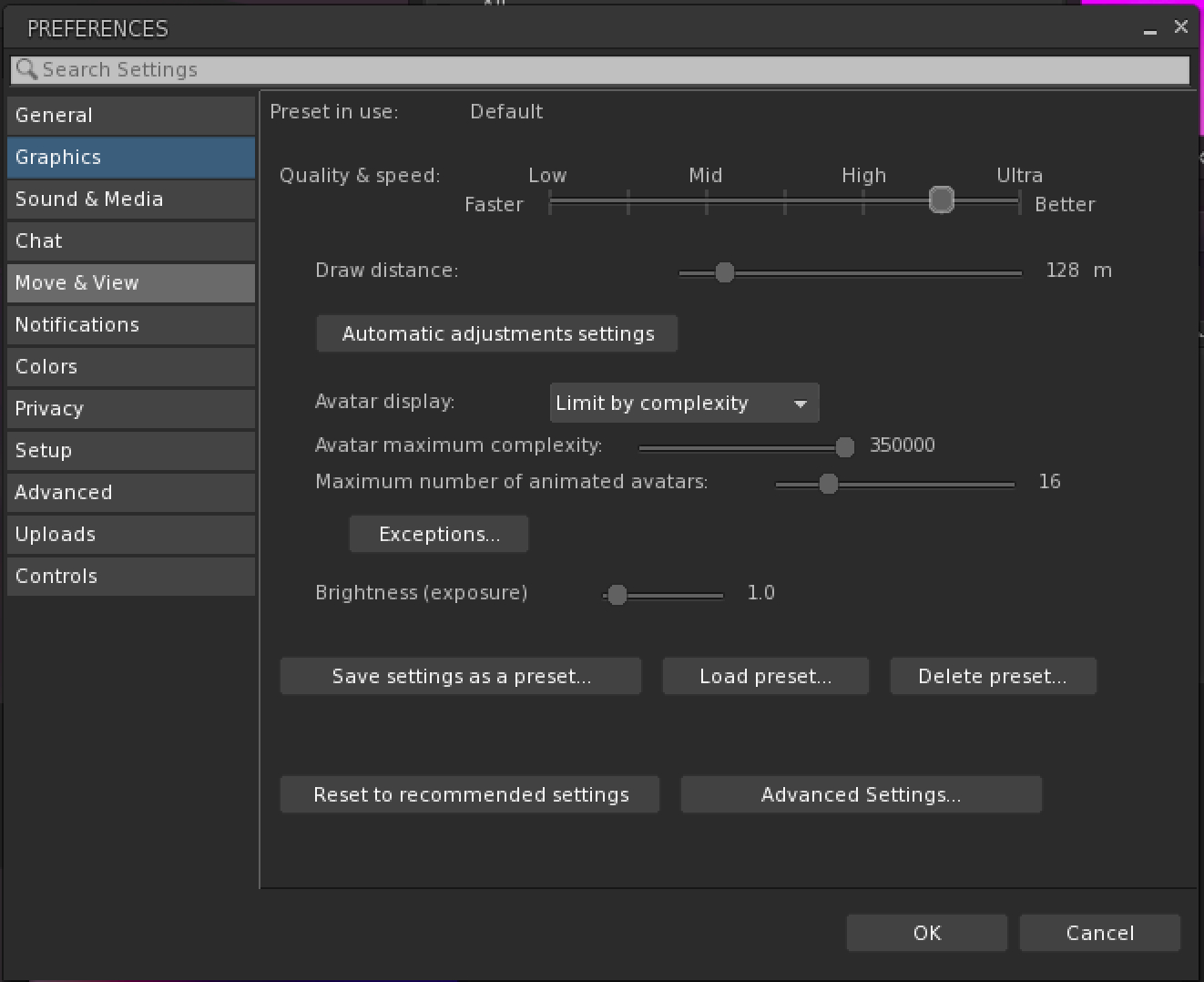
There has been some musing on re-working the viewer graphic settings to make them easier to parse (such as making options drop-downs grouped by the Low to Ultra quality settings, with only the relevant options appearing for each. However, this work is only at the musing stage, not something being pursued.
A general discussion of texture handling – including the option to add blank texture detection and reduced these to 1×1 to help reduce the RAM load with textures.
A general discussion on a number of issues bugs (e.g. the AMD bug which sees the avatar textures broken on newer AMD GPU drivers – which is hopefully being addressed by AMD; MOAP input handling bugs on Linux & Apple, said to make playing some games in SL impossible, etc- see the last 15 minutes of the video for more).
The following notes cover the key points from the Web User Group (WUG) meeting, held on Wednesday March 4th 2026. These notes form a summary of the items discussed and is not intended to be a full transcript. Pantera’s video is embedded at the end of this article, my thanks to her for providing it.
Meeting Overview
The Web User Group exists to provide an opportunity for discussion on Second Life web properties and their related functionalities / features. This includes, but is not limited to: the Marketplace, pages surfaced through the secondlife.com dashboard; the available portals (land, support, etc), and the forums.
As a rule, these meetings are conducted:
On the first Wednesday of the month and 14:00 SLT.
Meetings are open to anyone with a concern / interest in the above topics, and form one of a series of regular / semi-regular User Group meetings conducted by Linden Lab.
Dates and times of all current meetings can be found on the Second Life Public Calendar, and descriptions of meetings are defined on the SL wiki.
Friday February 27th Marketplace Outage
On Friday, February 27th, 2026, the Marketplace suffered an outage resulting in delays to item deliveries, background check-outs and viewer notifications for approximately 5 hours. This was apparently caused by a degradation in the MP asynchronous workers during a deployment, resulting in a backlog in the MP queuing system. The backlog should be clear now, and there have been no recent reports of missing / delayed items or notifications.
Updates
Changes are being made to the email verification prompt that comes up on the Second Life dashboard – those who have verified their email won’t see anything (“for a while”). Those who haven’t verified their email address for contact are advised to do so.
Updates to the web maps to allow searching by region name is still “slotted” for implementation.
Updates are in progress for the buying land experience – the look and presentation of the pages, UI changes, etc. – not changes to current land pricing.
The viewer splash screen will be changing soon as a part of the viewer UI / font changes contained in the upcoming 2026.02 viewer.
Work on making the Marketplace home page more responsive on Mobile devices is continuing, with small changes already made to the sidebar.
Quality of Life / Internal updates:
Further guardrails have been placed around Marketplace Product Listing Enhancements (PLEs) to prevent users being double-charged.
Multiple bug fixes related to wishlist displays, language selections and display name synchronisation, and similar.
Upgrades are being made to some web-related AWS services.
Marketplace
Th question was asked if people felt it would be worth a break of 12-18 months on work on all Marketplace development (bug fixing, etc., still continuing), in order to get variants / styles (e.g. multiple colour options, etc.,) in a single listing produced and released.
Whilst stated that a “year / year-and-a-half” was “very conservative”, it was still something of a surprised given that in late 2022, Reed Linden stated variants would be the “first deployment” in 2023.
Spidey Linden noted that the biggest hurdle with the project is actually migrating users as smoothly as possible from having multiple listings for the same item (but in different colours) to having all options in the one listing.
There was support for the idea and variants / styles is something that has long been promised and has been a popular request.
The above spun-out into a discussion on “Marketplace 2.0”.
Currently there are no plans for a “Marketplace 2.0”, so this was more a “throw out ideas” session.
This discussion also spun out into requests for “social” elements to be included on MP listing, such as a indicator as to when a store owner last logged-in to SL, the date any item was posts to the MP (already available via some 3rd party browser plug-ins, support Firefox, Edge and Chrome and its variants – I use it with both Brave and Gener8).
An alterative question regarded on “Marketplace 2.0”, were it to be developed, is whether merchants would access not having any migration mechanism and having to go through and manually re-list all their items on the new version.
This caused something of a divided response, with some seeing it as not being a problem for MP stores with large inventories, as it was argued (not unreasonably in the case of clothing), that the reason for many stores having large numbers of listings is because they have multiple colour version of each item, each with it own listing – which any new Marketplace would solve by allowing multiple variants in a single listing.
Others felt any requirement to manually upload to a new MP would slow adoption.
Still others felt that having a new MP with “more features” would still be worth the effort to give them a new, cleaner & more functional store.
It was suggested that some of the pain in moving to a “new” MP could be eased by offering an extended transition period to allow creators to gradually make the move.
However, it was pointed out that running two systems side-by-side will incur additional cost and so a) would have to be factored-in to the transition period; b) would likely preclude both the current MP and “MP 2.0” running side-by-side indefinitely; sooner or later merchants would have to move.
There is also the risk of consumer confusion over where to find items if the transition period is drawn out to the point where creators migrate their listings in small quantities (“one or two a week” was mentioned), which could then impact sales.
Calls were made to simply delete stores from the Marketplace on the basis of the creator not logging-in to SL for a given continuous period (currently, listings are made “inactive” if the owner has not logged-in during a certain period). This is a potentially damaging approach, as it could unfairly penalise users who are forced into a more restricted ability to log-in to SL due to social circumstance, illness, etc.
The discussion on “MP 2.0” spun out to include integration of CasperVend and the ability to see through the MP and via in-world vendor kiosks.
A request was make to solve the “translation issue” whereby automatic translation of products leads to things like the wrong colour being delivered (e.g. a translation referencing the “pink” item for delivery, whereas the listing shows the “red” version.
Other Items
Community Pages / Forums Changes:
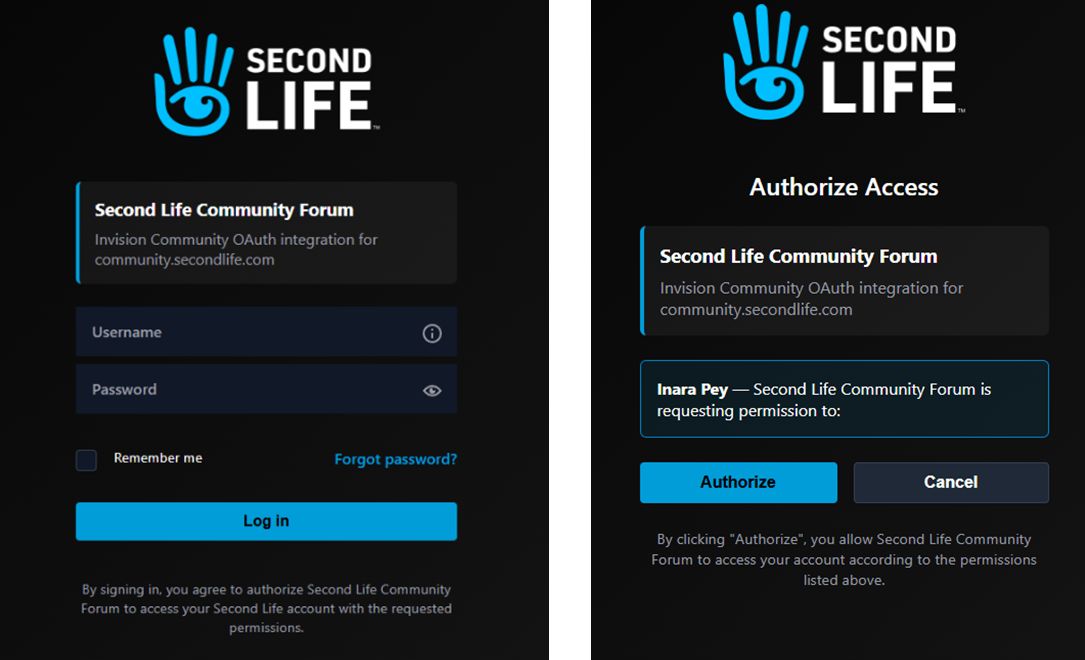
Concerns were raised over recent changes to the Community pages (e.g. the official blogs) / Forums — notably around logging-in.
These concerns took two parts:
The fact that the logging-in process has been changed by the third party providing the community pages / Forum platform (Invision) to use OAuth as their authentication method, rather than the Lab’s own MFA;
There was no announcement of the change by Linden Lab via blog or Forum post, in advance of it being made by Invision across their services.
The concern over the use of cookies seems to be (in part) born of misunderstanding: cookies are a “standard” means of maintaining login session IDs. However OAuth appears to be retaining the cookie after a user has physically logged-out from the Community pages via the sign-out option (which does not mean logging-out of SL), which appears to be the problem.
Kermit Linden offered to look into the authorisation flow.
Invision has implemented a new verification process outside of the lab’s MFA (which not everyone uses) for accessing the Community pages (official blogs, the forums, etc.), they host on LL’s behalf. The process was introduced without any communication from LL, and utilises cookies, which has raised concerns.
The issue of SL wiki thumbnail images not displaying has been partially resolved, but more work is required to completely resolve it.
A request was made to add a further SL Discord generic category for those whose blogs fall outside the current three categories of fashion, home & garden and bloggers-streamers.
Complaints that 2 clicks to reach a person’s transaction history on the SL dashboard, and Marketplace is too hard and the labelling is not precise (which is fair).
A general discussion on web search and its perceived drawbacks (such as being unable to exclude display Names from People searches, thus leading to “false positives” when seeking user names etc.)..
A discussion on being able to “register” brand names with LL to prevent things like copycat stores using the same name, or having stores using the sane name / word in their keywords coming ahead of registered stores in MP searches.
The following notes were taken from the Tuesday, March 3ed, 2026 Simulator User Group (SUG) meeting. These notes form a summary of the items discussed, and are not intended to be a full transcript. They were taken from the video recording by Pantera, embedded at the end of this summary – my thanks to Pantera for providing it.
Meeting Overview
The Simulator User Group (also referred to by its older name of Server User Group) exists to provide an opportunity for discussion about simulator technology, bugs, and feature ideas is held every other Tuesday at 12:00 noon, SLT (holidays, etc., allowing), per the Second Life Public Calendar.
The “SUG Leviathan Hour” meetings are held on the Tuesdays which do not have a formal SUG meeting, and are chaired by Leviathan Linden. They are more brainstorming / general discussion sessions.
Meetings are held in text in-world, at this location.
Simulator Deployments
No deployments are planned for the week, channels will be restarted.
It had been planned to slot the initial deployment of WebRTC between the 2026.02 Kiwi update (currently grid-wide), and the next formal RC release 2026.03 Loganberry. However a last-minute issue was discovered, delaying WebRTC whilst it is fixed.
The release to follow Loganberry will be 2026.04 Key Lime).
WebRTC Deployment
As noted above, the WebRTC deployment has been delayed, primarily for a couple of reasons:
LL is addressing some server issues that resulted in very occasional ‘drop from voice’ problems.
The WebRTC team is also digesting feedback from the recent Firestorm Town Hall in which firestorm users who have not moved away from a version 6.x (pre-PBR) version of Firestorm to a PBR-enabled version.
It is hoped the delay will not be longer than a week or so, so as to allow it to commence in March, but an update on this will be made soon.
In Brief
Rider Linden has just finished a tricky bit of infrastructure work and is now focusing on some the simulator aspects of the SLua project, including changes for being able to select a default script. A side effect of that is the ability for a viewer to specify a template script on create without the tricky copy stuff that the viewer was doing for that.
Leviathan Linden:
Has just finished fixing the “can’t save avatar action remap” problem with game_control but has not pushed the changes to a viewer repo as he working to clean the code up and produce documentation.
He regards this particular work as useful as it has reminded him of what remains to be done for game-control. In particular, remapping of controller buttons is not yet enabled in the preferences UI, although there should be work to support that already done under the hood.
He has not made any progress on Henri Beauchamp’s idea for solving the “perpetually cloudy avatar problem” see previously SUG summaries). It is coded on the server, but he hadn’t been able to test it.
His next project is to audit how some “reliable” UDP messages are sent between viewer and server. There is a possibility he can fix some of the login/teleport/region-crossing connection failures with some work there. One of the message pairs to be looked at are CompleteAgentMovement/AgentMovementComplete. Dropping these is the source of quite a few B&W screens every day.
Monty Linden has been:
Working on meta problems, such as identifying Voice issues.
Talking to Brad Linden about making it easier to include logs in reports generated in the viewer.
General Discussion
Please refer to the video below as well.
An extensive discussion on llSetAgentRot and how it works and how it and avatar rotation / camera rotation/movement might be improved.
A short discussion on text-to-speech and how favourable (or not) it might be, based off of this feature request.
It was noted that transcription – speech to text – is already being experimented with using WebRTC.
Region Crossings:
It is being reported that for the last week or so, region crossings – physical vehicle or teleport – have been getting worse.
In addition, it is being claimed that, after an extended period of time in a region, people are finding their avatars being “soft disconnected” from the simulators: they can still move around and communicate within the region, by any attempt to move out of it results in a complete disconnection – and allegedly a full disconnect can occur just by rezzing / deleting an object or changing outfits.
There have been no apparent changes to the simulator code that would account for a worsening of region crossings, and it’s not entirely clear how widespread the issues are.
However, Monty linden has requested logs from anyone encountering these issues.
This discussion took up the latter half of the meeting (and beyond the end of the meeting), mixed in part with the rotation discussion noted above,
A discussion on releasing SLua grid-wide without complete documentation, or waiting until a full set of documentation is ready for what is being released, and then updated as code updates are made.
Date of Next Meetings
Leviathan Linden: Tuesday, March 10th, 2026.
Formal SUG meeting: Tuesday, March 17th, 2026.
† The header images included in these summaries are not intended to represent anything discussed at the meetings; they are simply here to avoid a repeated image of a rooftop of people every week. They are taken from my list of region visits, with a link to the post for those interested.



 Inara Pey: Living in a Modemworld