Paradise lost: the third trailer – the first sin

A little while ago, I was invited by Canary Beck and Harvey Crabsticks, the creative team behind the The Basilique Performing Arts Company, to witness three scenes from their upcoming production of Paradise Lost: The story of Adam and Eve’s original sin, which will premiere this Spring (see the comments at the end of my review of the Company’s Romeo + Juliet).

Now the company has released the third trailer for the production. It features elements of the scenes the cast enacted on my behalf in January, comprising Adam and Eve’s sin and consequent banishment from Eden. Accompanying the trailer on Canary’s blog is a passage from the Ninth Book of Milton’s epic poem, which I offer here as well, in both the original and modern forms, as Adam laments what has come to pass.

O Eve, in evil hour thou didst give ear
To that false Worm, of whomsoever taught
To counterfeit Man’s voice—true in our fall,
False in our promised rising; since our eyes
Opened we find indeed, and find we know
Both good and evil, good lost and evil got
Oh Eve, it was an evil hour when you listened
To that false worm, taught by somebody
To imitate the voice of Man, truthful in saying we would fall,
Lying about our promised rise; since our eyes
Have opened we have indeed discovered that we know
Both good and evil; good lost and evil found.

Paradise Lost: The story of Adam and Eve’s original sin has been specially choreographed and set to the fourteen movements of Mozart’s Requiem Mass in D minor. It promises to be a tremendous production. I’ll be bringing you more news as it is announced.

Oriental mystery and beauty

Yamatai, Okami; by Inara Pey, Febtuary 2014, on FlickrYamatai, Okami (Flickr)

Unusually for me, I missed celebrating Chinese New Year this year.  I didn’t even make it to the Creations for Parkinson’s Dance in-world, so no chance to say goodbye to the snake and greet the horse 😦 .

To make up for things, I decided to hop over to Yamatai on the region of Okami. My friend Miro Collas poked me in that direction a while ago, but I held-off blogging at the time as I’d been a little oriental-focused, and the region was still under construction. The latter still appears to be the case, but such is my mood and the beauty of the build, I decided to blog on it anyway.

Yamatai, Okami; by Inara Pey, Febtuary 2014, on FlickrYamatai, Okami (Flickr)

The region is rated Adult, but don’t worry about any overt signs of naughtiness – at least not yet. Truth be told, I’ve no idea what the eventual intention for the region is; but whether it is period, role-play, combat, naughty fun or a combination thereof, it really is eye-catching in design.

I’m not sure if Yamatai is an intentional reference to Yamatai-koku, the Sino-Japanese name for an ancient country in Wa (Japan). First mentioned in the Wei Zhi, circa 297 AD, it has since been the subject of much debate as to its actual location down the generations.

Yamatai, Okami; by Inara Pey, Febtuary 2014, on FlickrYamatai, Okami (Flickr)

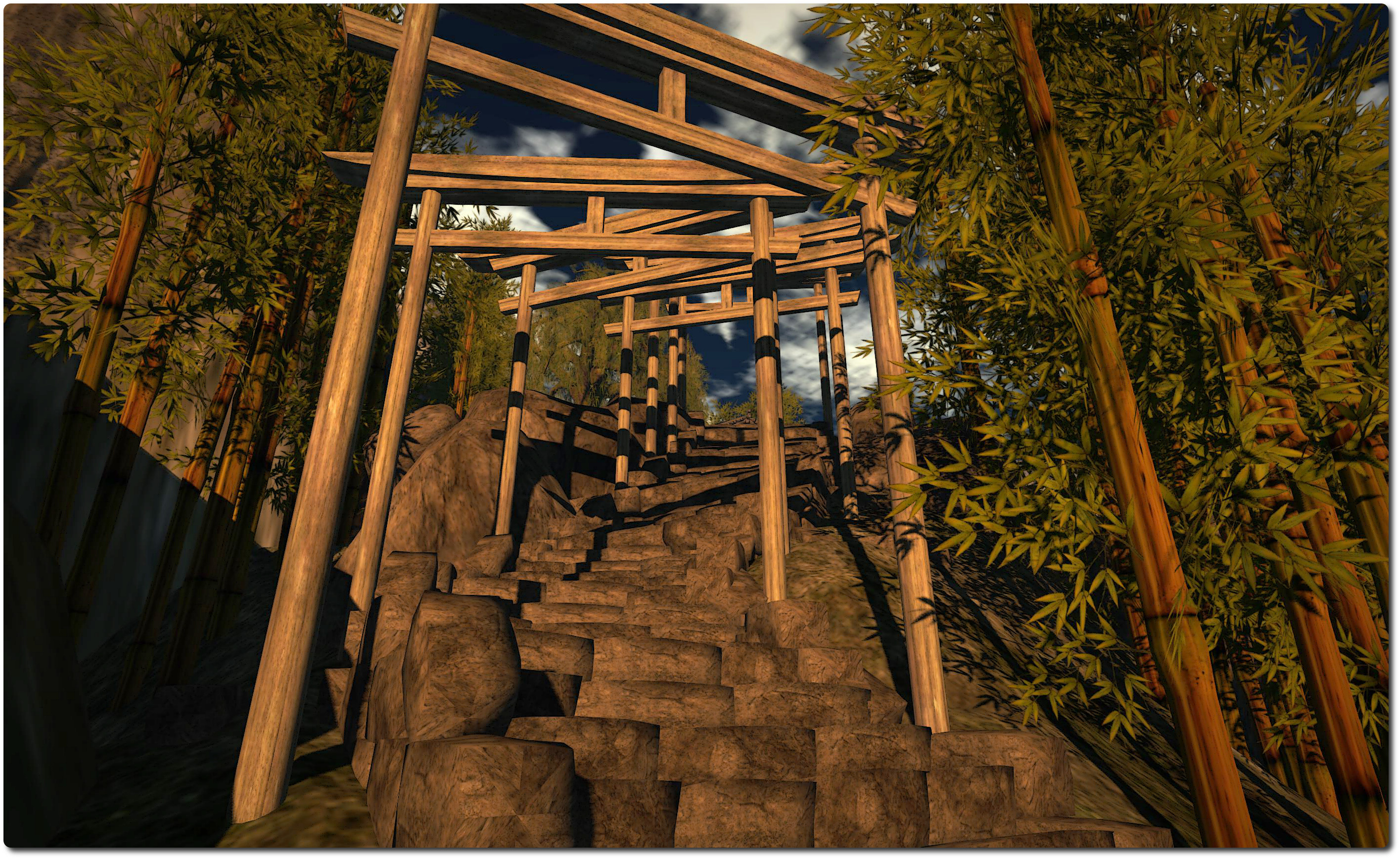
The Hou Han Shu (circa 432 AD) and the Sui Shu (636 AD) both report the mysterious Yamatai as being on a mountainous island or islands – and this certainly fits Yamatai in SL, which features dwellings and a tumbledown temple all built on a rugged landscape complete with wooded areas and tall growths of bamboo, surrounded by tall mountains through which a passage to the sea winds.

The landscape has been carefully sculpted, and the various buildings, both down on the waterfront and higher-up in the hills have been carefully situated to create an environment that is pleasing to the eye (and camera), and enticing in its invitation to be explored. There are a number of airborne houses hovering over the region, so you might want to derender them in order to avoid odd shadows showing-up in your pictures. Keep an eye out for the little touches of detail as well!

Well worth a visit.
Yamatai, Okami; by Inara Pey, Febtuary 2014, on FlickrYamatai, Okami (Flickr)

Related Links

Enter the Dragon Curves

Dragon Curves
Dragon Curves

In January I visited a Cathedral Dreamer, Gem Preiz’s Full Sim Art  installation at the LEA featuring images of his amazing fractal art. At the time, I commented to Honour McMillan that I’d love to see something like his work translated into in-world, real-time constructs which could be explored. Little did I know that Mac Kanashimi would be on-hand from February through June to provide something very close to what I’d been musing about!

Dragon Curves is Mac’s installation as a part of the LEA’s round 6 AIR selection. Despite the fact the regions were only handed over to the artists at the start of February, it is already open to the public. Don’t let the quick opening deceive you – there’s some six months of work gone into the piece – and it is simply stunning, particularly if you’re of a mathematical bent.

Dragon Curves
Dragon Curves

Mac says of the 1216-metre high piece, floating over LEA 26: “The Dragon Curves exhibit showcases sim-wide variations of dragon curve art. The spectacular script-controlled dragon curve landscape changes continuously.”

For those unfamiliar with the concept of the dragon curve, the concept grew from the Harter–Heighway dragon first investigated by NASA physicists John Heighway, Bruce Banks, and William Harter, and documented in 1967 in Scientific American. Essentially, it is any member of a family of self-similar fractal curves, as depicted by Heighway, Banks and Hartner.

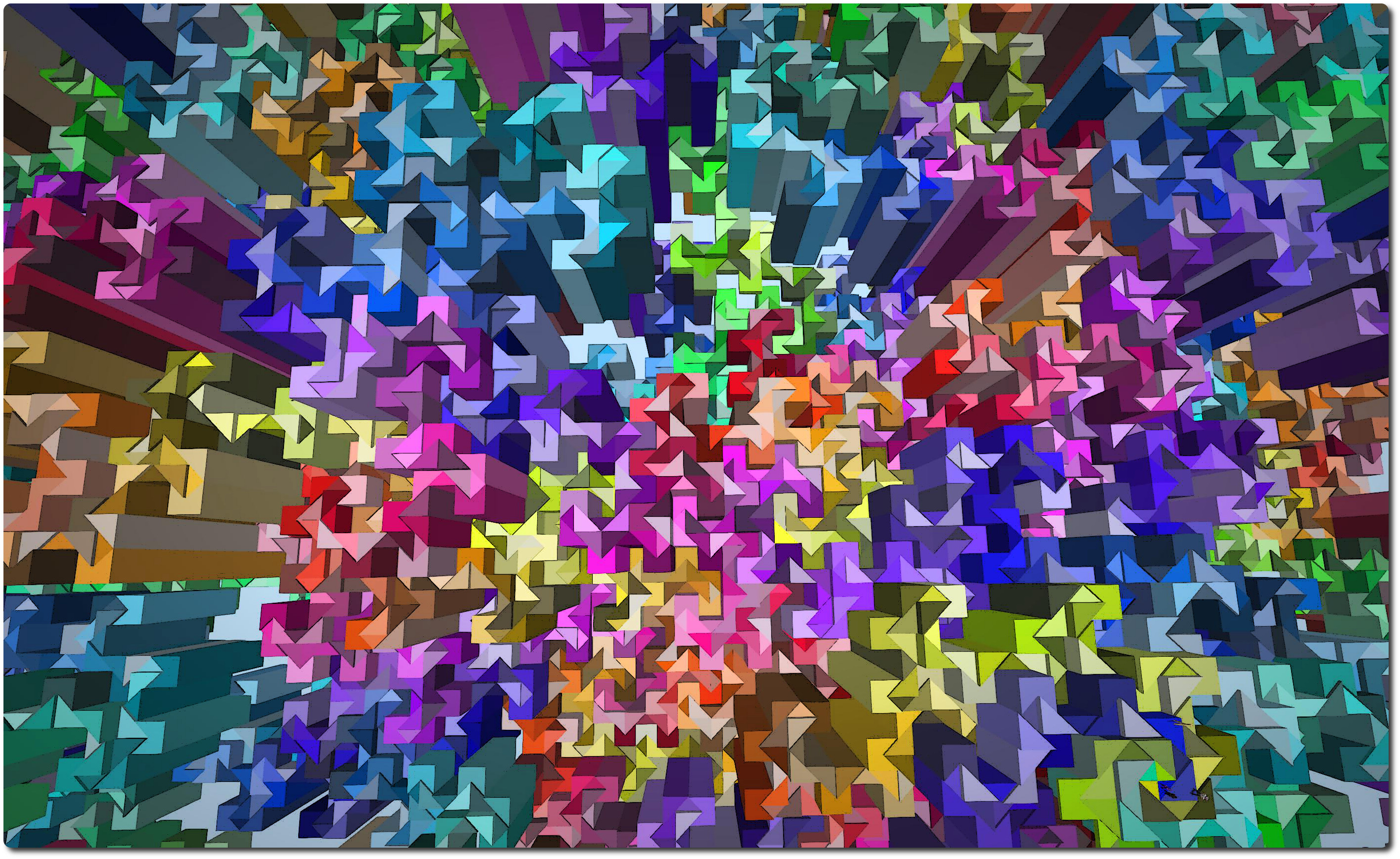
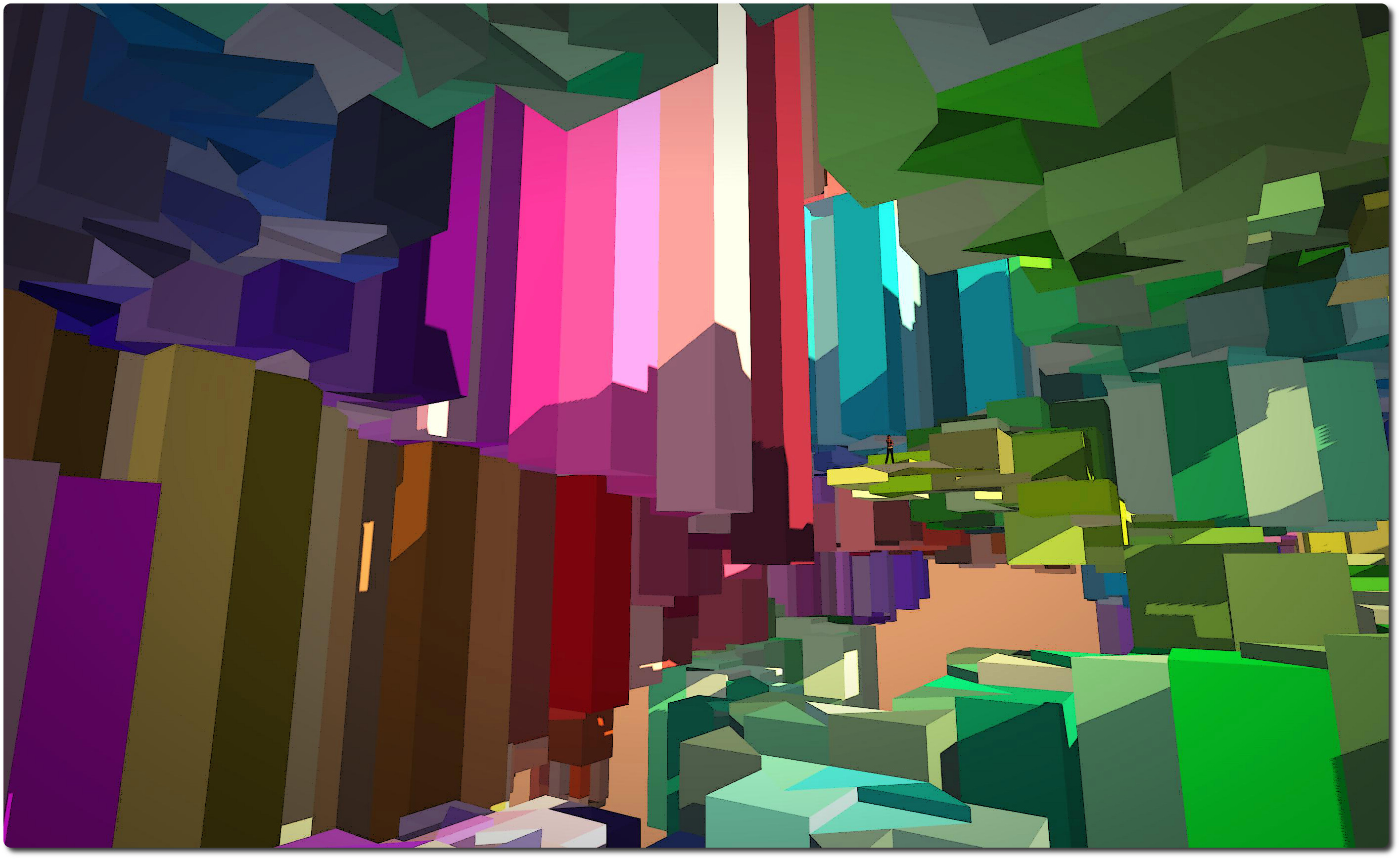
When seen from above, this pattern of self-similar curves is visible throughout this remarkable, ever-evolving piece in which the landscape within the three levels constantly changes as elements rise and fall and change colour (their colour being derived by height), and even resize themselves.

Dragon Curves
Dragon Curves

It is possible to find your way down from the arrival point at the top of the build to the lower platforms by way of the “dragon stair”, an 8 kilometre long, 1024m high stairway, itself a dragon curve, while each of the levels within the build comprise 10 dragon curves apiece and individual objects within the build comprise 1, 2, 4, 8, 16, 32 or 48 prims.

It really is an amazing and dramatic piece, a companion to Mac’s Mandelbrot Art, which was featured on an LEA region in early 2013. When visiting, set your draw distance to around 500 metres, if possible, in order to see the installation more fully. Also note that there are six safe junctions (including the landing point) where you can stand as the landscape on each level changes. Mac also notes that there is an “Emergency button to derez the dragon curves in case of crises”(!).

Dragon Curves
Dragon Curves from the inside as I descend

Related Links

Addendum, April 4th: Teno Theriac sent me a machinima of Dragon Curves he’s made of Dragon Curves:

Looking for Spring in Second Life

Small Town Green; Inara Pey, February 2014, on FlickrrSmall Town Green (Flickr)

The weather has been pretty lousy for many of us of late. The North American continent looks  like Antarctica decided to head north for a bit of a vacation while if Britain receives much more in the way of rain, the country will end up looking permanently wrinkled when viewed from space. However, the weekend has actually seen us with clear skies and sunshine where I live. The wind chill means it’s not exactly weather to be wandering around the garden in a sleeveless top and shorts, but the sky has been a beautiful blue and almost cloudless. This being the case, I decided to seek out what signs of early Spring might be found in Second Life.

Small Town Green; Inara Pey, February 2014, on FlickrrSmall Town Green (Flickr)

Actually, if I’m honest, I didn’t really look that far. I’d noticed earlier in the week that Small Town Green had  thrown off its wintry shackles, so “seeking out ” really comprised a quick teleport followed by rambling around prior to RL life again demanding my attention. One of the things that makes Small Town Green popular is that it is always evolving and changing. This makes it something of a magnet for SL photographers (and those of us who attempt to pass ourselves off as such *coughs and avoids making eye contact with her reflection*), and also for those curious to see what has changed and where.

Small Town Green; Inara Pey, February 2014, on FlickrrSmall Town Green (Flickr)

At the moment, spring and romance is in the air on an island that has again be transformed, but which still carries familiar motifs: the use of water, a train (this time right out in the bay), and similar. A clock tower sits on a rocky outcrop, dominating the main island, and down below is a venue for weddings. Bridges are also a part of the landscape this time around, crossing and re-crossing the river winding through the region, and also forming a link with a little offshore island complete with fairy ring and gazebo. As always, the attention to detail within the built will have the SL snapper camming around looking which is the best of many angles for a shot, while for those just wanting a place to sit and relax and spend time alone or with a friend, there are places to sit, lie, cuddle and dance waiting to be discovered. Just watch out for the lions. I’m not sure how friendly they are, and to be honest, wasn’t of a mind to find out, but they are certainly in a position to keep an eye on coming and goings.

Small Town Green; Inara Pey, February 2014, on FlickrrSmall Town Green (Flickr)

So even when the rain does come a-tapping on my window once more (and it will), I know there is at least one place I can go bask in the Spring sun.

Related Links

The Miniature Goal

The Miniature Goal
The Miniature Goal

“What if our physical world shrunk in proportion to the resources we drain from it?”

That’s the question Haveit Neox posits in The Miniature Goal, which opens at 14:00 SLT at the Art India Galley on Saturday February 1st.

It’s an intriguing question; one that results in an intriguing installation. Within the walled space, sits a Venice-like city in miniature, through which boats pass along the waterways; but this is far from the romance of Venice.

The Miniature Goal
The Miniature Goal

On the horizon marches a series of gigantic oil derricks, beyond which a strange weather pattern turns ominously. There is tension here between the city, the oil derricks and even Mother nature herself as a closer look at the city reveals that it is not build around canals and waterways, it is in fact slowly drowning in what appears to be a rising sea. Then there are the giants, wading through the water or perched atop some of the buildings at the edge of the city – how do they fit into this series of juxtaposed images?

“We deplete resources all across the globe,” Haveit warns us, “yet in our homes we may feel few repercussions. Though we don’t actually visit the oil spills, the cleared forests, or the mines, let’s imagine how it would appear, were our everyday life reflected proportionately to the current depletion. If our bedroom walls were to shrink at the same percentage as the forests or the extinction of species for instance, how high exactly would our walls become?”

The Miniature Goal
The Miniature Goal

And thus the truth of the piece is revealed. The city is wracked by the consequences of an ecosystem knocked completely off-kilter by our global activities, and the “giants” are in fact those who have found  their homes have shrunk as a result.

It’s a dark scenario but one with a visual impact which underlines the further questions Haveit poses about the future we may face if we don’t learn to control our appetites when it comes to the resources the world has to offer and we continue to ravage the ecosystem without pause. The various elements in the installation are each captivating in their own right, whilst flowing together as a whole.

The Miniature Goal will formally open at 14:00 SLT on Saturday February 1st, as mentioned, and will remain open through to March. The opening will feature music by Nnoiz Papp, which might feature tracks from his new album, Orientopolis – which has more than likely found its way onto my “things to purchase” list…

Related Links

Project Homeless: short film challenge, L$2.28M in prizes

Jayjay Zifanwe of the University of Western Australia brings word of a new film and machinima challenge

Project Homeless 2014 is a Challenge run by Screen My Shorts Incorporated and the University of Western Australia in partnership with, and sponsored by the Parramatta City Council.

Film-makers of all ages cultures and ability are invited to submit original creative digital content (conventional film and / or machinima) and win a share of the $10,000 Aus (L$2.28 Million) cash and prizes (with at least $700 Aus  reserved for Machinima), and have their works exposed on the international stage. Films may be individual or team efforts.

HomelessEntrants are asked to indicate two themes from the 22 listed by the competition, on which they would like to base their film. The organisers will then allocate one the selected options. Entrants then have full freedom to explore and interpret the allocated theme and create a completed film within 30 days. All entrants are asked to  be as creative as possible in interpreting their nominated theme.

All registrations should be received no later than Friday April 11th, 2014, which is the date on which entrants will be informed of their allocated film theme.

Completed films must be submitted by Sunday May 11th, 2014.

How to Register

  1. The preferred method is to register via the competition website– note that entry fees for machinima style film are being sponsored by the University of Western Australia.
  2. Send an email (or a NC in-world) with the following details to jay.jay@uwa.edu.au:
        • Second Life name
        • Team name (if applicable)
        • Email address
        • City & country
        • 2 preferred themes as the subject of the entry, in order of preference.

Essential Rules

  1. Only G or PG rated films will be accepted.
  2. Entry length to be between 3 to 10 minutes.
  3. Registration is essential.
  4. All entries are to be made specifically for the Project Homeless Competition.
  5. Register before the 11th of April & must nominate two of the listed themes.
  6. $10,000 Aus in prizes available with at least $700 Aus reserved for machinima.
  7. The full official rules should also be read, together with the 10 Step Guide.

Prizes

Please refer to the UWA website for a full list of prizes.

Related Links