When Life Gives You Apples…

When Life Gives you Apples ... Run! - LEA 6
When Life Gives you Apples … Run – LEA 6

Now open at LEA 6, in what is the final installation under the UWA’s Full sim Art series as we’re currently familiar with it, is Rebeca Bashly’s When Life Gives You Apples … Run

As Jayjay Zifanwee notes while introducing the piece in the UWA blog, it is fitting that Rebeca should be the final artist to participate in the Full sim Art series in its current format; in 2011, she was the very first artist to participate in the series – indeed, in any LEA exhibition – when her remarkable interpretation of Dante’s Inferno opened in October of that year (my review of which you can read here).

When Life Gives You Apples … Run Offers a provocative look at the subject of the abuse of women, either by others or by themselves.  “Looking at various myths, legends and fairy tales, apple seems to be pretty unfortunate for a woman. When an apple appears in a story, you know that something will go bad,2 Rebeca says of the piece. “From Eve, thru Greek mythology to Snow White there was always a catch with an apple. It is beautiful, delicious, tempting, seductive. A Perfect disguise for all bad that can come. I use it as a symbol for the monstrosities that woman too often don’t recognise as such in its early stages.”
When Life Gives you Apples ... Run! - LEA 6
When Life Gives you Apples … Run – LEA 6

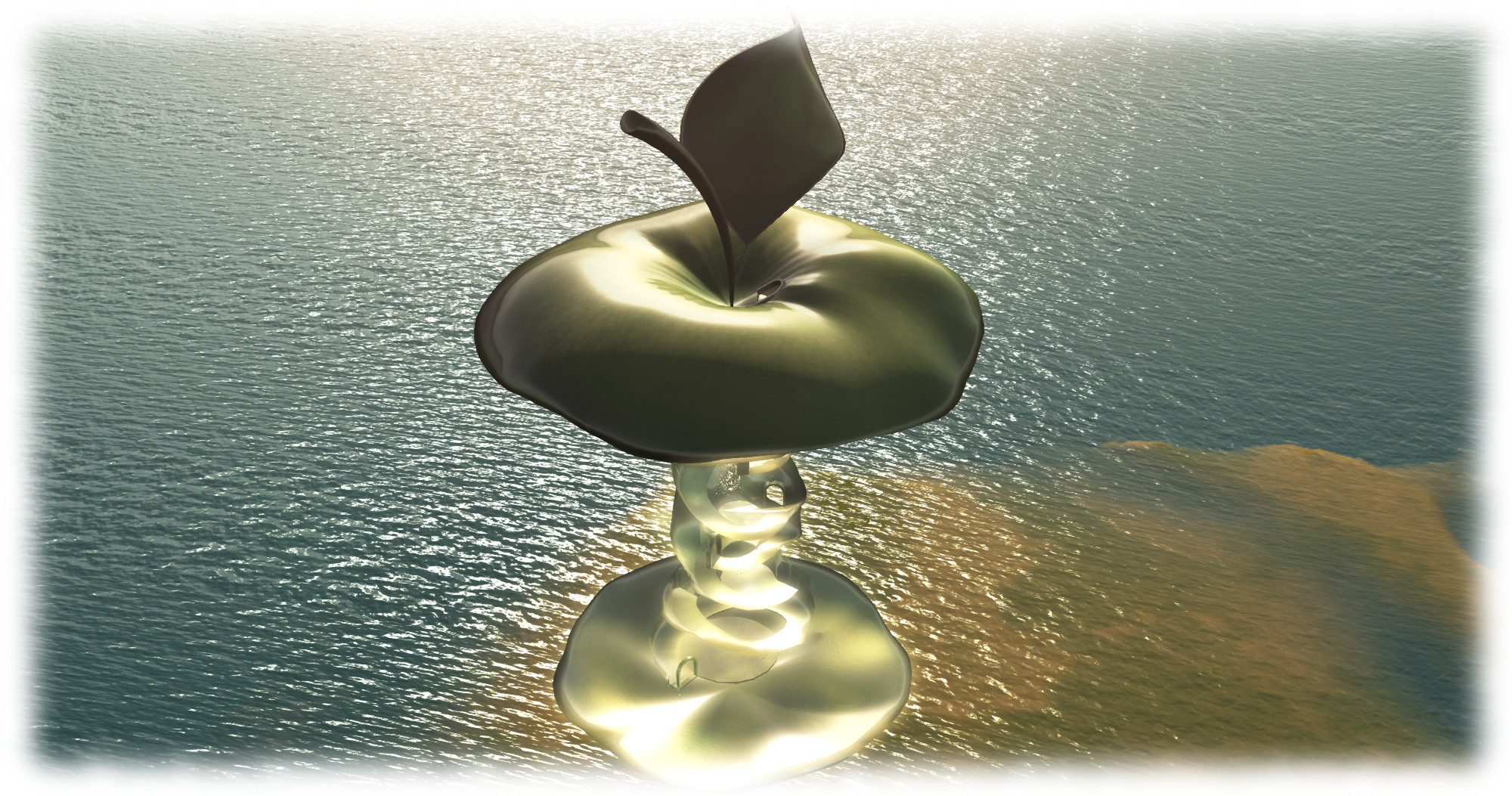
And indeed, the central part of the installation is – an apple. A quiet incredible apple in fact – or at least the core of one, as it has clearly been eaten. Constructed of mesh and over 70 metres tall, the apple sits on the ground, stalk pointing to the sky, the uneaten flesh at its lower end serving as the arrival point, where a smaller apple sits, offering visitors an introductory note card.

Winding up through the the core of the apple is a tunnel visitors are asked to follow.  This leads the way up to a couple of teleport platforms at different levels within the apple’s core, a sculpture in occupying the space between them; and it is by taking these teleports that the visitor is led to the parts of the installation dealing more directly with the theme of abuse (or perhaps “subjugation” might be an equally valid term) either inflicted from within or without.
When Life Gives you Apples ... Run! - LEA 6
When Life Gives you Apples … Run – LEA 6

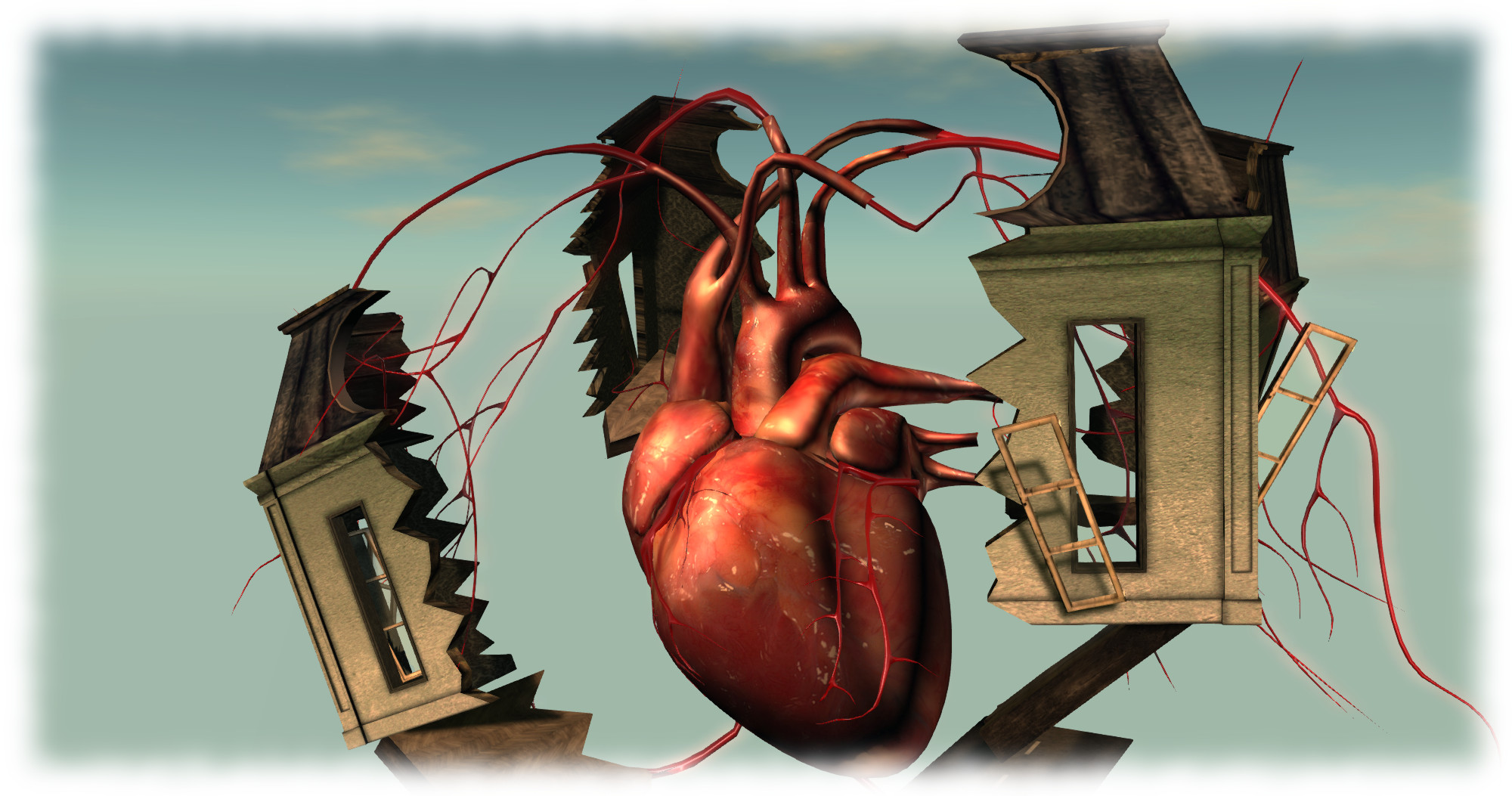
In the first, Home Sweet Home, we see a house being torn apart by a giant heart, both suspended above an open road – itself an image of freedom. The accompanying story suggestive of a person caught in a relationship marked by the abuse of lairs, deceptions, stories, words, finally breaking the circle and finding freedom in herself and in the world at large.

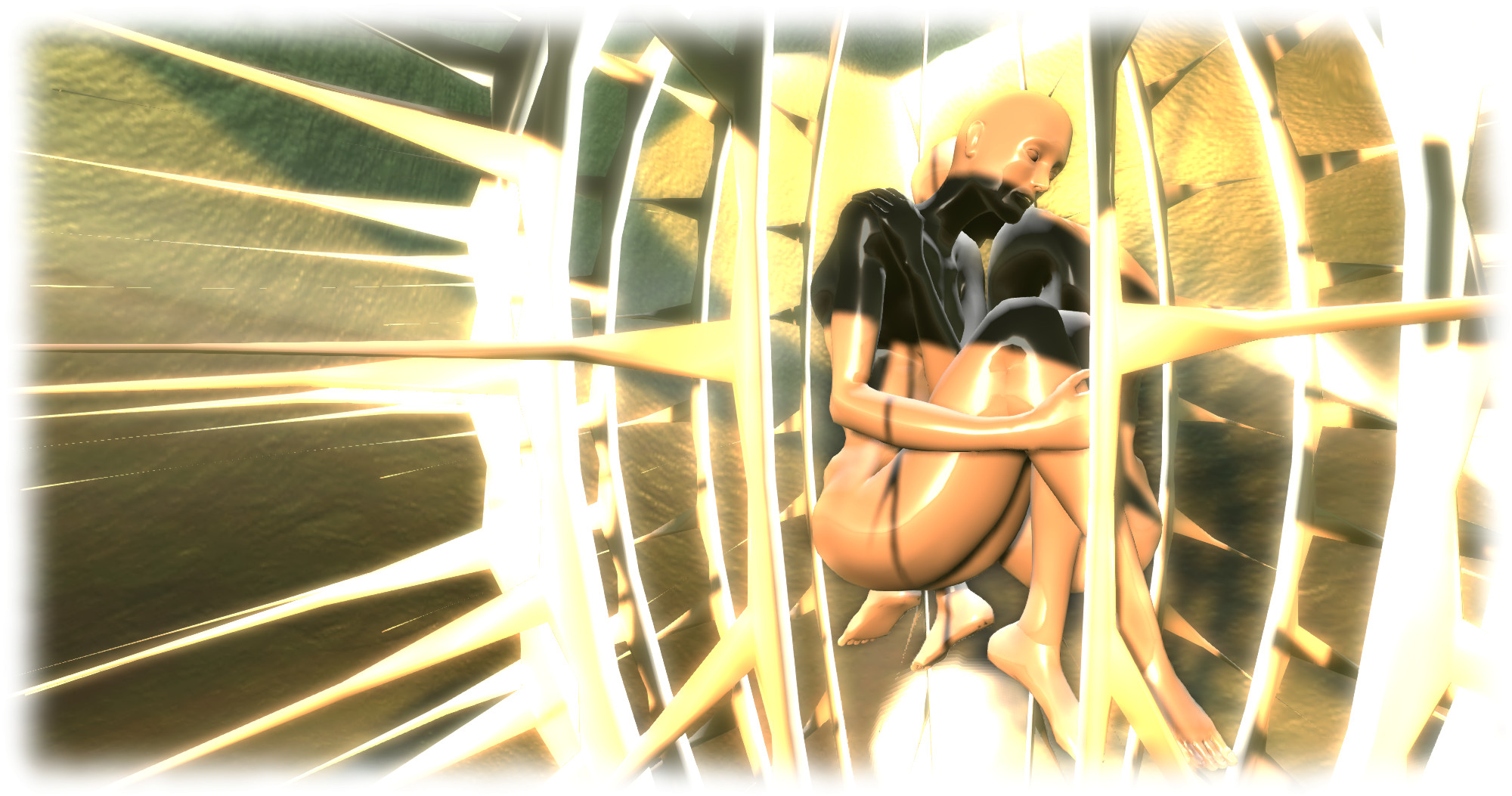
In the second, the subject matter focuses on self-abuse in the form of anorexia nervosa and Bulimia nervosa, and the destructive effects they can have on those stricken with them. This is also accompanied by a story, that of the Doll’s House.
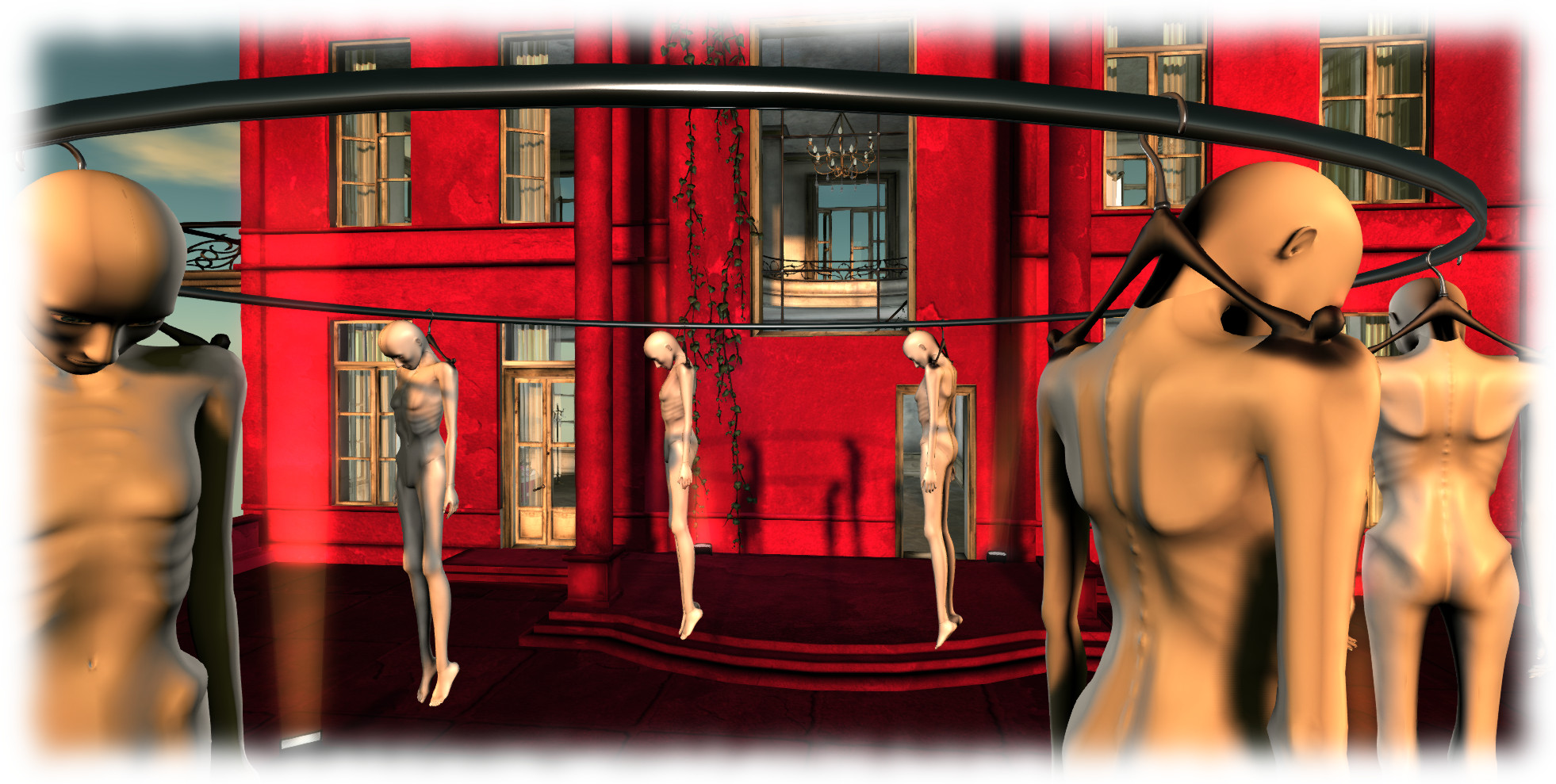
When Life Gives you Apples ... Run! - LEA 6
When Life Gives you Apples … Run – LEA 6

There is strong symbolism throughout this installation, be it with the story platforms, or the sculpture of the caged women. Even the tunnel winding up through the apple core has a meaning of its own, for example; an echo of the way in which maggots can bore through an apple, ruining its wholesome appearance via decay from the inside, just as relationships or lives which might appear whole from from outside are slowly decaying from within, as with the vignettes presented by this build.

As noted towards the top of this article, When Life Gives You Apples … Run is a provocative piece; but one of Rebeca’s strengths is that she’s never fought shy of making people think.  As such, this is a worthy piece on which to close the current UWA Full Sim Art series.

Related Links

Armenelos: the returning

Armenelos, Calas Galadhon; Inara Pey, March 2015, on Flickr Armenelos, Calas Galadhon (Flickr) – click any image for full size

In December 2014, Ty Tenk  contacted me to let me know that Calas Galadhon would be closing its gates for the month of January 2015, while he and Truck Meredith took their annual hiatus from things following the busy October through December period. He also informed me that during the hiatus, there would, again as usual, be some remodelling within the parks, and as a result, the long-running recreation of the famous Santorini, located in the Armenelos region, would be packed away, and the region itself re-purposed.

While Santorini may well have gone from Calas Galadhon, Armenelos itself formally re-opened on Sunday, March 8th, and true to their word, Ty and Truck have created something truly fabulous. Relocated to occupy the north-west corner of the estate, and sitting alongside a new addition to the park, Long Lake, which Ty and Tuck have added to Calas in order to bring the total number of regions in the park back up to 12, the new Armenelos is a visual and aural delight.

Armenelos, Calas Galadhon; Inara Pey, March 2015, on Flickr Armenelos, Calas Galadhon (Flickr)

On arrival, the visitor is presented with a rugged, wooded landscape, with high cliffs facing the sea to the west, west, and which drop slowly to lower-lying land to the east, and the bridge connecting Armenelos with the  mostly low-lying islands of Long Lake, and which in turn offer passage to the Misty Mountains.  Across Armenelos, tall spires of rock and flat-topped plateaus push their way between the trees, offering high vantage points from which to survey the world, while paths an trail wind through the tall grass and under the shade of high boughs, encouraging visitors to wander and explore.

And there really is a lot to see; so much so, that unless you are keen-eyed, you’re liable to miss many of the finer touches tucked away across the region which bring it to life. For a start, make sure to have local sound enabled; Armenelos has a wonderful sound scape that enhances the feel of immersion: waves crashing against the cliffs; the singing of birds inland, the bark and cry of gulls wheeling over offshore island  where they and pelicans are nesting; the honk of male deer, the plaintive cry of a high-soaring eagle or two; the slightly worrisome howl of wolves through the trees…

Armenelos, Calas Galadhon; Inara Pey, March 2015, on Flickr Armenelos, Calas Galadhon (Flickr)

Signposts close to the landing point will point you in the general direction of many of the region’s attractions, such as the oriental pavilion, where you can enjoy a refreshing cup of tea under the benevolent gaze of Buddha. From here you can follow a wooden board walk around the rocky escarpment that rises to one side of the pavilion and hop onto a boat with a friend or two and enjoy a trip around and through the waters of Armenelos and Long Lake, passing the Dolphin Cafe, which remains in a re-modelled form on the west side of the land, and which resume its live entertainments from Monday, March 9th at 18:00 SLT (Oz’s club also remains overhead as well).

For the daring, there’s the opportunity to scale the high plateaus and then traverse between the various high-points via rope glides supplied by Cube Republic, which have excellent camera positioning for giving you a real feel for shimmying your way over deep gorges on a single length of rope! There are also, of course, all the touches one would expect from Ty and Truck – places to sit and chat, to cuddle or dance, and hidden walks which might not be discovered on a first visit.

Armenelos, Calas Galadhon; Inara Pey, March 2015, on Flickr Armenelos, Calas Galadhon (Flickr)

For me the magic of Armenelos doesn’t just come from all of this; it also comes from the little details that have been added throughout the region, and which really do require a keen eye in order to spot. Such as spotting one of Morgan Garrett’s marvellous and beautifully detailed little birds sitting on a bough or watching you from the side of a board walk, song occasionally bursting forth from it; or looking up into the branches of a tree and spying a little lizard, frozen in place, looking back and you and pretending it really isn’t there…

Given all of this, you’ve probably gathered that Armenelos isn’t so much a place to be visited, but rather to be experienced. It its new form, it addes further depth to the already remarkable Calas Galadhon parklands – which, if you haven’t visited before, I strongly urge you to do so, as there is much to see, including new attractions. Should you do so, remember you can take a horse from near the park’s main entrance and ride up from Calas Galadhon, through Mirrormere and over the Misty Mountains to Long Lake (which, btw, offers activities of its own), and then on to Armenelos, making for a wonderful trail ride.

Armenelos, Calas Galadhon; Inara Pey, March 2015, on Flickr Armenelos, Calas Galadhon (Flickr)

When visiting, please also remember that Ty and Truck provide all 12 of the Calas Galadhon park regions purely for the benefit of other residents. They do not offer land rentals or use the regions to run an form of business, nor profit from the estate. They provide 40% of the total running costs out of their own pockets, the rest being made up by donations by visitors. So please, when visiting, do consider using one of the donation points scattered throughout the park to show your appreciation for, and support of, their work and generosity in bringing to much to Second Life for us all to enjoy.

Related Links

Lost Paradise

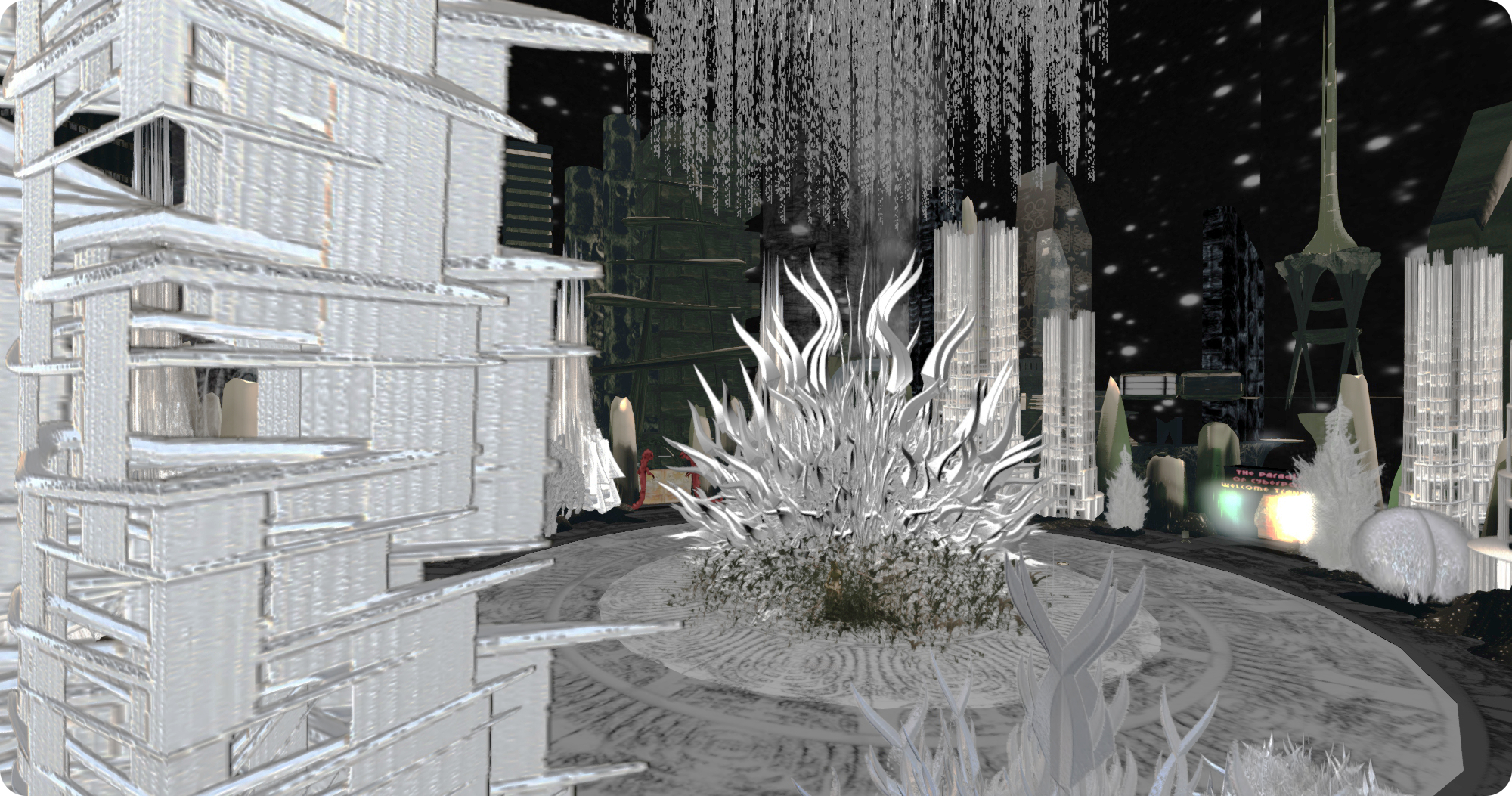
The Paradise of CyberPolis

Currently open to explore, although the official opening doesn’t take place until Sunday, March 15th, is The Paradise of CyberPolis, by Asmita Duranjaya and Sable (snakeappletree) at LEA 12. It is billed as a “a grey-scaled story and game-based art installation”, and comes with a narrative storyline visitors are asked to follow whilst exploring the installation, solving clues, with the explanatory notes reading:

Crash-landing on an urban planetary system …

A researcher is slowly awaking from unconsciousness, starting to explore the environment of an ancient, abandoned cyber-city and to solve its mysteries. Seven letters need be found to experience the last surprising solution.

The Paradise of CyberPolis

The starting point is the researcher’s crashed aircraft, complete with unconscious space-suited researcher. A HUD is also offered, and you’ll need this in order to unlock (literally) the mysteries and make your way to the surprising solution.

The HUD actually takes the form of a journal (available in English or German), written by the researcher, describing their initial examinations of this world and the discoveries made. Your task is to follow the clues in the book, re-trace the researcher’s  footsteps and learn all that they have learned, and in the process find the seven letters mentioned in the introduction. Four of these will be required to unlock the gates of the cyber-city proper (your initial investigations taking place outside of the city’s core), while all seven are needed to unlock the final secret.

The Paradise of CyberPolis
The Paradise of CyberPollis

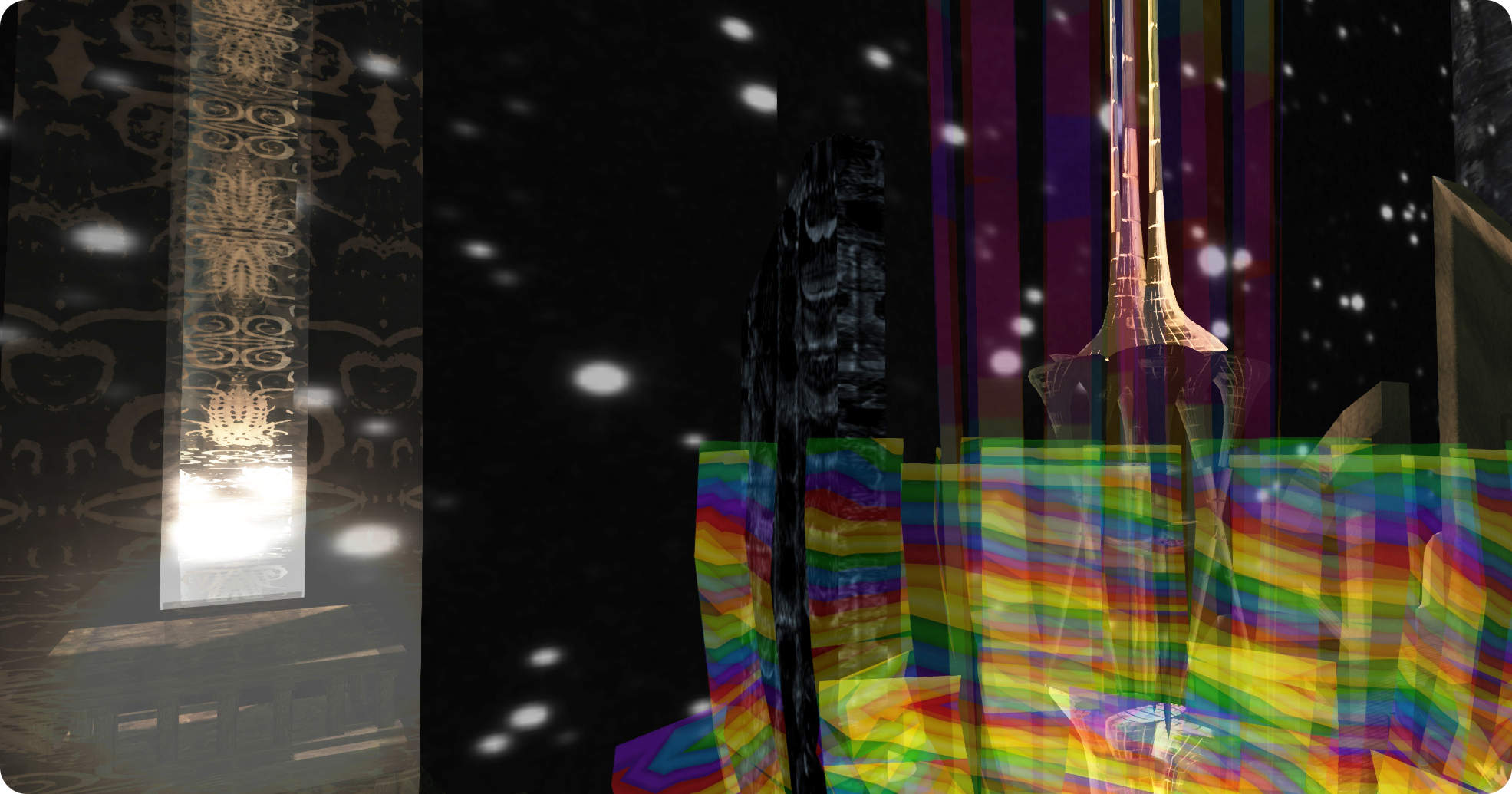
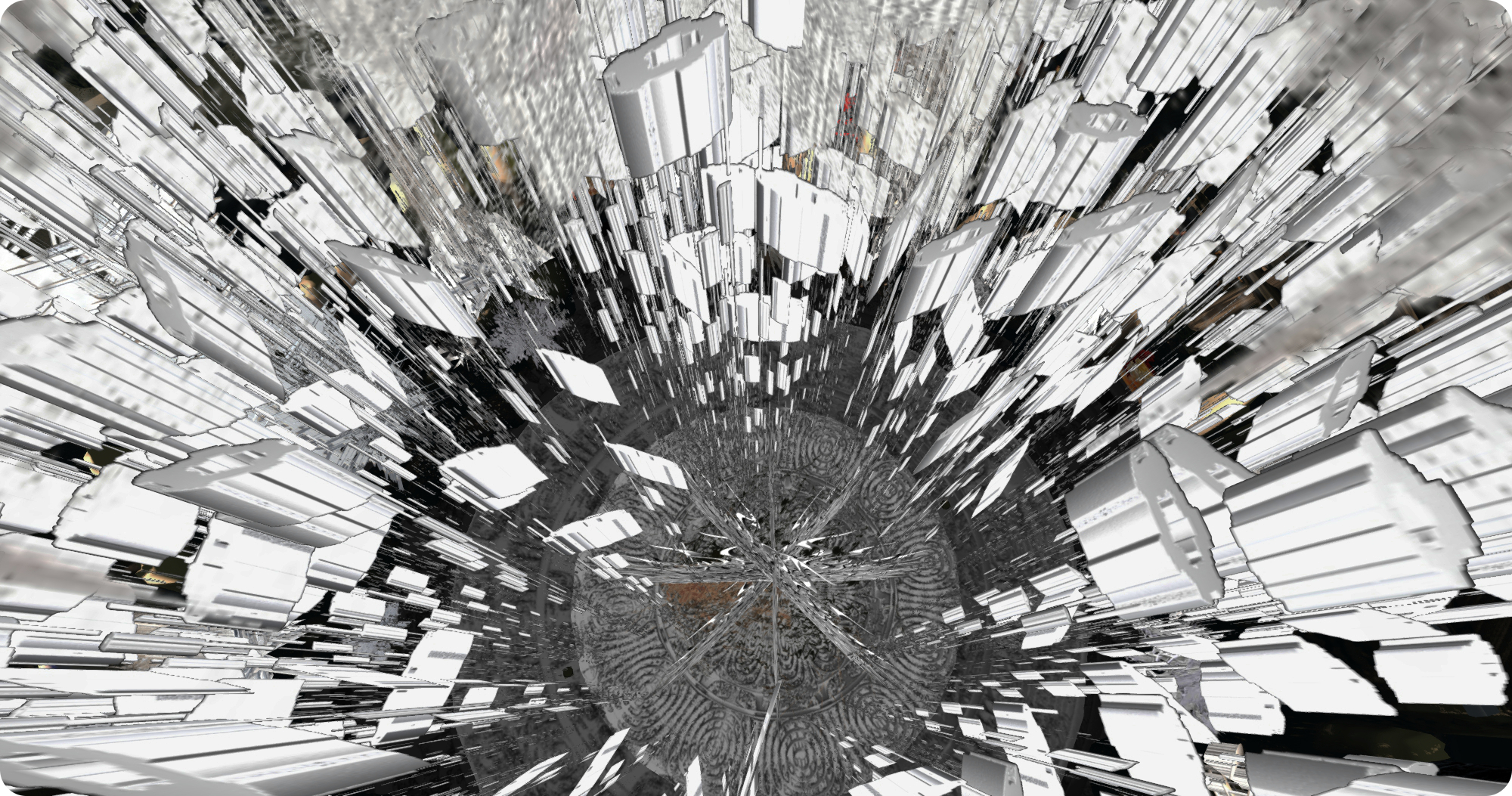
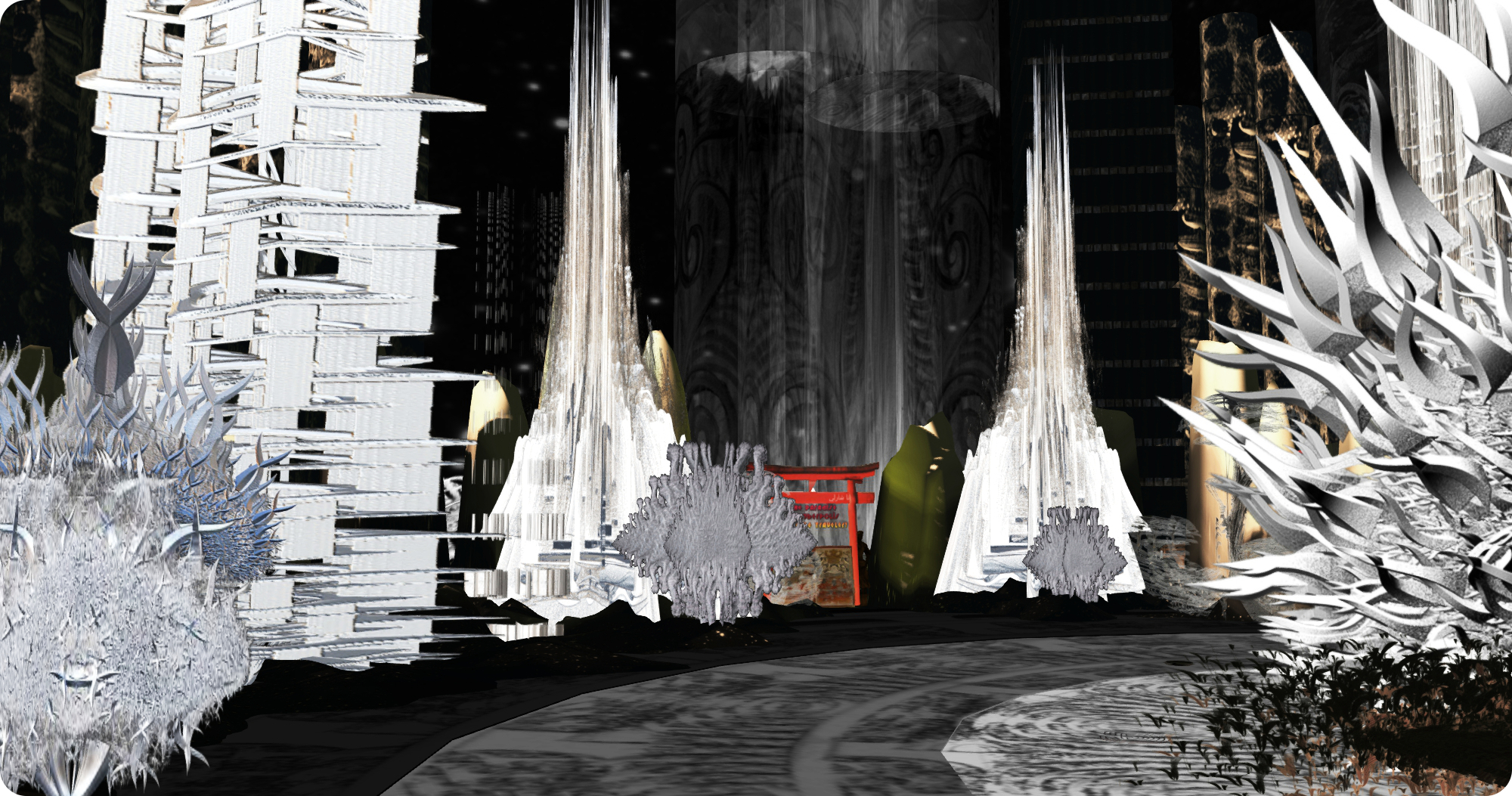
Along the way you’ll encounter a curious environment with mixed influences from the worlds anime, cyberpunk and dystopian sci-fi, in a story with something of a spiritual slant. Most of the landscape is a muted greys and whites, but there are splashes of colour scattered throughout, which form visual cues to places you might want to investigate more closely.

As a game, the idea almost works; you read the book, you riddle the clues, you uncover the required letters. But there is a problem. Of the seven letters to be discovered, only three actually require you investigate the city due to them requiring direct interaction with in-world objects to properly identify the letters in question; the other four can be discovered just by reading the book. Thus, it is possible for some of the visual context of the story to be lost as one simply reads ahead, identifies the letters and goes directly to things like opening the gates of the inner city; and sad to say, I’m not sure that much would be lost from the experience in doing so.

The Paradise of CyberPolis

The build itself, while interesting to explore, bears a strong resonance to the NeoCyberCity both artists recently built at Asmita’s own Space4Art / Port Lyndus region (indeed, the two builds appear to share many common elements). As such, it’s actually quite hard to determine why there was a need to utilise an LEA region to produce this particular piece, rather than incorporate it into a pre-existing and similarly themed environment already operating.

Related Links

Doing a “Little Nellie”

The Piaggio RR39F Orion

In January 2015, I wrote about my purchase of Ape Piaggio’s Kv23H FoilStream power boat, which I’ve come to really enjoy when in the mood to zap around on the water 🙂 . Since then, Ape has produced a new vehicle in her range. Not a boat, this time – an aircraft. Or more precisely, an autogyro, which I’ve recently had the opportunity to take out and about.

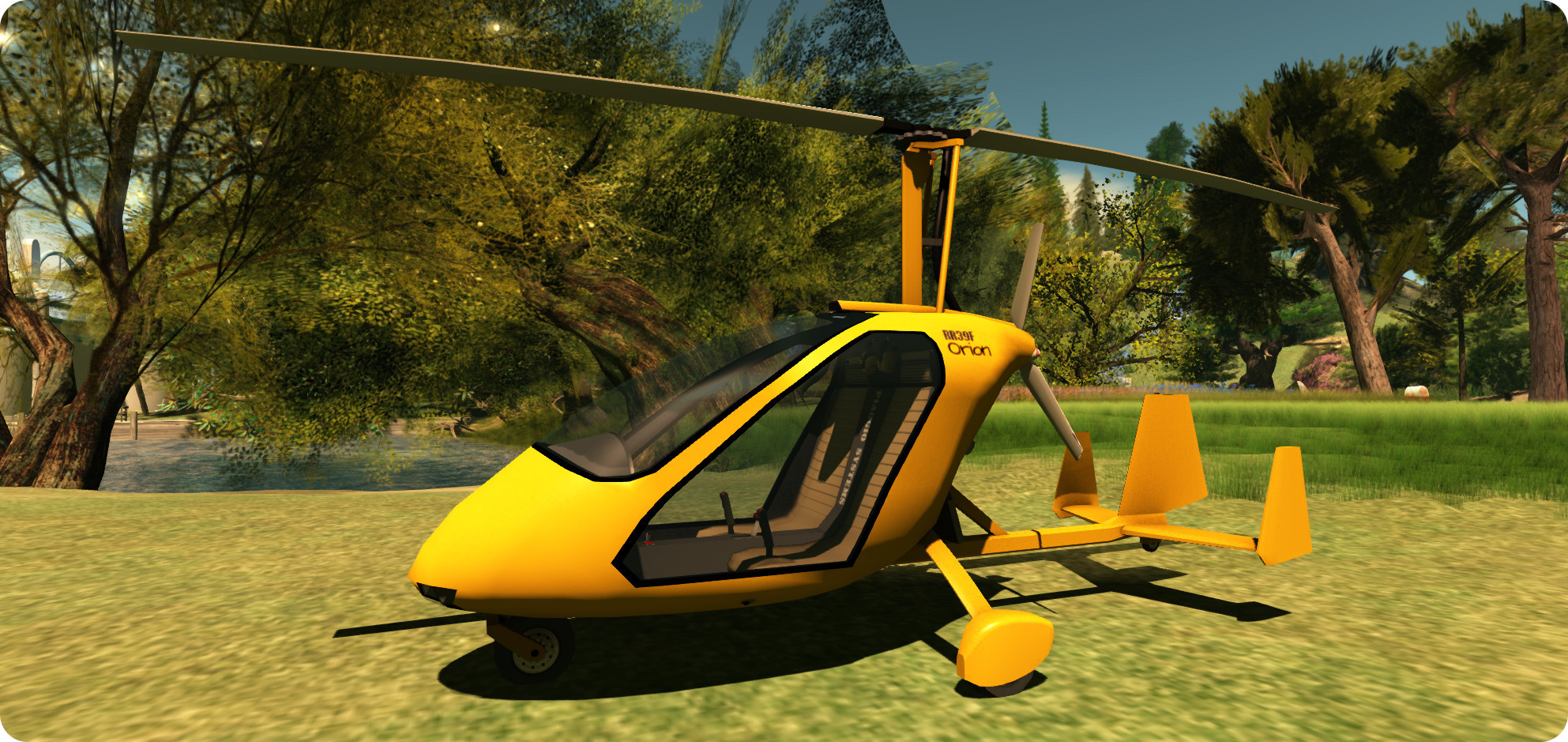
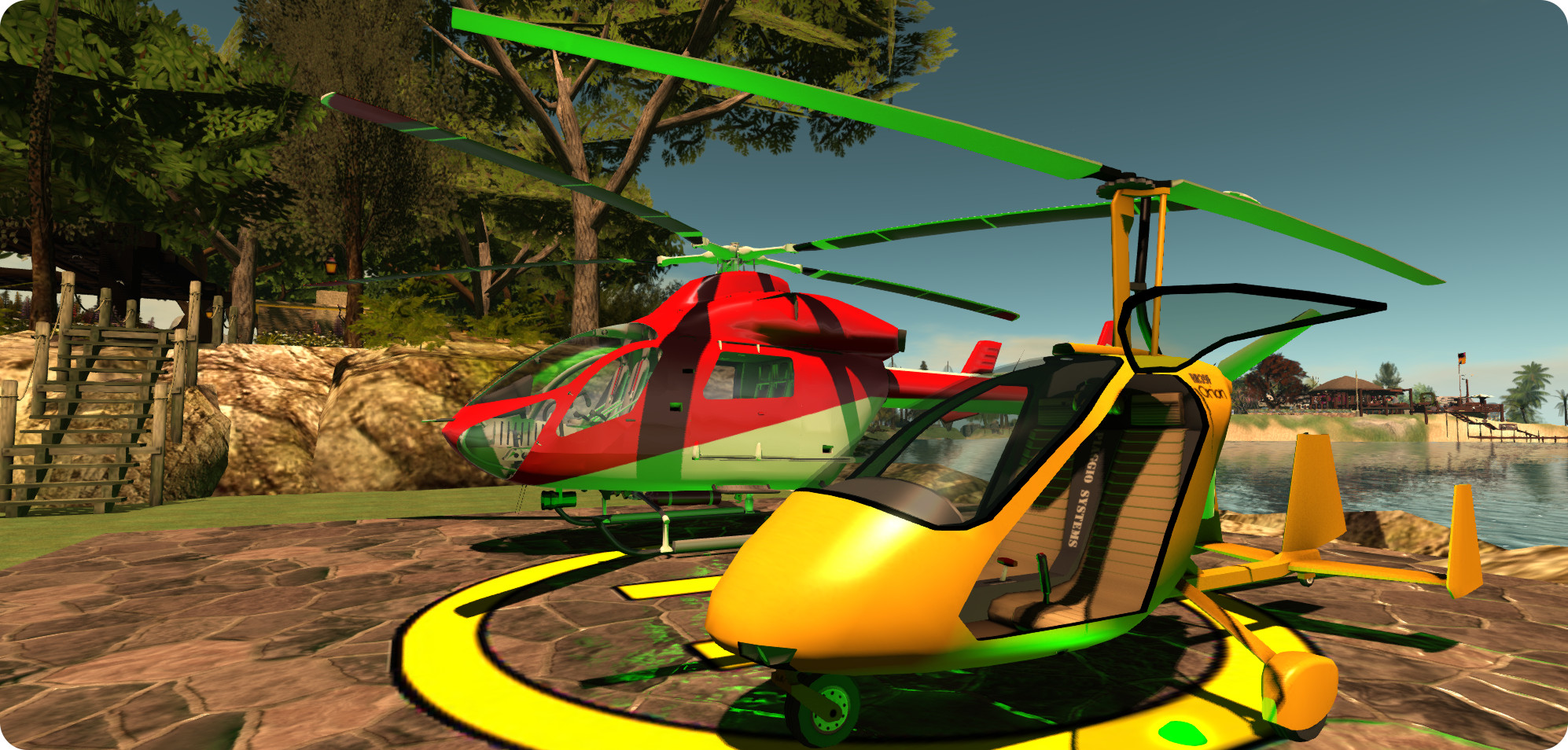
The RR39F Orion is a beautiful little two-seat (side-by-side configuration) autogyro with a fully enclosed cabin. Bright yellow in its default colour, I was immediately put in mind of James Bond’s famous “Little Nellie”, even though the two vehicles are worlds apart, and may even end up calling my Orion “Nellie” when I get around to repainting it!

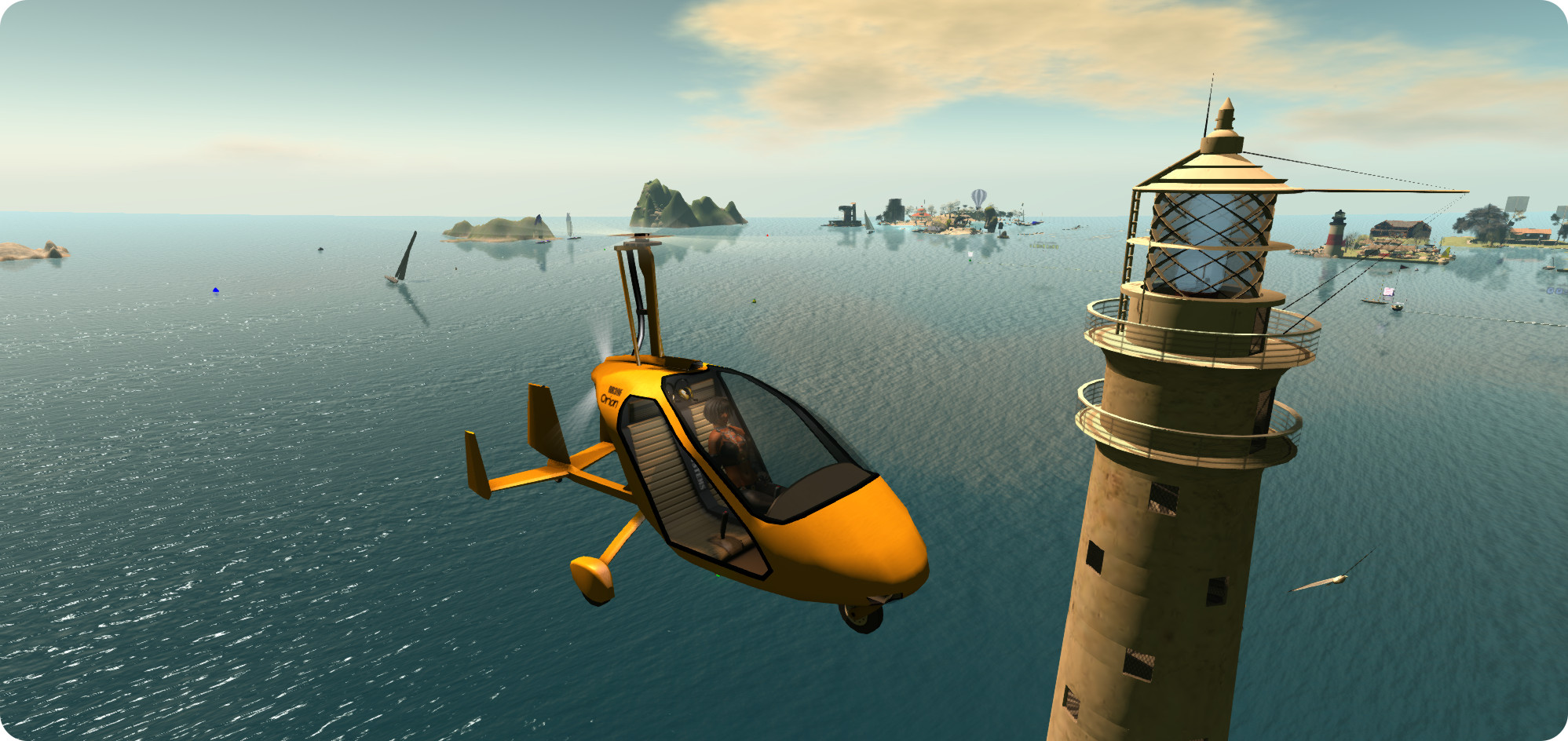
The Piaggio RR39F Orion - flying past a familiar landmark on Blake Sea
The Piaggio RR39F Orion – flying past a familiar landmark on Blake Sea

For those unfamiliar with the concept, an autogyro is essentially a combination aeroplane and helicopter, using a propeller engine for thrust, and a set of unpowered rotors in autorotation to generate lift and keep the craft airborne. This means it takes-off like a ‘plane, and can hover, descend and land like a helicopter (although it cannot hover and ascend like a helicopter).

This combination of characteristics means an autogyro can take a little time to master – and Ape’s Orion is no exception to this rule. Which should not be taken to mean it cannot be fun to fly; quite the reverse in fact. Half the fun in flying it is mastering it, and once it is properly understood, then it is an absolute joy to fly.

The aircraft comes complete with a HUD, texture maps (for custom painting), an additional paint kit (plain white), and a custom paint applier for your own designs and a manual. Often, when flying aircraft in SL, the instinct is to hop in, start-up and fly. With the Orion, I seriously suggest an appetiser of RTFM (Read The Flippin’ Manual) is the first order of business.

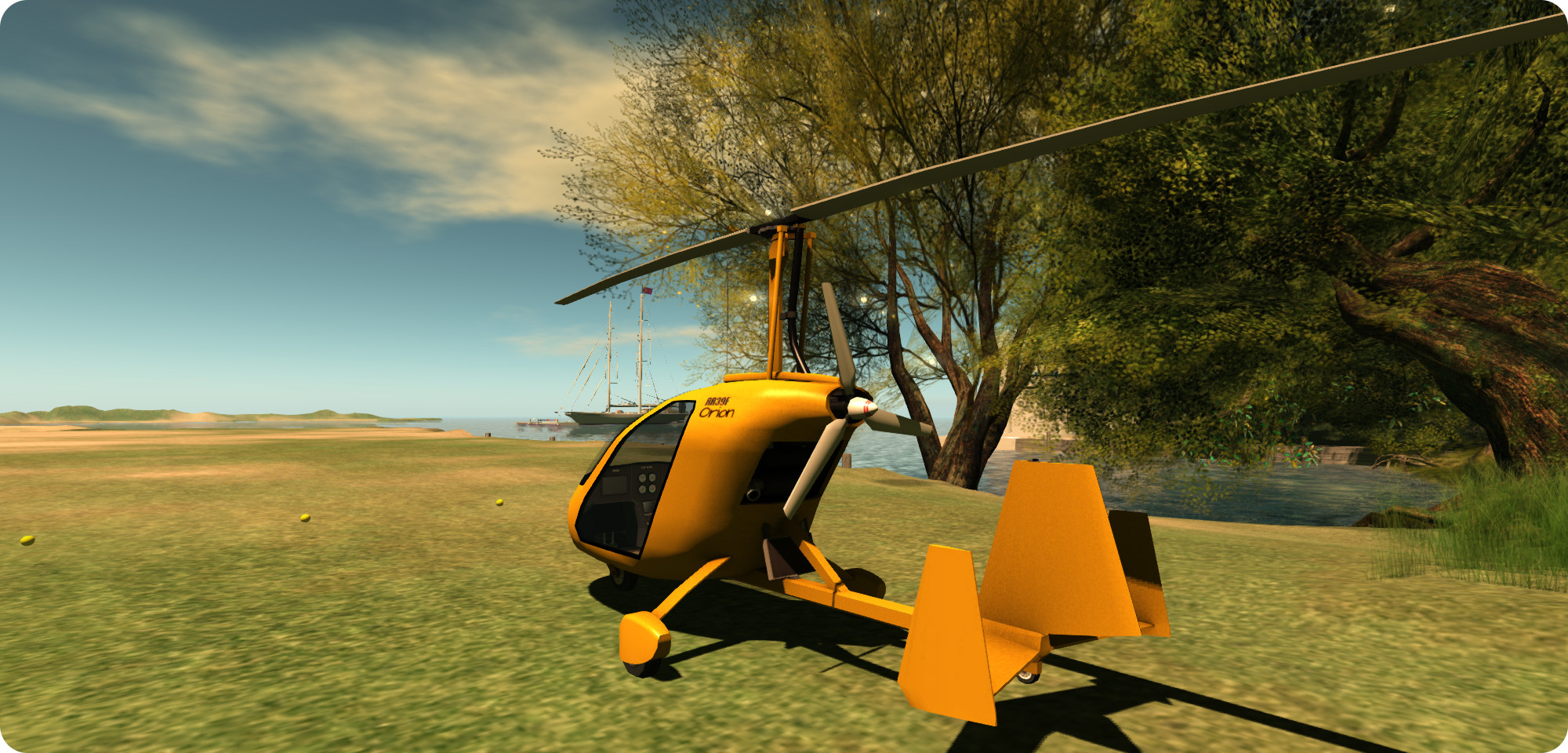
The Piaggio RR39F Orion is a "pusher" autogyro, with the egine mounted bhind the cabin, and facing the rear
The Piaggio RR39F Orion is a “pusher” autogyro, with the engine mounted behind the cabin, and facing the rear

The Orion has three operational modes: automatic, semi-automatic and manual. When flying in the first two modes, everything in terms of getting powered-up and ready to fly is taken care of for you, and you’ll only need the HUD for activating the lights and GPS system (if flying in Mouselook). If you’re flying in manual mode, you will need the HUD and the aforementioned RTFM time; like many real autogyros, the Orion has some very specific steps to getting airborne, including pre-rotating the overhead blades.

In the air, I found the Orion light and responsive, and could handle region crossings very well, both when flying it alone and with a passenger on board (I volunteered my Crash Test Alt for the privilege, rather than risking dunking a friend in Blake Sea 🙂 ). I did find the camera position a little high, giving the Orion the look of being nose-high in level flight, so you may, like me, find yourself using the hover text rate of climb / descent indicator to monitor your horizontal flight, and you may need to keep an eye on the rotor RPM reading as well. So just like real flying, using this autogyro can be a case of learning to trust your instruments over instinct!

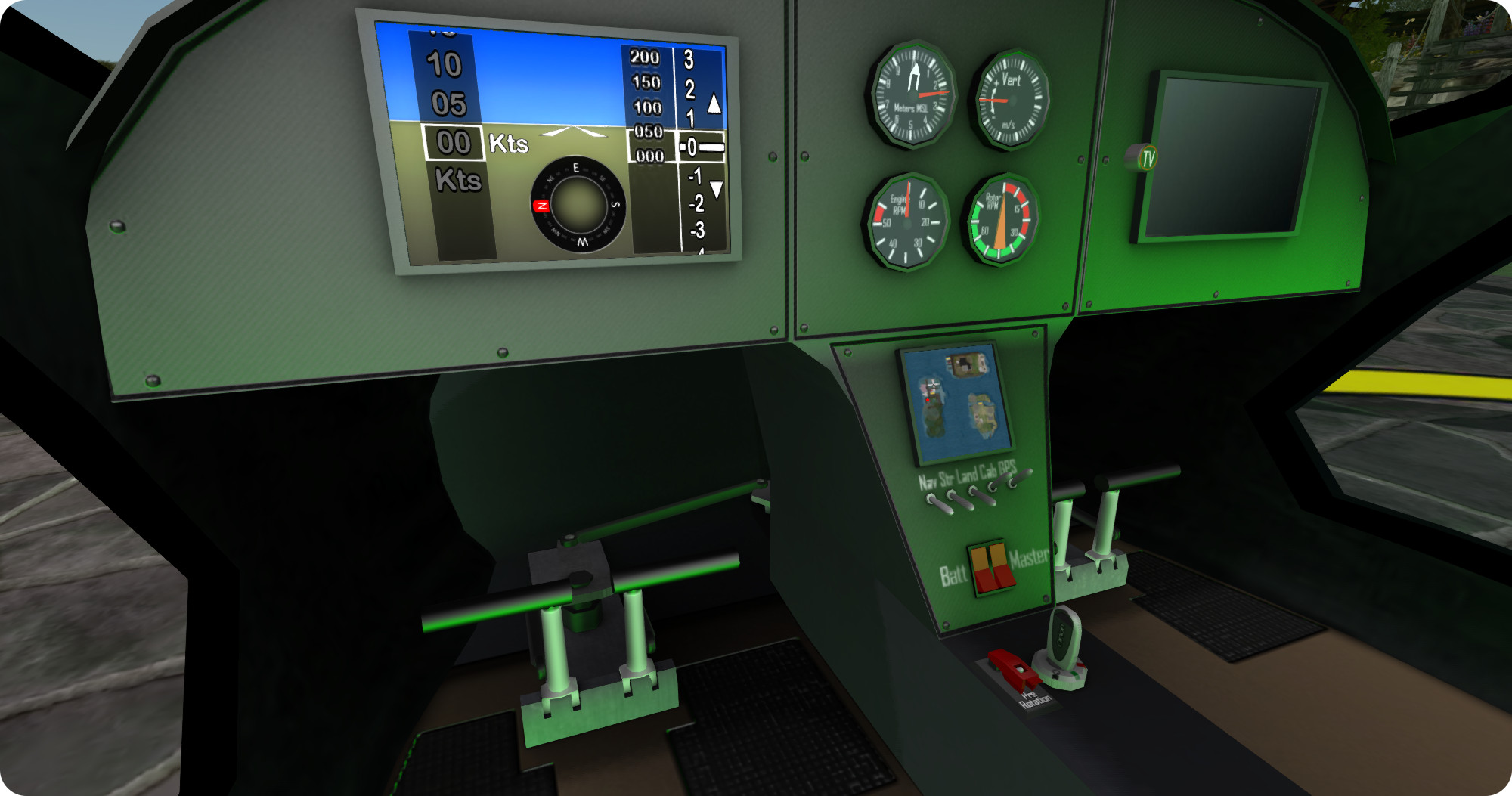
The Orion's cockpit includes fully working switches, CRT, GPS and even a media centre!
The Orion’s cockpit includes fully working switches, CRT, GPS and even a media centre!

The Orion handled well in Mouselook flying and, like the FoilStream, there is a GPS option on the dashboard which tracks your progress across the grid, while the pilot’s CRT will keep you informed of airspeed, etc., as well the hover text, which also re-aligns inside the cabin when using ML. A nice touch is that all the control switches in the cockpit work, although using them in ML will likely required a the use of CTRL-0 and CTRL-9, etc., to flip them. As with Ape’s boats, the cabin also has a built-in TV / media display.

A menu, accessed by touching the aircraft or by clicking on the menu option on the HUD, provides access to various setting – flight mode, throttle mode (digital = increase / decrease throttle by 10% increments; analogue = press and hold PAGE UP or PAGE DOWN to increase / decrease throttle). Digital works great when flying, however, when moving around on the ground, 10% (the minimum setting for the digital throttle) is a tad bit racy and may cause ground controllers (and other pilots at busy airports) to get a little apoplectic as you race along taxiways, so I recommend the analogue setting, which offers a more granular increase / decrease in throttle settings for ground movements. The menu also provides access to the paint controls, added skis for flying from snow, and setting-up the Orion so it can be flown by a friend.

The RR39F Orion alongside my MD900 Explorer

I can’t actually vouch for the painting system; right now I’m without my primary PC and running everything via SL Go, therefore I don’t have the means to download the supplied texture files full-size, so that’s something that will have to wait.

Overall, the Orion is a great little aircraft; fun to master, fun to fly, and with some nice options and touches, as I’d expect, given the creator. I  had fun putting it through its paces – and discovering some of the ways in which you can end up going for an unexpected landing (or if over water – a sudden bath). I found it flies well, handles two avatars on board without too much in the way of camera issues. If there is perhaps one thing it is missing, it’s a brake function for better ground movements control; jiggling the throttle, especially in analogue mode, can be fiddly at times. But, that said, I’m looking forward to flying the Orion again when my “big” PC comes back and can be used, and in getting it set with a custom paint scheme!

Price at the time of writing: L$1750; construction: mesh. LI:  29.

Related Links

FreeWee’s Lab: the magic of sound, light, physics and colour

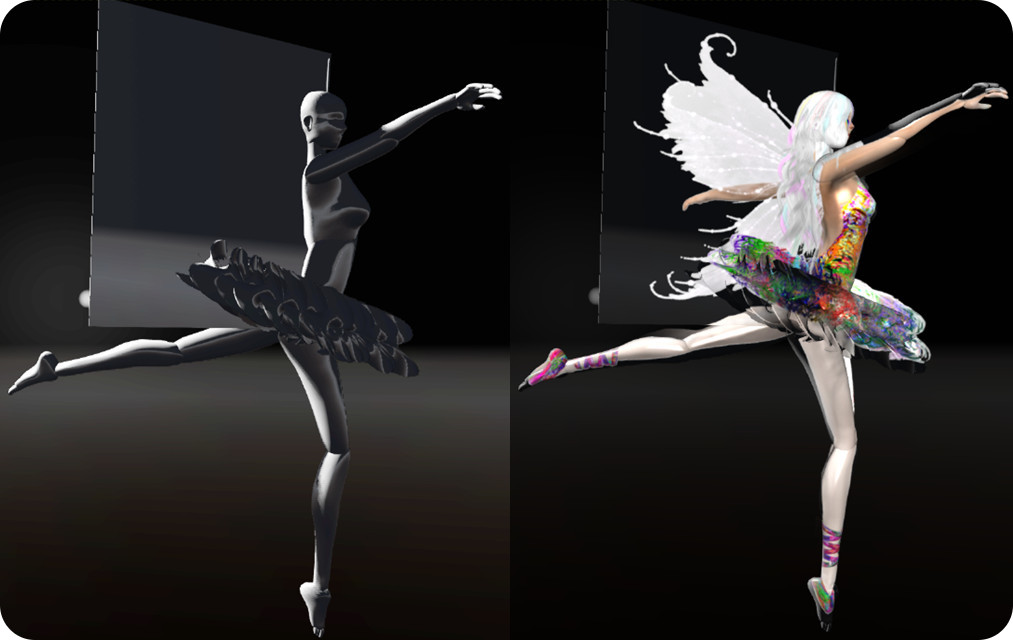
The power of projected lights at FreeWee's Laboratory v.8.0: Music, Myth, Magic, Light, Shadows, Physics, LEA27
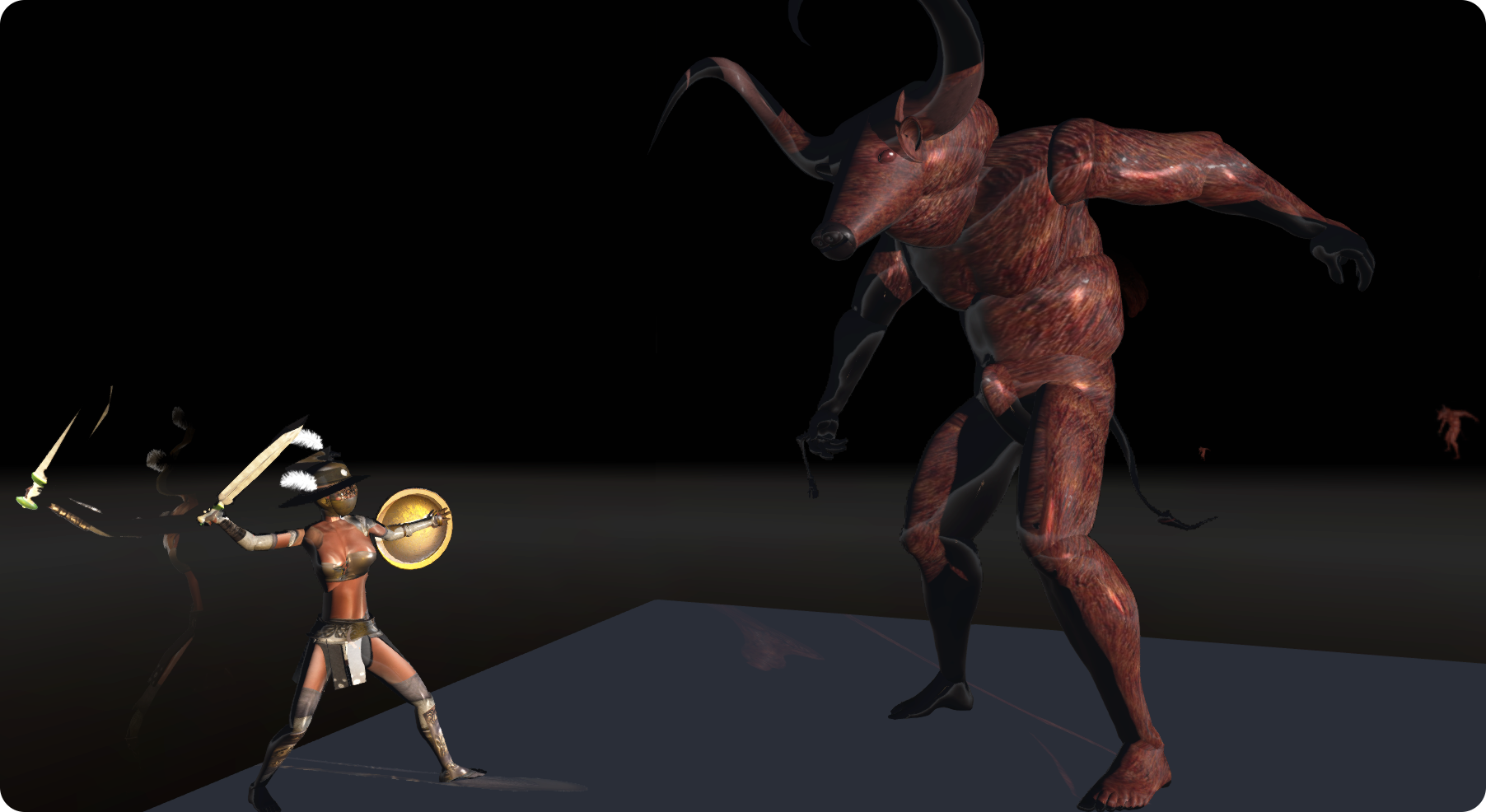
The power of projected lights – neither of these figures is textured; the colours and clothing on them is created purely be projected lights. FreeWee’s Laboratory v.8.0: Music, Myth, Magic, Light, Shadows, Physics, LEA27

FreeWee Ling is perhaps best known for her tireless work on behalf of the University of Western Australia (UWA), and co-organiser and curator of the UWA’s art-related projects, activities and galleries within Second Life. She recently – and rightly – gained recognition from the Australian Department of Education for this work when she was awarded her an Endeavour Fellowship at the end of 2014. This has allowed her to travel from her home in the eastern United States to spend four months at the UWA in Perth, Australia, where she is based with the UWA’s Department of Physics.

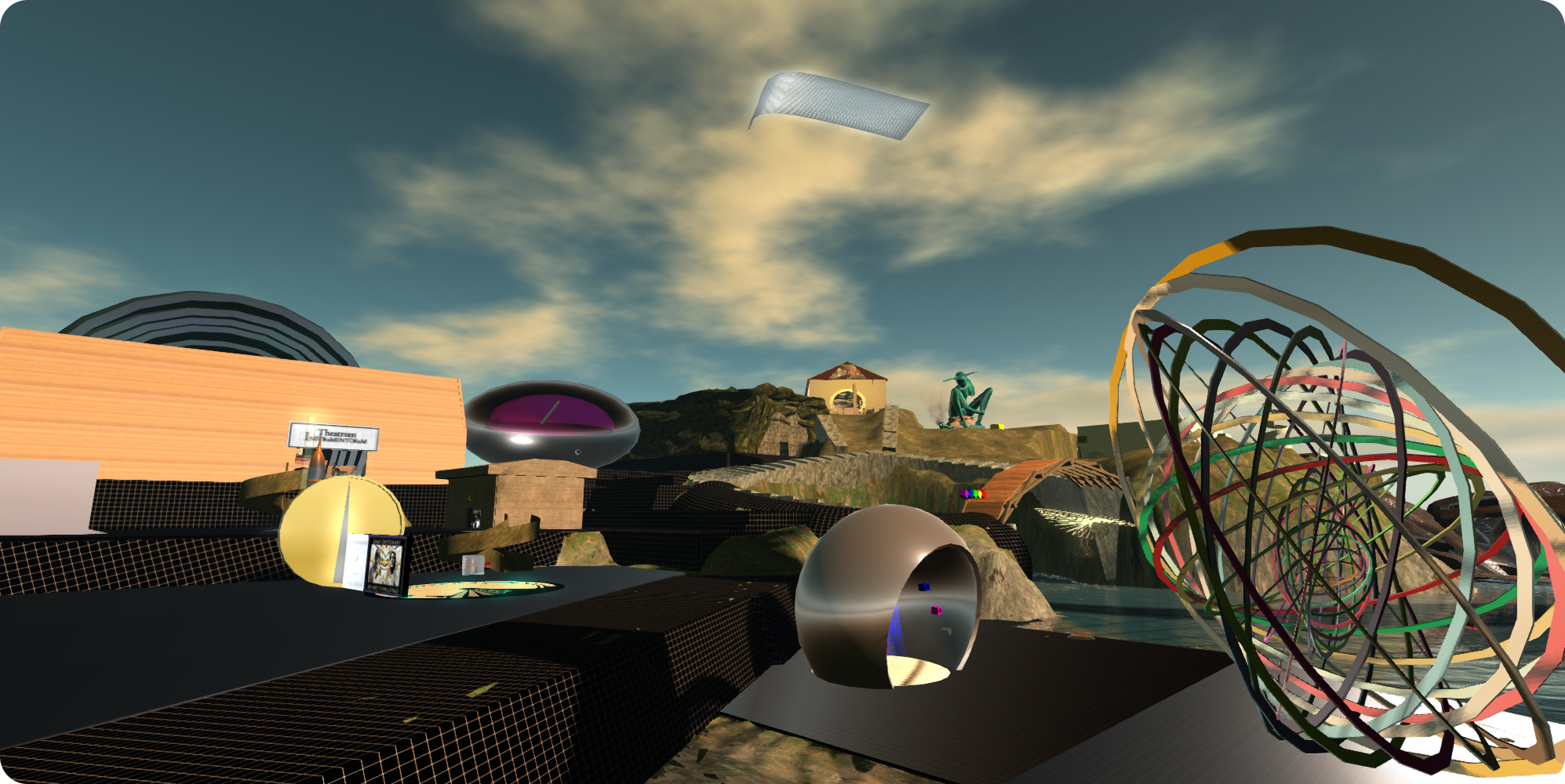
In conjunction with her time at the UWA in the physical world, FreeWee has been granted the use of a LEA Artist in Residence region, where she has established FreeWee’s Laboratory v.8.0: Music, Myth, Magic, Light, Shadows, Physics, a unique combination of workshop, study space, laboratory and gallery focused on helping her demonstrate the potential of virtual worlds to students at the UWA.

FreeWee's Laboratory v.8.0: Music, Myth, Magic, Light, Shadows, Physics, LEA27
FreeWee’s Laboratory v.8.0: Music, Myth, Magic, Light, Shadows, Physics, LEA27

When you arrive in the region, it may look somewhat chaotic and perhaps even feel half-finished. Don’t let this put you off; this is a workshop / lab, and what is on offer more than makes up for chaotic the appearance. Keep in mind as well, that elements within the installation may change over time in order to meet FreeWee’s evolving needs as a part of her work at the UWA.

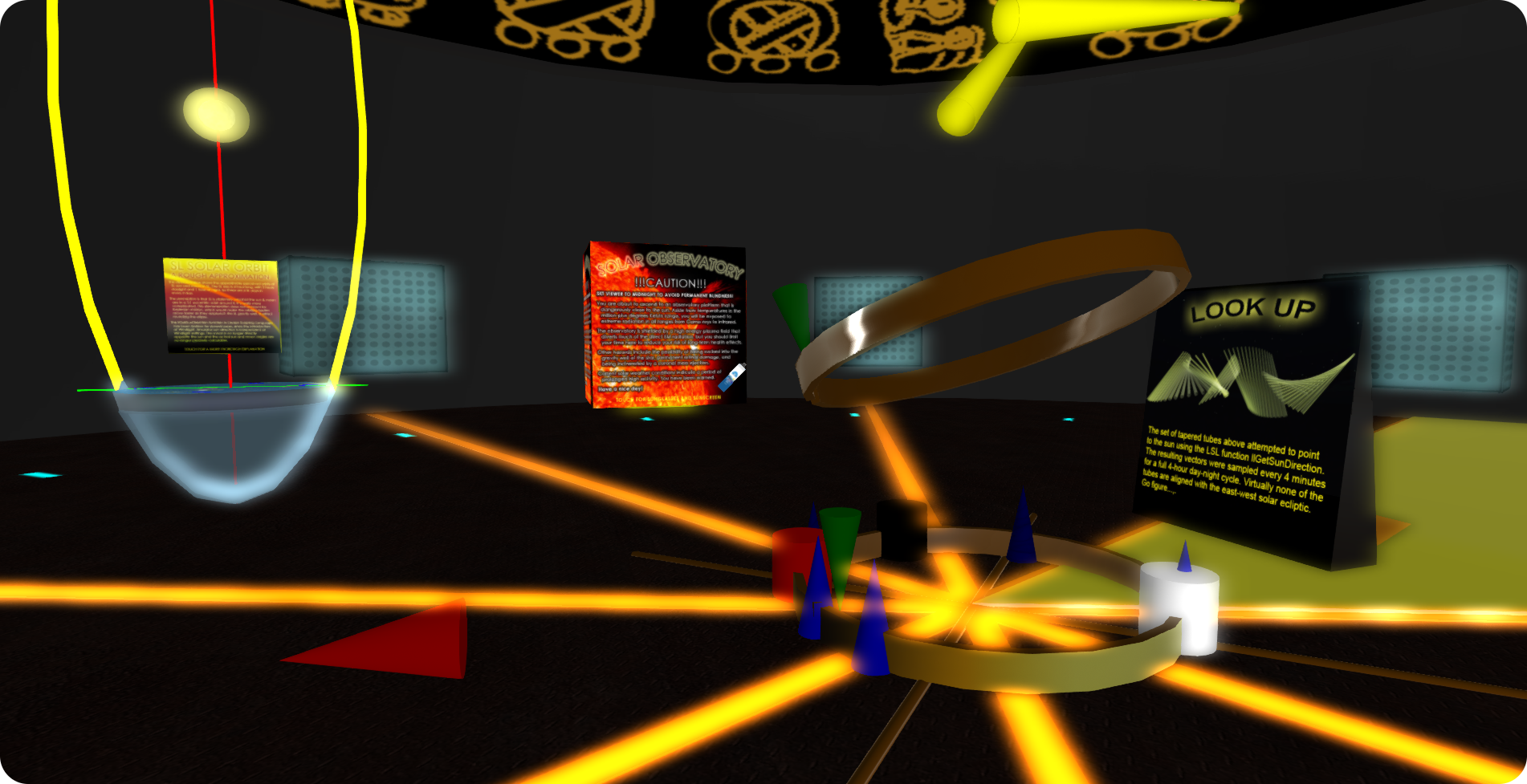
As FreeWee is working with the Department of Physics at the UWA, many of the items within the region explore the nature of physics in Second Life, be it through movement, light or colour.  Just up the ramp from the landing point, for example, is her award winning nanoprim physics lab from 2010, together with a rocket that will take you up to her Solar Observatory, which I’ll have more to say about anon.

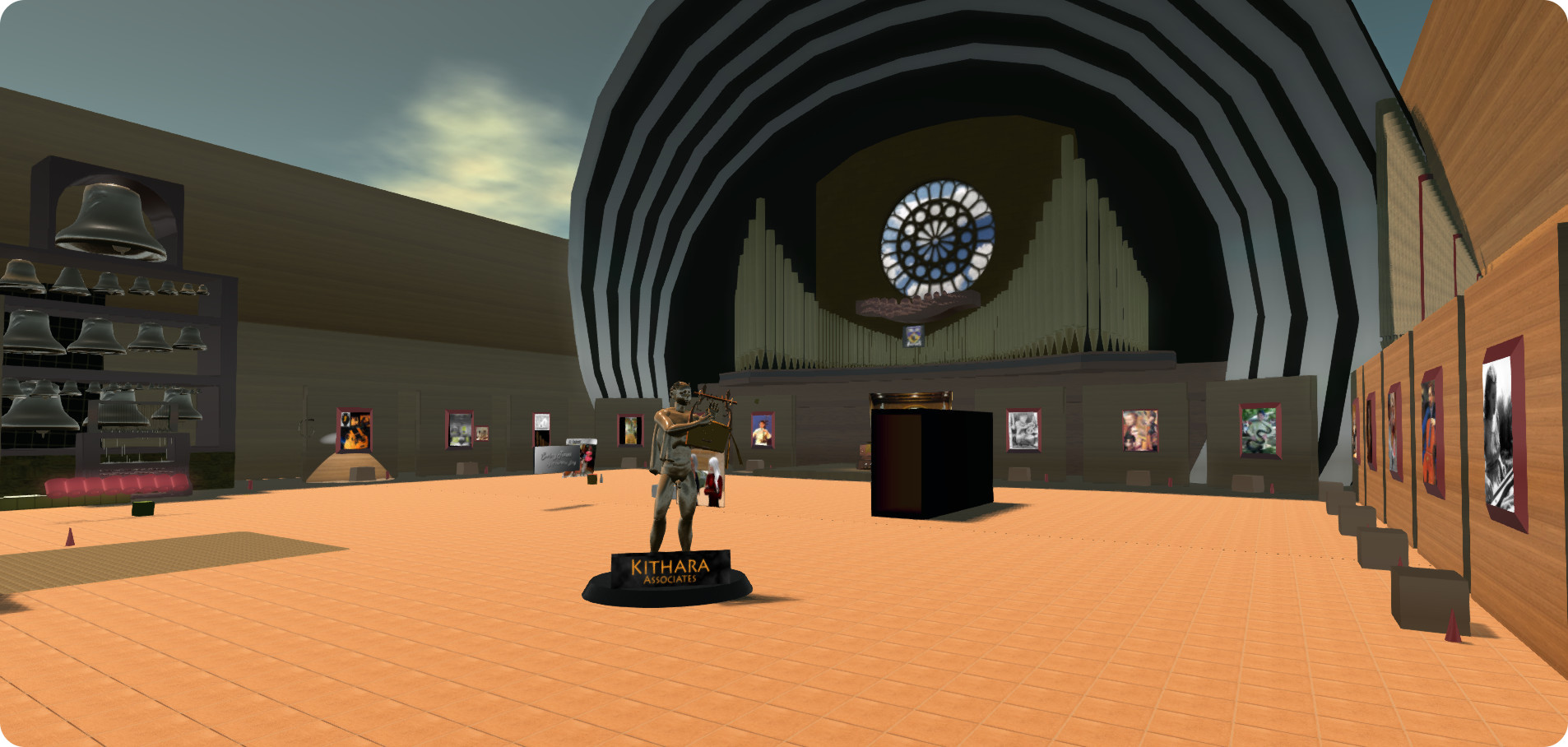
FreeWee is a musicologist by education, with a specialist interest in the history, use and physics of music. Together with fellow musicologist Oriscus Zauberflote, she formed the Kithara Associates, which is focused on the creation of musical instruments in SL that are reasonably authentic in appearance, in order to enhance the immersive experience of the platform for the purpose of learning and research, and this work is also present within the installation, in the form of the Theatrum Instrumentorum.

FreeWee's Laboratory v.8.0: Music, Myth, Magic, Light, Shadows, Physics, LEA27 - Tthe Theatrum Instrumentorum
FreeWee’s Laboratory v.8.0: Music, Myth, Magic, Light, Shadows, Physics, LEA27 – the Theatrum Instrumentorum

This is, in essence, a museum of musical instruments featuring photographs and information boards of the instruments in the physical world, and samples of instruments built in-world, some of which extend to the creation of hybrid / fictional instruments depicted in works of art. Several of the pieces are playable, and I particularly enjoyed using the carillon to play a melody I’d had to learn many, many moons ago when starting to learn to play the piano. Also on offer within the Theatrum is a teleport up to Swingtones, a demonstration of the effectiveness of sound in helping to create an ambient, immersive environment.

The Solar Observatory mentioned earlier, and which can be reached by rocket, is spread over two levels. The lower level presents visitors with both an introduction to elements of solar and stellar astronomy and also provides insight into the peculiarities of the SL “solar system” and day / night cycle, with interactive demonstrations throughout, as well as well-written information cards and links to external sources.

FreeWee's Laboratory v.8.0: Music, Myth, Magic, Light, Shadows, Physics - the lower floor of the Solar Observatory
FreeWee’s Laboratory v.8.0: Music, Myth, Magic, Light, Shadows, Physics, LEA27 – the lower floor of the Solar Observatory

The upper level, reached by elevator, offers the chance to study the Sun first hand, complete with coronal mass ejections (CMEs), sun spots and the flow of the solar wind. The elevator is guarded with a firm caution about the risks of blindness and exposure to gamma radiation should you opt to take the elevator, but both both sun screen (SPF 1000) and sunglasses are thoughtfully provided to mitigate the effects of both 🙂 . At the top of the elevator is a platform allowing you to view the Sun Sunshine-like, or if you’re feeling particularly daring, you can rez a chameleon flyer and fly yourself around the Sun. However, if you opt to do the latter, do try to keep in mind the story of Icarus, and what happened when he flew a tad too close to the Sun …

Elsewhere in the region you can find a novel “get away from it all” rezzer system, interactive art pieces, a gallery of FreeWee’s own art and, in what is another superb demonstration of SL’s capabilities in the Projection Room (a large white building on the east side of the region.

The power of projected lights - the image on the left shows an untextured figure; on the right, the same figure, lit entirely by projected lights. FreeWee's Laboratory v.8.0: Music, Myth, Magic, Light, Shadows, Physics, LEA27
The power of projected lights – the image on the left shows an untextured figure; on the right, the same figure, lit entirely by projected lights. FreeWee’s Laboratory v.8.0: Music, Myth, Magic, Light, Shadows, Physics, LEA27

This focuses on the use of projected lights in Second Life. As such, you will need to have the Advanced Lighting Model graphics option enabled on your viewer (you do not need to enable shadows, so any performance hit you may experience shouldn’t bee too great), and keep in mind that none of the figures in the room are actually textured. What you see as you move around and active the lighting sources is purely the result of using projected light sources and textures.

All told, the Laboratory makes for a fascinating installation, one in which it is easy to become absorbed in the individual elements on offer, allow of which are provided with informative note cards which not only provide insight into what they are and how they work, but often explore the creative processes involved in creating them, and provide a glimpse into FreeWee’s mind and thought processes, further enhancing the time one takes in exploring the installation.

Highly recommended.

Related Links

Re-visiting the Queen of the Sagittarian Sea

SS Galaxy
SS Galaxy

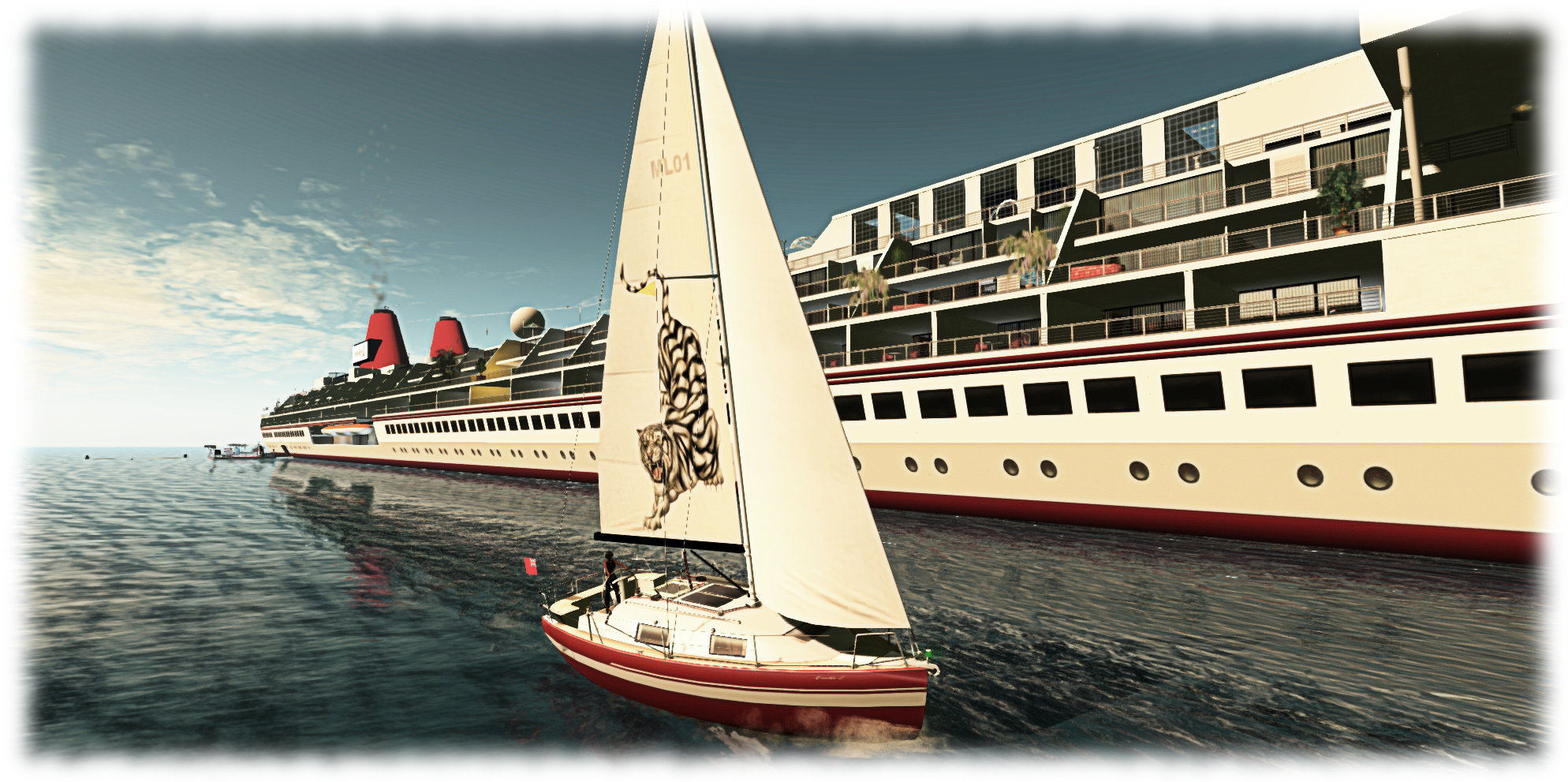
While introducing Maya to sailing in Second Life recently, I took us out on Exotix 2, heading south across Blake Sea with no particular destination in mind. As we headed down the coastal regions towards Honah Lee (see my write-up here),  I found myself asking, “ever seen the SS Galaxy?”

“No,” Maya replied. “What is that?” And with that, our course was set.

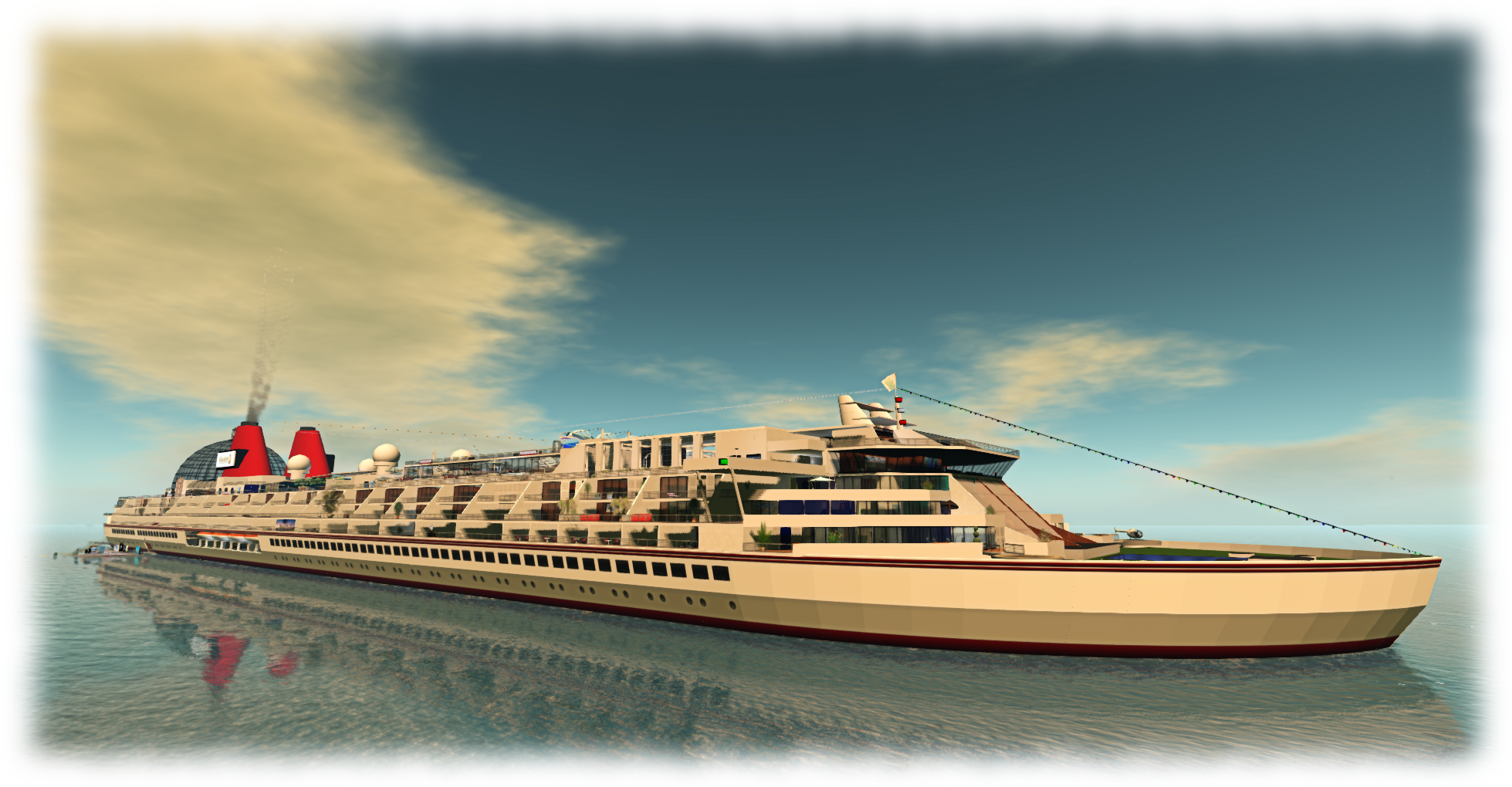
I mention this by way of introduction, because I frequently meet people unaware of the Queen of the Sagittarian Sea, more properly known as the SS Galaxy, which tend to surprise me, as she is quite unique and one of the sights of the platform. At almost three full regions in length and about 1/4 of of a region wide, she is quite probably probably the largest vessel afloat in any gird-based virtual world. “Launched” in mid-2007, she is a hugely impressive sight (and build), with an unladen primmage in excess of 32,000.

SS Galaxy
SS Galaxy – 3/4 view off the bow

Obviously, at that size, the Galaxy isn’t a mobile vessel, but that doesn’t matter, because what it has always offered Second Life residents is a destination with broad range of activities and a calendar of events in a very unique setting.  It also offers over 100 suites, cabins and mall spots to rent by those looking for a place to live or in which to establish a shop front.

I first visited the Galaxy in 2008, and became a semi-regular visitor over the years, first blogging about it in 2011.  I’ve continued to pay the occasional visit since then in as much as since taking up flying, I’ve often used the Galaxy as a way point for my solo flights when I’ve no particular destination in mind, and have very occasionally sailed around her. However, it’s actually been a few years since I last explored her decks and facilities, so the sailing trip with Maya turned into an unexpected opportunity to re-familiarise myself with this massive ship.

SS Galaxy - the spa pool
SS Galaxy – the spa pool

If you are going to explore the liner, the best place to start is the aft embarkation landing. From here you can peruse the ship’s deck plan and determine points of interest you might like to visit. The list of these includes the Zodiac Ballroom, Constellation Lounge, shopping mall, art galleries, swimming pools (indoor and out), ice skating rink, health spa, restaurants, nightclub, conference facilities, and more. Decks can largely be wandered at will, with both staircases and elevators linking them, making getting around easy.

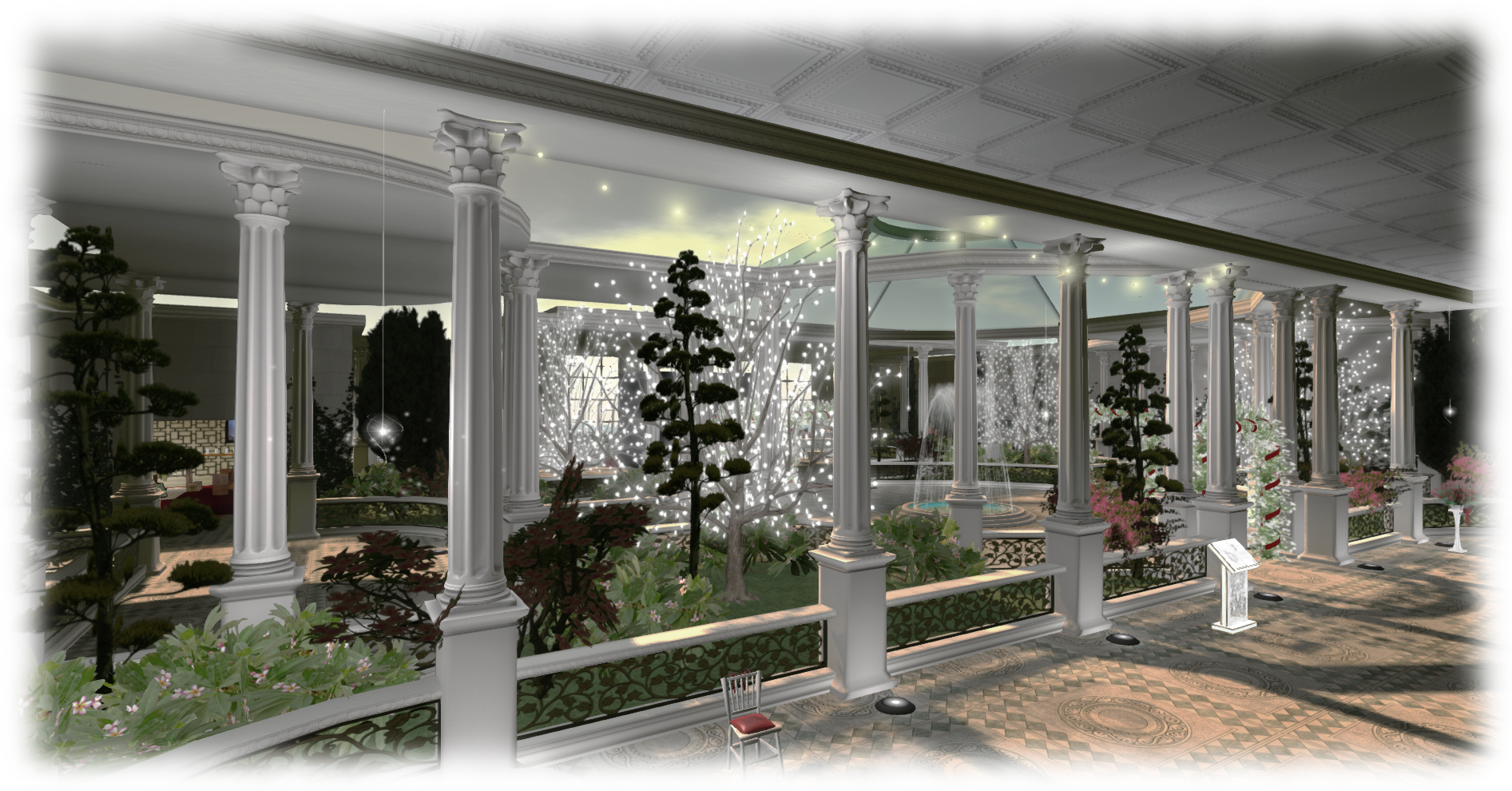
The upper deck offers the greatest concentration of attractions. It is here you’ll find the Zodiac Ballroom, sitting under a huge glass dome, the main dining room and bar, the ice skating rink, coral lagoon pool and the wedding chapel and reception area. A couple of public helipads offer those flying in a place to land, but be aware that auto-return in set to 15 minutes, and rezzing is disabled.

The upper deck also offers a couple of attractions I used to enjoy years ago with friends, but again haven’t played in a long time: the miniature putting green and the skeet / clay pigeon shoot. These are located at the aft end of the deck, close to the dome of the Zodiac Ballroom,  along with the skydiving launcher and landing point, where I was able to introduce Strawberry Singh to the joys of skydiving in 2014.

SS Galaxy - wedding reception area
SS Galaxy – wedding reception area

As one would expect aboard a cruise ship, live events and music are a regular part of the Galaxy’s calendar, and details of music / dancing events can be found on the ship’s events calendar, also reproduced on the on the Galaxy’s blog which also includes general news and information about the ship.

The Galaxy may be an all prim build and perhaps lack more recent innovations introduced to SL such as the use of materials as a part of interior texturing, but it would be a mistake to dismiss her as “old school” because of this. What she may lack in terms of modern day build options she more than makes up for in terms of facilities and things to do; as such she still stands as a worthwhile destination for those who like exploring Second Life. What’s more, as she approaches her eighth anniversary, the SS Galaxy stands as a part of the history of Second Life, and her presence in-world is testament of how the platform has always been a springboard to our imaginations and creativity.

Sailing around the SS Galaxy in 2014

Related Links