Return to ISM in Second Life

International Space Museum

It’s been over five years since I wrote about the International Spaceflight Museum (ISM) in Second Life.  At that time, this two-region facility, offering something of a history of space exploration, had just come through something of a financial crisis (see here and here).  Prior to that, my last visit was far back in 2012 – so I thought I’d hop back over for an update.

Comprising Spaceport Alpha and Spaceport Beta, and entirely funded by donations and sponsorship as a 501(c)3 non-profit, ISM is a large-scale undertaking, providing a good introduction to the history of space flight, charting many of the key events and the systems they used. It provides insight into international space operations covering – America, the Soviet Union/Russia, Europe, Japan, China, India – together with something of a look at commercial activities.

International Space Station: Rocket Ring

A visit starts at the main landing point / information hub. This features a citation to a letter from Konstantin Eduardovich Tsiolkovsky, the Soviet Russian rocket scientist regarded as the “grandfather” of modern rocketry. Given as Earth is the cradle of humanity, but one cannot live in a cradle forever, the quote is from a phrase Tsiolkovsky wrote in 1911, which transliterates as Planyeta yest’ kolybyel razuma, no nyelzya vietchno zhit’ v kolybyeli – “a planet is the cradle of mind, but one cannot live in a cradle forever”. However, both this literal translation and the more popular quote point to the same ideal: that to grow as a species, humanity must as some point reach beyond the planet of our birth.

A path leads away from the landing hub towards ISM’s most impressive feature: the Rocket Ring. This provides models of some of the major launch systems used by countries around the world. This includes vehicles such as the V2 rocket – which both Russia and America utilised in their early post-war experiments; launch systems developed from ballistic missile systems – such as America’s Titan and Atlas; through to more familiar launchers such as the Soviet / Russian Soyuz and Proton families, and a look at some of the more recent vehicles to enter the market: SpaceX’s Falcon 9 and Falcon Heavy.

International Space Museum: SpaceShipOne

The ring is far from complete – systems such as Blue Origin’s New Shephard and New Glenn are lacking, NASA’s Space Launch System is missing (although the cancelled Ares launchers from the US Constellation programme are present, dominating the ring alongside Russia’s massive N1 lunar booster). However, space is limited, and what is presented is still a rich array of launch vehicles which, for those interested in the less well advertised space programmes – such as Japan’s, India’s or China’s, provides some excellent models of their current fleets.

Beneath the Rocket ring are further exhibits, including models of the Apollo Command and Service Module (CSM) and Lunar Excursion Module (LEM), the Gemini capsule, and a look at the lives of  Tsiolkovsky and Robert Hutchings Goddard, regarded as the “father” of modern rockery. NASA’s Orion Multi-Purpose Crew Vehicle (MPCV) in both its original form, with rounded solar arrays and a more recent design, featuring twin rectangular solar arrays. Orion will use a Service Module based on the European Automated Transfer Vehicle (ATV), which used to haul up to 5 tonnes of supplies and equipment to the space station, and include the ATV’s unique arrangement of four solar arrays.

International Spaceflight Museum: an historical look at the ISS with the shuttle docked, and a European ATV resupply vehicle arriving. Also docked is a combination of Soyuz+Progress vehicles

Further out from these are further displays, including the Apollo Saturn 1B rocket, information centres and more. These also include interactive elements, such as a Gemini V / Atlas II rocket, which offers a ride up to one of the sky exhibits – that of the International Space Station (which can also be reached from the ground-level sit-on teleport kiosks). Also in the sky and reached from the ISS display, are models of the solar system.

Spaceport Bravo, reached via a runway-like bridge over which the first sub-orbital flight of SpaceShipOne is recorded, sits a reproduction of NASA’s Vehicle (or Vertical, as it was originally known) Assembly Building (the VAB). This is where the Apollo rockets and space shuttle systems were “stacked” and readied for launch, and where the SLS rocket will be assembled ready for flight. One of the bays in the VAB feature the space shuttle Atlantis, which has just been mated with its External Tank / Solid Rocket Booster units; the other features a Saturn V leaving the bay atop its crawler-transporter. Alongside of this is an Orbiter Processing Facility (OPF), the interior of which is somewhat sparse, but does offer models of NASA’s lunar rover vehicle and the  Lunniy Korabl (LK) lander vehicle which formed part of the Soviet Union’s manned lunar programme aspirations.

International Space Station: Mercury recalled

Visually, ISM offers a lot to see, not all of which is expressed here – and at one time hosted a range of events (it’s unclear whether this is still the case). However, there are some disappointments. An attempt has been made to link exhibits to a wiki, but the majority of pages have yet to be populated, for example. Several areas appear a little sparse – such as the OPF building, as noted; all of which gives a feeling the ISM is caught in time – as if in the midst of a still-to-be completed update, including elements which might be relatively easily seen to. Take the photo map of the Florida space coast, for example. This shows the facilities at both Kennedy Space Centre and Cape Canaveral Air Force Station, but has yet to be updated to reflect SpaceX’s use of Kennedy’s Pad-39A and Canaveral’s SLc-40 and SLC-13.

Even so, for those who want to dip their toes a little more deeply into the world of space flight, ISM retains a lot to offer, while across the water NASA’s Explorer Island offers an interesting looking back in history to the US space agency’s involvement in Second Life.

SLurl Details

International Spaceflight Museum (Spaceport Alpha, rated; General)

Steampunk Moods in Second Life

Steampunk Modes: Gem Preiz

Now open at Galerie des Machines, Paris Couture and curated by Olympe (OLYMPES Rhode), is Steampunk Moods, a celebration of steampunk and Victorian technology, with a touch of ecological commentary. The exhibition features art by Gem Preiz, Melusina Parkin, Haveit Neox and Bénédicte Petiet.

“Straddling the reincarnation of the past and a certain idea of ​​the future, Steampunk is primarily an aesthetic current of literary origin before developing on a multitude of other media,” Olympe states in the introduction to the exhibition. “A temporal paradox, it mixes centuries of fiction, Jules Verne, [Herbert] George Wells, popular culture, films, comics and other video games.” The art presented within the gallery’s halls reflects this in a most eclectic mix of 2D art spanning the virtual and the physical, and which mixes what might be termed “traditional” steampunk imagery with more familiar Victoriana and interpretations of the future.

Steampunk Modes: Melusina Parkin

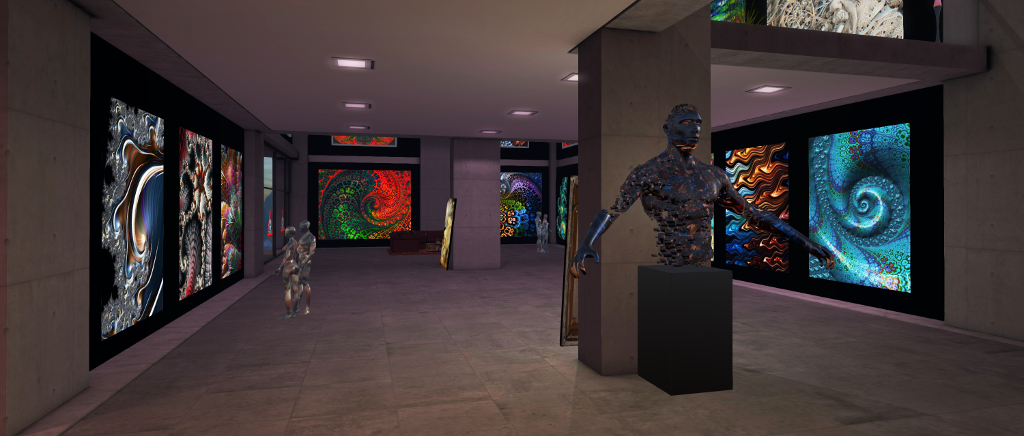
The ground floor of the gallery features a selection of Gem Preiz’s stunning fractal art, and the first glimpse into the future. It’s well established that I’m a major admirer of Gem’s work, and the pieces selected for this exhibit reflect why. Gem’s fractal art is hugely evocative in painting visions of the future; they encompass everything from cosmology through issues of ecology and human development,  touching – richly so – on concepts of architecture,  design and culture.

Several of these factors are touched upon within the thirteen images presented here – but so to is a sense of mechanisation. Several of the pieces have the look and feel of great engines – or parts of engines; others seem to suggest great cogs and wheels. There are also other reflections of steampunk: hints of lenses, twists of grill work and plating that are almost decorative in look and feel – the finery that can so often be found in more delicate pieces from the era. Each image is uniquely beautiful and  – literally – multi-faceted, demonstrating Gem’s multi-panel approach to his art that allow him to offer marvellously high-resolution pieces of his original art.

Steampunk Moods: Haveit Neox

On the floor above Gem’s exhibit is an extensive display of in-world photography by Melusina Parkin, featuring steampunk elements found throughout Second Life, both large and small and presented in a suitably metal-walled environment. Many of the images present objects and scenes in Melu’s familiar close-up style, focusing our attention on specifics, rather than a broader scene, while still conveying an entire story to a piece. Several of them present familiar steampunk themes – powered airships: both dirigible and boat-hulled. Propellers also feature, while there are hints of Verne and Wells to be found.The models of Battersea Power Station, dating from the 1930s, might seem a little incongruous. But given it is an iconic emblem to industrial power, it is somehow fitting.

Passing through the display of Melusina’s art brings visitors to a second hall, where Haveit Neox’s contribution can be found. This takes the form of an iteration of his installation, The Miniature Goal, first seen in 2014.  Within it, Haveit asks, “What if our physical world shrunk in proportion to the resources we drain from it?” As I wrote back in 2014, this is a fascinating piece; here it perhaps offers a slightly different look at steampunk. The technology of the latter is somewhat based on the consumption of fossil fuels and other natural resources, consideration of the consequences are perhaps not so at odds with the core theme.

Steampunk Modes: Bénédicte Petiet

Above the floor featuring the physical world art of   Bénédicte Petiet. Again, the canvas here is broader than what might be regarded as “traditional” steampunk. Like Melu, Bénédicte presents the most of his images in close-up: machines, wheels, pistons, gears, relays … all are presented here. So to are what might be considered elements from outside the realm of steampunk itself: cars from the recent past, and even street scenes. With the exception of the latter – which appear to be a mini-exhibit in their own right – the rest of the images suggest something almost “retro-futuristic”: the past we can recognise presented through a digital medium of their future.

All told, a multi-faceted exhibition, well worth exploring.

SLurl Details

Tarrying at Tramore Bay in Second Life

Tranmore Bay; Inara Pey, December 2017, on FlickrTramore Bay – click on any image for full size

Tramore Bay, the work of Pernilla (PernillaOhl) and Amelie Tautou (Amilee34) is once again evidence that you don’t need at entire region – Full or Homestead – to make a lasting impression in Second Life. Occupying the south-east corner of a Full region, Tranmore Bay is a compacts design, making full used of the space available to presents a highly photogenic and quite delightful cove-like environment in which to spend time.

That said, a visit begins, not within the cove itself, but high overhead, at the industrial / brewery chic Tramore Bar, where music can be enjoyed with a drink and game of darts or while cosying close to the fireplace.  Six teleport options are available on the wall next to the landing point (and a TP station in on the floor, the twin of several at ground level), each of which delivers visitors to an area of the cove at ground level. As all are within easy walking distance of one another, which you take to the ground isn’t that important – although the café is perhaps the most central.

Tranmore Bay; Inara Pey, December 2017, on FlickrTramore Bay – click on any image for full size

The default windlight at ground level is a deep sunset, but this is a place where a rich variety of environmental settings can be used to create the ambience required of your pictures. As Caitlyn and I both felt we needed a break from winter’s snow and hints of winter, I selected a more late summer setting for the pictures here to add some further sensations of warmth.  The café is an old wooden structure, looking equally out to sea and inland. It’s and the rest of the cove lay protected by high rocky walls on three sides, with a view out over beach and sea to the south.

Woodlands border one side of the café , sitting in the lee of the cliffs and offering paths to wander and deer and horses to watch. Inland from the café is a music stage, with a path lurking in the shadows, offering a winding path up into the west cliffs. It is this path, and the one to the east of the land, which add further depth to the setting, allowing visitors to climb up between rocky shoulders to the flat cliff tops, then roam along the grass-covered rock to a camp site on the west cliffs or, by way of wooden bridge, to the chapel-like lighthouse keeping a watchful eye on things from a rocky island in the very south-east corner of the region.

Tranmore Bay; Inara Pey, December 2017, on FlickrTramore Bay – click on any image for full size

The path to the lighthouse lies across a narrow body of water from the café , spanned by a rough bridge formed by the fallen trunks of trees. The path to it, like the one to the camp site, offers superb views over the land, particularly from the great rocky arch spanning the water to the lighthouse’s little perch. Also to be found on this side of the water, tucked under the cliffs, is an old ruin, the setting for outdoor dining, a little Romany camp close by.

Throughout all of this, there are charming little touches: the wild flowers; the snuggle posts on the beach and around camp fires; a scatter of art by Mistero Hifeng which add a unique feel to the setting; the sailing boat (privately owned) moored in the lee of cliffs and lighthouse island – and more besides. There are a couple of little rough spots in the landscaping where plants perhaps need to be phantom, or path sections don’t quite align, but these are more than compensated for by the sheer beauty of Tranmore Bay.

Tranmore Bay; Inara Pey, December 2017, on FlickrTramore Bay – click on any image for full size

All told, this is a really delightful place to visit. Those interested in learning about music events at Tramore Bay can join the local group, photographers can enjoy the setting for their work, and explorers will find plenty to see and appreciate – and to offer reasons to tarry a while. Should you enjoy your visit, do please consider making a donation towards the enjoyment of Tranmore Bay by others via the tip jar up at the bar.

Tranmore Bay; Inara Pey, December 2017, on FlickrTramore Bay – click on any image for full size

SLurl Details

Nevereux: an artistic Journey into Communication

MetaLES: Journey into Communication

Now open at MetaLES, curated by Ux Hax and Romy Nayar, is Journey into Communication, an installation by Nevereux. Mixing 2D art, words and 3D settings, it presents a quirky but thought-provoking journey into the ways in which we communicate which all contains a degree of social commentary and some insight into the artist herself.

Nevereux introduces the installation in a completely self-effacing manner, “So here you’ll find everything you need (aside from few artistic skills) so to waste your most precious 77 minutes. Due to a fortunate series of coincidences, you’ll find a brand new iPhoneZ and a handsome pencil on the ground. Sure I’ve also got lots of decent pictures, but they’re all just kinda boring. Keep yourself awaken by sniffing the paint(ings) on the walls.”

MetaLES: Journey into Communication

This drastically undersells the installation, reached via teleport from the MetaLES landing point. The art is ranging in a circle around a slightly undulating snowy landscape. Pictures hang from the sky, and are mounted within small sets related to their subject matter (those on signals from space, immersion, and similar, are presented within the shells of what might be a space station, for example).

At first, the installation can be confusing – however there is logic to it. A raised stage sits in the south-east corner, with a door marked Enter beneath it. This is the starting-point, and visitors should progress from here in a clockwise direction around the display areas. The first of these poses the question about how we look at the world: through the limits of the screen – be it television, computer, ‘phone and so on – or through the richness of knowledge and imagination presented by books. After this, we are warned – again in a self-effacing comment: This is where it all gets a bit surreal.

MetaLES: Journey into Communication

Surreal things might be in places; but so to are they rich in depth and meaning – pointed to by way of the labels each has. “The images you see here are concepts,” Nevereux states. And they very much are – and more. They are reflections and thought on life, how we relate to one another, to the world around us, our condition – even on the way life has been reduced to a matter of consumerism. In many these ideas are clearly offered, either directly or through the support of accompanying text; in others, they are more obscure, encouraging one to take time considering them.

This is a provocative exhibition in that it demands thought and consideration when visiting. There is even, as noted, a small section offering insight into Neverex herself – and it is beautifully presented: through the words of a poem. Bitter-sweet, poignant and rich in imagery, this alone make a visit worth while.

SLurl Details

D 0 X: an Island Fantasy in Second Life

D o X; Inara Pey, December 2017, on FlickrD o X – click on any image for full size

Update: D 0 X has closed, and Paradise has a new setting – Tokyo Street. Read this review for more. SLurls removed from this article. 

D 0 X is a Homestead region designed by Paradox Ivory, and the home of the Urben Gallery. Open to the public, the region, at the time of our visit, lay split into three winter-bound islands, rowing boats (via rezzer) enabling explorers to travel between them without the need for flying.

Visitors arrive on the largest of the three islands, on the north-west side of the region, where snow is falling heavily. The landing point is on the central neck of the island, a short distance from the warehouse forming this single living space on the island. This has been converted into a cosy home, where someone has been baking and the table is set for dinner. Through a glass panelled door, the bedroom is scattered with the bric-a-brac of daily living, the entire scene within the building one of homely warmth, perfectly contrasting with the snowy scenes visible through the windows.

D o X; Inara Pey, December 2017, on FlickrD o X – click on any image for full size

Outside, paths offer ways west, east and south. The latter is the shortest, running past an old church gatehouse (in which sits information on the region and a teleport up to the Urben Gallery, which will open on January 7th, 2018. This path ends at a wooden jetty where a rowing boat can be reached, providing the way to reach the remaining two islands.

The path to the east climbs a little set of stone steps under an arch of rowan boughs string with lights. It leads, by way of a path running between trees and bushes, to a rocky outcrop providing a view out over the winter waters to the smallest of the three islands, the home of a ruined lighthouse. Westwards, the path is wilder, again running between trees and bushes to a south-facing headland and offering a view towards the second largest of the islands.

D o X; Inara Pey, December 2017, on FlickrD o X – click on any image for full size

With a grey rocky skirt topped by undulating snow, this island is home to a barn converted into a warm snug of a home, where the traditional bed appears to have been replaced by a chaise. The fireplace sparkles with flames, armchairs you could lose yourself in ranged before it, with all the accoutrements of life again scattered cosily around. Whoever lives here obviously isn’t put off by the cold: the brick paved terrace to the front of the property features a table set for dinner, an outdoor fireplace glowing with warmth alongside it.

The barn is reached via a path rising by step and curve from the island’s jetty, guarded at either end by gabled gates. This path runs alongside the house, offering access to the front terrace before continuing on to another outdoor seating area atop a small squared-off terrace and warmed by another fire. A little to the south from the barn, and overlooking a little inlet, is another outdoor fire and seating, a Thermos available for hot drinks.

D o X; Inara Pey, December 2017, on FlickrD o X – click on any image for full size

The northern end of this island is crowned by a great wind turbine – presumably providing electrical power to the properties on both of the larger islands. Its great blades turn steadily, shadows seeming to slice silently over the snow, completely ignored by the deer roaming here.

With two further (off-sim) islands to the north-west and south-east, D o X has the feel of a tiny winter-bound archipelago in which seasonal retreats have been established. Set beneath a twilight sky circled by an aurora and patrolled by deer, it is a picturesque setting. We’ll doubtless be returning in the new year, when we’ll also pay a visit to the Urben Gallery up in the sky.

D o X; Inara Pey, December 2017, on FlickrD o X – click on any image for full size

Behind the Avatar in Second Life

Club LA and Gallery: Behind the Avatar

Now open at the Club LA and Gallery, curated by Fuyuko ‘冬子’ Amano (Wintergeist), is Behind the Avatar, an exhibition of images by Panteleimon Aeon. On display are eleven pictures (one of which forms a free gift to visitors) by Pan, which present Second Life as it might be seen through the eyes of an avatar, and in which we’re being allowed to share.

Each picture features a setting and a solitary avatar – mainly Pan himself, although Like Dreaming of Angels  and …Through both clearly feature a female avatar, and  Isoldes Remorse might feature a woman under the hat and coat.

Club LA and Gallery: Behind the Avatar

The avatars are mainly presented from the rear or in a three-quarters profile from the rear. In this way, they are not necessarily the central focus of each piece – although our eyes are obviously drawn to them. Rather then become come a part of the image, blending, if you will, with their surroundings whilst also offering a glimpse of what they might be reflecting upon whilst looking at the scene themselves.

I was first introduced to Pan’s work by Sorcha Tyles. At the time I commented, “Pan’s work is visually striking, combining a sense of posed set piece with natural flavour. The result is that while each may well have been composed, so to could each have been easily caught as a moment from the subject’s life; a frozen instant of an unfolding story, the subject unaware they have been so captured.”

Club LA and Gallery: Behind the Avatar

This is again very much the case with the images in this selection, offering as they do a wonderful sense of depth, emotion, and feelings. Each very much carries a story within it, combining avatar and setting into a whole – whilst also allowing us to more metaphorical see from behind the avatar – and through the eyes of the artist himself.

As such, this is an expressive display, and a superb means to gain familiarity with Pan’s work for those who have not previously encountered it. Behind the Avatar can be found on the mezzanine area to the right of the main gallery entrance, with stair leading up to it from the garden end of the hall.

Club LA and Gallery: Visions – Kimeu Korg

While visiting, be sure to check Transitions by Myra Wildmist, which I reviewed at the end of October, and Visions by Kimeu Korg.

The latter is another set of studies of Second Life, often featuring and avatar or avatars, some of which are beautifully humorous, while others weave a story in the observer’s mind. All are beautifully executed and the exhibition as a whole should not be missed.

SLurl Details