Emotion as Landscape, Marven Art Collective, November 2026: Leica Frame, Zia Branner and Bria Stone
One of the most fascinating science fictions novels I’ve ever read is Greg Bear’s Queen of Angels (1990), containing as it does themes of consciousness, psychiatry and – notably for me – psychology. Within it, Bear uses the concept of the Country of the Mind to explore the intricate relationship between personality, actions, and our internal thoughts, both conscious and subconscious.
In particular, the idea postulates that thoughts and emotions combine within us to create a “country” of shifting and changing landscapes which influence –in ways we might not consciously be aware of or recognise ourselves – how we interact with the physical world and those who occupy it at any given time.
Emotion as Landscape, Marven Art Collective, November 2026: Julana Allen
I was reminded of the entire idea – of which the above simple encapsulation hardly does justice – in visiting Emotion as Landscape, the new ensemble art exhibition which opened at the Maven Art Collective in Second Life on Tuesday, November 10, 2026, and hosted in a sky gallery above the Maven Art Quarter – just step through the teleport portal in the entrance of the ground-level gallery.
The exhibition brings together pieces by 16 noted artists working in both Second Life and the physical world, the central theme being the exploration of our relationship with our emotions and experiences, and how they shape the landscape of our lives – although some of the artists have leaned into emotions evoked by landscapes (which is still a fair direction to take).
Emotion as Landscape, Marven Art Collective, November 2026: Eta and Sisi Biedermann
As such, the art offered is both broad and deep in style and content. Featuring physical art brought into Second life, images which started life as in-world captures; and with abstract rubbing shoulders with landscape, photograph with painting and 3D with 2D – all of the pieces reflect the ever-changing landscape of emotions, whilst each piece in a series by an artist carrying an emotional theme of its own.
I don’t want to offer personal interpretations of any particular pieces here: several of the artists have their own thoughts to accompany their work, but from a consideration of Jaku (寂) through to an almost perfect personification of Bear’s Country of the Mind, these are works offering a richness of expression on the broad theme of the exhibition.
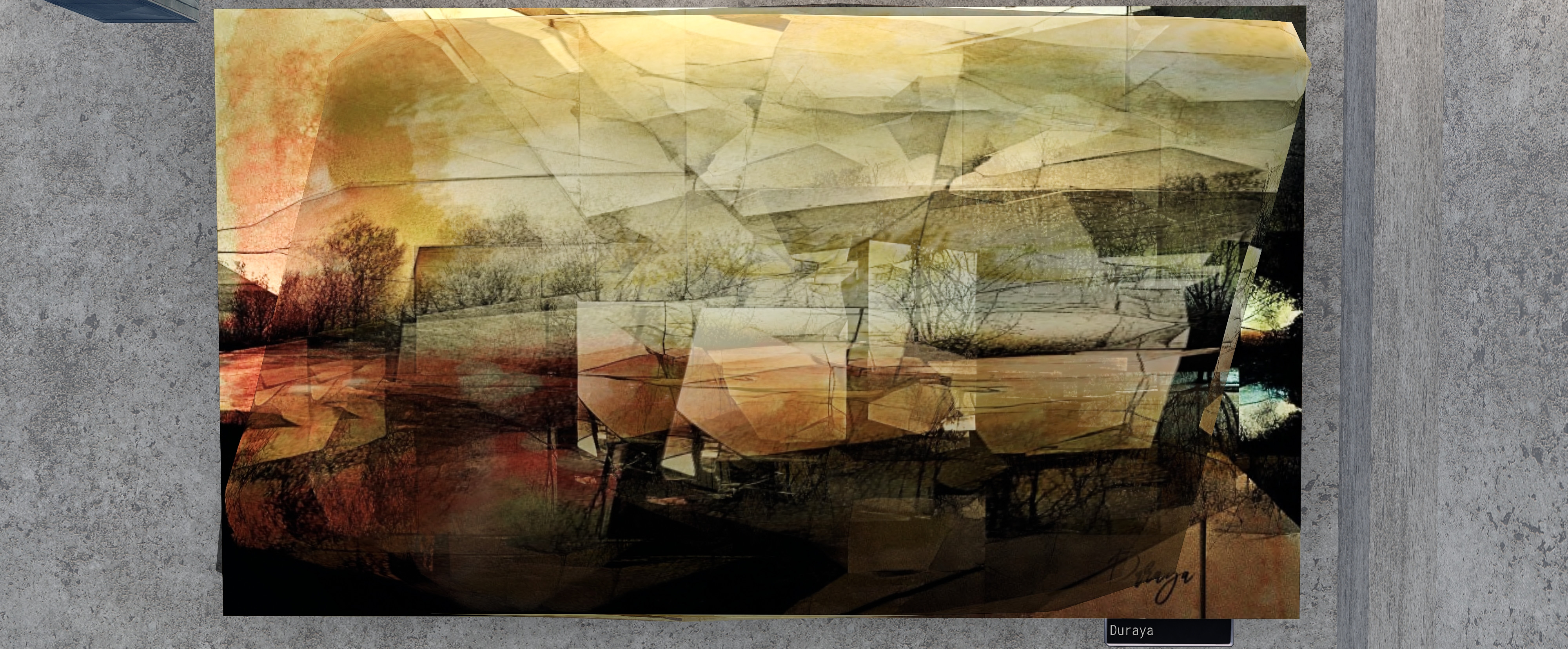
Emotion as Landscape, Marven Art Collective, November 2026: Duraya
In this as well, I thoroughly recommend reading the text pieces by Janus Fall accompanying her work as a first stop on arriving in the gallery space. It marvellously sets the tone for the exhibition as a whole.
Château Des Sylves, November 2026 – click any image for full size
I love stately and country homes; I’ve been fortunate enough to visit estates and places of antiquity across the British Isles and lean about them and their history. It’s a passion I’ve carried with me into Second Life, visiting and often writing about some of the grand estates (most of which have now passed into history) which have been presented here.
I was therefore intrigued to find Château Des Sylves in the Recently Added section of the Destination Guide early in November 2026. The description immediately had me intrigued, so I had to log-in and take a look. And probably the easiest way to summarise the build is – “Wow!”
Château Des Sylves, November 2026
The work of Brooklyn Michalski with the assistance of Tronalu, the house and its surrounds draws on the Black Périgord (aka Sarladais) region in the south-east portion of the Dordogne department of France for its inspiration.
This is a region noted for its rugged landscape, the dark, rich green of its evergreen trees and dark soil (from both of which it takes its names), and is home to numerous châteaux and castles, some of which – like Château de Beynac – are impressive sited on the edge of tall escarpments, commanding stunning views.
Château Des Sylves, November 2026
So far as I can make out, Château Des Sylves is not based specifically on one particular such house with Périgord Noir. However, sitting as it does within a Full private region dressed by tall rocky outcrops at they form a surrounding curtain with a region surround of tall peaks crowned by deciduous and evergreen trees beyond, it’s not hard to imagine coming cross the house whilst touring the Périgord Noir region. And to be honest, put the rugged cliffs and hills to one side, and the château would not be out-of-place among the country estates to be found here in England.
The house itself sits upon a raised terrace well to the southern side of the region, allowing it to be fronted by large formal lawns to either side of a magnificent water feature and, flanking these lawns, formal gardens to one side and the former stables and outbuildings to the other. Such is the design, with a tunnel entrance facing the house on the far side of the lawns and pool; it’s not hard to imagine visitors in times past emerging from the tunnel within their horse-drawn carriages and being utterly stunned by the house and its frontage.
Château Des Sylves, November 2026
There has clearly been some modernisation carried out to the estate since those times, however: the surface of the square drive is flagged with stone rather than being gravel, as might have once been the case, as is the spur leading up to the stables. While it looks just a little out of place, the reason for its presence is made clear within the stables – now converted to house an array of cars (and a small games room for those interested!) – the flagstones being more suitable to handling modern cars as they roll around the driveway and up to the carriage entrance on one wing of the house.
The gardens are perfectly laid out as they retain their gravel paths. Sitting in perfect symmetry in the style of the garden à la française, they include manicured hedgerows and ornate floral designs. Both the gardens and the the more open lawns offer places to sit throughout and admire the view, whilst the garden also offers access to another modern aspect of the estate: a terrace to one side of the house given over to a large swimming pool and lido.
Château Des Sylves, November 2026
But it is the house which sits figuratively and literally as the centrepiece of the estate, and it is genuinely magnificent in terms of its appearance, its interiors and its overall design, much of which is totally unique to Second Life, as is explained on the information boards Brooklyn has placed around the grounds – notably close to the Landing Point. This reads in part:
The château was designed and conceived in prim first in Second Life in Feb 2025 and drew huge inspiration from my favourite house for purchase at that time from Never Totally Dead… It is [now] a custom mesh home that I made in Blender and substance Painter. The house and a very small part of its furniture were made to be 1:1 here.
Troy [(Tronalu] helped design the château and made the foyer staircase, ballroom and the various railing in the house and worked with me the whole time – I love him and you should check out his store!
Château Des Sylves, November 2026
The result is a beautiful period home in styling and overall furnishing, one which has – like all such houses – seen small touches of modernisation here and there (such as the elevator!) – and appears to still be having items installed.
This is a place to be wandered through slowly in order to be appreciated Not all are furnished to be sure, but those that are have been done so perfectly. I can think of no higher praise that to say that both the main lounge downstairs and the bedroom with its adjoining drawing room immediately carried me back to the many times I’ve been fortunate enough to spend Christmas or the New Year in the elegance of country house (now a hotel) here in England.
Château Des Sylves, November 2026
That said I’ve never seen a house with such magnificent galleried rooms as can be found here – the library is simply jaw-dropping!
Not everything here has been created by Brooklyn and Troy, obviously – but everything has clearly been selected and purchased with an eye for bringing a depth of life and detail to the château such that it exudes a sense of familial history and a sense of place. This is very much helped by some of the pictures to have found around the house, and by touched such as an “architects model” of the house on display in one of the ground floor cabinets.
Château Des Sylves, November 2026
With places like Angel Manor having closed in Second Life, Château Des Sylves offers a refreshing and captivating opportunity to recapture a sense of the romance and gentility in a grand house (albeit it more modestly scaled than Angel Manor!).
Utterly photogenic, particularly when seen within the region’s Shared Environment, and completed with an ideal soundscape of bird song, this is not a place to be missed.
Château Des Sylves, November 2026
Kudos and congratulations to both Brooklyn and Troy on their work.
Mayonaka City, November 2026 – click any image for full size
Megan Prumier has been busy of late, helping to design city-based environments – notably The District, on which she worked with region holders Roman Godde and Lana Fierce (a place I visited and photographed just after it opened – and then forgot to write about. Doh!), and also with Serana Lacuna (Serana Aridian) in the creation of Mayonaka City, the subject of this piece.
While there are some similarities between the two in terms of the chosen region surround, The District and Mayonaka City are very different places. The District is clearly influenced by US city designs – notably New York – whilst Mayonaka, as the name might suggest, is very Japanese-centric.
Mayonaka City, November 2026
The idea for Mayonaka City lies with Serana, as she notes:
An idea that I had back in March, and one I worked with the incredible Megan Prumier to bring to life. This city is my happy place here on Second Life, a place that I hope others can come to and enjoy, and will make them happy too.
[It has] A lovely neon district, a bowling alley and Arcade filled with functional games, a Fightality boxing gym, hot tubs scattered around, and even more fun stuff to come. Explore, hang out, enjoy the sights…Mayonaka City is a place for everyone.
Mayonaka City, November 2026
The Landing Point for the city sits within this neon district, just across the road from the bowling alley Serana mentions above. From here it is possible to explore the streets and alleys, and to dip in and out of some of the buildings (those which have interiors – some might still be awaiting practical use).
The alleys have more going on along them in terms of detail, potentially making them attractive for avatar photographs – although some might want to be wary of the naughty shop (well every city has a little tint of adult pursuits!).
Mayonaka City, November 2026
One thing to look out for when exploring the alleys is the entrance to one of the music venues. This uses the MINIMAL Cabaret skybox, here presented as a basement club, one which has perhaps seen better days but remains atmospheric with its wall lighting and stage awaiting music.
This basement club is actually one of a total of seven music venues to be found throughout the setting, and trying to locate them all can be part of the fun of exploring. Just remember that like this basement club, not all of them might be above ground.
Mayonaka City, November 2026
My favourite part of the setting, however, is the park / gardens. These sit to the north side of the region and also extend a finger down the east side of the city. Built largely using Alex Bader’s Zen Garden set, the parks and garden present a wonderful flow of green and open spaces, all of which carry with them a sense of age and of representing a time before the noise and towering faces of the surrounding buildings arrived to stare down on them. Indeed, surrounded as they are by the glistening forms of a modern city, they exude a quiet calm in the face of the hectic, loud pace of city life.
The park is also home to two of the larger, more “permanent” music venues in the city, one of which is easily my favourite spot in Mayonaka, and it really should take a play on words and call itself The Coy, given its major feature 🙂 .
Mayonaka City, November 2026
Throughout the parklands are marvellous touches of detail which help bring them to life: places to sit and enjoy a meal; places of literal and metaphorical reflection, places to sit or play or exercise with yoga, and more.
I particularly liked the stone Shaolin Buddies (yes, buddies) going about their exercises, but couldn’t help but feel the Taiko Drums should be playable as a form exercise as well. But then, I’m odd that way.
Mayonaka City, November 2026
Another spot I like is the 9 Lives Café, located along one of the alley not far from the parklands. The name should give away its theme, and it is a purrfect place to rest up. It forms one of multiple indoor and outdoor eateries and restaurant peppering the city, and I did spend a little time at a row of four little places sharing a common seating area, neatly tucked away as a quiet and unassuming corner in which to pass the time.
However, I did have one small niggle; whilst the park is very attractive, I did find the neon district a little soulless. While appreciating they are not everyone’s cup of tea, I couldn’t help but feel it might feel more “lived in” were there a few static characters scattered around.
Mayonaka City, November 2026
But this should not put people off visiting, there is, and noted, a lot to see and discover within Mayonaka City; in fact, I couldn’t help but smile on seeing a structure I recognised as once being used as a part of the DixMix Art Gallery Megan put together a good few years ago now. While it might not be recognised as such by many, it did further give me a sense of Mayonaka City as a place in reminding me of the many art exhibitions I visited when the building’s design served as that galley.
November is upon us, and with it – for the northern hemisphere at least – Autumn casts one last spell across the land before winter seizes all within its much colder hands; the time when, as American editor, journalist and romantic poet informs us, the outgoing year throws its last, loveliest smile.
And so that last and loveliest smile forms the theme for Cica Ghost’s November installation called, appropriately enough Autumn.
Cica Ghost’s Autumn, November 2026
Welcome to a world of warm browns and reds, of sepia flowers and tangled branches bereft of leaves, where fallen boughs now form sticks and mushrooms sprout through the loam of fading leaves. The colours are muted beneath a swirling latte sky, but all is not dour or sad; in fact the warmth of that autumnal smile Bryant refers to is much in evidence, if not directly visible.
For this is a land where mushrooms and toadstool sprout their way into red-roofs houses, and acorns dangle from hooked branches to offer little windowed shelters overhead. It is welcoming in spirit, whispering requests that visitor explore.
Cica Ghost’s Autumn, November 2026
Scattered through the landscape and the fungal homes are characters to be found – a tapir-like creature conversing with a mouse; rabbits perhaps looking slightly nervous at the prospect of winter – even a giant snail! None of them mean any harm, despite their size, not even Black Bear sitting up in his perch – in fact the ladder alongside him invites you to climb up and say hello.
And whilst there might well be giants sitting around, their backs to muddy slopes or squatting on hill tops, none of them are here for mischief or meanness. Big they might be and their smiles might be a little intimidating in their toothiness – but can those who wear bright yellow or green knitted socks, or socs with stars on them really be up to no good? I don’t think so.
Cica Ghost’s Autumn, November 2026
No, this is a place where Autumn can be celebrated and we can dance among the last of the flowers and between the red caps of mushrooms and toadstools. A place where Autumn gives us a last smile, itself a reminder that while winter might be lumbering towards us, so too is spring not too far behind it.
Yet one smile more, departing, distant sun! One mellow smile through the soft vapoury air, Ere, o’er the frozen earth, the loud winds run, Or snows are sifted o’er the meadows bare. One smile on the brown hills and naked trees, And the dark rocks whose summer wreaths are cast, And the blue gentian flower, that, in the breeze, Nods lonely, of her beauteous race the last.
Vally (Vally Lavender) and Benny Vortex recently invited me to preview the latest region design to spring from Vally’s imagination: Pulau Lintea, which has been brought to life by an exceptionally talented team of designers.
And when I say talented team, I genuinely mean that: Pulau Lintea is the work of Konrad Rune – famous for his partnership with Saskia Rieko in producing many outstanding region designs inspired by physical world locations under the Natthimmel brand (and which I’ve covered at length down the years!) -, Benny (Benny Vortex) – creator of both [Refuge] and The Great Mother (both of which you can read about here and here) -, and Art Oluja (Artistik Oluja), known for her outstanding soundscapes. Together they have produced an atmospheric, immersive and captivating setting which is utterly stunning and has its roots in the physical world.
Pulau Lintea, November 2026
It takes as its backdrop a desire Vally has long held as one she would like to bring to Second Life. Unfortunately, the physical world decided to interrupt her plans prior to her Angels coming to her aid, as she noted to me:
After I closed Sojourn region that Terry [Fotherington] designed, I was full on intending to rebuild it myself. I knew I wanted something Indonesian inspired. But before I could get started, I became ill and am having some health issues. I was about at the end of my rope mentally before I could even begin.
Konrad was the first to come to my aid, offering to build the region for me, and then Benny stepped up as well. They are my Angels #1 and #2. Konrad then recruited Art to work with Benny on the soundscapes here. She is my Angel #3.
Vally describing how Pulau Lintea came into being
Pulau Lintea, November 2026
In particular, the name of the region takes inspiration from Pulau Lentea, a tiny (just 8.5 square kilometres in area) island which forms part of the Wakatobi Regency within the Banda Sea within the Indo-Pacific waters and known to ecologists and divers for its rich marine biodiversity.
Whilst the region may not be physically based on that island, the two share some common traits, helping to draw them together somewhat. Both are, for example, almost entirely encompassed by sandy beaches; both have wetlands, they each share a relatively low maximum elevation (around 20 metres at the highest point of Pulau Lentea), and much of their landmass is covered by lush canopies of foliage.
Pulau Lintea, November 2026
Given the talents involved in the region design – Konrad and Benny both being known for balancing setting with overall environment – it is essential when visiting that you have Use Shared Environment enabled, and local sounds on. The former obviously allows the region to be seen in its intended lighting, whilst the latter captures not only the ambient sounds one might expect from such an island design, but also Art’s broad, atmospheric and beautifully subtle soundscape which shifts, grow, fades and changes as you explore, giving further depth to the region.
Those familiar with the Konrad’s work will know he has a fondness for weaving back stories into his region designs, and such is the case with Pulau Lintea. This story is offered at the Landing Point in printed form and as a notecard for those who care to read it – and I recommend doing so for a couple of reasons. Firstly, it obviously does much much to instil a sense of place for the region; secondly it forms the prologue to a much broader tale concerning the setting – but more on that later!
Pulau Lintea, November 2026
In the 9th century, long before maps carried names and borders, Pulau Lintea was known only by the sailors who followed the winds across the Banda Sea. They called it Lintea Sawa: the island that listens, because its shores seemed to echo every whisper of the ocean. The island was small, wrapped in mangroves and guarded by reefs so sharp they could slice the belly of a careless prau. No kingdom claimed it. No sultan sent tax collectors. It belonged only to the sea, and to the handful of families who lived in stilted huts above the lagoon.
Among them was Sira, a young girl of the Bajo people. Her family lived mostly on their boat, drifting between Lintea, Tomia, and Binongko, following the migrations of fish and the moods of the monsoon. But Lintea was special to Sira. She believed the island had an old spirit, watching over those who respected the sea.
– From the back story for Pulea Lintea
Pulau Lintea, November 2026
The Landing Point sits just south of the region’s centre. It is located on a tongue of sand extending out from the substantial bulk of the land as it rises to the north and east, and a smaller a mass to the south and west.
Whilst not insubstantial and home to a fair amount of flora, this spit of land is under a tireless assault on both sides by the tide (provided by Benny, using Cube Republic’s excellent Coastal System, which I reviewed here) such that it would seem to only be a matter of time before the two larger masses become islands in their own right as the sea lays complete claim to the space between them.
Pulau Lintea, November 2026
Boardwalks connect the Landing Point deck with both land masses, so which you decide to explore first is up to you. As this is a preview piece, I’m not going to say too much on what to look for – there is a lot to see and discover, and I don’t want to spoil the enjoyment of doing so.
What I will say is that Benny, Konrad and Art have toiled hard to create a living, breathing setting; the flora and fauna are entirely in keeping with the part of the world on which the region is based (yes, I appreciate the wading elephant is African – but as I’ve noted elsewhere, SL doesn’t really offer much in the way of “wild” Asian elephants), and trails and ancient stone steps help guide the feet while exploring, helping visitors to find most of the hidden delights.
Pulau Lintea, November 2026
Some of the latter take the form of very obvious ancient ruins, the great stone lamps of which have been repurposed to illuminate the various boardwalks – or perhaps the boardwalks have been laid over trails once cut and flattened by the builders of the ruins? But there are hidden locations to be found as well.
Konrad uses his own meshes throughout many of his region designs, giving all of them a unique look and feel, and such is the case with Pulea Lintea. The rock stacks, temple ruins – even some of the flora and fauna – are all by Konrad. The most stunning –to me – of these elements are the tall, knobbled spires of rock rising from the shallows around parts of the coastline. Eroded by wind, waves and salt, in the region’s twilight they stand like groups of guardians protecting the land.
Pulau Lintea, November 2026
Throughout all of this, Benny has woven a rich ecosphere of plants, wading birds, water fowl and more, with Art breathing life into the entire setting with 140 unique sounds, from ambient and atmospheric chiming and chanting which grows and fades as one explores, to the very natural crunch and hiss of footfalls on fallen sticks and sand.
The entire setting sits wonderfully between a setting Sun and an oversized full Moon. But rather than overwhelm the setting’s natural feel and sense of life, this huge Moon increases both, adding both romance and mystery to Pulau Lintea.
Pulau Lintea, November 2026
As noted, there are some hidden spaces to be found within Pulau Lintea. One of these lies within Pulau Lintea’s damp depths and carries with it a possible sad tale of its own. Beside it in the water lies a recording device (and I’m being intentionally vague here to make you look 🙂 ). It is via this device that you can hear the complete tale of Pulau Lintea; just make sure you have media enabled in your viewer (the film camera icon, top right of the desktop viewer) and work your way left-to-right along the buttons of the recording device to listen to the unfolding story.
I make no secret of my love of the Natthimmel builds; they have been and are some of the most captivating in Second Life – and I always look forward to visiting the latest iteration. However, with Pulau Lintea, Konrad, together with Benny and Art, has created something genuinely spectacular, and for which Vally can feel justifiably proud. The images here simply do not do it justice – so please do be sure to pay a visit and experience the magic for yourself.
Pulau Lintea, November 2026
My thanks to Vally and Benny for the invitation to preview, and to Vally, Konrad, Art and Benny for their time when I was visiting.
Myrdin Sommer: Planet M’s Sleeping Beauties, November 2026
Planet M’s Sleeping Beauties is the title given to a remarkable – almost heart-rending – installation by Myrdin Sommer at her current region, Planet M.
I’ve covered Myrdin’s work as an artist/region designer with the March 2026 iteration of Planet M (see: A trip to Planet M’s Tula in Second Life) and her 2025 build, Drone Haven (see: A Drone Haven in Second Life), both of which I enjoyed. However, Planet M’s Sleeping Beauties is very different in theme, tone and depth, being wrapped around Myrdin’s own life experience.
Myrdin Sommer: Planet M’s Sleeping Beauties, November 2026
This is made clear by the introduction to the installation, which reads in part:
I built this place from my mother’s heart. I wanted 6 children, but they were never born. I carry this sorrow with me always … I wanted to have children of my own so badly that I often thought, all those children in the world who are seen as ‘flawed’ in some way and whom no one loves, bring them to me, I will love them, and so I did. And so I began to sculpt children who were not perfect.
– From the introduction to Sleeping Beauties
The result of this is a remarkable exploration of coming to terms with Nature’s denial of a heartfelt desire – to give birth, to hold, love, and nurture one’s own children – and to seek a form of catharsis for that denial through artistic expression. At the same time, Planet M’s Sleeping Beauty might also been seen as a layered commentary on modern society.
Myrdin Sommer: Planet M’s Sleeping Beauties, November 2026
The installation begins with an Experience-led journey (be sure to accept the local Experience on arrival, make sure the HUD attaches (top right of the viewer’s window and that you are using the Shared Environment), in which the symbolism is clear from start to finish (penetration, the nourishment of life within the human body and birth). This delivers us – and I use “penetration” and “delivers” here intentionally and without pun – to an alien landscape which is itself somehow fitting given the subject of the installation, around which are six remarkable sculptures of babies.
These are by no means perfect, as is obvious from the start. But they are clearly vulnerable and deserving of love, carrying with them a beauty known to their mother. As such, they embody Myrdin’s almost life-long desire to have children of her own or to have had the opportunity to raise those who otherwise might have passed through infancy and childhood without the love of a mother or parents.
Myrdin Sommer: Planet M’s Sleeping Beauties, November 2026
In and of itself, this gives these sculptures depth and beauty. I take no shame in saying that as one who passed on the opportunity to have children of my own, seeing these tiny (in terms of their size compared to my human self) raised an ache in my heart for the choice I made earlier in life. Just how much harder must it be for someone to be denied that choice from the outset?
Then there is the wider commentary contained within the installation, which Myrdin notes in her introduction.
Much of modern society is not pleasant. Not only do we seem hell bent on wrecking the planet for the generations who follow us, some have reached a point where even babies are more a commodity than a living being, judge for how well they accessorise; self and style matter more than care and nurture. Then there is the fact that within a society which by now should know better, there is an idolatry promotion of the perfect, the beautiful, the ideal which carries with it the subtext that those who fall short – particularly visually – should be at best made aware perfection is not for them or at worst, be shunned and ignored.
Myrdin Sommer: Planet M’s Sleeping Beauties, November 2026
And for this I say thank God for people like Myrdin; through her and this installation we can always be reminded that everyone born into this world is deserving of love – and we can all do with learning to love all that is different.