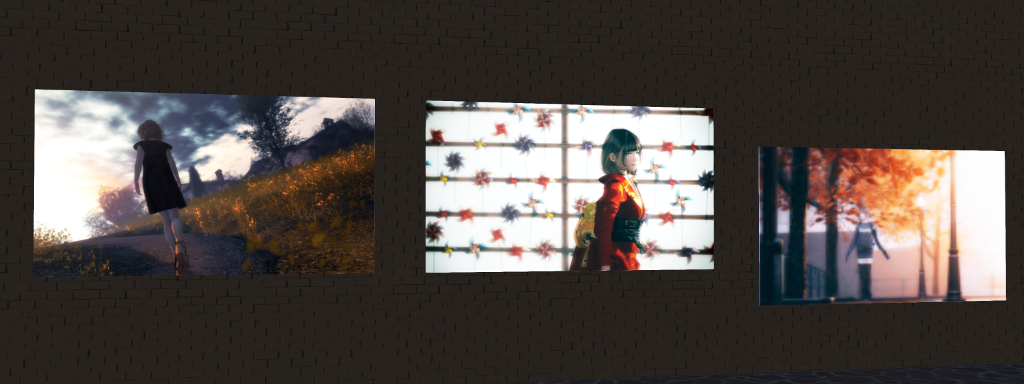
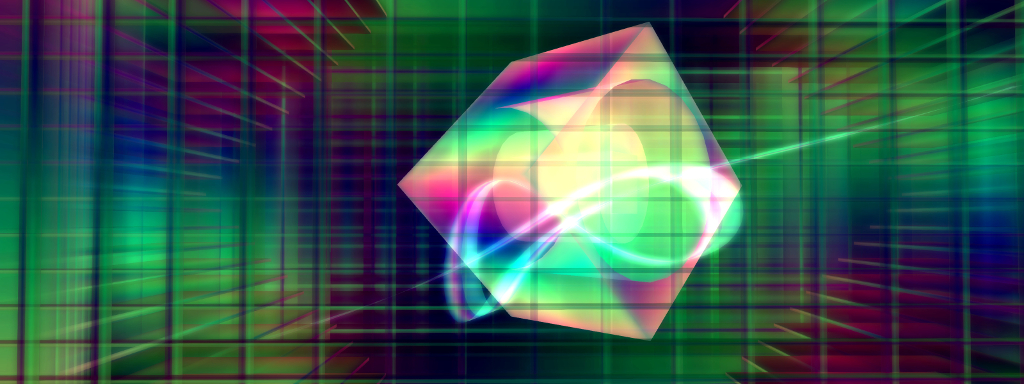
Now open at Club LA and Gallery, curated by Wintergeist are two very contrasting exhibitions of art; the first in 2D and the other in 3D. Both will remain open through into the new year, and make for an interesting demonstration of art and creativity in Second Life.
The 2D art is presented by Reesla Chau, a Second Life photographer from Japan, who offers a portfolio of 16 avatar portraits focused on her own avatar in various locations around the grid. It’s a fascinating series of images richly showcasing Reesla’s eye for creating a scene and her use of angle and soft focus / depth of field.
Club LA and Gallery: Reesla Chau
In terms of the latter, I’d particularly draw attention to Summer Visit, on the wall immediately to the left on entering her exhibition space. But for one or two giveaways around the trees and leaves. it could so easily have been taken in a park in the physical world. Way Back is similarly engrossing due the the sheer realism folded within it.
Others in the series offer a digital take on classical portraiture-as-paintings – notably Windmill, The Moonlit Night and Country Road During Summer Vacation, the latter two of which again demonstrate Reesla’s marvellous use of depth of field. However, what is most engaging about Reesla’s work is her ability to tell a story with her photographs; every one of the 16 here whispers and entire story to those who stand before them.
Club LA and Gallery: Reesla Chau
The 3D art is presented by Moki Yuitza is entitled Rainbow Flakes. It’s a piece best seen with the viewer set to midday, rather than the region’s default time, and with local sounds enabled in order to hear the specially composed music by Daddio Dow.
Describing this piece isn’t easy; perhaps the best means of doing so is to refer to it as a coloured mobile of geometric forms set within a rainbow grid and turning slowly, it’s motion seemingly driven by the the gentle tones and vibrations of the music.
Club LA and Gallery: Moki Yuitza
It’s a fascinating piece, potentially hypnotic in form, colour and tone, and should be seen equally from both inside and outside of the surrounding grid in order to be full appreciated. However, fully quantifying it is something that’s very much an individual task. If not a mobile, I’d personally view Rainbow Flakes as a living kaleidoscope, free to change form and colour at will.
Tonarino, December 2019 – click any image for full size
Shawn dropped a landmark for Tonarino, a Full region with a distinctly Japanese look and feel. A group design, the region is split into five major parts – not all of which are open to the public. To the south is a square block of a flat island, topped by scrub grass and what appears to be a café, while off to the west are three more fairly regularly shaped islands in a north-to-south line.
The majority of the region, however is given over to a large landmass the rises from east to west, and is home to a small semi-urban setting that sits at the end of a single line of railway track. A wooden bridge connects the little town with southern islands, and on crossing it, I found no evidence that the island and it’s café are not open to the public.
Tonarino, December 2019
However, given that the westward islands are separated from the main landmass both physically and by the fact the lay of the land largely hides them from view, they would seem to be collectively for private use. Certainly, the middle of the three islands – and the only one that offers a landing point for those making use of the pedal boats available from the western shore of the town – is restricted to Group access only. Given that the north and south islands either side of it are only connected to it and are without any obvious at which to come ashore for those using the pedal boats, there is the suggestion that they are also private. Either way, I opted not to risk trespass.
The eastern side of the main landmass offers a mix of buildings from cement blockhouses with shops on the lower floor to little apartments on the floor above to stores and eateries modelled along more “traditional” lines all split into little groups by a small grid of roads and by the railway line. Sitting among them is space to grow vegetables an fruit although part of this ground is apparently lying fallow under the snow. To the west, between the hills, the ubiquitous school blockhouse that is often found within regions with a modern Japanese theme, squats as it overlooks the pedal boat moorings mentioned above.
Tonarino, December 2019
The railway line terminates with a station that’s little more than a waiting room with a bus stop neighbouring. On the other side of the track the land that is being cleared for building. A stream tumbles from the hill to the south-west to run parallel with the train line as it emerges from a tunnel under the hill before it eventually turns inland to cross the stream via a trestle bridge. Stone steps also climb the hill to overlook the waterfall and to provide access to a small cemetery.
To the north-east another craggy hill rises, stone steps cut into its face. It is home to the solid presence of an old temple sitting within a small garden, a little refreshment stand lurking just outside the gardens for those feeling hungry after a climb up the steps or a time of prayer in the temple. A (large) step down from this on an out-thrust shoulder of rock is an traditional Japanese walled house. Reached via separate steps, this appears to be linked to the spaces for growing fruit and vegetables, suggesting they may be owned or managed by whoever lives within the house.
Tonarino, December 2019
Looking careworn and a little tired under its light covering of snow, the setting at Tonarino has a very lived-in feel that offers scope for photographers looking for backdrops for avatar studies or who enjoy landscapes that feature buildings and urban / suburban settings. Places to sit may be few and parts of the region off-limits to most, but these don’t detract from any appreciation of the Tonarino.
Itakos Project – Overlapping Realities: On Mars You Only See What You Wanna See! by Jean Toussaint Tosi
I’ve long been a supporter of the use of Second Life as a medium for artists to present their physical world art to audiences they might otherwise not be able to meet. While there are other means for 2D artists in particular to be able to present their work – their own websites and photo-sharing platforms such as Flickr / Smug Mug, for example – Second Life presents something of a unique opportunity to allow an audience to experience more of a uniquely “personal” involvement when witnessing physical world art and photography in-world.
Hence why I was drawn to Overlapping Realities, at The Itakos Project, an exhibition featuring the work of Jean Toussaint Tosi, a Corsican born, Paris residing photo artist. As well as providing the mean to witness Tosi’s work, the exhibition marks the start of a new series of exhibitions at Itakos Project, one that adds a unique flavour to physical work art being shown through Second Life, as gallery founder and creator Akim Alonzo explains:
With Overlapping Realities the Itakos Art Gallery inaugurates a new experience and exhibition concept: to show works by artists who have no presence in the Second life virtual world.
The Itakos Project – Overlapping Realities: Vision #12 by Jean Toussaint Tosi
As Akim goes on to note, while Tosi is an artist with no virtual presence in Second Life, thus very much making his work as fitting the aim of this new series of exhibitions, his photography carries with it a cinematic look as feel that is both rich in presence and style, it can also be surrealistic in look and tone. In doing so, it can be said to both reflect the richness, depth, and sometime surreal nature in having a virtual life, and so becomes a fitting bridge between SL and the aims of the exhibitions it inaugurates.
Offered in monochrome, these prints are quite marvellous in scope, forming sweeping panoramas rich in story. Some have a dark or coy sense of humour about them, while the surrealism can clearly be evidenced in pieces like On Mars You Only See What You Wanna See! (seen at the top of this article). Nor is that all; in places, Tosi’s photography offers commentary on life (She’s Waiting on the lower floor of the gallery hall and shown below) and / or issues such as the climate (Waves, aka Vision #7).
Itakos Project – Overlapping Realities: She’s Waiting by Jean Toussaint Tosi
I am above all, a serious humorist photographer. Just a dreamer who loves all kind of pictures! I’m never satisfied but I always try to do the best I can. Many thanks to all the dreamers who follow me!
– Jean Toussaint Tosi, describing his work
Drawing on elements of fashion, fantasy, science fiction and Hollywood, coloured – despite their monochrome nature of the pieces in this exhibit – with Tosi’s vision and outlook, Overlapping Realities is a marvellous exhibition in its own right and serves as an excellent introduction to his art as a whole; each of the images here link directly to his Flickr stream for those wishing to see them in full and explore the rest of his work.
Itakos Project – Overlapping Realities: Vision #6, by Jean Toussaint Tosi
An official opening for Overlapping Realities will be held on Saturday, December 14th, 2019 starting at 13:30 SLT.
We last visited On The Other Side in February 2019, when the region – designed by xxMichelle20xx and Indrielx – was all set for spring (see: Back On The Other Side in Second Life). But given it does change with the seasons, we decided to go and see what the winter months might have brought forth – and it turns out that the region has been transformed into a marvellous rural winter wonderland.
Surrounded by a range of mountains, On The Other Side forms a little coastal area or island setting, watched over by a red brick lighthouse and within which the buildings are few and far between, the majority of the landscape being a haven for assorted wildlife. Even so, there are some echoes of past designs to be found, some of which might be easy to spot by returning visitors, while others might require a little searching out.
On The Other Side, December 2019
As with past designs, the landing point is underground – in this case a wintry cavern decorated as a (perhaps chilly) reading room. From here the way out into the region gets a trifle foreboding – a drop down to a lower cave via ladder brings visitors to the remains of five unfortunates lying in the snow and a ghostly figure, palms aflame, apparently pressed against the frosted exit to the cave. Step through this into the region proper, and then next surprise awaits: a large bear, angrily rearing up on his hind legs at you.
While all this sounds menacing, once you’re past the bear (who is actually quite harmless, giving rise to the temptation to comment “Why, Paddington! What big teeth you’ve got!” when passing him), you’ll find yourself in a marvellous winter landscape where admirable restraint has been shown in putting out falling snow (often a performance killer) and which keeps itself predominantly as a landscape in winter, rather than a frame for all the usual seasonal trappings for the end of December.
On The Other Side, December 2019
Most of the region looks open to the public, although there is a high table of rock to the south-east topped by a small cabin that might well be private: there is no obvious path up to this, and we weren’t going to start forcing our way up the one obvious slope to reach it for fear of trespass were it to prove to be so.
The cabin looks out across a gently curving bay, its sand dusted in snow, to where that lighthouse rises from the north-eastern headland. Both cabin and lighthouse have a little comic reflection of Santa on roof and chimney, while the lighthouse is open to the public as the region’s Christmas hang out.
On The Other Side, December 2019
But it is the lands between and to the west of these headlands that holds the attractions of the region. Marked by rocky uplands with snowy trails winding around and between them, and in places marked by paths and steps climbing their slopes, the region here feels more expansive than its 65,536 sq metres. This is a landscape blanketed in snow and home to a mix of fir trees and naked oak, birch and maple, their trunks an boughs well whitened with hoarfrost.
Across the setting there is much to be found, with the animal life mixing domesticated cows and sheep with horses, wildfowl, deer, reindeer, wolves, seals, penguins, raccoons, otters, jaguars, pandas – even a giant turtle!. Most of these form scenes-within-scenes across the region, awaiting discovery and photographs, gathered together in a little vignette that stands both on its own and as a natural part of the whole. More are set out quite naturally – although the pandas clearly have the right idea for dealing with the cold!
On The Side Side, December 2019
Everywhere across the region, from the southern seal cove to the northern cave (home to Ganesh, who has also featured in past iterations of the region) are places to sit and spend time. These range from chairs set out on decks or along the eastern beach (which offers surfing for those feeling like they need a cold dip!), to a cosy huts and blanket-laden carts and sleighs people and huddle and cuddle within to keep warm. For those wanting to escape the snow and cold, a barn and the Christmas Hangout offer more places to sit and enjoy the warmth of a fire (we were also appreciative of the hot cider as we explored!).
Previous versions of On The Other Side have included more eclectic elements to them, aspects that offer a little twist of fantasy. This is also this case with this build: anchored to the ground by a stout rope and held aloft by magical runes circling below it, floats a tiny island. Reached by climbing the rope, it offers another place to sit – and quite the high point to view the region as a whole; however, getting back to ground level in head-first descent can be a little dizzying!
On The Other Side, December 2019
Beautifully designed, accompanied by an ideal sound scape and filled with detail, On The Other Side once again offers a delightful, highly photogenic region that should not be missed.
Cica Ghost returns to The Sim Quarterly with a new installation. Donkeys opened on Thursday, December 12th, and it is once again a delightful and light-hearted installation. As the name suggests, it is a place with a certain focus on domesticated equus africanus asinus. However, within it, visitors can find nods to many of Cica’s past installations and work, all of which means that it is place that is guaranteed to raise a smile, whether as a result of discovering Cica’s work for the first time, or because of the Donkeys and their heart-warming looks or because of the flashes of recognition brought about when coming across those familiar touches.
The donkeys, with their oversized ears and curious, confused looks, sit within a grassy, hilly land from which palm trees rise. Around this landscape sit Cica’s familiar finger-like houses, some of which are closed, others of which offer little vignettes. Ladders climb up to some, while others sit close enough to the ground to be entered without assistance.
Donkeys by Cica Ghost – The Sim Quarterly
Within these houses are interactive elements – seats, dances, surprises – and reminders of works like 50 Cats (see 50 cats in Second Life) and Strings (see: Cica’s beautiful Strings and stories). When exploring, it is essential you mouse over almost everything in sight in order to find opportunities for sitting and dancing – and for hanging around! For those who prefer, three sailing boats sitting on the waters around the island each offer a little perch from which to watch the comings and goings of others.
But really, it is the donkeys that hold the attention; there is something quite touching about their soulful and at times slightly confused or worried looks; it’s hard not to to be drawn to them. Watched over by seagulls and some of Cica’s snails, they stand on their own or in little groups as if conversing. Nor are they entirely static – mouse over some and you’ll find additional sit points and poses.
Donkeys by Cica Ghost – The Sim Quarterly
Following on from Rocks, Cica’s previous installation at The Sim Quarterly, Donkeys is another charming setting – one that offers just the right amount of lightness and cause for smiles given the time of year. When visiting, it is recommended you have local sounds enabled.
Northern Shore, December 2019 – click any image for full size
On Sunday, December 8th, 2019 Elvira Kytori opened Northern Shore, a Full region forming part of her White Dunes estate. Primarily a residential region, it offers some waterfront public spaces.
Normally I’d be hesitant in blogging a region like this, simply because the public areas are so localised, and there is a risk of visitors accidentally intruding into tenant’s homes. However, Northern Shore – as is often the way with Elvira’s designs – offers something just that little bit different.
Northern Shore, December 2019
To get directly to the point, Northern Shore is inspired by Stockholms skärgård, the Stockholm archipelago. The largest archipelago in Sweden, comprising approximately 24,000 islands and islets. Many are home to private houses, villages and small towns, and during the winter, the sea between come of the islands can freeze over. Most interestingly, all the the isles in the chain are subject to Allemansrätt (or “everyman’s right”), a law which gives anyone the right to go ashore or anchor on any ground not in the direct vicinity of buildings.
It is the rich diversity of islands within the archipelago that Elvira has sought to capture within the confines of a single region – and she has done so exceptionally well. Scattered across Northern Shore in such a way as to look entirely natural, is a series of islands and islets of varying sizes with rocky outcrops spaces around them. Some of these islands – notably the larger ones – have the rental properties on them, others off tributes to the fishing and formed a part of Skärgården’s history.
Northern Shore, December 2019
The landing point is to be found on one of the largest two islands in the group. It faces a broad, iced-over channel to face the waterfront of the other large island. Both offer working wharves for fishing boats – although none will be putting to sea given the presence of the ice. Wharves extend out into the waters, while boathouses, cabins, and places of business line the shore, although the paths and walks linking them are few: visitors must pick their way over the rocks in places.
Inland from these lie the rental houses, all of which are wooden built, their exterior boards painted in what might be seen as a “typical” Scandinavian look. These sit within their own parcels, many of which can be distinguished by gate and fence or line of trees; others may not be so obviously demarked – hence the need for care when exploring.
Northern Shore, December 2019
Travelling between islands is a matter of walking on the ice – or, if you prefer, by skating (which is welcomed) by those with skates. But again, be aware that several of the smaller, outer islands are also given over to rentals and may not offer much in the way of public spaces.
For those interested in living within this northern winter setting, the parcels in the region can be rented via the mail boxes on their walls. For those who enjoy photography, images can be submitted to the White Dunes estate Flickr group. While for those who enjoy exploring Second Life, the region makes for an engaging visit.