Visiting Longing Melody in Second Life

Longing Melody, January 2022 – click any image for full size

Bambi (NorahBrent) is the owner of the Oh Deer brand and is also is well-regarded among Second Life bloggers for her Missing Melody region designs – I’ve reviewed several iterations of that region myself in these pages. However, in 2021, she launched a new region setting – Longing Melody – which I finally managed to visit at the start of 2022.

Utilising a Full region rather than a Homestead as seen with Missing Melody, Longing Melody presents three different but interconnected seasons / settings that offer little hints of England and the British Isles and plenty to see and appreciate.
Longing Melody, January 2022

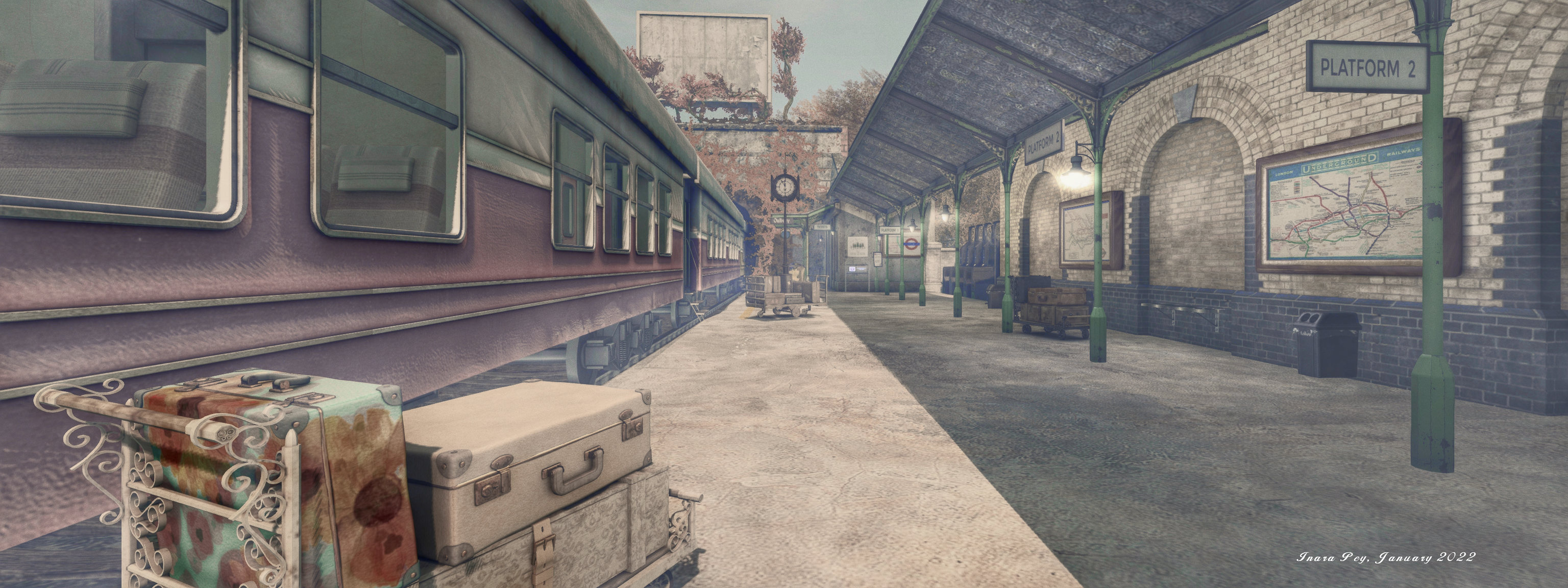
Visits start at the Longing Town train station, where a train with a decidedly continental lean sits at the platform to form the landing point. Exiting the train places new arrival on the platform (no surprises there), where two maps on the London underground are mounted on the platform walls. One of these is likely to be very familiar to users of the Tube, the other somewhat older and offers a more “natural” look to how London’s underground lines actually sit under the city’s roads and reaches. On a second wall is what might appear to be a further Tube map but is in fact a stylised map of the region that offers clues to a form of homage Bambi presents in the design. Alongside of this map in an information giver for the Second Life Nature Collective club.

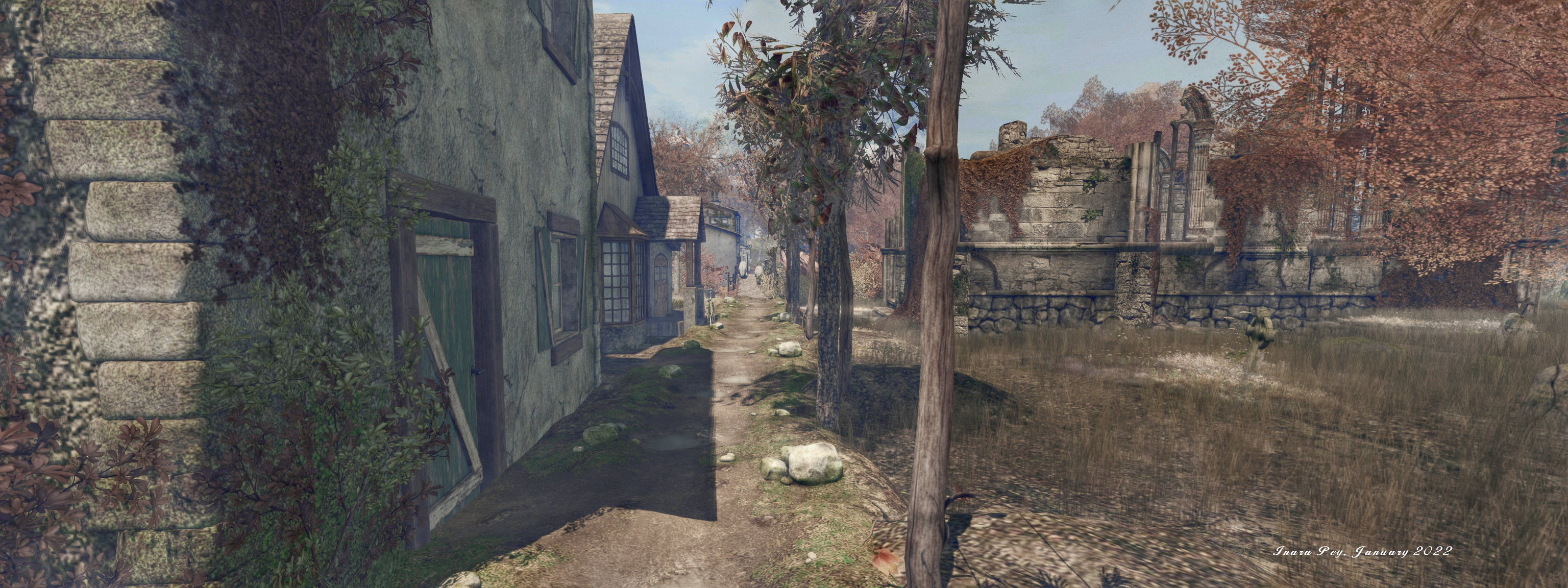
Beyond the turnstiles for the station sits Longing Town itself, there the homage mentioned above is largely located, taken the form of links to Liverpool’s Fab Four. The road leading from / to the station for example, is called Abbey Road, home of a certain recording studio and also the title of the group’s eleventh album with its iconic (and much imitated) cover photo – which is also reproduced in the forms of silhouettes of John, Ringo, Paul and George filing across the road.
Longing Melody, January 2022

Before reaching the silhouettes, the road also passes Penny Lane, an alley leading in to courtyard behind the houses lining the road. Beyond the four silhouettes, the road makes a 90º turn to the right continuing to to a waterside promenade called The Globe. This in turn might be a reference to The Globe Theatre, Stockton on Tees in the north-east of England, famous for being the venue for two Beatles concerts that effectively bracketed their “breaking into” the US market after a lot of resistance from US record moguls (and the first of which took place shortly after John F. Kennedy had been shot in Dallas, Texas).

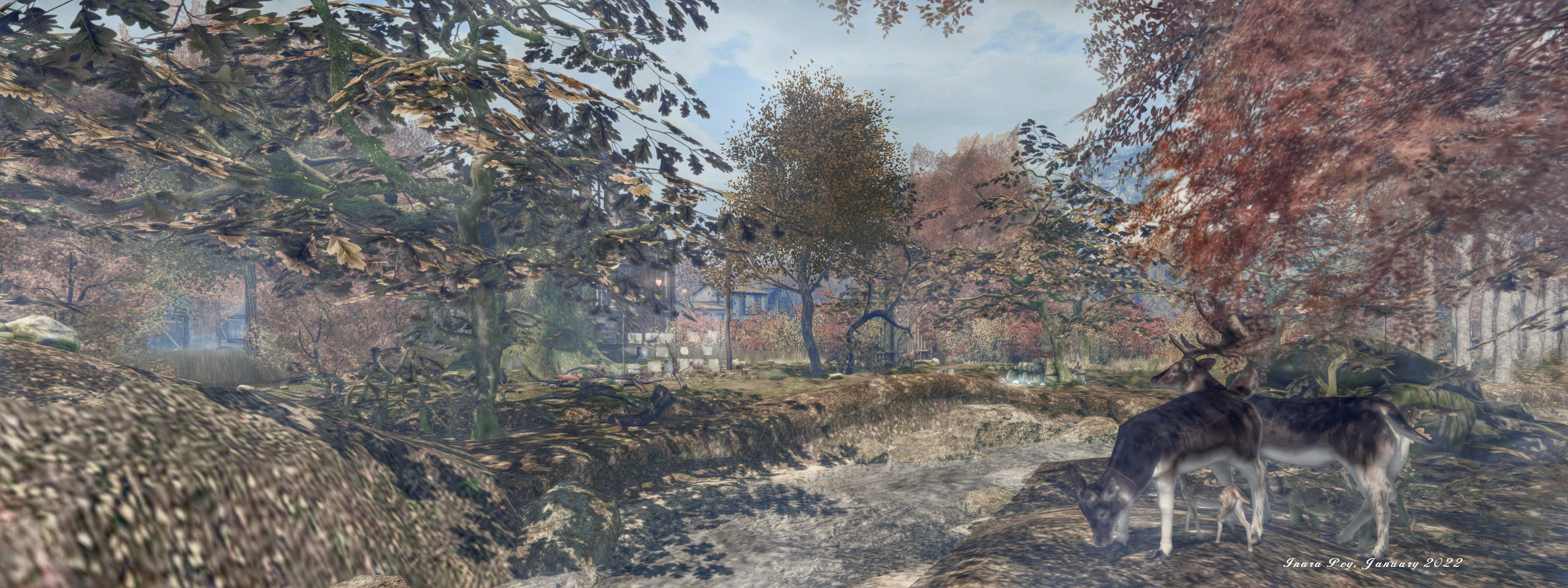
Outside of the town proper, and reached via an arched passage, is a further reference to the Beatles, in the the form of Strawberry Fields, a broad concrete path runs north to reach the second element of the region. Here, beyond the gardens of some of the houses is a more rural setting, a place of meadows, sheep, a bubbling stream, rough footpaths and ruins. And where the town might be thought of as being caught  in a late summer, this northern rural area sits more in autumn, a place where the trees are turning a golden brown and sheep and deer roam free.
Longing Melody, January 2022

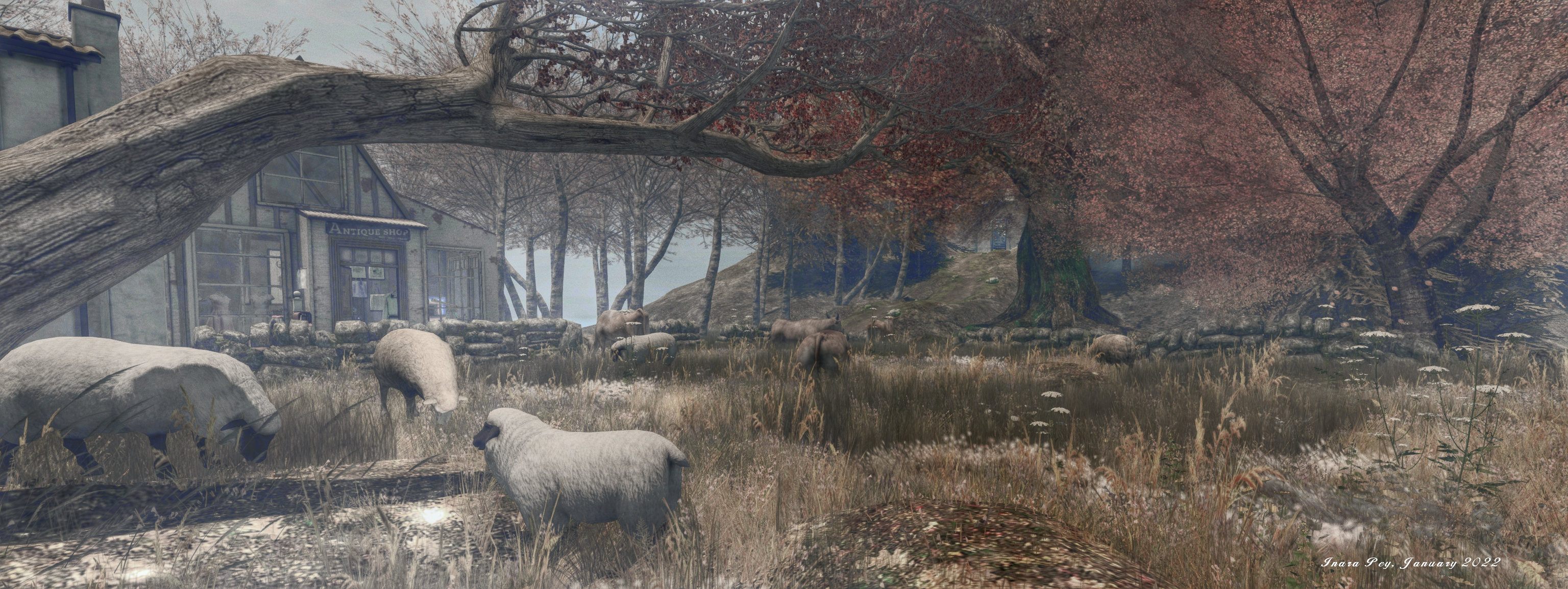
A canal cuts through this rural area; deeper than the local stream, it is crossed by a single hump backed bridge. The path beyond this continues eastwards, passing between more farm buildings and a large field guarded by drystone walls and home to sheep and cows. Once past these, the path starts a gentle climb to where a high brick wall bars the way, except for the open wooden door set within it.

This wall marks the point where the third of the region’s seasons commences, the hills beyond the wall being blanketed in winter. Snow cover the land, a narrow path winding up between the hills. Here the trees are either fir or denuded of there leaves, all equally frosted by the snow.
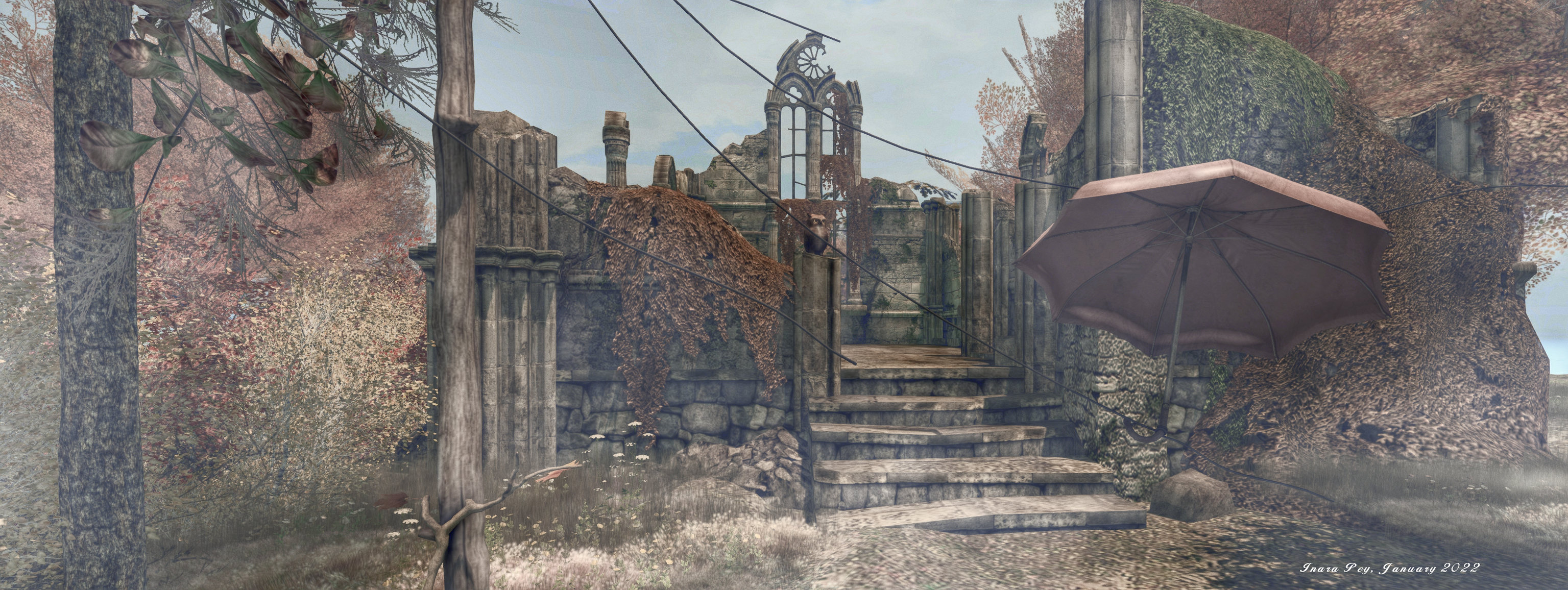
Longing Melody, January 2022

Cottages and more can be found on the shoulder and crown of the hill; one of the former cosily furnished, the other a shell. Watched over by foxes, snowmen and polar bears, this winter area offers further places to sit and pass the time and further opportunities for photography.

All of the above just scratches the surface of things. In the town, many of the buildings are simple façades, other have interiors that can be viewed through windows or entered and explored. Similarly, the gardens, the promenade, the rural spaces, all offer places to sit and relax. and needles to say, the region in rich in opportunities for photography.
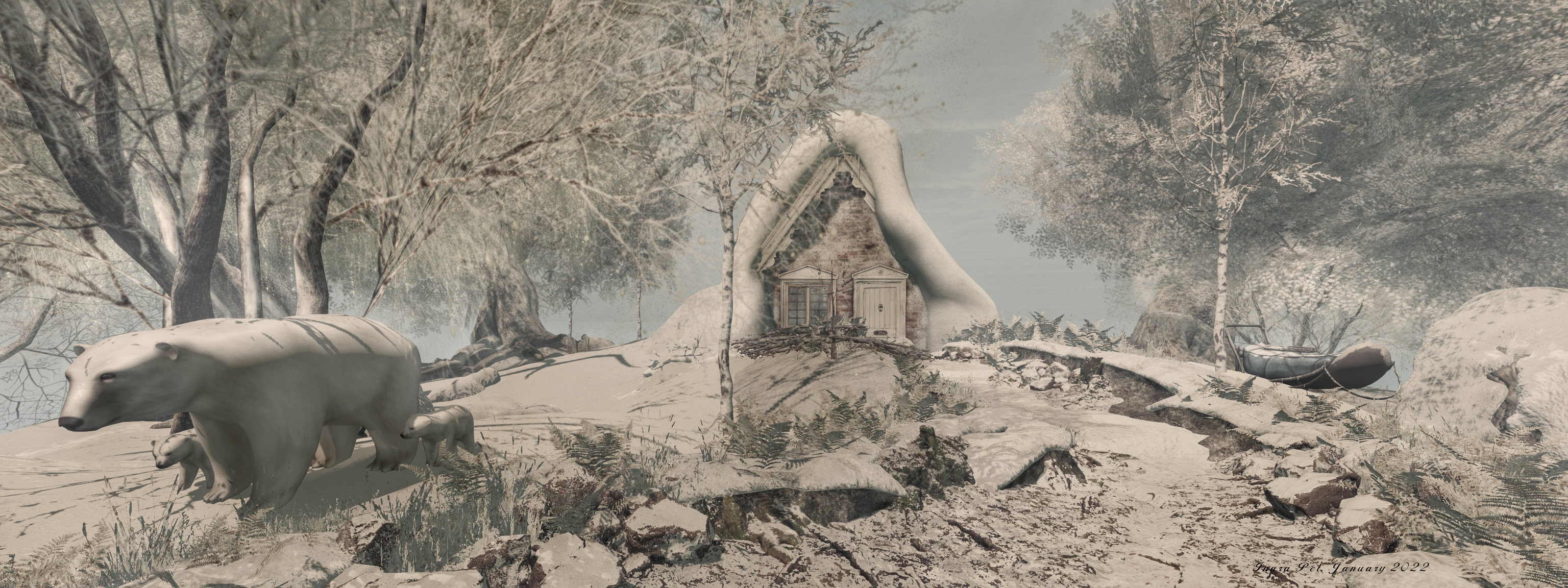
Longing Melody, January 2022

Sharing a spiritual design with many of the settings that have surfaced within Missing Melody, Bambi’s Longing Melody offers visitors its own richness and diversity that should be savoured during a visit.

SLurl Details

Invisible beauty: more art of the microscopic in Second Life

Desiderartum Gallery: Guille – Invisible Beauty

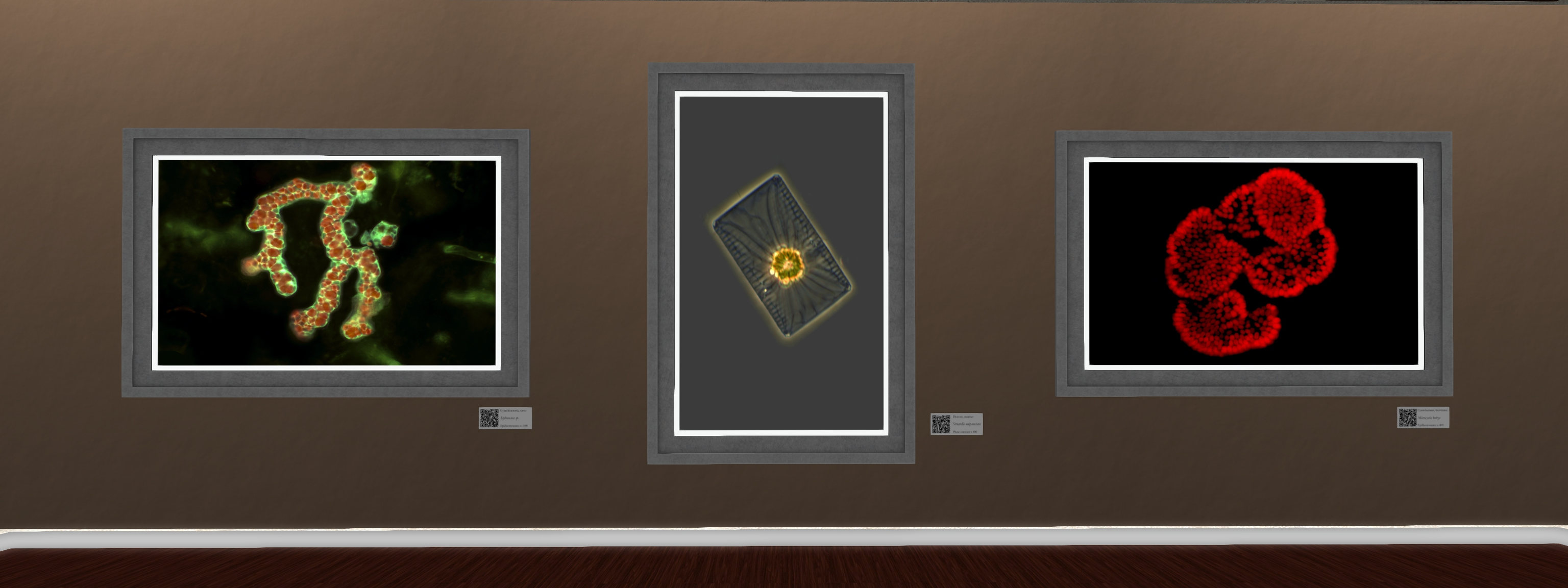
In November 2011, I wrote about an intriguing exhibition of images by Guille (Antoronta) entitled Unseen Beauty, held at the Annexe of the Limoncello gallery. It was one of the the most unusual, engaging and informative exhibitions of photographic art I’d witnessed during the year, taking us as it did on a journey into the world of the microscopic (see: The art and beauty of the microscopic in Second Life).

While (at the time of writing) that exhibition is still open), I’ll delighted to say that the Desiderartum Gallery, managed by Peru Venom is hosting what might be regarded as the “part two” of a display of Guille’s work, in the form of Invisible Beauty, which formally opened on January 10th, 2022 (and my apologies to Guille for not being able to attend the opening in person).

Desiderartum Gallery: Guille – Invisible Beauty

The virtual incarnation of Antonio Guillén, Guille is a doctor in Biology and professor of Natural Sciences, whose background is as fascinating as his art, given his research projects span the environment, microbiology and astrobiology. He also has a refreshing – almost holistic, one might say – perspective on art and science in which the two interact with one another sans borders, informing one another and helping to jointly educate students and the public at large.

In particular, and given his professional focus on the microscopic, he has become a noted photographer-artist who captures the tiny worlds of micro-organisms – bacteria, fungi, archaea and protists – in all their exquisite beauty. And by “noted”, I mean precisely that not only has his photography been exhibited across his native Spain – including the National Museum of Natural Sciences, Madrid -, it has also garnered awards such as Spain’s National Prize for Scientific Photography and the Giner de los Ríos Prize, the country’s most prestigious educational award. In addition, his project The Hidden Life of Water received the first world award at a Google Science Fair (2012).

Desiderartum Gallery: Guille – Invisible Beauty

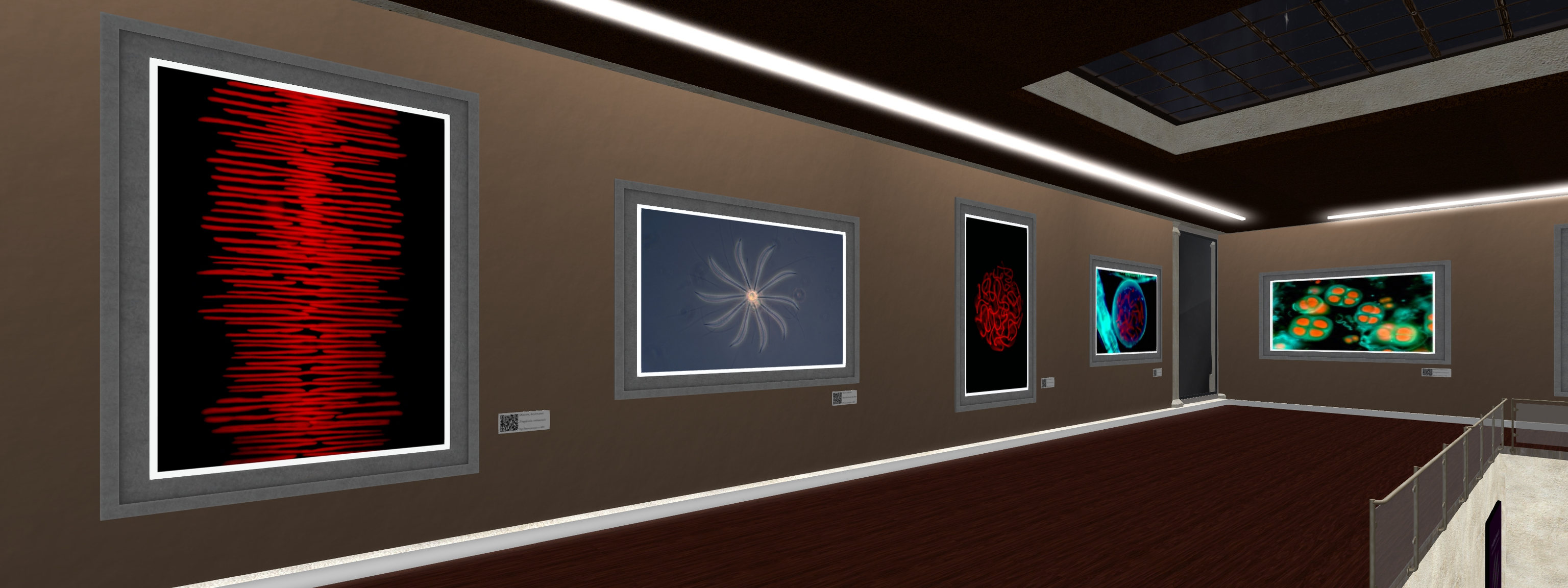
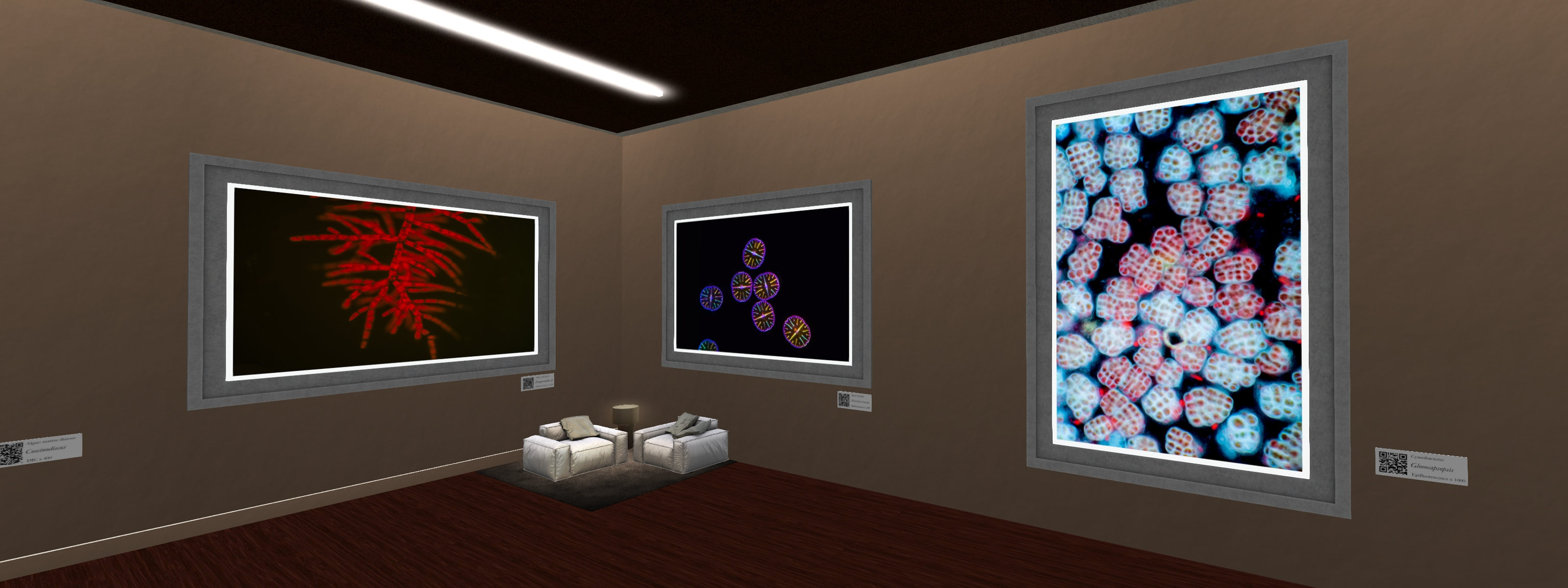
As I noted in November 2021, Guille’s work doesn’t just present images of these incredible, tiny and diverse living organisms, it takes us on a journey into their worlds, the images revealing them individually or collectively in the the most amazing detail, while the texts he has supplied to go with the images (obtained by clicking the title card either below or to the right of each image) reveal more of the realities of these micro-organisms – and not in in dry, scientific terms that are starved of emotion. Rather, Guille’s descriptions are wonderfully fluid, descriptive and in places poetic. It thus offers further life to the tiny creations his microscope has captured in still form, whiles also underscoring his belief that art and science should freely interact.

Like most of the algae of the desmids family “Euastrum” it seems to look at itself in a mirror creating a pair of green Siamese joined by the same heart in a game of symmetry in which survival today and that of the future are bathed of this simple and intense beauty.
A thick transparent layer, adorned with winding valleys, spines or sculpted buttons and made with cellulose and pectin protects the body from these beautiful algae and helps them to float and move slowly both floating and on the bottoms where they live.

Guille’s sparkling description of the supernova-like Euastrum Verrucosum

Desiderartum Gallery: Guille – Invisible Beauty – Euastrum Verrucosum

Split across the two levels of the gallery building, Invisible Beauty mixes some of the images seen within Unseen Beauty with those specific to this exhibition, providing a natural overlap between the two, and making a visit to both a natural experience.

In addition to the  journeys into the worlds of prokaryotes and eukaryotes presented by Unseen Beauty and Invisible Beauty, more of Guille’s work can be found on his Flickr stream, whilst in-world, his has – with the support and assistance of Kimika Ying – created El Universo en una Gota de Agua (“The Universe in a Drop of Water”). There, visitors can see more of Guille’s photography as well as learning about the history of the microscope and about the study of micro-organisms – and even enter their world, where a human hair offered at a scale to represent its magnification by a factor of 10,000 helps put all of this tiny life into perspective.

Universo en una Gota de Agua

SLurl Details

Grauland’s tropical beauty in Second Life

Grauland, January 2022 – click any image for full size
It was back to JimGarand’s Homestead region of Grauland for me to mark the start of the year. As regulars to this blog know, I’ve tended to drop into the region two or three times a year to witness Jim’s designs and work. In fact, my last came in October 2021, a couple of months after Jim had decided to move things away from Mobile – leaving it as the home of his SL business – and give his region designs a little more room in terms of land capacity.

That design for Grauland was something of a departure from the designs we have tended to associate with the region, offering as it did an examination of lighting in Second Life using an urban setting. However, with this current iteration, Jim returns to his more familiar island themes in which he folds art and landscape into a unified whole.

Grauland, January 2022

The landing point sits to the north-west of the island, tucked into the cover of a large concrete-and-wood structure of the kind that can so often be a feature of of the region. This faces a line of jet skis sitting on the water across the beach that are available for riding around the island’s shallows. But if you opt to do so, take note that these waters form a narrow ribbon along the north and west sides of the island, so careful navigation is required to avoid bouncing off the region boundary (there’s more room to the south and east).

Those who prefer can walk around the beach to the west side of the island, passing by one of Jim’s little touches that always make visits interesting: a telephone kiosk that sits on the sands under the single light of a street lamp.

Grauland, January 2022

The southern end of the beach provides access to the island’s most prominent natural feature: a sandstone headland. This is a place where time has allowed the sea to sculpt it into a series of large caverns, the eroded rocks in turn ground down to form a broad expanse of sand below that that now helps prevent the sea from washing way the narrow towers and walls of rock that support the high ceilings of most of the cavern spaces – although a part of these have actually collapsed to form an open ring of stone.

Follow the sand through the caverns and it is clear the sea is still shaping them on their east side, where a table of rock extends out into a large bay, leaving their top supported by broad legs of rock, although a blow-hole has been blasted through a part of the table, forming another ring of stone.

Grauland, January 2022

The easiest way to see this high ground is to climb the steps at the back of the landing point structure or take the stone steps rising from the beach close by to reach a cutting and path through the rock. Both of these routes offer their own attractions, with the staircase in the building allowing visitors to climb to the roof and thence to a path the heads south over the top of the west cliffs to where a zen garden awaits – something that helps link this design with past iterations of Grauland.

Alternatively, prior to climbing all the way to the roof of the landing point, visitors can opt to walk along a roofless corridor  that offers an echo of the previous version of Grauland, lit as it is by a series of coloured lighting strips. Beyond this sits a an artificial depression that forms part of an artistic statement, the second part of which is to be found beyond the zen garden, itself connected to the depression by a set of steps.  Beyond the zen garden a further path winds to where concrete columns rise from the grass and rock over the top of the southern caverns.

Grauland, January 2022

To the east of the island, paths run between its uneven surface, one from the stone steps and path running up from the beach, the other from the concrete depression. Both point the way to the island’s main house as it overlooks the sweep of the island’s southern bay and eastern and southern beaches – the later of which forms a broad finger of sand.  With its deck and pool and split-level nature, the house is open to the public and offers a cosy retreat. To the north of it, along a loosely paved footpath sits a further little hideaway for those seeking a little privacy

As a personal note, I’ll admit that I did find the sound scape – designed to represent the echoing sound of the sea within the caverns – a little overwhelming whilst wandering. Nevertheless, with places to sit throughout, including out on the water to the south (brave souls, given what lies beneath!) – so jet ski users be aware that others might be relaxing on the water – Grauland again offers an engaging and rich environment in which to spend time, together with (need it be said?) plenty of opportunities for photography.

Grauland, January 2022

SLurl Details

Moki’s Mindscapes at Nitroglobus in Second Life

Nitroglobus Roof Gallery: Moki Yuitza – Mindscapes

For the opening exhibition of 2022 at her Nitroglobus Roof Gallery, Dido Haas brings us Mindscapes, a celebration of the humble prim by Moki Yuitza. Featuring both 2D and 3D elements, this is an engaging, joyous exhibition, which is best introduced by Moki herself:

SL is a virtual world in which everything is possible; space is a mathematical/mental construction in which anything we can conceive can be realised. When I was young, I loved building everything that popped into my head with coloured bricks, and here in SL I used the same basic bricks which were available to give substance to my mental spaces; landscapes, formed just with simple prims in which we as avatars, giving it body and dimension [because] one is meaningless without the other.

– Moki Yuitza on Mindscapes

Mindscapes can be very broadly split into two parts. On, over, and under the transparent floor is the 3D element: prims ranging from the relatively small to the extremely large, some apparently jumbled together, others arranged to form patterns and objects or stacked into columns. Around the walls, meanwhile, is a series of 2D images by Moki, presented in the traditional large format used at Nitroglobus.

Nitroglobus Roof Gallery: Moki Yuitza – Mindscapes

The latter most clearly offer a visual representation of our avatar-based relationship with prims. Offered as primarily black-and-while / monochrome pieces, the 2D elements used the shapes and forms present within several of the 3D pieces within the gallery to present intriguing landscapes, rooms and situations from the seemingly simple – giant pyramids being looked upon by a couple of avatars -, through to almost alien landscapes filled with what might be giant spores or pollen, or spaces that seem to comprise random shards of light and dark through which two tiny avatars dance.

Colour plays a minimal role in these pieces, but where it is used, it is to great effect, emphasising the avatars through arms, hands, feet (and in one shot, the avatars directly). By using colour in this way, Moki both draws attention to the avatars, even if largely unseen, and thus the relationship we have with them when bringing this virtual world to life, whilst also equally emphasising the life and vitality we give to our avatars.

Nitroglobus Roof Gallery: Moki Yuitza – Mindscapes

Through many of the images and the 3D elements, Moki also celebrates the mathematical dimension of shapes and space, a further outworking of the aspects of Second Life, design and art she notes within her introduction to Mindscapes.

Moki has a long and deservedly recognised reputation for producing installations and art that is richly expressive, engaging and thought-provoking. With Mindscapes she offers all of this and an exhibition that simply offers – as noted – a joyful celebration of the magic to be found within the humble prim.

Nitroglobus Roof Gallery: Moki Yuitza – Mindscapes

SLURL DETAILS


Clau Dagger’s Awakening in Second Life

Kondor Art Centre – Into the Future Gallery: Clau Dagger

January 6th 2022 saw the opening of Awakening, an exhibition of art by Clau Dagger, which is being held at the Into The Future Art Gallery, a part of the Kondor Art Centre, operated by Hermes Kondor.

Specialising in avatar studies, Clau is an artist photographer whose work I’ve not previously seen exhibited in-world, but who has – as this exhibition demonstrates – a talent for creating images that not only present her avatar, but offer an entire story within – and beyond – their frame. As someone who always tends to look for a narrative within a picture, this makes her work particularly fascinating to me.

Kondor Art Centre – Into the Future Gallery: Clau Dagger

Comprising over 30 images spread across the three levels of the gallery building, the art within Awakening presents an visually engaging mix of studies that are richly expressive in terms of their colour and presentation, and which offer a range of themes and stories. From “simple” pictures celebrating the seasons, through to those focused on fantasy, horror, science fiction and glamour, with dips into literature and film, this is a collection that will capture the eye and offer a richness of story that extends will beyond the framing of each picture on its own.

While there are many who practice the art of avatar study and in creating single-frame stories with their images; Clau’s work stands apart in the level of detail presented in each piece. From backdrop through props, to angle, framing, focus and pose, everything within each picture is brought together not just the create an image, but to create a world that lives beyond the limits of each image.

Kondor Art Centre – Into the Future Gallery: Clau Dagger

One aspect of this “larger than the frame” story aspect of Clau’s work is her conscious directing of her avatar’s eyes. Rather than looking out of the image towards the camera, Clau frequently directs her avatar’s gaze to a point off-camera, with the rest of her avatar’s pose set to suggest a reaction to something out-of-frame and entirely separate to the camera’s position. This gives these pieces – such as Ritual Night, Holy Gral [sic] and Cabell (as three examples) – a cinematic feel, we are caught in a moment of something wider, that were the camera pan around, we’d see more of the story and the action would resume.

Another factor that brings a number of these pieces to life is their richness of colour. Often with avatar studies, there is a tendency to tone down colour in post-processing an image, to add “natural” haze or “natural” light. While this is true in several of the pieces within this exhibit, there are also pieces here where the colour has either been left untouched or perhaps enhanced (e.g. Supernatural, Under the Holiday Tree, Spring Fae and Metamorphosis) that further intensifies their framing and story.

Kondor Art Centre – Into the Future Gallery: Clau Dagger

All of which makes for an exhibition that is genuinely worth visiting, one that lifts avatar studies to a new dimension of expression.

SLurl Details

Patch Thibaud’s Hanging Gardens in Second Life

Hanging Gardens of Babylon, January 2022 – click any image for full size
In this palace he erected very high walks, supported by stone pillars; and by planting what was called a pensile paradise, and replenishing it with all sorts of trees, he rendered the prospect an exact resemblance of a mountainous country. This he did to gratify his queen, because she had been brought up in Media, and was fond of a mountainous situation.

– Berossus, priest of Bel Marduk, 4BCE, quoted by Flavius Josephus

The above words  – admittedly quoted almost 300 years after they were said to have been written – are the earliest mention of the fabled Hanging Gardens  of Babylon.

Hanging Gardens of Babylon, January 2022

Listed as one of the  Seven Wonders of the Ancient World by Hellenic culture, the gardens were said to have been constructed close to the city of Babylon and alongside the grand palace built by the Neo-Babylonian King Nebuchadnezzar II (642-562 BCE). As the quote from Berossus notes, they were said to have been a remarkable feat of engineering; an ascending series of tiered gardens containing a wide variety of trees, shrubs, and vines resembling a large green mountain constructed of mud bricks, which he ordered built in order to help his queen, Amytis of Media to overcome her homesickness for her native lands.

Hanging Gardens of Babylon, January 2022

Whether or not Berossus was writing literally or figuratively is unclear: a lot is known about Nebuchadnezzar II’s reign and works – and there is no mention of fabulous gardens built for Amytis (or any of his other queens) isn’t listed amongst them, nor do any other ancient Babylonian texts from the times around the period in which the Gardens were said to have existed make any mention of them; further, of all the ancient Seven Wonders, the Hanging Gardens alone are the one for which the location has not been definitively established.

Hanging Gardens of Babylon, January 2022

This has led some scholars to believe that the texts quoting descriptions of the Hanging Gardens are actually describing palace gardens that were known to exist, such those that Assyrian King Sennacherib (704–681 BCE) had built in his capital city of Nineveh (close to the modern city of Mosul in Iraq), and Berossus attributed them to Nebuchadnezzar for purely romantic / political reasons; others lean more the the belief the Hanging Gardens were simply the result of romantic imaginings.

Hanging Gardens of Babylon, January 2022

However, whether real or not, the legend has given rise the many descriptions of the Hanging Gardens, together with a plethora of illustrations and paintings, such that it is possible to (re)create how they may have appeared through 3D modelling – or to use the basic descriptions to offer an interpretation of how the Hanging Gardens may have appeared, complete with personal expressions and twists.

This is precisely what Patch Thibaud has done within Second Life, with his utterly fabulous Hanging Garden of Babylon, a Full region design (utilising the private Full region land capacity bonus), and which is currently highlighted in the Destination Guide. Patch is a long-time Second life resident who has, down the years created some outstanding builds in-world. In fact, I recently wrote (in part) about one of his most famous – The Cathedral – which has become both an outstanding statement of art in its own right and a venue in which art can be presented, courtesy of it being located within Chuck Clip’s Sinful Retreat arts estate (see: A Cathedral and Silent Beauties in Second Life).

Hanging Gardens of Babylon, January 2022

With this build, Patch (with the assistance of Cristabella Loon and Lιlly Hawk (NatalieRives)) brings together a genuinely stunning interpretation of  the Hanging Gardens that mixes into it elements that are not from the period in which the Gardens were said to exist but also from periods a lot more recent, including touches that might be seen has echoing the Greco-Romano period in which the legends of the Hanging Gardens began to gain wider circulation within the (then) Known World.

The centrepiece of the design is the great “mountain” of the gardens, here presented as a towering palace, tiered without and with multiple levels within, the structure rises from the waters and surrounding gardens to offer a place of rooms, stairs, walkways, rooms, outlying tiers where trees and shrubs grow as per the classic descriptions of the Gardens. Routes window up through the interior of the building and via outside stairways and ramps connect the various levels and eventually reach the “rooftop” gardens.

Hanging Gardens of Babylon, January 2022

The latter is a formal garden, richly laid out around a water feature, and of a kind that would look at home in the gardens of any grand European home or palace of the 18th or 19th centuries. Surrounded by building elements with the Greco-Roman lean, this “rooftop” garden also sits within rooms that have a distinctly Renaissance styling. Taken on its own, this rooftop area, complete with terraces and infinity pool, would be eye-catching enough, but it is just the jewel in a stunning crown of the design.

However, I’m not going to ramble on about the build here – I hope the photos I’m including here will encourage you to visit – what I will say is that this a genuinely engaging build, from the outlying gardens through the lower levels of the palace to the rooftop gardens. Throughout all there are numerous places to sit, paths to explore and – obviously – multiple opportunities for photography, the Hanging Gardens of Babylon is one of the Seven Wonders of our Digital World. And don’t miss the boat ride around and under the palace!

SLurl Details