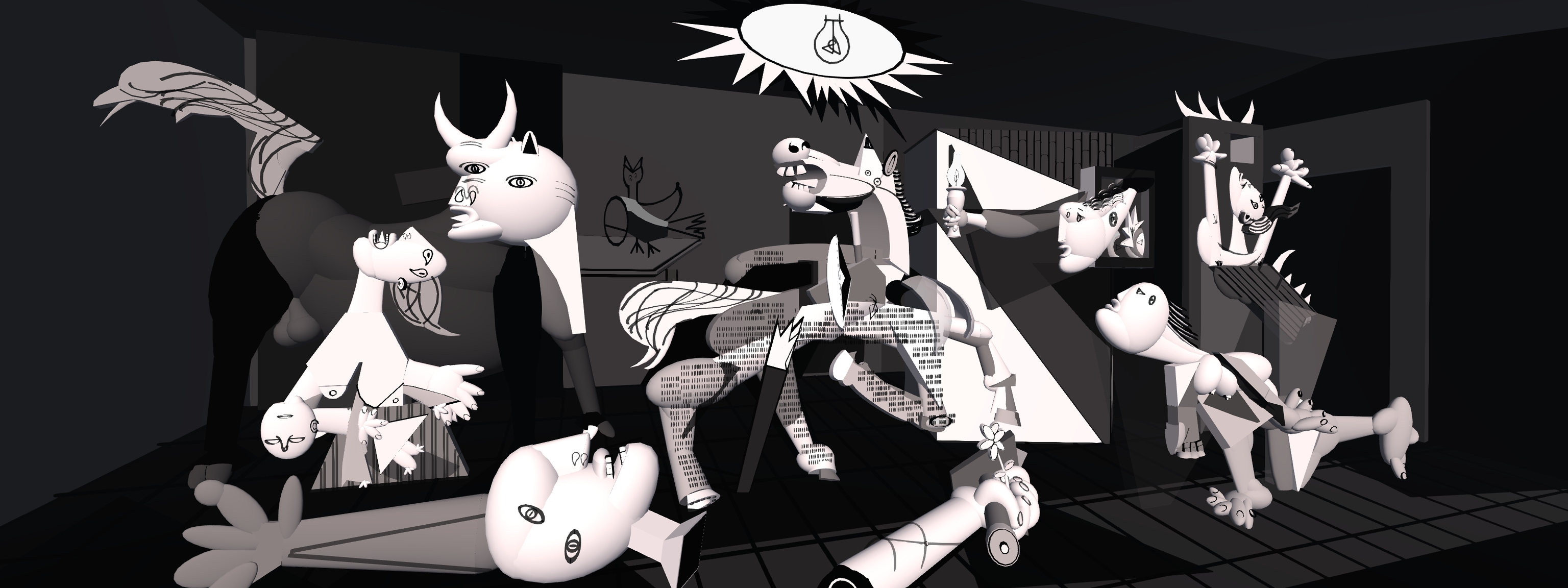
Invisible Cities: Fighting Women at Nitroglobus in Second Life

Nitroglobus Roof Gallery: Debora Kaz – Invisible Cities – Fighting Women

Invisible Cities – Fighting Women is the title given to a combined 2D and 3D art installation by Debora Kaz that is currently open to the public through until the end of August 2022 at Nitroglobus Roof Gallery, curated by Dido Haas.

Supported by a custom lighting environment created by Adwehe, this is perhaps one of the most complex installations and layered installations I have seen – something that in itself is saying a lot: Dido has a consummate skill in challenging the artists she invites to exhibit at Nitroglobus, consistently leading to installations that stand head-and-shoulders above those found elsewhere in Second Life in terms of their richness of presentation, meaning, and narrative.

Perhaps the best way to describe the installation is to use Debora’s own words, both from the introductory notes (available via the giver at the landing point) and the open letter Debora has written form women and which is displayed on the north side of the gallery space (and which is included with copies of each of the pieces in the exhibition when they are purchased):

Invisible Cities – Fighting Women wants to show the pain and difficulty of being a woman in a world where women historically were portrayed as objects of desire, exposed to consumption, which induces rivalry, resulting in us women not having a real union to fight the violence that is directed at us.

– Debora Kaz, introducing Invisible Cities – Fighting Women

Nitroglobus Roof Gallery: Debora Kaz – Invisible Cities – Fighting Women

Whether we like it or not, we live in a world that is largely derived in terms of patriarchy, be it societal, historic, or religious or a mix of all three. It is a global environment where even today, women are faced with a broad range of physical violence (1 in 3 women world-wide will be beaten or raped or face other forms of direct violence at the hands of males at least once in their lives) and more subtle psychological violence.

It is something many women the world over are trying to address and overcome through projects and activities such as One Billion Rising, through protests, activism and even through art – as has often been seen here in Second Life.

Nitroglobus Roof Gallery: Debora Kaz – Invisible Cities – Fighting Women

However, as Debora moves to point out in Invisible Cities – Fighting Women, we so often undermine these efforts by committing “violence” upon ourselves and one another: we cave to the demands of advertising, objectifying ourselves, turning ourselves into things of desire to attract others; we seek to dominate one another at work or socially, and so forth.

Within this capitalist game of consumption and desire, women compete with each other attack each other in an irrational way; and most of the time, they are not aware of it, because of the superstructure. Structural misogyny occupies the minds of not only men, but it is also present in the formation of every woman who is born objectified. The demand to be desired grows and seeks to be desired all her life – by men, but mostly by women; to be desired by another woman is to have power, to be better than others is wanting to be better than any other woman.
With this in mind, the union that women desire [in order] to combat violence against women [as] imposed [by] the history of patriarchal societies becomes unviable. It is not possible to unite when someone wants to have one power relationship over another.

– Debora Kaz, Invisible Cities – Fighting Women

Through the 16 images and 5 sculptures, Debora presents aspects of all of this in quite vivid and engaging pieces. Within them, we can find reactions to patriarchal dominance (Fuck God) to the need for mutual support (I’m By Your Side), and more. Throughout all of the pieces, colour pays a major role. Pink references both female empowerment and the struggles we face  – external and internal – to be understood as individuals, while harder, courser colours are used to represent emotional and the turmoil they can and create and the conflicts – again, internal and between one another – they induce.

Nitroglobus Roof Gallery: Debora Kaz – Invisible Cities – Fighting Women

Individually, these are striking pieces; each carries a weight of narrative that has impact – this cannot be denied. However, I would be remiss if I didn’t admit to being somewhat confused in understanding the core theme and message of this installation. I’m not sure if this is down to a shortfall on my part or because the artist has accidentally cast her net too wide and introduced to much in the way of narrative and subtext. As such, I encourage you to visit and explore Invisible Cities – Fighting Women for yourself and free from any confusion on my part.

SLurl Details

The art of Suzanne Graves and AL in Second Life

Selen’s Gallery: Suzanne Graves

I’m a little behind in my art blogging (and blogging in general), so I’m getting to this article a little later than intended, having originally hoped to get it out over the last weekend in July because it is something of special event in Second Life, featuring as it does the 3D work of Suzanne Graves, with a special exhibition of 2D art by Selen’s father, AL.

Having opened at the ground level on Selen’s Gallery, operated and curated by Selen Love (Selen Minotaur), this untitled installation features the 3D piece by Suzanne Graves, whose work has been featured in exhibitions at such august institutions as the University of Western Australia and Linden Endowments for the Arts and at arts hubs such as Sinful Retreat.

Selen’s Gallery: Suzanne Graves

Here, Suzanne presents a series of 3D sculptures with a lean towards the surreal. Some are static, others are animated with either moving parts or shifting colours – and in some cases, both.

Created entirely using prims, sliced, cut, twisted to create almost organic forms, these pieces are a remarkable celebration of natural form and the richness of geometry, bound together in an expressive environment created by Selen. However, to see them at their best, it is strongly recommended that you do so with the viewer’s Advanced Lighting Model enabled (Preferences → Graphics) is enabled, and you utilise the environment settings Selen has created for the gallery space (World → Environment → Use Shared Environment).

Set one side of the Suzanne’s pieces is the glass pavilion where AL’s artwork is displayed.

A physical world artist, AL works in oil acrylics, and the 15 pieces presented here have been selected by Suzanne, who encouraged him to consider Second Life as a further means to show his work – and this exhibition represents the first time he has done so.

AL’s primary inspiration in terms of genres is that of surrealism – and that is certainly to be found within these pieces, as are touches of abstractionism. He is also an experimentalist, sometimes using paint pouring to produce pieces.

As the name suggests, this is a technique – or rather, a series of techniques – primarily used with acrylics, where the paint is “poured” onto the canvas, rather than by using a brush. However, it is not simply a case of taking the paint and just tipping on to suitable medium (e.g. canvas or paper); not only do the paints require different approaches to how they are diluted in order to alter their viscosity and the degree to which the will flow, it also involves a range of techniques to assist in how they are blended and mixed, either as a part of the pouring process, or before they have dried, to develop a finished result.

Selen’s Gallery: AL

These mixing techniques are many and varied – pouring a batch of colours into a single container with one or more outlets, and letting them pour through as the container is gently swirled to mix them, or pouring them individually either directly onto a surface or a base colour / tone and then using assorted tools (such as a hairdryer!) to mix them / form patterns within them, and so on.

Several examples of the technique sit among the pieces presented within the exhibition at Selen’s Gallery, some of which are combined with more direct surrealist over-painting to produce the most richly colours and engaging pieces. Other pieces are more “traditionally” produced, folding in both surrealist elements and  / or abstract painting.

Selen’s Gallery: AL

All of the pieces by AL are for sale, but rather than being offered at a fixed price, they are offered on the basis of “pay what you will” by means of a tip jar just outside the entrance to the gallery pavilion (the pieces themselves are offered at L$0), and Selen will ensure gratuities are passed to her father.

Visually captivating, demonstrating both the power of prims in artistic expression and also offering a view of physical world painting techniques which may be unfamiliar to many, this is a exhibition not to be missed. And while visiting, don’t miss the teleport point just outside the pavilion to reach Selen’s gallery on a sky platform, home to her own art.

For those curious about paint pouring, check the video below.

SLurl Details

A Dance Of The Crows in Second Life

Krayentanz, August 2022

For her latest 80 Days region builds, Camila (Camila Runo) carries us from Italy and the town of Ars Vivendi (see: A touch of Italy for photographers in Second Life), to her native Germany and a place of the imagination called Krayentanz, which once again presents a picturesque setting well deserved of a visit by SL explorers.

I say “place of the imagination” because while a visit takes us to Germany, it carries us back in time to offer a view of that nation as it might have appeared in the Middle Ages – a fact reflected in the setting’s name, as Camila explains:

Krayen is a variation of the Middle High German word “kraeje” and means crow. So the meaning of Krayentanz would be Dance of the Crows in English. As Middle High German was spoken from approx. 1050 till 1350 AD, so the build matches the time frame.

– Camila (Camila Runo)

Krayentanz, August 2022

This is very much a setting of three parts, two of which are open the public, and the third, tucked into the north-eastern corner of the region, forms a private home. The latter is neatly hidden by a curtain run of a hill, a richly wooded landscape and the hide side of a table of rock and grass; as such it is very hard to run the risk of trespass – just stay on the village side of the humpbacked curtain of hills or the top of the table of rock and grass.

The latter is home to a sprawling collection of buildings set within a large, enclosed courtyard protected by high walls and a pair of stout gates themselves guarded by defensive towers. Described as a convent, these buildings, with their stone towers, look like they many have previously served another, possibly more war-like purpose, while the floor mosaics within several of the rooms give a suggestion of Romanic influences.

Krayentanz, August 2022

But whatever its past, the place is now given over to holy worship and to the vows of the nuns who live within its walls. And two of these nuns can be found within the courtyard of the cloisters, engaged in conversation with an individual I assume is a visiting Prior or Brother. Behind them, the Blessed Mother holds the baby Christ as she keeps watch on the convent’s gates, whilst beyond the side of the cloisters the nuns are facing, the land rises again to become the seat of a church, reached via stone steps set into the grassy flanks of the hill.

The convent is itself reached via a dusty track the meanders from a small steam that feeds a much large pool of water, and which passes the region’s landing point just as it divides. One arm of the track then continues around the foot of the plateau before finally climbing it to the convent; the other presents a short walk to where a small but apparently prosperous town, given the look and conditions of the buildings and the garb of the locals, sits behind high, protective walls.

Krayentanz, August 2022

The men folk here clearly take the responsibility of protecting the town seriously: the gatehouse under which the road passes is very solidly built and has a strong portcullis which can be dropped to bar access into the town. Further, the walls sweeping away from the gatehouse to enclose the town in their protective arms are in good repair, if a little lacking in defensive positions along their length. Meanwhile, arms for the defenders come by way of the local smithy, conveniently place closed enough the gatehouse so they can be grabbed whilst running to defend it.

Most of the houses and buildings here are furnished in keeping with the period and are open to the public, whilst the town square features a raise stage where, doubtless pronouncements may be made from time-time-time to the gathered inhabitants – although for visitors, it offers the chance to partake of a medieval dance with music provided by the local bard. Music lovers can also find more at the local tavern, sitting on the lower should of an escarpment also within the town’s walls, on the track that leads to a thumb-like knoll rising above the town, and upon which a windmill benignly keeps watch on all that goes on.

Krayentanz, August 2022

As well as the village, stream and pool, the region’s lowlands are home to gentle woodlands to the west, sitting below the plateau of the convent. Here, sunlight slants between leaf-laden boughs to offer pools of light amidst the trees whilst glades open out from between their trunks, and deer wander and graze.

In introducing Krayentanz, Camila offers an apology for having to downsize her work from a Full private region to a Homestead. Personally, I think this is misplaced; this is a setting as richly engaging as any of her previous designs, the greater land capacity afforded by the Full regions they occupied notwithstanding.

Certainly, moving to a homestead has not diminished Camila’s eye for detail, and the manner in which she has seamlessly presented the region within a mesh surround helps enhance the sense that were are somewhere deep within Germany’s borders. This sense of immersion is further enhanced by the soundscape she has created for the setting – so do please make sure you have local sounds enabled when visiting. Finally, those wishing to engage in informal period role-play are apparently welcome to do so, whilst photographers and bloggers will doubtless find a lot to see and appreciate when visiting.

Krayentanz, August 2022

SLurl Details

Terrygold’s Crack in Second Life

Terrygold: Crack, July 2022

Drug and alcohol abuse among you people – teenagers from 13 or 14 upwards – has long been a problem. So much so that today within many western countries, it scarcely appears to be on the radar of politicians, who instead prefer to point their fingers and rabble-rouse about imagined “evils” facing their countries from -*horror* – refugees seeking sanctuary or – *gasp* – the terror of equal rights for women, ethnic minorities, the disabled, and LGBTQ+ communities.

Terrygold: Crack, July 2022

In Europe, studies have shown that while not rampant, substance abuse – including the use of tobacco – as a whole has been increasingly found among children below the age of 15 (per the European Monitoring Centre for Drugs and Drug Addiction (EMCDDA)).

Much of this has been put down to “experimentation”, although peer pressure has also been noted as a factor, as has the fact that in terms of illegal drugs, some dealers have taken a leaf out of the tobacco advertising playbook from several years ago, but “promoting” their wares to younger consumers.

Further, while many reports note that such experimentation / engagement with alcohol and drugs in particular has tended to be among younger male teenagers, the EUCDDA studies from 2007 onwards have shown that more and more young girls are increasingly following suit, and the gap between boys and girls in terms of drug use is closing.

Terrygold: Crack, July 2022

Drug use among young girls is something artist Terrygold has had to face in the physical world and within her own neighbourhood; and what she has witnessed, almost daily, has resulted in her latest installation Crack, which opened at her art gallery in late July 2022.

As with her recent pieces, it comes as a set of vignettes, each narrated by a static, NPC called “Terry”.

These vignettes – a pair this time – are literally framed as pictures; in the first, linked to the installations landing point (reached via teleport disc from the gallery’s main landing point), we she a happy time at home; a wife and husband in a comfortable lounge, their little daughter apparently tucked behind an armchair with her teddy as she plays hide-and-seek with her father. It’s a setting of domestic bliss, which can be seen – literally – through two frames set to either side of scene so as to present frozen images of a happy, safe home life.

A further frame – be it a window or a picture frame, it matters not – presents a view of a world outside this cosy home; a place where alcohol is freely available, the siren glow of neon drawing all too it regardless of age, with those standing in the doorways also caring little about identity or age. Close by, under a streetlight two young girls draw lustful gazes from an older male, whilst another girl, provocatively dressed, staggers down the middle of the road, the worse for – something.

Through the words of “Terry” as we stand next to her looking out onto the scene, we learn this vignette is a reflection of a tragic situation she has witnessed: a girl high of drugs or alcohol, wanting – needing – more – and desperate, spiralling ever deeper into an addiction that can only lead to worse.

Terrygold: Crack, July 2022

Within the house, “Terry” also vents the artist’s frustration in the way that stories of abuse and suffering have become so commonplace that not even the age at which youngsters find themselves trapped by addiction causes anything more than a raised eyebrow. And we, like her, should feel that shame frustration and anger; but how many of us turn the page of the newspaper, shutting out the story just as we can shut the terrors of the world outside by closing the drapes on the windows of our homes?

But just how safe are we, really? Herein lies a deeper layering to Terrygold’s piece.

The entire installation is offered under a dark environment setting. While this clearly adds atmosphere to the street setting, where faces are shadowed, and the sense of danger and intrigued raised, so to does it alter the “indoor” scene of familial bliss, casting pools of darkness that reduce the home to a small island of light, a visual metaphor of the fact that no matter where we go, the darkness in the world is never far away,

But more than this, the shadows within the house serve another purpose. If you view the family through one of the frames, that little girl playing hide-and-seek vanishes, and the faces of the mother and father can no longer be clearly seen. Suddenly the position of the mother as she sits on the edge of the coffee table apparently making a casual call whilst her husband and daughter play, becomes something more urgent, her look more worried.

Similarly, the smiling face of the father is now wreathed in darkness, his tall figure a shadow within a shadow, looming close to his wife. Thus, the entire scene becomes tense and foreboding. The stances of father and mother, together with the apparent absence of their child reminds us that little girls who play hide-and-seek grow into young girls who for whom teddy bears, armchairs and hunting daddies are not enough, but the world, for all its threats, is a wondrous place – and even the threats can tempt and attract, opening young lives to those who would hunt them and/or their money for reasons far less innocent than a game of hide-and-seek, and parents are left fraught and anxious; desperate for the reassurance of a voice on a telephone, for an ear to hear their pleas to come home.

Expressive, offering much to consider, Crack is best seen under the local environment settings (World → Environment → make sure Use Shared Environment is checked), and with ALM (Preferences → Graphics → Advanced Lighting Model) enabled (Shadows are not required, despite the instructions and the landing point, should enabling them impact your computer’s performance unduly).

SLuel Details

Use the teleport disk to reach the installation

A corner of Provence in Second Life

Tourtour de Prouvenco, July 2022 – click any image for full size

Occupying one half of a Full private region leveraging the additional Land Capacity bonus, sits Tourtour de Prouvenco, a setting designed by Annisss Moreau (annisss) that is offered for public enjoyment.

Tourtour is a small French Provencal village where you can relax by the sea and listen to the best DJs of the second life at the Blue Note ‘Club evenementiels Djs LIVE’.

– from Tourtour de Prouvenco’s About Land description

This is a setting very much of two parts separated by a deep inlet that cuts across the parcel, a wide bridge close to its mouth providing the sole direct link between the two elements, helping them to flow together. The parcel itself offers an east-west orientation, the landing point sitting upon a small square.

Tourtour de Prouvenco, July 2022

The home of a small open market, this square is book-ended on its west side by the bridge mentioned above, and a gatehouse accessing what might be considered the older part of the town. The square and the bridge offer good views of the almost rectangular inlet as it forms a natural shelter / harbour. Looking at the basin of the inlet, it is not hard to picture it as once having been a port of call for trading ships plying the coastal regions under the power of wind and canvas. Today, the stone wharf has been extended by wooden moorings that offer places of rest for a mix of small fishing boats and the shark-like forms of power boats and speedboats.

The way down to the boats is presented on the far side of the bridge from the landing point, steps descending down from road level, the buildings behind them set well back from the drop to the water to provide a broad waterfront area, home to stores, stalls, cafés, kids at play and a sandy pétanque court awaiting older players.

Tourtour de Prouvenco, July 2022
The buildings here are suggesting of having been built in the 18th or 19th centuries, although they are centred on a much older structure, almost a ruin, lacking a roof, some walls broken and the floors they once supported collapsed. Accessed via an arch, this has in fact been cleared out and partially renovated to become the Blue Note referenced in the About Land description, and home to DJ events.

A further arched passageway facing the bridge offers the way between the tall houses and buildings, allowing visitors to reach more features with the setting. These include the western beach, overlooked by the Chocolat, where visitors can enter into a (kilo-gaining!) romance with all forms of chocolate and dessert. This side of the town offers the local cinema, and a marvellous courtyard comprising façades of shuttered houses.

To the east, the older element of the setting is far more rural in nature, and includes some almost Tuscan touches thanks to some of the selected architecture. sitting on the top of rocky cliffs that fall to a further beach on their north side, and cut through by a deep gorge, this is much the larger of the two parts of the setting, and offers a huge amount to take in.

Tourtour de Prouvenco, July 2022

The houses and stores here are furnished, giving a rich sense of homeliness, whilst the town can be explored by following various paths through it. The most obvious of these is the rutted lane that runs between the Tuscan-like buildings to cross a natural rock pass over the waters of the gorge as it empties into the sea. In the far side, this road curls back on itself to follow the southern lip of the gorge, passing below the local art gallery.

Set within a grand building reached via a couple of separate footpaths leading up to it – both of which should be explored in order to fully appreciate the region – the gallery dominates the setting in terms of its elevation, and does tend to draw the attention. However, and while a visit is recommended, do take the opportunity to explore around and behind the houses to discover all that the setting has on offer.

Tourtour de Prouvenco, July 2022

And also, when passing under the arch from the landing point square, be sure to keep an eye out for the teleport posters that will take you up to a couple of locations in the sky that I’ll allow you to discover for yourselves!

Charming, well designed and laid out with plenty of opportunities for photography Tourtour de Prouvenco is well worth spending time visiting.

Tourtour de Prouvenco, July 2022

SLurl Details

Dinosaurs and Coconuts in Second Life

Cica Ghost: Dinosaurs and Coconuts, July 2022

Cica Ghost carries us through the end of July and into August with her latest installation, which opened on Friday July 29th, 2022, bringing us a touch of Jurassic Park meets The Flintstones in another easy-on-the-eyes-and-brain piece.

Dinosaurs and Coconuts comes with a quote from the Dalai Lama – Once a year, go somewhere you have never been before, and this is a setting that surely offers us the opportunity to do just that.

Like Jurassic Park, this is an installation that presents avatar the opportunity to witness the great reptiles of an prehistoric era as they go about their business. Scattered across the landscape visitors might find armoured dinosaurs mind of those common to the Cretaceous period (Taohelong, Dyoplosaurus, Struthiosaurus, et al); sauropod-like dinosaurs that bring to mind those of the Jurassic the Late Cretaceous periods (such as Brachiosaurus, Apatosaurus and the truly enormous titanosaurians); and two-legged carnivores suggestive of the infamous velociraptor genus.

Cica Ghost: Dinosaurs and Coconuts, July 2022

However, this is no trip down Archaeological Lane; Cica’s dinosaurs are not intended to be reflective of the great beasts that once called the world their own. Rather they are here to offer a lightness of mood and sense of fun, as demonstrated by their expressions and the tip towards the fantastical among some of them. This sense of fun is further emphasised by the landscape in which the are located; a place in which Fred Flintstone and Barney Rubble may well find familiar were they to walk into it, with its stone-hewn houses and  cobbled-together wagons and caravans of stone and wood.

Some of the latter sit on the ground, others upon stilts and trestles. Quite who built them is open to debate; no sign of early Man here – although the local technology has clearly reached the point where the wheel is understood, as is the concept of the see-saw and that of the bridge (a concept a couple of the local raptors perhaps have yet to grasp, befuddled as they appear to be by the stretch of water which divides them, despite the bridge that sits close by…).

Cica Ghost: Dinosaurs and Coconuts, July 2022

At least one of the mysterious locals has even reached a point of understanding matters of ecology, a small windmill jutting through the roof of one stone house, presumably to supply power, and rudimentary garden spaces have been established to help give a sense of homeliness with some of these dwellings.

But it is the dinosaurs who hold sway here. From small to large (and in some cases I do mean large), they all have characters of their own, given life by a subtle sense of expression that suggests some of the thinking going on behind their eyes. Even the raptor-like dinos look like they’d be more interested in fun over hunting.

Cica Ghost: Dinosaurs and Coconuts, July 2022

Quirky and fun, and with a number of places for people to sit (or carry out handstands!), Dinosaurs and Coconuts is another fun installation from Cica, and the Dinos are available to buy though the little shop within the region.

Oh, and the coconuts? Just keep an eye on the local giant palm trees – and be careful not to stand too close to them!

SLurl Details