Under the Northern Lights, December 2022 – click any image for size size
Under the Northern Lights is the title Carrie Lemon Rogstad (LemonPuss) has given to her winter-themed Homestead region, currently open to visitors this December 2022.
As the name suggests, this is a snowy setting, largely open to the public to explore, although it has twelve small rentals around its edge. Available at L$700 a week, these present is simple geodesic dome (the GeoDome by Ria Bazar, a unit I’ve used myself in laying out region designs), with basic furnishings of bed, fireplace and décor elements, all of which is set out on a deck with each of the units.
Under the Northern Lights, December 2022
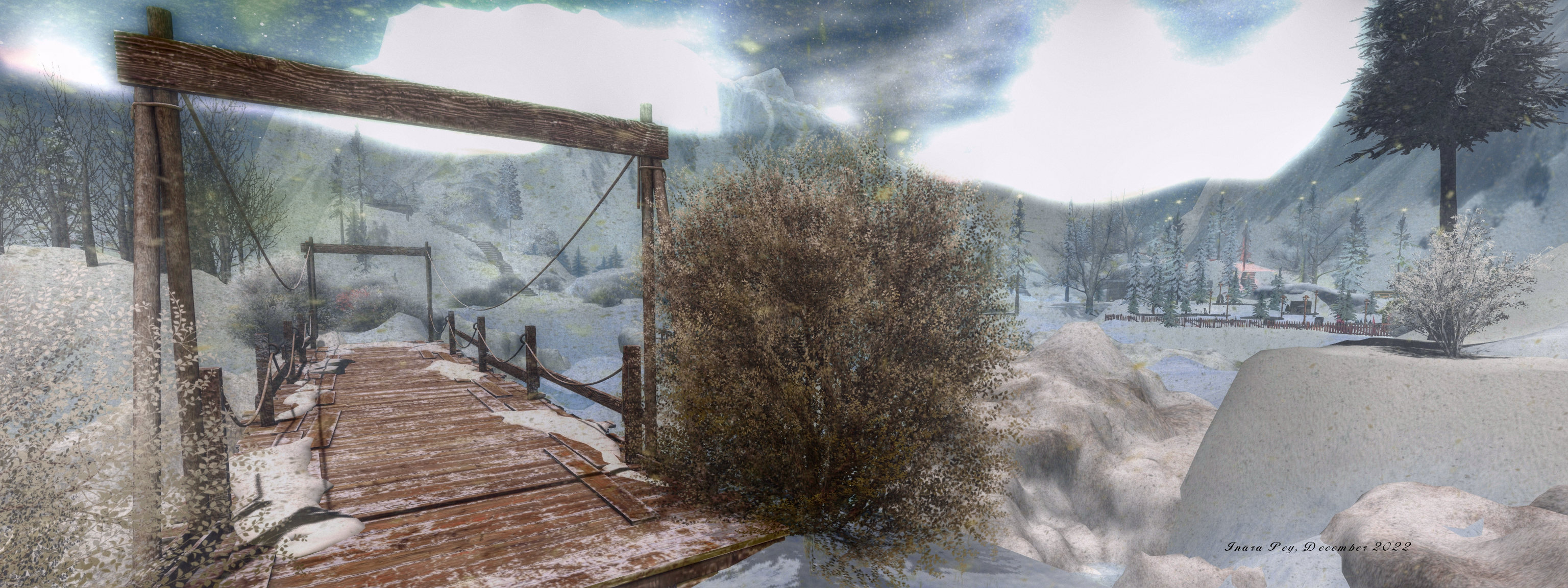
The landing point sits towards the middle of this snowy, icy setting, caught within the arms of the surrounding mountains. This mid-point sits over frozen water as they cut into the region. A rutted track, dusted in the snow – which is more-or-less constantly falling – offers a short walk to a miniature golf area, with many of the holes themselves dressed for the season.
Come explore a Northern Winter Wonderland underneath the Northern Lights! Dome rental, Madpea mini-golf, Santa … ice skating, sleds [and] hangout.
– Under the Northern Lights About Land
Under the Northern Lights, December 2022
Follow the track in the other direction and it runs past and around the local skating rink to loop back to the landing point, passing by way of a mobile café offering plenty of hot drinks for those who need warming up. Beyond this, multiple bridges and a couple of paths provide access to the outer parts of the region and the little rentals. At the time of my visit, several of the latter were rented and so obviously off-limits to casual explorers, but three were still available for those looking for something a little different to rent for the holidays.
Two of the bridges lead to a further public area, a setting fully of seasonal cheer, from Santa awaiting visitors to a roaring fire in a hearth and cost seating to be enjoyed; and – for those in need of them, some essential winter supplies and the opportunity to purchase a Christmas tree. Walk down the snowy slopes on the north side of this little winter market setting and you’ll come to another café. Brick built and with an inviting interior, it is far more permanent than the one up by the skating rink.
Under the Northern Lights, December 2022
With polar bears playing on the ice, and deer and horses scattered around, the setting keeps to the “Northern” in its name by only allowing penguins carved from snow to inhabit it.
Easy on the eye and presenting a gentle chance of exploration and multiple opportunities for photography, Under the Northern Lights makes for an easy-going visit.
The Arctic Sanctuary, December 2022 – click any image for full size
Nailah Carlucci-Remain (Nailah Carlucci) recently invited me to visit her latest design, The Arctic Sanctuary. which she co-hold with Satria Pexington. Occupying a Homestead region, it is – as the name suggests – an Arctic setting, albeit it one with seasonal touches throughout and with the typical quirk of such settings in Second Life.
Walk through an arctic expanse, among the polar bears and penguins. Then climb onto the enchanted Hogwartz express. From there, stop for some tea and a look at the art and charming rooms at the classical chateau. Then warm yourself at the Christmas village for hot chocolate, ginger snaps, games and lots of skating. Take the balloon ride for a tour of the region.
– Nailah Carlucci-Remain (Nailah Carlucci)
The Arctic Sanctuary, December 2022
The balloon tour is actually one of the first elements in the region arriving visitors may encounter, sitting as it does alongside the landing point in the north-west of the setting. The landing point is perhaps a little unsteady, being an ice floe tipping and pitching in the waves. From here the path runs by way of ice passing around the base of an iceberg to where the flank of a larger iceberg blocks the way forward, necessitating a climb up the ice face.
A set of climbing poses rise at the ice cliff, but these appear to be poses only, not animations; to get to the top of the ice is a manual climb. From here it is possible to climb up to a small bivouac or continue onwards over the ice to the rest of the region, starting with a headland where penguins play and polar bears hunt for fish along the edge of the water. Hot pools, there sides formed by calcified sulphur, sit across the spit of land from where the polar bears are seeking a meal, suggesting this is a volcanic location.
The Arctic Sanctuary, December 2022
As the land opens out a little, visitors arrive at the express train mentioned in the description above – although a ride aboard it is liable to be problematic given the engine sits derailed with a snowdrift (not that it had anywhere to go; the rails end at the drift and rocks, presenting the train more for photographic purposes than a means of transit).
Within the carriages are the elements of the Harry Potter series also referenced in the description. These can be enjoyed by those boarding the train, the restaurant car offering tea and cakes via magically floating service tables. The best way to board the carriages is via the rails that bend away from the main track to the trestle bridge on which the carriages sit, and then entering the first carriage via the forward door.
The Arctic Sanctuary, December 2022
The chateau and village lie beyond the tunnel from which the train is emerging, the tunnel or the snow and ice at the foot of hill it cuts its way through apparently the only ways by which to reach either the village or the chateau on foot. The trip through the tunnel reveals another of the region’s little quirks (the first being the presence of penguins in an Arctic setting; a not unusual factor in winter / polar settings in SL despite the incongruity, as noted at the start of this article): whilst the tunnel has at one end a railway line exiting it, at the other it has a paved footpath passing over a stone bridge, a broad drive pointing north to the chateau, steps to the east descending down to the little village.
The chateau is pleasing furnished as a period setting offering plenty of opportunity for photography; the village offers a range of attractions, including ice skating, a catch-a-Santa game, cosy indoor sitting and outdoor paces to enjoy roasted chestnuts or hot chocolate. Interactive elements exist throughout the region, both above and below the waves.
The Arctic Sanctuary, December 2022
When aboard the train for example, it is possible to obtain drinks from the elf and also touch the books for a few surprises; and should you be tempted by the treasure at the bottom of the waters under the rail bridge, you might find yourself becoming a snack for Bruce the Shark (film buffs may get the reference here). And even if you get past him, another surprise awaits at the treasure itself – you have been warned! In the meantime, for those who prefer their critters a little more sedate, there are a number of ice sculptures scattered around the setting.
An easy visit, The Arctic Sanctuary offers multiple opportunities for photography and interactive elements that help to make a visit fun and just a little bit different from the usual seasonal fare this time of year. All of which makes time spent within the region worthwhile.
Angel Mist is a Full private region that is genuinely multi-faceted in its offerings to visitors; so much so that when I initially dropped in back earlier in 2022, I ended up stuck on how best to tackle it without ending up with just a list of SLurls and individual descriptions. Even now, I’m not sure I’ve really escaped doing that, but given the diverse range of settings it offers and its potential for broad-based appeal, it deserves a write-up.
When I say multi-faceted, I really mean it; designed by Madam Chaos (TheAwkwardMochi) and Maxi (Maxwell Raynier) this is a region that cannot be simply pigeon-holed as club venue or a photographing region, or a role-play setting or purely as a hang-out; it is a mix of all of these elements and more – and as such, can be slightly bewildering given the number of potential access points (on my original visit, I came to the region via a Destination Guide entry that delivered me to the ground level, for example, and initially oblivious to the skyborne locations). This being the case, I recommend fist-time visitor avail themselves of the main landing hub.
Angel Mist, December 2022
It is here that visitors can gain an introduction to the region as a whole, and obtain a Tour Guide HUD, offered as a 24-page book (and which includes map-based teleports). The book can also be found at many of the locations scatter across and over the region, as can teleport boards and portals in the forms of photographs of various locations within the region (walk through a picture to be teleported).
Which you take is entirely up to you – in this, the Guide Book can help with the major locations with the region as it offers a description of each of them. However, there are a couple of words of advice I would give as you start out on your explorations:
This is an adult-themed region, and clearly noted as BDSM friendly; therefore there are some destinations within the region that include furnishings and other items associated with the lifestyle & sexual activities. Most of these items are in the more private areas within the region (e.g. the Boudoir, the Hidden Bedroom), but some can be found elsewhere and might be in use when you come across it. If such activities aren’t to your sensibilities or should the equipment / rooms are in use, the teleport will take you elsewhere in the region, such as the Cloud Garden.
Parcel and altitude EEP settings are used throughout the region, so make sure you have your viewer set to Used Shared Environment (World → Environment).
Angel Mist – Norrland, December 2022
The greater portion of the ground level is given over the The Cloud Garden, a fantasy / romance setting washed through with bright light. the light can be a little overwhelming when first encountered, but it gives the setting a dream-like quality, with all that is contained within the garden being revealed only as people explore. This is a place where clouds float with dance floors and houses sitting on their backs and when elven tree houses spiral upwards into the light and steps and stairs and paved footpaths present some of the ways by which the garden might be revealed.
The Cloud Garden sits nestled between rugged uplands reached via trail and stair. With towers rising from two shoulders, waterfalls tumble from their mid-point and paths winding across them, in places they hide a range of tunnels and caverns below, all with their own attractions, which I’ll let you discover. The coast and lowlands are a little rougher in terms of landscaping, with grassy and sandy landforms mixing a little chaotically, but there are further points of interest to be found here as well, with boardwalks and paths helping with explorations.
Angel Mist, December 2022
Overhead, the largest single area is Norrland, the name given to the Swedish-style village which shares a high sky platform shared with one of the regions clubs. The village is caught in the depths of midwinter, the aurora painting the night sky with swirls of colour and light. Here visitors can wander at leisure, sit and watch the snow fall or take a horse from one of the rezzers and ride around the snowlands and / or try their hand at the local jump course.
Overlooking the village to one side is the Graveyard Shift Goth Club, occupying the ruins of an old stone-built church. As noted, it is one of a couple of club venues within the region, the other being Max’s Jazz and Blues Club, located within its own sky box and offering three music venues inside as well as a link to The London Room, “for those who need a little romantic privacy”. Meanwhile, for those who prefer warmer settings, a further skybox offers the Harem, a more middle-eastern locale.
Angel Mist – The Graveyard Shift Goth Club, December 2022
All of this is still barely scratching the surface of what is an intriguing region in many ways; one where these parts might be seen as individual destinations for those with specific interests. Those who enjoy romance and dancing are bound to find a lot to enjoy here (dances are offered through the region’s different locations, whilst those looking for intimate BDSM locales for a little fun are also well served, as are photographers through the like of the Cloud Garden and the Earthquake Room.
Thus, Angle Mist makes for an engaging visit and very different visit.
Moochie – ‘Tis the Season 2022, December 2022 – click any image for full size
The last time I wrote about Maia Macabre’s Moochie was in January 2019 – see A Moochie Winter in Second Life – in what was a post-holiday visit. So this year I decided to make a pre-holiday visit and drop in to see the region in its 8th iteration of its theme ‘Tis the Season and have a little looks around.
This is a theme that carries with it from year-to-year familiar elements whilst also offering something new/and or different for visitors to appreciate. For example, the landing point tends to be located alongside a railway track; a place where arriving visitors can receive a folder containing an introduction to the region, a schedule of campfire events and a map denoting points of interest; there’s the ice-skating and the walk along a boxed hedgerow pointing the way to the local chapel; and, of course there are the many places for people sit together and / or enjoy a cuddle along the trails and paths and amongst the trees.
Moochie – ‘Tis the Season 2022, December 2022
The smell of roasted chestnuts drifts on the air, and mugs of steaming hot cocoa are generously filled to keep us fortified during the cold nights ahead. The gentle whisper of singing carollers draws your ear, as the flickering festive lanterns guide your eye through the woods to awaiting pathways.
– From the Tis the Season introduction
And speaking of cuddles – couples who wish to enhance the romance of a visit may wish to available themselves of the couples walking rezzer also available at the landing point railcar!
Moochie – ‘Tis the Season 2022, December 2022
The centrepiece of the region remains the frozen pond occupying a portion of the middle of the region. Surrounded by trees, this is reached by following the railway line south to where it is replaced by a string of wooden logs laid out over the snow to form a path. Illuminated by lights strung from and around the trees and by lanterns, its outer edge offers various places to sit and keep warm, whilst at its centre is a dance machine for those wishing to avail themselves of it.
Two further paths run through the tree from (or towards, depending on the direction of your wanderings!) this frozen pond; one of them taking visitors to the aforementioned chapel, and the other to where a box bridge spans a river as frozen as the pond. Beyond the bridge is a welcoming sight of a baked potato and hot drinks kiosk for tummies and hands in need of extra warmth, with copious seating seat out on the ice alongside the boardwalk running along what would otherwise be the water’s edge.
Moochie – ‘Tis the Season 2022, December 2022
The kiosk, and another one across the ice, are overseen by Grannies Glittercrackers and Snoozypudding respectively. It is also on the ice of the river that visitors can avail themselves of the opportunities to skate on the river, go sledding or enjoy a tour around the region in the back of a sleigh (seating up to 2 avatars) as it almost circumnavigates the landscape, looping back through the start-point of the tour in the process, allowing you to resume your explorations from there. You can optionally jump out of the sleigh at any time to continue on foot, but it will immediately de-rez to avoid cluttering things up.
As well as offering the path down to the pond, the landing point offers a second route of exploration: a snow-bound track winding through the trees to the right of the North Pole sign at the end of the tracks, and marked by a red lantern. Also leading the way to the river, this path is marked by sleighs parked-up for cuddles, braziers bright with wood fires warming them and offering further illumination along the trail.
Moochie – ‘Tis the Season 2022, December 2022
In retaining much that is familiar cross the years, ‘Tis the Season at Moochie offers something of a sense of tradition, comfort and familiarity to those who return each year. At the same time, the little tweaks here and there Maia makes to the setting helps to ensure there is always something new to discover and enjoy.
Those who do appreciate their time in the region can show their appreciation by signing the guestbook located at the middle of the frozen pond or by leaving a donation towards the region’s upkeep at the landing point. It is also at the landing point that people can send a postcard from the region to a friend in-world.
Back in November I wrote a piece on three cafés within the Mainland continent of Heterocera (see: The coffee houses of Heterocera in Second Life). At the time, I noted that I might do further pieces of a similar nature in the future – although at the time, I didn’t realise how popular that article would be; following it I received several notes card and IMs suggesting other cafés I might appreciate visiting (thank you to all who sent them!) and the Destination Guide has recently highlighted its section on cafés and similar social spots.
Given the feedback I’ve had, I thought I’d offer another handful of such spots in Second Life, starting with a further destination in Heterocera: Jitters Coffee Shop.
Located in the north-east of Heterocera and bordering Beach Road (Route 4), Jitters is the property of Cynthia Deere and landscaped by Emm Vintner (Emmalee Evergarden) of The Nature Collective fame (and who has helped with or formed other cafés with Second Life (and Heterocera).
Jitters Coffee is a feeling and a hope that we can all come together over a cup of your beverage of choice and have splendid conversations!
– Jitter Coffee Shop About Land
Jitters Coffee Shop, Heterocera – December 2022
Occupying a tidy 4,256 square metre parcel, Jitters was, at the time of my visit dressed for winter which, given the largely outdoor nature of the seating, might make a visit a little on the chilly said at this time of year! Fortunately, warmth can be found in front of the terrace fireplace or the open fire pit a very short walk from the shop, for those who feel they may need warming up.
This is an wildlife-friendly spot, the grounds around the coffee shop playing host to a number of bird boxes and houses (some of them occupied / in use), while foxes and owls keep a watchful eyes on all comings and goings, whilst deer, rabbits and a weasel are also to be found. Being sited at the roadside, it’s a place that can easily be added to a road tour which might also encompass the cafés feature in my previous piece.
The Rainy Café, Jeogeot – December 2022
My next stop keeps with the winter theme, although it shifts continents and isn’t accessible by road, although that shouldn’t keep folk from visiting. Designed and built by Evangeline Miles, The Rainy Café sits within a skybox setting above the southern coast of Jeogeot. Established in Autumn 2021, this is a place which, despite being down on a southern continent, is joining in the general winter theme common to Second Life at the end of each year.
Come in out of the snow. The coffee and treats are fresh & there are plenty of cosy corners to curl up in. Discover a carefully-curated space for those who think life is better with coffee, conversation, & calm snowy days.
– The Rainy Café About Land
The Rainy Café, Jeogeot – December 2022
Sitting with woodlands where snow is falling gently to blanket the ground, The Rainy Café offers respite from the weather with a cosy interior composing the central coffee bar and sofa-style seating warmed cast-iron and electric heaters, it has been extended with the addition of two glass conservatory wings with counter seating and high tables. It’s a functional setting edged with cosiness. For those who prefer, there is a table outdoors to the rear of the café, whilst sitting back among the trees is a glass Gazebo offering a warm, cosy retreat for those who seek it.
Also found within southern Jeogeot and down on the ground is Pumpkin Spice Café. This is an ultra-modern design set alongside a small garden, both the work of Nutmeg (NutmegPinch) and Becca Vichan. Unlike the previous locations, this is a two-storey café brought to life by the presence of static non-player characters (NPCs) either seated in the building’s lower deck or queuing for coffee indoors. Upstairs is a small lounge area where coffee appears to be offered on a self-service basis and the seating a chic mix of sofas and armchairs. Outside, the garden offers a relaxed circular walk and a circular seating area sitting below a shaded swing.
Pumpkin Space Café, Jeogeot – December 2022
My last two stops for this article like within Corsica, and between them offer the opportunity for a road trip, each with its own attractions.
The first is NovaOwl Café, down on the continent’s south coast. It combines both a café and the NovaOwl Gallery operated by ULi Jansma, Ceakay Ballyhoo & Owl Dragonash and a regular feature for art reviews in this blog, and which thus offers the opportunity to appreciate the current exhibitions on both the ground level alongside the café or in the sky galleries above. The outdoor deck of the café is used to host opening events at the ground-level gallery, whilst the indoor area offers addition dance space alongside the coffee bar whilst a mezzanine above offers a comfortable seating area.
NovaOwl Café, Corsica – December 2022
Across the water to the north, Circuit la Corse – the major road looping around Corsica – passes around the continent’s southern headlands. Follow this eastwards and eventual and by way of tarmac, cobbles and wooden boardwalks, it is possible to reach The Reading Room by Shoshin Café, operated by Zoe Foodiboo.
A haven for those who love reading, this is a novel café in that it is divided sharply into two parts. Approached from the road, it appears to be a glass-fronted reading room / library with little hint of it being a café. However, two of the large bookcases forming the back wall of the reading room are in fact doors. Behind them is a single large room where group reading can be enjoyed with a cup of coffee or tea or other beverage. With an opportunity to have your poetry feature on a board outside the front of the café, allowing The Reading Room to offer a personal touch for those wishing to available themselves to the offer.
The Reading Room Café, Corsica – December 2022
Diverse but linked by a common theme, the cafés of Second Life offer plenty of reasons to explore the Mainland continents and also, for those who wish to, the many private estates found throughout the grid – some of which are also connected by water and may well be the subject of a further article in this series.
A Calas Christmas Wish, December 2022 – click any image for full size
In the bleak mid-winter Frosty wind made moan Earth stood hard as iron, Water like a stone; Snow had fallen, snow on snow, Snow on snow, In the bleak mid-winter Long ago.
So goes the first stanza of the 1972 poem, A Christmas Carol, by Christina Rossetti, and which is perhaps known since 1906 – when it was set to music by Gustav Holst – as the seasonal hymn, In the Bleak Midwinter. It’s an odd poem in many ways, confusing the hard, cold winters of the Victorian era with the warmer climes of the Middle East and the birthplace of Christ.
A Calas Christmas Wish, December 2022
But putting the religious cast of the poem to one side, that first stanza does capture the essential point that winter can be an especially hard time for all; the weather can be bitter; snow, whilst fun for some, can also be isolating in many ways; the days are short and can often be leaden with heavy cloud or dulled by freezing fog which refuses the Sun’s urges to burn itself away, and so on.
That said, even in the depths of Midwinter do come times to celebrate, to revel – if just for a moment or two – in that the same snow on water gives the latter the strength of stone as it lay sheathed in ice; that we might look to the end of the year in joy, and perhaps think of the coming year and the opportunities it may hold and the joy it may bring. In short and despite the cold, the end of year and its association with winter within the northern hemisphere can be a special, precious time, with traditions aplenty.
A Calas Christmas Wish, December 2022
Within Second Life, one of the greatest of those traditions is the Calas Galadhon Christmas / Winter setting with its two regions of snow, entertainment, ice skating, dancing, sledding, balloon tours, sleigh rides, and lots of opportunities for photograph and exploration.
The theme for this year is once again A Christmas Wish, which this year is located on the regions of Midwinter and Midwinter 2 (the region names giving me the excuse to quote Rossetti’s A Christmas Carol!). This is perhaps actually a more relaxed setting than previous years with a greater sense of an open wilderness marked by snow and bounded by woodland and off-region surround elements which add to its since of remoteness and romance; all of which all come together under the guiding hands of Ty Tenk and Truck Meredith to offer a setting with a familiar mix of time-honoured elements and new trails to wander.
A Calas Christmas Wish, December 2022
Visits begin at the skybox landing point for those visiting for the first time. On arrival, new visitors are offered a copy of the music events schedule in texture form and a notecard of landmarks for direct teleporting to various locations within the regions, together with the option of visiting the Calas Galadhon website. From here, follow the candy stripe arrows across an icy landscape to where the portal to the regions awaits (if you’ve never done so before, you’ll be asked to join the local Calas Galadhon Experience in order to complete the teleport down to the ground level), where your explorations proper may begin.
Of course, the centrepiece for the setting remains the Pavilion, rich in its holiday / Christmas looks and home to the music and entertainment – check just inside the main entrance for dates and times of events, or join the Calas Galadhon in-world group for notices if you did not collect a copy of the schedule from the landing point. This sits above the giant skating rink at the northern end of the trails winding up from the ground-level landing point, allowing people to wander through the landscape, explore, take photos and find the little cosy spots indoors and out along the way by which to rest and maybe enjoy a cuddle or two.
A Calas Christmas Wish, December 2022
Around the frozen waters of the ice skating lake can be found other familiar touches – the Calas Polar Express, the balloon tour, the winter lodge and the fine dining pavilion with their own opportunities for dancing. For those who prefer, there are the sleigh tours alongside the landing point to carry you around the setting. Capable of carrying up to four, depending on which you select, they give the excuse of keeping a sense of warmth and you huddle under blankets and watch the sights of the region sliding by. Not far from the sleigh rides, and at the start of the Pavilion trail, is a horse rezzer for those who fancy time exploring on horseback.
A Calas Christmas Wish, December 2022
The Calas Christmas regions are always a popular destination, and avatars can place the heaviest load on the viewer, consider keeping your avatar dressed accordingly, use Bakes on Mesh, and avoid outfits that utilise multiple high-res unique textures. Also, to assist the simulators, do lighten your script load.
Also, keep in mind that because the regions are popular, you may want to make adjustment to your viewer to help with processing: reduce the maximum number of fully-rendered avatars, perhaps turn off shadow rendering, if used (other than for photography), drop your draw distance, etc.