Kubrick and Wells in Second Life

The Kubrick Rooms

I was recently alerted to a couple of small exhibitions in Second Life with could be of interest to lovers of film and of science fiction: The Kubrick Rooms and the Wells Exhibit.

The Kubrick Rooms are the work of Rumpledink Robbiani. As the name suggests, this is something of a homage to legendary film-maker Stanley Kubrick. First opened in 2008 and available to visitors for a year thereafter, the rooms have been in limbo since then. However, Rumpledink’s friends encouraged him to bring them back in-world and he notes that this time, he hopes the money received in donations and from sales will help keep it around for longer.

Rooms is neatly designed around three of Kubrick’s most notable films: The Shining, 2001 A Space Odyssey and A Clockwork Orange, with The Shining taking overall centre stage by providing the setting. Visitors arrive at a small anteroom where instructions are offered (set the viewer’s time to midday), together with a single door. Step through this, and a familiar – to anyone who has seen The Shining – hallway from the Overlook Hotel opens up, complete with child’s tricycle.
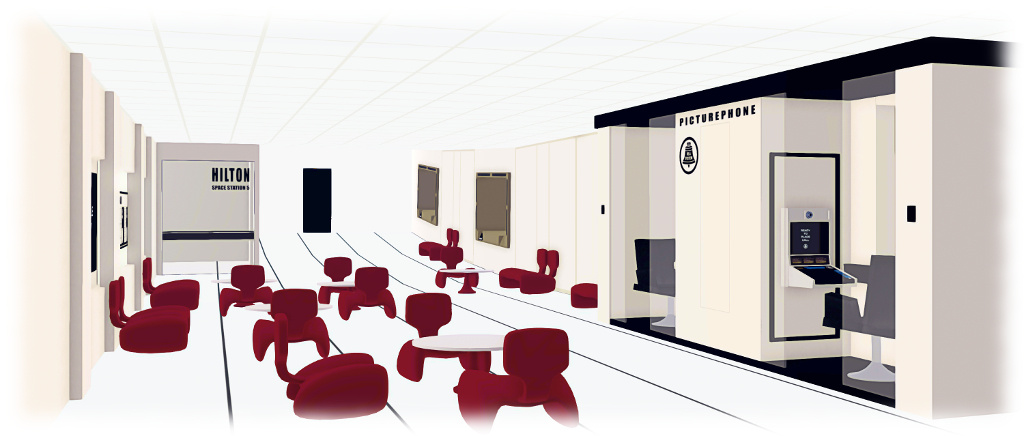
The Kubrick Rooms

As one would expect of a hotel, the hallway is lined in either side with room doors, some of which have their keys in the locks. They offer access to sets from The Shining – a lounge, the restrooms, the bathroom – as well as to the main rotating hallway of Space Station 5 from 2001 A Space Odyssey, where Doctor Heyward Floyd stops-over en route to the Moon and TMA-1, and another featuring A Clockwork Orange.

Within some of the rooms there are videos which delve into The Shining and 2001 – just ensure media is enabled on your viewer and click the screens as you come across them. A small cinema at one end of the hallway offers the 2014 documentary Kubrick Remembered, looking back on the great man’s life. At almost 90 minutes long, this is more than worth watching, presenting a fascinating retrospective on the man. Alongside of this is a small gift shop.

Wells Exhibit

The Wells Exhibit can be found on the floor above Netera’s Coffee Lounge in Snug Harbour, and is curated by the lounge’s owner, Netera Landar. Use the teleport door set into the wall of the lounge, the disk on the floor, or the outdoor staircase to reach it. Examining the life and works of Herbert George Wells, the English writer, this is a somewhat more modest affair than The Kubrick Rooms, designed to fit within the space provided by the upper floor of the coffee lounge.

Information boards provide biographical information on H.G. Wells while the walls are home to archive photographs of him and a note card giver listing his publications. However, the majority of the exhibit focuses on Wells’ science fiction works. There are posters celebrating The Island of Dr. Moreau (1896), The Invisible Man (1897) and The Sleeper Awakes (1910), together with small pictures dedicated to A Modern Utopia (1905) and The Shape of Things to Come (1933).  Two slightly larger displays touch upon what might be his most well-known novels: The Time Machine (1895) and The War of the Worlds (1897).

Wells Exhibit

Information on Wells’ writing is actually a little light and could perhaps benefit from two or three additional information boards. However, the Wells Exhibit still makes for an easy-going visit for those with an interest in his work. For those looking for a more unusual outing, it and The Kubrick Rooms might be just the ticket.  

SLurl Details

A return to The Mill in Second Life

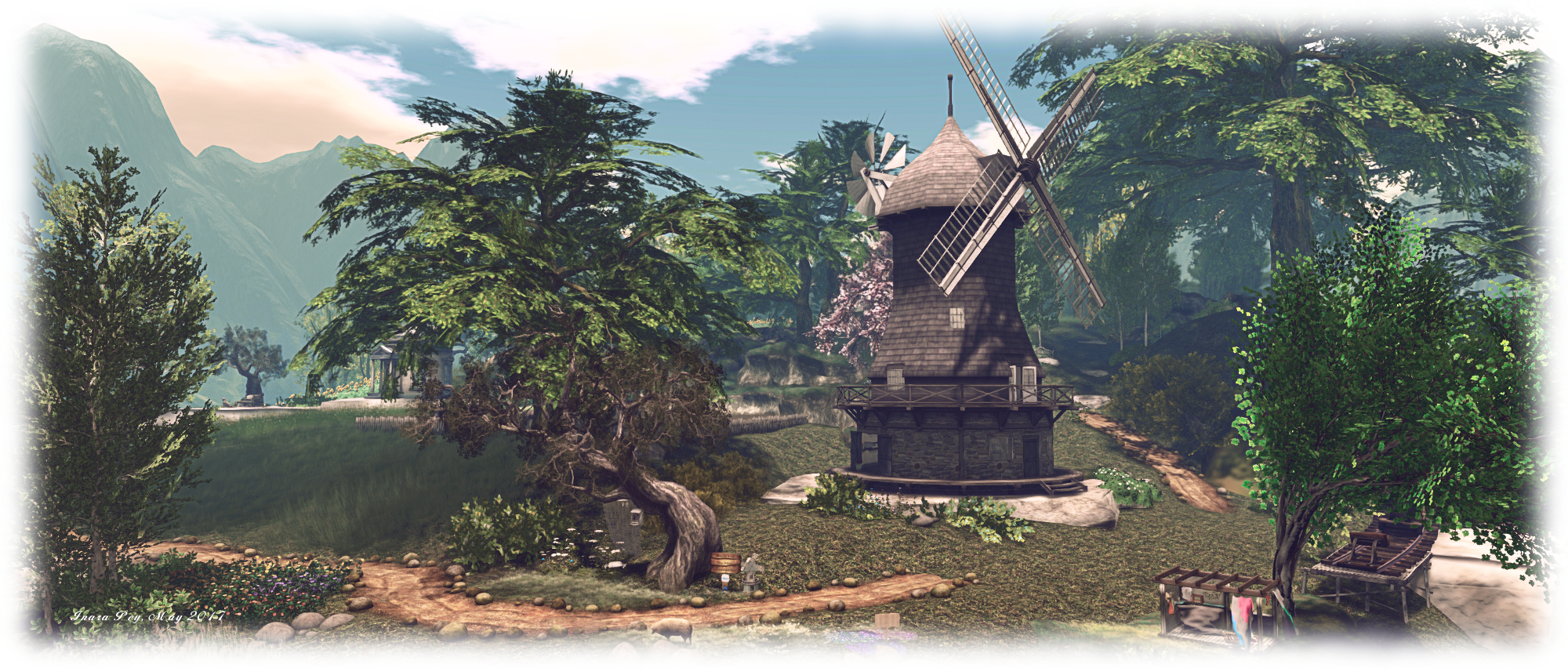
The Mill, Pale Moonlight; Inara Pey, May 2017, on Flickr The Mill, Pale Moonlight – click any image for full size

Just as in the physical world, there are certain places in Second Life we’re drawn back to again and again. This might be because the place has special significance, or because it is held by friends or offers a opportunities or photography or simple enjoyment, or because it is like the seasons – constantly changing and renewing.

For me, The Mill encompasses all of the things, and so is a natural choice for semi-regular revisits. Designed by friends Max (Maxie Daviau) and Shakespeare (SkinnyNilla), it is an ever-evolving place, always marvellously landscaped and presented, beautifully photogenic and delightfully restful.

The Mill, Pale Moonlight; Inara Pey, May 2017, on Flickr The Mill, Pale Moonlight

Celebrating spring and summer, this version of The Mill takes us to what might be the Apennine Mountains – perhaps, going on the style of buildings here, the Tuscan–Emilian Apennines. Surrounded by tall, rugged peaks, the rocky dome of a hill (or if you prefer, an island) rises from the waters of (again, depending on your point of view) either a lake within the mountains, or the confluences of rivers running through them.

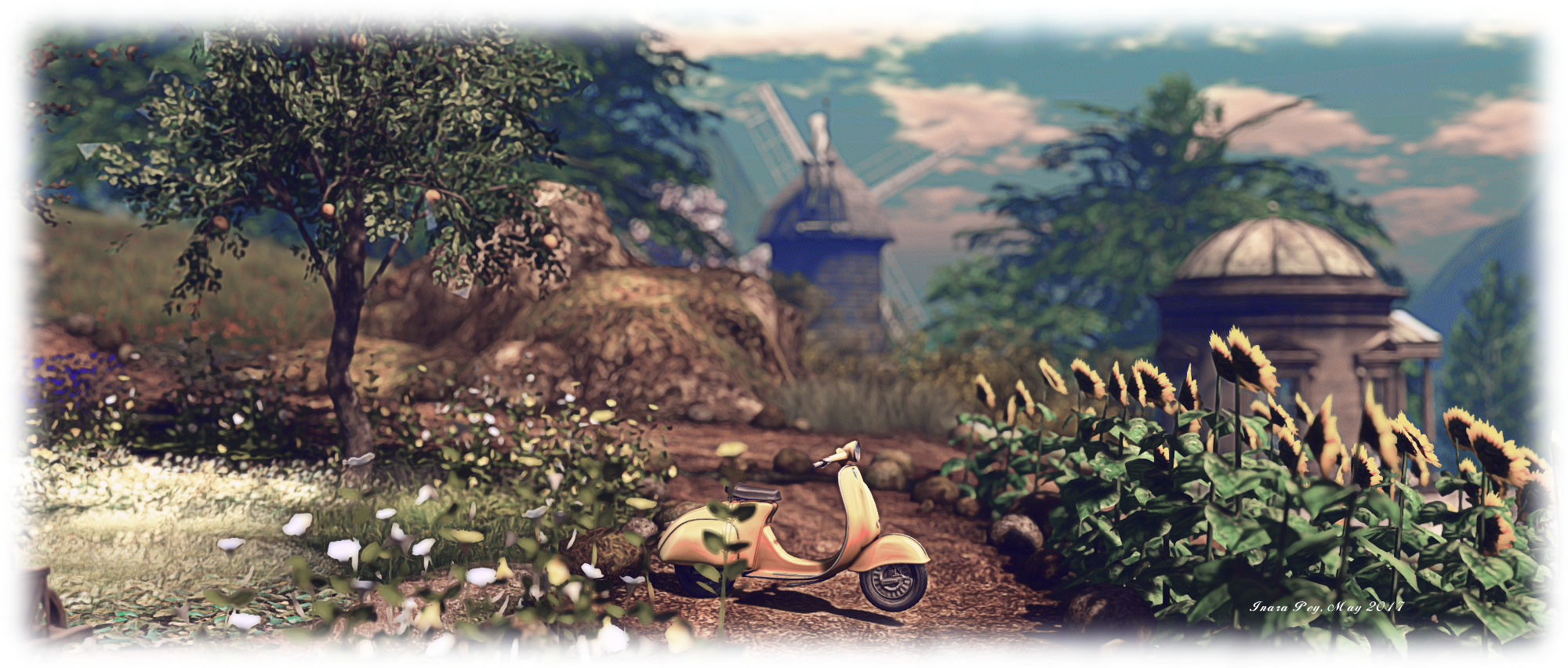
The majority of this island hill is given over to a farm where grapes and sunflowers are being cultivated. The farmhouse sits at the top of the hill, surrounded by woodland trees, wild grass and the nearest field of sunflowers. It is reached by a meandering track that slowly winds its way up the hill, passing further rows of regimented sunflowers and flat-topped outcrops of rock, content in taking its time to reach the farm, its wandering course encouraging visitors to do the same.

The Mill, Pale Moonlight; Inara Pey, May 2017, on Flickr The Mill, Pale Moonlight

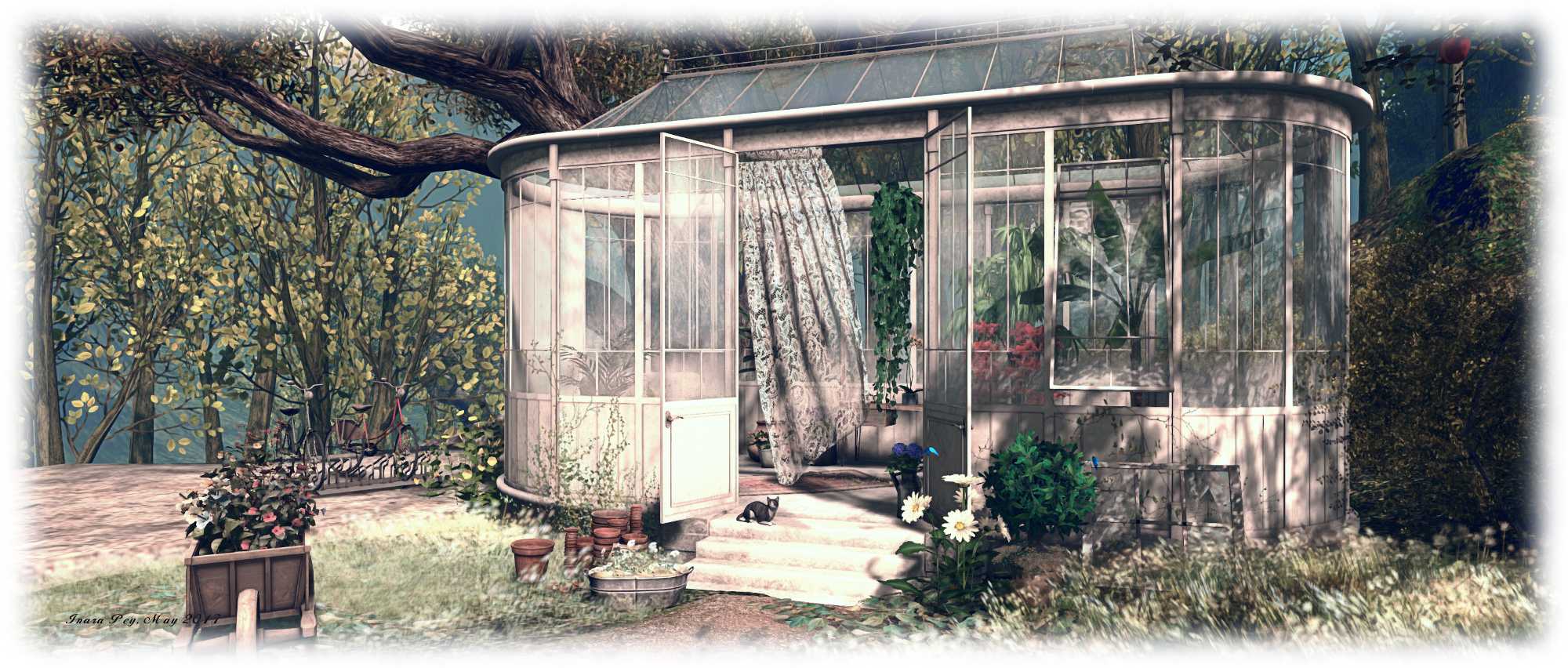
Few of the rocky tables pushing their way clear of the hill’s slope and grass are bare, Instead, each offers a point of interest – a folly, an artist’s studio, a swing beneath an aged, bent tree exerting a tenacious grip on the rock under it. Thus, each becomes a destination in its own right, filled with detail, enticing people to tarry, rather than hurrying onwards.

The track, which runs alongside the landing point, offers a fork which leads around the east shoulder of the hill to a steep slope falling away to the waters below. Here tall beech trees watch over a parade of vines already heavy with ripening grapes while a small summer-house sits close by, atop another outcrop and offering views both inland and out over the water.  On the north side of the land, the grassy slopes roll gently down towards the water’s edge, pointing to a café sitting atop a square promontory. Bracketing this and forming the shoreline, is a sandy beach to one side, and a grassy, gravelled bank on the other, connected to the track above by a terraced board walk.

The Mill, Pale Moonlight; Inara Pey, May 2017, on Flickr The Mill, Pale Moonlight

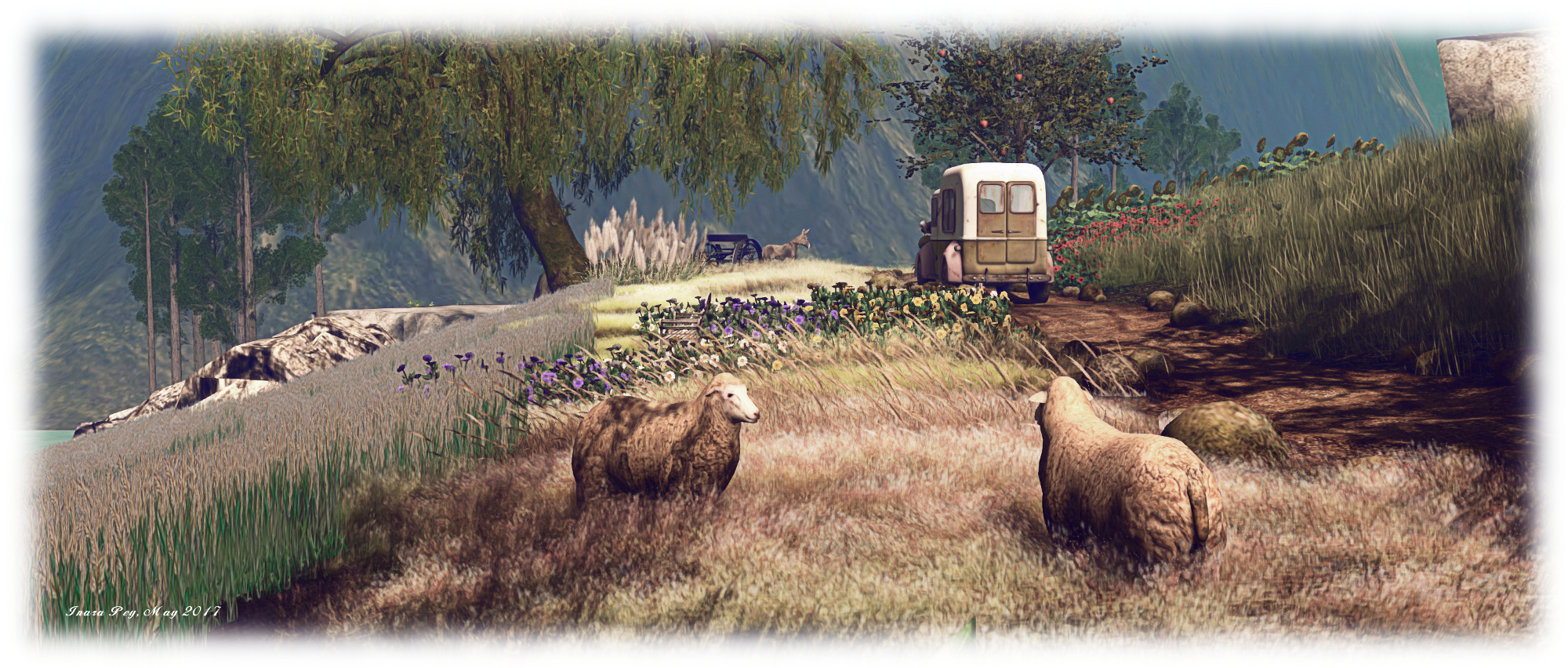
One of the things that repeatedly attracts me to The Mill is the way the landscapes designed by Shakespeare and Max are always beautifully natural. In this design, the blending of grassy slopes, woodland copses, the mix of gentle slopes and rocky outcrops and the way in which the natural contours of the hill are used for buildings and tracks, etc., is a perfect reflection of how such a place would appear in the physical world. Fenced grazing for horses is provided in a natural step in the hill, sheep wander the slopes as they wish; everything is as nature (and human needs) would intend.

There is also an attention to detail here that is exquisite, be it the inclusion of livestock and wildlife, or little touches such as the shaded beehives, the sprinkler feeding the sunflowers and all the little signs of habitation that bring the farm to life, and the little knick-knacks to be found inside the studio, folly and so on. All of this further brings The Mill wonderfully to life.

The Mill, Pale Moonlight; Inara Pey, May 2017, on Flickr The Mill, Pale Moonlight

With plenty of opportunities to simply sit and admire the landscape and enjoy the accompanying sound scape, or to wander through the long grass and between the trunks of beech, oak, pine and birch, The Mill continues to offer something for every lover of nature and much to please the eye and lens of any photographer.

SLurl Details

  • The Mill (Pale Moonlight, rated Moderate)

A Rustic Retreat in Second Life

Rustic Retreat – click on any image for full size

Rustic Retreat is a full region designed by Pred Fromund (Predator Ryba) and Bluey Porthos Fromund (Blue Whitefalcon). Described as ” an ideal place for photographers – or those that like to explore or just chill out”, it is a place of many facets: fantasy, whimsy, beauty, mystery – and a little darkness as well.

The fantasy element is made apparent at the landing point, alongside of which a Troll stands, whilst fairies play around a nearby fountain. The mystery is also evident to keen eyes, as strange plants can be seen further away along the fire-lit path, glowing and swaying in the breeze. Also not too far away, fantasy and mystery come together beyond a stone arch sitting alongside the trail.

Rustic Retreat

The default lighting for the region is night (although I opted to take most of my images in daylight), and I recommend exploring it; at least in part, as there are several areas which deserve to be seen in daylight, such is the attention lavished upon them. Torches and fires light the trails winding through parts of the region, and the glowing beauty of Elicio ember’s fabulous plants lend themselves perfectly to the night-time lighting.

Where you wander during a visit is entirely down to you; the trails will lead you to various places – one might lead to ancient ruins here, a little cuddle spot there, Another might take you to where a fork in the path gives you a choice of a climb up to a platform among waterfalls, or a  path through the skull of a dragon and thence to a basalt-ringed garden and pool with a coastal board walk beside gigantic mushrooms close by.

Rustic Retreat

This is a place where a Tree of life raises strong and tall into the sky, its base a place of elven-like power; where a lone tower rises from the surrounding woods, overlooking a wizard’s cottage on one side, and anther mystical glade on the other – albeit one also given to a touch of whimsy thanks to the characters to be found there.

Travel far enough and you’ll encounter more: coastal ruins, the gaiety or rabbits frolicking,  more whimsy in the form of pixie and fairy houses and gardens – and throughout all of it, places to sit and enjoy the sights and sounds. Meanwhile, the more adventurous can available themselves of network of teleport discs.

Rustic Retreat

These offer shortcuts to some of the ground-level locations, but it can also take you skyward, where the “darker” aspects of the region lie, such as a ghostly club where one gets the impression vampires and lycans might put aside their differences for a  while. Alongside of this is a post-apocalyptic setting where zombies and other creatures roam – and visitors are offered the protection of a free weapon. Elsewhere, you might find a small homage to Mary Shelley’s classic Gothic novel.

Picturesque by daylight, hauntingly mysterious by night, photogenic under any lighting conditions, Rustic Retreat offers an intriguing and eye-catching visit.

Rustic Retreat

SLurl Details

An Asian Fusion in Second Life

Asian Fusion: Oyster Bay – click on any image for full size

We received word that Sera Bellic had given her Homeland region of Oyster Bay a further make-over some 24 hours before it appeared in the Destination Guide Highlights for Friday, April 28th – and I was immediately intrigued by the theme title: Asian Fusion. Regular readers of this blog will know that anything having any kind of Eastern or oriental flavour is bound to get my attention. So, off we hopped to take a look.

Now, truth be told, “Asian” and “oriental” fusions in Second Life often tends to lean towards regions with a blending of predominantly Chinese and Japanese elements, so I was curious to see if Sera would cast her net wider than purely Sino-Japanese influences. And she has. Quite marvellously so.

Asian Fusion: Oyster Bay

From the landing point in the north-west corner of the region, visitors are encouraged under a rocky arch and into a land that immediately puts one in mind of Indochina (or as we more boringly refer to it today: South-east Asia). Across a small river spanned by a simple yet ornate wooden bridge, a paired tier of rice paddies are stacked against a rocky bluff. Working oxen stand on the grassland between stream and paddies,  ignoring the click-clank of a nearby shishi odoshi which forms part of the region’s nods towards Japan. Another such nod can be found on the north bank of the river, where a small Japanese style cabin sits amidst elephant’s ears and clover, refreshments on offer inside, a sampan sitting at the river bank close by.

Immediately to the right of the rocky arch guiding visitors into the region is a clear nod to China. A bamboo grove rises on a step of clover-covered rock, home to a bamboo of pandas (I much prefer that to the the idea of an “embarrassment” of pandas, or the Royal Society’s 1866 decree that a group of pandas should be called a “cupboard”).  Like the oxen across the river, these bears are not the slightest bothered by the steady clank of an shishi odoshi.

Asian Fusion: Oyster Bay

Southwards across the region, and the landscape becomes home to a dense, forest-like woodland. Here one is put in mind of Myamar (Burma), such is the jungle-like feel, coupled with the presence of another vulnerable / endangered species: the tiger. Within this mini reproducion of what might be  the Hukawng Valley, can also be found a Japanese torii gate marking a set of ancient stone steps leading to a decidedly Chinese pavilion where Buddha sits, all of which speaks further to the beautiful fusion of influences provided. Guarding this pavilion and hilltop are white Bengal tigers, offering a further and interesting fusion.

Travel north from the forest, and another  torii gate and flight of steps await. These lead up to a Japanese house sitting behind the rocky bluff against which the rice paddies have been built. Another house stands further to the south, beyond the forest and not far from the pandas in their bamboo grove, while in the middle of the region, rich in cherry blossom petals, sits a tranquil pond which feeds into the little river.

Asian Fusion: Oyster Bay

I’ve long enjoyed Sera’s designs. each one tends to be unique and offer food for thought when considering designs and ideas of use at home or elsewhere. However, every so often there is a design which tends to stand slightly above Sera’s other builds for one reason or another. Asian Fusion is, for me, another such design; the way a range of influences have been brought together is simply marvellous (I even felt Sri Lanka, a country I love dearly reflected in a couple of places).

This is not so much a place to be visited as it is to be savoured. Simply wonderful.

Asian Fusion: Oyster Bay

SLurl Details

Asian Fusion (Oyster Bay, rated:  Moderate)

Enchanted Art in Second Life

Enchanted Art

Enchanted Art, operated by Oema Resdient and Magda Schmditzau, is based on Oema’s homestead region, Astralia, which I last blogged about in August 2016. The idea is to present artists with the opportunity to display a selection of their work on a monthly basis, with those who apply and are accepted being promoted through the Enchanted Art web pages on Oema’s blog and through the usual in-world channels for art.

The current exhibition features Bamboo Barnes,  Jarla Capalini, Clary Congrejo, Paola Mills, Antarctica Slade, Toysoldier Thor, Lissa, Terrygold, with Oema and Madga rounding-out the numbers. Each artist is provided with space to display two 2D pieces of art, with Toy also supplying one of his 3D masterpieces.

Enchanted Art

The region offers a marvellously enchanted aspect for exhibitions, being decorated using Elicio Ember’s wonderful plants and  creations, which have been brought together under a suitably atmospheric windlight to  present an ethereal, otherworldy setting visitors are encouraged to explore. Within this, there are two areas in which art is displayed: an open-air setting and a separate gallery building.

The landing point delivers visitors at the foot of the outdoor exhibition area, caught in the light of a setting sun, which is periodically eclipsed by the presence of another body in the sky – one big enough to suggest is it a planet, and the gallery and its surrounds are perhaps on a moon of that world. This outdoor space makes for a pleasant walk, platforms for the artists to either side of the path, each clearly labelled and with a Flickr link to the artist’s photo stream. The offer of biographical notes would have been appreciated, but this is a minor point.

Enchanted Art

Close to the landing point sits a teleport disc, part of a network that connecs the major features of the region, including the aforementioned gallery building. However, there is also a set of footpaths winding their way around and through the landscape, and these offer an opportunity to see more than the teleports might suggest is to be found. So an exploration by foot is recommended.

Artists wishing to join an exhibition at Enchanted Art can click on the application boards in-world, which will provide a link to an application form. Successful applicants are selected by Magda Schmdtzau. Criteria / focus for exhibitions aren’t given, suggesting that applications are open to artists from all fields (although the April exhibition does show a strong bias towards avatar studies).

Enchanted Art

Enchanted Art is an eye-catching way of presenting art exhibitions. The use of the entire region to create an environment – and in this case and ambience – is something I enjoy seeing (and something we’ve striven to achieve, environment-wise with Holly Kai Park). Ergo, I have no hesitation in recommending a visit.

SLurl Details

Patankar’s peace in Second Life

Patankar – click on any image for full size

Patankar is one of those places to which we all want to escape every once in a while. A corner of the world where worries and needs can be forgotten, and you can lose yourself in the landscape, wandering where you will, or idle on a sandy beach, or sit and watch the local wildlife and livestock while your mind wanders wherever it likes.

Designed by  Dama (Damatjo Magic) and Alex Broxy (FullD2), Patankar is a beautifully conceived homestead region, the majority of which is open to the public to explore and appreciate. The only exception is a private home in then north-west corner of the region which is off-limits to causal visitors.

Patankar

There doesn’t appear to be a set landing point (although the pier has a welcome mat / group joiner), and the landmark I’d been passed dropped Caitlyn and I neatly towards the south-east corner of the region, where a board walk snakes its way from dusty track and along the edge of a beach to where a small stream tumbles over rocks the reach the open sea. Curving around the south-western sides of the island, the beach offers little places to sit, both out in the sun and under canvas shade, separated from the rest of the land by two scrawny hillocks.

A little further northwards, between the beach and the private residence, there sits the long finger of the aforementioned pier, pointing out to sea and reached by a broad set of wooden steps. Not far away, the island’s dusty track meanders past before turning sharply inland. Follow it, and you’ll quickly reach a T-junction – one of several which split the track as it weaves across the island. The left fork of this particular junction points the way to a Tuscan-style farmhouse, while to the right, a wooden bridge spans the stream before the track forks again.

Patankar

A second small farmstead sits near one arm of the track as it curls back to the stream and another bridge. Horses graze in a small paddock next to the tin-roofed farmhouse, a tractor parked and waiting close by. Behind the farmhouse the land rises sharply into a rugged hill, the abode of goats but with a path winding up through it. Those willing to take the hike along it can be rewarded with time in a hot air balloon; those less inclined to make their way to the peak will find several places to sit down and take in the scenery along the way – although the view from the peak really is worth the effort!

Sitting in the lee of the hill stands a wooded copse, blankets spread on the ground or on tree stump, awaiting those seeking rest. Not too far away, a little dock offers a view eastwards out over the sea, and more places to sit.

Patankar

And even with all this, the region still has more to offer – such as the little island to the north-east, or the stepping-stones criss-crossing the small lake to the south, where an upturned rowing boat leans on its prop to offer a secluded snuggle spot beside the water. In fact, wherever you roam, you’re bound to find places to sit and relax, and cuddle or chat, such is the welcome to be found throughout the region.

Complete with an appropriate sound scape, Patankar is a genuine delight – yes, there is the odd tree and bank levitating very slightly above the ground, but these don’t change the fact that the region has been put together with a considerable amount of love; nor do they make it any the less photogenic. This is very much a place to be visited, savoured, and enjoyed.

Patankar

SLurl Details

  • Patankar (Family Dreams, rated: Moderate)