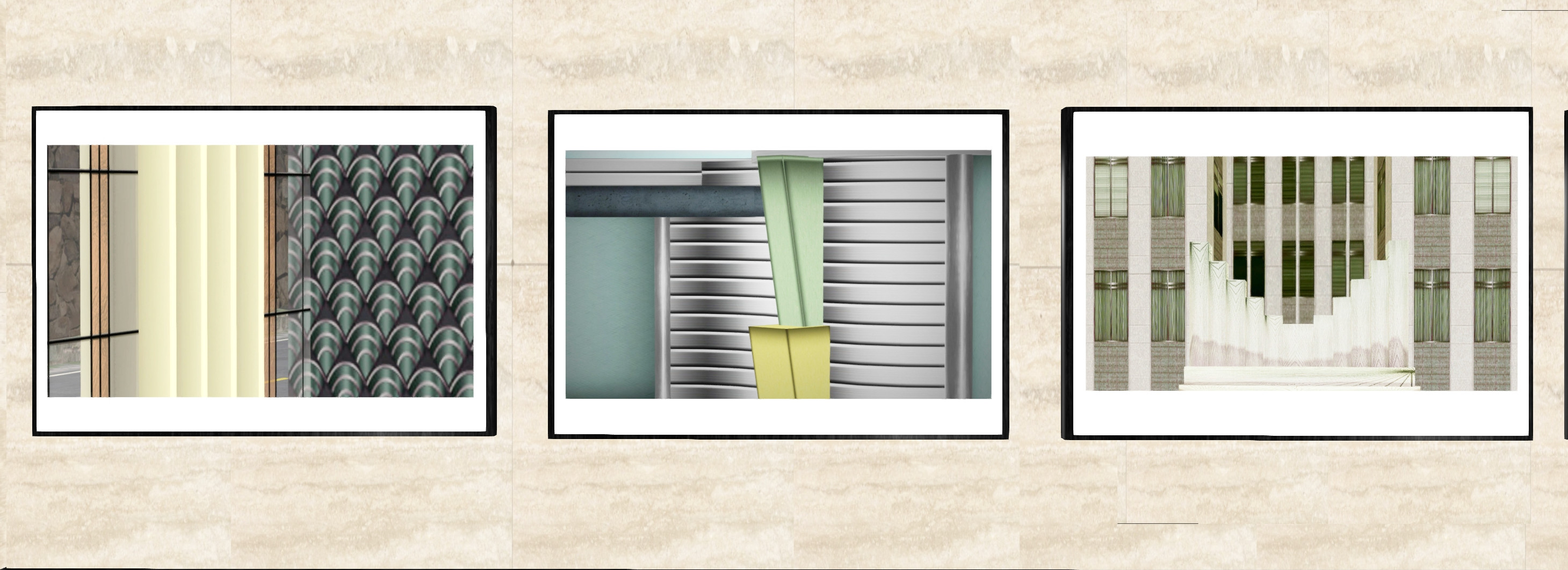
Spread across two levels in the south-west corner of the main structure, the gallery space is a blend of the antiquarian architecture of the core build mixed with modern glass-and-steel elements to present a space that is both enclosed enough so as not to impinge on the sense of history found within the rest of the build, but also in and of itself carries a sense of being light, airy and free from any sense of being confined within the larger build.
The Antiquorum Art Gallery: Alexa Wulfe – Landscapes – My Personal View
The aim of the gallery is to to work alongside the ballroom and other facilities found within the Hanging Gardens to provide a “home for some of the best artists in the grid to show their work, together with a very exclusive cultural programme of concerts and cultural events”, and April 2nd, 2022 saw the opening of Landscapes – My Personal View, by Alexa Wulfe (Alexa Bouras).
Supported by Mistero Hifeng’s familiar sculptures, the exhibition presents some 24 images by Alexa spread across the gallery’s two levels. As the name suggests, this is a very personal view of Second Life, one seen through the eyes of the artist-observer, offering unique views of our digital realm. Most of which have been post-processed with the aim of presenting them as paintings (primarily watercolours, although a couple have the heavier sense of oil about them whilst others offer a finish suggestive of having been drawn.
The Antiquorum Art Gallery: Alexa Wulfe – Landscapes – My Personal View
However, the one thing all of them have in common is the fact that they have been beautifully executed to offer richly engaging views of Second Life that cannot fail to capture and hold the eye and the imagination. With them, we can voyage through several of SL’s popular public regions and see them as Alexa viewed them in her travels, the colours and finish of each allowing us insight into Alexa’s sense of her subjects and the tales they may have formed in her imagination.
For me, the exhibition was a superb introduction to another highly talented Second Life photographer, and I look forward to seeking out more of Alexa’s work in-world – and also to visiting more exhibits to The Antiquorum Art Gallery.
The Antiquorum Art Gallery: Alexa Wulfe – Landscapes – My Personal View
The 22 ArtSpace: Alice (Mostly) Doesn’t Live Here – Boudicca Amat and Trinity Yazimoto
I confess that when the invitation to visit the exhibition at The 22 ArtSpace, the boutique gallery operated by Ricco Saenz and Randy Firebrand in Bellisseria, which opened on April 1st, 2022, my mind immediately leapt to thoughts of the Scorsese comedy drama starring Ellen Burstyn.
However. whilst somewhat similarly titled, the ArtSpace exhibition, Alice (Mostly) Doesn’t Live Here has nothing to do with Scorsese’s Alice Docesn’t Live Here Anymore, but instead takes its inspiration from the poetic writings of Charles Lutwidge Dodgson, who better known by his pen-name of Lewis Carroll gave birth to a pair of literary classics – books that have proven enduringly popular in Second Life, simply because of their marvellous dive into the world of literary nonsense and adventure.
The 22 ArtSpace: Alice (Mostly) Doesn’t Live Here – Ricco Saenz and Whiskey Monday
The exhibition features one or two images by Randy and Ricco, together with Boudicca Amat, Whiskey Monday and Trinity Yazimoto, that have been drawn from a pre-defined list of Carroll’s poems, with the poem itself offered alongside each picture.
Within the 22 ArtSpace house, which has been redressed by Ricco and Randy to suggest the kind of living spaces in which Carroll may well have penned his works, this is a light-hearted and engaging little exhibition that presents a treat for those – like me – who enjoy the author’s broad wit and observations.
The 22 ArtSpace: Alice (Mostly) Doesn’t Live Here – Randy Firebrand
Offered without pretence or metaphor or allegory – but occasionally with a moral -, these are pictures and poems intended to raise a smile and offer light reflection. And, truth be told, they succeed in both! And while they may not be within the main pictures on display, neither Mr. Carroll not Miss A. Liddell pass entirely without mention!
Coffee is a beverage that has been around a long time, and one that takes many forms. Making a really good cup of coffee is both a skill and an art form; in fact the way in which some types – such as the latte – are made and presented has been directly elevated to an art form complete with world championships (thanks largely to the work of David Schomer and the baristas at Espresso Vivace in Seattle, Washington State in the case of the latte).
As a coffee lover, I genuinely appreciate the skill and care that goes into making a really good cup of coffee; as someone who appreciates artistic expression, I also admire the beauty and expression that goes into creating the perfect piece of latte art – so much so that since purchasing a fabulous Sage duel boiler expresso maker, I’ve been attempting to learn latte art for myself!
Art Korner Gallery III: Mara Telling – Coffee
Someone else who has opted to use her love of coffee as a means for artistic expression is Mara Telling, and we can witness this at Frank Atisso’s Art Korner Gallery III, where she presents a collection of specially-produced images under the title Coffee. In all, thirteen images are offered – three of them forming a trilogy – which all present a fun examination of the coffee lover’s relationship with their beverage of choice.
Each of the ten individual pieces might be seen as something of a eye-wink metaphor: the velveteen touch of a really well made mocha in which the wine-like accent of the bean has been retained without any over-egging of its natural acidity such that its taste is like that of a lover’s kiss; the idea that we can feel safe and at home as much with a cup of good coffee as we can in the room stuffed with furnishings; that the comfort of a perfect latte can be as relaxing (or invigorating, depending on one’s mood!) as a visit to the spa, and so on.
Art Korner Gallery III: Mara Telling – Coffee
Nor are they overly reverential; Coffee Ride joyously celebrates the wild kick of caffeine that can mean so much, while Coffee Break reflects of the coffee drinker’s almost voyeuristic indulgence of people watching while sipping an innocent cup or mug; whilst Haute Coffture pokes fun at the serious coffee drinkers almost snobbish approach to appreciating the beverage. Thus, within all ten pieces lies something anyone who enjoys coffee will both recognise and have cause to smile about.
And nor is the art of making coffee forgotten, celebrated as it is through Coffee Trilogy, focused on a marvellous gacha set previously offered by Andraus Thor. With a hand bean grinder, moka pots and a traditional Turkish coffee maker (among other items), the set brings the full richness and delight of “traditional” coffee brewing (and skill) to Second Life.
Art Korner Gallery III: Mara Telling – Coffee
Rounded-out by an interactive coffee bar – grab yourself a cup of coffee and sit and people-watch others as they come and go within the gallery or take a ride on the giant cup of coffee as it turns slowly (and perhaps capture yourself on camera) – Coffee is a display of art than is both fun to witness, and which also speaks to Mara’s talent as a self-taught photographic artist; one who fully understands the use of colour, light, framing and cropping, and the need for subtlety in their use to produce pictures that are instantly pleasing to the eye.
Nitroglobus Roof Gallery: Elfi Siemens – Status Menti
The April 2022 exhibition hosted in the main hall of the Nitroglobus Roof Gallery, operated by Dido Haas, features the work of Elfi Siemens within a collection she has called StatusMenti. It is a richly metaphorical examination of self, as the artist notes:
We all have those dark, sinister places inside our minds: Areas where the sun does NOT shine all the time. And oh, how hard we try to hide them from the world around us!
Status Menti / State Of Mind is an emotional trip through my personal darkness – and who knows, maybe you will find parts of your own inner twilight zone in those images painted with shadows.
– Elfi Siemens
Nitroglobus Roof Gallery: Elfi Siemens – Status Menti
Thus, through the fourteen images presented at Nitroglobus, we are invited to tour elements of Elfi’s Country of the Mind, to use a term coined in fiction by Greg Bear to describe a means of visually exploring a person’s psychology. True, Greg – notably through his novel Queen of Angels (1990) – used a form of virtual reality to allow a character to directly interact with another’s psychology / subconscious, but the fact that we are viewing Elfi’s work through a virtual medium – Second Life – does allow for a foundational link between Bear’s fiction technique and our explorations of the art present here.
More particularly, the subject matter projected through the fourteen images allows us the ability – as Elfi notes – to witness and explore the more shadowed aspects of her psyche, to join her on a journey through her thoughts and fears, reflection and projections.
What is particularly engaging about the fourteen pieces Elfi has presented is the sheer diversity of presentation and symbolism. From monochrome to colour through varying degrees of hue and tone, from the direct portrait through to framed story, in the use of surrealist through to the abstracted, each piece is unique to itself, yet retains strands of identity, self-doubt / self awareness that binds it to the rest, and the idea of exploring one’s subconscious.
Nitroglobus Roof Gallery: Elfi Siemens – Status Menti
Some of the imagery is both powerfully clear and also marvellously layered – just take Madness, Cornered, Who Am I Today? and Decisions as examples; elsewhere it is more nuanced – as with Time (complete with a subtle borrowing from Dali), for example. Then there is the use of motif, notably that of the heart (which also appears within the one 3D piece Elfi has included in the exhibition), and the layering of its use.
Of course, one might question as to had genuine a story of self we are on, by virtue of these fact that, like it or not, these are images that have been consciously constructed and thus subject to the influence of the artist’s mind rather then being pure observations of what lies beneath. However, whether this matters or not is down to the individual witnessing the pieces offered; at the end of the day, the artist set out to offer an insight into her thoughts and moods – so even if the results are influenced by conscious thought, they nevertheless still sit as windows to what lies within.
Nitroglobus Roof Gallery: Elfi Siemens – Status Menti
Thus, Status Menti sits as a valid exploration of self / self-doubt and the darker thoughts that are a necessary part of out psyche. While, for those who wish to appreciate art for its own sake, they also sit as a set of rich images to enjoy, each on its own merit.
What fascinates me about ritual is its primal essence, reaching way back to a culture’s birth. They may be highly decorative or stylized versions of cherished concepts. These inflexible portraits of a culture are meant to endure the tests of time.
– Haveit Neox, Golden Light
With these words Haveit Neox introduces Golden Light, a small-scale installation that opened on March 19th, 2022 within the Ribong Artspace 2336, curated by San (Santoshima). While the scale might be comparatively small, this is an installation that offers a personally stylised and richly layered exploration of the subject of ritual, with symbolism that may well reach beyond what might first be apparent.
The core installation takes the form of a large bowl set beneath a dome of stars (whilst not expressly required, I set my viewer’s time to Midnight as the stars suggest – like many rituals – this is one undertaken after the Sun has set). The walls of the bowl bear four large paintings whilst its floor is largely given over to a vast pit, dark and foreboding and crossed by a single tightrope. It is a setting that can be best summed up using Haveit’s own words:
Draped chairs of giants stand among the plant life. The plants have yet to bloom; the seats have yet to be occupied. The landscape is portrayed entirely in 2D, except for the tightrope apparatus suspended over the deep pit. A supplicant brings a pinecone offering from the real world. Perched precariously on a tightrope over a deep, dark pit, perfect balance must be maintained for the ceremony to succeed.
– Haveit Neox, Golden Light
Ribong Artspace: Haveit Neox – Golden Light
All of this is plain from looking at the installation, marking it as a statement on ritual; however, it is what is presented rather than what is going on that brings forth the richness of the piece.
Take how the tightrope is held across the pit by a pair of stags. Whilst perhaps superseded in some respects by the likes of bears, boars, great cats, raptors etc., as the totemic animals of deities across Indo-European cultures and civilisations, the stag nevertheless was of importance to the Scythians and the Kurgans, associated with strength and fertility; concepts that were carried westward, embraced by paganism. Similarly, across the Atlantic, the stag was seen as totemic of numerous tribal gods, and a harbinger of fertility. Additionally, white stags have oft been seen as symbolic of protectors watching over the land, the tribe, etc., and thus venerated.
Similarly, the pine cone, with its natural Fibonacci sequence has, throughout multiple civilisations from Ancient Egypt and Assyria on one side of the world, the Mayans and Incas on the other, and all the way through to modern paganism, been seen as both a symbol of fertility and of enlightenment; And I need hardly mention the physical and symbolic importance of trees to many cultures. Meanwhile the four paintings are placed at the cardinal points, so-called because they are the chief – or true – directions, whilst the reference to gold enfolds the idea of purity (of both ritual and self).
Ribong Artspace: Haveit Neox – Golden Light
Thus, by including these specific elements, Haveit encompasses symbolise that have played a role in humanity’s cultures down civilisations down through the halls of time – and which continue to be a part of our cultures, rituals and religions to this day, even if we don’t always recognise them as such.
For example, we are all familiar with the role of trees within the Christian religions: humanity’s separation from God started with a tree (Eden’s tree of the knowledge of good and evil), with the path to redemption marked by a tree (the cross upon which Christ was nailed). However, what might not be so well recognised is that both the pine cone and the stag also have their places in Christian religions; the stag for example, is seen as representative of Christ, standing in opposition to the snake’s totem in representing Satan, with the white stag symbolic of God’s protection.
This continuing need for (/appropriation of) rituals and symbols down the ages is further marked by the fact the supplicant within the installation carries not an actual pine cone across the tightrope, but the image of a pine cone. It is symbolic of all that has happened down the ages, and which still happens in various ways and forms today, allowing it to stand as a symbol for future ritual, whatever form it might take (and in this, I was stuck by the way the paint itself resembles a tablet, something that has both ancient and modern connotations for ritual!).
Ribong Artspace: Haveit Neox – Golden Light
Simple in style, complex is interpretation, Golden Light is another wonderful mix of art, metaphor and meaning from Haveit.
Art Korner Gallery: Selen Minotaur – The Inner Path Update, June 27th, 2022: Art Korner has Closed.
Who looks outside, dreams; who looks inside awakes
Carl Jung, October 1916, Letters, Vol 1, page 33
These are the words Selen Minotaur has chosen to frame her exhibition The Inner Path, which opened within a skybox gallery space at Frank Atisso’s Art Korner Gallery on March 17th 2022.
The quote is from one of a series of letters Jung wrote during correspondence with Fanny Bowditch Katz, an American woman who had suffered a severe breakdown following the death of her father in 1911 (she she was 37 at the time), and who was referred to Jung for treatment in 1912. At the time Jung wrote these words, she had actually ceased direct therapy under his guidance (for which she had travelled from the US to Switzerland in order to receive), but she and Jung continued to correspond in regards to her condition for several years.
Art Korner Gallery: Selen Minotaur – The Inner Path
Over the years these words have become relatively well-known, appearing as they do on posters and pictures of the motivational kind. This is actually a shame, because in reducing Jung’s words to something to be framed and / or hung on a wall, we reduce their essential truth from something to be genuinely explored to a statement we can look at and nod towards sagely in a strokey-chin moment and without ever progressing further towards understanding and moving beyond that affliction.
And what is that affliction? Our increasing inability to really understand who we are by looking within. We are complex beings, each with his or her struggles, hurts, wants, needs, conflicts. At some point, we all have what Jung refers to as a “confrontation with the unconscious” that can leave us lost, vulnerable, uncertain, lonely, depressed, isolated, empty, and more. Indeed it is something that can happen ore than once through our lives – and something increasingly exacerbated in the way we are persistently bombarded by ideas that the path to happiness and peace lay through the acquisition of wealth and things, that we can never truly or fully be happy unless we have X, Y or Z and / or that spirituality can never be achieved unless we conform to this or that doctrine, and so on.
Yet, as Jung knew only too well – thanks to his own experiences in 1913, and which affected him through the next several years, helping to formulate his ideas through self-examination, military service and in trying to help patients like Fanny Bowditch Katz – the genuine path to understanding ourselves, to gaining balance (mental and spiritual) – lies within ourselves.
Art Korner Gallery: Selen Minotaur – The Inner Path
I realise the under the circumstances you have described you feel the need to see clearly. But your vision will become clear only when you can look into your own heart.
Without, everything seems discordant; only within does it coalesces into unity. Who looks outside, dreams; who looks inside awakes.
Carl Jung, October 1916, Letter, Vol 1, page 33.
Through the seven rooms of The Inner Path, Selen similarly challenges us through images and props and metaphor to look within, to understand what makes us who we are, and undertake a journey of self and release. Starting in greyscale monochrome and progressing through the first hints of tone and hues and finally arriving in full colour, these are images that reflect elements of the journey, the rooms in which they hang additionally presented with sculptures and pieces intended to tip our thinking back and forth, encouraging responses and interpretations rather than presenting outright directions.
Art Korner Gallery: Selen Minotaur – The Inner Path
Some of the symbolism might at first seem easy to grasp: the progression from greyscale to colour reflecting our rise to self-awareness, the presence of yin/yang representing acceptance of the “negatives” and “positives” we possess, and so on. However, things here are far more nuanced, the metaphors more subtle than might at first seem to be the case, as with the words within the first room and the sculpture of the caged figure (the latter, for example juxtapositioning the idea that as long as we look inward, we will remain caged and confused, trapped within self, with the reality of Jung’s words that only through continued navigation of self heart (/soul), can we genuinely start to reach any sense of understanding, balance and release).
The inner path we travel when we look within ourselves is unique to each of us, even if – should we compare – there are similarities in encounters we each have along the way. As such, just as Selen offers suggestions and uses visual metaphors throughout The Inner Path, and prompts rather than explicitly directs, so I am reluctant to impinge more of my own thinking on all that is offered through this installation.
Instead, I encourage you to go along yourself when free of physical distractions, and walk the halls of The Inner Path with open eyes and mind, giving your inner self a chance to speak as the images and setting prompt. And don’t be surprised if you find yourself passing through the rooms more than once, as this is an installation which, if we allow it, will speak to us constantly.
Art Korner Gallery: Selen Minotaur – The Inner Path