Fading Melu: unique expression in Second Life

Melusina Parkin: Fading Melu

Almost two years ago, Melusina Parkin presented her first collection of avatar-centric images.  Just Melusina was very much an experimental collection; as Melu noted herself at the time, portraiture and taking images of her avatar were entirely outside of her focus (no pun intended), her work to that point being largely directed towards landscapes, architecture and design.

However, Melu is a uniquely gifted artist; she has the ability to identify angle, eye line, subject and focus to present intriguing picture in which it is possible to define a single line of narrative or dialogue that naturally leads one to perceive a story far broader than the canvas, and which at the same time can draw us along subtle lines of thinking. In bringing these techniques and approach to portraiture, Melu presented series of self-studies which, while obviously set and posed, were nonetheless utterly natural in style and tone, and completely captivating in their potential to tell stories – as I wrote at the time.

Now, two years on, Melusina has returned to the subject of self studies with Fading Melu, a collection of images centred on her avatar and with the same rich potential for weaving stories – but which are very different in tone and approach; something she set out intentionally achieve, as she noted to me as we discussed the collection just ahead of its September 10th, 2022 opening.

Melusina Parkin: Fading Melu

Comprising some 23 pieces Fading Melu offers portraits which are linked by three major elements: they are mostly set against a dark background; they carry a sense of being over-exposed; they utilise a depth of field that ensures both subject and backdrop (where visible) are intentionally out-of-focus.

This latter point might sound counter-intuitive; sure, depth-of-field can be used in many ways – most obviously by “fading out” a backdrop / the “less important” and either focusing the eye on the foreground subject or the specific element within an image that caught the photographer’s eye; but to blur the entire image, subject and all? After all, and as I noted in writing about Just Melusina:

“Traditional” portraits tend to be exercises in power and / or ego, however subliminal. The subject and their pose is what counts, the clothes they wear, the backdrop to their sitting, etc., are all merely accoutrements to the central theme of look at ME. Even self-portraiture can follow a similar route [so] the end result tends to be the same: to push their audience into a single track of emotional response. 
Melusina Parkin: Fading Melu

Thus, in blurring each image within Fading Melu, Melusina is literally blurring how these portraits might be perceived, and so potentially making their narrative harder to define.

But in doing so, Fading Melu – to me – achieves two goals. First, because subject and background are both equally out-of-focus, we cannot so easily discern what may have driven the thinking behind each one’s composition and presentation. Thus interpreting them becomes much deeper and more personal, our reactions formed more by our own outlook and perception rather than any subtle hints in direction presented by the artist.

Second, Fading Melu might be said to offer a commentary on the human / avatar relationship. Our involvement in Second Life brings with it a certain investment in our avatars; for some, this can be superficial in terms of how our “real lives” permeate our avatar in terms of looks, behaviour, etc; for others the investment can run very deep. Either way, the fact remains that no matter how we try, we can never fully inhabit our avatars; there is always something of a divide between avatar and self. Thus, through their intentional out-of-focus finish, these are pieces that might be seen as offering a subtle underlining of this entire “me / not me” dichotomy.

Melusina Parkin: Fading Melu

Thus, within Fading Melu we have another multi-faceted collection of images capable of stirring the grey matter, and which serve as a superb expansion and enhancing of ideas first seen within 2020’s Just Melusina.

SLurl Details

Alexa’s Art in Second Life

Alexa’s Art Gallery  – Alexa Bouras

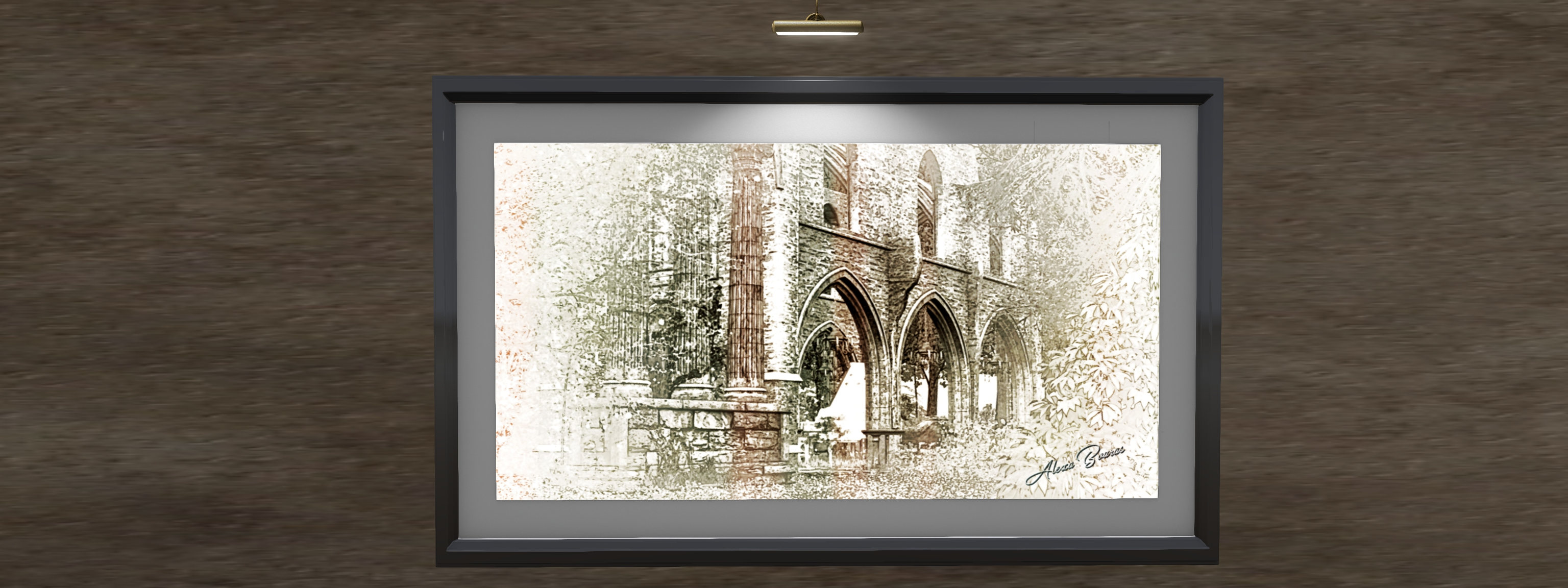
In April, I wrote about an exhibition of art featured as the opening exhibit for The Antiquorum Art Gallery within Patch Thibaud’s stunning Hanging Gardens region build. Entitled Landscapes – My Personal View, the exhibition featured the art of long-term Second Life resident Alexa Bouras – although I believe it marked my first full exposure to her work (see Alexa’s personal view of Second Life). I was immediately captivated by Alexa’s work for its reichness of content, style and narrative and noted at the time that I looked forward to seeing more of Alexa’s art.

Well, I’m pleased to say that wish has been granted – for all of us – as Alexa has a new gallery space, one still located within the Hanging Gardens of Babylon region, but occupying its own skybox as provided by the region’s holder, Cristabella Loon. Alexa was kind enough to drop me a line about her new artistic home over the weekend, and as soon as the opportunity arose,  I hopped over to take a look.

Alexa’s Art Gallery  – Alexa Bouras

Offered as a spacious cube with a mezzanine level to one side, the skybox provided to Alexa is of a modern interior design highly suited to her art, with a central water feature on the lower floor and a sweeping, suspended staircase rising above it to reach the mezzanine. This split in floor space allows Alexa to display her work in different formats and sizes, with large pieces displayed along the walls of the more “open” space to the front of the skybox, and smaller more intimately-sized pieces displayed along the walls of the lower floor beneath the mezzanine and around the mezzanine itself.

The art presents a rich mix of styles and subjects, including the Second Life landscapes-processed-as-paintings I found to be so richly evocative with Landscapes back in April 2022, together with pieces which can be regarded as drawings and / or etchings (notably the uttering captivating Anya’s Awakening, which is simply gorgeous), and those which are, by dint of angle, focus and subject, beautifully intimate in their content.

Alexa’s Art Gallery  – Alexa Bouras: Anya’s Awakening

By “intimate” I do not necessarily mean they are avatar studies and / or in any way NSFW;  quite the reverse, in fact. These are pieces focused on what might be regarded as the mundane, the often unnoticed or the everyday, but in a manner which grants them their own unique beauty and story through Alexa’s use of angle, focus, colour and depth of field.

These pieces are most obviously found along the back wall of the mezzanine level, where sit two absolutely delightful pieces captured at Longing Melody (see: Visiting Longing Melody in Second Life) which tell as entire story about the life and work of an artist, together with a third piece from the same region which I guarantee will capture the heart of any piano player (including myself) for the way it captures the story of these majestic instruments.

With their tight focus and unique perspectives, these appear to be part of a further evolution of Alexa’s artistic expressiveness and her growing mastery of a medium which she has come to out of a need to express herself creatively, rather than the application of skills and knowledge initially gained through the physical world. It’s a growth in techniques which I find admirable within a Second Life artist (particularly as my own attempts remain decidedly one-dimensional!), offering as it does new avenues to be explored by both the artist and their audience.

Alexa’s Art Gallery  – Alexa Bouras

Utilising the region’s day / night cycles, with point lights to illuminate the art during the latter (so do make sure you have Advanced Lighting Model (ALM) enabled via the viewer’s Graphics Preferences!), Alexa’s Art Gallery makes for a genuinely engaging visit, presenting the opportunity to view (and purchase, if you’re so taken) the art of a very visual and engaging Second Life artist.

SLurl Details

Art and a walk in Southern Corsica in Second Life

Corsica Tourist Centre and Tea Garde – start of the CSC Art Trail

A while back, and via Owl Dragonash, I received an invitation to explore (and possibly participate in) the Art Trail at Corsica South Coasters. While I have not directly participated, I did finally manage to get my bum and feet over to Corsica and take a walk along the Art Trail – and enjoyed doing so.

As the name suggests, the Art Trail is an open-air walk along the southern coast of Corsica, winding its way between the Corsica Tourist Centre and Tea Garden and Port Emyniad, with the former noted at the starting point; although there is no reason why trail-walkers can start from the Port and follow the signs backwards – there is no order into how the path is followed and the order in which the art is viewed.

CSC Art Trail, Corsica – just follow the signs!

It’s a route that takes in a number of sights along the south coast of Corsica, including gallery spaces at Port Emynaid and Ceakay Ballyhoo’s gallery (Ceakay is one of those – along with Owl, Catori Mistalker and Bijoux Barr – responsible for the trail) and others, as well as the trail itself marked both by trailside signs and mounted art from participating artists, either just for exhibition purposes or for sale.

The walk takes about 5-6 minutes when going directly from point-to-point. However, such is the nature of the walk, coupled with the opportunities to witness the art on display both along the trail and within the many studio galleries, and well as catching other points of interest along the way.  Doing so can draw a walk out into a very pleasant stroll, with the route itself home to a number of teleport station that provide access to additional points of interest within Corsica.

CSC Art Trail – Isle Biedermann and MJ Biedermann (MarjorieBrickard)

The Art Trail is intended to be an “eternal” art display (although pieces and galleries might naturally change over time), and artists from across Second Life are invited to participate along the trail-side art frames. Artists wishing to have work displayed along the walk can do so by:

  • Select one piece of their art as both a texture an a framed / on canvas piece of part – both to be set to Full permissions.
  • Send the art and texture in a folder to Ceakay Ballyhoo, together with the following:
    • If the art is to be sold – the permissions to be set against the art if it is to be sold & the price at which it is to be offered.
    • A copy of your biography as an artist and / or information on the art you would like to share.
  • Ceakay will then set the art up on one of the available art frames along the trail.
The galleries at Port Emyniad

Any question about the Art Trail should be directed to one of Ceakay Ballyhoo, Bijoux Barr (bijouxbarr) or Catori Mistalker.

SLurl Details

An Art Walk + 3 in Second Life

UASL, September 2022: Roxksie Logan

It was back to the ever-evolving United Artists of Second Life (UASL), the community “for artists … by artists”, for me at the start of the week to catch-up on a couple of art exhibitions there, both of which opened this month: the Art Walk and the respective work of a trio of artists who are being exhibited together at the UASL’s Galerie Principale.

Presented by Michiel Bechir, Art Walk offers the work of Blip Mumfuzz, Elfwym, Georgie Iceghost, Harlow Isabelle Stoop, Jamison, Karly Kas, Mara Telling, Owl Dragonash, Susietea, and Violette Rembrandt (Myra Wildmist is listed on the invite note card, although I didn’t find any of here work along the walk), all of whom present four images apiece located in a open-air lawn sitting between the futuristic building of UASL’s galleries and supporting buildings.

UASL, September 2022: Art Walk

Ranging from landscape images captured within Second Life to animal studies from the physical world, to digital paintings, Art Walk is an easy-on-the-eyes exhibition that brings together a wealth of photographic, painting, and post-processing styles and techniques, with visitors able to wander around the lawn and viewer each artist’s quartets of images at their leisure, with bio givers alongside the works present the chance to learn more about each of the artists.

Occupying three of the floors within UASL’s Galerie Principale are a trio of exhibitions by BijouxBarr (ground floor), Nodome (second floor) and Roxksie Logan (third floor): three very different artists brought together in a trio of exhibits which are individually and collectively engaging to the eye.

UASl, September 2022: BijouxBarr

Within her section, Bijou presents a selection of art in two parts. To one side is a set of landscape paintings. Bright, their colours in places almost over-saturated, these are pieces that breathe life through their colour. Across the hall, are eight images of an altogether different nature – portraits, both human and animal, and fantasy pieces. Containing their own tonal quality that is completely distinct from the landscapes, these are marvellous walks through the imagination.

Nodome is an artist whose work I don’t think I’ve encountered before – more is the pity – as she has much to say, both through her art and in words. These are pieces ranging from the sexual (if not conventionally so), through the abstract to the expressionist. Each has a richness of narrative rippling through it.

UASL, September 2022: Nodome

Roxksie Logan is an artist whose work I’m very familiar with, and whom I’ve always enjoyed for her ability to offer images and installations that challenge perceptions and thinking. Here, on the third level of the gallery she presents the most captivating of digital images (as per the image at the top of this article). Rich in colour, enfolding elements of fantasy, cyberpunk, science-fiction, and with a look and tone that is fanciful, alien and familiar – all by the same measure, these are a tour de force of digital artistry at its finest.

Both Art Walk and the display at Galerie Principle sit as just two among the gathering of galleries and art spaces that being UASL to life. As such, when visiting, do take the time to explore and visit the other exhibitions awaiting discovery – or better yet, take the time to make several visits to explore UASL properly, if you’ve not previously done so.

SLurl Details

Note that Karpov is rated Moderate.

Art and allegories in Second Life

The Vordun: Allegories of Artemisia, September 2022

Recently opened at The Vordun Museum and Gallery, operated and curated by Jake Vordun, is a stunning exhibition of art from the physical world offering a celebration and exploration of the life and work of Artemisia Gentileschi (1593-1656) also known as Artemisia Lomi), one of the most accomplished artists of the Baroque period, (c. 1625-1740).

Born in Rome on the 8th July, 1593, the eldest child Prudenzia di Ottaviano Montoni and noted Tuscan artist Orazio Gentileschi, Artemisia took up art at an early age, and was producing professional works by the age of fifteen. Like her father, she followed the innovations set by Caravaggio – such as the use of real models – whilst also developing a natural eye for the use of the brush and in the mixing of paint and use of colour to depict the female figure with a naturalism which extended beyond the more idealistic approach of her male peers.

Artemisia Gentileschi: Self-Portrait as the Allegory of Painting, 1638–39. Via: wikipedia

Initially regarded more out of curiosity than in recognition of her skills – she came to wider public knolwedge as a result of the trial of artist Agostino Tassi, who raped her when she was 18 – by the time she was in her early twenties, she had become the first woman accepted into the  Academy of the Arts of Drawing in Florence.  As her work gained a broader audience, so to did her career flourish through patronage and hard work, her art carrying her from Florence back to Rome, thence to Naples – and even to England and the court of King Charles I.

As well as its depth of realism, her work is notable for its focus on women from myths, allegories, and the Bible, with many featuring herself as one of – if not the – protagonists. Her art eschews the more accepted view of the female form – that of a gentle, sensitive, vulnerable creature – to instead present women as figures of power, strength, and the equal of men.

The exhibition at The Vordun – entitled Allegories of Artemisia – is an extensive look at Artemisia’s work offering one of the most unique gatherings of reproductions of her art to been seen outside of the printed page.  A collaborative display by Jake Vordun (producer), Marina Münter (vivresavie) – curator; Paul Gils (ObertonX) – research assistant; and Cibele Cibernética (profetadigital) – graphics designer, it is a multi-room exhibit made all the more abosrbing by its non-linear approach to Artemisia’s life and art, one which – in the words of those responsible for the exhibition:

[Traces] a parallel between the the characters she depicted in her paintings and her own life, the visitor gets the chance to experience real scale works by her and artists from the same period, given the chance to analyse visually the aspect of her work.

From the introduction of Allegories of Artemisia

The Vordun: Allegories of Artemisia, September 2022: Judith Beheading Holofernes (left: Caravaggio, c.1599; centre: Artemisia Gentileschi, c. 1614-20; right: Artemisia Gentileschi, c.  1612-13)

On accessing the exhibition from the gallery’s main hall, vistors should follow the route through the opening to the right. This takes a route through a series of rooms, starting with a general introduction to Artemisia Gentileschi, followed by a series of self-portraits that help into introduce both the artist and the artistic tradition of a painter focusing on a subject more than once during their career.

From here, further rooms offer reproductions of some of Artemisia’s more noted works drawn from biblical stories (including from deuterocanonical books of the Old Testament), together with reproductions of the same subject by her male contemporaries – thus providing that opportunity to directly compare the work of Artemisia with her contemporaries, and appreciate both the uniqueness of her depiction of female characters and the depth of naturalism found within her work.

Wall text in each room help contextualise the subjects of the paintings and also to provide historical / biographical information (such as on Artemisia herself or her father) where relevant. This set of rooms culminate in a three-part section dealing with the deuterocanonical character of Judith which include both Judith Beheading Holofernes and Judith and Her Maidservant. This in itself is an exquisitely framed and presented series of images – some of them the most famous of the Baroque period – forming an exhibition-within-an-exhibition.

The Vordun: Allegories of Artemisia, September 2022

Beyond these initial rooms lies a large hall that brings together further pairings and small groups of paintings by Artemisia and other artists of her period (one of which includes a piece by one of her few female contemporaries – Elizabetta Sirani), and well as individual pieces by Artemisia. This is bracketed to one side by two further “themed” sub-sections entitled Church Commissions and Mary Magdalene.

Throughout the exhibition there is a wealth of information carefully brought together by the organisers. Each painting is presented with a plaque supplying the title of the piece, the name of the artist, the approximate time in which it was painted, and where it resides today. In  typical Vordun style, these plaques can be clicked to display their information in local chat. Meanwhile, the main hall includes a timeline of Artemisia’s life, defined in terms of the recognised periods of her work as an artist, and the notable events within them, together with a small display of works by other artists and inspired by her work and life.

The Vordun: Allegories of Artemisia, September 2022

Since its inception, the Vordun has presented a series of long-duration, richly immersive exhibitions that seek to replicate the experience gained within a physical world museum, whilst presenting exhibits which either cannot be reproduced in the physical world or, if they do have something of a  physical world analogue, are far more accessible than their counterpart might be. All of this makes The Vordun an engaging visit, and Allegories of Artemisia adds to this enormously.

When visiting The Vordun, do be sure to accept the local experience and specifically for Allegories of Artemisia, make sure your viewer is set to Used Shared Environment.

SLurl Details

Cica’s Pink Fairytale in Second Life

Cica Ghost: Pink Fairytale – September 2022

Every one loves a fairy tale, the opportunity to escape to a world where our imaginations can be exercised, to explore to lands far away, share in adventures and see good triumph. Fairy tales are stories we gain exposure to at an early age, and the four words that so often start them tend to remain with us forever – something English author Sir Philip Nicholas Outram Pullman once noted,  both in terms of the memories hearing the words can evoke and the escape they offer.

This power of fairy tales is the subject of Cica Ghost’s latest region-wide art installation which opened on September 12th. It takes as its foundation that quote from Pullman – an author who has perhaps enjoyed renewed exposure to a public courtesy of the BBC adapting his coming of age, multiverse-spanning trilogy His Dark Materials into a television series.

Cica Ghost: Pink Fairytale – September 2022
Once upon a time lasts forever.

– Sir Philip Pullman

Entitled Pink Fairytale, the setting offers an environment in keeping with its name: a pink landscape beneath a pink sky;  a place where pink flowers and trees climb towards the sky, and where the buildings and features of the setting resemble cakes and edibles topped with icing, and the cups of a carousel appear to be filled with ice-cream or some other delight, marking them as a haven for allowing the child inside to revel.

This is a place populated by animals and characters who in turn suggest stories and tales to the active imagination, where thrones with ears await a king and queen – or perhaps a princes and princess – the jug between them perhaps bringing forth thoughts of magic lamps. Elsewhere a princess can indeed be found, together with an entourage of geese – also often characters found within fairy tales –  and watched over by a elephant which, if not fairy tales, when certainly other famous childhood stories.

Cica Ghost: Pink Fairytale – September 2022

Scattered with little vignettes such as these and complete with Cica’s many places to sit or dance or – in the case of the bubble-burping fumaroles – float. Pink Fairytale is another light and fun installation form a Second Life artist who consistently offers us a reasons to smile. So, should you decide to hop over and experience Cica’s work first hand, do please consider making a donation to help her continue to keep us smiling.

SLurl Details