Kicking off 2023 at Monocle Man Galleries, curated by Lynx Luga and Kit Boyd is an exhibition of art by Hannah Starlight entitled Dream Again – a fitting title to go with the start of a new year. It is an exhibition taking place in one of the newer galleries spaces Kit and Lynx are providing for artists within the Monocle Man facilities, being hosted within the Cabaret sky gallery.
This is an interesting gallery space, offered as something of a speakeasy-like cabaret club, tucked away out-of-sight of any passing authorities, reached by walking down a back alley and then climbing down into what appears to be a storm drain, but which is in fact the entrance to a “basement” club with wood panelled walls and deco-like electric lights.
Monocle Man Gallery: Hannah Starlight
Dream Again is a collection of 28 images, either mounted on the walls of the club or on easels located around the the columns and edges of the dance floor. Predominantly avatar-centric these are images rich in content and message – commentaries, if you will on life, love and expressing oneself, at least one of which I seem to recall from a prior exhibition (His Song), which does not in any way detract from the overall thrust of this exhibition.
Offered in a variety of formats, small and large, 4:3 through to fully panoramic, these are pieces which are all richly expressive and predominantly celebratory in nature. Given the time of year, some of the pieces might be seen as holding to the Christmas theme and ideals of faith: Here’s My Heart, Lord, The Prayer, He Carries Me, and – perhaps most notably – A Baby Changes Everything. However, even while they may do so, they also speak to more secular interpretations; take A Baby Changes Everything: is it not true that a baby, whether of natural or divine conception, a miracle that truly changes everything for its parents?
Monocle Man Gallery: Hannah Starlight
Meanwhile, Beautiful Warrior speaks to the physical beauty of the subject, as we are drawn to look at her face. However, her pose, the placement of her arms in particular, speaks powerfully and eloquently to her inner strength in the face of what can be a terrifying and seemingly implacable foe – check the description of the piece for more on this.
Elsewhere within the collection, Hannah offers more direct celebrations on love, marriage and the joy of being able to freely express oneself and enjoy life. All are worthy of appreciation, although I confess that Light for Your Path drew me to it, not only because of its panoramic nature; whilst New Light, tucked away behind one of the columns, carries with it a simple, direct message of the power of new life, layered with the taboo nature of pregnancy as an expression of beauty (one might even say it offers a link to the other pieces with a divine lean to them: might the light of the Sun breaking through the clouds be taken as a spiritual reference to the light of God?
Monocle Man Gallery: Hannah Starlight
I’ll leave that for you to decide if this might be the case. In the meantime, I will say that Dream Again is a richly engaging exhibition, and it officially opens at 12:00 noon SLT on Sunday, January 1st, 2023 with a performance by Rogue.
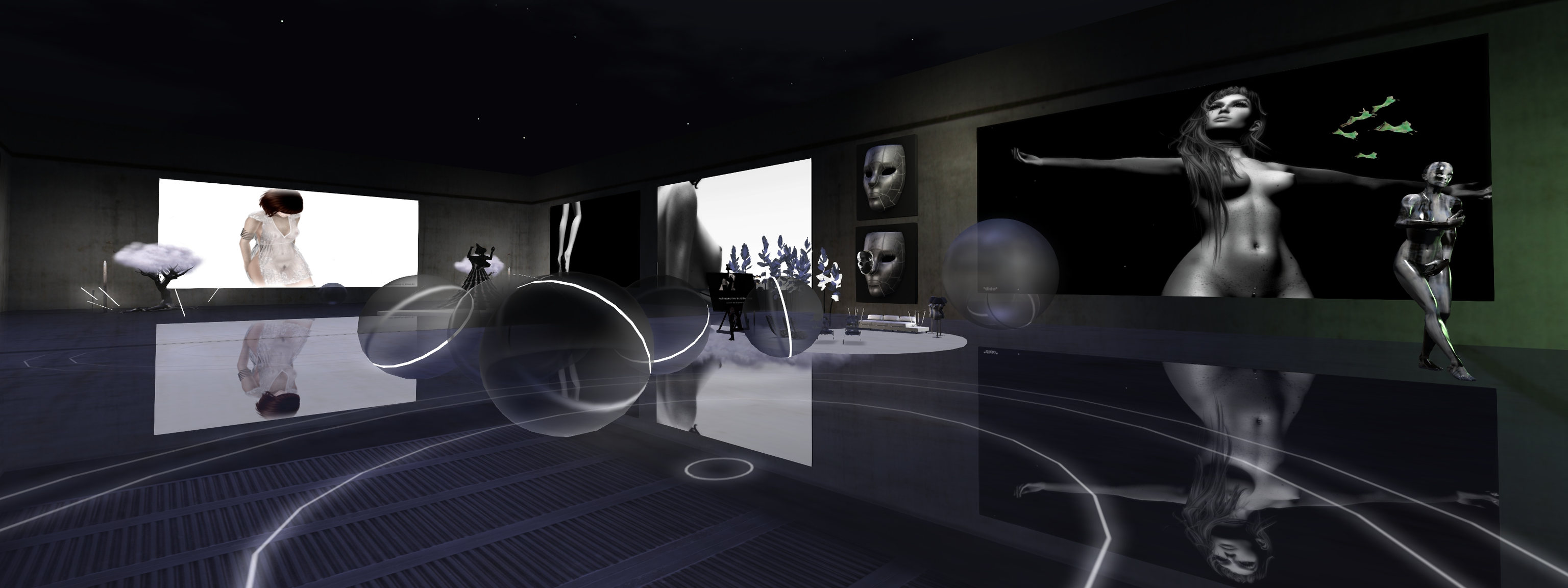
Since co-launching the original Nitroglobus Gallery and, over the last several years, Nitroglobus Roof Gallery, photographer-artist Dido Haas has established a well-deserved reputation for curating one of Second Life’s most engaging galleries for art in Second Life. Month on month she brings out the very best in the artists she invites to exhibit within the gallery’s halls, resulting in perhaps the most consistently enthralling series of art displays each and every year, hence why I attempt to cover the gallery as fully as possible through the year.
However, there is a drawback to all of this: such is the amount of work involved in managing and curating the gallery, Dido’s skills as a photographer-artist rarely get to be seen in-world, and this is a shame, as her work is the equal of any of those she invites to exhibit at the gallery. Hence why, when she drops a note about presenting a (possibly short-term) exhibition of her work in the Nitroglobus Roof Gallery Annex, I’m scooting across to take a look.
Nudospective, as the name implies, is something of a “retrospective” in a much as it comprises a set of images Dido has produced over time. It is also, again as suggested by the title, utilises nudity as a linking theme. As such, this is an exhibition that might best be considered NSFW when viewing.
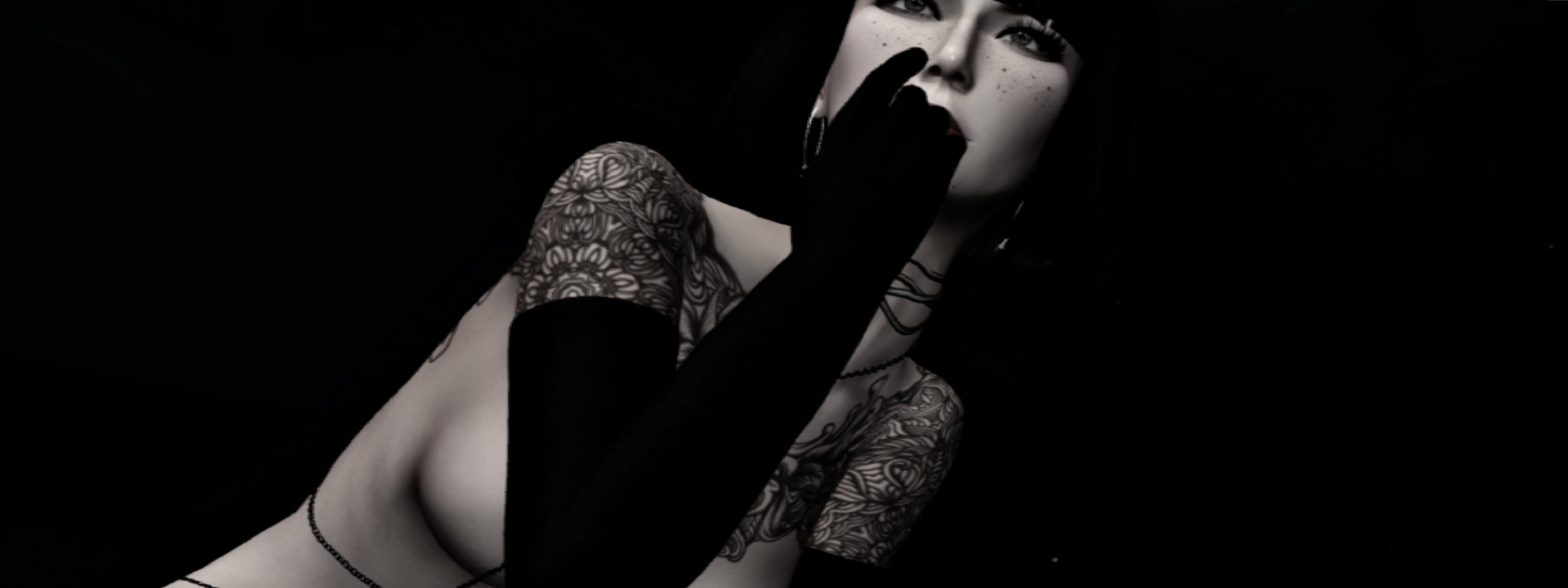
My love of Dido’s photography lies in several elements. First, she tends to work predominantly in black-and-white or greyscale or with a monochrome lean. Secondly, she specialises in avatar studies and thirdly – and most importantly – she has the ability to communicate so much through her work simply through the use of angle, pose, and focus rather than relaying on excessive props or post-processing.
This is very much in evidence within Nudospective; mostly presented in greyscale, these are pieces which – although utilising nudity – are not in any way directly sexual or voyeuristic. Rather, they are elegant narratives on the beauty of the female form as visualised through the medium of a virtual avatar, some of which offer what might be considered a subtle commentary on the subtleties of beauty compared to the expectations of beauty.
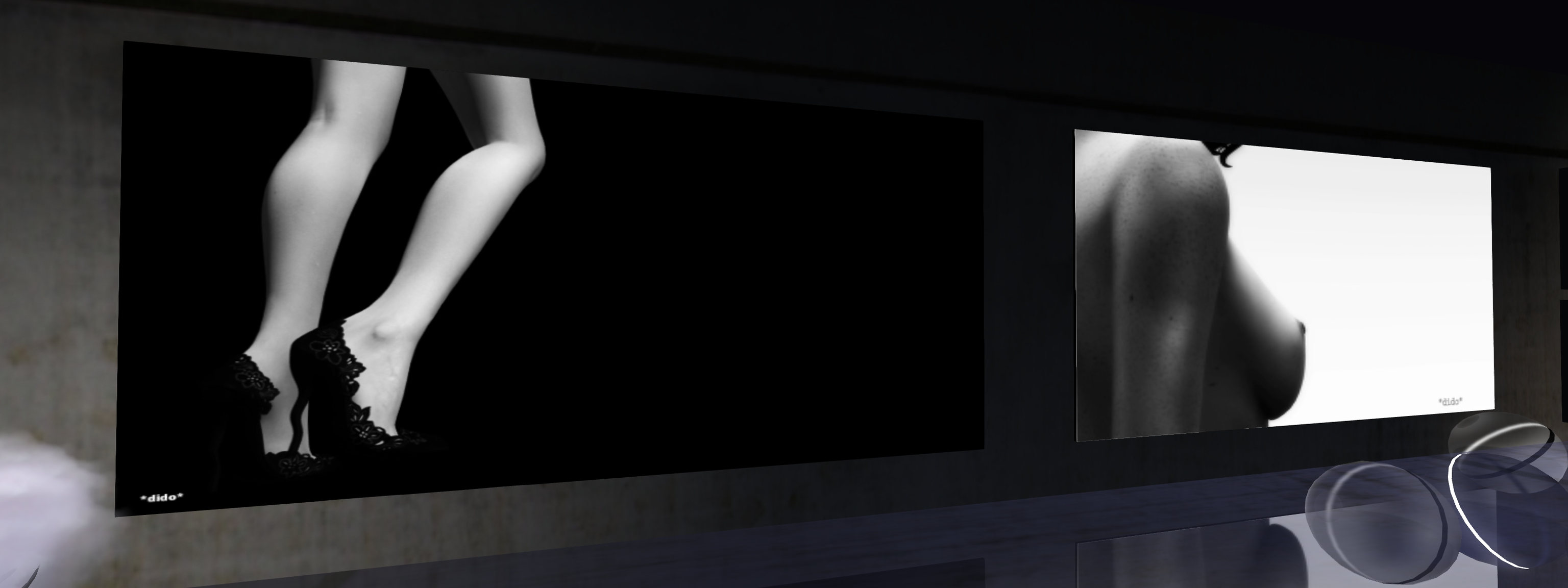
Take, for example, Legs. It features what is all too frequently a tool of heightened (literally and metaphorically) sexualised beauty: the high heel. But is it the heels that give the legs image their inherent form and beauty, or is it their muscle tone, angle and placement – all of which could be present sans the heels? Similarly, in Freckles alongside of it, is it really the firmness and curve of a breast – again so often seen as an expression of sexuality – really as worthy of our attention as a mark of beauty as much as the simple patina of freckles over the flesh of an upper arm and shoulder?
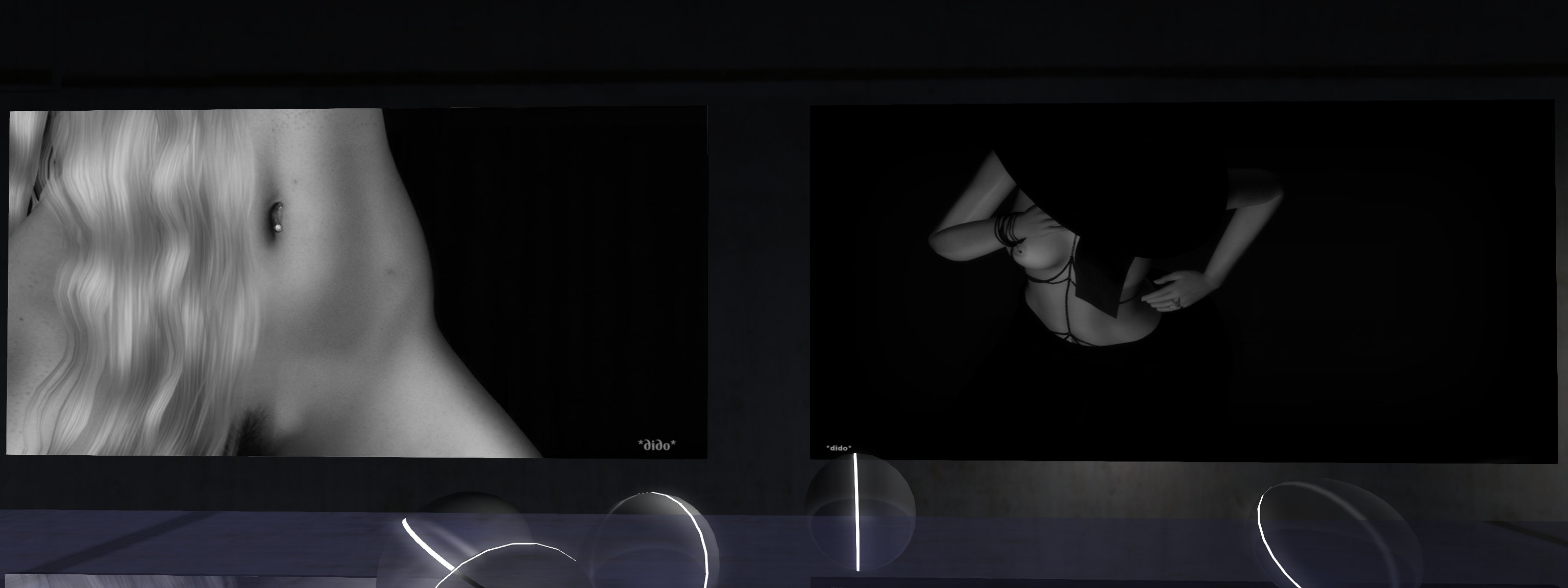
Across the hall, and a little conversely, Belly Piercing comes from another direction entirely. Within it sits a duality of innocence pointing towards a certain sexuality. On the one hand, it offers a natural statement on the beauty of a body piercing, whilst on the other the ball of the pearl, sitting on the cusp of the navel and the play of shadow within it offers a suggestion of focal point of female sexual pleasure.
Beautiful executed individually, taken collectively, Nudospective forms an engaging, easy-to-appreciate exhibition of photography which potentially has a lot to say.
Theme for art exhibitions is not a new idea – many, many art exhibitions are built around a theme, whilst individual works are frequently used by artists to express an idea or ideal or theme, often with a defined commentary. Such themes can be complex and layered; hinted at, rather than openly expressed, offering their audience suggestions to prod their own cognitive faculties. Others are more direct in tone and theme, presented as a direct commentary – or simply as a celebration.
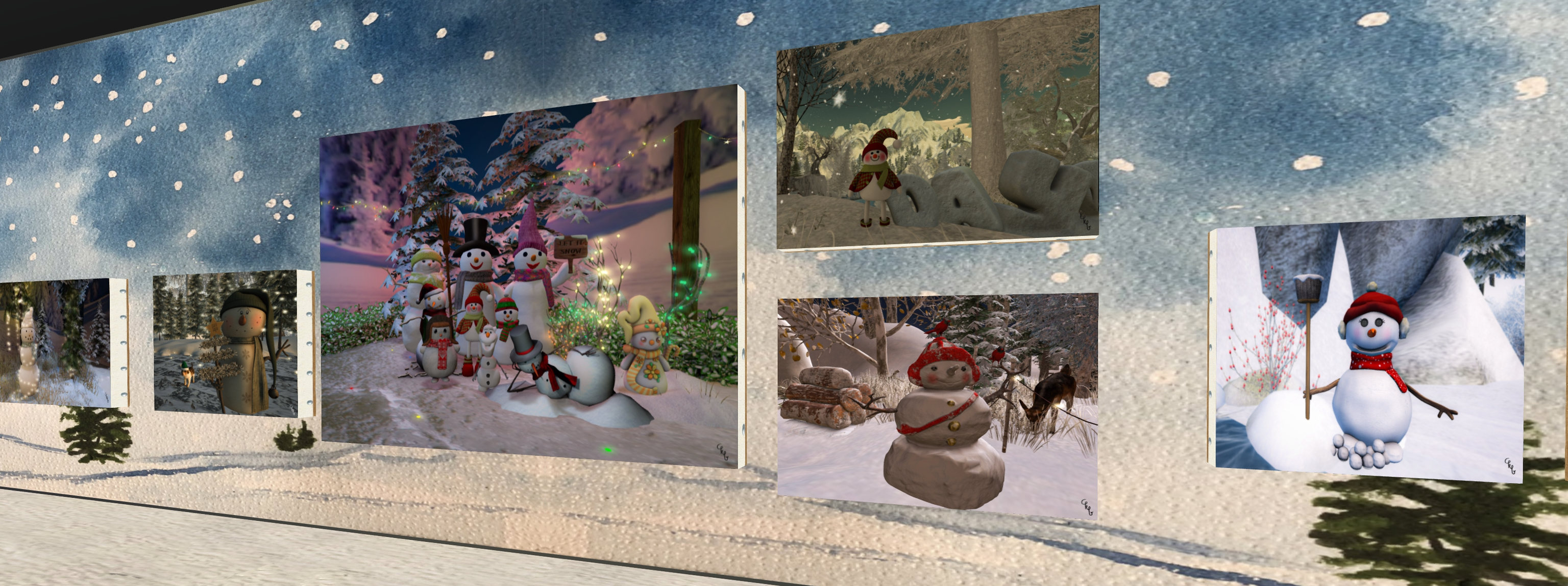
Ode to Snowmen falls cleanly into that last category. Presented by CK (Ceakay Ballyhoo) at the NovaOwl Sky Gallery, curated by curated and operated by ULi Jansma, Owl Dragonash and CK herself, this is an unbashed celebration of winter snowscapes and the joy and humour found within the creation of snowmen.
NovaOwl Sky Gallery: CK Ballyhoo – Ode to Snowmen
Naturally split between the two levels of the gallery, the exhibition features images of snowmen CK has found in her travels across Second Life, from the massive sculpture at the heart of Linden Lab’s Winter Wonderland through to snowmen (and snowwomen and their children!) getting up to all sorts of activities and mischief from simple family portraits to skiing (yes, some snowmen have legs!) to peeping in through windows to see what is going on in those warm places which we love but are anathema to snow folk.
With the floorspace covered in snow and dotted with paintings and drawings of snow-laden fir trees and snowmen, this level of the exhibition also stand as a reminder of the immersive storytelling installations CK used to build in-world, often working with artists such as Silas Merlin and CybeleMoon (Hana Hoobinoo).
NovaOwl Sky Gallery: CK Ballyhoo – Ode to Snowmen
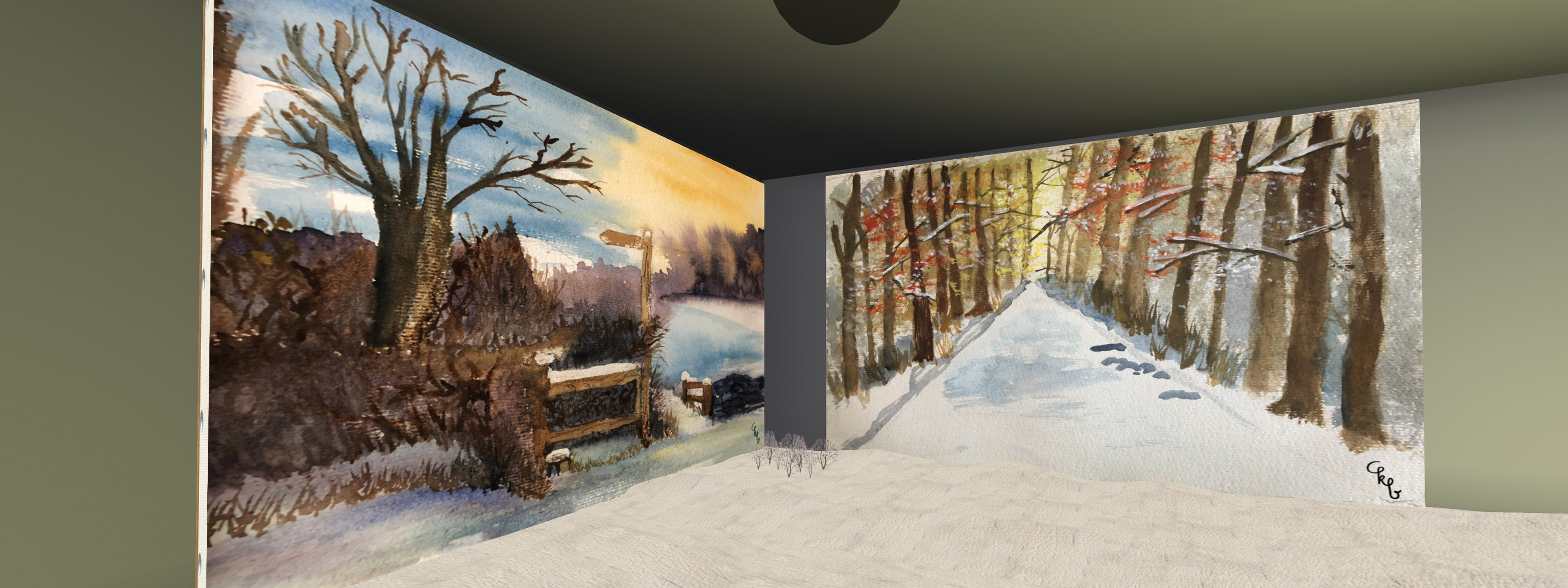
The upper floor of the exhibition features a set of seven watercolour paintings by CK celebrating winter landscapes. Collectively, they offer views which bring to mind lyrics from songs like Walking in a Winter Wonderland and (for me, as I love its haunting tones – particularly in Isao Tomita’s evocative version) Debussy’s Des pas sur la Neige (Footprints in the Snow), itself said to have been inspired by a painting of a winter snowscape.
From snow-covered paths guarded by denuded trees standing to attention on either side, to frozen ponds suggesting an invitation to go skating, and signs pointing the way to trails lying just out-of-sight relative to the painting, these are all warm, inviting pieces which call to the fore childhood memories of the wonder of snow and (perhaps for some) romantic walks through pristine fields of snow with a loved one. All of this is overseen by several snowmen painted on one wall, and several on the floor which blend nicely with one of the paintings.
NovaOwl Sky Gallery: CK Ballyhoo – Ode to Snowmen
A fun, easy-on-the-eyes exhibition presented in a timely manner for the holiday season, Ode to Snowmen will be open through until the end of December 31st, 2022 – so get your visit in soon!
Artsville, December 2022: Milena Carbone – the 5th Season (Heroes)
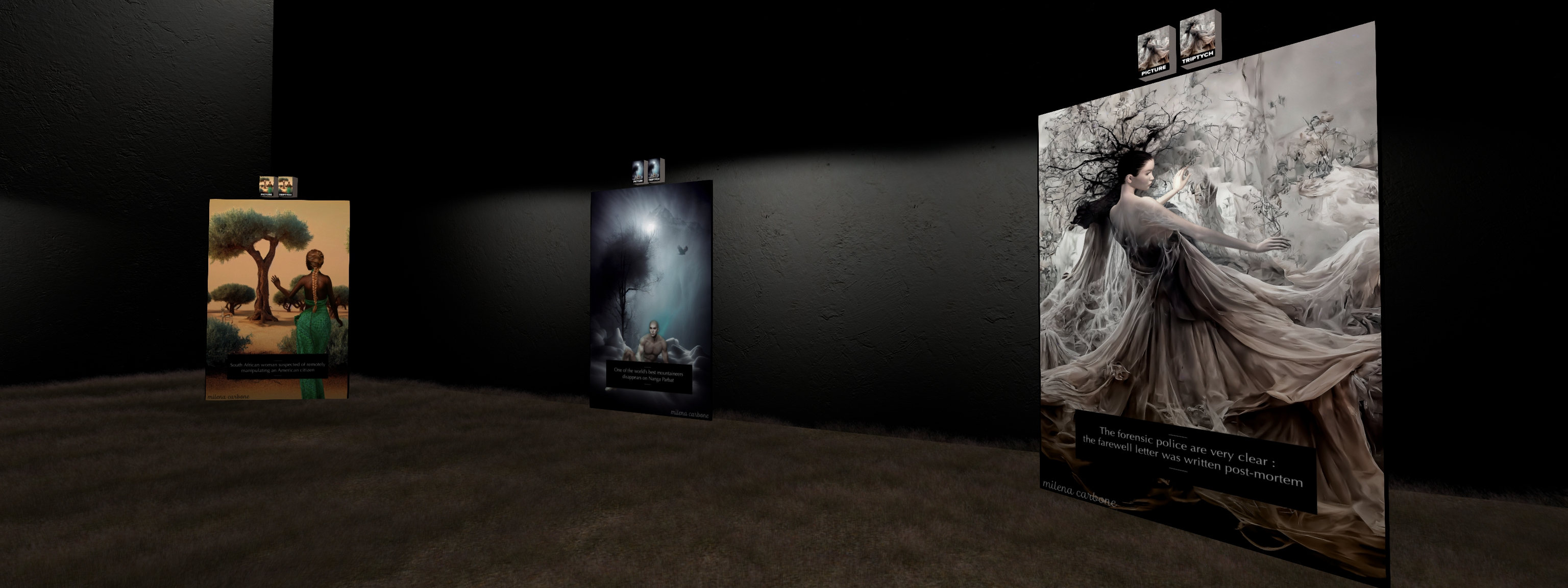
Now open at Frank Atisso’s Artsville, and seeing out 2022, is another provocative art installation by Milena Carbone entitled The 5th Season. Perhaps best described as a trilogy, it comprises three individual but inter-related exhibitions: Blind, Africa, and Heroes. Two of these offer a reflection of previous installations Milena has presented, and they should preferably be visited in the order given, although whether you opt to visit all three sequentially in a single tour, or visit them each as an individual visit (whilst keeping their linked themes in mind) is entirely down to you.
To define the core themes present through The 5thSeason, it is perhaps best to start by quoting Milena directly:
The 5th Season … questions our tendency to follow a path of self-destruction. It is related to the imminent threat of dramatic consequences for all living species as a result of climate change. It tries to dig deeper into the roots of our denial.
The “fifth season”, is an imaginary season, which will replace the four seasons we have known. One season in a year, chaotic, devastating. A foul beast that humanity will have created.
– Milena Carbone
Artsville, December 2022: Milena Carbone – the 5th Season (Blind)
The important point to note within this description is the term “it is related to the imminent threat … of climate change” (my emphasis). I highlight this because, whilst climate change and our response (or lack thereof) to its existential threat does offer the foundational thread of theme linking all three parts of this installation, bound within two of them are references to a greater malaise that has affected humanity throughout time: wilful self-destructiveness – be it on the purely personal level or through religious and / or political indoctrination, or national / racial fervour.
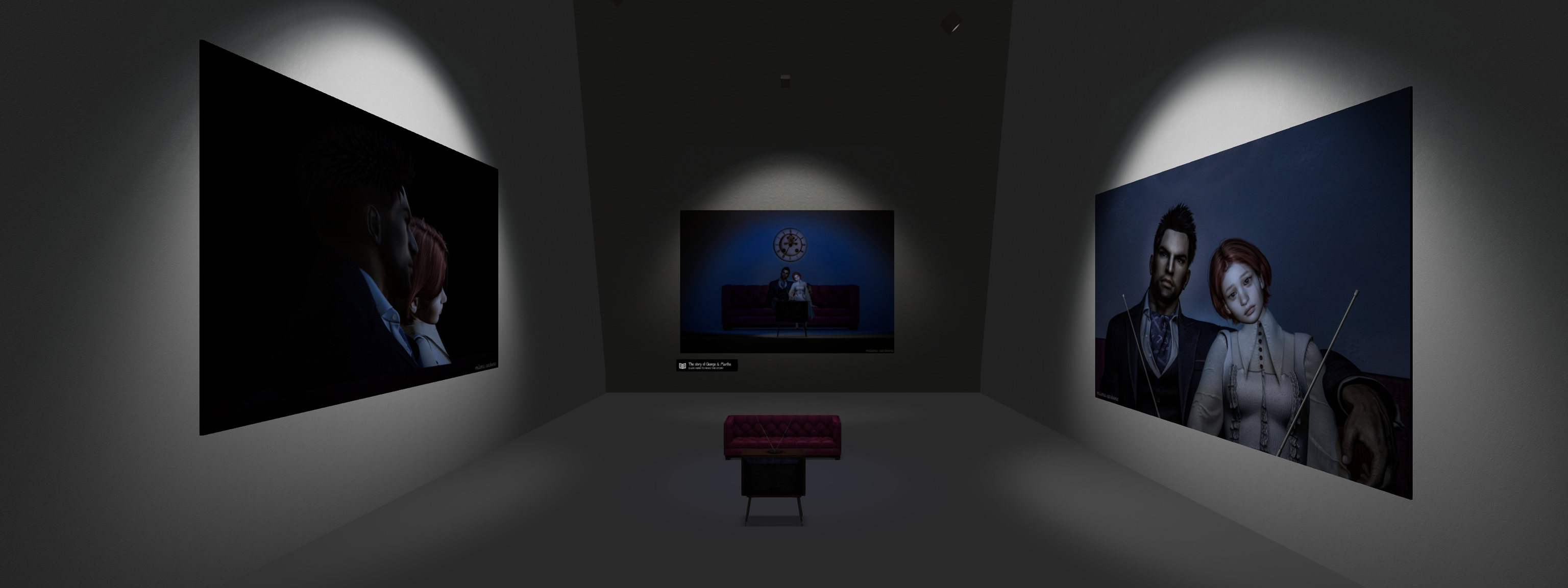
To achieve this, Milena uses the three elements of the installation to present images and stories to prompt us not so much on an emotional level, but rather intellectually, asking us to dissect what we are seeing and reading and look beyond. As such, these are stories and images that might be taken literally (e.g. George and Martha, and The story of Daphne (both found within Blind) – the first being a direct commentary on the destructiveness of the demands placed upon all of us to be “successful” and “happy” through acquisition and idealisation (such as through the insidious nature of television programmes ad ads) rather than by simply communicating with one another; the second a pointed reference to the artificial use of war and bloodshed in order to maintain the status quo of a decades-old corrupt regime).
Other stories are more metaphorical (e.g. The Story of Antigone (also in Blind) or the entirety of Africa); still others utilise elements of history or mythology. Some of the stories are reproduced on the walls of the three exhibition spaces, but most are accessed via links to Milena’s website – and I recommend reading all of them there, as several contain further links to help gain familiarity with the subjects offered (after all, how many of us are familiar with the myths surrounding Tiresias?).
Artsville, December 2022: Milena Carbone – the 5th Season (Africa)
“A time is coming when men will go mad, and when they see someone who is not mad, they will attack him, saying, “you are mad, you are not like us.”
– From The Sayings Of The Desert Fathers, a quote which eloquently
encompasses the polarised nature of modern society, which Milena also touches upon
As the first element in the trilogy, Blind – I believe I’m correct in saying – originally appeared (at least in part) within an exhibition Milena presented in June / July 2022 (I admit to being hazy on this, as it is not an installation I managed to see). It’s core arch is that of our aforementioned denial – our blindness – to the realities of climate change; a blindness that exists, again as noted, as much among those who acknowledge the threat but who go on to do nothing, however small the move, to play their part in trying to lessen the impact, as it does among those who persist in denying it, despite the weight of evidence before them.
In this, I found the inclusion of Tiresias particularly fitting as a double-edged sword; his gift of foresight might be aligned with the the mountains of data gathered over the last 30-40 years relating to climate change. On the one hand, just as Tiresias offered help and counsel to Odysseus in his quest, so too might the data we have gathered offer us the means to avert the coming global crisis; on the other is that just as Tiresias was stuck blind by Hera due to his ability to divine the future and truth, so to are those who seek to raise greater awareness of the the threat of climate change all too often vilified by those unwilling to hear their message.
Artsville, December 2022: Milena Carbone – the 5th Season (Blind)
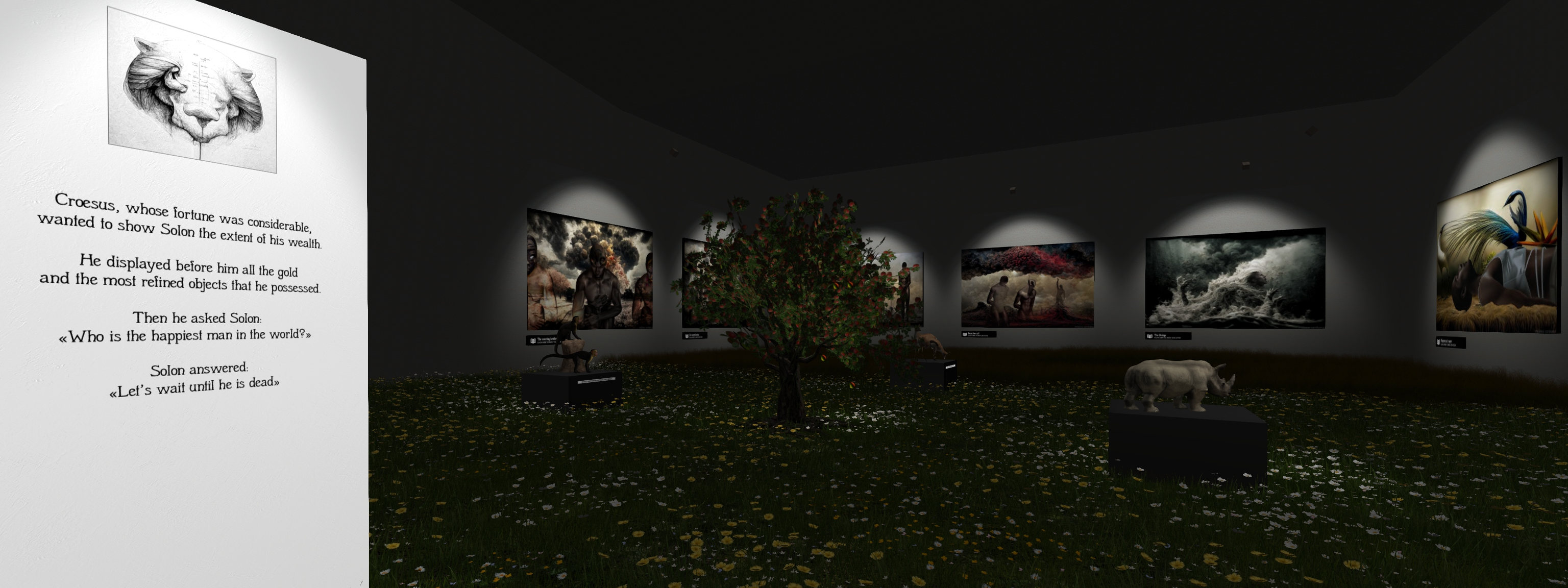
Within Africa – which Milena originally presented at Nitroglobus Roof Gallery in October (see: Milena Carbone’s Africa at Nitroglobus), the theme of climate change and its impact on the cradle of humanity is further explored through image and commentary. Here, in addition to the story elements are 3D models of various African animals; these should be approached directly to reveal further elements of this part of the installation. As with Blind, the stories and elements offered in Africa also contain broader themes, some of which (notably colonialism) link back to Blind and The story of Daphnie.
Heroes, the final part of the trilogy, offers a more hopeful chapter for viewing. As a race, we are too rooted in the past – up to and including the view climate change deniers have on the historical nature of this planet’s biosphere – claiming it is no more different to other periods of heating and cooling that have occurred in the planet’s long history. And while that may be true to a point, it nevertheless ignores two inconvenient truths: the first is that for the last 250 years, humanity has been pumping out increasingly huge amounts of greenhouse gasses into the atmosphere; and the second is that for the last 50 years, we’ve been busily decimating the natural means by which the Earth regulates its atmosphere to help purge it of those gases, such as the Amazon rain forest.
Artsville, December 2022: Milena Carbone – the 5th Season (Heroes)
Thus, if we are to survive, we need to stop looking back; we need to focus on the future. And this not only includes how we husband this planet and its resources, but in how we look upon ourselves as a global society. As Milena notes, too much of our history and our “mythology” is rooted in the past in – dare I say it – a patriarchal, hunter-gatherer history.
If we are to mature as a race, we will need modern heroes, modern myths founded on respect, understanding and care, which foster the belief that we can all, regardless or creed, colour, gender or personal belief, aspire to do better, to be better. Through the presentation of the 12 modern-day fictional tales, complete with their tabloid-style headlines (be sure to sit in the chairs before each of them to see more), Milena challenges us to leave this exhibition with a willingness to do just that: look to the future and play our own role, howsoever small, to bring about the changes we as a people – as a world – need.
The idea behind this collaboration was to recreate the magic of nature that resonates with one spiritually and touches one either in the form of falling snow, gentle rain, or floating leaves. We hope you enjoy the creations as much as we did creating them.
– Introduction for Mountains, Mandalas and Magic, Third Eye gallery
Currently open at the Third Eye Gallery, curated by Jaz (Jessamine2108), is a collaborative exhibition by Viktor Savior, Orpheus Paxlapis and Jaz herself, which, as the description above notes, is intended to offer a spiritual reconnection with nature.
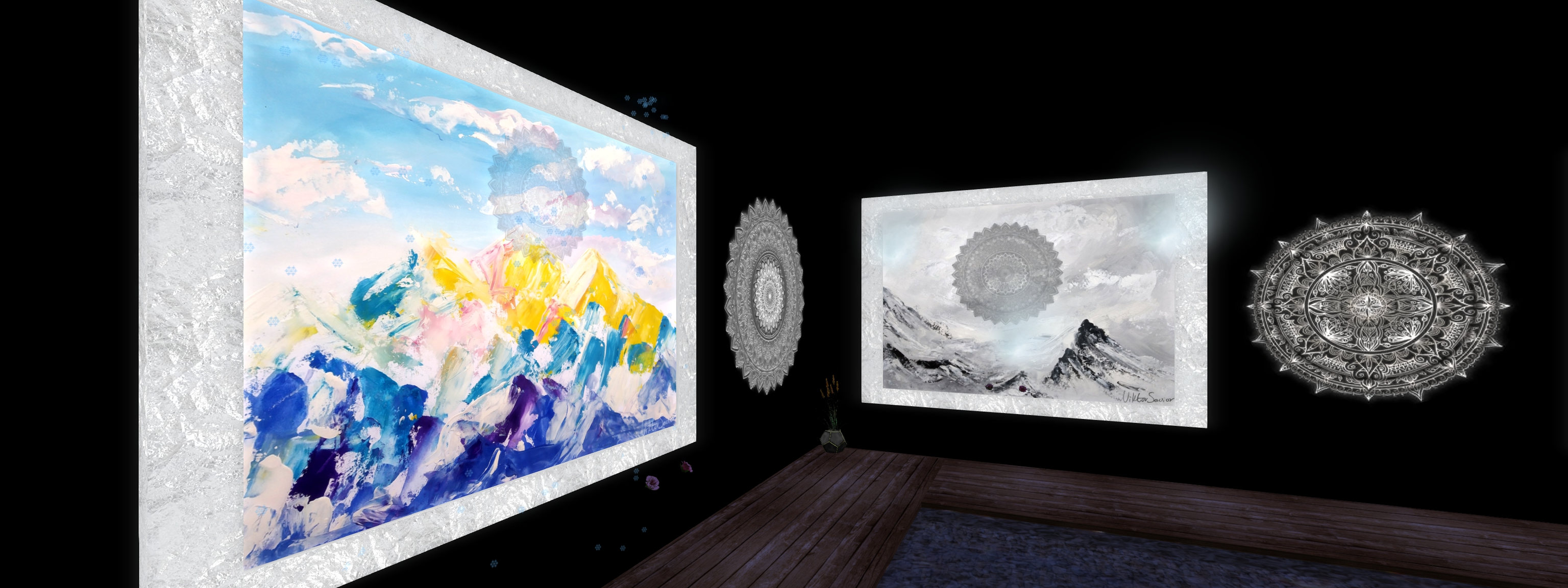
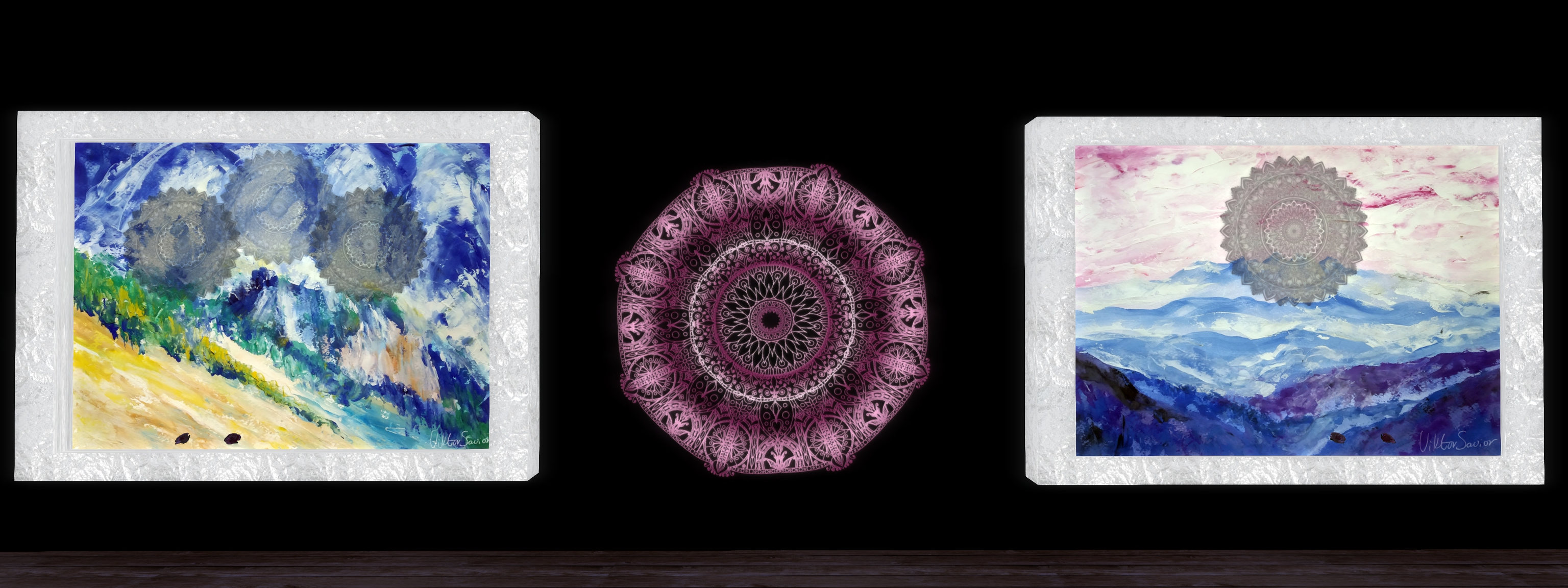
Mountains, Mandalas and Magic sees Vikor produce a series of paintings, the majority of them featuring mountain views (with one perhaps leaning more towards autumn leaves adrift on water, complete with what might be shadowy white Koi below the ripples), Orpheus a series of mandalas, some of which are animated, some of which are static and set within Viktor’s images, and Jaz the particle effects which accompany the paintings in reflection of them: falling leaves, the teardrops of rain, misty clouds and drifting snow…
Third Eye Gallery: Mountains, Mandalas and Magic
In addition, in front of the paintings are static poses – two per image – allowing visitors to take their own photograph before any of the paintings as a keepsake of the exhibition.
The combination of mandalas with mountains is appropriate; while mandalas are common to the Eastern religions of Buddhism, Hinduism, Shinto and Janism, they are perhaps most noted in the west through the growing popularity of Tibetan Buddhism (even though they started in India in around the 8th century), and Tibet offer some of the most stunning mountainous landscaped in the world.
Set around the water garden of Third Eye gallery, this is an engaging, easy to view exhibition with a spiritual content suitable for the time of year, if not entirely in keeping with the general theme of the yuletide time.
These days, the Twelve Days of Christmas aren’t kept as carefully as they once were, however, in the Middle Ages, it was commonplace for workers to put down tools and relax and celebrate Christ’s birth with masses and revels that stretched over almost two weeks. But why was the period so long when Christ’s birth happened in one day?
– Chuck Clip, Ghosts of Traditions Past, UASL, December 2022
This is the question Chuck Clip asks of his audience as the visit his new installation Ghosts of Traditions Past, which officially opens on Sunday, December 18th, 2022. In asking it, he sets the stage for an exploration of “Christmas traditions” in both images and words which explores how Christianity essentially usurped pre-Christian festivals associated with the end-of-year – notably that of the Roman festival of Saturnalia.
This usurping of already-popular / observed festivals from pre-Christian eras was pretty much de rigueur for the early Church, both to stamp its authority on things, and to bring people into the fold, so to speak. However, With its week-long festivities, Saturnalia was an obvious target for the Holy Roman Church for “conversion” to a “Christian” celebration, and in about the 4th century AD, it settled on December 25th as the date of Christs birth (although in reality, He had most likely been born in the spring or autumn) – the date which, under the Julian calendar used the the Romans, the winter solstice fell.
In fairness to the nascent Christian church, the Romans had themselves sequestered the period in which Saturnalia was celebrated from earlier belief systems, notably those of the Celts in Western Europe and (particularly) the British Isles, who had in turn absorbed traditional going by even further into history – of which more anon.
UASL: Chuck Clip – Ghosts of Traditions Past
It is from Saturnalia (itself, as noted, “borrowing” for other pagan festivals of earlier peoples) that many of what we regard as “Christmas traditions” come: the giving of gifts (such as candles, intended to signify the growing return of the Sun after the solstice and small terracotta figurines known as signillaria); the placing of coins in food for dinner guests to find; the use of wreaths; and so on. And, of course, the celebration of a “king” (Saturnalicius princeps), which generally occurred within Roman households – albeit one far from being a redeemer born as a babe, one far more mischievous and disruptive (and so also referred to as the “lord of mis-rule”), seen as a means by which Romans could thrown off the invisible bonds of orderly society and simply revel in a (brief) period of disorder, pranks and generally having fun at the expense of others.
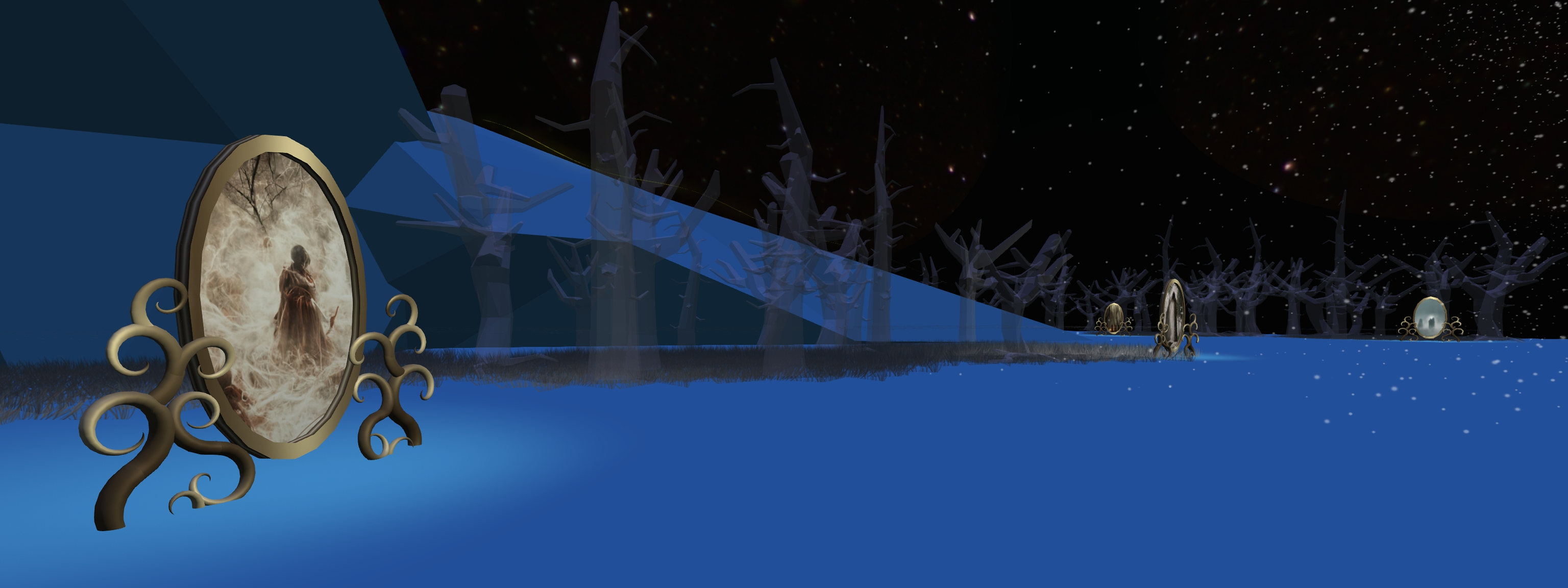
Within Ghosts of TraditionsPast, Chuck takes his audience on a 12-chapter tour of Christmas, a walk through a snowbound landscape to view 12 individual images representative of the traditions we now associate with Christmas and their likely origins, each told through local chat as one approaches each of the images.
Starting with Saturnalia (which itself started as a single day of festivities before expanding to around 7-8 days commencing some 14 days before the end of the 29-day Julian month of December (all of which helped to formulate the notion of the “12 days of Christmas”), these chapters take us through many of the pagan rites and observances which have been either absorbed into the Christian observance of the birth of Christ either directly or through their prior acquisition by Saturnalia.
UASL: Chuck Clip – Ghosts of Traditions Past
Thus, following them in what amounts to a clockwise direction from the entry point (a tunnel leading into the landscape at its 6 o’clock position), the images run in an arc from the left, each one offering the story of a given Christmas tradition – the symbolism of the Christmas wreath, the pagan meaning of holly berries, the meaning of the yule log – even the significance of mistletoe in both pagan and Roman times.
The first 10 of the pieces are located to the snowy plain, backed by ghostly trees, with the final two on the rocky slope leading up to a Christmas tree sitting within Stonehenge, where visitors can obtain a special gift for the season from Chuck. And if you think that Stonehenge is somewhat out-of-place within this Christmas setting, being today more associated with summer solstice celebrations, you’d not be entirely correct.
Recent research (2017-2021) by a consortium led by the University of Bradford and the Ludwig Boltzmann Institute for Archaeological Prospection and Virtual Archaeology, and involving the universities of Birmingham, St Andrews, Warwick, University of Wales Trinity Saint David, has revealed that Stonehenge sits within one of the largest prehistoric sites in the UK, a ring of 10m wide, 5m deep “shafts” encircling it, the Durrington Walls and Woodhenge. Dating back over 2,500, this ring of shafts 2km across, lends considerable weight to the idea that in Neolithic times, Stonehenge was the centre of extended winter solstice celebrations.
UASL: Chuck Clip – Ghosts of Traditions Past
In much the same way, I’d hazard a guess that the use of ghostly trees surrounding the installation sit as a reflection of the tree and The Green Man as a symbol of rebirth and renewal – themes also closely associated with Christ, but which hold their origins to multiple pre-Christian religions. The Green Man (is that him or the face of God looking down on the setting from above?) also sits as a reminder that, even in the midst of its attempts to stamp its authority on the “old ways”, Christianity fell subject to pagan motifs; many are the churches and cathedrals to be found with the face of the Gren Man carved over their entrances or within their halls.
In viewing Ghosts of Tradition Past, I’m reminded of an observation by W. Somerset Maugham: Tradition is a guide and not a jailer. With this exhibition, Chuck cleverly uses the strictures of Christian seasonal tradition to guide visitors to an understanding of the festivals, beliefs and symbols which are both enfolded within that tradition and yet pre-dates it.








 Inara Pey: Living in a Modemworld