Cica’s Summer Night in Second Life

Cica Ghost: Summer Night, June 2023

Cica carries us to the magic of summertime night skies and coastal retreats with her installation Summer Night, which opened on June 16th, 2023. It’s another happy setting, rich in content and details that is light-hearted and intended to lift the spirit. utilising Cica’s custom textures to paint the terrain, the installation is set out on five landmasses of varying heights, between which, like an inlet or bay, a body of water flows.

The first of these landmasses sits as the landing point and presents itself as a broad deck or boardwalk, trees growing in the corners, and a huge fish spelunking down one hole in the boards and rising from a second, head and tail visible, but body lost to sight. a ladder spans the water horizontally to reach the local lighthouse, whilst a second ladder further to one side rises up to the decking covering the top of a flat-topped mesa and the bridge reaching across the deep chasm below to a little fishing town.

Cica Ghost: Summer Night, June 2023

Perched high above the waters, with nets hanging from walls and draped over red-tiled roofs, this is a place where dancing might enjoyed, where cats roam rooftops or await visitors at the local café and where walls have been used as canvases for painting little vignettes here and there. Down below in the bay proper,  2D waves rise and fall and fish and whales frolic even as a fishing boat sails by, whilst star fish climb the net cast up the side of the remaining headland, perhaps to dance under the beaming Moon floating just overhead.

The magic of this setting is that it it appears to have been drawn, literally and figuratively, from a childhood memory or a remembrance of childhood drawings. It doesn’t matter that fish appear to be floating above the waves alongside octopi, whilst crabs scuttle from side to side with claws raised in a cheer or the landscape appears the creation of pencil and paper rather than Mother Nature. What matters is the way the setting lifts the heart and encourages a smile, drawing visitors into it with a childlike joy, particularly when the more unusual sit points are discovered!

What’s more, all of this is caught under the most fantastic night sky, filled with stars, fish, the smiling faces of cats, starfish and more. It’s a sky guaranteed to capture the eye and heart as much as the rest.

Cica Ghost: Summer Night, June 2023

As is usual for Cica, Summer Night draws its name from a quote. In this case, a Haiku by Japanese poet and lay Buddhist priest, Kobayashi Issa (June 15, 1763 – January 5, 1828). Known simply as “Issa”,  a pen name meaning Cup-of-tea, he is referenced as one of the Great Four haiku masters in Japan (along with Bashō, Buson and Shiki). The Haiku Cica has chosen is one of Issa’s most well-known and – for many – most perplexing (how can stars whisper, and to whom are they whispering?).

Summer night—
even the stars
are whispering¹

Kobayashi Issa

Cica Ghost: Summer Night, June 2023

However, there is no need to plumb the depths of Issa’s possible meaning here; it is enough to visit Cica’s Summer Night and enjoy it for all it is beneath its blanket of whispering, playful “stars”.

SLurl Details

  1. Yes, this doesn’t appear to follow the “5-7-5 rule” for a total of 17 phonetic units. However, that’s because it is a translation; the original Japanese version does follow the 17 phonetic “rule”. More particularly, it includes both a kireji (cutting word) and a kigo (seasonal reference), clearly marking it as a haiku, rather than something like a senryū

Through Their Eyes in Second Life

Nitroglobus Roof Gallery, June 2023: Caly Applewhyte – Through Their Eyes

Now open at Nitroglobus Roof Gallery, curated and operated by Dido Haas, is an exhibition by Caly Applewhyte (Calypso Applewhyte). Entitled Through Their Eyes, it opened of June 5th and is the second exhibition I’ve visited of late (the first being Yes Her, which I reviewed for both itself and a possible wider context here) seeking to make a valid statement about women in society, and the unfair bias all too often demonstrated concerning our right simply to be who we want to be in societies – including, increasingly, even within so-called liberalised nations in the west – and not to be subject to uneven demands / expectations.

As Caly offers her own very clear and concise description of the focus of Through Their Eyes, I won’t bore you with my own subjective ramblings; instead, I’ll quote Caly directly.

Women have long been an integral part of society, but their experiences and perspectives are often ignored or undervalued. When we look at the world through women’s eyes, we see a complex and multifaceted reality.
In many societies, women are expected to conform to certain standards of behaviour and appearance, which can be restrictive and limiting. These societal expectations can have an impact on women’s self-esteem, confidence and sense of worth. Women often face a double standard, where they are judged more harshly than men for the same behaviours or actions. Despite these challenges, women have shown incredible resilience and strength, and have made significant contributions to society in a variety of fields.

– Caly Applewhyte, on Through their Eyes

Nitroglobus Roof Gallery, June 2023: Caly Applewhyte – Through Their Eyes
Through women’s eyes we can better understand the challenges they face, the unique perspectives they bring and the importance of promoting gender equality. By recognizing and addressing these challenges, and promoting women’s unique perspectives and contributions, we can work towards a more just and equitable society for all.

– Caly Applewhyte, on Through their Eyes

Thus, the exhibition presents a series of individual studies representing women of many ethnicities and backgrounds, even one a focused head-and-shoulders portrait in which the colour of skin, style of hair, mode of dress (where visible), is not intended to be the primary focus (although they clearly have a role to play in reminding us that women are global citizens who come from many backgrounds and social groups and who aspire to many things – just like the male of our species). What is important in these images are the subject’s eyes.

Nitroglobus Roof Gallery, June 2023: Caly Applewhyte – Through Their Eyes

Whether looking directly at the camera or focused on something unseen from the perspective of the camera’s lens, the eyes of the women Caly has created / drawn together for this series all speak to matters of intelligence, vitality, hope, strength, desire; the emotions and drives that play such a key role in the lives of men, often to high levels of peer praise and adulation, but when shown by women are discounted – or worse, derided or subjected to passive-aggressive responses that (truth be told) perhaps speak to the fragility of the male ego than anything else.

These are eyes that speak of a wish to be free to express, to strive, to achieve; they present each individual in these portraits as an individual. At the same time, they offer a window by which the the world might be seen as women are too often forced to regard it: as a place of struggle simply to be accepted as an individual with needs, wants, drive and desires. In considering the world the eyes in these portraits are looking out upon, some might be encouraged to better understand the constant uphill struggle women face to simply gain a foothold of equitable respect within societies which are still the world over, driven by a patriarchal expectation of position and privilege rather than equality and openness.

Nitroglobus Roof Gallery, June 2023: Caly Applewhyte – Through Their Eyes

SLurl Details

Yes Her in Second Life: strength in the face of intolerance

Factory Arts Collective Gallery – Yes Her, June 2023

Intolerance of others, whether based on gender, ethnicity, religion, and /or sexuality has throughout human history been as much responsible for human suffering, depredation, subjugation and death as any of our multitudinous wars throughout the ages (with religion and ethnicity themselves being two of the most obvious causes of war / conquest).

In the modern age, to say, “you are less than me” purely on the basis of skin colour, gender, sexual preference and to whatever deity a person might opt to pray (or indeed, the manner and direction of said prayers), should, for most individuals capable of the basics of free and rational thinking be anathema. And yet, here we are, facing a rising tide of politically-motivated and damaging “otherism” which encompasses all of the above noted differentiators. Even women in what are regarded as “free” societies are finding their basic rights under threat / being rolled back.

It is a level of public intolerance that is concerning on multiple levels. There is obviously the increased risk those being marginalised face in terms of diminishing rights and growing potential for violence against them – and well as the encouragement it gives to others to engage in such violence. Then there is also the the positive reinforcement repressive regimes in other nations might see when they hear views similar in nature to their own being espoused by politicians from so-called “world leading” nations. Both of these should give pause to reconsider words about to be spoken by those considered to be in high office – but they don’t.

Factory Arts Collective Gallery – Yes Her, June 2023

Such intolerance is poisoning almost all walks of life; for those facing it, it can be – as intended – utterly debilitating, and thus either achieves the goal of subjugation, or generates an anger that can overtake thinking and outlook to a point where it is as damaging to the individual as any form of mental disenfranchisement in the face daily exposure to it. So what can be done? The answer to this simple-sounding question is both myriad and complex; but one part of it can be summed up as support one another and be who we are.

Yes Her is an exhibition of art curated by Scylla Rhiadra which seeks to do just that, with a specific focus on the matter of women’s rights, possibly spurred by the manner in which they are under open attack in the United States, but which embraces women the world over who face a daily challenge simply to exist as people rather than chattel. To use Scylla’s own words concerning the exhibition:

Women around the world are under a great deal of stress right now. And whether we live in Tehran, in Manchester, or in Forth Worth, Texas, we have good reason to be angry. Anger can be a powerful motivator to action. But swimming in constant anger is also a terribly toxic and ultimately self-destructive way to live your life. 
Yes Her is an exhibit that chooses instead to highlight positivity and optimism, and the immense point on which women can call, whether or not they are aware of it. … This exhibit argues that, while our anger can be justified, we need not always be reactive: we can make positive change happen without being prompted by assaults upon our rights. 
We can make a change by being who we are. 
This exhibit celebrates the positive strength and affirmation of what it means to be a woman.

– Scylla Rhiadra, from the introduction of Yes Her

Factory Arts Collective Gallery – Yes Her, June 2023

Having opened on Sunday, May 28th, at the Factory Arts Collective Gallery, Second Life Left Unity (if the SLurl delivers you to the ground-level unity station rather than the gallery, climb the steps into Nelson Mandela Park and follow the track to the left to the teleport kiosk), Yes Her sees Laurel Aurelia, Suki Blossom, Kira Fizzgig, Tatiana Demonix (Nikolay), Eva Knoller, Belinda Newell, Onceagain (Manoji Yachvili) and Saskia Rieko, join with Scylla in an exhibition celebrating womanhood. Each of the artists has contributed at least one image, which are displayed with several of Syclla’s own pieces – including the original Yes Her which help foment the idea for this exhibition.

These are images which are all narratively rich (and self-explanatory), offering a reminder to all of us that women are people, capable for expression the same emotions and desires as the male of the species – and, like it or not – the same autonomy of choice and right to a voice (both of which perfectly exemplified by Scylla through Yes Her (My Door) and Yes Her (Listen!). Within them are statement of power through simple companionship, fearlessness (and facing the future), strength, beauty and the essential humanity in being a woman – a humanity to which all of us should aspire, again regardless of religion, creed, gender, sexuality, age or ethnicity.

Factory Arts Collective Gallery – Yes Her, June 2023

Whilst a statement on the power of womanhood, as we enter Pride Month at a time when the LGBTQ+ communities are facing what is fast becoming an all-out assault on their rights (even, I’m ashamed to say by women of “status” who really should know better), Yes Her has a broader context in which to be seen.

Although the focus of the art is clearly on the power and beauty of womanhood and the right of women to make their own choices in life, Yes Her speaks out against all such intolerance and toxic behaviour and offers encouragement to any finding themselves marginalised by the bigotry of others. Simply substitute the word of your choice (gay, lesbian, pagan, refugee, person of colour, and so on) for the final “woman” in the quote from the exhibition’s introduction I’ve used earlier in this article, and you’ll see why. As such, it offers a message of strength extending well beyond its core focus, and offer s a reminder that no matter what those who would use intolerance as a message of hate and a means to ostracise and / or control, we are all people, with far more that unities us than separates us.

SLurl Details

Kayly Iali at the the Windlight Loft in Second Life

Kultivate Magazine Loft Gallery: Kayly Iali

It’s been a while since I’ve had the opportunity to visit an exhibition by Kayly Iali in Second Life, so when Kultivate Magazine announced the opening of such an exhibition of her paintings within their Loft Gallery, I decided to make amends for this and hop on over.

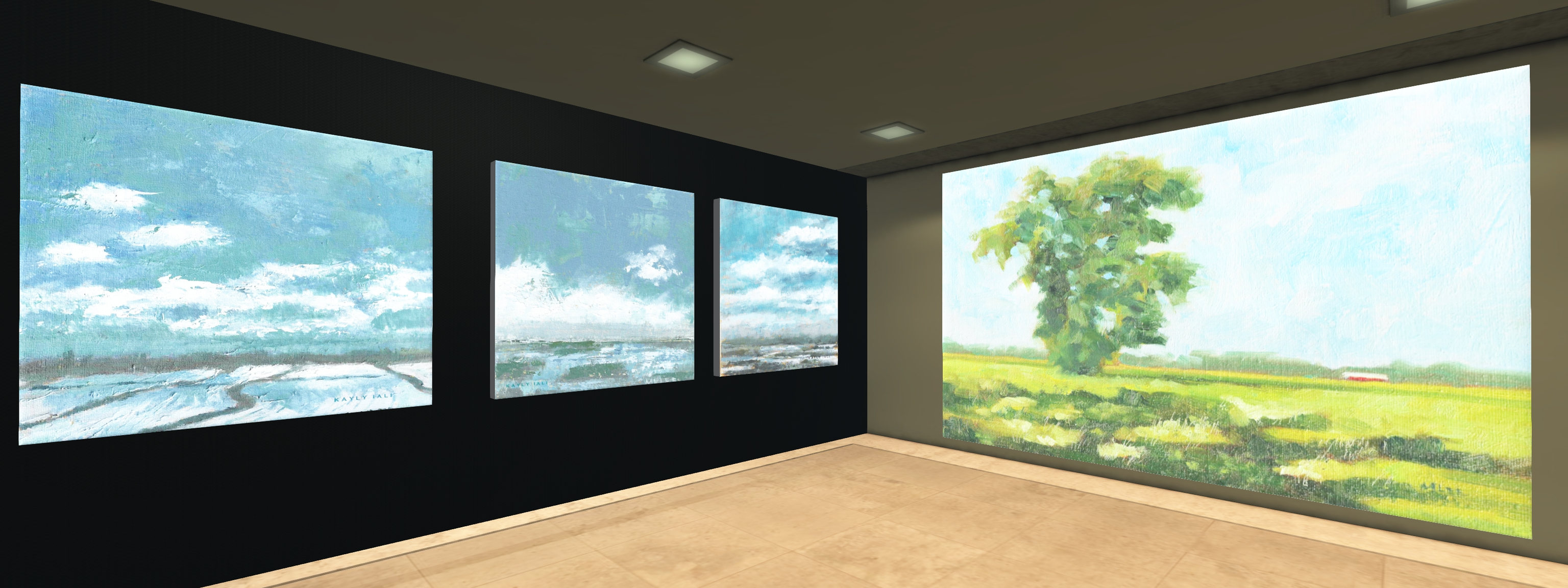
Kayly is an artist in the physical world who uses Second Life as a means of reaching a global audience and present her work. She most frequently works with watercolours and oils, and describes herself as an impressionist in terms of her style of painting, utilising relatively small, thin, yet visible brush strokes, open composition with an emphasis on an accurate depiction of light and movement within her work. Her subject range encompasses still life, portraits and landscapes, and she has a reputation for producing engaging commissioned portraits of pets belonging to Second Life users, some of which have also featured in her in-world exhibitions.

Kultivate Magazine Loft Gallery: Kayly Iali

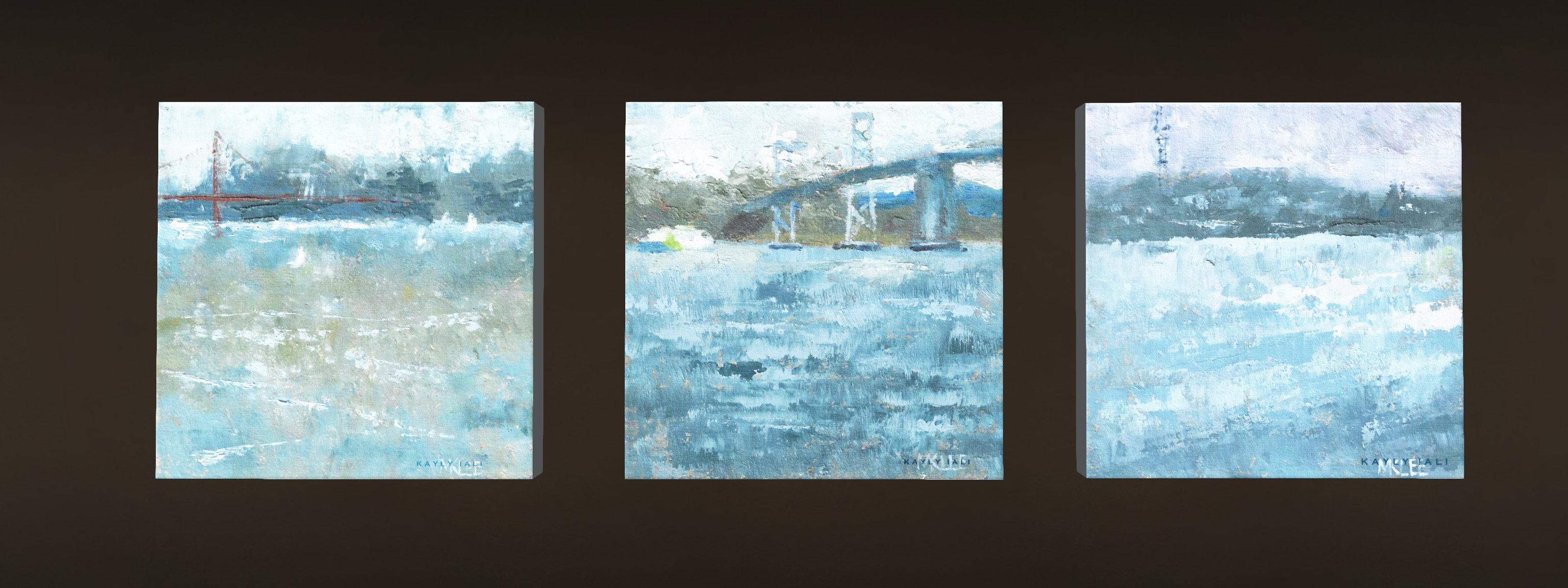
At the loft, Kayly presents a modest selection of her landscape art – twenty in total – featuring locations and sights to be largely (exclusively?) found within her home state of California. Whilst all of them are individual pieces, some might also be drawn together as themed sets or pairings – such as those featuring various landmarks in San Francisco, the “causeway” paintings, and the “Vacaville” pairing. The majority are presented in that impressionist approach noted above, although the “San Francisco trio”, as I’ll loosely refer to it and featuring Alcatraz and both the Golden Gate and Oakland bridges, also leans  towards something of an abstract styling.

Whilst all originating in the physical world, these are pieces that could just have easily had their inspiration rising from within Second Life. As such, they offer something of an artistic bridge between both the physical and the digital, reminding us that our two worlds, whilst never exactly meeting are nevertheless closely intertwined.

Kultivate Magazine Loft Gallery: Kayly Iali

These are engaging pieces which form an equally engaging exhibition; they are also – given the way the link our two worlds – pieces that will grace any Second Life home.

SLurl Details

Invisible Cities: The Future in the Present Overflows in Second Life

Artsville Galleries and Community – Debora Kaz:  Invisible Cities: the Future in the Present Overflows

Friday, May 26th saw the opening of Invisible Cities: the Future in the Present Overflows at the Artsville Galleries and Community, operated and curated by Frank Atisso. The work of Debora Kaz, the exhibition is a further instalment of her Invisible Cities series, which I first encountered in August 2022 when  Dido Haas hosted Invisible Cities: Fighting Women at her Nitroglobus Roof Gallery (and which is reviewed here).

With Invisible Cities: The Future in the Present Overflows, Debora once again tackles a societal issue and the lasting effect it can have on the lives of those subjected to it: violence, in all its forms, visible and invisible; physical and mental / moral.

In this exhibition, the idea is to suggest parallels between past, present and future of lived stories where violence is present since childhood. To bring out the need to talk about these stories, to heal, survive and protect. Violence as an instrument of power … brings with it disorders and dependencies, fragilities that need support, affection and respect. [This is] An exhibition to put you in a place less critical and more solidarity.

– Debora Kaz, introducing Invisible Cities: The Future in the Present Overflows

Artsville Galleries and Community – Debora Kaz:  Invisible Cities: the Future in the Present Overflows

However, before getting into things, there are a couple of points to note up front. The first is that it should be viewed using both the local environment settings (World → Environment → Use Shared Environment) and with Advanced Lighting Model (ALM) enabled (Preferences  → Graphics → make sure Advanced Lighting Model is checked); Shadows do not need to be enabled as well, so flipping ALM on (if you usually have it disabled) should not impact viewer performance.

The second is that the installation is multi-level, the three levels linked by a teleport system. This takes the form of an atom-like structure. Right-clicking on it will sit you and display a list of numbered destination options. While it is not implied by the ordering or within the introduction, I would perhaps suggest that in starting a tour, you first use the teleport to visit the elements labelled Past 1 through Past 6. These will deliver you to the uppermost elements of the installation, representing childhood and the past. Within each is a father / daughter combination, each with what appears to be a duality of purpose. At first, they might seem to simply represent a parent / child relationship – out walking, holding hands, a loving pat on the head, the gestures of nurturing care.

But look again, particularly at the likes Past 2, Past 6 and Past 1; note the body language of the child, the way the adult’s arm grips wrist or upper arm:  these suggest something less than loving and closer to restraint, control, subjugation. Now take the hand resting on the child’s shoulder and the apparent head-pat; are these actually gentle gestures of love, or might they also be further suggestions of restraint and subjugation aimed at the child?

Artsville Galleries and Community – Debora Kaz:  Invisible Cities: the Future in the Present Overflows

Thus, within these six dioramas is manifested the idea of violence present in childhood, the lances extending from these bubbles to the lower levels representing the way such violence can literally spear every aspects of a life exposed to it from that point on.

Between them, the mid and lower levels of the installation offer reflections (so to speak) of the present and future of a life spent in the receipt / fear of violence, with the lower level offering a series of rooms in a house which can either be reached via the teleport system or simply explored on foot once within them.

The house and its contents is a poignant tour-de-force of a life riven by fear – rational or otherwise – resulting from the persistent pressure of both physical and mental violence. It is a metaphor for both solitary comfort a home can offer  those so afflicted – and the prison it can be become, where fears can still haunt and the world beyond the windows seem full of threats.

Within it, the images reflect the fear – the flight reaction – under which those affected by prolonged violence of deed and word find themselves almost constantly feeling; the figures reflect the confusion, the sense of self-blame and guilt they feel for allowing the violence  they suffered and the fear they are now living with and their self-perceived weakness in being unable to cope within a world which too often tells them much the same.

Artsville Galleries and Community – Debora Kaz:  Invisible Cities: the Future in the Present Overflows
The victim is trapped within a cycle of violence that is almost impossible to get out of. The mental damage, the fragility, the feelings of impotence cause paralysis, guilt and frustration. And [while] while all the help in the world might be useless, [by] letting the victim know that she can count on someone may be the only hope for life. All together we can care and protect – and most of all, love.

– Debora Kaz, introducing Invisible Cities: The Future in the Present Overflows

Invisible Cities: The Future in the Present Overflows might not be the easiest installation to grasp or feel comfortable with; but that’s the point. This is a challenge to all of us living in a world increasingly riven by attitudes, outlooks and beliefs that are increasingly polarising and driven by the need to “other” those who refused to adhere to ideals and morals that are – frankly – immoral, and to foster violence upon them in the process, that perhaps we all should endeavour to rise above such actions and reach out, love and nurture our children and those around us because they are different, and that pain, ostracization and brutality of action and word should have no place in a civilised society.

SLurl Details

Re-visiting Strandhavet Viking Museum in Second Life

Strandhavet Viking Museum, May 2023

In April 2021 I visited the Strandhavet Viking Museum, curated and operated by Katia (katia Martinek) and sitting within Second Norway, the estate which has been “home” for the last few years. At the time, I enjoyed my visit (see Strandhavet Viking Museum in Second Life). Unfortunately, life being what it is, Katia had to close the museum for a time and relinquish the half island on which it stood. However, it appears that Odin himself may have appreciated Katia’s work, because when she felt she wanted to re-establish the museum, the entire island on which it originally stood was available for rent, allowing her to both return to the museum’s roots, so to speak, and make use of the increased space to revamp it entirely, expanding the exhibition spaces. So when she dropped a note to me explaining all that had happened I knew I’d have to make a return visit.

Visits commence at the southern end of the north-south oriented island, where a wharf (landing point) sits with a ferry alongside, as if the latter had just disgorged visitors. A broad paved walkway runs north from here, passing outdoor exhibit spaces before reaching the imposing form of a Viking long ship sitting outside the museum’s new main hall.

Strandhavet Viking Museum, May 2023

It is not unfair to say that the Viking culture and society has (notably from the 18th century onwards) tended to be romanticised, leading to the popular – if incorrect – conceptions that Vikings were predominantly violent, piratical heathens driven by a need to plunder and subjugate; attitudes which also happened to drive them to intrepid acts of seamanship and exploration. In the 19th century and during the Viking revival – which also saw attempts in Scandinavia to put the Vikings on a correct historical footing – this romanticising of myth and legend particularly came to the fore in the United Kingdom and in Germany; for example: the idea that all Viking men tromped around wearing horned helmets owes more to opera by one Wilhelm Richard Wagner (and perhaps, by indirect extension, the influence of Warner Brothers cartoons on young minds in the mid-20th century!) than anything factual.

Whilst the Vikings did wage war where necessary (who didn’t in those times?), their society was actually highly structured, with laws and codes of conduct, own art and architecture, writing (runes) and religion (later subsumed by the rise of Christianity – easily as bloody a religion as Viking paganism)/ The majority of Viking men tended to be craftsmen, fishermen, builders, farmers and traders first, and warriors second. In this regard, it was – like most civilisations – the desire to trade and explore that led Vikings to spread out from their Scandinavian homelands and achieve an impressively expansive presence right across Europe to Asia, Iran and Arabia in one direction, and the continent of North America in the other.

Strandhavet Viking Museum, May 2023

This desire to trade and explore is recorded in one of Viking-style structures sitting alongside Strandhavet’s broad path. Within a two-roomed house of typical Viking design, visitors can learn about the extensive travels of Viking ships and Viking traders. through a series of maps and charts. These trace the routes taken through The Baltic, down through Europe and onwards and eastward, via and and river. They also chart westward travels to Iceland and onwards to Greenland and then what we now call Canada and the United States, and the voyages that sent Vikings to Britain, France, and down and along the Mediterranean.  From the settlement formed by many of these expeditions arose the Normans, Norse-Gaels, Rus’ people, Faroese and Icelanders. Of course, conflict inevitably arose from this expansion, and some of this is also recorded with the “Map House” as well.

Across the path from the “Map House” and standing within a cobbled, open-sided courtyard between the excavated Viking long ship mound and the museum’s main hall, can be found a slideshow open for anyone to use. It offers further insight into one of the elements of Viking society – its spread across Europe as far as Miklagard (or Miklagarðr, from mikill ‘big’ and garðr ‘wall’ or ‘stronghold’) – the city also known as  Byzantium or Stamboul or Constantinople, and which we today call Istanbul. This slideshow is just one of several interactive elements to be found within the museum.

Strandhavet Viking Museum, May 2023

Within the expanded main hall of the museum there is much to be admired and appreciated. The lower floor has been divided into a series of topic-based exhibition areas through which visitors can amble. These cover subjects such as Viking mythology, Norse heroes, the role played by magic / ritual / religion, the use of runes, a timeline of the Viking era, insights into the Viking lifestyle, laws, beliefs, and the legacy left by Viking society.

Superb use is made of the increased floor space within the building, and Katia should be congratulated not just on the wealth of information she has drawn together (available through note cards obtains by touching individual display plinths and stands), but in the way she has brought together items from multiple Second Life content creators and use them to create miniatures and models, together with artefacts we might imagine to have been uncovered by archaeologists. These help to give the museum a mix of authenticity and immersion that builds on the legacy of original whilst also broadening it.

Strandhavet Viking Museum, May 2023

On the upper floor of the museum is what might be rotating displays related to Vikings. At the time of my visit, these included representations of the Överhogdal tapestries – textures dating back 1,000 years and in remarkably good condition, and which appear to incorporate both pagan and Christian influences within them. The actual Överhogdal tapestries are carefully preserved and displayed at Jamtli, the regional museum of Jämtland and Härjedalen in Östersund, central Sweden – and the reproductions within Strandhavet are nicely annotated as being “on loan” from that museum!

Also on display on the upper level is Viking Women, presenting the opportunity to learn about 12 actual Viking women of extraordinary stature in Viking society down the years.

Strandhavet Viking Museum, May 2023

Richly expanding on its original concept and build, Strandhavet Viking Museum’s return to Second Life is both welcome and deserved; the love and care put into it by Katia can only be admired, and a visit to the museum by any and all with any interest in medieval history is to be highly recommended (and do consider a donation towards the museum’s continued existence should you pay it a visit!

SLurl Details