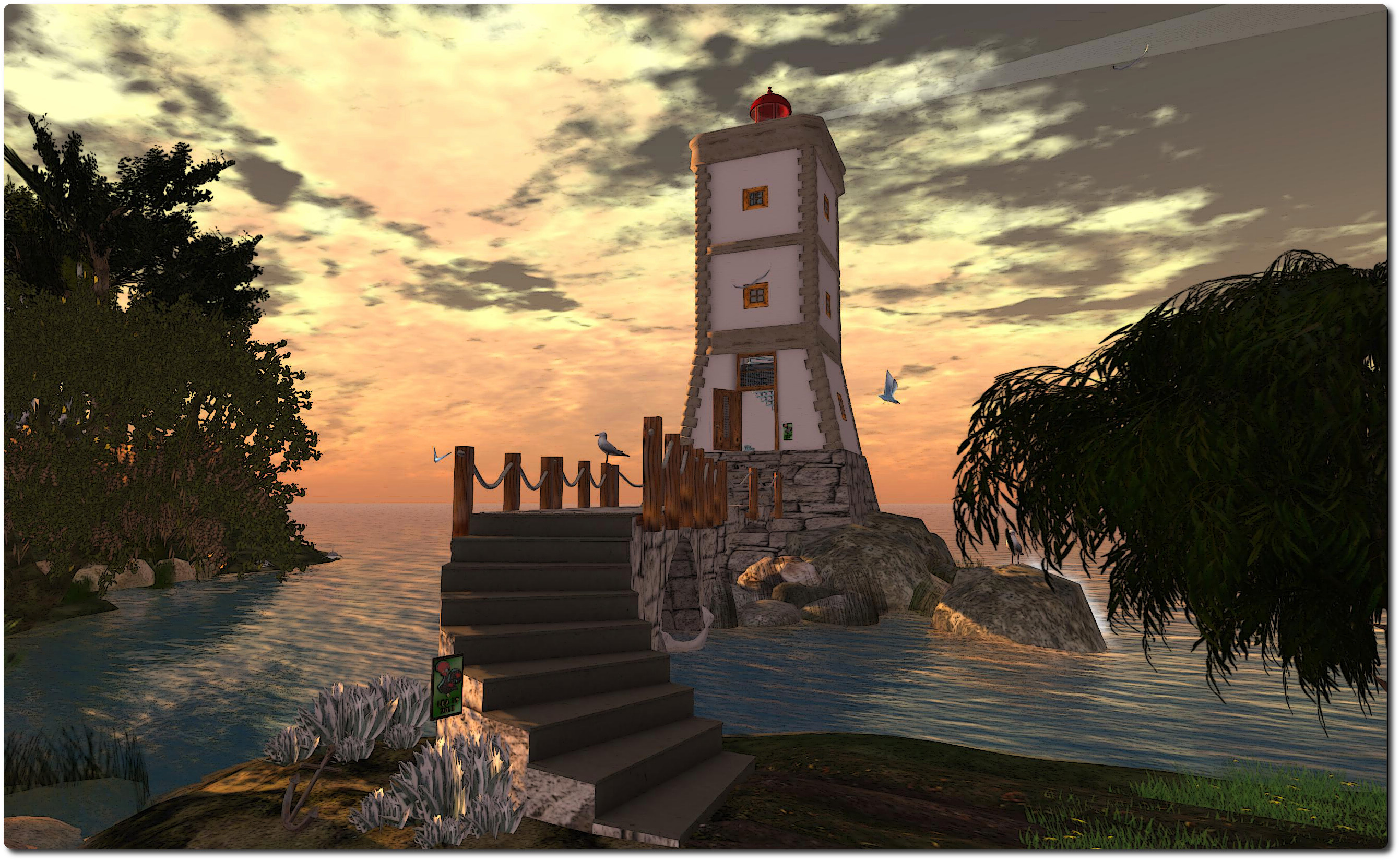
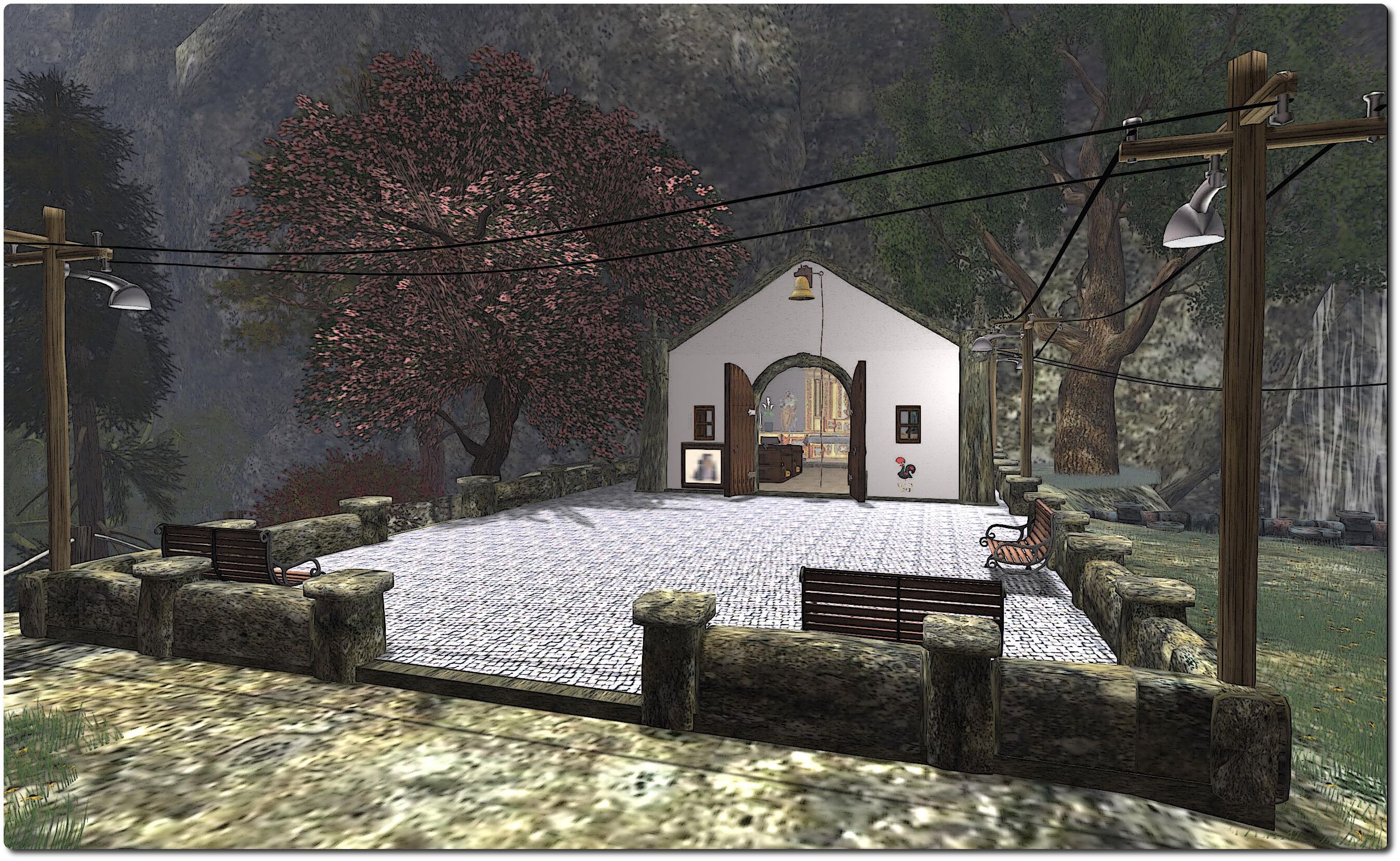
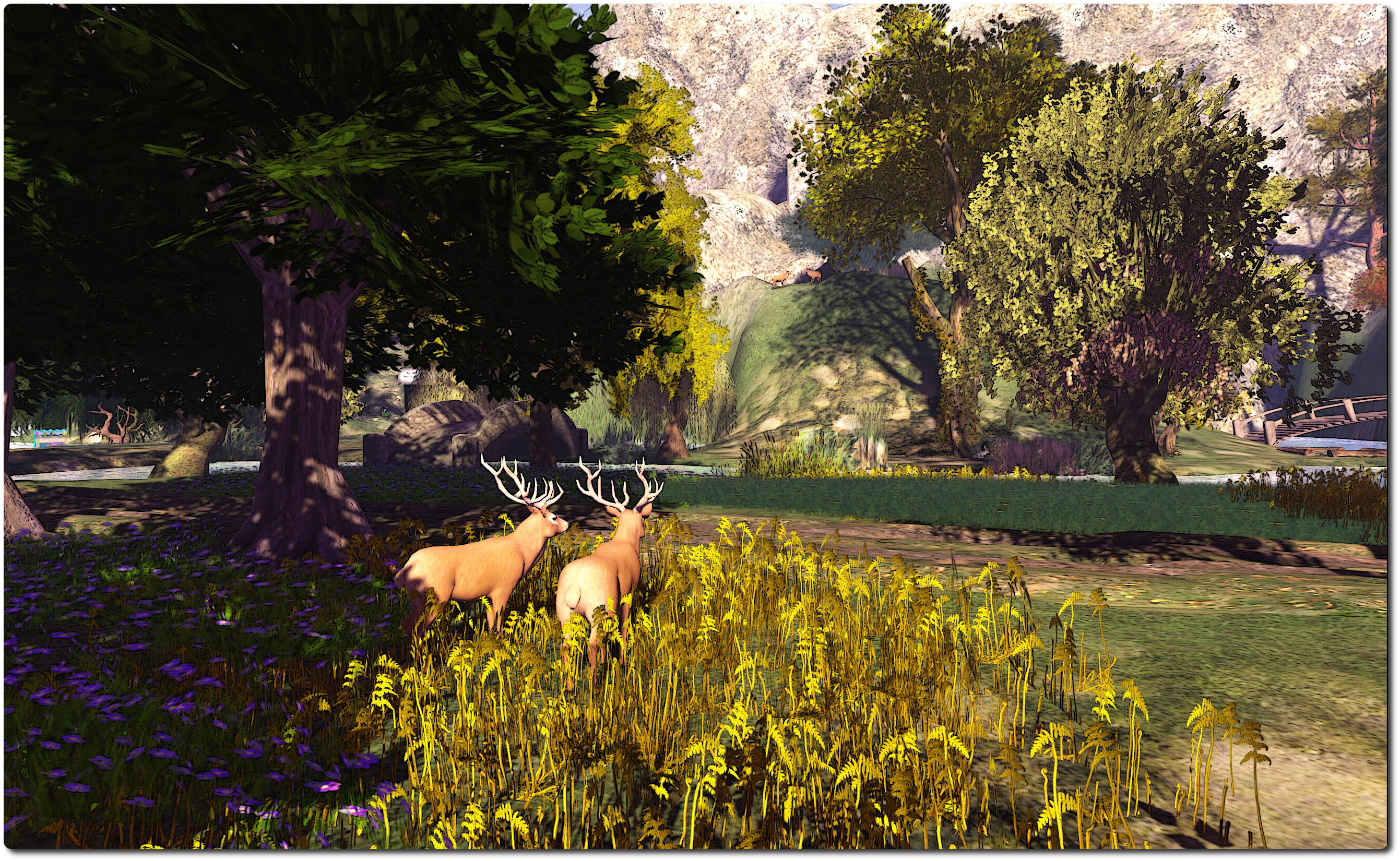
The Portuguese Way, a collaborative piece by Chagal Campestre, Flor Campestre, Janjii Rugani, Wan Laryukov, Winter Wardhani, is a little different from “the usual” (however you might define that!) exhibitions at the Linden Endowment for the Arts.
Explaining their piece, which opened on September 13th, the team said, “When we decided to present a project to apply for a LEA sim, we thought about doing something different from what we usually see in the LEA sims.
“So we opted to do a realistic sim, depicting RL Portuguese landmarks and at the same time, show our history and culture, hopefully breaking the stereotype that Portugal is all about sun and sea. We called it ‘The Portuguese Way.”
The Portuguese Way: a model of the 25th of April Bridge, one of the world’s longest suspension bridges (2.2 km long), with the art centre beyond
Portugal is somewhere I’ve never had the pleasure of visiting. I rather suspect that, like a lot of other people, my view of it amounts to thoughts of Portugal in a modern context – as the team state, a destination for holday goers and of being “the country between Spain and the Atlantic”. It’s very easy to forget that it was once the centre of the longest-lived colonial empire in Europe, lasting some 600 years from the capture of Ceuta, northern Africa in 1415, through until the handover of Macau to China in 1999 (de facto) or the granting of sovereignty to East Timor in 2002 (de jure), depending on one’s point-of-view.
During that time, the empire held territories across what are now 53 different sovereign states, with some 240 million Portuguese speakers (making it the 6th most-spoken language in the world).
The exhibit itself presents a number of famous Portuguese landmarks and historical sites, as well as various rural scenes, in a landscaped environment one can explore in a number of ways – on foot (recommended), via balloon or via teleport links, for example.
The Portuguese Way
There are information givers scattered throughout the region, each disguised to blend-in with its surroundings which provide a broad range of information on the country: history, political, economy, legends – such as that of Sebastian – culture, art and more. On one side of the region sits a maze, inspired by Ensaio sobre a Cegueira ( Eng: Blindness), a novel by Portuguese writer and recipient of the 1998 Nobel Prize in Literature, José Saramago.
All told, the region packs a lot into it, so it is worthwhile taking the time to explore. The note cards are both informative and clearly written and help present one with insight into Portugal and its rich and diverse history and its position in the modern world. As well as the exhibit itself, the team responsible for The Portuguese Way are planning a series of cultural and musical events by Portuguese artists and performers working in Second Life.
On Sunday September 1st, the University of Western Australia, in association with Virtual Ability Inc., and the Centre for ME/CFS and Other Invisible Illnesses announced the launch of The Freedom Project: A 2D/3D Art and Film Event.
This is not a competition per se. Rather this is an opportunity for artists suffering from a disability or chronic illness, or associated with those suffering from either, to demonstrate how virtual life has enabled them to engage in activities and interact with others in ways which may not be possible in the real world.
As such, the organisers are inviting artists and film makers from all over the world who self-identify as having a disability or a chronic illness, to create an artwork or a film/machinima on the theme of ‘Freedom’, showing how virtual worlds have in some way helped them or those around them.
Films and artwork can be submitted any time between the 1st of September 2013 and the 28th of February 2014. Artwork should have no more than 200 prims, and films should be around 3-5 minutes (although no hard limits on film length will be enforced). Artwork will go on display immediately at the UWA Virtual Gallery, and films will be put on the UWA Second Life Blog.
Submissions do not have to be created in isolation or alone; they can be collaborative, so long as the project leader or primary driving force behind the creation is clear. The extent of collaboration and assistance by others should be detailed in the submission note card, and credit given as appropriate.
Submitted pieces will be displayed at the UWA gallery and blog through until the end of the project, when a number will be selected by a panel to appear in a special journal marking the project, which will be made available in print and on the web.
It is hoped that the journal, along with all the artwork, machinima, and stories, will inspire others, and will demonstrate how virtual worlds can be used to help some people who may have had difficulties finding other means of expression to believe in themselves more, or to connect with others. Those artists selected to appear in the journal will each receive a copy, and machinima selections will be represented as stills and a link to their on-line presence. In addition, ten pieces submitted to the project will be selected by the panel to each receive L$10,000.
Commenting on the project during the launch on September 1st, Dianne Elton, representing the Centre for ME/CFS and Other Invisible Illnesses said:
The Freedom Art Project invites people with illness and disabilities not only to showcase their art, but to share how SL may perhaps provide opportunities not available to them in real life. In my own case, being housebound, SL has extended my social world exponentially. I now have many friends right around the world. No longer able to attend art galleries, I was delighted to find I could come to UWA and enjoy stunning innovative art without leaving my bed. My illness has taken away many activities I used to do in real life but as I don’t have to leave my bed, I can do things in SL including attending and facilitating bookclubs. meditation and guided relaxation sessions and I can even go dancing with hubby!
This is how SL gives me “freedom”. Freedom to be active within the limitations of my health. Freedom to interact with others from the confines of my house. I am really looking forward to seeing the artworks produced for this event and to learning how sl might give others “FREEDOM”.
Key Details for Entering the Project
Artwork and film entries should reflect the theme ‘Freedom’, and should attempt to show how the virtual world has helped or how it could help
This event is open to all who identify as having a disability or a chronic illness (of any nature)
A maximum of 2 entries per artist for the art event with a 200 prim limit per artwork
A maximum of 3 entries per artist for film/machinima (preferred length between 3-5 minutes)
Entries will be received beginning 1 September 2013 until 28 February 2014. (Note that the earlier work is submitted, the longer it will be on view.)
Artists are additional invited to add, in 100-300 words, how the virtual world has assisted them and/or those around them, has helped create community, or has helped them to transcend difficulties and challenges real life has posed. This is an optional aspect of the project, but the organisers hope all artists opting to participate will provide such a description.
Entries should be placed Place the artwork in the receiver (drop box) for the Freedom Project at the UWA Art Challenge platform, along with a completed Artist’s Notecard form. (No perms required, but copy is appreciated if possible.) If you have problems with the receiver, you may give artwork directly to FreeWee Ling or Jayjay Zifanwe along with the note card.
For the complete set of rules and technical requirements for the project, please refer to the UWA blog post announcing the project.
About Virtual Ability and the Centre for ME/CFS and Other Invisible Illnesses
Virtual Ability
Many disabilities in the real world can be a barrier to entry into the digital as well. People may have difficulties in dealing with the keyboard due to illness or disability; others many be reliant upon voice recognition software, and so on. Virtual Ability, Inc. helps people with these kind of challenges get into and become successful in virtual worlds like Second Life.
From an individual skills assessment undertaken during a unique intake process, Virtual Ability inc., are able to refer clients for help with assistive hardware and software as appropriate, and provide customised training and orientation. Once clients are in-world, Virtual Ability Inc., helps them integrate into the virtual society, and provides an ongoing community of support. The community offers members information, encouragement, training, companionship, referrals to other online resources and groups, ways to contribute back to the community, and ways to have fun.
The organisation runs a number of in-world centres, which can be read about on their website.
The Centre for ME/CFS and Other Invisible Illnesses
The Centre for ME/CFS and Other Invisible Illnesses provides resources, support and guided relaxation sessions, for people with Myalgic Encephalomyelitis, Chronic Fatigue Syndrome, Fibromyalgia, Post Traumatic Stress Disorder, Irritable Bowel Syndrome, Gulf War Syndrome, and other invisible illnesses. They host general and research discussions once a week on Mondays at 18:00 SLT, and guided relaxation sessions every day, twice a day, at 08:00 and 20:00 SLT, in the Centre to help people manage their illness. This Centre is open to all, and all are welcome, including anyone with an illness, their families and carers to meet here and help each other. The Centre is located in Curtin University in Second Life.
Musiclandia, a full sim art piece by Livio Oak Korobase, opened on LEA-11 on Wednesday August 28th as a part of the 5th round of the Artist-in-Residence (AIR) programme. The piece is billed as an exploration of music as an art form, and offers-up the following teaser:
What is the definition of music? What is the relationship between music and mind? What is the connection between music and emotions? Search for your answer in Musiclandia.
It’s a fascinating piece, offering a watery landscape in which musical instruments form a series of set pieces inviting exploration. This is an interactive piece, requiring a reasonable amount of time in order to discover all of its secrets, so it’s worth taking your time to look around each of the pieces and discovering what there is to see and learn – note cards are offered at various points around the installation, providing further information and food for thought.
The arrival point provides some basic instructions – you’ll need sounds active to enjoy the exhibit (although not necessarily media streaming enabled) and you should drop draw distance to 128 or so metres to stop most distractions from the neighbouring regions creeping into your view. There’s no set order to exploring things, just go where your eyes take you, out from the little village square under the massive brick piano and across the water.
Some of the many roles music plays in our lives are explored here; how it can channel a freedom of personal expression, how it can play an emotional, spiritual or therapeutic role. In these explorations, issues of identity and self are also touched upon. Symbolism is also strong here; some of it obvious, some of it less so; when it comes to matters of self, a towering stag, harp held within its antlers, reminds us umuntu ngumuntu ngabantu – “you are who you are because of how you relate to others around you”.
The food for thought comes in a number of forms; the Musiclandia Beach, for example delves into the role of music and sound in creation myths, including the origin of that simple Biblical phrase “In the beginning was the word”. Elsewhere, the Lab and Jam area examines the role of music in therapy, while Feathers and Kites probes matters of self and identity.
In these explorations, Livio draws on the writings of a number of people; some may be recognisable – even notorious / controversial – to visitors, others perhaps not so; but the selected passages do invite further explorations; if you find this is the case, the sources are cited, and the Interwebz are your friend.
Which is not to say that it’s all a dry, intellectual piece; there are plenty of opportunities to find your own self-expression through music, be it via dance, interacting with objects or enjoying the sensation of simply playing an instrument.
The piece isn’t limited to the ground, either, there are a couple of sections up in the sky; Moby and Paradiso. The latter looks like it is intended to be used as live music / entertainment venue, although this is by no means clear (at least, I didn’t get a note card explaining its purpose on my arrival).
Getting around the exhibit can be done on foot, via the teleport map in the village square, or for those who are feeling serene, via a number of Harleywan Haggwood’s flyable kites. As mentioned above, this is a piece that requires a little time – and an open mid – to explore, and the kites are actually a fun way of getting around and letting thoughts and reactions to the piece flow freely.
Quan Lavender invited me to the opening of two new exhibitions at the Art India Gallery on Wednesday August 14th. Together, they make interesting companions – and a strong juxtaposition of images and emotions.
Inner Prisons
“The sculptures of Chuckmatrix Clip always had a strong dark side for me,” Quan opens her introduction to the first of the pieces, Inner Prisons by Chuckmatrix Clip. “About 6 months ago I asked him if he would like to exhibit at Art India Gallery and to concentrate on this dark side. Luckily he agreed.”
The result is something of an autobiographical exhibit which, I understand, has it roots in a piece Chuckmatrix submitted to the UWA, one that touched upon his own struggle with mental illness.
Inner Prisons takes this a stage further, presenting a series of sculptures which vividly – and with the help of the accompanying soundtrack – very emotively capture the struggles he, and others with the same affliction, face in dealing with the demons inside their minds.
Staged within the confines of a set representing an asylum, the sculptures are mixed with a series of pictures which provide insight into the many factors which can contribute to the unsettling of the mind from childhood through to adulthood, and which can so easily leave a person isolated, feeling unloved, alone, and with little more than self-loathing and fear for company.
It is a series of dark vignettes which one does not often see identified as art, much less put together in an open exhibition like this. It’s also a very moving experience as well – as Quan says in her notes, this is an emotional bearing of a man’s soul, and intensely powerful one at that.
And the fact that it is, is also why Inner Prisons carries an underlying message of hope in the final piece. Fears can be controlled; inner demons can be exorcised. It takes time, it takes help, it takes a willingness for people to understand – but it can be done. One can be brought back from the edge of despair and a contemplation of suicide to face one’s darkest thoughts and, if not be rid of them entirely, be able to sublimate and dispel them; all it takes is a simple trigger to start the entire process. For Chuckmatrix, that trigger came in the form of a small white teddy bear, the focus of the final sculpture.
While it may have been a long, painful road from where he was when that bear re-entered his life towhere he is today, Chuckmatrix nevertheless stands a proof – to use his own words – that “no matter how far you fall, there is always a way back up”.
Pictures alone do not do this work justice. It needs to be experienced.
My work shown in SL manipulates and abstracts pornographic imagery. Porn is generally not treated as art, yet it is part of our visual language. Porn as an escape for some, an anathema for others, but to simply dismiss it or hide it under the bed denies us the ability to understand something about who we are. I look for the art in it.
His pieces are a vivid contrast to Chuckmatrix’s work. Here we have vivid colours and shapes, all drawn from the naked human form, female and male, but not exactly in a manner which is NSFW. The images have been abstracted (some, admittedly a lot more than others), some have been given motion, scrolling slowly across the canvas in a series of hypnotic and ever-changing patterns. All are exhibited in a more “usual” gallery-style environment.
The contrast between the two exhibits couldn’t be stronger. Where Inner Prisons is stark, dark and disturbing, Escapes is initially loud, proud, and bold. Escapes is also much smaller in scale and setting than Inner Prisons, which also makes it perhaps more intimate.
There an initial subtext here as well which tends to get the mind boggling a bit, and I’ll be curious to know what conversations may well come out of it. Here were have images deliberately focused on pornography on display in a virtual environment which is, in the eyes of the world, some kind of hub for pornography and sexual encounters. Yet the images are themselves, through the very nature of being abstract, demure and devoid of the in-you-face attitude people associate with pornography.
There is also something else in Escapes, however; something Quan picked-up on herself in her notes as curator of both exhibits. Whereas Inner Prisons is stark and unsettling, it nevertheless carries a message of hope. By contrast Escapes, because it is based on the pornography business which can be dark and ugly, may well be bright and alluring to look at, but it perhaps carries a darker and more uncomfortable subtext.
Which is not to say it should be avoided – both exhibits make compelling sets and are equally deserving of an audience. You can catch both of them now through until September 29th.
On Monday August 5th, the University of Western Australia (UWA) announced the winners of both its Centenary 3D Art Challenge and the 6th UWA Machinima Challenge. All told, both competitions saw a total of L$1.7 million on offer for the winners, of which some L$65,000 was on offer to members of the public participating in the judging.
As always, the entries came from all around the globe, with 64 pieces submitted to the 3D Art Challenge, in which artists were tasked with creating a piece of 3D art which fits the theme of the challenge, and to do so using no more than 150 prims (LI 150). The theme was that of “Reflections”, in recognition of the fact that the UWA is itself celebrating 100 years of existence and pondering on what the next 100 years might bring.
The first prize of L$100,000 went to Australian artist Glyph Graves, and his piece, I Thought I Hated Him. described by the artist as “a romance of the old style pulp paper book variety”, and also a “dance piece, one conducted between the New York Stock Exchange composite index and The Shanghai Stock Exchange composite index.”
I Thought I Hated Him by Glyph Graves, winner of the UWA’s Centenary 3D Art Challenge (image courtesy of UWA)
In it, two figures dance a dance of cautious passion, with both the moves and the music generated by the interaction of the New York Stock Exchange (the male character) and the Shanghai Stock Exchange (the female character). The characters, move towards or away from each other depending upon the “price” of their index, a reflection of the desires, thoughts and wants of the millions who trade on these markets.
The 6th Machinima Challenge similarly saw 64 entries from around the world, which was held on the same theme of Reflections, which the original challenge announcement described as:
Reflections in a pool of water… Reflections of light… Reflecting on the grandeur of the universe… Reflections of art…. An Inner Reflection…..Reflecting on opportunities lost, or seized… How ‘Reflections’ is interpreted is exactly like how beauty is interpreted…. in the eyes of the beholder… or in this case, the eyes and lens of the machinimatographer.
The video awarded the L$200,000 first prize came from Vilvi Rae of Finland, ending Tutsy Navarathna’s 3-year run as “defending champion”. Vilvi’s piece, Past I Beyondis described by Jon Stubbs, Director of UWA’s Student Services as “a hauntingly beautiful future fantasy autobiography that explores past choices and what lies beyond. Beautifully filmed: 5 stars from the judging panel!”
Tutsy’s own piece, Narcissus, was awarded the second prize of L$150,000.
The full list of all prizes winners in both challenges can be found in the UWA blog post. In addition, FreeWee Ling has put together a superb on-line exhibition catalogue for the 3D Art Challenge, and the pieces themselves can be enjoyed for a while longer by visiting the exhibition space at UWA. Links to the winning machinima can also be found in the UWA blog post, while all of the entries to this year’s Machinima Challenge can be found on Aview TV.
Fruit of Time by Rebeca Bashly, joint 8th prize winner, and one of my personal choices in the 3D Art Challenge
Audience Participation 1st Prize Winners
The first prizes in the audience participation competitions for each of the challenges went to Gisle89G (L$7,000) for the 3D Centenary Arts competition and Karima Hoisan (L$15,000) for the Machinima Challenge competition. In addition to the cash prizes, both will receive real-life prizes and offered the chance to be on the judging panel for the next art and machinima challenges. The full lists of audience participation winners are again available in the UWA blog post.
I find the Machinima Open Studio Project intriguing, as past posts on the subject demonstrate. Chic Aeon’s work to provide machinima makers and photographers with a range of facilities and sets is always evolving. As such, I tend to periodically pop back and see what is going on and look at what has changed since my last visit. I did so at the start of August, knowing that Chic has recently spent some time adding, tweaking and updating, and was curious to have a look at what’s changed / arrived, and report back on some of the updates.
At the ground level, there are some new buildings, a place to go fishing (complete with casting animations, etc.), and a new rural / farm scene complete with green house, crops and plants and beasty of a tractor. These all combine to add a range of filming / photography options in a natural, open setting.
One of the recent ground-level additions at MOSP
Up in the air there have been quite a few changes / updates since my last visit. The “green platform”, now called Sage, has received a number of new additions. There’s now a pond with a water wheel, a little campsite with caravan and barbecue, and a play area with a roundabout. The seats outside of the caravan are scripted, as are the places around the table set for a meal from the barbecue, which also give out utensils, etc.
Not far from it, and sitting as another outdoor set which could be used with it or those on the ground as well as suiting a period setting, is Cherry Blossom Romance, which looks particularly inviting at sunset. While the Country Road continues the outdoor theme and features a long stretch of open prairie land road, with a water tower and a tractor out in the fields.
For those looking for something more urban, there is the full sim city I looked at last time I visited MOSP, and to which has been added the City of Lost Souls, a backstreet set with both an exterior street and several interiors which show the grungy side of town after dark.
Several of the sets I’ve previously visited have been given an overhaul as well, including the village, while a new set, Something Wretched, provides something for those into the horror / mystery / gothic scene, with a build incorporating materials for added depth.
Sci-fi film-makers are not left out either, as there is a ship’s interior which provides a corridor and a control room, and which has sections that are transparent from the outside to enable freer camera movement. I’ve no idea if more ship parts are planned, but would assume they can be provided were there a demand.
The great thing about this project is that it is always being updated and new sets are always appearing. This makes listing all the changes a little hard – but if you’re into machinima and want to track what is going on and whether there are sets appearing which may interest you, then make sure you keep an eye on Chic’s own MOSP blog.
Don’t forget as well that there are always things being added around the sound stages, which offer smaller set-piece opportunities for filming, and the corporate offices, which can be used for a wide variety of roles. You can get the LMs for these from the arrival point, together with LMs to all the other sets / areas.
Whether you are a machinima maker or a photographer, if you haven’t visited MOSP before, it is worth while taking the time to do so; you never know what you might find there to help with a given project, and Chic herself can easily be reached to provide assistance and advice, if needed.