Nin9: the making of a machinima series

Marx Catteneo is a name perhaps known to some. He’s been involved in Second Life since 2007, and has made his mark as a machinima maker with an eye for detail, as with his video of the 2012 Fantasy Faire, and a quirky sense of humour which has created Staying Alive, a somewhat different take on the SL zombie scene to that portrayed in the official promo videos…

As a successful applicant to the 2013 Artist in Residence programme, Marx opens up the doors on the machinima film-making process in May as he starts work on his new web series Nin9, and is offering SL residents the chance to see the sets of the 9-part series, which will be debuting in Spring 2013.

The Streets of Felice, Michigan - a part of a set from Nin9
The Streets of Felice, Michigan – a part of a set from Nin9

Set in the fictional city of Felice, Michigan in late 2000, the series is described as a dark and disturbing psychological thriller playing in an alternative reality and which influenced by the likes of Se7en, Twin Peaks, Hitchcock, Basic Instinct, European Graphic Novels. The introduction to the series frames the story:

Francis Maddox, lieutenant and head of the homicide division at FPD, comes across a very nasty Neko murder.  It has all signs of a serial killer’s first victim. The crime scene brings back traumatic events from Francis’ past. The investigations will lead him into the seductive world of Neko strippers. Will he be able to withstand the charms of Layla? Is she just a colleague of the first victim, is she involved herself, or is she next on the killer’s list?

Felice
Felice, Michigan – a part of a set from Nin9

The set is currently open to public viewing from now until the 15th of May, when filming the series commences. Built by Rachelle Raviprakash, it packs-in an incredible amount of detail into the comparatively small space of a single region, which beautifully renders the run-down heart of an aging city. Several of the principal locations are present, including the Police Headquarters for District 13 and the strip club where (I assume) the mysterious Layla works.

Felice
Felice, Michigan – a part of a set from Nin9

I’m not sure if the region will remain open to the public during filming, or only open between the times when shooting in going on. The LEA blog post on the project suggests the former might be the case, but without sight of a filming schedule, it’s hard to be sure.

If you do opt to pop along and filming is going on, do note that the region is rated Adult, and that Nin9 is aimed “at an adult audience (it’s not porn but there will be nudity and violence). European graphic novels have a long tradition in this kind of adult genre and many of them are on the edge of art and entertainment (Moebius, Enki Bilal, Jacques Tardi, Schuiten & Peeters).”

Related Links

Art and a walk in the Shire

artwalk-2013Sunday May 5th sees the eighth annual Raglan Shire Artwalk open its doors.

Running through to May 26th, the Artwalk brings together over 100 artists from across Second Life in a display of 2D and 3D art ranged across four regions of Raglan Shire, providing visitors not only with the opportunity to see  photos, artwork and sculptures, but to also explore the Shire itself.

“We are once again so excited to see such a wonderful collection of excellent works exhibited by the artists of Second Life,” said Teal Freenote, ArtWalk Director, commenting on the Shire’s website. Teal is also one of the exhibiting artists. “Fabulous artists, both tiny and big, make this a visual feast.  What better way to enjoy May than wandering the lush grounds of the Shires reveling in wonderful art!”

AW13-1

2D art of many kinds are exhibited along the hedgerows in the central area of Raglan Shire sim. SL sculptural works are exhibited among the trees and along the shores of the western half of Heron Forest in Heron Shire, in the park on Morning Shire and around the Athen Shire village.  TP kiosks to the display locations are throughout the grounds of the festival.

The SLurls

Note that all regions are rated General.

Ascension: rising through very mixed feelings

Update: An alternative viewpoint as to the reason for the music venues has been posted in the comments, which is also worth reading. Ziki Questi has also posted on the installation as well.

Ascension
Ascension

Ascension is a full sim art installation by Mantis Oh (Cari Lekebusch in real life) as a part of the 2013 Artist in Residence series at the Linden Endowment for the Arts.

Mantis Oh is well-know is SL art circles, and his work tends to fuse ancient and futuristic elements into his builds – and this is much in evidence here, as the visitor is invited to explore a tall tower sitting to one side of a region filled with strange plants, hovering buildings and structures (from Mantis Oh’s Hybrid Productions range) and a huge and very futuristic Sphinx, and which features ancient-looking symbols scattered throughout.

It is  – to be clear on this point – a very impressive build and very photogenic. Whether it  qualifies as a full sim art installation as a part of the LEA’s Artist-in-Residence series, however, is a matter of personal interpretation.

Ascension: the root level

The LEA’s blog piece on the installation reads:

 Ascension is a combined art installation and sound experience that encourages the visitor to explore the seven levels of a cubic, tower like structure. Loosely based on the seven chakras (energy centres) of the human body, visitors begin the journey by stepping down twelve steps that each release a musical note underfoot, before entering the base level room which is bathed in deepest crimson red. Music and sound are intrinsic to this build, and you can create your own unique musical compositions by stepping onto the trigger objects on each of the levels. If you explore the sim with friends, together you can create sound patterns in a truly social and fun environment.

So far, so good – and it has to be said that a trip through the tower is an interesting diversion (you’ll need sound and particles, etc., enabled and be prepared to poke and prod at things).  You start at the base level, as the description notes – analogous to the root chakra, and work your way up via teleporters to the uppermost crown (or “spirit” in this case) level. Each level presents a different environment in which you are encouraged to walk on things, touch things and play with things to create sound and light, either on your own or in the company of whoever is with you, be they friend or fellow visitor.

Ascension
Ascension

This is all fine, and very much in keeping with the idea of an art installation. What troubles me is that it isn’t actually something which requires the provisioning of a full region. The tower takes up less than a quarter region area. The rest of the region, while undoubtedly visually stunning and photogenic, came across – and I’m simply being honest here – as being more about using the provided space as a promotional opportunity than as a medium for expressive art.

Alongside the tower there are no fewer than three dance venues in the region – the “Beach Club”, the “Ultra Club” and the “Sphinx Club”. According to the LEA’s blog post on the installation these are “designed to host seven Techno music and DJ events that will take place during the lifetime of the build and well-known Techno DJ’s from real life record label H-Productions will be performing in-world.”

Now there is absolutely no reason why music and art cannot mix, or for music to be used as an art form in and of itself. As such, were these “clubs” to be used as an extension of the main exhibit itself, one could understand their inclusion. However, from the given description in the LEA blog, this appears not to be the case; the implication is that the venues will be used to host techno parties promoting Mantis Oh’s real-life record label, and this leads me to very mixed feelings on the installation.

Ascension
Ascension

It might be argued that the dance venues offer a means of presenting techno as a progressive form of art, and are therefore in keeping with the aims and ideals of the LEA. However – and I’ve wrestled with this exact issue for a considerable time in writing this article – I cannot escape the feeling that such an argument is perhaps hollow. Certainly, given the immersive nature of SL, I would suggest that if the intent is to demonstrate “techno rock as an art form”, then it could perhaps be achieved more immersively and interactively than slipping it a few dance floors and inviting people to come boogie down.

As mentioned, I came away from Ascension with very mixed views. The trip through the tower is an interesting diversion, and as a photographic, set the entire build is impressive. Both of these points can make a visit worthwhile. However, I cannot escape the feeling that the three dance venues are less about any expression of art and more about the promotion of a specific genre of music for the sake of entertainment – and that as such, there are better venues outside of the LEA where this could be achieved.

Related Links

Far Away in Dreamland

The Far Away
The Far Away

In their time, AM Radio’s builds in Second Life gained legendary status – and rightly so.  Sadly, with the passage of time and other things, his builds have all but vanished from SL, leaving just The Far Away up and running – and even that was recently endangered.

The Far Away is beautifully minimalist in its execution and design. Smaller than AM Radio’s other SL art pieces, it covers a little under a quarter region and presents a simple tableau of a wheat field in which sit a few carefully chosen objects  – the most noticeable of which is a large, rusting locomotive – and around which a box has been placed which forms a panoramic vista which adds huge depth to the piece and gives it a TARDIS-like feel of being much bigger on the inside than when seen from without.

The Far Away
The Far Away

The other prominent items in the piece are a dining table with violin atop and china cabinet nearby, and a table with a radio set, apparently just abandoned by whomever have been using it.

The windmill presents visitors with the opportunity to escape gravity’s hold for as long as they wish – as Richard Burton’s O’Brien tells us, possibly a little out-of-context, “The Law of Gravity is nonsense. No such law exists. If I think I float, and you think I float, then it happens.”

I could draw some parallels between Burton’s words and the installation, and while they might not fit with anything AM Radio had in mind when selecting the audio clip, the parallel would perhaps seem appropriate. Nineteen Eighty-four was Burton’s last film, for example, and The Far Away now stands as AM Radio’s last surviving work in Second Life, as I mentioned at the top of this piece.

The Far Away
The Far Away

However, such parallels are perhaps superficial and beside the point. While Burton has long since sadly departed, The Far Away survives. That is does is in no small part to Ziki Questi, who has stepped in to ensure the parcel on which the installation stands remains for as long as AM Radio is happy to have the piece rezzed in-world.

Ziki did so, not because she sees herself as any kind of saviour of AM’ Radio’s work, but simply because her passion for art meant that she could not stand by and let what is widely regarded as a classic Second Life art installation vanish into the ether, simply because it is so well-loved. This is something she expressed to me as we discussed her decision recently. “I know that many people love AM’s work and visit The Far Away frequently,” she told me, “And that it resonates in beautiful ways, providing people with a sense of solitude and quiet, but also a shared sense of delight and wonder.”

Personally, I’m glad she did step forward; it’s encouraged me to dig out some old photos of the build and caused me add it to my list of places to re-visit.

Perhaps I’ll see you there when I do.

The Far Away
The Far Away

Related Links

With sincere thanks to Ziki.

Art on nine immersive planets

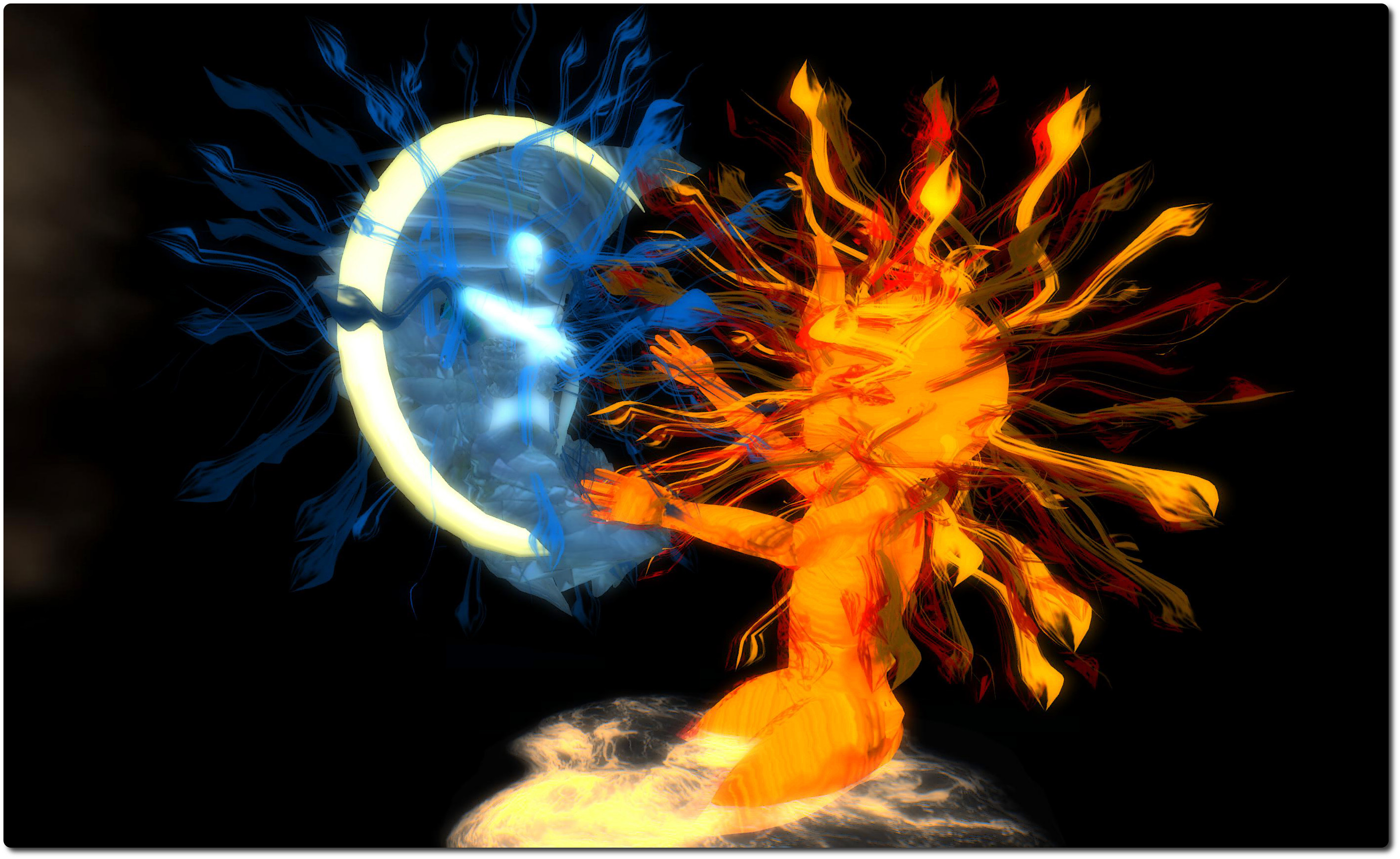
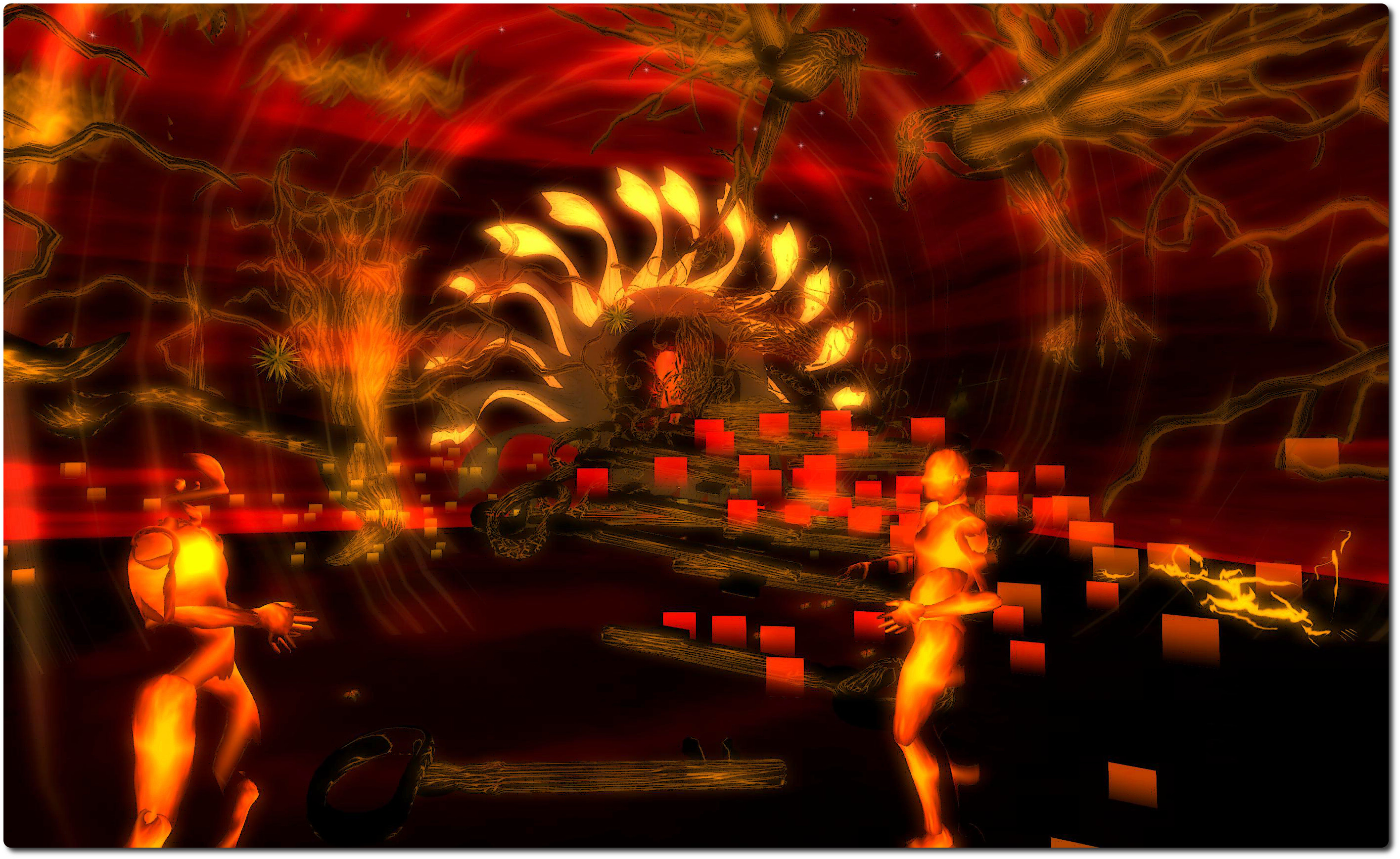
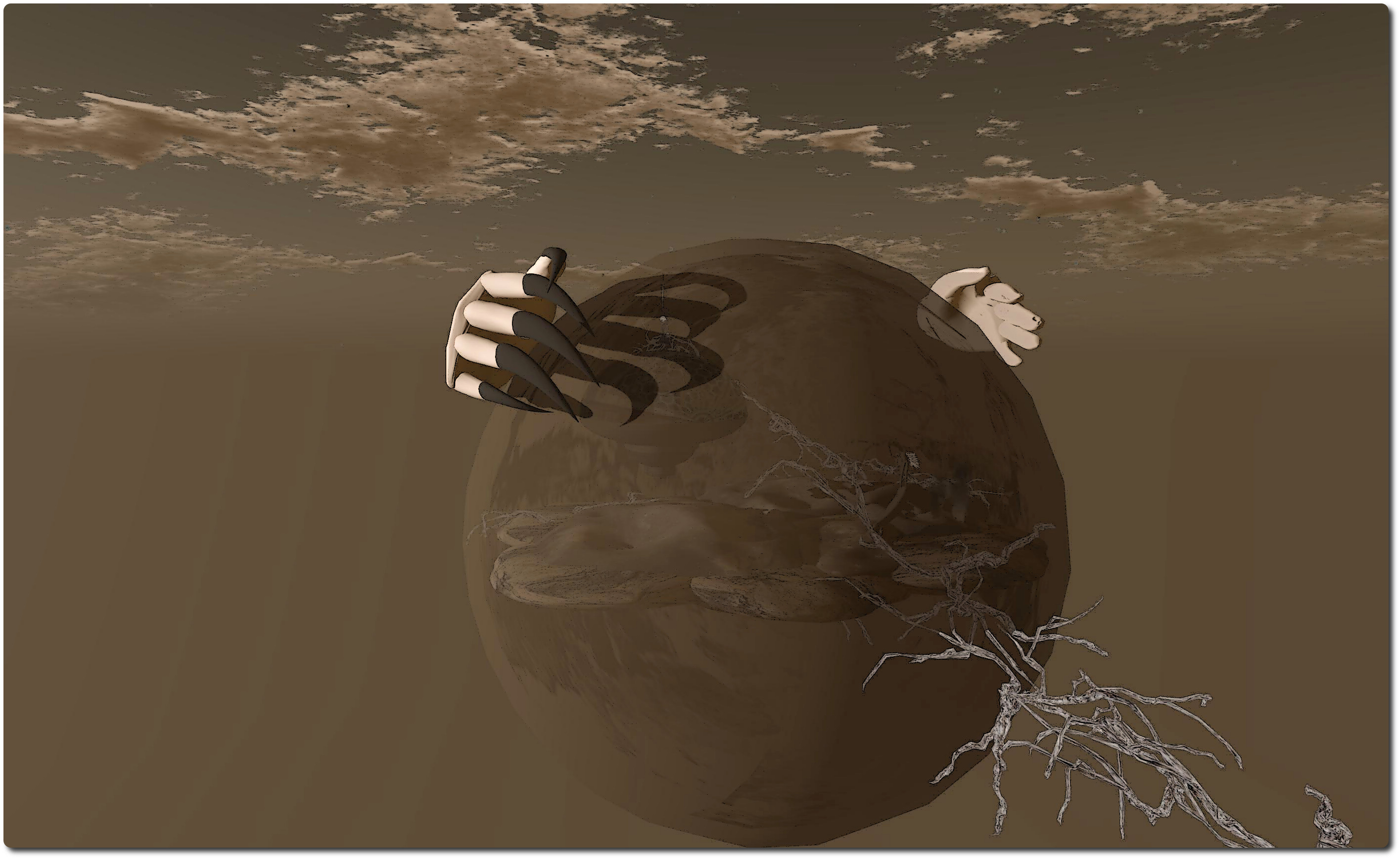
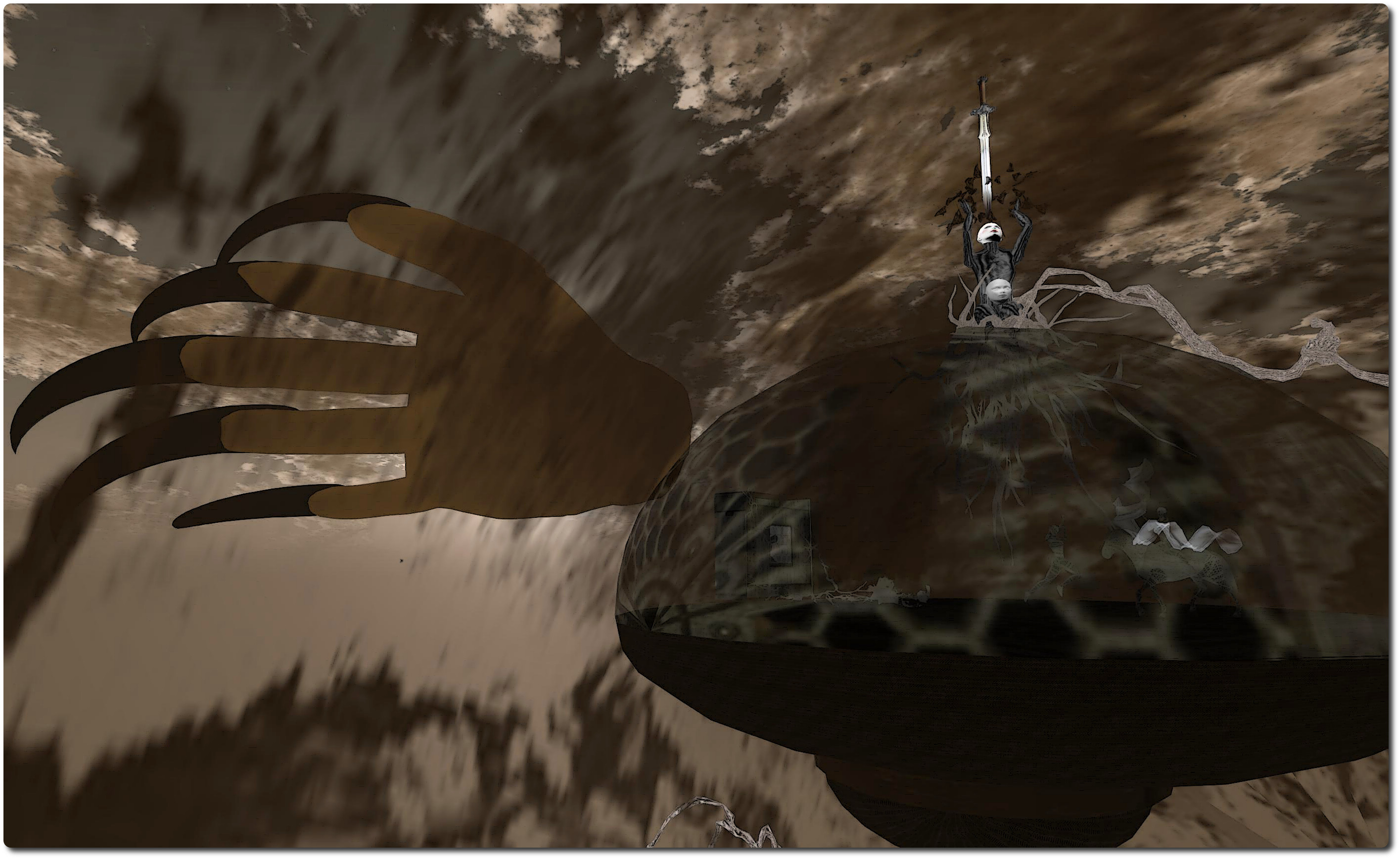
Quan Lavender invited me to a preview of Betty Tureaud’s immersive  / interactive installation The 9 Art Planets.

Betty describes the piece thus:

The Art Planets is an art installation where I want to give the visitors 9 different emotional feelings, reflected in their subconscious mind. One level is inspired by Char Davies who I think invented the Immersive Virtual Art. I am using space, colors and sound and some interactive objects to reach my goal in The 9 Art Planets. So turn on your sound and music … The Art Planets have a music stream especially composed for this place, by Ultraviolet Alter. a French composer and good friend of mine. Set your light two midday. Sound should be set to hear sound and music. Media should not be set to autoplay, you will see a note where to switch on.

9 Planets: where something as easy as opening a door can blow you away...
9 Planets: where something as easy as opening a door can blow you away…

Your journey through these nine planets commences on a Mars-like plain, a Geiger counter clicking away somewhere and a building before you. A small case outside the building will provide you with a visitor’s HUD to get around the installation and also an introductory notecard.

As the name implies, there are nine elements to the installation to visit, with the HUD providing easy access to all of them. Whether you go in the suggested left-to-right order suggested by the HUD (the start location being on the left-hand end of the HUD, or whether you pick destinations according to curiosity is up to you.

9 Planets
9 Planets

Despite some resemblance to parts of the solar system, this is not an installation which presents art against a backdrop of the planets orbiting our sun. Rather, as Betty’s introduction states, the aim is to induce an emotional response based on colour, light, sound, music and interaction. This last part is important, as it is easy to pass through sections and miss interactive elements. Some of these may set you flying, others leave you dancing. Some may require a degree of passive observation. Some are also more active than others – such as the maze, in which you place yourself in the role of a “mouse” seeking the “cheese”. Whether you attempt the hard or easy route is agin up to you…

9 Planets
9 Planets

Given the nature of the piece, it is actually hard to quantify; given the immersive / interactive nature of the various elements, it really is something which has to be explored and experienced. For those of a mind to do so, there are little gifts scattered around the various elements, which can be collected along the way. And again, as Betty’s notes explain, be ready with media;  Ultraviolet has produced some wonderful pieces to accompany the installation, and the experience really isn’t the same without them.

All-in-all, very much worth a visit – just even yourself time to explore, experience and enjoy.

The 9 Art Planets opens its doors to the public on Friday, April 19th at 14:00 SLT.

Related Links

9 Planets
9 Planets

“Lights, camera, action – and take 2!”

Back in October, I looked at the Machinima Open Studio Project (MOSP), a full sim environment on LEA20 created by Chic Aeon as a part of the 2012 Artist-in-Residence series and for use by machinima makers and photographer across Second Life.  As noted at the time, I thought the installation was a superb idea, and was saddened to think it would be vanishing as the new Artist-in-Residence series got underway.

However, rather than vanish, MOSP has been moved to a new location and given an update. The new location at LEA7 features a revised ground-level layout and a host of new features which are again open for use. If you have any interest at all in machinima and  / or photography, I can’t emphasise enough the value of this resource and the opportunities it presents for film-making and photographic work.

The new MOSP
The new MOSP

The most obvious updates brought to MOSP are at ground level – obvious, because that is where you arrive on teleporting. While the railway track from the original is still there, the landscape has been re-worked and Chic has added a number of buildings which can be used both independently of one another, and in combination to tell a story, film a promotional video or as sets for the photographer.

These aren’t the only changes either, so when you arrive, do spend time at the information area, where you can pick-up an introduction to MOSP and a folder of LMs to all of the facilities – you’ll need them! And if you’re concerned about the landing zone being smack in the middle of the scenery – always remember that the derender option in most TPVs can neatly hide it from the camera’s eye when filming.

The new MOSP
The new MOSP

Up in the sky, the sound stages are still available for studio-based work, as are the corporate offices, which again could be used for studio filming as well as offering other opportunities. Also in the sky are a number of new themed sets, including a desert complete with old fort and camels and a rural / farm scene. These sets are also mach larger than the sky sets from the original MOSP and provide even greater potential and flexibility of use when filming, either as standalone feature or in combination with other parts of the faculty.  There’s also a viewing theatre where MachinimUWA, LEA and MoMac machinima can be watched in a unique three-into-one environment.

Sand at MOSP
Sand at the new MOSP

MOSP offers a 20-minute rez time for those who need to use props and the like, and as the environments are open to being revised or updated, it is best to contact Chic herself regarding any projects which may require the using the MOSP’s facilities over a period of time to ensure a set isn’t updated or revised if real life means that filming has to be broken-up over a period of time.

Chic went to great lengths to ensure the best possible filming experience could be enjoyed at the original MOSP, particularly with the placement of the studios and specialised scenes places well overhead to avoid as much lag as possible and thus ensure good frame rates. The same care has been exhibited here as well, and the sky scenes positioned such that all can be used independently of one another and (providing you adjust any high draw distance downwards sufficiently) at any time of day without shadows from those above interfering with any filming.

The new MOSP
The new MOSP

For those wishing teach others about machinima or photography (or indeed start out in either), MOSP also now has a dedicated classroom area, and there is an open invitation to those wishing to run classes to contact Chic and enroll in the MOSP group, where they can be given a teaching role and announce events.

Whether you’re looking to film you own romance, mystery or adventure story and need some additional locations or you want to have a number of ready-made sets for a photo shoot or are looking for studio-style or indoor sets to film a scene or two, the Machinima Open Studio Project more than likely has you covered. This was a superb resource when Chic first opened at on LEA20 last year; now, with the move to a new, permanent home at LEA20 MOSP stands to become a an outstanding and unique faculty for film-makers and photographers alike. Chic is to be commended for bringing it all together and working so hard to extend MOSP’s capabilities. Kudos as well to the LEA committee for ensuring MOSP has a home at the LEA following the end of the 2012 AIR series.

The new MOSP
The new MOSP

Related Links

Updates video courtesy of Chic Aeon