A visit to a Sister Planet

Sister Planet
Sister Planet LEA27

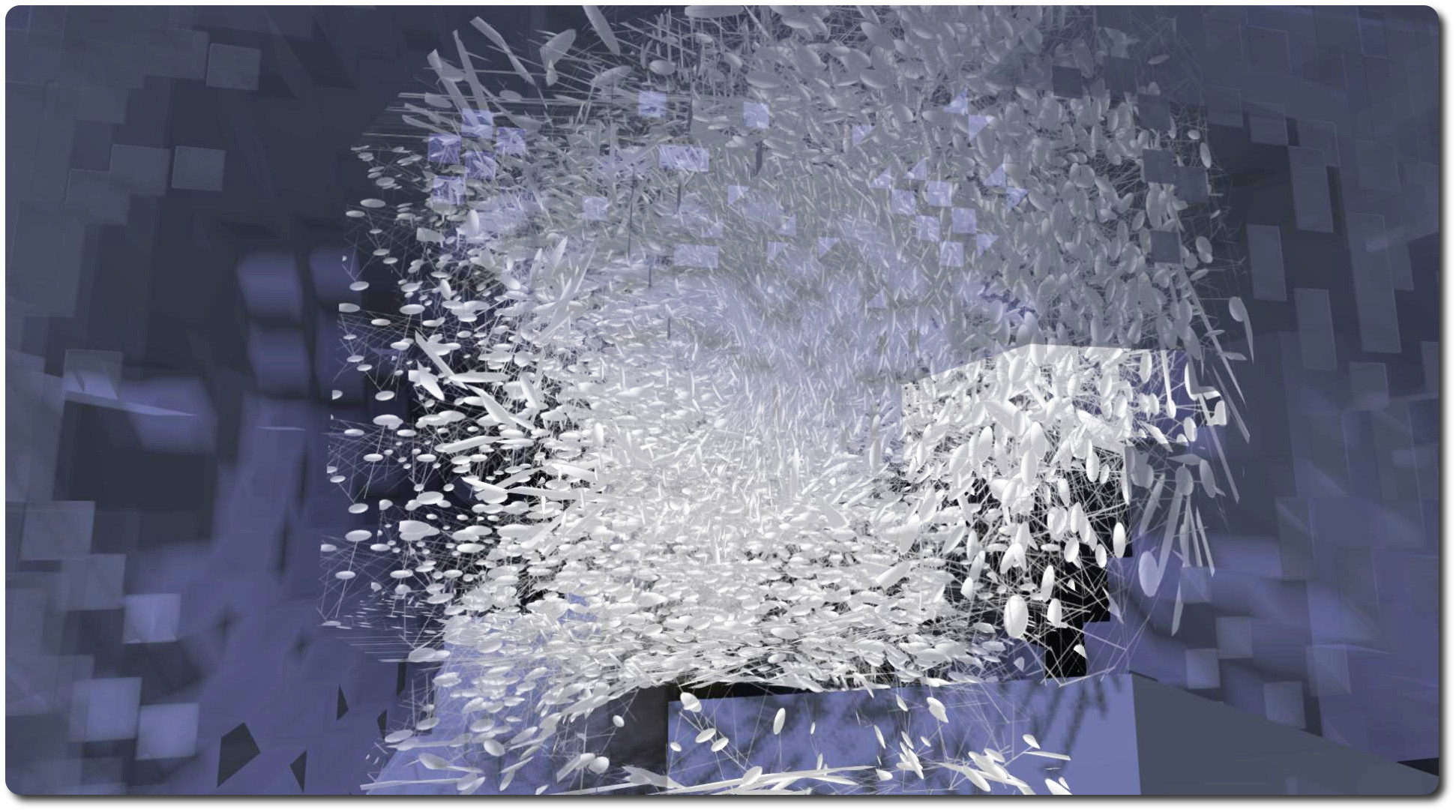
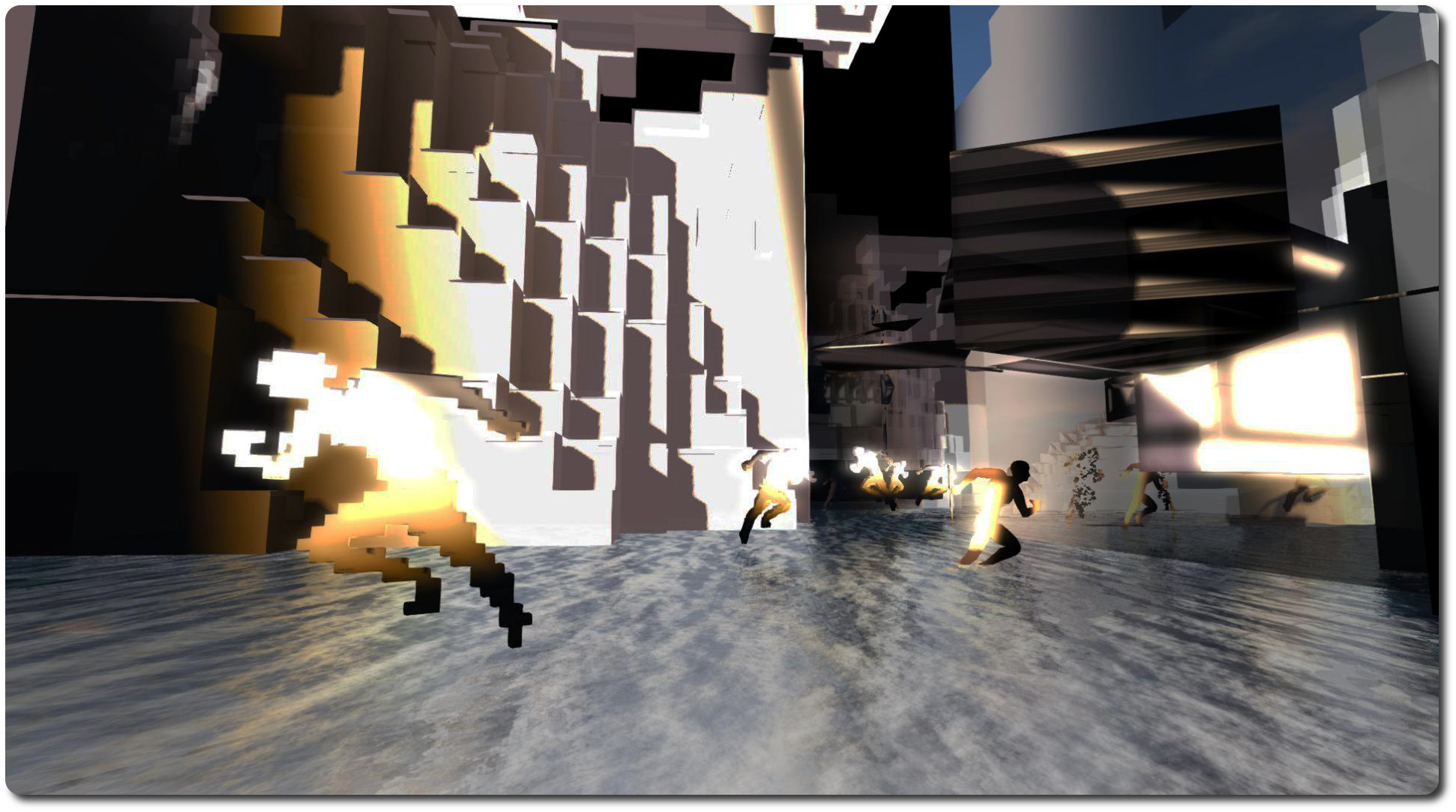
Sister Planet is Kimika Ying’s latest installation at the LEA, and given I enjoy science-fiction and have a bit of an interest in space exploration and astronomy, it’s one that should be right up my street. It takes as its theme what is often referred to as Earth’s “sister planet”, Venus (so-called because it has a similar size, gravity, and bulk composition to that of Earth). But what is presented here is not the Venus known to science today, but rather the Venus science-fiction once presented to us, even as late as the 1940s: a warm, wet planet with verdant rainforests existing under its heavy clouds.

Here, then, is a world from an alternative universe, where human beings have started to explore, establishing a small base on the edge of a verdant rainforest surrounded by hills and strange rocky outcrops, and above which the odd volcano or two pokes its snout.

Sister Planet
Sister Planet LEA27

The forest itself is both strangely terrestrial in nature, and also very alien, while the base camp mixes parts of old rockets with pot-bellied units sitting on spindly legs. Above the trees and beneath the clouds, strange green creatures fly, often chasing large seed pods which periodically drift up into the sky. The creatures have no wings as such, but propel themselves by a sudden spinning motion, which also gives them their name; while under the canopy of trees, other strange flora and fauna reside.

Of course, we now know that all the early hopes of Venus really being a sister planet to Earth have been well and truly dashed; the planet is in fact one of the most inhospitable places in the solar system; yet the old science-fiction stories might, under other circumstances have been right. The orbit of Venus sits just beyond the inner edge of what is called the “circumstellar habitable zone”, or “Goldilocks zone”, the region around a star within which planetary-mass objects with sufficient atmospheric pressure can support liquid water at their surfaces, and thus possibly offer conditions suitable for the advent of life. As such, an exploration of what / if with regards to Venus perhaps isn’t in appropriate.

Sister Planet
Sister Planet LEA27

Sadly, however, I’m not sure that this installation succeeds in doing that; while the blog that  accompanies the installation makes for good reading, chart as it does both the development of the idea and Kimika’s leap into mesh content creation, I’m not sure it achieves anything else. Certainly, as one who very much enjoyed at appreciated Kimika’s Oceania Planetary Park, which formed a part of the fifth round of LEA AIR grants, I came away from Sister Planet somewhat disappointed.

Related Links

From a Little Village a Little Town does grow…

Little Town
Little Town

In March through April 2014, Cica Ghost has a charming installation on the region of Caramel. Called Little Village, it was a marvellous collection of whimsical little houses with wobbly chimneys, huddled together in groups or standing alone, some on level ground, others precariously straddling little hills, and about which I blogged at the time it was open.

Little Village may have gone from the virtual world at large, but on Thursday, October 30th, Cica opened Little Town, which might be regarded as Little Village all grown-up. And it is another absolute delight of the quirky and the fun.

Little Town
Little Town

The buildings here are “life-sized” (in avatar terms) when compared to Little Village, but they all display the same higgledy-piggledy charm. Most are gathered around a town square atop a large flat hill in the centre of the region, although several are scattered more widely afield.

Here you will find tall finger-like houses, their once-bright paint a little faded and warn, sharing space with other structures of unknown intent. Pipes and tubes and horns twist and run between buildings or point skywards while trees and bright patches of flowers add further colour to the scene, as bright balloons drift about the place. There’s even a building that looks peculiarly like a gigantic coffee pot, a pipe-like handle on one side, and the spout formed by a another pipe as it twists it way to connecting with conical neighbouring structure.

Little Town
Little Town

While the inhabitants may be conspicuous by their absence, this is a town that is very much alive in its own way; there is motion everywhere as windmills turn in the breeze, cogs and wheels rotate, horns stretch and contract from rooftops, strange spherical objects push their way through pipes; even the odd rooftop rises and falls as if breathing slowly, all of it serving to add a depth and further charm to the whimsy on display.

Getting around is easy: wide steel roads, heavy with rivets, offer various routes around the town and its outlying areas, while steps down from the hill provide access to those places off the main roads, and of course, visitors are free to wander where they like. For those not into walking, there are cars available from a rezzer near the cinema cafe, while a gift giver near the landing point will present you with Cica’s Flying Ventilator, if you fancy getting a bird’s-eye view of the town. And speaking of the cinema – do be aware that some of the buildings can be entered as well – there’s even a cage where you can do Airkix-style “skydiving / flying” :).

Little Town
Little Town

Should all the exploring tire you out, Cica has provide a trio of floating beds in the south-west corner of the region, where the weary can rest a while. The field over which the beds floats is also home to Cica’s little flower shop, where you can purchase sets of the flowers which can be seen around the town and region, as can copies of the two mechanical birds sitting under a nearby parasol – proceeds from sales doubtless help towards keeping the sim open.

Given Little Town involves so much motion, something no always captured in a simply snapshot, I’ll leave you with a video of the town in the hope it’ll encourage you to pay a visit and share in Cica’s whimsy!

Related Links


A visit to a kitten’s garden

Petit Chat Gallery
Petit Chat Gallery

Petit Chat-Moumou’s Square is the home of Trinity Yazimoto’s store and art gallery, both are located within the grounds of a garden currently rich in the colours of autumn, and where visitors are invited to spend time relaxing.

Trinity’s store, Petit Chat, occupies an old mill partially surrounded by water features fed by the falls that tumble from the high cliffs that border the garden on three sides. The water actually divides the land into several distinct areas, all linked one to another by stone bridges. There is the store itself, with its own garden nestled behind it, complete with Romany caravan and lamp-lit lily pond, a bridge providing access to a cuddle area across the pond. In front of the store, and reached via another bridge, is a further garden area, complete with swings and a roundabout, rocking horses, and a pergola offering shade and a place to sit and enjoy a cake or two.

Petit Chat store
Petit Chat store

A further bridge offers a crossing to the rest of the garden, where stone steps lead up a grassy slope to where a cobblestone terrace, complete with fountain, can be found, offering further shaded seating for visitors. Beyond the terrace sits the ruins of an old tower, the curved steps of which lead the way to a artist’s workspace, while hidden behind its walls lies a picnic area.

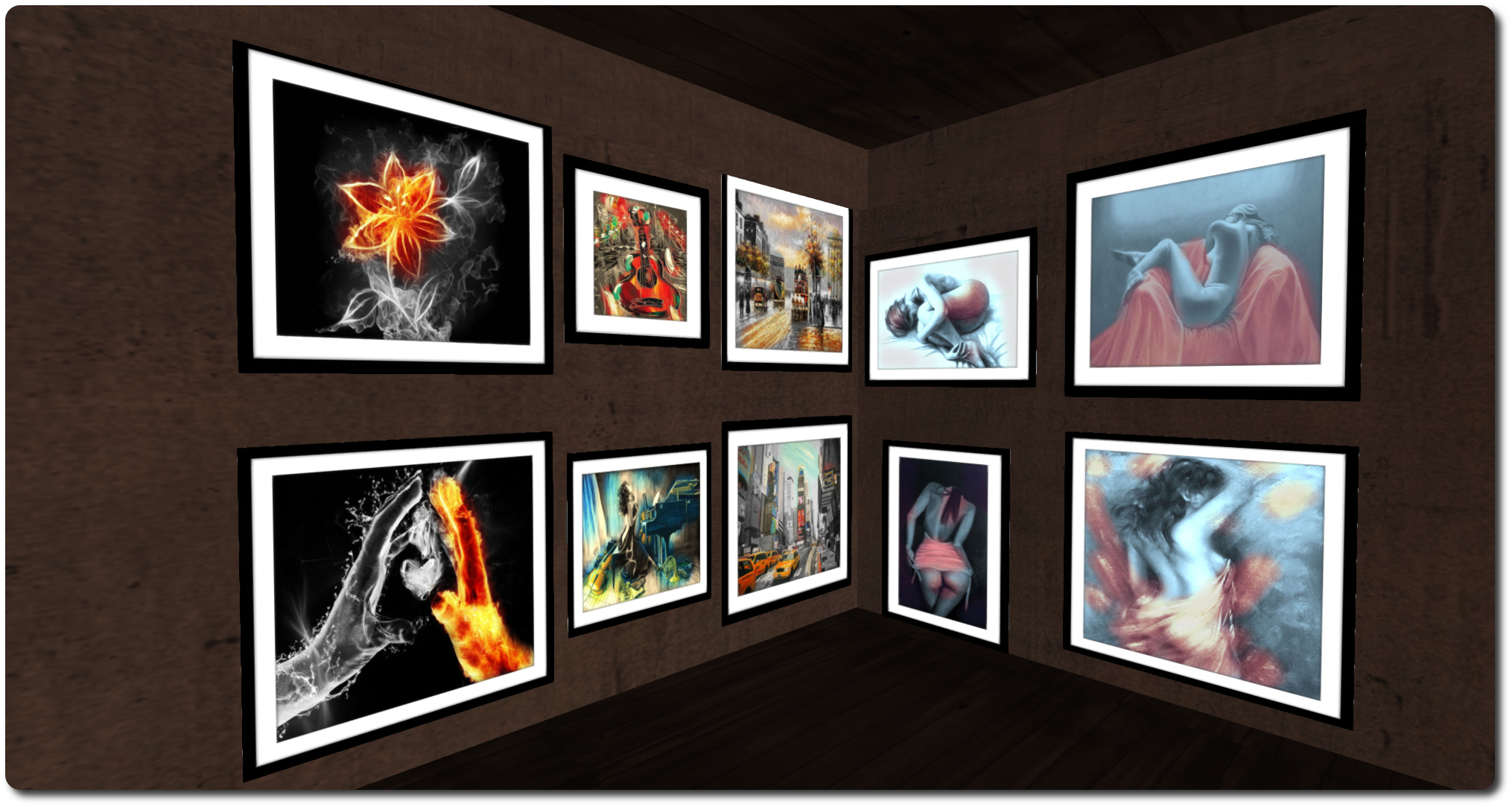
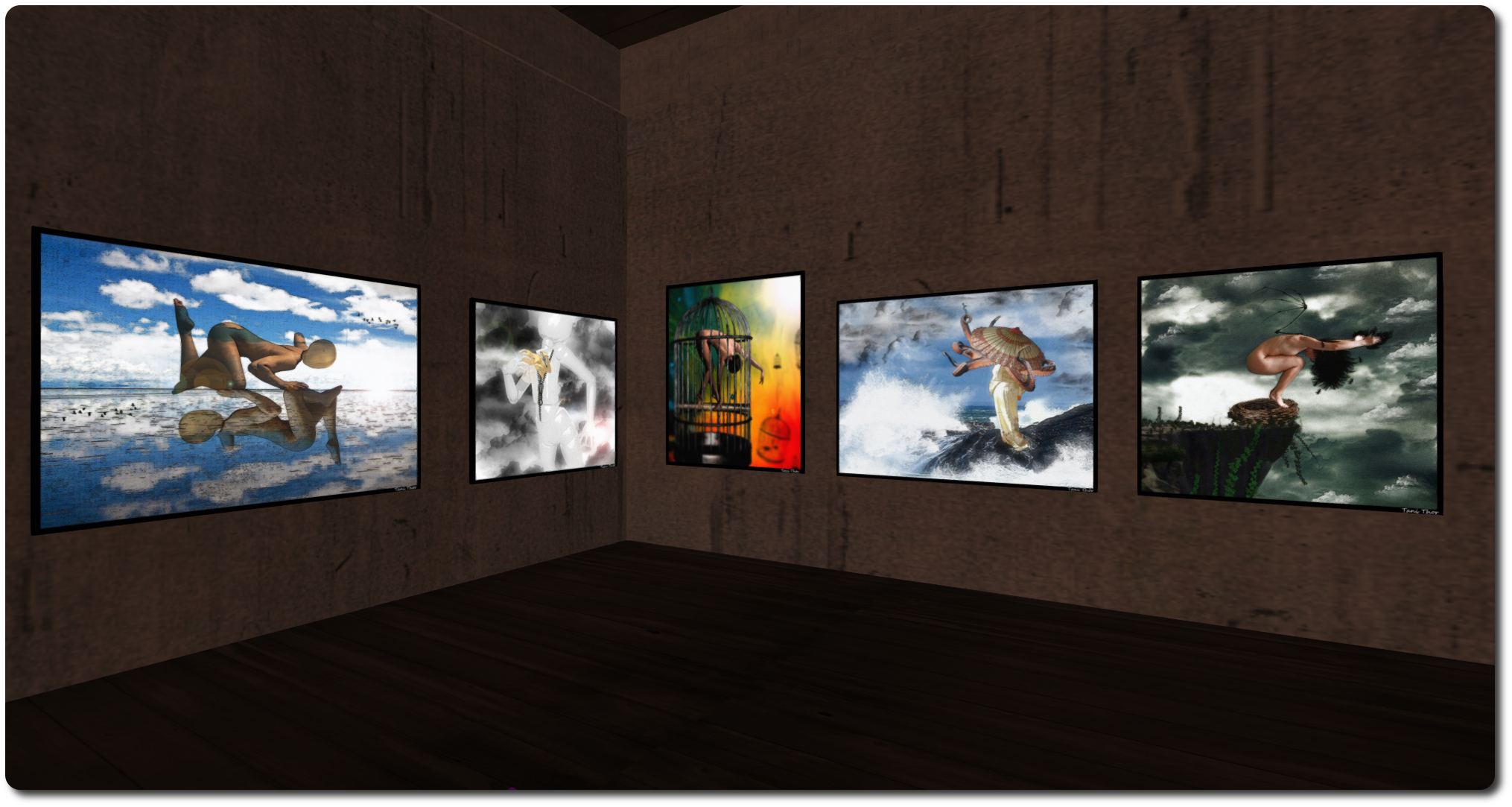
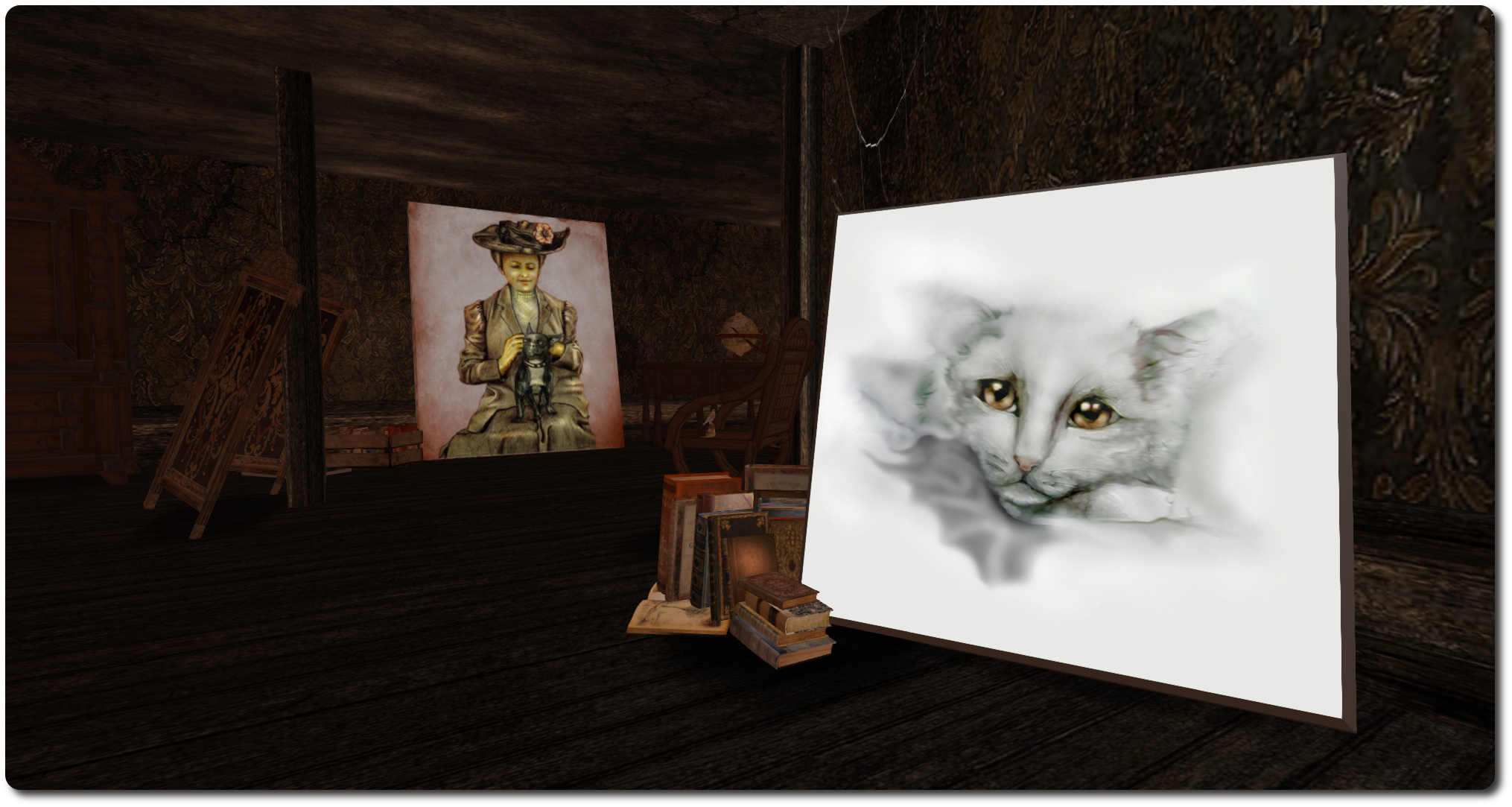
But it is what lies under the tower and terrace that will be of interest to lovers of art and SL photography. Here, in a vaulted, crypt-like space, is Trinity’s art gallery, a ladder held within the curve of the old tower’s walls providing access – simply touch the ladder to climb down to it.

Petit Chat Gallery
Petit Chat Gallery

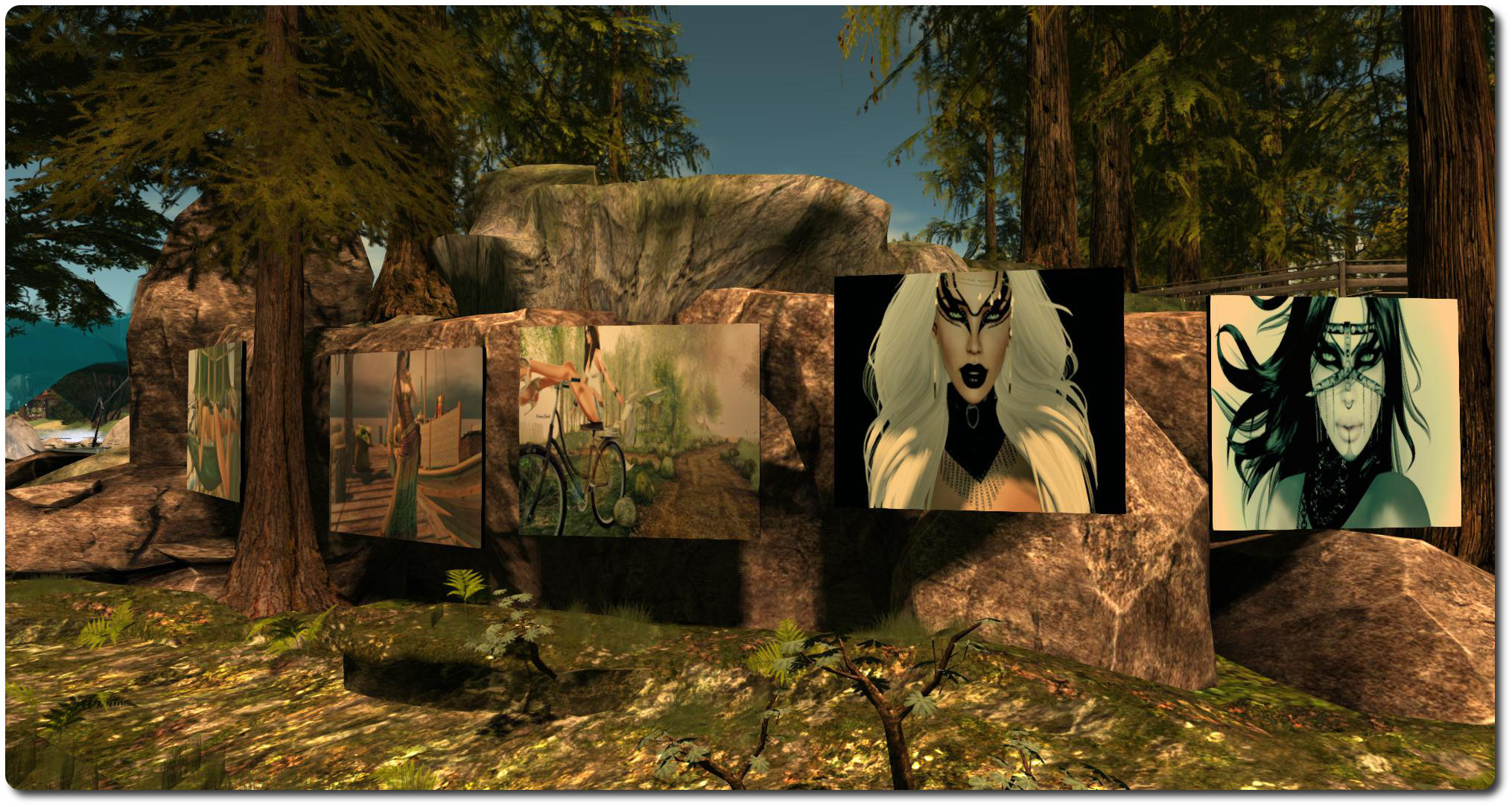
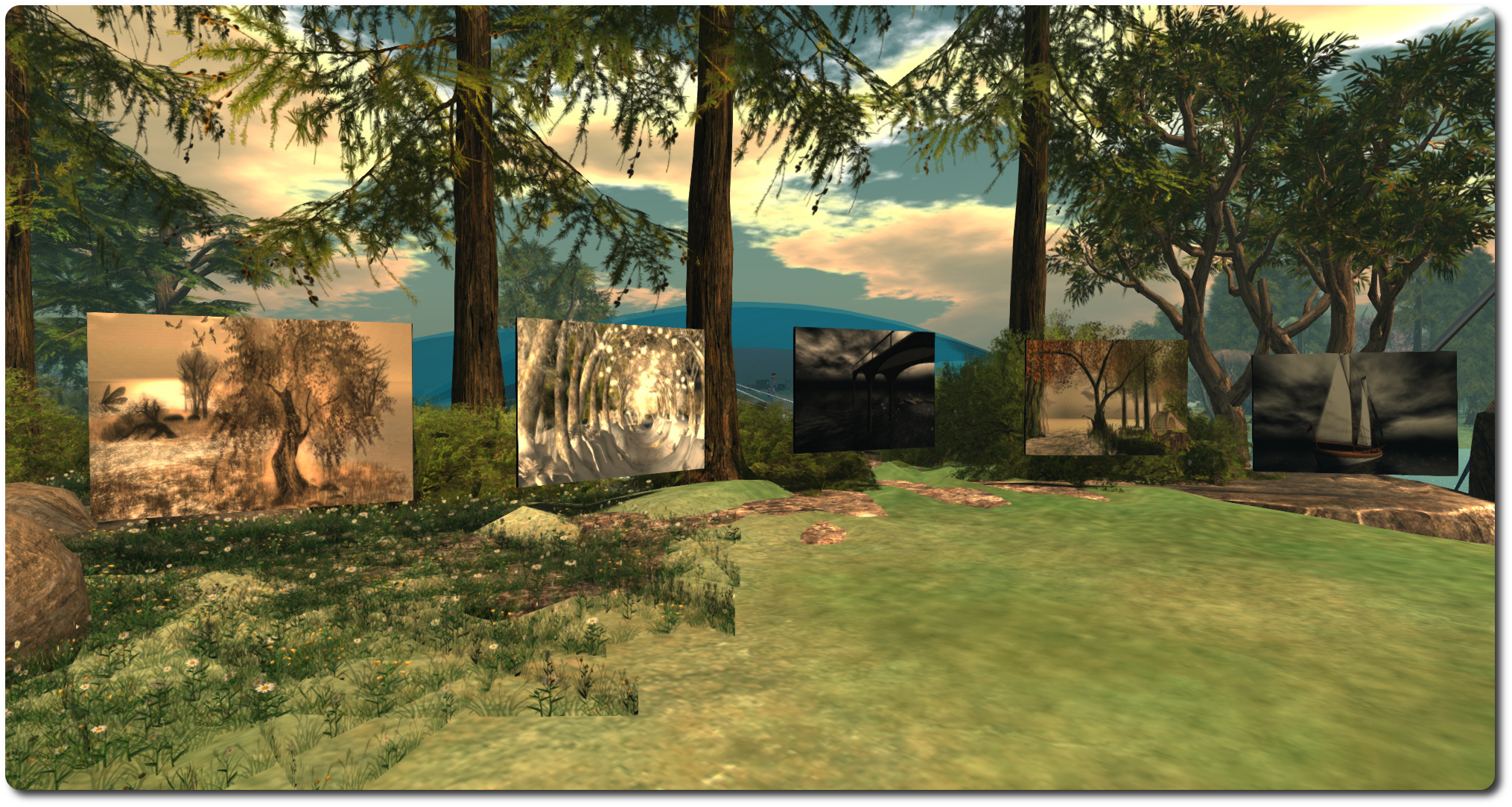
I first became familiar with Trinity’s work during the Terms of Service upset in late 2013, and then through seeing her work on the SL feeds and on Flickr, where her landscape work has always been incredibly eye-catching for me. Within the gallery, her landscape work is mixed with more personal pieces, all displayed in a manner that is well suited to lower lighting conditions that match the look and feel of the gallery space.

A nice touch with the items on display is that Trinity provides a note card with many of them (right-click on a piece, and select “Info” from the menu). This provides information on the inspiration for the picture and details of the location where it was shot – handy if you feel like paying it a visit.

Petit Chat gardens
Petit Chat gardens

Trinity openly admits she works extensively within Photoshop to produce her images; where her landscape work is concerned, some might say that the result doesn’t really represent the region in which it was taken.  I’d beg to differ with such views – as Trinity states in some of her note cards, these are her interpretations of the places she visits.

Besides, it’s not as if we don’t have tools within the viewer which can help us enhance / alter the look and feel of the regions we visit and photograph, whether it is simply by altering the windlight settings or using the likes of the SL Share filters or a tool set like Phototools or even doing it the hard way and digging through debug settings.

Petit Chat Gallery
Petit Chat Gallery

As such, whether or not Trinity uses Photoshop is incidental to the quality of her work; her landscapes are beautifully presented, and her still life work, often featuring herself as the model, is creativity composed and frequently conveys a strong message which draws the observer into it.

all told, Petit Chat-Moumou’s Square makes for a delightful visit, offering a charming garden in which to relax, excellent art to view and purchase, and an opportunity for the fashion hungry to do a little shopping. And for those who would like to combine art with fashion, check-out the top for of the shop 😉 .

Related Links

Trinity’s gallery also featured on the SL Destination Guide highlights for October 24th.

Of bread and roses

Bread and Roses
Bread and Roses

Bread and Roses, located at LEA13, is an interactive, educational installation commemorating the 1912 Lawrence Textile Strike, and which is open now through until the end of December 2014.

The strike, which commenced on January 1st, 1912, was prompted by textile mill owners in the town of Lawrence, Massachusetts, arbitrarily cutting workers pay after a new law reduced the working week from 56 hours to 52. The cut, amounting to around 30 cents, equated to the loss of around three loaves of bread for the already hard-pressed working families in the town (hence one of the strike’s other names: “The Three Loaves Strike”).

To put this in perspective, the staple diet of mill workers and their families in Lawrence was bread and molasses. Meat was a luxury few could afford. What’s more, the conditions were so harsh that the mortality rate for children was 50% by age six, and that 36 out of every 100 mill workers, male or female, were dead by the age of 25. Families were crammed into poorly maintained tenement blocks; thus the pay cut was, to say the least, cruelly severe.

With its largely immigrant population (some 51 different nationalities), the work force in Lawrence had been deemed by more conservative trade unions to be too ethnically divided to be properly organised. However, under the guidance of the Industrial Workers of the World (IWW), representatives of which had been active in the town ahead of the imposition of the pay-cut, the strike grew within a week to encompass some 20,000 workers and ran through a harsh winter prior to both sides reaching agreement.

Bread and Roses
Bread and Roses

The strike particularly came to the attention of the United States as a whole (and the rest of the world) after local police attempted to prevent IWW from sending 100 children from striking families in Lawrence to Philadelphia to stay with the families of supporters of the strike until it had reached a conclusion. Arriving at the railway station, the police drew their batons and began clubbing mothers and children alike, in full view of the press, resulting in Congressional hearings being called.

In the end, the mill owners acceded to the demands of the strike organisers. Pay was raised, working conditions were improved – but it was in the end something of a pyrrhic victory.  The IWW refused to enter into written agreements, allowing the mill owners to slowly but surely take back the concessions made, whilst also removing union representatives from their workforce.

Bread and Roses
Bread and Roses

The installation at LEA13 is the brainchild of Canadian-born Dr. Sharon Collingwood (aka Ellie Brewster in SL), a Professor in the Women’s Studies department at The Ohio State University, Columbus, Ohio. It’s an interactive piece, aimed a school students, and offers plenty to do.   A tour through the set takes students through a mill where images provide visual and text-based information on the strike, while large blue buttons provide additional information or questions to be answered by students. In addition, there are media elements and links to external web resources.

As well as examining the strike, the installation also offers some social commentary as well; not just in the strong contrast between the houses and attitudes of the well-to-do mill owners and the frightful conditions endured by the workers – but also in the often entirely blinkered viewpoints of movements which marked the times. The latter is perhaps most clearly demonstrated in the house occupied by the (white, middle-class) suffragettes, citing the strike as an example of the “power” embodied within women, whilst ignoring the black scullery maid in the kitchen…

Bread and Roses
Bread and Roses

An exploration of the installation will reveal it to be seemingly incomplete. There are empty rooms, etc. This is intentional, as it is hoped that students will add to the exhibit throughout its duration. In addition, students can assume one of four identities prior to explore the exhibit and, for the benefit of those who may not be familiar with using Second Life, there is a brief set of tutorial items offering basic instructions on finding one’s way around the viewer.

All told an interesting glimpse into history, and a useful educational tool. Those wishing to use the classroom facilities within the exhibit should contact Ellie Brewster in-world.

And the title of the piece? “Bread and Roses” was another name by which the strike came to be known, after being incorrectly linked to the strike by author Upton Sinclair. The origins of the phrase in fact seem to lie with labour union leader, Rose Schneiderman, who was not directly involved in matter in Lawrence, but who stated during a speech that, “The worker must have bread, but she must have roses, too.” This in turn inspired James Oppenheim to write a poem of the same name, which in turn became a song strongly associated with labour movements and the concepts of fair wages and dignified working and living conditions.


Bread and Roses: Joan Baez and her sister, Mimi Farina, who founded “Bread and Roses”, a nonprofit co-operative organisation, designed to bring free music and entertainment to institutions: jails, hospitals, juvenile facilities, nursing homes, and prisons.

Related Links

Waterscapes and Flying Things

Waterscapes and Flying Things

During my wanderings through the SL10B Community Celebration regions in June 2013, I came across Evan Moonshine’s Lepidoptera Museum. It was both a lovely build, and the subject matter within it fascinating; my only regret being that the cards describing all of the  lepidoptera on display were to small to the read, and the subjects were themselves a little on the small side to be fully appreciated.

Now, in an exhibit at the Ode’s Arts & Culture Community running through until November 15th, 2014, DecemberGrey has brought some of her own images of lepidoptera and beetles to Seceond Life, combining them with some of her fabulous waterscapes of well-known SL regions. Called Waterscapes & Flying Things, it adds up to a fascinating display of artistic talent well deserving of a visit.

Waterscapes and Flying Things

The images of moths and beetles occupy the ground floor of the OACC’s converted watermill gallery. At first glance, these might appear to be reproductions of drawings of the subject matter painstakingly created in the physical world by some 19th century botanist. Not so. These are images painstakingly created by the artist as a result of getting unexpectedly sidetracked at university, as DecemberGrey explains:

While in my second year of a BSc in botany (some fair while ago), I looked into the microscope on the lab bench while the lecturer was talking about angiosperm reproduction…. And from that point on, was captivated by the world seen only through a magnifying lens. I forgot the lecture, became lost. Today, all I remember is the brilliance that captivated me. It changed my life.

…My macro work started manually, my fingers moving the focus ring on the camera – millimetre by millimetre – to create a number of images of the same body which would then be compiled into a single image. Now it is a process somewhat automated. Technology is impressive, and allows an entirely different method of working. It gives me time to dabble in color and light. And to imagine. To transform. To create.

Waterscapes and Flying Things

The results are simply amazing, with each of her subjects beautifully presented (and all of them available for purchase).

For DecemberGrey’s waterscapes, climb the stairs all the way up to the mill’s attic, where you’ll find them displayed perfectly on the whitewashed walls.

Featuring famous locations such as Roche, Hazardous, The Colder Water, Nagare and Frisland, and arts locations such as Imagin@rium and Immersiva, these pictures are as beautifully composed as the real-life images on the ground floor; in fact I’d say without a shadow of a doubt that they are among the finest images I’ve seen captured from within SL. To call them exquisite would not be over-emphasising them at all.

Waterscapes and Flying Things

Related Links


Mistero Hifeng: straddling reality and the imagination

Spettatori malinconici di felicita' impossibili - Mysterio Hifeng
Spettatori malinconici di felicita’ impossibili – Mistero Hifeng (click images for full size)

I’ve been coming across the work of SL artist Mistero Hifeng a lot of late; his pieces have appeared in a number of regions I’ve dropped into recently, and he has an entry in the UWA’s Transcending Borders challenge. So when artist and friend Sniper Siemens invited me to pay a visit to Mistero’s gallery and store, I was only too delighted to hop along.

Volare - Mistero Hifeng
Volare – Mistero Hifeng

While some may not be familiar with his name, I would endeavour to suggest many are familiar with his work, his sculptures being instantly recognisable when encountered, many of them presenting a subtle blending for realities: very human figures often in very extraordinary – you might say surreal – situations, driven from deep within the imagination. Little wonder, then, that Mistero takes a Tom Watts quote for his profile description:

Mostly I straddle reality and the imagination. My reality needs imagination like a bulb needs a socket. My imagination needs reality like a blind man needs a cane.

E' soltanto  un ricordo - Mysterio Hifeng
E’ soltanto un ricordo – Mistero Hifeng

Mistero presents his work to visitors in an open air gallery space occupying one half of a homestead region. The design is minimalist, little more than a beach, partially flooded by the (presumably) incoming tide and a handful of off-sim islands, one of which is volcanic in nature, all overlooked by a marbled sky of white and black (do make sure you accept the parcel windlight on arrival). But while minimalist, it is also highly effective, the sand and water naturally acting to isolate each of the pieces on display, giving a sense that they each occupy a space that is independent of the others, no matter how relatively close some may be to one another.

The windlight setting also serves to complement the subdued colours used within each piece, allowing them to stand out on their own, an effect which certainly encouraged me to keep to the default rather than fiddling with alternatives.

Bella - Mistero Hifeng
Bella – Mistero Hifeng

The pieces on display are large – all the better to see the detailing within them; so much so, that I doubt my efforts here really do them justice – they really must be seen first-hand.

While there is a line of flat stones laid across the sand to form a footpath through the gallery space, linking two teleport points with one another, there is no need to keep to this when viewing the displayed works, the open space makes for relaxed wandering, and the park benches and pianos which can be found at various points encourage meandering – and sitting.

As well as connecting one to the other, allowing people to hop between the two ends of the gallery space, the two teleporters also provide access to Mistero’s skyborne store. Here one can purchase versions of the items displayed in the gallery, or images of them as captured by Mistero, as well as images of works not currently on display.

Mysterio's store
Mysterio’s store

If you’ve not visited Mistero’s gallery before, I have no hesitation in recommending it to you. His work is an exquisite blending of ideas, images and emotions, presented through a skilled layering of the real with the surreal to produce pieces which are marvellous evocative and compelling.

Related Links

Spettatori malinconici di felicita' impossibili - Mistero Hifeng
Spettatori malinconici di felicita’ impossibili – Mistero Hifeng