When thinking about art is Second Life, the mind perhaps tends to focus on thoughts of paintings and photographs and sculptures and 3D models. It’s rare that why immediately think of the written word as a form of art in SL, despite the extensive use of the spoken word in readings and performance pieces like plays and musicals.
So it was with a degree of pleasure I found myself at the Lin C Art Gallery, which is – through until the 10th of August, 2018 – hosting an exhibition of the poems of Tim Timaru.
Occupying two levels within the gallery, Tim’s poems are presented framed within images that help define the mood and tone of the written word. Most of these images have been taken from the physical world, but some have come from Second Life. In terms of subject matter, many of the poems are focused on a subject close to many a poet’s heart: love and relationships (and loss). Others are perhaps more philosophical in nature, questioning or seeking to challenge our perspective. All cause the grey cells to cogitate as the eye appreciates the accompanying images.
Most of the pieces here stand as a perfect fusion of image and words giving rise to a response from within us. But some reveal just how liberating the medium of Second Life might be for a poet as much as a photographer, painter or builder. Words are, by their nature, static. Once arranged and written, their metre and measure generally points towards a single interpretation. But within Second Life, the poet has a certain freedom: words unchanged can be presented side-by-side, but with different images to underpin them, rendering their interpretation dynamic.
Take The Deck and The Deck 2, in this exhibition, for example. Both are the same poem, but where the image of one presents a couple walking hand-in-hand up a crystal-like staircase leading to a cabin floating idyllically against a night sky, the second offers images of a coastal setting behind a wind-blown sky coloured by a sunset. Thus, with the first image, we’re encouraged to think of the poem in terms of togetherness and what is and what will be; poem and image are together, uplifting. However the second leads us in a different direction. Here, perhaps, is not promise, but regret; no looking forward to what is now beginning and will grow, but what has passed and what was – and will never be again.
With playful tickles of humour, considered reflections on life and love, echoes of Eliot and even Shakespeare (in form if not in words), this is an enchanting collection of poems and images; an absolute delight for any lover of the written word.
There was no SLS main channel deployment or restart on Tuesday, July 17th, 2018, leaving regions on that channel running on server release 18#18.06.14.516450.
On Wednesday, July 18th, the release candidate channels should be as follows:
Bluesteel and LeTigre will remain on server release 18#18.07.03.517389 and will not be restarted.
Magnum should receive a new server maintenance package, 18#18.07.11.517746, comprising “internal fixes”.
The Main channel roll – which was to have included Animesh – was postponed, as Simon Linden explained at the Simulator User Group on Tuesday, July 17th:
We unfortunately held back this morning’s update with the Animesh roll. Late last week we found some code that is probably causing problems with the physics shapes of mesh bodies … not Animesh, but other normal mesh stuff … Not using the correct physics shape. When building with mesh, there are a few ways to set that shape, and the Animesh code changes affected that code.
Simon Linden, SUG meeting, Tuesday, July 17th 2018.
It should be pointed out that in the context of Simon’s comments, “mesh bodies” means “in-world mesh objects, as worn mesh items doesn’t have a physics shape per se.
Deployment of the Animesh code to the SLS channel will therefore likely await the deployment of a fix for the issues encountered.
SL Viewer
There have been no Sl viewer updates / changes to mark the start of the week, leaving the pipelines as follows:
Current Release version 5.1.6.516459 and dated June 15, promoted June 21 – formerly the Pálinka Maintenance Release Candidate – No Change
Release channel cohorts:
Quinquina Maintenance RC viewer updated to version 5.1.7.517594, on July 12.
Project viewers:
Animesh project viewer updated to version 6.0.0.516979 on June 25.
Bakes on Mesh project viewer, version 5.1.6.516270, dated June 14.
Linux Spur viewer, version 5.0.9.329906, dated November 17, 2017 and promoted to release status 29 November – offered pending a Linux version of the Alex Ivy viewer code.
Obsolete platform viewer, version 3.7.28.300847, May 8, 2015 – provided for users on Windows XP and OS X versions below 10.7.
Attachment Loss / Ghosting on Teleport / Region Crossing
Some people are reporting loss / ghosting of attachments on teleporting. The problems sees to vary in the number of teleports taken before it is noticed, and tends to take the form of others noticing an avatar is missing parts, rather than the wearer (for whom everything still appears to be worn).
It’s not clear how widespread the issue is, although it seems it has been reported a lot through the Firestorm support groups. Mazidox Linden did confirm some attachment / region crossing testing was occurring on Aditi, but it’s not clear if this is in reference to this specific problem, or to with examining / improving region crossings in general.
Firestorm has a Refresh Attachments option (Advanced menu), however, addressing the issue from the viewer is seen as a less than optimal approach, a server-side fix being preferable.
Commenting on region crossings and attachments in general, Simon Linden said, “From what I can tell with my investigations so far, most attachment problems with region crossings come down to messaging failures, and then the viewer and region(s) get out of sync and don’t recover. ” He also noted that his own testing of “double” region crossings (e.g. cutting across the corner of a region while moving between two others) lead him to want to say “stop!” at the first, and not even attempt the second until the first hand-off have completed.
At this point I want to improve the code and communications so after a crossing, both regions and the viewer can agree that everyone is on the 2nd region with all attachments and vehicles and, when something goes wrong, try to recover … At both ends, viewer and region, it should be able to realize it’s been a few seconds and things are missing or not, and then re-try.
Simon Linden on investigating region crossing, Tuesday, July 17th, 2018
As an aside, one of the reasons the Lab is working on region crossings and attachment issues beside trying to make region crossings smoother and more predictable in general, is so that they might increase the limit on the number of attachments that can be simultaneously worn (currently 38). However, as Oz Linden noted at the Simulator User Group meeting, this won’t happen until such time as attachments can remain reliably … attached.
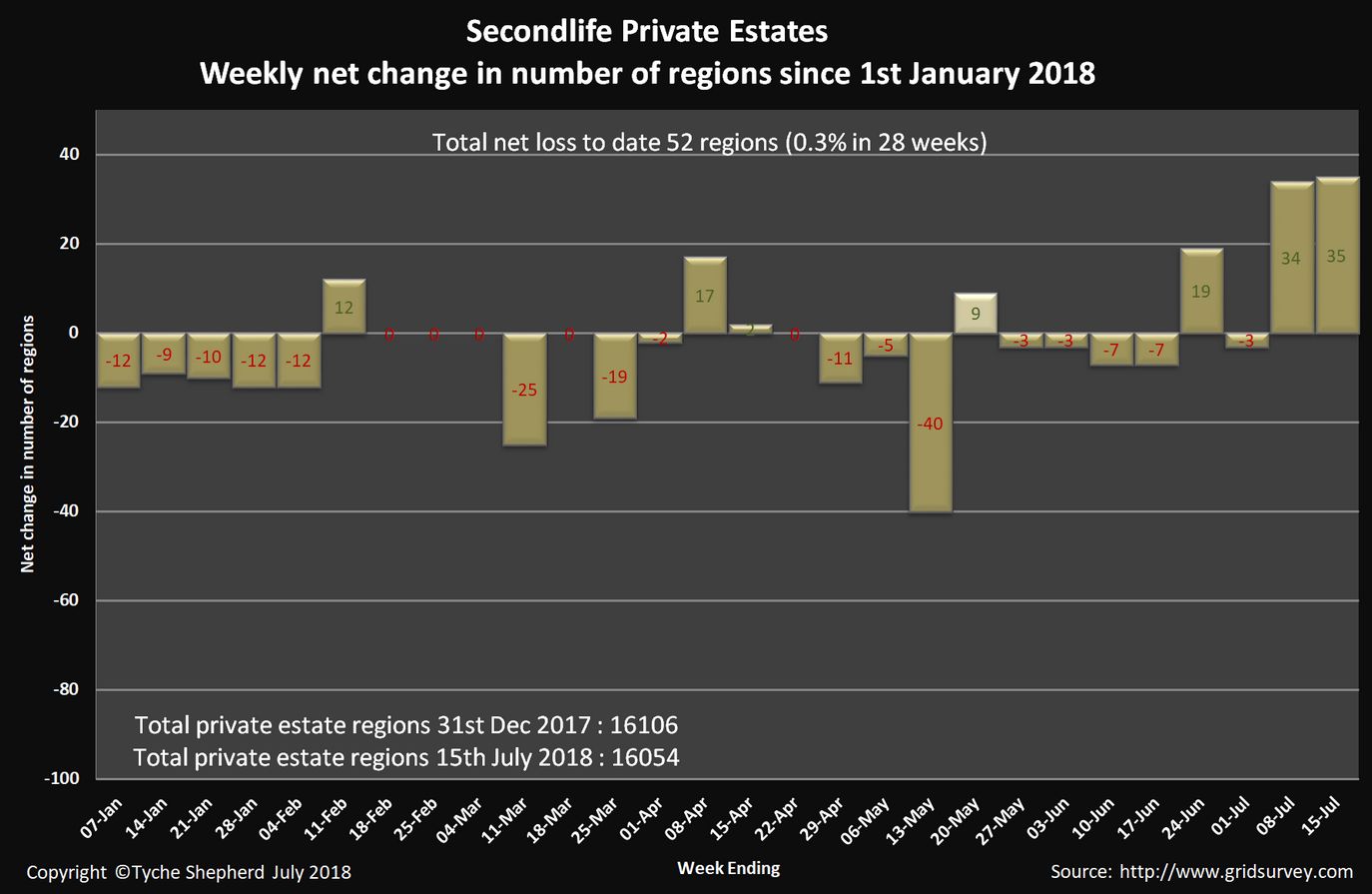
It’s been two weeks since Linden Lab introduced the new pricing structure for private regions, and as Tyche Shepherd reports, her Grid Survey shows the grid has experienced its second consecutive week of net private region growth since the change came into effect.
In the week immediately following the introduction of the new pricing structure (Monday July 2nd through Sunday July 8th), the SL grid saw a net increase of 34 private regions, while in the week Monday July 9th through Sunday July 15th, the net increase was 35 private regions.
As Tyche indicates, these increases have helped slow the overall rate of private region attrition to just 0.3% – a net loss of 52 private regions between January 1st, 2018 and July 15th, 2018. By comparison, some 326 private regions were lost to the grid between January 1st and July 16th, 2017 (with an overall net loss of 667 private regions through the entire year).
The two weeks following the private reduction pricing changes have seen net increases in the number of regions on the grid. However, it’s still too early to call this a trend or draw significant conclusions. Credit: Tyche Shepherd
So, have regions losses turned a corner as a result of the price change?
Frankly, it is too soon to tell; two weeks is only two weeks – we need to see how things trend out over a longer period before anything can really be determined. A lot here will depend on how much of the tier reduction land rental businesses pass on to their tenants in order to make private rentals more appealing; something I noted in passing in Looking at the new private region and L$ fees. Plus, a simple count of region growth isn’t the entire story here.
Simply put, the private region pricing restructure will have seen the Lab take a reduction in monthly revenue generation. It’s questionable whether such a modest increase in region numbers, even when coupled with other options for increased revenue generation such as the Mainland price restructuring (with its possible attendant increase in Premium subscriptions) and the US $0.50 increase on L$ purchase transaction fees, has wholly overcome the immediate deficit of the tier rate cut.
Thus, while the uptick in private region count is a positive turn, it is too early to be celebrating. We’ll need another 4-6 weeks before we can start to get a genuine feel for how things are going as a whole. It will also be interesting to see how long new regions entering the grid remain in place or whether we see some rapid comings / goings month-to-month. I’m also curious as to how the restructuring affects the Full / Homestead product ratio on the grid, so will be looking to see if Tyche can provide some updates on this in the coming weeks / months.
In the meantime – and totally off-topic as far as private regions are concerned – I wonder if Tyche has had time to have a bop around Mainland to see how the abandoned land situation there is fairing? As of January 2018, abandoned land stood between 22% and 23% of all Mainland; it would be interesting to see how it now stands, some four months on from the Mainland price restructuring.
Logos representative only and should not be seen as an endorsement / preference / recommendation
Updates for the week ending Sunday, July 15th
This summary is generally published on every Monday, and is a list of SL viewer / client releases (official and TPV) made during the previous week. When reading it, please note:
It is based on my Current Viewer Releases Page, a list of all Second Life viewers and clients that are in popular use (and of which I am aware), and which are recognised as adhering to the TPV Policy. This page includes comprehensive links to download pages, blog notes, release notes, etc., as well as links to any / all reviews of specific viewers / clients made within this blog.
By its nature, this summary presented here will always be in arrears, please refer to the Current Viewer Release Page for more up-to-date information.
Note that test viewers, preview / beta viewers / nightly builds are not recorded in these summaries.
Official LL Viewers
Current Release version 5.1.6.516459 and dated June 15th, promoted June 21st – formerly the Pálinka Maintenance Release Candidate – No Change
It’s time to highlight another week of storytelling in Voice by the staff and volunteers at the Seanchai Library. As always, all times SLT, and events are held at the Library’s home at Holly Kai Park, unless otherwise indicated.
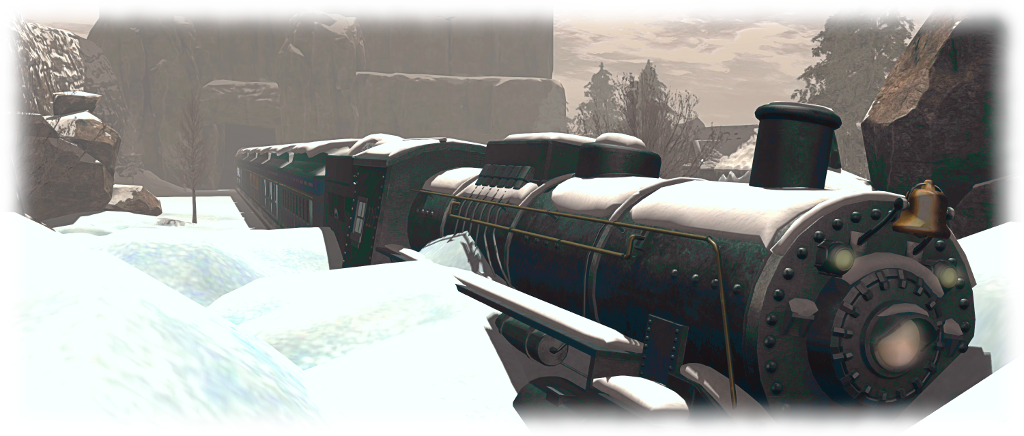
Join Seanchai Library and friends aboard one of the most luxurious means of rail travel, the Orient Express, as they continue their investigations into the most disagreeable events that have occurred en route to Paris.
Having been required to return to London from Istanbul post-haste, Hercule Poirot sought passage aboard the most famous train, gaining seat initially in second class, only to be “upgraded” to first class by his friend – and member of the board of directors for Compagnie Internationale des Wagons-Lits, the operators of the service – M Bouc. Prior to his “upgrade”, Poirot is accosted by one Samuel Ratchett, an American also travelling on the train, who demands the detective’s aide as he believes his life is in danger. However, Poirot refuses, on account of finding the American a distasteful individual.
Then, on the night after his upgrade to the sleeping berth next to Ratchett’s, he is woken by two events: the first is that the train has become stranded in snow not far from the city of Vinkovci in Yugoslavia. The second is the discovery that Ratchett’s fears about his safety were correct: his has been murdered in his cabin. But who is responsible?
With nowhere to go until assistance for the stricken locomotive arrives, Poirot sets out to discover – did someone board the train in secret to put an end to Ratchett, or was one of his fellow passengers in fact the murderer? And what of Ratchett himself? Was he really all he seemed?
Offered in a special setting, Murder on the Orient Express, one of Agatha Christie’s most popular stories, continues into its second weekend reading!
18:00: Magicland Storytime
When a fortune-teller’s tent appears in the market square of Baltese city, orphan Peter Augustus Duchene knows the questions that he needs to ask: Does his sister still live? If so, how can he find her?
The fortune-teller’s mysterious answer that an elephant – an elephant! – will lead him to his sister, sets off a chain of events so remarkable, so impossible, that you will hardly dare to believe it’s true. And thus we’re off on a wondrous adventure of the kind only Newbery Medalist Kate DiCamillo could tell.
In this timeless fable, she evokes the largest of themes — hope and belonging, desire and compassion — with the lightness of a magician’s touch, and we are joined in a world of What if? Why not? Could it be?
Join Calaedonia Skytower at the Golden Horseshoe for this most enchanting of stories.
Monday, July 16th 19:00: The Drowning World
They call it the Drowning World; Fluva, a planet on the fringes of the Commonwealth where the rain is – but for one month in the year – maddeningly torrential. For Chief Administrator Lauren Matthias, it is a new posting; one which comes with a major requirement: keeping the indigenous and warlike Sakuntala and immigrant and hard-working Deyzara, from annihilating one another.
But when the vessel used by bio-prospector Shadrach Hasselemoga crashes in Viisiiviisii, an immense, mostly unexplored jungle, and the wettest place on the planet, Matthias must dispatch a team made up of one Sakuntala and one Deyzara on a rescue mission. Can the two form an alliance long enough to both rescue Hasselemoga and survive the deadly jungle?
But as the mission unfolds, Matthias realises something much bigger and darker is occurring on Fluva. A mysterious presence is at work, manipulating events, one which not only puts the lives of the rescue mission at risk, but also her own – and which could ultimately threaten the Commonwealth itself!
Join Gyro Muggins as he reads story #21 in Alan Dean Foster’s Humanx Commonwealth series.
Tuesday, July 17th 1900: Brief Cases
Corwyn Allen dives into Jim Butcher’s 2018 collection of several of his excellent short stories and novellas from the universe of Harry Dresden.
The tales presented here not only offer excellent short narratives that dabble between the scenes of the other novels in the Dresden Universe series, they even encompass what might be Dresden’s greatest challenge…
….Becoming a father.
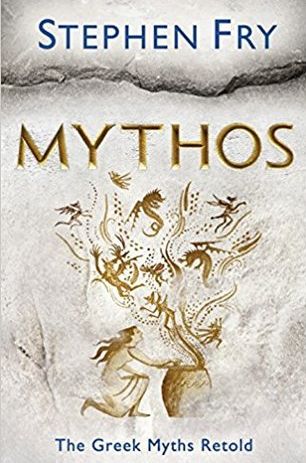
Wednesday, July 18th 19:00: Mythos
The Greek myths are the greatest stories ever told, passed down through millennia and inspiring writers and artists as varied as Shakespeare, Michelangelo, James Joyce and Walt Disney.
They are embedded deeply in the traditions, tales and cultural DNA of the West. In Stephen Fry’s hands the stories of the titans and gods become a brilliantly entertaining account of ribaldry and revelry, warfare and worship, debauchery, love affairs and life lessons, slayings and suicides, triumphs and tragedies.
Through them, you’ll once again fall in love with Zeus, marvel at the birth of Athena, wince at Cronus and Gaia’s revenge on Ouranos, weep with King Midas and hunt with the beautiful and ferocious Artemis.
Thursday, July 19th
14:00: Fireside Tales
Caledonia Skytower reads selections from Neil Gaiman and Terry Pratchett’s Good Omens: The Nice and Accurate Prophecies of Agnes Nutter, Witch.
According to this tome of very specific and very accurate prophecies – written in 1655, shortly before Agnes exploded (which tends to happen when you pack 80 pounds of gunpowder into your petticoats ahead of a mob of self-righteous twits burning you at the stake for being a witch) – the world will end on a Saturday.
Next Saturday, in fact. Just before dinner. Which some might see as being a bit of a nuisance, really; particularly an angel, a demon and an 11-year-old boy (himself the subject of a hospital mix-up at birth), all of whom have other plans for the weekend …
21:00: Salome Jane
A tale of the Wilder West with Shandon Loring, also presented in Kitely (hop://grid.kitely.com:8002/Seanchai/144/129/29).
Please check with the Seanchai Library’s blog for updates and for additions or changes to the week’s schedule.
Most of us have probably owned – or still own – a bicycle, whether it be for fun, sports, fitness, part of our daily working routine (or even a requirement to work) or simply an alternative means of getting out and about and enjoying the countryside / local sights. We can lavish care and attention on them to keep them in tip-top condition, or we can simply regard them as a utility and replace them when they get too old or break. But are they art?
Well, yes they can be – as the July / August 2018 exhibition at DiXmiX Gallery demonstrates. Entitled Bicycles, it is a slight departure from the more usual run of exhibitions at the gallery, in that it takes up all three halls as a single display of themed art, featuring images by 25 Second Life photographers.
DiXmiX Gallery: Bicycles – Anu Papp and Ornella Batriani
Taking part in the event are: Calypso Applewhyte, Ornella Batriani, Skippy Beresford, Bliss Bookham, Jimmy Boots, A.DeLauren, Mareea Farrasco, Carisa Franizzi, Gaus, Huckleberry Hax, Kimeu Korg, Loverdag, Mich Michabo, Key Monk, Tutsy Navarathna, Mr Noboby, Randonee Noel, Karen Oliven, Anu Papp, Melusina Parkin, Megan Prumier, Grace Rotunno, Dixmix Source, Twain, and Jonda Zabaleta, with each artist submitting one or two images.
The pieces vary in style and presentation. In some, it is not unfair to say that the bicycles might be considered incidental to the overall image; they were simply a part of the landscape or setting when the picture was taken. Equally, some appear to have been use to frame an image intended to convey a broader emotional response than a focus on the bike itself. Then there also those where the bicycle is clearly the intended focus, bit it being ridden, standing on its own, lying broken, or images just in part. Thus, we get to view the bicycle in numerous ways, whether central to an image or not.
Which is to say this is a richly diverse exhibition in which the subject matter is more broadly presented than one might think. All of the images are captivating in one way or another, be it the way in which they are offered, the narrative they encapsulate, the use of colour and tone – or the various combinations of these factors. Presentation is also a significant part of the images and their presentation: the collection of monochrome pictures on the upper level of the Grey Gallery, for example, offers a power contrast to the majority use of colour images through the rest of the exhibition, while the considered placement of Cloudy Day by Gaus and Bicycle 3 by Key Monk also providing a contrasts with their surrounding images, and thus capturing the eye. Meanwhile, the two large format images in the foyer area of the Grey Gallery demonstrate how humble velo can be an icon of pop art.
The emotional content of the images is equally as broad as the colours, tones and subjects offered through the pictures. But there is one emotion often associated with bicycles that within this exhibition is conspicuous by its almost total absence: joy.
Yes, bicycles can be props to frame moods and offer a sense of depth and feeling, be it with someone leaning moodily back against their bike, or walking it gently over terrain unsuitable for riding, or in the sight of a machine lying broken or bent. But bikes are also fun. Riding one can give a wonderful sense of freedom, a liberating sensation of speed and escape. It is for this reason I fairly leapt at Skippy Beresford’s Last Day of School (seen above). Yes, it’s not unfair to say the bicycle is in some ways incidental to the broader idea of escape from the routine a rigours of the school week – but it’s equally fair to say the sense of exuberance and excitement exuded by the picture perfectly encapsulated the sheer sense of joyful freedom a bicycle can offer.
Which is not to detract from any of the other images displayed here; all do have something to say, and all are fine examples of the subject and the artistry of the photographers. Why not take a ride to DiXmiX yourself and have a look?