Logos representative only and should not be seen as an endorsement / preference / recommendation
Updates for the week ending Sunday, August 18th
This summary is generally published every Monday, and is a list of SL viewer / client releases (official and TPV) made during the previous week. When reading it, please note:
It is based on my Current Viewer Releases Page, a list of all Second Life viewers and clients that are in popular use (and of which I am aware), and which are recognised as adhering to the TPV Policy. This page includes comprehensive links to download pages, blog notes, release notes, etc., as well as links to any / all reviews of specific viewers / clients made within this blog.
By its nature, this summary presented here will always be in arrears, please refer to the Current Viewer Release Page for more up-to-date information.
Note that for purposes of length, TPV test viewers, preview / beta viewers / nightly builds are generally not recorded in these summaries.
Official LL Viewers
Current Release version 6.2.4.529638, formerly the Love Me Render RC viewer dated August 5, promoted August 12th – NEW.
Release channel cohorts:
Bakes on Mesh RC viewer updated to version 6.3.0.530037 on August 16th.
Umeshu Maintenance RC viewer updated to version 6.2.5.530030 dated August 15th.
Clifton Forge, August 2019 – click any image for full size
Clifton Forge is a half Full region offering “modern supernatural para role-playing,” featuring humans, witches, vampires, and werewolves.
Supported by its own website, the setting is distinctly urban, representing a small city nestled within a mountain environment. It is intended to offer a place where, “blissful everyday living masks a darker and more turbulent truth”, the website setting-up a place where normalcy forms a blanket over a range of strange activities which those interested in role-playing within the environment can then take-up:
All manner of depravity conceals itself behind a flawless veneer here; the Hotel’s façade is cracked by stories of staff suicides, the Church here asks for alms – but whether it intends to divert these funds to charitable causes or fill its own coffers is unknown. A harried city cop turns Sheriff in what some might see as a peaceful retirement plan, while others wonder why she has escaped to a more pastoral clime. Everyone has a secret – what is yours?
Clifton Forge, August 2019
Like many RP environments in Second Life, the official landing point sits in the sky over the parcel in the sumptuous setting of a grand hall. Here visitors can contact the Clifton Forge administrators, and follow browser links to the RP back-story, rules and apply to join the group to participate in local role-play. Those arriving at the landing point will also be asked to join the local Out Of Character (OCC) group prior to making a visit down to the city proper. The group is free to join and helps mark visitors as non-playing characters during a visit, and you can always leave it following a visit if you have no interest in remaining a member.
Taking the main teleport to group level will deliver visitors to the east side of the parcel, and a further teleport board ready to take people onwards to some of the principal points of interest in the city which might conceivably be leaping-off points for role-play opportunities. These include some typical locations for any city setting: the local church, the hotel, the medical centre, the police station, places to sit and eat or find entertainment, and so on. However, the setting is far better seen by exploring on foot or by using the local bicycles available from the rezzer located close by.
Clifton forge, august 2019
The town is split into two, with the portion that contains the landing point also offering the main square, the city hall, the emergency facilities, various businesses and paths to some of the local residencies (note that some or all of the latter are available for rent, so do be aware of the potential to trespass into someone’s home when exploring). The second of the city’s districts – reached via a single tunnel – is home to the church and the hotel, together with further local businesses, before giving way to a more rural setting, of rocky bluffs and woodlands in which sit shacks and cabins.
Given the city only occupies a half region, attempts have been made to make use of elevation in places – notably the woodland area mentioned above, and with some of the rental properties and the church. This, together with at least one underground parking area both adds literal depth to the setting as well as making role-play more interesting by providing a sense of greater space than had things been kept more-or-less on the one level across the parcel.
Clifton Forge, August 2019
When exploring, notes that there are NPCs dotted around. some of these – such as the bouncer outside of the Castle House – will provide note cards when touched, and these cards contain game play information and local rules (e.g. such as player being frisked and fully disarmed before entering an establishment).
One or two aspects of the setting look like they might still be under development – I noted a couple of floating pieces of vegetation in the sky above the town, and the ground around Castle House looks like it might be awaiting further landscaping. However, the setting is, overall, as it is presented in the description: an urban environment representative of a small city; one that is awaiting a cast of role-players. If you’re into the supernatural and are looking for a role-play environment that offers in in a modern setting, might be interested in taking a look – just note that for the purposes of this article, I did adjust my windlight settings away from the local default.
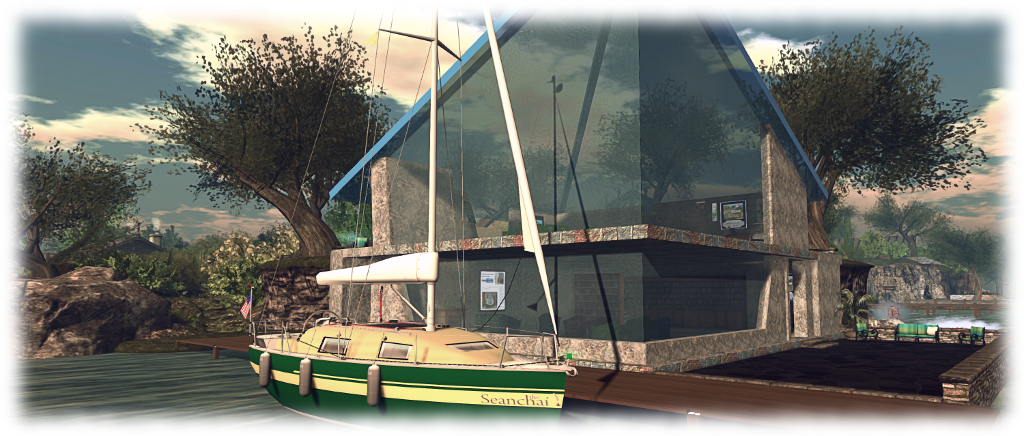
It’s time to highlight another week of storytelling in Voice by the staff and volunteers at the Seanchai Library. As always, all times SLT, and events are held at the Library’s home at Holly Kai Park, unless otherwise indicated.
Sunday, August 18th
13:30: Tea Time with Jeeves
Just for summer, Seanchai Library takes a dive into the world of Reginald Jeeves, a well-educated, intelligent valets of indeterminate age who is employed by the amiable young man-about-town, Bertie Wooster, whom Jeeves routinely has to benignly rescue from the consequences of his idiocy.
Created by author, humorist, and lyricist (working with Guy Bolton and Jerome Kern) Pelham Grenville Wodehouse (October 1881 – February 1975), Jeeves and Wooster are perhaps his most iconic characters, their adventures eventually growing to 35 short stories and 11 novels, the majority of which are first-person narrated from the perspective of Bertie Wooster.
This week comes the third part of The Inimitable Jeeves.
A semi-novel published in the UK and the United States in 1923, The Inimitable Jeeves brings together 11 previously published stories structured as “chapters” rather than appearing as individual stories, giving the volume the appearance of being a novel something initially enhanced in early editions, which split the first five and final story into two chapters apiece, giving the impression the book was 18 chapters long (later editions reversed this, each story being just a single chapter for 11 in total).
The stories also add to the novel-like feel, as they each focused variously on a small group of characters throughout including Bertie’s Aunt Agatha, his somewhat inept friend Bingo, and his cousins Claude and Eustace, brought together with Jeeves and Wooster in some familiar Wodehouse themes.
Join Da5id Abbot, Kayden Oconnell, and Caledonia Skytower as they read this delightful series at Ceiliuradh Glen.
18:00 Tilly and the Bookwanderers
Eleven year-old Tilly has lived above her grandparent’s bookshop ever since her mother disappeared shortly after she was born. Like the rest of her family, Tilly loves nothing more than to escape into the pages of her favourite stories.
One day Tilly realises that classic children’s characters are appearing in the shop through the magic of `book wandering’ – crossing over from the page into real life.
With the help of Anne of Green Gables and Alice in Wonderland. Tilly is determined to solve the mystery of what happened to her mother all those years ago, so she bravely steps into the unknown, unsure of what adventure lies ahead and what dangers she may face.
Join Caledonia Skytower at the Golden Horseshoe to find out more!
Monday, August 19th 19:00: Arthur C. Clarke’s Rendezvous with Rama
Gyro Muggins reads one of the greatest science fiction novels of human first contact with alien intelligence.
In 2131, a fast-moving object of extremely large size is detected beyond the orbit of Jupiter travelling on a course that will see it pass through the inner solar system to swing around the Sun, before heading out into space. An automated probe launched from Mars reveals the object to be a perfect cylinder, 50 km long and 20in diameter rotating regularly along its long axis and clearly artificial in nature.
The deep space survey vessel Endeavour, her crew untrained for first contact scenarios, is the only vessel that can intercept the cylinder as it uses the Sun’s gravity well to accelerate and bend its path onto a new trajectory. After a high-speed chase, the Endeavour reaches the cylinder – christened Rama by those who first identified it – and finds one of the end caps has curious triple chamber airlock systems within it. Through one of them, the crew gains access to the object.
What they find within stuns them: the cylinder is hollow, a 50x16km “tube” the inner surface of which forms a circular world of three parts: a large plain, with six city-like groups of structures scattered around it, a central band of frozen water the crew call the Cylindrical Sea with a single long, thin island (which they dub “New York” due to its superficial similarity to Manhattan island). Beyond the sea lies a landscape of split into cubes and squares, dominated by a group of massive cones extending inward along the cylinder’s long axis from southern end cap.
Initially in darkness and frigid when the Endeavour’s crew enter, the cylinder gradually comes to life, revealing its strange alien nature, where everything appears to be done in triplicate (or multiples thereof). And then, as tensions among the human civilisations across the solar system rise, the “Ramans” appear.
Tuesday, August 20th 19:00: Chitty Chitty Bang Bang
So, you think you know the story because of the film? Well, guess again! Disney’s famous 1968 film can best be described as being loosely based on the children’s story by Ian Flemming, the creator of James Bond.
Flemming’s last novel, Chitty Chitty Bang Bang was published posthumously, and initially in three volumes, two months after his death in August 1964. He took his inspiration for the titular car from a series of post-War World I aero-engined racing cars called “Chitty Bang Bang”. They were built by Count Louis Zborowski at Higham Park, in Kent, England, and one of them, the “Higham Special” went on to take the land speed record in 1926 with a speed in excess of 170 mph, after it had been purchased by racing driver J.G. Parry-Thomas specifically for that purpose.
In the book, the car is a Paragon Panther, a powerful 1920s touring car that is restored by Commander Caractacus Pott. At first the car is just that – a powerful 4-seater tourer Pott uses to transport himself and his wife and children around. But then the car starts to exhibit a “personality” and abilities beyond those of any normal motor vehicle. Some of these will be familiar to those who have seen the film, but where the latter options to introduce jealous barons and a wicked Child Catcher, the book offers a more down-to-Earth but equally engaging series of adventures of Commander Pott and his family.
Join Caledonia Skytower to discover the real Chitty Chitty Bang Bang!
Wednesday, August 21st: A Cyberpunk Summer
Short stories with Finn Zeddmore.
Thursday, August 22nd
19:00: The Blue Salt Road
An earthly nourris sits and sings And aye she sings, “Ba lilly wean, Little ken I my bairn’s father, Far less the land that he staps in.
– Child Ballad, no. 113
So begins a stunning tale of love, loss and revenge, against a powerful backdrop of adventure on the high seas, and drama on the land. The Blue Salt Road balances passion and loss, love and violence and draws on nature and folklore to weave a stunning modern mythology around a nameless, wild young man.
Passion drew him to a new world, and trickery has kept him there – without his memories, separated from his own people. But as he finds his way in this dangerous new way of life, so he learns that his notions of home, and your people, might not be as fixed as he believed.
With Shandon Loring, also Also in Kitely – teleport from the main Seanchai World grid.kitely.com:8002:SEANCHAI.
21:00: Seanchai Late Night
Contemporary sci-fi fantasy from on-line sources such as Lightspeed, Escape Pod, and Clarkesworld with Finn Zeddmore
The Kokua team released Kokua 6.2.4 on Friday, August 16th, 2019, and with it come some changes to general administration of the viewer’s website and management tools.
In terms of the latter, and for ease on management going forward, a number of changes are in the works including:
The use of the Atlassian Confluence platform to provide:
A blog capability.
Release notes support.
A master download pages.
RSS feeds.
The use of Atlassian Jira (as used by Linden Lab and the likes of Firestorm) for bug reporting and tracking.
The switch-over is still a work-in-progress, so the existing blog, wiki and bug tracker remain in operation for the time being, however, relevant links for the new environment are given as:
Existing issues have been imported to the Jira. However, note that while contributor’s names have been preserved as much as possible, the accounts have been set as inactive for easier management.
Issue numbers have been similarly preserved during the import process, but are now prefixed KSL.
While the switch-over is in progress, users are advised against linking to individual sub-pages within these sections, as pages may change as things are bedded-in. For this purposes of this blog, the new Kokua home page is referenced in the sidebar links (right, under Maintained Viewers) and within my Current Viewers Release Page and the weekly release summaries drawn from that.
Kokua 6.2.4
Kokua 6.2.4 brings the viewer to parity with the most recently Linden Lab viewer release (version 6.2.4.529638, formerly the Love Me Render RC viewer dated August 5th, promoted August 12th). In addition, it updates the RLV version to Marine Kelley’s RLV 2.9.26.2.
As has been customary with Kokua releases of late, the viewer is provided in three versions for each of the supported operating systems (Windows, Mac OS X and Linux, all 64-bit):
Non-RLV – version 6.2.4.45881.
“Standard” RLV (can be enabled and disabled via a viewer restart) – version 6.2.4.45882.
“Full Time” RLV (RLV is active all the time) – also version 6.2.4.45882.
In addition to these updates, Kokua 6.2.4 includes a number of third-party additions, most notably from Firestorm, as noted in the sections below, and with due credit to the originators of the code updates.
Settings Backup
Sometimes when installing a new version of a viewer, there can be a recommendation to perform a “clean install” – removing all cached and settings files. This can make any viewer installation labour-intensive, as settings all need to be restored after the installation is complete.
The Settings Backup (Preferences > Backup) eases some of the pain by allowing users to back-up many of their global and account settings to a local hard drive. Once done, the back-up can then be restored to an updated version of Kokua (e.g. if a clean install has been required, or if some settings have become corrupted). Settings can also be backed-up at any time as changes are made.
The Kokua Settings Back-up option, courtesy of Firestorm
Settings can be backed-up to any location on a local drive, and users can select those settings they wish to back-up by unchecking / checking the available options. It is also possible to save settings on a per account basis. So if you have several accounts, each with different settings, you can back-up each of them separately – just make sure each back-up has a unique location.
Restoring previously backed-up files requires the viewer is restarted after the restore – and again, this is conveniently taken care of by the viewer allowing you to quickly log-out following a successful restore – although you’ll have to manually re-start the viewer once you’ve been logged out.
Sounds Output Device Selection
Preferences >Sound and Media includes a new drop-down allowing users to select their preferred output device for playing in-world sounds.
Sound output device selection, courtesy of Firestorm
When using it, note that:
Selecting Default will always select the first output device in the list.
If Default is selected but the previous device is no longer available, the viewer will automatically switch to the next available “default” device as defined by your operating system.
Manually selecting an output device from the drop-down prevents the viewer from automatically switching to another device if the selected device is no longer available. Instead, the field will show “Unavailable Device” until such time as the nominated device is again available, or the drop-down is changed to Default or an alternate is manually selected.
Updated Debug Floater
Finally from Firestorm, Kokua 6.2.4 includes an improved debug settings floater with search and sanity checking of key values.
The improved Debug floater, courtesy of Firestorm
Other Updates of Note
Finally there are a number of fixes/improvements on the Kokua code base itself, notably fixing the pie menus so that the Hover Height command appears (i.e. was there but a mistake in the file concerned prevented it being shown). For details, please refer to the Kokua 6.2.4 release notes.
Feedback
Kokua 6.2.4 continues to maintain parity with the official viewer whilst also importing some additional updates from Firestorm that Kokua users will doubtless find useful and which are likely to help enhance Kokua as the go-to viewer for those who have used Firestorm , but who are looking for an alternative that offers reasonable familiarity.
Vibes Gallery, curated by Eviana Robbiani, is currently home to an untitled exhibition featuring Sunset Theas, Paola Mills, Lyack Glenwalker, Megan Prumier, and Aurora Donner. Given some of the images involve nudity, it should perhaps be considered an exhibition that is NSFW.
Immediately inside the entrance to the gallery is a quartet of images by Sunset Theas that follow a theme of their own, perhaps best described as condensing the seven stages of life into four evocative monochrome images, entitled, Embryonic, Birth, Life and Death. As the titles imply, each captures a moment in time and life.
Vibes Gallery: Sunset Theas
The use of monochrome, soft focus and life and shadow serve to make each of these pieces an intriguing study that fully captures the essence of their titles. Take Embryonic, for example. The use of depth of field and the off-centre capture are so suggestive of an ultrasound scan, with just enough form and substance for us to understand what we are seeing.
And so the images progress: Birth using light and shadow and a huddled form that offers the idea of a babe is dark swaddling; Life offers a image of the full vitality of a person in their prime, the use of a mask preventing us from being drawn into studying the model, but considering that broader idea of life. Then depth, with it simple setting, soft focus and back view of a naked body without adornment of clothing or within the setting is simply glorious – if such a term can be used – in its presentation of the body’s emptiness in death.
Vibes Gallery: Megan Prumier
At the far end of the gallery space are four images by Megan Prumier that again offer a theme; this one using reflections in the form of overlaid images of the female body. Each displays a considered use of technique that makes the nudity within the images secondary to their narrative. Take Warm Shivers, for example; the marvellous placement of the image, one copy superimposed over the other wonderfully suggests both someone feeling the cold in their nudity whilst at the same time presenting the idea of receiving warm comfort from someone close.
Between these two groups lie another set of four images by Paola Mills, and two pairs of images by Lyack Glenwalker and Aurora Donner. I admit to being unfamiliar with the latter two, but again, on the strength of the two images presented here, Lyack has a talent for producing images rich in narrative. Certainly, his images reflect the stories inherent in the four pieces offered by Paola, while Aurora’s pair of studies round-out the exhibition nicely.
The following notes are taken from the Content Creation User Group (CCUG) meeting, held on Thursday, August 15th 2019 at 13:00 SLT. These meetings are chaired by Vir Linden, and agenda notes, meeting SLurl, etc, are usually available on the Content Creation User Group wiki page.
Items Coming out of the SL Summit
LL might potentially be looking at a refresh of SL terrain texturing in the near future.
Pathfinding is recognised as a pain-point, but no resources are available within the Lab to tackle improvements / enhancements in the immediate future.
ARCTan
Project Summary
An attempt to re-evaluate object and avatar rendering costs to make them more reflective of the actual impact of rendering both. The overall aim is to try to correct some inherent negative incentives for creating optimised content (e.g. with regards to generating LOD models with mesh), and to update the calculations to reflect current resource constraints, rather than basing them on outdated constraints (e.g. graphics systems, network capabilities, etc).
Current Status
The project has been on hold for some time, but due to be rebooted during the current quarter.
Emphasis will initially be on data gathering, as previously.
No decision has yet been made on whether or not the first pass of work (once the data has been gathered) will include avatar accountability (including a further pass with Animesh), or initially only focus on in-world objects.
The overall aim is that of encouragement – getting users to think and want to be on-board with the changes, as they can see the benefit.
This work will not reduce the maximum texture size (1024×1024 – and remembering that for Bakes on Mesh avatar texture sizes have actually been increased from a 512x512cap to 1024×1024). However, ARCTan might penalise for “improper” use of textures (e.g. multiple uses of unique 1024×1024 textures across object faces, no matter how small the faces might be).
There are a lot of ideas around ARCTan (e.g. finding a means to not encourage lowest LODs of near-zero triangles, not penalising people if they include valid LODs, etc). However, threading the need to find the right balance on how things should be handled is acknowledged as being difficult, and as such, do not expect ARCTan to start changing anything soon.
Environment Enhancement Project
Project Summary
A set of environmental enhancements (e.g. the sky, sun, moon, clouds, and water settings) to be set region or parcel level, with support for up to 7 days per cycle and sky environments set by altitude. It uses a new set of inventory assets (Sky, Water, Day), and includes the ability to use custom Sun, Moon and cloud textures. The assets can be stored in inventory and traded through the Marketplace / exchanged with others, and can additionally be used in experiences.
Due to performance issues, the initial implementation of EEP will now likely not include certain atmospherics such as crepuscular rays (“God rays”).
The viewer should be updated shortly to bring it to parity with the most recent viewer release (version 6.2.4.529638, formerly the Love Me Render RC).
There are still issues on the rendering side affecting people on various graphics systems that need to be resolved, together with some remaining performance issues.
Bakes On Mesh
Project Summary
Extending the current avatar baking service to allow wearable textures (skins, tattoos, clothing) to be applied directly to mesh bodies as well as system avatars. This involves viewer and server-side changes, including updating the Bake Service to support 1024×1024 textures, but does not include normal or specular map support, as these are not part of the existing Bake Service, nor are they recognised as system wearables. Adding materials support may be considered in the future.
Still a number of bugs to be resolved, and Vir is now working on these as well as the Animesh follow-on (below). These include, but are not limited to:
Shadows are failing to render correctly.
Issues with some alpha settings.
Otherwise, most of the functionality is now believed to be in place.
Animesh Follow-On – Project Muscadine
DRTSIM-421 on Aditi (region Bakes on Mesh) now has the server-side code to support the new visual parameters LSL code.
Project viewer supporting the new LSL code should be out for use on Aditi in the next week.
This will provide the means to test the new LSL code functionality, but as with all project viewers, may not work 100% in all other areas.
May get enhanced with additional Animesh-related capabilities, although this is dependent on commitments with other projects, notably Bakes on Mesh and Project ARCTan.
General Discussion
Possible SL Wiki Deprecation?
For the last few years, the Lab has been moving information away from the SL wiki and into knowledge base articles.
During a recent Web User Group meeting, it was indicated that this trend will continue, and that the use of the SL wiki may be deprecated over time.
One of the reasons for this is the wiki software has some issues, and there are problems in opening the wiki for general management by users.
These changes will not result in the wiki immediately vanishing.
It’s not clear as to the best mechanism for getting outdated / incorrect knowledge base articles corrected – potentially the best way at the moment is to raise a bug report.
Documentation
The wiki situation prompted a broader discussion on documentation.
LL has been considering how to better provide documentation and demonstration videos for upcoming features and new capabilities.
It has also been suggested a Content Creation blog where notes on projects, best practices relating to them and for things like mesh design – LODs (including how to make efficient low LOD models rather than just tossing a low number of tri into the mix) – uploads, etc., and other content creation information could be posted.
It is acknowledged that there is a lot of expertise within the Lab and within the community for content creation, and none of it really resides within a single individual – therefore determining what should be documented, how it should be documented, etc., is not an easy matter.
A lot of the existing best practises for content and build has come from users / creators.
Given the status of the wiki, adding to this is currently difficult.
While creators have produced their own documentation, etc., it does come at a cost, and tends to focus n their own specifics. Leveraging this into a more general set of best practices and documentation library would take a lot of further time and effort.
As such, some sort of collaborative effort between creators and the Lab might be the way forward, although even organising this and ensuring a consensus of opinion may not be easy.
Another way to enhance documentation might be to submit new articles / updates to existing articles through a mechanism like the open source contribution agreement.
Mesh Uploader
Work is continuing on improving the mesh uploader – notably with the contributed updates from Beq Janus of the Firestorm team (see my Firestorm 6.0.1 review for details).
Further work could be done to improve feedback information given by the uploader, but this is currently seen as being more UI intensive, and outside the immediate scope of this updates.








 Inara Pey: Living in a Modemworld