Jeeves, Rama, Anne and more in Second Life

Seanchai Library

It’s time to highlight another week of storytelling in Voice by the staff and volunteers at the Seanchai Library. As always, all times SLT, and events are held at the Library’s home at Holly Kai Park, unless otherwise indicated.

Sunday, September 1st

13:30: Tea Time with Jeeves

Just for summer, Seanchai Library takes a dive into the world of Reginald Jeeves, a well-educated, intelligent valets of indeterminate age who is employed by the amiable young man-about-town, Bertie Wooster, whom Jeeves routinely has to benignly rescue from the consequences of his idiocy.

Created by author, humorist, and lyricist (working with Guy Bolton and Jerome Kern) Pelham Grenville Wodehouse (October 1881 – February 1975), Jeeves and Wooster are perhaps his most iconic characters, their adventures eventually growing to 35 short stories and 11 novels, the majority of which are first-person narrated from the perspective of Bertie Wooster.

This week comes the fourth part of The Inimitable Jeeves.

A semi-novel published in the UK and the United States in 1923, The Inimitable Jeeves brings together 11 previously published stories structured as “chapters” rather than appearing as individual stories, giving the volume the appearance of being a novel something initially enhanced in early editions, which split the first five and final story into two chapters apiece, giving the impression the book was 18 chapters long (later editions reversed this, each story being just a single chapter for 11 in total).

The stories also add to the novel-like feel, as they each focused variously on a small group of characters throughout including Bertie’s Aunt Agatha, his somewhat inept friend Bingo, and his cousins Claude and Eustace, brought together with Jeeves and Wooster in some familiar Wodehouse themes.

Join Da5id Abbot, Kayden Oconnell, and Caledonia Skytower as they read this delightful series at Ceiliuradh Glen.

18:30 Tilly and the Bookwanderers

Eleven year-old Tilly has lived above her grandparent’s bookshop ever since her mother disappeared shortly after she was born. Like the rest of her family, Tilly loves nothing more than to escape into the pages of her favourite stories.

One day Tilly realises that classic children’s characters are appearing in the shop through the magic of `book wandering’ – crossing over from the page into real life.

With the help of Anne of Green Gables and Alice in Wonderland. Tilly is determined to solve the mystery of what happened to her mother all those years ago, so she bravely steps into the unknown, unsure of what adventure lies ahead and what dangers she may face.

Join Caledonia Skytower at the Golden Horseshoe to find out more!

Monday, September 2nd 19:00: Arthur C. Clarke’s Rendezvous with Rama

Gyro Muggins reads one of the greatest science fiction novels of human first contact with alien intelligence.

In 2131, a fast-moving object of extremely large size is detected beyond the orbit of Jupiter travelling on a course that will see it pass through the inner solar system to swing around the Sun, before heading out into space. An automated probe launched from Mars reveals the object to be a perfect cylinder, 50 km long and 20in diameter rotating regularly along its long axis and clearly artificial in nature.

The deep space survey vessel Endeavour, her crew untrained for first contact scenarios, is the only vessel that can intercept the cylinder as it uses the Sun’s gravity well to accelerate and bend its path onto a new trajectory. After a high-speed chase, the Endeavour reaches the cylinder – christened Rama by those who first identified it and finds one of the end caps has curious triple chamber airlock systems within it. Through one of them, the crew gains access to the object.

What they find within stuns them: the cylinder is hollow, a 50x16km “tube” the inner surface of which forms a circular world of three parts: a large plain, with six city-like groups of structures scattered around it, a central band of frozen water the crew call the Cylindrical Sea with a single long, thin island (which they dub “New York” due to its superficial similarity to Manhattan island). Beyond the sea lies a landscape of split into cubes and squares, dominated by a group of massive cones extending inward along the cylinder’s long axis from southern end cap.

Initially in darkness and frigid when the Endeavour’s crew enter, the cylinder gradually comes to life, revealing its strange alien nature, where everything appears to be done in triplicate (or multiples thereof). And then, as tensions among the human civilisations across the solar system rise, the “Ramans” appear.

Tuesday, September 3rd 19:00: Chitty Chitty Bang Bang

So, you think you know the story because of the film? Well, guess again! Disney’s famous 1968 film can best be described as being loosely based on the children’s story by Ian Flemming, the creator of James Bond.

Flemming’s last novel, Chitty Chitty Bang Bang was published posthumously, and initially in three volumes, two months after his death in August 1964. He took his inspiration for the titular car from a series of post-War World I aero-engined racing cars called “Chitty Bang Bang”. They were built by Count Louis Zborowski at Higham Park, in Kent, England, and one of them, the “Higham Special” went on to take the land speed record in 1926 with a speed in excess of 170 mph, after it had been purchased by racing driver J.G. Parry-Thomas specifically for that purpose.

In the book, the car is a Paragon Panther, a powerful 1920s touring car that is restored by Commander Caractacus Pott. At first the car is just that – a powerful 4-seater tourer Pott uses to transport himself and his wife and children around. But then the car starts to exhibit a “personality” and abilities beyond those of any normal motor vehicle. Some of these will be familiar to those who have seen the film, but where the latter options to introduce jealous barons and a wicked Child Catcher, the book offers a more down-to-Earth but equally engaging series of adventures of Commander Pott and his family.

Join Caledonia Skytower to discover the real Chitty Chitty Bang Bang!

Wednesday, September 4th: Anne of Green Gables

As soon as Anne Shirley arrives at the white farmhouse called Green Gables, she is sure she wants to stay forever. The problem is, the owners of Green Gables, Matthew and Marilla Cuthbert wanted a boy to help Matthew with household chores; so at first it seems as if she will be returned to the orphanage from whence she came.

However, Anne is determined to stay, trying hard not to get into trouble or speaking out of turn, and the Cuthberts come to realise she is someone blessed with an enormous imagination. The latter is especially noticed by the quietly-spoken Matthew, who persuades his sister that young Anne should stay.

Thus we are drawn into Anne’s life and world as she settles into her first real home. Over the course of a five year period from her arrival in Bolingbroke at age 11 through until her move to Queen’s Academy at the age of 16, where she earns a university scholarship, we follow Anne’s adventures and ups and down within the close-knit community, making friends (and sometime enemies whom she is perhaps too stubborn to admit she’s long since forgiven for perceived wrongs) and her domestic trails and tribulations. The later, when tragedy strikes, we follow her back to Bollingbroke, where she indeed becomes Anne of Green Gables, and her story is left open.

Join Faerie Maven-Pralou as she reads L.M. Montgomery’s 1908 classic (and first of a series).

Thursday, September 5th

19:00: The Blue Salt Road

An earthly nourris sits and sings
And aye she sings, “Ba lilly wean,
Little ken I my bairn’s father,
Far less the land that he staps in.

– Child Ballad, no. 113

So begins a stunning tale of love, loss and revenge, against a powerful backdrop of adventure on the high seas, and drama on the land. The Blue Salt Road balances passion and loss, love and violence and draws on nature and folklore to weave a stunning modern mythology around a nameless, wild young man.

Passion drew him to a new world, and trickery has kept him there – without his memories, separated from his own people. But as he finds his way in this dangerous new way of life, so he learns that his notions of home, and your people, might not be as fixed as he believed.

With Shandon Loring, also Also in Kitely – teleport from the main Seanchai World grid.kitely.com:8002:SEANCHAI.

21:00: Seanchai Late Night

Contemporary sci-fi fantasy from on-line sources such as Lightspeed, Escape Pod, and Clarkesworld with Finn Zeddmore

A Summerland visit in Second Life

Summerland, August 2019 – click any image for full size

Late in August we visited – on the recommendation of Miro Collas – Iniquity Constantine’s Homestead region of Summerland. At the time of our visit, Ini described the region as “an idyllic garden where the spirit may rest and rejuvenate,” offering a mix of “pagan, ritual, mythology, mythic … magic, runes, druid, nature, elemental, [and] familiars” in its elements.

These elements are apparent as soon as visitors arrive in the region: the landing point sits within a barn converted into a Wiccan / pagan centre where psychic readings are on offer, and the trappings of Wiccan and magical supplies and symbols are much in evidence.

Summerland, August 2019

Outside, a deck extends over coastal waters under a late summer sky as seagulls wheel around in search of a fishy meal. The deck offers place to sit and appreciate the view across the rest of the region and the surrounding (off-sim) hills. This view reveals that the region forms a semi-circle of small islands that form a horseshoe around what is – given the foaming waters – a shallow bay sitting over a broad shelf of rock.

One its western end, this horseshoe bay is watched over by the tall red finger of a lighthouse; at its eastern extent, it is mirrored by a set of horseshoe waterfalls that tumble from the cliffs of the highest island in the curved chain. It is these falls, visible through the haze that draw visitors around the side of the landing point barn to where a wooden bridge offers the way to the next island in the series.

Summerland, August 2019

Here lie the first ruins with pagan / druid elements: ancient statues, a broken henge of shaped stones around a hewn alter and reach via a stone arch. Beyond it, a second bridge connects to the tall island, the exploration of which can be split into two parts. Just across the bridge, a set of stone steps climb up the grassy shoulder of the island, while just to the left, through a gap in a broken wooden fence, a ladder offers the first part of a way down to where a shingle beach sits at the base of the island, presenting a path to a little beach house sitting on another deck built out over the waters.

At the top of the stone steps, the upper plateau of the island presents a hazy mix of the pastoral and the pagan / ancient. Horses graze on the long grass, shaded by the island’s woodlands, trees that help hide and disguise the ruins scattered beneath their boughs. These take several forms, including those of a chapel and a much more recent glass-and-metal pavilion that has been turned into a place of meditation.

Summerland, August 2019

A path winds across the grassy table of the island, offering a means to see most of the sights whilst pointing the way to where a rocky route drops down to another bridge and also an almost-cave or cavern. As well as providing a means to reach the last two islands in the chain, the low-lying grassy headland provides the means to reach a modern and comfortable orangery – a further place for visitors to sit and rest during a visit to the region.

The two remaining islands offer a further mix of trees, ruins and places to sit and rest or in meditation, all within the region’s sound scape that is, perhaps a little too dominated by the thunder of waterfalls. There is also a little roughness to some of the landscaping with floating bushes and candles here and there, together with some slight alpha issues (sadly common and often unavoidable when combining foliage and off-sim elements), but nothing that excessively gets in the way of appreciating the beauty of the setting, and which certainly don’t interfere with opportunities for photography. Images captured may be shared through the region’s Flickr group.

Summerland, August 2019

SLurl Details

Made in SL: education and CNDG in Second Life

The CNDG FutureWork Institute, as 2-region setting within CNDG’s spread of some 42 regions for education, training and showcasing

On Thursday, August 29th, 2019, the Lab launched the first segment of the new Made in SL series of videos. Carrying the  banner name Learning In SL, it would appear to be the first of a series (likely interspersed with segments covering other subject matter, as indicated by the original Made In SL series announcement) looking at the use of Second Life for educational / learning / training opportunities. Specifically for this piece, the work of the international and very successful Chant Newall Development Group, LLC (CNDG) is peviewed.

CNDG is a Virtual Learning Environment (VLE) developer. We specialise in creating tailored, user-friendly VLEs, offering a fully supported service on all major virtual reality platforms.

We provide our clients with networked environments where instruction, learning activities, assignments, and synchronous and asynchronous exercises are available 24 hours a day, 365 days a year.

– From the CNDG website

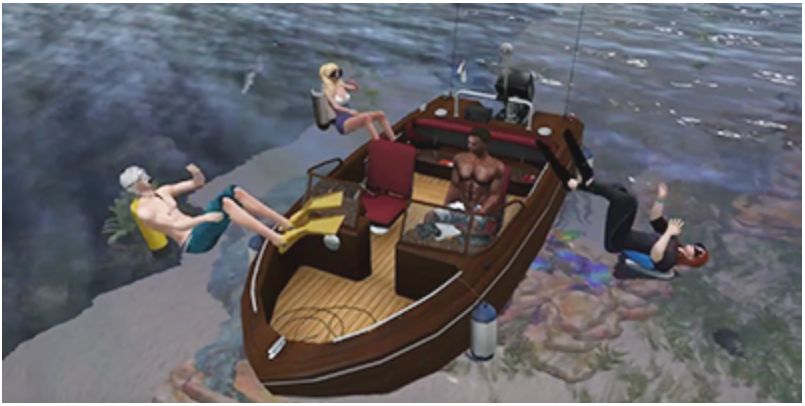
Students on CNDG’s Environmental Studies course (run with Florida State University) take to the water in SL simulating studies in climate change and ocean acidification. Credit: CNDG

CNDG is deserving of being surfaced in this series as their track record is impressive – but perhaps largely unknown to Second Life users. The organisation operates an impressive 42 regions within Second Life, which are split between what might be considered “core” regions, together with sets of “demo” and “live” regions and a series of specialised study regions – including sea / undersea settings. Not all of these are open to the public, being focused on servicing clients and students.

The organisation was founded in 2006, and has grown into one of the most respected providers of VLEs for clients – universities and other educational organisations, working in partnership with Pearson, the largest education company and book publisher in the world. This success also includes working with a number of commercial clients, including the likes of US Department of Veterans Affairs, Honeywell Corporation and Pfizer, the pharmaceutical conglomerate, to provide various specialised environments and facilities in Second Life.

We are not interested in building completely automated, run-on-their-own, no-contact systems: we build environments that help educators communicate their expertise and their knowledge to students in a direct, impactful way … We have the technology needed to create more opportunities for all students at all levels and all over to enter into relationships with mentors and teachers as needed. Virtual Learning Environments which are live and networked give us the ability to break down those barriers, and bring people together across boundaries.

– CNDG CEO and founder, William Prensky

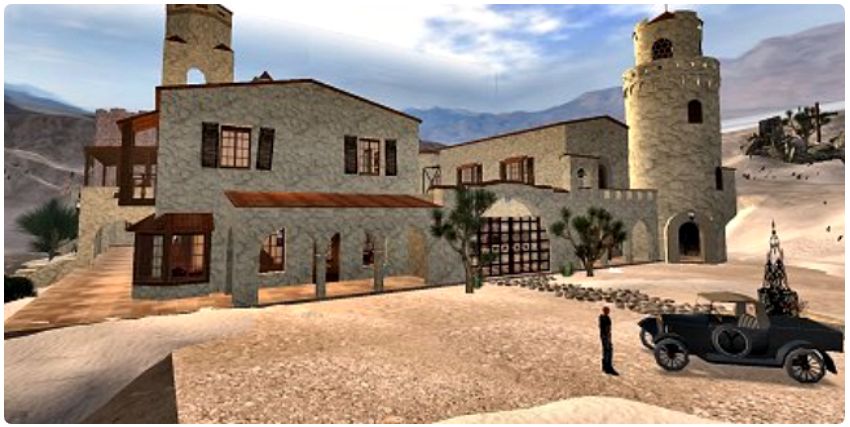
Scotty’s Castle, a recreation of the idiosyncratic villa in Death Valley, was at the time, both CNDG’s first project and most elaborate and realistic buildings in Second Life. With the help of Linden Lab, it brought CNDG to the attention of their first commercial client, America’s Public Broadcast Service. Credit: CNDG LLC

Within SL, CNDG has developed and provided courses in biology, chemistry, economics and environmental science, working particularly with Florida State University and the University of Central Florida, which have seen in excess of 2,000 students participate in activities – with around 25,000 students having participated in programme developed by CNDG as a whole over the past 12 years.

A key part of the courses and units supplied is that students can access the in-world environments through the CNG gateway. This, like SL Community Gateways, provides sign-up, avatar selection and log-in at the main CNDG campus, where tutorial-style guides familiarise them with the viewer and their initial assignments. For clients – universities, collages, and so on – CNDG can provide tailored courses based on a client’s own materials, while Pearson can provide supporting printed material for CNDG’s broader courses (including access codes to sign-in to the CDNG virtual environments), which can be made available to students through the likes of university bookshops.

Within the video itself – running to just under 2.5 minutes, we are introduced to CNDG and its work, touching on some of the successes and partnerships that have arisen from 12+ years of supplying networked educational solutions within Second Life. It’s a fascinating glimpse and well worth taking the time to watch – hence embedding it below for ease of reference.

Given the sheer breadth of educational uses SL is put to, I certainly hope that Learning in SL will  – as seems to be implied by the title itself, as noted at the top of this piece – continue to be a theme within Made in SL as the series continues to evolve.

The Stolen Child in Second Life

The Itakos Project, The Stolen Child – CybeleMoon

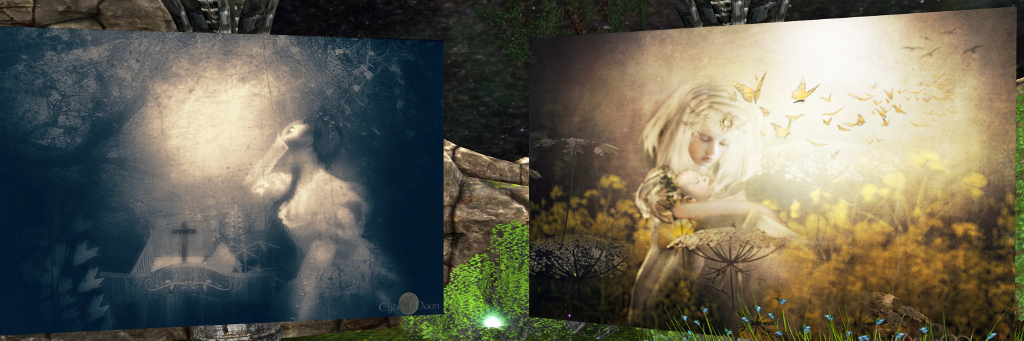
CybeleMoon (Hana Hoobinoo) is renowned for her fabulous mixed-media art. It carries within it a richness of tone, a mixing and balance of light and shade, a depth of symbolism and – most poignantly – a wonderful framing of narrative that makes any exhibition of her work in Second Life utterly unmissable.

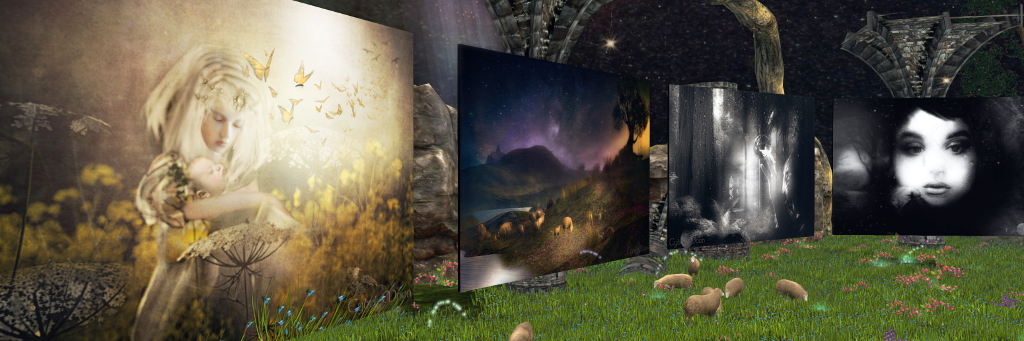
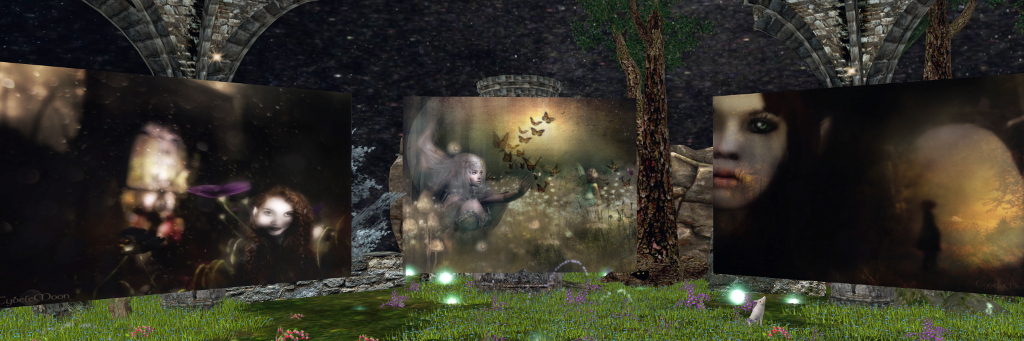
All of this richness, depth and framing is on display in full force at The Itakos Project, curated by Akin Alonzo, where Cybele presents The Stolen Child, a series of 15 images presented within a glade-like setting caught in the enfolding arms of ancient ruins, which has been specially built for the exhibit by Akim. Reached via the teleport door in the main foyer of the gallery, this setting is not merely a backdrop for Cybele’s art, it is part of the overall theme of the exhibition, designed through its form and lighting to increase the feeling of immersion in in the story the exhibition presents.

The Itakos Project, The Stolen Child – CybeleMoon

This story is not offered as a linear tale; rather, there is a central strand of theme running through both setting and images. This strand leads us through Cybele’s images, linking them indirectly and without necessary order (although one is suggested, somewhat by the circular placement of the pieces) as they form windows, if you will, into the underlying proposition of the exhibition; a proposition a proposition Cybele explains thus:

Fairies are not benevolent creatures at all, attracted by the strength and vitality of mankind, they kidnap children and especially newborns, or seduce (for the purpose of kidnapping) beautiful girls and boys.

She continues by noting the myth of the fairy lies routed in a times past need to rationalise the death of a child, be it at birth or with a short span of months or years thereafter: that the fairies had stolen the child away from a otherwise sad destiny. Within this weaving of fable, there was also menace: children with autism, depression, or other mental health issues were at times considered to have lost their souls as a result of eating fairy food.

The Itakos Project, The Stolen Child – CybeleMoon

Thus through Cybele’s art were are presented with a series of poignant scene sit within the framework of the dome of a night’s sky – the time when fairies might be abroad more than during the hours of daylight – and within a symbolic ring of ancient walls and arches. The latter carries with it a echo of the fairy ring of mushrooms that act as doorways to the fairy realms, or the idea of the faery castle hidden from mortal eyes by the form of a hill, and into which abducted children might be taken should they not take care.

That central strand running through the images – and the exhibition as a whole – takes the form of The Stolen Child, written in 1886 by by William Butler Yeats, who was also captivated by the entire mythology of faeries in Irish mythology. Through the words of his poem, we witness the bewitching song of the faerie folk, calling to children, tempting them away…

Come away, O human child!
To the waters and the wild
With a faery, hand in hand,
For the world’s more full of weeping than you can understand.

The Itakos Project, The Stolen Child – CybeleMoon

Cybele takes lines and words contained within the poem as titles for each of her pieces. Thus, each image forms that window I mentioned above, a glimpse into a scene, one that is often double-edged. On the one hand, it may seem innocent and rich in joy or tranquillity: young folk running through a meadow; a view across rolling hills at twilight while sheep graze; the innocence of blowing into a dandelion. On the other, the titles of the pieces hint at the darker element of fae intent: the stealing away of children, of leaving mothers bereft, to deny the young that chance to see sheep grazing at twilight or know the comforts of home and hearth, their young lives having been swept away with the promise of dances by moonlight in places forbidden by their ever-anxious parents.

To further accompany the exhibition, Cybele also provides a short story, together with additional images, that can be found on her (always enchanting) website. Also presented with the story and images is an audio recording of the marvellous Loreena McKennitt, who put the words of The Stolen Child to music. I’ll leave you with a video of the song from one of Ms. McKennitt’s live performances, and the note that this is a truly engaging and evocative exhibition; rich in narrative and atmosphere, and absolutely not to be missed.

SLurl Details

  • The Itakos Project (ATL, rated Moderate) – remember to take the teleport door in the gallery’s foyer to reach the exhibition!

2019 SL User Groups 35/2: Content Creation summary

(fae forest), July 2019 – blog post

The following notes are taken from the Content Creation User Group (CCUG) meeting, held on Thursday, August 29th 2019 at 13:00 SLT. These meetings are chaired by Vir Linden, and agenda notes, meeting SLurl, etc, are usually available on the Content Creation User Group wiki page.

Bakes on Mesh

Project Summary

Extending the current avatar baking service to allow wearable textures (skins, tattoos, clothing) to be applied directly to mesh bodies and heads. This involves viewer and server-side changes, including updating the Bake Service to support 1024×1024 textures, but does not include normal or specular map support, as these are not part of the existing Bake Service, nor are they recognised as system wearables. Adding materials support may be considered in the future.

Resources

Current Status

  • BoM is now live. See:
  • There are some local edit issues  – some already noted in the viewer release notes – that can produce odd results when using the appearance editor which correct themselves on exiting the appearance editor and when baked via the Baking Service.
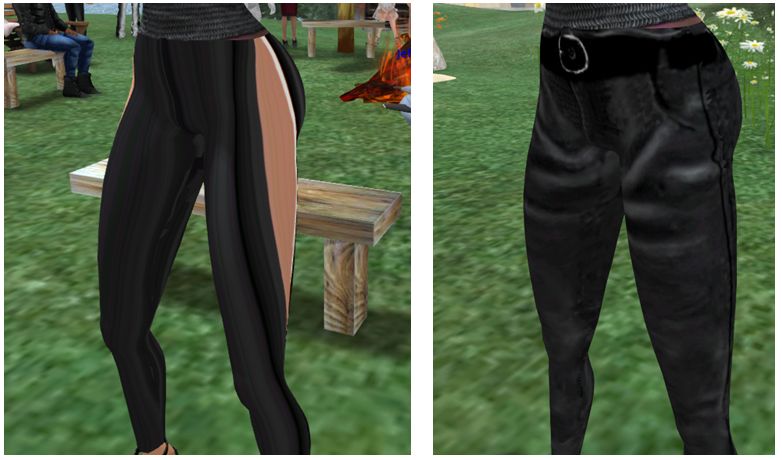
Cathy Foil has noted this glitch than can occur with Baked_Lower wearables on BOM: when editing locally in the appearance editor, the leg does not appear to be masked correctly by the wearable (which is also incomplete at the waist). Once baked, however, the wearable appears correctly applied and in full (r). Credit: Cathy Foil.
  • Some of these local edit issues may not be specific to Bakes on Mesh, but may be more noticeable as a result of BoM, and the Lab is looking to resolve them.

Animesh Follow-On – Project Muscadine

Project Summary

Currently: offer the means to change an Animesh size parameters via LSL.

Current Status

  • The simulator support on Aditi (the beta grid) – DRTSIM-421 (region Bakes on Mesh) has been updated, but there are no feature changes within it.
  • The project viewer has been merged with Bakes on Mesh (as the release viewer) and is passing through the Lab’s QA, and so should be appearing soon.

ARCTan

Project Summary

An attempt to re-evaluate object and avatar rendering costs to make them more reflective of the actual impact of rendering both. The overall aim is to try to correct some inherent negative incentives for creating optimised content (e.g. with regards to generating LOD models with mesh), and to update the calculations to reflect current resource constraints, rather than basing them on outdated constraints (e.g. graphics systems, network capabilities, etc).

Current Status

  • Work has now resumed.
  • First part of this is to continue data-gathering and look at re-aligning some figures based on the changes made for Animesh.
  • Thus far, the project primarily comprises enhanced logging to assist the Lab in data collection, allowing information on the overall cost of a specific avatar or in-world object to be gathered.
  • Once enough data has been gathered across a broader enough spectrum of content to give the Lab confidence they have a good understanding of things, then work can start on adjusting the cost calculations for rendering, etc.
  • It’s important to note that any user-viewable changes as a result of ARCTan are still some way off, and the Lab will be staging things to let users know what is happening when, and what it is likely to impact.
  • There was a lot of general conversation towards the end of the meeting on what people hope ARCTan will do (e.g. forcing creators to make proper use of avatar LODs, etc.).

Environment Enhancement Project

Project Summary

A set of environmental enhancements (e.g. the sky, sun, moon, clouds, and water settings) to be set region or parcel level, with support for up to 7 days per cycle and sky environments set by altitude. It uses a new set of inventory assets (Sky, Water, Day), and includes the ability to use custom Sun, Moon and cloud textures. The assets can be stored in inventory and traded through the Marketplace / exchanged with others, and can additionally be used in experiences.

Due to performance issues, the initial implementation of EEP will now likely not include certain atmospherics such as crepuscular rays (“God rays”).

Resources

Current Status

  • Work continues on rendering bug fixes.
  • The number of remaining issues is “trending downwards”.

Misc. Items

  • The upcoming Voice RC (or project) viewer mentioned at the last TPVD meeting still has a couple of issues preventing it from surfacing in the Alternative Viewers page.
  • The Umeshu Maintenance viewer (currently version 6.3.1.530411, merged with Bakes on Mesh) could be promoted to de facto release status as early as week #36 (commencing Monday, September 2nd), in a break from the Lab’s preferred 2-week gap between release promotions.
  • Date of next meeting: Thursday, September 12th, 2019.

Lab Gab episode 1 – a summary

Strawberry and Xiola Linden with “Gabby”the cat (name TBC) on the Lab Gab set

The first episode of Lab Gab streamed on Wednesday, August 28th, hosted by Xiola and Strawberry Linden, and drew a comfortable audience. I intentionally stayed out of the chat but saw a few familiar names there.

Running to 35 minutes, the programme was not deeply revelatory with regards to Second Life news – that will likely be for future segments of the show. However, it did offer a comfortable, if slightly frustrating start – I say frustrating because the broadcast gremlins raised their little heads to try to keep Strawberry from being heard over the stream.

The first few minutes  – up to around the 9 minute mark – of the show covered Xiola and Berry’s roles at the Lab, and folded in notes on the Lab’s various social media presences and also the Destination Guide for finding places to visit.

Bakes on Mesh (BoM) then got a plug, being the latest update from Linden Lab. Berry attempted to clear-up confusion as to what it is (simply put: a means to apply system avatar wearables to suitably prepared mesh bodies and heads in a manner somewhat akin to how they used to be used with the system avatar, albeit with the option of supporting high resolution textures than available for the system avatar).

The official blog post on the release is available here, and I attempted to cobble together a basic primer on the subject (although I suspect that in part might also veer a little too close to the technical).

In talking Bakes on Mesh, Berry underlined at that BoM will require mesh body and head creators to provide updates to their offerings that are correctly flagged to use Bakes on Mesh natively. She also noted to the experimental Omega Bakes on Mesh applier system that I also referenced in my primer article. This is available from the Omega in-world store. However, I was interested to note that it did not work for Berry  – and I actually found it less than satisfactory when testing. Overall, the results seem variable, with some having absolutely no issues with it, and others (like Berry and I) encountering problems – hence, again, why it is called “experimental”. For those who wish to try it out, step-by-step instructions, courtesy of Theresa Tennyson (who is not associated with Omega, so please don’t crowd her with questions if you do have issues!) are available here.

Additionally, Berry pointed to an alternative HUD (L$125) which apparently works just fine, although I’ve yet to try it myself.

One of the key points with Bakes on Mesh is that it should enable body / head creators to make their products less complex, simply because they do not need to include so many onion skin layers, hence why the release advantage with BoM really lies in updates to existing bodies and heads, as the various creators will hopefully make available in the coming weeks (Slink has already updated). Thus, even for those who don’t use applier systems for clothing that mush, Bakes on Mesh is important, as adoption of updated bodies / head can have the potential to help reduce general rendering load for everyone.

Around the 14:40 mark, Xiola indirectly replied to some speculation on my part (raised when writing about Lab Gab ahead of the show), when I wondered:

I also admit to being curious as to whether the show might at some point down the road – depending on its longevity – also occasionally “hop over the fence” into Sansar or even perhaps take some “behind the scenes” (desires for things like privacy allowing among staff) looks at the Lab itself. “Lab Gab” seems to be too broad a title to remain purely about Second Life (although there is a lot to explore on that subject alone), even allowing for it being intentioned as a “catchy” name for the show.

By way of “reply” (I’m not sure Xiola’s comment was driven as a result of my speculation or not) Xiola noted:

I know the name of our new show here is “Lab Gab” – we just really likes how that sounded … but currently, short-term, our plans are to definitely focus on Second Life, although obviously we work for Linden Lab and Linden Lab also has Sansar … but the focus of this show is, initially and short-term, Second Life and the Second Life Community.

After some general chit-chat around giveaways, the show turns to a mini Q&A session from around the 19:15 mark, some of which are summarised below:

  • Linden Lab is currently working on an communications / companion app for iOS
  • When are last names coming back?
    • Still being worked on, have a lot of variables involved in terms of back-end systems and complexity.
    • Again, those interested can catch the last formal update I have (including comments from Oz Linden) in the First and last names section of my coverage of Oz’s appearance at SL16B with April Linden in June 2019. This also addresses a number of questions on the topic.
  • Linden Homes:
    • There is now a weekly roll-out programme (Mondays, Wednesday, Fridays) when homes are made available through the Linden Homes web page.
    • New types and styles of Linden Homes are still in the works, but no release dates.
    • Best way to stay up-to-date is to keep an eye on the official blogs and on the Linden Homes update thread on the forums.
  • Will Lab Gab include interviews with Lab staff? – Yes.
  • Upcoming major updates:
    • Bakes on Mesh is now out, per above.
    • The Environment Enhancement project (EEP) is progressing towards release – but no definite time frame other than Soon™ as bugs are being stomped on.
    • Not directly mentioned in the show is the new Animesh enhancements work (Project Muscadine) and also back on the horizon is the restarting ARCTan (two name but two of the more user-facing projects – there is also a lot of under-the-hood work going on).
    • Details on projects like this can be found in my (generally) weekly Content Creation User Group meeting summaries and also my other SL tech summaries.

An interesting start to the series, nicely relaxed, and a segment where the voice issues didn’t spoil things too much. Some nice teasers were dropped on future shows and direction which suggest Lab Gab will be a good option for tuning into every couple of weeks. In the meantime, you can catch the entire first show below.