Now open at Club LA and Gallery, curated by Wintergeist are two very contrasting exhibitions of art; the first in 2D and the other in 3D. Both will remain open through into the new year, and make for an interesting demonstration of art and creativity in Second Life.
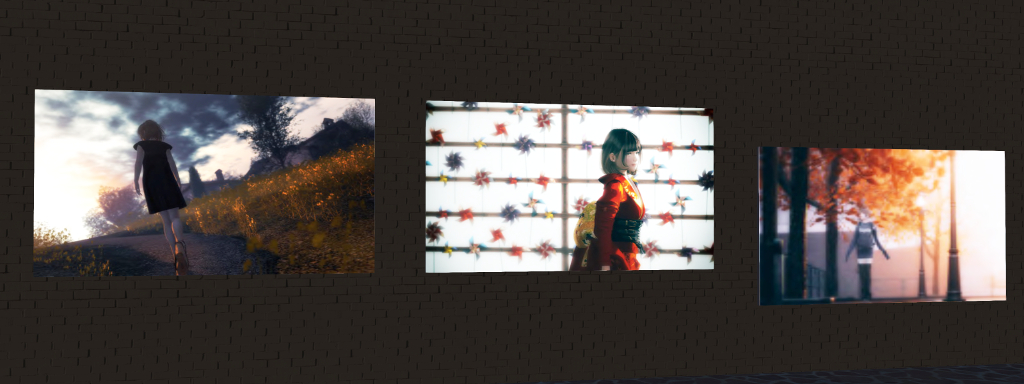
The 2D art is presented by Reesla Chau, a Second Life photographer from Japan, who offers a portfolio of 16 avatar portraits focused on her own avatar in various locations around the grid. It’s a fascinating series of images richly showcasing Reesla’s eye for creating a scene and her use of angle and soft focus / depth of field.
Club LA and Gallery: Reesla Chau
In terms of the latter, I’d particularly draw attention to Summer Visit, on the wall immediately to the left on entering her exhibition space. But for one or two giveaways around the trees and leaves. it could so easily have been taken in a park in the physical world. Way Back is similarly engrossing due the the sheer realism folded within it.
Others in the series offer a digital take on classical portraiture-as-paintings – notably Windmill, The Moonlit Night and Country Road During Summer Vacation, the latter two of which again demonstrate Reesla’s marvellous use of depth of field. However, what is most engaging about Reesla’s work is her ability to tell a story with her photographs; every one of the 16 here whispers and entire story to those who stand before them.
Club LA and Gallery: Reesla Chau
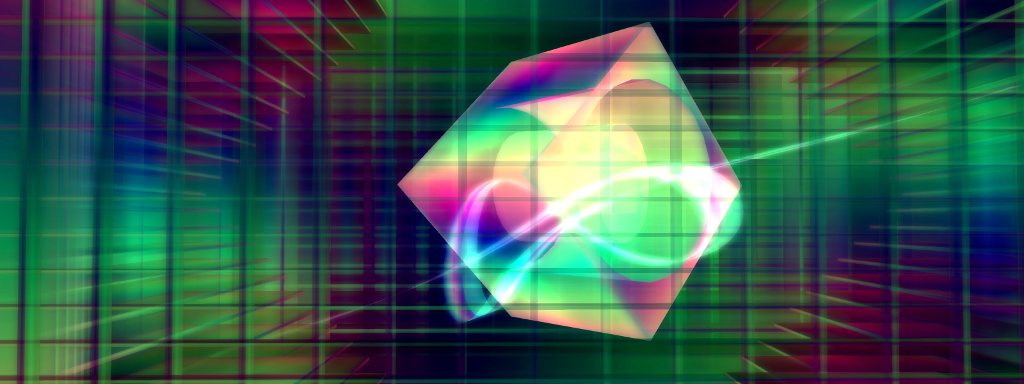
The 3D art is presented by Moki Yuitza is entitled Rainbow Flakes. It’s a piece best seen with the viewer set to midday, rather than the region’s default time, and with local sounds enabled in order to hear the specially composed music by Daddio Dow.
Describing this piece isn’t easy; perhaps the best means of doing so is to refer to it as a coloured mobile of geometric forms set within a rainbow grid and turning slowly, it’s motion seemingly driven by the the gentle tones and vibrations of the music.
Club LA and Gallery: Moki Yuitza
It’s a fascinating piece, potentially hypnotic in form, colour and tone, and should be seen equally from both inside and outside of the surrounding grid in order to be full appreciated. However, fully quantifying it is something that’s very much an individual task. If not a mobile, I’d personally view Rainbow Flakes as a living kaleidoscope, free to change form and colour at will.
Tonarino, December 2019 – click any image for full size
Shawn dropped a landmark for Tonarino, a Full region with a distinctly Japanese look and feel. A group design, the region is split into five major parts – not all of which are open to the public. To the south is a square block of a flat island, topped by scrub grass and what appears to be a café, while off to the west are three more fairly regularly shaped islands in a north-to-south line.
The majority of the region, however is given over to a large landmass the rises from east to west, and is home to a small semi-urban setting that sits at the end of a single line of railway track. A wooden bridge connects the little town with southern islands, and on crossing it, I found no evidence that the island and it’s café are not open to the public.
Tonarino, December 2019
However, given that the westward islands are separated from the main landmass both physically and by the fact the lay of the land largely hides them from view, they would seem to be collectively for private use. Certainly, the middle of the three islands – and the only one that offers a landing point for those making use of the pedal boats available from the western shore of the town – is restricted to Group access only. Given that the north and south islands either side of it are only connected to it and are without any obvious at which to come ashore for those using the pedal boats, there is the suggestion that they are also private. Either way, I opted not to risk trespass.
The eastern side of the main landmass offers a mix of buildings from cement blockhouses with shops on the lower floor to little apartments on the floor above to stores and eateries modelled along more “traditional” lines all split into little groups by a small grid of roads and by the railway line. Sitting among them is space to grow vegetables an fruit although part of this ground is apparently lying fallow under the snow. To the west, between the hills, the ubiquitous school blockhouse that is often found within regions with a modern Japanese theme, squats as it overlooks the pedal boat moorings mentioned above.
Tonarino, December 2019
The railway line terminates with a station that’s little more than a waiting room with a bus stop neighbouring. On the other side of the track the land that is being cleared for building. A stream tumbles from the hill to the south-west to run parallel with the train line as it emerges from a tunnel under the hill before it eventually turns inland to cross the stream via a trestle bridge. Stone steps also climb the hill to overlook the waterfall and to provide access to a small cemetery.
To the north-east another craggy hill rises, stone steps cut into its face. It is home to the solid presence of an old temple sitting within a small garden, a little refreshment stand lurking just outside the gardens for those feeling hungry after a climb up the steps or a time of prayer in the temple. A (large) step down from this on an out-thrust shoulder of rock is an traditional Japanese walled house. Reached via separate steps, this appears to be linked to the spaces for growing fruit and vegetables, suggesting they may be owned or managed by whoever lives within the house.
Tonarino, December 2019
Looking careworn and a little tired under its light covering of snow, the setting at Tonarino has a very lived-in feel that offers scope for photographers looking for backdrops for avatar studies or who enjoy landscapes that feature buildings and urban / suburban settings. Places to sit may be few and parts of the region off-limits to most, but these don’t detract from any appreciation of the Tonarino.
The Dickens Project 2019: the Museum of Dickens Projects Past, the Dickens Library and the Listening Room
It’s time to highlight another week of storytelling in Voice by the staff and volunteers at the Seanchai Library. As always, all times SLT, and this week’s events are all held at The Dickens Project, where Monday through Friday form Carol Week, in which the entire tale of A Christmas Carol is told over successive days at times suitable for most audiences.. What’s more, this year presents a special additional presentation of two parts of the tale featuring a very special guest!
Sunday, December 15th
11:30 – Wald Schridde, Live from Dickens Square: Wald plays a selection of folks songs and music from the British Isles that could have been familiar to those in Dickens’ time.
13:00 – Tea-time with Charles Dickens in Dickens Square: VT Torvalar, Da5id Abbot, and Caledonia Skytower present selections from Little Dorrit, Oliver Twist and the short story The Poor Relation.
14:00-16:00 Fantasy Faire Radio Presents Rock from Dickens Square: DJ Elrik Merlin spins classic rock-n-roll from both sides of the Atlantic.
Carol Week, December 16th-20th
Monday, December 16th – Stave One: Marley’s Ghost:
14:00: VT Torvalar, Da5id Abbot, and Caledonia Skytower.
19:00: Aoife Lorefield, Corwyn Allen, and Kayden Oconnell.
Tuesday, December 17th –Stave Two – The First of Three Spirits:
14:00: Dubhna Rhiadra, Corwyn Allen, and Faerie Maven-Pralou.
19:00: Corwyn Allen, Gloriana Maertens, and Caledonia Skytower.
Wednesday, December 18th: Stave Three – The Second of Three Spirits:
14:00: Aoife Lorefield, Da5id Abbot, and Dubhna Rhiadra.
19:00: Kayden Oconnell, Gloriana Maertens, and Caledonia Skytower.
Thursday, December 19th: Staves Four & Five – The Last of the Spirits & The End of It:
14:00: Aoife Lorefield, Da5id Abbot, and Dubhna Rhiadra.
15:00: Kayden Oconnell, Gloriana Maertens, and Caledonia Skytower.
Friday, December 20th: Special Encore of The Last of the Spirits & The End of It:
12:45: the WOOTMAS cheer of the Raglan Shire Carollers.
13:00: Aoife Lorefield, Caledonia Skytower, and special guest Patch Linden.
18:30: Misfit Dance & Performance Arts SL present A Very Misfit Christmas.
Saturday, December 21st
10:00: The Community Virtual Library hosts a Resource Centre tour for The Science Circle.
11:00: Misfit Dance & Performance Arts SL present A Very Misfit Christmas.
13:45: The WOOTMAS cheer of the Raglan Shire Carollers at the Opera House.
14:00-16:00: Fezziwig’s Ball at the Opera House with DJ Dano Bookmite.
Sunday, December 22nd
11:00: Wald Schridde Live at The Dickens Project.
12:00-15:30 – THE BIG READ – all five staves of A Christmas Carol in a single sitting!
Please check with the Seanchai Library’s blog for updates and for additions or changes to the week’s schedule.
The following notes are taken from the TPV Developer meeting held on December 13th, 2019. A video of the meeting is embedded below, my thanks to Pantera for recording and providing it. As always:
Time stamps are given with links that will open the video at the appropriate point in a separate browser tab for reference.
Core points of the meeting are listed below. Other subjects of lesser import may have been discussed, please refer to the video.
SL Viewer News
Note: the comments below also include updates given at the Content Creation User Group meeting of December 12th.
Copy / Paste viewer project vewer updated to version 6.3.5.533365 on December 9th.
The Wassail RC viewer, version 6.3.5.533275, was promoted to de-facto release status on Thursday, December 12th. This was likely the last viewer promotion to release status for 2019.
The rest of the current viewer pipelines remain as follows:
Release channel cohorts:
EEP RC viewer, version 6.4.0.532771, dated November 20th.
Project viewers:
Copy / Paste viewer, version 6.3.5.533365, dated December 9th.
Legacy Profiles viewer, version 6.3.2.530836, dated September 17th. Covers the re-integration of Viewer Profiles.
Project Muscadine (Animesh follow-on) project viewer, version 6.4.0.530473, dated September 11th.
360 Snapshot project viewer, version 6.2.4.529111, dated July 16th.
General Viewer Notes
It is thought the Legacy Profiles viewer could be next in line for promotion to defacto release status. However, this viewer is still awaiting the release of an update that integrates the profile feed into the viewer.
There are reportedly multiple issues with the Copy / Paste project viewer, some of which are UI related – no specific bug report reference to relay here at present, though.
In addition, and awaiting surfacing / further work internally, are further Maintenance viewers and improvements to the mesh uploader.
Bitbucket, used to manage viewer repositories) will be sunsetting support for Mercurial in early 2020. Because of this, Linden Lab has now started migrating their viewer repositories from Mercurial to Git on Bitbucket.
This means the pace of viewer updates might slow down while this work is in progress.
A document outlining the steps in migration has been provided specifically for TPVs to allow them to keep in sync with how LL main the viewer code and its branches. See: Viewer Repository Migration (Google Docs).
This is not the only way for TPVs to manage their own repositories, but it is the one that LL recommend for those wishing to reflect how LL manages things.
[36:48-41:15] Thus far, the Lab have not run into problems in making the migration. It was also pointed out that:
There are a number of cheat sheets out on the web for TPVs and self-compilers to make / understand the switch from Mercurial to Git.
There will be fewer repositories used by LL for the viewer, as Git provides better support for branching and better matches the LL build process.
Two viewer updates that will be surfacing in 2020 are Name Changes and Premium Plus.
With regards to Name Changes, TPVs many what to consider migrating people’s settings and chat histories when they change their names, as all of this information is stored in a local folder / directory based on the avatar name.
This could take the form of switching to using the avatar key UUID, although this isn’t necessarily user-friendly when looking at log files, etc.
Windows 7 officially reaches its end of life on January 14th, 2020. After this date, patches and security updates, etc., will no longer be provided, and the company is unlikely to provide any support.
As a result of this, it is very Linden Lab will cease officially supporting Windows 7 after that date. While users will still be able to log-in to Second Life on PCs running Windows 7:
They will not receive assistance from LL support should they encounter problems.
Viewer updates from the Lab will no longer be tested against Windows 7 prior to release.
Bugs reported against Windows 7 that cannot be reproduced using Windows 8 or Windows 10 will not be investigated.
Around 12% of SL users are running Windows 7, and this applies to them.
Obviously, given Microsoft is ending Windows 7, the recommendation is for users to upgrade to Windows 10.
The 2019 end-of year No Change window is from Friday, December 20th 2019 through Thursday, January 2nd 2020. During this time there will be no simulator or official viewer updates, and TPVs are asked also not to make releases during this period in case they accidentally cause support or operational issues for LL.
In Brief
[7:15-9:02] The updates to the viewer build process (to support Visual Studio 2017 and Xcode 10.3) are in a bug hunting mode at the moment, and so will see light of day in early 2020.
It is possible that work on updating to VS 2019 might commence later in 2020.
[9:07-11:23] One of the projects awaiting the deployment of the new build process is updates to the Chrome Embedded Framework (CEF) responsible for handling media in the viewer. It is hoped that when these updates can be provided within the viewer they will help with media support playback and eliminate at least some problems.
These updates should help with MP4 playback as more codecs are being added – although again, MP4 is a container with flavours rather than a specific format, so all flavours may not play back equally.
[12:08-19:00] Discussion on Bugsplat, the crash reporting tool. This is probably outside the interest of most users, so is not listed below – please refer to the video.
[22:40-24:00] Discussion on a Firestorm OpenSim release. Again, this probably not relevant to the majority of readers of the blog (and I’ll be covering it separately as and when it appears anyway), so again – please refer to the video.
[32:04-32:40] BUG-227179 – All off-line inventory offers from scripted objects are STILL lost: this bug is still awaiting work.
Itakos Project – Overlapping Realities: On Mars You Only See What You Wanna See! by Jean Toussaint Tosi
I’ve long been a supporter of the use of Second Life as a medium for artists to present their physical world art to audiences they might otherwise not be able to meet. While there are other means for 2D artists in particular to be able to present their work – their own websites and photo-sharing platforms such as Flickr / Smug Mug, for example – Second Life presents something of a unique opportunity to allow an audience to experience more of a uniquely “personal” involvement when witnessing physical world art and photography in-world.
Hence why I was drawn to Overlapping Realities, at The Itakos Project, an exhibition featuring the work of Jean Toussaint Tosi, a Corsican born, Paris residing photo artist. As well as providing the mean to witness Tosi’s work, the exhibition marks the start of a new series of exhibitions at Itakos Project, one that adds a unique flavour to physical work art being shown through Second Life, as gallery founder and creator Akim Alonzo explains:
With Overlapping Realities the Itakos Art Gallery inaugurates a new experience and exhibition concept: to show works by artists who have no presence in the Second life virtual world.
The Itakos Project – Overlapping Realities: Vision #12 by Jean Toussaint Tosi
As Akim goes on to note, while Tosi is an artist with no virtual presence in Second Life, thus very much making his work as fitting the aim of this new series of exhibitions, his photography carries with it a cinematic look as feel that is both rich in presence and style, it can also be surrealistic in look and tone. In doing so, it can be said to both reflect the richness, depth, and sometime surreal nature in having a virtual life, and so becomes a fitting bridge between SL and the aims of the exhibitions it inaugurates.
Offered in monochrome, these prints are quite marvellous in scope, forming sweeping panoramas rich in story. Some have a dark or coy sense of humour about them, while the surrealism can clearly be evidenced in pieces like On Mars You Only See What You Wanna See! (seen at the top of this article). Nor is that all; in places, Tosi’s photography offers commentary on life (She’s Waiting on the lower floor of the gallery hall and shown below) and / or issues such as the climate (Waves, aka Vision #7).
Itakos Project – Overlapping Realities: She’s Waiting by Jean Toussaint Tosi
I am above all, a serious humorist photographer. Just a dreamer who loves all kind of pictures! I’m never satisfied but I always try to do the best I can. Many thanks to all the dreamers who follow me!
– Jean Toussaint Tosi, describing his work
Drawing on elements of fashion, fantasy, science fiction and Hollywood, coloured – despite their monochrome nature of the pieces in this exhibit – with Tosi’s vision and outlook, Overlapping Realities is a marvellous exhibition in its own right and serves as an excellent introduction to his art as a whole; each of the images here link directly to his Flickr stream for those wishing to see them in full and explore the rest of his work.
Itakos Project – Overlapping Realities: Vision #6, by Jean Toussaint Tosi
An official opening for Overlapping Realities will be held on Saturday, December 14th, 2019 starting at 13:30 SLT.
We last visited On The Other Side in February 2019, when the region – designed by xxMichelle20xx and Indrielx – was all set for spring (see: Back On The Other Side in Second Life). But given it does change with the seasons, we decided to go and see what the winter months might have brought forth – and it turns out that the region has been transformed into a marvellous rural winter wonderland.
Surrounded by a range of mountains, On The Other Side forms a little coastal area or island setting, watched over by a red brick lighthouse and within which the buildings are few and far between, the majority of the landscape being a haven for assorted wildlife. Even so, there are some echoes of past designs to be found, some of which might be easy to spot by returning visitors, while others might require a little searching out.
On The Other Side, December 2019
As with past designs, the landing point is underground – in this case a wintry cavern decorated as a (perhaps chilly) reading room. From here the way out into the region gets a trifle foreboding – a drop down to a lower cave via ladder brings visitors to the remains of five unfortunates lying in the snow and a ghostly figure, palms aflame, apparently pressed against the frosted exit to the cave. Step through this into the region proper, and then next surprise awaits: a large bear, angrily rearing up on his hind legs at you.
While all this sounds menacing, once you’re past the bear (who is actually quite harmless, giving rise to the temptation to comment “Why, Paddington! What big teeth you’ve got!” when passing him), you’ll find yourself in a marvellous winter landscape where admirable restraint has been shown in putting out falling snow (often a performance killer) and which keeps itself predominantly as a landscape in winter, rather than a frame for all the usual seasonal trappings for the end of December.
On The Other Side, December 2019
Most of the region looks open to the public, although there is a high table of rock to the south-east topped by a small cabin that might well be private: there is no obvious path up to this, and we weren’t going to start forcing our way up the one obvious slope to reach it for fear of trespass were it to prove to be so.
The cabin looks out across a gently curving bay, its sand dusted in snow, to where that lighthouse rises from the north-eastern headland. Both cabin and lighthouse have a little comic reflection of Santa on roof and chimney, while the lighthouse is open to the public as the region’s Christmas hang out.
On The Other Side, December 2019
But it is the lands between and to the west of these headlands that holds the attractions of the region. Marked by rocky uplands with snowy trails winding around and between them, and in places marked by paths and steps climbing their slopes, the region here feels more expansive than its 65,536 sq metres. This is a landscape blanketed in snow and home to a mix of fir trees and naked oak, birch and maple, their trunks an boughs well whitened with hoarfrost.
Across the setting there is much to be found, with the animal life mixing domesticated cows and sheep with horses, wildfowl, deer, reindeer, wolves, seals, penguins, raccoons, otters, jaguars, pandas – even a giant turtle!. Most of these form scenes-within-scenes across the region, awaiting discovery and photographs, gathered together in a little vignette that stands both on its own and as a natural part of the whole. More are set out quite naturally – although the pandas clearly have the right idea for dealing with the cold!
On The Side Side, December 2019
Everywhere across the region, from the southern seal cove to the northern cave (home to Ganesh, who has also featured in past iterations of the region) are places to sit and spend time. These range from chairs set out on decks or along the eastern beach (which offers surfing for those feeling like they need a cold dip!), to a cosy huts and blanket-laden carts and sleighs people and huddle and cuddle within to keep warm. For those wanting to escape the snow and cold, a barn and the Christmas Hangout offer more places to sit and enjoy the warmth of a fire (we were also appreciative of the hot cider as we explored!).
Previous versions of On The Other Side have included more eclectic elements to them, aspects that offer a little twist of fantasy. This is also this case with this build: anchored to the ground by a stout rope and held aloft by magical runes circling below it, floats a tiny island. Reached by climbing the rope, it offers another place to sit – and quite the high point to view the region as a whole; however, getting back to ground level in head-first descent can be a little dizzying!
On The Other Side, December 2019
Beautifully designed, accompanied by an ideal sound scape and filled with detail, On The Other Side once again offers a delightful, highly photogenic region that should not be missed.