Wandering Poughkeepsie in Second Life

Poughkeepsie, September 2020 – click any image for full size

Poughkeepsie is a parcel covering just under a quarter of a Full region which has the bonus LI capacity applied, that was recently highlighted in the Destination Guide, prompting me to hop over and take a look.

Held and in part designed by Peresphone Kore (LeriaDraven) – Loly Hallison performed a lot of the general landscaping -, the parcel has an interesting description and greeting, reading in turn (via About Land and a sign post at the landing point):

An amazingly whimsical photography sim with plenty to see and do. From date night, chilling by the fire, relaxing in the library, or taking on a game in the arcade (yes the games really work!) This is all my own creation and I’m super excited for this!
Warning. You are about to enter someone else’s dream.
Poughkeepsie, September 2020

Both the description and the sign present a huge promise, and visually, the parcel does deliver on this promise. Located in the north-west of the region, it offers a north-facing beach cupped between a curtain wall of rock that runs diagonally across the back of the parcel from east to south-west, and an upland area. The curtain of cliffs neatly separates Poughkeepsie, with the western table plateau overlooking the north beach and the lowlands running back from it to the feet of the cliffs.

Topped to a large house, the rocky plateau falls directly to the sea to the west, but also hides a low-lying corner of the parcel in which sits a second house complete with a west-facing beach of its own, both screened by giant oaks. This house, and the one top the plateau appear open to the public, with the latter reached by curving stone steps rising from the landing point, the former by following a winding path that curls around the base of the rocky table. This second house, sitting within its screen of giant oaks has something of a Halloween feel in the grounds on its landward side, whilst the shingle beach on its waterside offers the opportunity for a game of chess.

Poughkeepsie, September 2020

Each of the houses is fully furnished, offering multiple rooms to explore, while the house on the plateau additionally offers a rock-and-wood terrace / deck for outdoor seating and an outbuilding that looks like a greenhouse converted for use as a little café. A barn and field, home to cattle and sheep may at first give the impression this is a working farm. However, given the expansive nature of the house, and the small number of animals, it’s hard not to wonder if the latter are more a hobby for the owners, rather than a working source of income.

The lowlands of the parcel offer their own attractions. There’s the sandy, north-side beach, with multiple places to sit and a view of an off-shore (and off-region, although it doesn’t appear to be phantom / without physics) fairy-tale castle. On the grass behind the beach is a little open market area offering fresh fruit and veg, with a seating area ranged before it, complete with cakes, toffee apples and drinks available to visitors. It again suggests that maybe the house up on the plateau is might be a working farm – but equally, it also stands as a vignette on its own.

Poughkeepsie, September 2020

Also to be found in the lowlands are ruins, a folly and the unexpected – an old British red telephone box – as well a sculptures and a fair amount of local wild life. There’s even a touch of Tolkien waiting to be found, although saying Mellon before it as instructed by the runes didn’t result in the expected (and by “saying Mellon” I do mean touching it to see if anything happened, given its scripted nature).

Photogenic, rich in detail and with much to see, Poughkeepsie makes for a rewarding visit – but I say so with a caveat: a visit does come with something of a performance hit. How much of this is down to what is in the parcel itself, and how much is down to what’s in the region as a whole, is hard to say (some of the sculptie giant oaks in the parcel do have high render costs). I found my system peaked a 7 fps with shadows enabled at a moderate draw distance, mostly hovering at 4-5 fps. Disabling shadows raised this to the mid-teens., although even this could drop into single-digits – so be prepared to make adjustments if you’re on  a mid-range system and are used to having things like shadows on all the time.

Poughkeepsie, September 2020

Nevertheless, Poughkeepsie offers a rewarding visit for those willing to make any necessary adjustments.

SLurl Details

2020 SL project updates week #38: TPVD summary

Winter Moon, July 2020 – blog post

The following notes are taken from the TPV Developer meeting held on Friday, September 18th, 2020. These meetings are generally held every other week, unless otherwise noted in any given summary. The embedded video is provided to Pantera – my thanks to her for recording and providing it. Time stamps are included with the notes will open the video at the point(s) where a specific topic is discussed. Note these summaries are not intended to be a full reporting on all topics discussed, but focus on those items that are more directly user-facing.

The second half of this meeting was fairly text intensive, covering things like the water performance impact on EEP, together with subjects that are unlikely to become Lab projects / activities in the near future.

SL Viewer News

[3:41-6:49]

The Bormotukha Maintenance RC viewer updated to version 6.4.8.548890 on September 18th.

The remaining official viewer pipelines were unchanged through the week, leaving them as follows:

  • Current release viewer version 6.4.7.546539, dated August 11, promoted August 17, formerly the Arrack Maintenance RC viewer – No Change.
  • Release channel cohorts:
  • Project viewers:
    • Project Jelly project viewer (Jellydoll updates), version 6.4.8.547487, issued August 26.
    • Custom Key Mappings project viewer, version 6.4.5.544079, June 30.
    • Copy / Paste viewer, version 6.3.5.533365, December 9, 2019.
    • Project Muscadine (Animesh follow-on) project viewer, version 6.4.0.532999, November 22, 2019.
    • Legacy Profiles viewer, version 6.3.2.530836, September 17, 2019. Covers the re-integration of Viewer Profiles.
    • 360 Snapshot project viewer, version 6.2.4.529111, July 16, 2019.

General Viewer Notes

  • It is likely the Bormotukha Maintenance RC will be promoted to de facto release status in week #39 after being delayed for further updates.
  • It is possible that the Mesh Uploader RC may be promoted to release status in a shorter period than the usual 2 weeks between release promotions (so possibly in week #40), as it is also in “good shape” for promotion.
  • As  noted in my previous CCUG summary, there is now only one significant EEP-related fix the Lab would like to clear (related to alphas in local edit mode) prior to promoting the Love Me Render (LMR) RC to release status, so this again could be ready to be lined-up for promotion to release status in the very near future – although the next update to this viewer will still be an RC version.
  • The Legacy Profiles viewer is still awaiting a back-end update to the feeds, which may be being worked on.

Aditi Cloud Testing

[0:13-3:00 and 9:05-13:00]

On September 15th, Linden Lab published a blog post asking users to log-on to Aditi, the beta grid, and play linden Realms there to help with testing region performance on  simulators running in the cloud (see:  We Need Your Help Testing Performance on Uplifted Simulator and also Play Linden Realms in the cloud and help the Lab).

However, these are not the only regions on Aditi operating via AWS cloud services: there are also a number of test regions that have been set-up, comprising (at the time of writing):

  • All of the Blake Sea regions on Aditi.
  • Cloud Sandboxes 1-4.
  • Ahern, Mauve, Morris.
  • The Testylvania Sandbox (restricted access).

At the start of the meeting, Oz Linden requested TPV developers (and possibly by extensions script creators) use the likes of the sandbox regions to test performance and general operations to help in the overall testing of simulator and simulator / viewer performance with regions running in the cloud and help identify configuration or other changes that may be required. Those testing the regions should be prepared to note any unexpected / unusual behaviours, unexpected outcomes, etc., and be prepared to file with with Linden Lab via Jira.

The Lab is making “very, very good progress” on ensuring simulators and regions are able to run within the AWS environment (there are also a number of Linden-only regions on Agni now running in the cloud), and this testing is seen as a key aspect of building confidence to start transitioning further regions on Agni to AWS and allowing people to test them. However, there is already a list of issues the Lab wants to deal with before this happens, and the above testing may add to this.

The focus is (as has oft been stated) on getting the simulator code to a state where it can be uplifted relatively smoothly and dealing with issues arising from uplift tests (such as with HTTP messaging), rather than dealing with bug fixes (unless they are particularly troublesome), and / or implementing features.

In  Brief

  • [10:05-13:49, as a part of the Uplift discussion] Bug BUG-202943 “Group notice text is truncated by the simulator”: this is a somewhat complicated issue to initially grasp, but is clearly explained in Kitty Barnett’s comment on the bug report. This is of concern to the Lab, but due to the uplift work, a fix may not be immediately forthcoming.
  • [13:50-18:35 with further discussion in text beyond]  The in-viewer log-in cookie issue (non-public BUG-226643) referred to in my previous TPV Developer meeting summary  (see the In Brief section) has been looked at and may not require a server-side change to rectify, and is flagged as a web issue. However, it’s not clear on where it sits in the list of priorities.


All4Art at IMAGOLand in Second Life

All4Art, IMAGOLand, September 2020: Mareea Farrasco

Recently renewed and reformed, the All4Art Project, managed by Carelyna Resident, opened its latest ensemble exhibition at IMAGOLand, on September 17th, 2020. It features the work of Sandi Benelli, Leonorah Beverly, Carey Chenault, Carisa Franizzi, Rose Hanry, Black Rose and Carelyna, together with Mareea Farrasco, who is also providing the setting for the exhibition on her IMAGO Land.

Described as being attached Mareea’s IMAGO Galleries, IMAGO Land is described as “an open area for visitors who love to explore or simply relax and for landscape photographers. Conceived as small islands, the different spots have different destinations: a park, a fishers village, a vacation resort, a beach, a country home with its yard, a bar and a dance floor, etc. As such, the location is perfect for the art on display, given the emphasis throughout on natural and natural – particularly coastal – settings.

All4Art Project, IMAGOLand, September 2020: Carey Chenault

The landing point for the exhibition sits within what might be called the social / events area of this half-region design, located on one of the larger islands in the the group that includes the dance floor and an old barn converted into a simple bar area. From here, three wooden board walks offer a choice of routes around the rest of the setting – which you take is entirely up to you, as the art is spread out around the various islands awaiting discovery as one explores.

Most of the artists participating in the exhibition are well known in these pages, and seeing them all together offers a delightfully complementary and also contrasting selection of images. Each artist has provided 5 images for the exhibition with some presenting their work on both sides of each canvas, simply because the layout of the island means their work can be seen / approached from either side.

All4Art Project, IMAGOLand, September 2020: Carisa Franizzi

With the exception of Black Rose, who provides a set of stunning original paintings, all of the images presented have been captured in Second Life. With a similar exception of Carisa Franizzi, who offers five black and white images that can quite capture the eye, all are presented in colour, from the soft tones of images post-processed to give a watercolour look and feel, to the vibrant hues and tones of Autumn and and bright hues of summer cast through an oil painting like finish.

Together, all of the images presented through this exhibition help remind us that beyond the walls of self-isolation and the constraints of social distancing and limited travel opportunities, there is still a rich and vibrant world around us. A world, one might be tempted to say, that is doing rather well because of our enforced absence – but will nevertheless be waiting to greet our return when times are such that we can once again roam freely and appreciate all of nature’s delights.  Further, many of the places presented in these images remind us, however subliminally, that humans and nature can get along side-by-side.

All4Art Project, IMAGOLand, September 2020: Black Rose

SLurl Details

2020 Content Creation User Group week #38 summary

Glitch Social, July 2020 – blog post

The following notes were taken from my audio recording and chat log of the Content Creation User Group (CCUG) meeting held on Thursday, September 17th 2020 at 13:00 SLT. These meetings are chaired by Vir Linden, and agenda notes, meeting SLurl, etc, are are available on the Content Creation User Group wiki page.

EEP Fixes

There is now only one major EEP issue out of the current batch that has been undergoing work that remains unresolved, and it is being worked on. This means the current Love Me Render (LMR) RC viewer (version 6.4.8.547427 at the time of writing) is close to being ready for update and promotion – although it is likely the current Bormotukha Maintenance RC viewer (version 6.4.8.548394) will be the next viewer to be promoted to de facto release status.

Project Jelly  – Jelly Dolls Improvements

  • Vir’s work in updating Jelly Dolls is now available in the Project Jelly viewer, version 6.4.8.547487 at the time of writing).
  • A number of bug reports have been filed on this, and fixes are currently with QA, so the hope is the project viewer will be updated “fairly soon”.

Mesh Uploader

  • It is likely the Mesh Uploader RC, version 6.4.8.548061 at the time of writing) will move towards release more-or-less as it is now, rather than being held over for significant updates.
  • There have been concerns over the design of the new tabs within the updated uploader and how discoverable some of the added controls really are.  However, the consensus opinion at the lab is to leave things as is, and if there prove to be significant UI issues with the updated uploader, to deal with them in a future update.
  • Things like the ability to specify pivot points within a mesh (e.g. for hinging doors, etc., rather than having the pivot point aligned through the centre of the object), requires simulator-side support, and so this won’t be dealt with until after the cloud uplift work has been completed.
  • So, as it stands, it is felt the Mesh Uploader RC is also in line for possible promotion alongside the Maintenance RC.

Bakes On Mesh

While Bakes of Mesh has seen the introduction of BoM clothing to a degree, the take-up has perhaps not been as widespread as might be the case, with some body / head makers yet to fully embrace it.  Two of the most commonly-cited reasons for this are:

  • Lack of full specular / normal map support (something that would require a further large-scale overhaul of the avatar Bake Service, so not easy to implement at this point in time).
  • The problem of established user behaviour and an unwillingness to change from that behaviour, It is claimed that people have become used to mesh bodies having multiple alpha cuts (which add to their complexity) and being able to “hide” specific parts of the body at will via a HUD-based, scripted system, and are unwilling to switch to the direct use of alphas, which need to be located and applied manually.
    • Some mesh clothing designers do actually provide a means to “auto hide” parts of a mesh body when their clothing is worn, but they appear to be in a minority of mesh clothing makers.

Cathy foil has been brainstorming how both of these issues might be resolved without the need to necessarily dramatically overhaul the Bake Service in the case of specular and normal maps, and so as to allow the easier application of alpha textures to mesh bodies that would enable more fluid “hiding” of body parts when wearing mesh items or BOM layers. Her solution is to both increase the number of alpha channels available for use with mesh bodies (which would not impact the Bake Service) and Linden Lab “borrowing” from RLV / RLVa to allow a HUD to be used to  apply clothing / alphas to a body directly from inventory, as she explains in the video below.

The alpha solution offered is perhaps not entirely ideal (what about alpha conflicts when mixing / matching clothing from different makers?), and it might be argued that – insofar as the use of the Outfits folder + the WEAR + ADD options for general folder use, that the wearing / applying alphas may not be as significant an issue as might seem to be the case – but again, this can depend on the user behaviour / the clothing itself and how it is worn.  Any “official” adopt of RLV capabilities, even if restricted to just your own avatar, would also seem to be questionable in terms of adoption by LL (if nothing else, the code would need to be contributed).

However, as there was little time at the meeting to go through the video thoroughly, this is a subject that is liable to be further discussed at future meetings – although for any work to proceed from it (or in relation to BOM in general), a feature request Jira will be required.

In Brief

  • There was an extensive (and theoretical, at this point), discussion on mesh bounding boxes (e.g. allowing different sized bounding boxes – with certain constraints – per LOD). However, I’ll save further reporting on this until there is a feature request Jira to which I can refer readers (hopefully by the next CCUG).
  • Vir asked a general question on whether people would like to seen the animation uploader receive and update pass, and if so, what they would specifically like to see.
    • Suggestions included:
      • Improvements to the preview panel for better tracking of offsets.
      • Running .ANIM files through the uploader (as long as this is not made compulsory, as some animators prefer not to use the uploader).
      • Suggestions focused more on being able to either edit uploaded animations or to use the uploader as a means of exporting your own animations to make change.
    • The conversation also encompassed animation priorities, and the ability to either change them or constrain them better. As priorities can be baked into a mesh, Vir suggested rather than a greater ability to edit and change priorities might be to have them set at runtime, rather than being an object attribute.
    • General feedback on animation improvements included the ability to made adjustments to animation speed on the fly, better pre-loading of animations in a sequence, etc.
    • Jiras on specific features / improvements have been requested to help determine what might need to be done, what the scope of work might be, etc., to help determine feasibility.
  • Date of next meeting: Thursday, October 1st, unless otherwise indicated on the CCUG wiki page.

The penguins of Boulder, in Second Life

Boulder, September 2020 – click any image for full size

Note: membership of the [valium] group is required to access this region – see below for why.

We first visited Boulder, the latest region to be opened by Vally Lavender (Valium Lavender) back at the time of its opening at the end of July  2020.  At the time, I admit I held off on writing about it, as both Caitlyn and I found the region somewhat heavy-going – which can often be the case with terry Fotherington’s regions designs (as Boulder is) when heavily populated by avatars. As such, I had intended to drop back in August, once the initial rush of a new region opening had passed and Boulder would be quieter. But things bring what they have been, I’ve only just managed to make good on that plan, so my apologies to Vally for only now getting around to re-visiting and writing about Boulder.

Boulder, September 2020

Since that first visit, summer has come to the region – which might seem odd to those of us in northern latitudes, where we’re now entering the autumn period. However, Boulder is inspired by Boulders Beach, Simon’s Town, South Africa, sitting in the southern hemisphere, and which is enjoying its spring season; so presenting the region in a summer setting makes perfect sense.

Boulders Beach is most famous for being the location of a penguin colony, the land-based and endangered species Spheniscus demersus, the African Penguin (also called the Cape Penguin or South African Penguin). A part of the Table Mountain National Park, the Boulders Beach is also a focal point of operations for  SANCCOB, Southern African Foundation for the Conservation of Coastal Birds. It is in support of SANCCOB’s work that Vally established Boulder: the money raised through people joining the [valium] group go directly towards adopting penguins in SANCCOB’s care, helping to provide the money needed for their welfare.

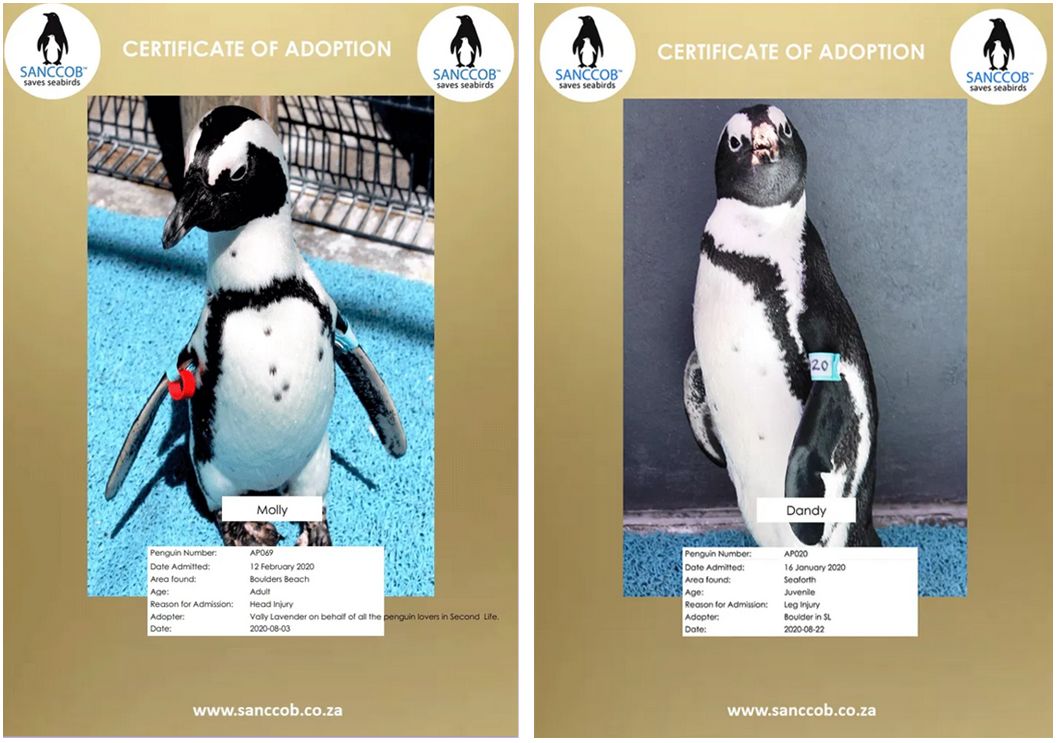
The two penguins from SABCCOB so far adopted with the assistance of donations at Boulder

The Penguin colony is a relatively “recent” addition to the Western Cape of South Africa: there is no record of any penguin colony in the region prior to 1983.  A series of sandy inlets sheltered by granite boulders from which it takes its name, the beach provides a perfectly sheltered environment for the penguin colony, which is also under the protection of the Cape Nature Conservation programme, due to their extremely endangered status.

Hunted on both land and sea by natural predators, it is thought that the Boulders Beach colony was made possible by the reduction in land-based predator threats thanks to the local human presence at Simon’s Town. In these respect, the arrival of colony has been mutually beneficial for both the penguins and townsfolk: the humans have kept land-based predators at bay, whilst the penguins have allowed the town to enjoy controlled interest as a tourist destination; and during the SARS-CoV-2 lockdown, the penguins even took to providing “street patrols” as shown in the SACCOB tweet, below!

Within Boulder, Second Life, both the beach and its penguins and a portion of Simon’s Town are nicely represented adjacent to one another. The landing point offers a map of the region, together with copies of the Certificates of Adoption for Molly and Dandy, the two South African Penguins thus far (at the time of writing) that have been adopted.

The beach offers open aspects looking north and west, the land to the south of it rising steeply in a series of rocky, palm-crowned cliffs and plateaus within which are nestled additional attractions – a shanty-style event space reached via stone steps that climb the cliffs, and beyond it a secluded plateau of trees and waterfalls. For the daring, there are places to quite literally hang out waiting to be found, both in terms of swing seats in the trees and a zip line; however, do be aware that the house on the highest plateau is a private residence. A high, tunnel-like arch of rock bores through these uplands to reach the south side of the region, and a ribbon of beach backed by sheer cliffs that runs westwards to join the main beach as it curls around what might be regarded as a low-lying headland.

Boulder, September 2020

The latter is home to the Boulder Art Gallery which, at the time of both of my visits, was featuring the art of two more renowned region designers: Fred Hamilton (frecoi) and Lotus Mastroianni.  The gallery is watched over by a penguin carved from stone, and overlooks a further stretch of sand occupied by penguins.

The waterfront town at Boulder is a take on the historic centre of the town – Simon’s Town ((Afrikaans: Simonstad) has been in existence for over 200 years, being located in a large bay of strategic importance (the South African Navy still has a major facility there). The historical centre offers a range of colonial-style buildings that could look as at home in Australia or America as they do in South Africa. Within Boulder, this colonial style of building is retained, if presented in a more colourful manner than might be the case with the actual Simon’s Town – not that this detracts from the region’s design.

Boulder, September 2020

I’m not sure if the waterfront itself is taken from a part of the actual Simon’s Town, which appears in photos to have a lot more of a modern look, with a large yacht marina and the aforementioned naval base. However, if it is more a flight f fancy than pulled from Simon’s Town, that doesn’t change the fact that it works perfectly within the region, ideally rounding it out.

During our first visit, I noted the region had at least two Firestorm parcel-level Windlight settings in place (day and night) which I found jarring when moving between them simply by stepping on / off the beach. I’ve no idea if this is still the case, as I’ve transitioned entire to EEP-based viewers. However, the performance hit is still there, and can make itself apparent for those on mid-range systems who like to go around SL with things like shadows enabled; so if you do, you might like to consider turning them off when exploring the region. But that said, neither the potential impact on viewer performance nor any Windlight changes that may occur should deter anyone from visiting. And if you haven’ already visited, I do recommend you consider joining the [valium] group to help support the work of SANCCOB and pay a visit.

SLurl and Links

The art of Hermes Kondor in Second Life

Hermes Kondor: Reflections

In July I wrote about an exhibition of physical world photographs by Hermes Kondor, available at his own Kondor Photo Gallery (see: The beauty of steam machines in Second Life). However, that gallery is only a part of a complex that Hermes has put together, so I decided to hop back for a further look. The complex comprises several individual areas linked by a teleport disc system. These facilities comprise: a boulevard of rental studios for artists, an attractively Deco night club, and three galleries – including the photo gallery noted above – and a studio/gallery used to display Hermes’ SL avatar studies.

Hermes’ primary gallery is the Kondor Art Centre, which at the time of my visit was home to an exhibition entitled Reflections.

I invite you to join on a journey deep inside a magical lake, where we will find strange and beautiful creatures, lightbeings and gates to an alternative reality, deep inside a garden of fantasy and wonder.

– Hermes Kondor, describing his exhibit Reflections

Hermes Kondor: Reflections

This is a collection of 24 digital images that are truly remarkable in their content and depth. At their heart, each image features a mix of light, water (that of the magical lake) and and the reflections of the exhibit’s title. The majority of the pictures feature macro views of plant elements presented in such a way as to suggest they indeed from some alien – as in unknown – environment; alien, and yet somehow familiar.

Beautifully composited and and framed, these are images that are entirely captivating in their use of colour and light to create a rich sensation of living creatures of the imagination.

Hermes Kondor: Flowers

Plants and macro photography are also the subject of the images displayed within the Kondor Art Garden. Here, sixteen close-up images of garden flowers, each again perfectly framed through the aforementioned macro lens, again offering a considered balance of light and depth of field that makes for another quite entrancing collection of photographs, each one deeply attractive.

For those who enjoy images produced in Second Life can visit the Kondor Photo Studio. This is both a gallery and a studio, presenting a series of avatar studio by Hermes. Those interested in engaging him for a photo session should contact Hermes directly.

Hermes Kondor: Flowers

As noted above, I first came across Hermes work in his exhibition of photographs taken at the Electricity Museum, Lisbon, Portugal. I was immediately taken by those images, which can still be enjoyed at the Kondor Photo Gallery,  and admit to be utterly taken by his work in touring the rest of the gallery facilities he operates.

Full SLurls List

Waka is rated Moderate