Logos representative only and should not be seen as an endorsement / preference / recommendation
Updates from the week through to Sunday, August 2, 2026
This summary is generally published every Monday, and is a list of SL viewer / client releases (official and TPV) made during the previous week. When reading it, please note:
It is based on my Current Viewer Releases Page, a list of all Second Life viewers and clients that are in popular use (and of which I am aware), and which are recognised as adhering to the TPV Policy.
This page includes comprehensive links to download pages, blog notes, release notes, etc., as well as links to any / all reviews of specific viewers / clients made within this blog.
By its nature, this summary presented here will always be in arrears, please refer to the Current Viewer Release Page for more up-to-date information.
Outside of the Official viewer, and as a rule, alpha / beta / nightly or release candidate viewer builds are not included; although on occasions, exceptions might be made.
Official LL Viewers
Default viewer – 26.2.0.25386466510, May 19 -“flat” UI and font updates.
Release Candidate 26.3.0.30006559438, July 27 – quality of life improvements; performance improvements; bug fixes – NEW.
Outpost Bay, July 2026 – click any image for full size
Update: both Outpost Bay and The Boathouse Café have closed, and Sorcha now has opened Stillwater Coast – read more here. SLurls have therefore been removed from this article.
In July, I visited The Boathouse Café, a charming setting designed by Sorcha Tyles under her Dutch Pavilion banner (see: More coffee and photos in Second Life). Well, Sorcha has been busy!
Paging through the Destination Guide I came across an entry for Outpost Bay, sitting within the region hosting The Boathouse, and which at the time of my last visit has been a private space for Sorcha. So, intrigued, I had to pop over and have a look.
Outpost Bay, July 2026
Listen to the gentle sound of waves and birds as you take a peaceful stroll down to the beach and relax by the vintage changing huts. When you’re ready, wander into the cosy Concept Store to pick up a fresh coffee, breakfast, and something good to read. Settle in at a table on the deck to enjoy the morning sea breeze, or head over to the lighthouse and take a boat out on the water. Outpost Bay is a warm, rustic place made for slowing down, unwinding, and living in the moment.
– Outpost Bay Destination Guide Entry
Outpost Bay, July 2026
One of the things I really appreciate with Sorcha’s designs is how she can take a relatively small space and turn it into something that is inviting and encouraging of visits.
The Boathouse Café, for example sits on 3120 sq metres; Outpost Bay is barely bigger, sitting on a 3136 sq metre parcel. Yet both are visually impressive and photogenic, carrying plenty of detail without either parcel ever feeling overcrowded.
Outpost Bay, July 2026
Given the two locations are within the same themed region (and sitting just across a water channel from one another), they share something of a similar look, both in terms of the flora and the buildings present on them.
This is not a critique: by using the same flora and similar architecture, Sorcha creates a sense of continuity flowing between the two islands – and with the rest of the estate. It also suggests that both islands were developed as little places of commerce around the same time, the buildings sharing ta wooden construction style as they were built around the same time and shared the same readily-available materials in the form of the trees growing on them.
Outpost Bay, July 2026
With Outpost Bay, the main building was once a warehouse-come-seafood market, the original signage conjuring images of fishing boats coming alongside and their catch going from boat through cleaning to sale.
Now, however, the building serves as a café-come-store (do note that the doors are phantom, rather than opening, so just walk through them). It’s a little tired inside, to be sure – perhaps a statement to its frequent use – but there is more seating outside on a wooden deck for those who prefer.
Outpost Bay, July 2026
The one exception to the dominance of wooden buildings in both settings is the tall white tower of Outpost Bay’s lighthouse. This looks out over a rocky corner of the island which might cause boats passing along the channel between it and the next island over.
With the lighthouse and café located on the east side of the island, the rest is relatively open as a wild garden which partially surrounds the cafe’s deck before giving way to a cosy beach alongside a short, rocky length of coastline.
Outpost Bay, July 2026
The sands of the beach is patrolled by godwits and watched over by ibis whilst offering humans a place to relax and enjoy the summer Sun.
There is a main path wandering through the setting, and it does so in a manner intended to reveal rather than simply lead, winding out from the cafe’s deck it gently reaches out to the lighthouse and the beach, allowing people to gently explore and discover many of the little touches Sorcha has placed around the setting.
Outpost Bay, July 2026
In all – and as I noted with The Boathouse Café – Outpost Bay is an utterly delightful setting with a lot to offer for those seeking to relax and those wishing to take photos. Individually or taken together, these are locations well worth visiting.
Nathhimmel – Sula Sgeir, July 2026 – click any image for full size
Sula Sgeir – or Sùlaisgeir in Gaelic – is one of the most remote isles to be found in the British Isles. Less than a kilometre in length and about 200 metres across including a headland, it is marked by high cliffs, frequently inhospitable weather, and remains uninhabited by humans for most of the year.
The island is most famous for its population of gannets, and (more infamously) for the annual autumnal ‘guga’ hunt for young gannets by men from the Isle of Lewis, 70 kilometres away, where the bird is considered a delicacy.
Nathhimmel – Sula Sgeir, July 2026
I mention all of this because Sula Sgeir is the name given to the latest Nathhimmel region build by Konrad Rune and Saskia Rieko, this time additionally assisted by Art Oluja (Artistik Oluja) who has added a fantastic soundscape to the setting.
However, rather than focusing on the actual island of Sula Sgeir and its bloody and callous hunt, Nathhimmel’s Sula Sgeir focuses on an underwater environment through which visitors can engage in their own far more pleasant adventures: diving, swimming and exploring the ocean depths either freely or aboard a 2-seat mini sub or on a “jelly(fish) ride”.
Nathhimmel – Sula Sgeir, July 2026
The Landing Point is a small deck on an outcrop of rock rising above the waves and loomed over by a gigantic Moon. While this island is small, it does contain the skeletal remnants of a great dome standing behind it – a possible hint of a waiting mystery?
The deck includes givers for a swimming HUD, the “jelly ride” (which is a wearable vehicle by Art), and a rezzer for the mini sub. The latter is of Konrad’s design, and a neat little 2-seaters for sharing with someone or simply enjoying on your own.
Nathhimmel – Sula Sgeir, July 2026
Beneath the waves is a strange and haunting world, one in which it is very easy to take on the spirit of Jacques Cousteau when exploring its depths.
However you opt to go, once you are underwater it is essential you have local sounds enabled to add to the sense of immersion as you move amidst fields of tall seaweed, forests of twisted corals, and over an almost alien landscape of strange luminant aquatic plant life.
Nathhimmel – Sula Sgeir, July 2026: “We cruised on, slowly descending to leave most sunlight behind, our headlamps spearing the darkness. At first there was nothing, then, slowly out of the watery haze, giant and majestic figures emerged…”
In the shallower waters, sunlight attempts to probes the water, shafts of light spearing down. Elsewhere it is possible to spot the red glow of ocean floor vents and the now quiet mouths of fumaroles gaping wide, the heat that may have once caused them to once belch clouds of mineral-rich gases long since moved on.
As visitors skirt jellyfish and schools of fish, the flickering, hazy light will eventually reveal the giant denizens of this world. A trio of giant manta rays appear to holding a council session; humpback whales slowly emerge through veils of shimmering, fading sunlight, whilst the ghostly forms of blue whales appear from within the forests of seaweed and kelp-like growths.
Nathhimmel – Sula Sgeir, July 2026: “as we slowly circled the motionless leviathans, we realised they were not alone. To figures floated listlessly, victims of some catastrophe we had yet to understand, and the whales remained, bodies inclined with heads down, as if mourning this tragic passing…”
This is a place holding secrets as well. The humpback whales have their great heads dipped as if in mourning, the lifeless forms of two divers in deep sea gear with airlines detached and the visors of their helmets glowing eerily, floating before them, caught in a state of neutral buoyancy before they could reach the surface. What happened to these poor souls is open the question – perhaps they are connected to the secret hidden in deeper waters.
Then there are the glowing fronds and planets and the strange blue veins to be found in some of the rocks. What do they signify?
Nathhimmel – Sula Sgeir, July 2026
It is to the north and west where this ocean’s secret lays. Here, the the sea floor falls away sharply and sunlight is left behind. At first it appears to be an abyssal deep where not even the whales stray, leaving only the tall fonds and watery growths. But then, from between the growths comes a dance of light, a flash which demands attention.
Close on this lone point of light and it will reveal itself as an abandoned deep ocean structure, its domed roof mindful of the wrecked dome at the region’s Landing Point. Pipes run into it from the surrounding seabed, but what might it be? And what is it lying within, expanding and contracting slowly as if in respiration? Those are questions to be answered by your own imagination.
Nathhimmel – Sula Sgeir, July 2026: “Our descent into this strange world continued, slowly approaching the limits of our dive capabilities. We were about to come to a halt and start an ascent when something loomed up from the sea floor, something which should have been impossible: a structure apparently made by human hands…”
For my part, I will only suggest that getting down to this strange structure is possibly best done using one of Konrad’s mini subs. Whilst a little choppy on the controls, they handle well enough, and going down into the depths of the setting in one definitely heightens the sense of mystery and deep-diving adventure.
My only other observations would be to make sure you obtain introductory notecard at the Landing Point – it contains a backstory touching on the mysterious nature of Sula Sgeir. Also, as if it needs mentioning, do make sure you use Nathhimmel’s Shared Environment when visiting, and for the best immersion, make sure you are running a PBR capable viewer.
Nathhimmel – Sula Sgeir, July 2026
I have never failed to be impressed by the designs Konrad and Saskia create for Nathhimmel, and this remains the case with Sula Sgeir. Fascinating, and engaging, it is a genuinely captivating aquatic environment given additional life by Art’s soundscape, and definitely not a destination to be missed.
IMAGOLand and Galleries: Kirjat Umarov – The Autumn Sun at Gorky Park and other Stories
If I had to say where I felt most alive in my life, or name the place I long for most, or the one I would want to visit again, the answer is: Moscow.
So notes artist and Second life resident Kirjat Umarov in introducing his exhibition The Autumn Sun at Gorky Park and other Stories, which opened at Mareea Farrasco’s IMAGOLand & Galleries on July 21, 2026.
This is a very personal collection of pieces, centred on a celebration of Gorky Park, which Kirjat notes he has been able to visit in both in spring and winter whilst in Moscow, but never in autumn. Thus within this exhibition we have original art which starts from the idea of imagining Gorky Park in the months of autumn, and which broadens into so much more.
IMAGOLand and Galleries: Kirjat Umarov – The Autumn Sun at Gorky Park and other Stories
This is not, however, a series of “traditional” paintings of landscapes directly reflecting the park and its physical structures as we might see them (photos of which can be found in one corner of the exhibition space). They are abstract in nature, suggesting through their use colour – the yellows and golds of autumn, the pale blues of colder autumnal sky, the greys and darker colours of autumn’s wetter moments.
At the same time, the colours are a reflection of memories of Gorky Park and Kirjat’s life as a whole; the warmer, bright shades representing happier times, the darker colours hinting a times apart or times of sadder thoughts. Within several of the pieces are blocky forms, silhouetted outlines: a church, suggestions of a city’s skyline. They serve both as echoes of the city and nation in which the park sits, and of those more personal memories and emotions.
IMAGOLand and Galleries: Kirjat Umarov – The Autumn Sun at Gorky Park and other Stories
Thus, within all of the pieces lay – as Kirjat calls them – “painted memories”, real or imagined, both from his own experiences and of emotions that might be felt on seeing a familiar place but dressed in the colours of a season for the first time. In this way, they draw us into them and interpret them, gently putting our imaginations to work as they provoke the senses. They create snippets of stories which might be shaped by our own emotions and memories to produce new stories; stories which are not necessarily bound to Gorky Park or Mother Russia. The paintings simply invite us to drift through the libraries of our own memories of places visited, times remembered, times missed, and the seasonal colours of emotion and imagine.
An engaging selection of original physical world art.
Grauland / Primary Colors, September 2024 – click any image for full size
MorganaCarter, who is one of multiple people who have pointed me to various regions and parcels over the years, dropped me an IM directing me to Jim Garand’s Grauland Flickr group, and specifically to an image and message simple in form, but very saddening:
Many people in SL have regarded Grauland as a favourite location; a place to visit and enjoy, each new iteration bringing something special to our digital world.
For more than seven years I’ve routinely visited it to appreciate Jim’s work and to blog about it. And while I didn’t managed to captures every single version of the region which arose in that time, I did cover 30 – and I will genuinely miss being able to visit it and see what else has come forth from Jim’s fertile imagination.
The builds Jim has presented with Grauland were always unique, although there were certain themes to which he would return – sci-fi, urban, minimalist, industrial -, but no single design ever re-tread exactly the same path as any previous design.
My first visit was in March 2019; I think that was to the first region build Jim had opened to the public – but I could well be wrong on that. At that time, the region was leaning heavily into a landscape-as-gallery, featuring things like an arrangement of great concrete blocks (a geometric motif which would oft appear in Jim’s designs in various guises), an indoor galley and outdoor 3D displays.
Art always remained a part of Grauland, be it front-and-centre, as in March 2020 with Grauland Castle and Art Park and again in July of that year in which an ancient henge, modern architecture and statuary all combined with the landscape, or with June 2021’s Grauland Falls; sometimes it was more subtle, as with October 2021’s Grauland’s Lights, where geometrics forms and a cityscape served to highlight the use of lighting in Second Life; sometime it even appeared to be a natural part of the architecture or urban space – a graffiti-marked statue here, wall paintings there…
As well as offering unique designs, Grauland could also present places inspired by locations in the the physical world – tropical islands, deserts, urban centres and industrial outlands and more. Iceland in particular became the focus of two designs (both favourites of mine, as I’ve always loved the times I’ve spent in that country) – July 2023’s Grauvik and February 2025’s Grauvik 2 – both of which were set on a fictional island just off the Icelandic coast.
As noted earlier, Grauland also took us to places far away from Earth. Some of these carried with them the opportunity for visitors to create a back story to account for the mystery which might be implied within them (November 2023’s Grauland / The Deity Machine) or engage their their sense of adventure, as with January 2023’s visit to a space station and a Mars-like planet, together with The Grauland Cluster (September 2025) and June 2026’s visit to the Spires of Sector 7.
One – The Last Trees, from April 2024 – might be seen as gentle warning about the perils of unchecked global warming here on Earth, whilst Arrakis / Fremen Home in May 2025 offered a take on Frank Herbert’s Dune.
One of my favourite industrial designs Jim produced was Grauland / Primary Colors (September 2024), a marvellous setting in which primary colours were very much part and parcel of the build, often in the most subtle of ways (just look at the use of red on the locomotive), and which very cleverly gave a hint as to where it might reside were it in the physical world thanks to an advertising board.
Grauland is going to be missed by many, and there is so much more that might be written about it, but I’ll close here with the words I left for Jim on the Grauland Flickr group – if you’re also a fan of his work, I hope you’ll leave some words of appreciation as well -, and a couple more images.
Will always appreciate the work you put into Grauland, Jim, and in being able to visit and blog. Many, many, thanks for all the time and effort and consistently building special places for us all to enjoy.
The CCUG meeting is for discussion of work related to content creation in Second Life, including current and upcoming LL projects, and encompasses requests or comments from the community, together with related viewer development work.
This meeting is generally held on alternate Thursdays at Hippotropolis and is held in a mix of Voice and text chat.
While viewer 26.3 is now available as a Release Candidate viewer, it does not include all the hoped-for performance improvements (particularly with some of the texture streaming work.
This was because of time constraints in getting the updates tested across as many hardware configurations as possible.
As a result, this work will be held over for the Graphics Care Package (GCP) viewer.
The GCP viewer is a lot of fixes and improvements around PBR and correcting issues within it as far as possible. It is hoped that this viewer, which has been suffering a lack of resources, will start to move forward once more in the near future.
Various pull requests (PRs) are now being looked at and worked on (e.g. semi-transparent media on a prim), but no guarantees as to when these might surface in a viewer.
Lua Updates
There is a new versions of the Lua editor viewer, as noted above.
This includes a new version of the VSCode plugin.
This has a much tighter integration with the viewer.
It is possible to select multiple objects in-world and open them for examination in a Visual Studio panel and then manipulate them (e.g. stop scripts, remove scripts or notecards) subject to permissions.
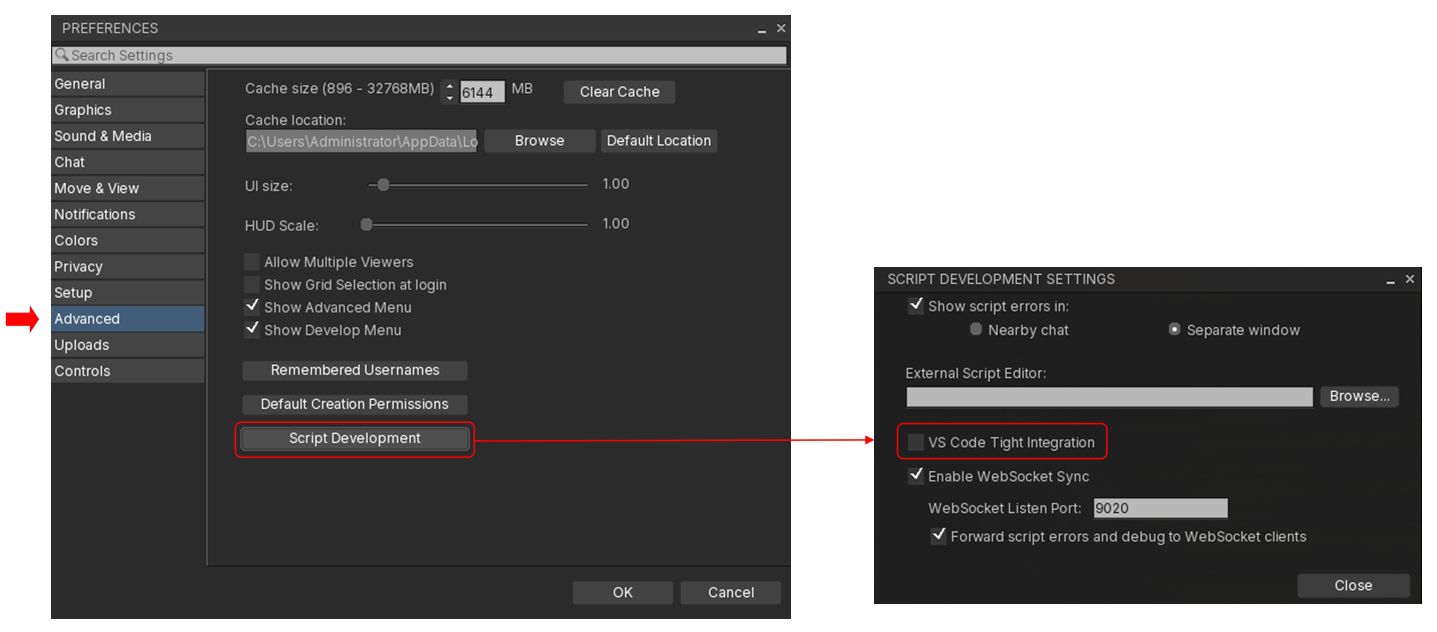
These new features do need to be enabled for use in the viewer:
Preferences → Advanced → Script Development → Script Development Settings floater → check VS Code Tight Integration.
Enabling tight VS integration on the most recent Lua editor viewer
Rider Linden is actively looking for bug reports on both the viewer and the VS Code plugin.
Note that the above does not mean that Lua is grid-wide.
Server-side support for Lua scripting remain available only in those regions with the required back-end code.
Currently, the hope is to:
Have the Lua editor got to beta / Release Candidate status after the 26.3 viewer is promoted to release status, with the caveats again being a) viewer priorities may change; b) at the time the viewer reaches beta / RC, Lua code support in the viewer still may still be restricted to those regions running on simulators with the required back-end support.
Have the back-end support for Lua deployed grid-wide “some time” during quarter 3 2026 (e.g. between this meeting and the end of September 2026)
Official Linux support remains with the Lua editor viewer as its first release.
General Discussion
Discussion on mesh improvements are continuing internally at LL. This is something the Lab wants to get done, but it may not be something that surfaces in the near future. Once the internal discussions have led to decisions, then more details will be put to the CCUG for discussion.
The game_control code now might not ship with the Lua editor viewer given the additional back-end work Leviathan Linden has agreed needs to be done (see my notes from the previous Leviathan Office Hours meeting).
A demonstration of a means to export scripts from a HUD to an external app to assist with HUD creation / positioning / testing was demonstrated (videos here, here, here and here). The end goal for the project – making it available to others and how, was not too clear.
The above led to the subject of SVG support in the viewer being again raised. This is seen by Geenz as being “something that could be interesting at some point”, but the Lab is “a ways off” of having time for the work outside of MOAP.
In the meantime, Callum Linden is looking at MOAP + SVG support and what can be done there.
Viewer-native (aka “official”) PBR support for Bakes on Mesh (BoM):
Geenz noted there is interest at LL in providing this, but there there are various pre-requisites and consideration to be worked through, together with priority.
One example of this is: considering how to combine PBR BoM with Blinn-Phong, with a prerequisite being PBR specular support in the viewer (which is due to be a part of the GCP viewer).
There is also some need for work on BoM in general, such as improving elements of the UX.
glTF lights:
glTF lights are described as “still a ways out”, but SL is getting radiometric units per the glTF specification for the Sun and Moon as a part of the GCP viewer.
Point and spotlights are a “much bigger ask” requiring additional wire protocol work and updating object parameters. As such, there is work in advance which needs to be completed in order to make point and spot lighting “doable”.
The above touched on shadow casting, which was seen as a combination of being something that might have to wait for the graphics API / Vulkan work, and as requiring sufficient controls and settings so as to allow users to adjust it for performance on their hardware.
A pull request (PR) to add the ability to take screen shots with a transparent background only showing avatars, Animesh, particles from the avatar, objects sat on, and selected objects (eliminating green screens) has been put forward and looks like it is going to be accepted.
A question was asked if the consensual system at the Adult Welcome Hub (see my review here) will be made available to content creators for use grid-wide. There is apparently a Feature Request asking for this, and it is under review.
Geenz requested that if people know of regions parcels with pre-PBR EEP settings which look “broken” when viewed on a PBR viewer rather than a non-PBR viewer (e.g. things seem to be unnatural dark or objects are unnaturally glowing, etc., when see on a PBR viewer but not on a pre-PBR viewer such as non-PBR versions of Firestorm), to please for LMs to him for investigation. This does not include PBR EEP settings looking differently on pre-PBR viewers, etc.