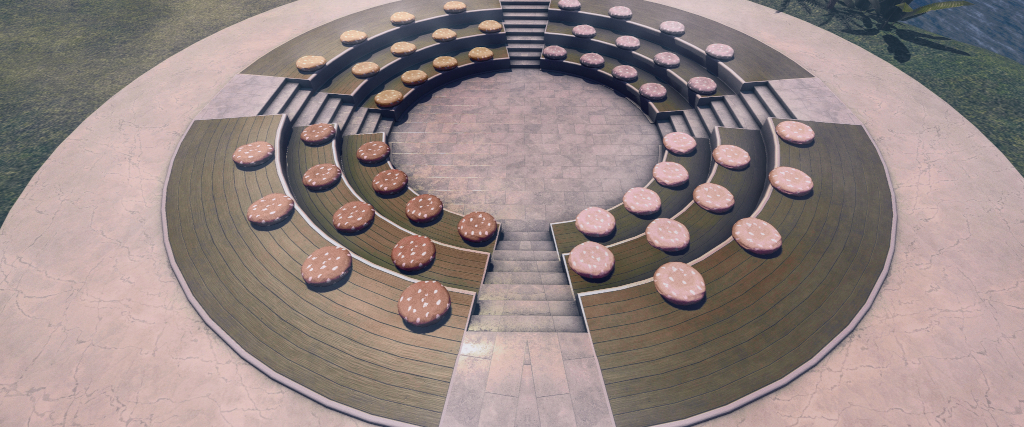
The Open Source User Group (OSUG) meeting is an open discussion of Second Life development, including but not limited to open source contributions, third-party viewer development and policy, and current open source programmes.
This meeting is generally held twice a month on a Friday, at 13:00 SLT at the Hippotropolis Theatre and is generally text chat only.
Default viewer 26.3.0.31203661088, August 10, promoted August 17 – quality of life improvements; performance improvements; bug fixes – No Change.
Second Life Lua Editor RC / Beta viewer with Linux support 26.4.0.35914774337, September 24 – NEW.
Lua scripting support (on regions with Lua scripting enabled).
Improved communication between the Viewer and the newly published Second Life VS Code extension.
Offers an experimental Linux viewer build.
Includes the latest WebRTC Voice and viewer-maintenance updates.
Second Life Chat Modernization viewer 26.3.0.35248298254, September 22 – NEW.
Recent conversations follow you seamlessly: a direct message you receive on SL Mobile can also be available when you return to desktop, and vice versa; Recent direct message history will be available on logging-in; existing desktop chat logs are preserved – previously saved local history isn’t being replaced or removed; conversation history feels continuous: on desktop, your existing local history and newer message history are brought together into a single conversation.
Viewer Notes
The 26.4 Lua Editor / Linux viewer remains at RC / beta status, but the hope is to promote that to de facto release status in the coming week.
Work is going into the 26.5 viewer – currently, it looks like this will include the Chat Modernisation work currently at Project / alpha stage (per the list above), together with maintenance fixes and other items.
Leviathan Linden’s game_control work is currently held pending further server-side work, however the overall plan for this in terms of the viewer are:
Get a Project / alpha viewer out as soon as possible
Possibly go on to roll game_control in viewer 26.5.
General Discussion
Chat Modernisation work:
There was a reiteration that this work is currently concerned with persistence of IM histories when moving between devices / viewer instances, rather than dealing with matters such as encryption (although it was noted that the chat history itself is encrypted end-to-end).
It was also noted that other improvements will be made as is feasible, according to roadmaps / resource availability.
Official RLV support:
This was a project started some time ago – with the assistance of RLVa developer Kitty Barnett – to add RLV support to the official viewer.
This project has been stalled for some time, however, Geenz noted there is no technical blocker for the project, and internal discussions are still going on at the Lab as to how best to progress the project.
There is also a Github thread for RLV/a discussions.
There was a general discussion of texture handling – decoding, options, VRAM management, consideration for better Mobile use, etc. See the video, 25:19-35:51 (note this runs concurrent with comments on the deletion of orphaned assets from the asset service and the opening of comments on RLV/a support as noted above).
Please refer to the video below of the rest of the meeting comments..
Ofrenda Nocturna: Whispers of Nocturna, October 2026
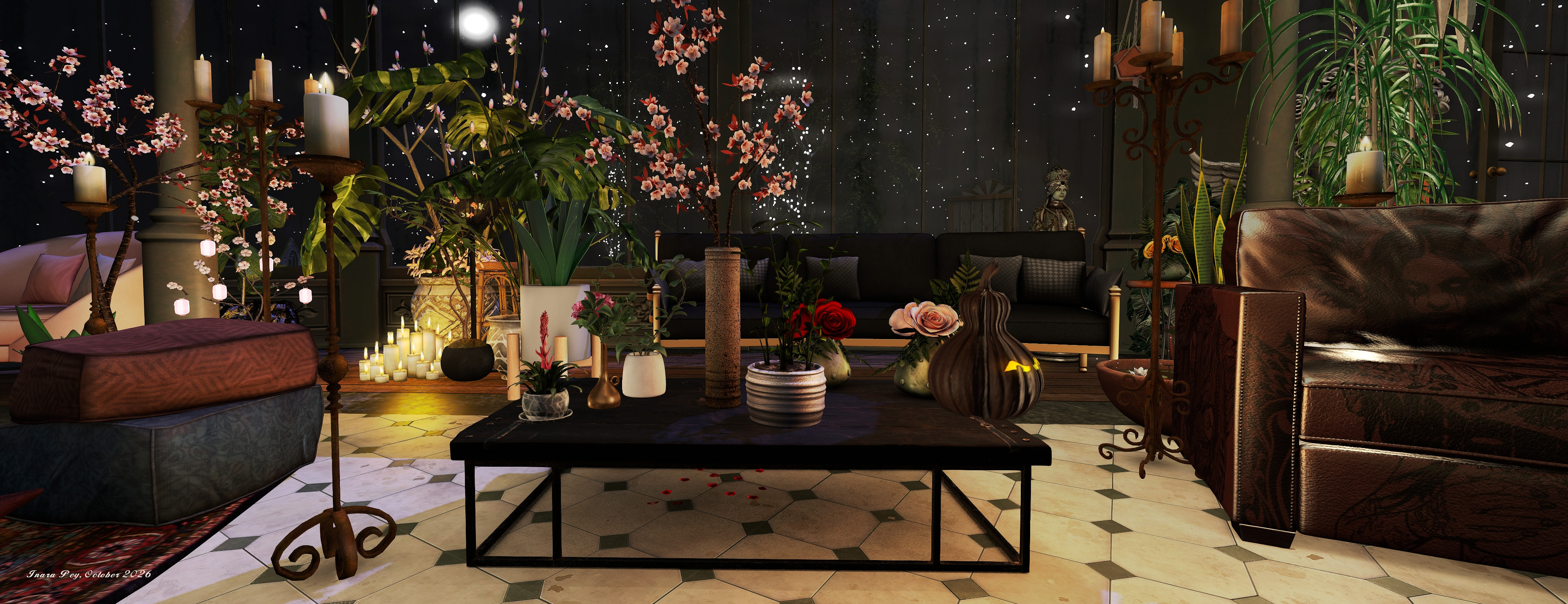
Fellow destinations blogger Sam Rougefeu (Dodderi Haifisch) pointed me back to Tera Byte’s (Terabyte Amour) Ofrenda Nocturna, a region I first visited in September 2025, and which is currently offering a couple of special events for the month of October in the form of The Whispers of Ofrenda and a hunt.
Designed primarily by , Pris (Pris Pixels) on behalf of Tera Byte, Ofrenda Nocturna is an Adult-rated region where some adult-rated activities are allowed in keeping with the region’s rules, but these are discrete enough that that should not put people off.
Ofrenda Nocturna, October 2026
At the time of my previous visit, I found my PC and the region’s storm-like Shared Environment didn’t exactly get on. Fortunately, for this visit this wasn’t the case, the setting now sitting under a star-spangled dome.
Also at the time of my first visit, the main Landing Point sat to the east of the region, where a ferry boat gives visitors the impression of having just arrived by water. Whilst this can still be used (and I would recommend it for first-time visitors wishing to explore the region in full, as it is here that pointers to finding your way around can be obtained), for October the LP isn’t enforced, allowing those specifically wishing to follow the Whispers of Ofrenda to do so directly.
Ofrenda Nocturna, October 2026
The latter takes place within the grounds of ruined abbey as it sits perched on a headland to the north-east of the region, overlooking the harbour to one side and a bay cutting into the north coast on the other. As per the information board outside of the abbey, Whispers offers visitors a walk-through of the abbey and its grounds to hear or read a collection of stories (eight at the time of my visit, although more may be added).
The stories are indicated by posters of their own, and can be read or heard (or both) by touching their posters and then clicking on the preferred option. Of the two – and if you can, I recommend listening (you will need to have media enabled – click the movie camera icon at the top right of the viewer window), because the production quality is exceptional, and the voice artists superb.
Ofrenda Nocturna, October 2026
Beyond the abbey, the region remains genuinely photogenic and atmospheric, with much to discover. Afterneath, the main nightclub continues to sit tucked underground and beneath the Zen garden to the west of the region. The garden offers one of two points of entry to the club, the other being via the tunnels burrowing under the plateau separating the garden from the inland areas of the setting (but be prepared to get your feet wet!).
This plateau is home to an outdoor event space bordered on one side by a couple of buildings. At the time of my visit in 2025 both of these stood empty. Now one is occupied by the Ofrenda / Pris Gallery (it appears to have two names going on the website links). The other is occupied by the Adequate Gatsby, a quirky bar with a literary theme (as if you couldn’t tell by the name 🙂 ).
Ofrenda Nocturna, October 2026
The Gallery is hosting a double exhibition entitled Two Sides of the Shutter, featuring the work of Sio Skytower and Tera Byte, and which formally opens at noon SLT on Sunday, October 4, 2026 with the promise of “a little art and murder”!.
Also taking place across the region throughout October is a “video tape hunt”, details of which can be found on a poster down at the harbour. And speaking of the harbour, an interesting factoid I missed first time around is that the barber shop there is actually inspired by The Tonsorial Artist in Holt, Norfolk.
Ofrenda Nocturna, October 2026
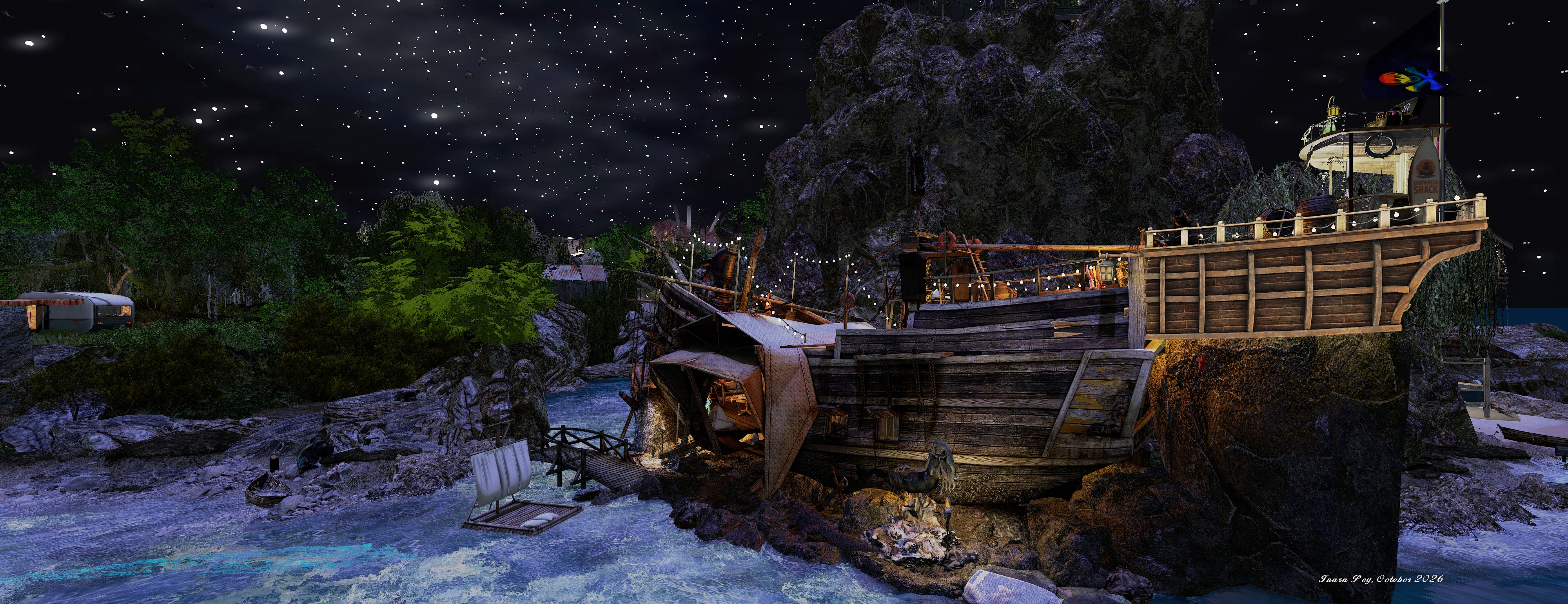
Another event space which I believe may have been added since my September 2025 visit is the Shipwreck Bar, sitting on the far side of that northern bay overlooked by the abbey ruins. This offers cocktails on the poop deck and cuddles in the hold for those interested – one of many places scattered across the region for sitting / cuddling and/or canoodling.
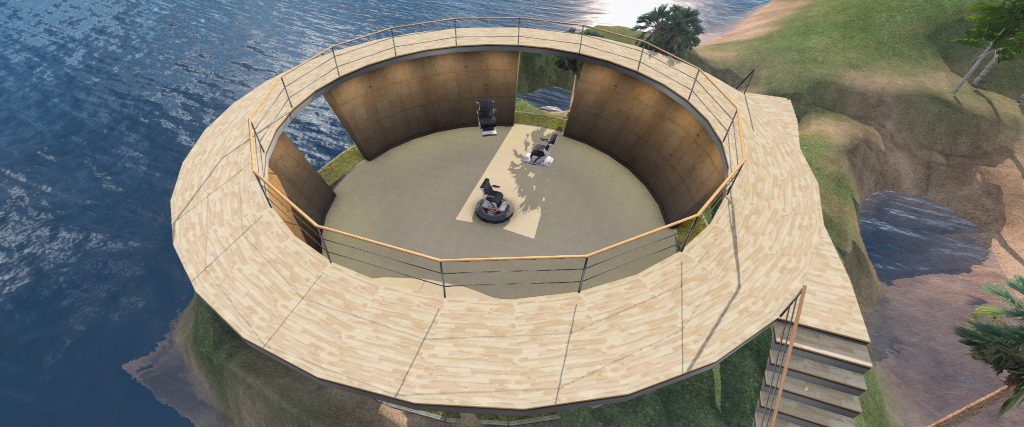
One part of the region I didn’t mention last time around is the region’s Observatory, located in the north-west corner of the region, high on a peak. Under the October dome of stars, this looks particularly gorgeous and inviting. Events appear to be held here as well, whilst there is plenty of space of sitting and relaxing, cuddling and smooching.
Ofrenda Nocturna, October 2026
A genuinely engaging region with much to see and appreciate, Ofrenda Nocturna is a great place to visit any time of the year. I will admit to finding one of the stories offered in Whispers discomfiting as it references a genuine tragedy here in the UK. However, taken as a whole Ofrenda Nocturna does not set out to upset; rather the reverse in fact, as it has some nicely understated humour – as see with the Adequate Gatsby, and is undeniably photogenic under a wide range of EEP settings (although for at least Whispers, the Shared Environment is recommended).
Congrats to the Ofrenda team on becoming part of The Nature Collective, and my thanks to Sam for pointing me back to Ofrenda to enjoy Whispers.
Cica Ghost once again invited me to drop into her region of Mysterious Isle and her installation for October, Lune. And given the time of year, it should come as no surprise that it is spookily themed.
I’ll make no bones about it, Lune creepily fun and offers both tricks and treats wherever you go.
Cica Ghost: Lune – October 2026
As is usual for Cica’s installations, Lune features a quote. In this case, line from Joseph Conrad’s Lord Jim, itself something of fitting choice given its focus on a young man haunted by a decision made in a moment of terror when he bowed to the pressures of his peers.
There is something haunting in the light of the moon.
– Joseph Conrad, Lord Jim
Cica Ghost: Lune – October 2026
However, rather than offering a treatise on the novel’s themes, Cica uses the quote to underscore the haunting delights of her setting, where even the Moon is looking a little skeletal in nature.
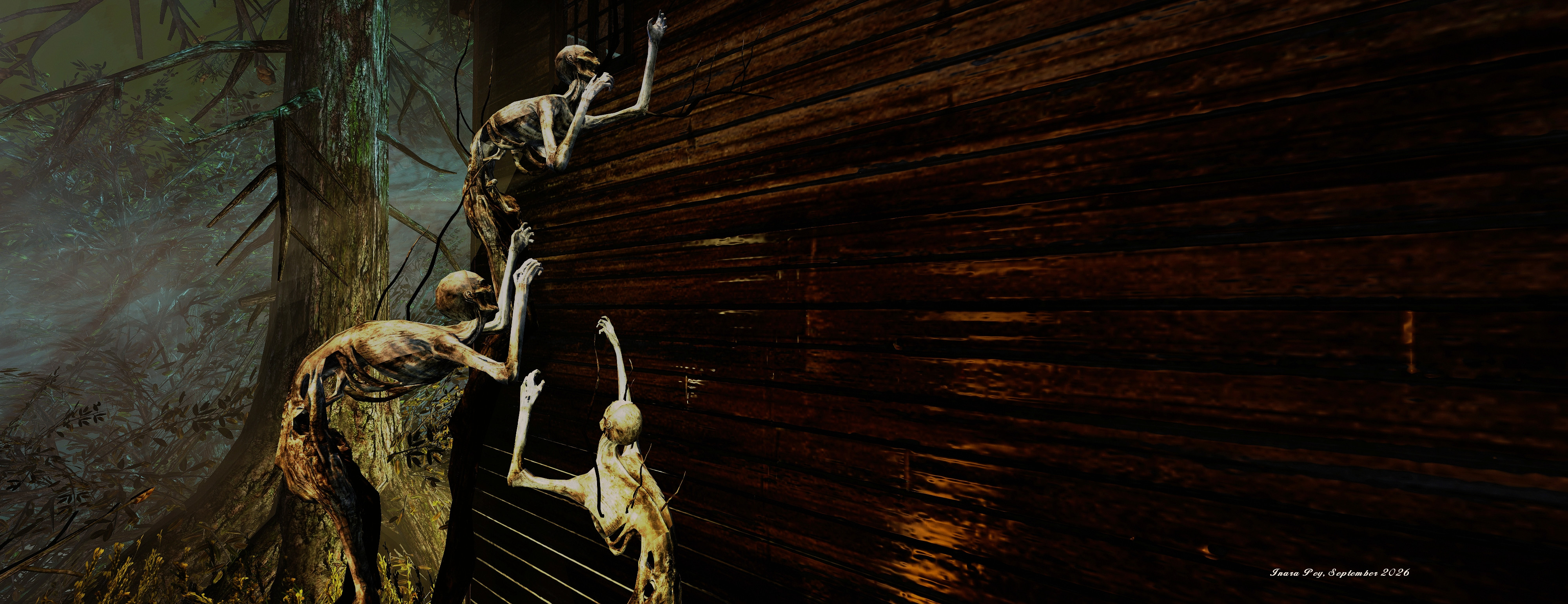
Indeed, under this Moon’s crescent, trees whip upwards like tentacles, a graveyard lies is shadow, some of its occupants attempting to rise even and others are already wandering abroad. At least one even appears to have returned home!
Four
This is a place where crows and vultures watch all that happens and bones lay scattered across the ground.
In the middle of all of this, an little quintet of Trick or Treaters appear to have wandered – one of whom has something of Cica’s own look about her as they glance nervously around, there costumes fitting the setting even if their eyes are wide in possible trepidation.
Cica Ghost: Lune – October 2026
This is a place where even the term “bat mobile” takes on a near literal form as it provides one mode of transport, the other being a little more gruesome. Not that it prevented me from, umm, revving up with fellow blogger and Second Life traveller, Sam Rougefeu (Dodderi Haifisch)!
Finished with a very suitable audio stream – do have music enabled when visiting – Lune brings a lightness and sense of fun to Halloween that’s delightful in its touch and difference to the darker region themes that tend to come out at this time of year!
Cica Ghost: Lune – Sam Rougefeu takes to a BAT mobile to avoid my SKUL(L)duggery 🙂
Dido Haas dropped me a line concerning an emotive exhibition by Second Life artist-photographer Christian Carter due to open at Limoncello Gallery, operated by Dave (Lord Junibalya) with the assistance of Fenella Allen, on October 1, 2026.
Dido’s note prompted me to realise I haven’t actually covered Limoncello since 2021, so before turning to Christian’s exhibition I will take a look at Limoncello as it sits within its most recent location and remains one of the longest-running art collections in Second Life.
Limoncello Gallery: Janus Fall, Sina Souza and Diconay Boa
The collection was originally founded nigh-on 20 years ago (at the time of writing) by the superbly-named LastDitch Writer in 2007, and stood as a private collection within the unique environment of a massive airship. In 2011, LastDitch departed SL for a time after the passing of his wife (although he is now again active in-world as the Chieftain of the Clan McDitch and live at Nyuvegan Castle on the Isle of NyuSkye).
Rather than vanish from SL, Limoncello passed into the care of Dave. In 2020 an annexe opened in Bellisseria, which I covered at the time. However, the main gallery now sits in a towering skyscraper rising over the City Borough of Manda Vale, itself located high above NyuSkye.
Limoncello Gallery: Janine Portal, Louvre, Stephen Venkman, April Acorn and Prins Evergarden
The many floors of the skyscraper contains pieces by artist right across Second Life, featuring SL landscapes, avatar studies, 3D pieces, physical world paintings. And yes, right up on the roof the airship with its gallery spaces is moored, reached via the Experience-based teleport doors on both the roof of the skyscraper and on the ground floor, where a similar teleport door connects to the Bellisseria annexe.
Movement between floors in the gallery is via elevator, which is where I have a minor niggle. Whilst “real”; the elevator is painfully slow if it is more than a couple of floors away from you. Perhaps a teleport or-whilst space-intensive – stairs might be a better choice.
Limoncello Gallery: Royal Shippe and ArtemisGreece
But be that as it may, the entire gallery is more than worth a visit for its collective history of Second Life Art. Also, while visiting, Amanda Tamatzui has a gallery a short walk from Limocello’s front doors, whilst the far side of the Bellisseria Consulate (facing Limoncello’s tower) is Art Galleries of Second Life, presenting teleport portals to many of the galleries to be found in-world.
Christian Carter: After You
Which brings me to Christian’s After You, located within Limoncello Tower. This is a small but emotional collection of pieces mixed with text elements. To describe it, I’ll simply use some of Christian’s own words.
These photos grew out of an experience of absence, loss and the strange space that remains when someone is no longer there. They are not meant to tell a complete story, but to hold fragments of one.
– Christian Carter, After You
Christian Carter: After You, Limoncello Gallery
These fragments as thus presented in four parts: Before (or connection); Loss (or distance), Aftermath (or disappearance) and Becoming (or what comes after).
Each section comprises two or three images, each one highly minimalist in presentation whilst including individual styling. This minimalism and choice of style – monochrome, light colour wash, chiaroscuro and deep colour tone – serves to give all of the images there emotional depth.
Christian Carter: After You, Limoncello Gallery
I’m not going to offer any personal interpretation of the art; how each piece speaks to us is down to our own experience of loss and absence and how that shapes our response to these pieces.
All I will say is that loss does not doesn’t necessarily mean being physically without; loss can be felt as much by a sense of distance in terms of mental / emotional separation as by any physical absence (and can eventually result in the latter) – which is beautifully represented here by Christian is the second and third parts of After You.
Christian Carter: After You, Limoncello Gallery
A sublime and moving collection, perfectly presented, After You formally opens at 12:00 noon on October 1, 2026 and will remain in place through until December 31, 2026.
Limoncello Gallery is an ideal destination for Second Life art lovers, and After You is the ideal exhibition from which to commence a viewing of the collection.
The Halloween Experience: Salem 1692, September 2026 – click any image for full size
I’ve followed the work of Kaiden Tray (KaidenTray) – together with his long-time collaborator and RL wife, Pandora Ceridwen Tray (Voodoo Macabre) – both in the design of dedicated designs under the KTL Destination brand and on behalf of other region holders since 2018, and was recently intrigued by a series of notices issued via the KTL Destinations Group about a new development: The Halloween Experience: Salem 1692.
Specifically developed as a Halloween 2026 experience, Salem 1692 is another joint presentation by Kaiden Pandora. As the name suggests, it presents a return to the period of the Salem Witch Trials, offering both a come-as-you-please opportunity for exploration or to participate in guided tours – as well as special events.
The Halloween Experience: Salem 1692, September 2026
A point to note with the couple’s work is that it is always exceptionally well-crafted; they combine design, atmospherics/environment and soundscape, and this is especially true for Salem 1692.
Do please use the Shared Environment settings why visiting the Full private region utilising the Land Capacity bonus from LL – if you find it on the dark side, a lantern is offered at the Landing Point, so just ADD that to your avatar. Also make sure you have local sounds enabled.
Salem 1692 schedule for tours – click to view details
As noted, the region is open to come-as-you-please explorations (given the period and theme, dressing the part might be fun!), and there will also be guided tours exploring the history and folklore of Salem and its dark witch trials.
The latter are pay-to-participate activities, with the core details being:
Tours will be held every Friday, Saturday and Monday through October, commencing on Saturday, October 3 – see the poster to the right.
Tickets are L$500 each, available via the Marketplace or a kiosk at the region’s Landing Point.
Tickets are for any single tour – you don’t have to buy a ticket for a specific date. They are on a per-avatar basis and are transferable (not Copy), so you can purchase one and give it to a friend.
You should be available in the region at least 10 minutes prior to the start of any tour (with your ticket!). Late arrivals will not be able to join the current tour.
In addition to the tours, there will be a further series of special VIP events featuring the Legends Cabaret Dancers and Burlesque Dolls. Details on these will, according to the information provided on the experience be made available via “notices in the in world groups, social media accounts, or Discord where they will be sold”.
And if that weren’t enough, there will be a range of entertainment events, such as 3 hours of music on Saturday, October 3, starting at 14:00 SLT with Coralie, followed by Mimi Carpenter at 15:00 SLT and Amforte at 16:0, at the Forbidden Fairgrounds. Again, details of any additional event will likely be announced through the Group, etc.
The Halloween Experience: Salem 1692, September 2026
When visiting on your own, explorations commence on the east side of the region at the run-down docks. From here the best path is inland past the shipwright’s warehouses (and the teleport board linking key points in the region), to the houses behind – where a Teagle horse rezzer can be found for those wishing to explore on horseback.
Note that there is an active SL Experience within the region – so do accept this when you encounter a request from the Bee Designs Experience. If you don’t – you’ll be missing out!
The Halloween Experience: Salem 1692, September 2026
Not all of the buildings in the setting – understandably – have interiors, but those that do could be worth looking inside J .
The overall atmosphere of Salem 1692 is very well done – and the lamp given at the landing point will be required during a thorough exploration. While the main paths through the region are obvious, they are not the only route – so keen eyes might be required to find everything.
The Halloween Experience: Salem 1692, September 2026
Even the juxtaposition of things like a modern(ish!) Ferris wheel, sky spinner and other modern fairground attractions don’t look entirely out-of-place given the region’s overall theme. One might even say that, huddled in a corner of the setting as it is and even with its own spooky touches, the fairground sits in a little trepidation of the rest of the haunting and darkness across the region.
And I have to admit, the drum kit and telegraph pole in the ruins of the chapel at the Forsaken Revival Grounds look like they belong there. Although heaven knows what locals in Salem village would have made of the amp and speaker sitting on the stage 🙂 .
The Halloween Experience: Salem 1692, September 2026
There are a few rough spots within the region where physics might need adjusting – on exiting the fairgrounds, for example, I ended up walking up through the roof of the church gate there. However, these are far enough apart not to interfere with overall enjoyment.
In all, an engaging, immersive and fun region for exploration rich in detail – I’ll look forward to perhaps jumping in on one of the tours.
The Halloween Experience: Salem 1692, September 2026
The Simulator User Group meeting place at Longfellow
The following notes were taken from the Tuesday, September 29, 2026 Simulator User Group (SUG) meeting. These notes form a summary of the items discussed, and are not intended to be a full transcript. A video of the meeting by Pantera is embedded at the end of this summary – my thanks to her for providing it.
Meeting Overview
The Simulator User Group (also referred to by its older name of Server User Group) exists to provide an opportunity for discussion about simulator technology, bugs, and feature ideas is held every other Tuesday at 12:00 noon, SLT (holidays, etc., allowing), per the Second Life Public Calendar.
The “Leviathan Office Hour” meetings are held on the Tuesdays which do not have a formal SUG meeting, and are chaired by Leviathan Linden. They are more brainstorming / general discussion sessions.
Meetings are held in text in-world, at this location.
Simulator Deployments
The Nectarine update has a “pretty persnickety issue” at the network layer.
This is the ObjectUpdate UDP messages issue record in my previous leviathan Hour summary. Overall, there has been some problems with reliability reproducing the problem. given this, at the time of the making, a decision had yet to be made on the best route for a fix.
As noted in the Leviathan OH meeting, this issue can affect the 26.4 viewer, and a fix for that is also to be worked on.
It’s likely that any fix will go to the RCs, on September 30.
General Updates
Also refer to the video
Rider Linden is back on-call and investigating a couple of simulator crashers.
Leviathan Linden indicated that approval has been given for game_control to be included in the 26.5 viewer (set to be the last viewer release of 2026, once it surfaces).
At the time of the meeting, the game_control code still had to be merged into the 26.5 branch.
It has been suggested that the mouse cursor is hidden and hovertips are disabled when flycam is being used with a controller, and this is on Leviathan’s list of work to be done. He is also considering a sub-tab for future game_control options / toggles.
This led to another discussion on what game_control does (in short: allow game controller to be used with Second Life, including for moving vehicles, the avatar and camera and other typical game controller capabilities, etc.; however this does not support more advanced options such as virtual keyboards + provide some LSL support).
Harold Linden (Lua) continues to work on backwards compatibility with script serialisation which will hopefully be the end of any “breaking rolls” when deploying future Lua updates.
The engineering team is still trying to get a selection of regions put together specifically for region crossing testing.
When sorted, this will likely be available through a Snack RC channel, (that is, a mini-channel of regions intended for specific testing).
This work has been delayed by the focus on the ObjectUpdate UDP messages issue on Nectarine.
Leviathan Linden further noted that Pepper Linden has a proposal for patching their region crossing work to avoid the worry of any performance exploit at the server for misbehaving clients, as noted (again) in the previous Leviathan Office hours summary, linked-to above.
This led to the inevitable discussion on region crossing improvements & their availability.
General Discussion
Please refer to the video for details on the following:
A general discussion on avatars being able to pick-up object / grab object in-world (a goal the long-suspended Puppetry Project had hoped to achieve). The ran through the middle third of the meeting.