2024 week #12: SL CCUG summary

Serene Retreat, February 2024 – blog post

The following notes were taken from my audio recording and chat log transcript of the Content Creation User Group (CCUG) meeting held on Thursday, March 21st, 2024.

Again, apologies for the lateness of this appearing; a major RL home project is getting finished-up, but it is still taking a good deal of my time.

Meeting Purpose

  • The CCUG meeting is for discussion of work related to content creation in Second Life, including current and upcoming LL projects, and encompasses requests or comments from the community, together with related viewer development work. This meeting is held on alternate Thursdays at Hippotropolis.
  • In regards to meetings:
    • Dates and times are recorded in the SL Public Calendar.
    • Commence at 13:00 SLT on their respective dates.
    • Are conducted in a mix of Voice and text chat.
    • Are open to all with an interest in content creation.
  • The notes herein are a summary of topics discussed and are not intended to be a full transcript of the meeting.

Official Viewers Status

No changes to any of the official viewers through the week, leaving the list as:

  • Release viewer: version 7.1.3.7878383867, the Emoji Viewer, issued February 15, promoted March 1st, 2024 – NoChange.
  • Release channel cohorts (please see my notes on manually installing RC viewer versions if you wish to install any release candidate(s) yourself).
    • glTF PBR Materials Maintenance-2 RC viewer, version 7.1.4.8149792635, March 11, 2024.
    • Maintenance X RC (usability improvements), version 7.1.4.8148263040 , March 11, 2024.
    • Maintenance-W RC (bug and crash fixes), version 7.1.4.8113624779, March 6, 2024.
    • Maintenance Y RC ( My Outfits folder improvements; ability to remove entries from landmark history + Maint Z RC integration) updated to version 7.1.4.8114240508, March 6, 2024.
  • Project viewers:

It is possible the glTF Maintenance-2 RC viewer might be promoted to de facto release status early in week ’13 (commencing Monday, March 25th, 2024).

Graphics / glTF

  • Work continues on the GLTF Featurettes viewer.
    • There have been refinements to the applying glTF materials to terrain, notably the UV density was halved in the interest of 2K textures, and further work put into making sure repeats are less noticeable.
    • It will now be possible to have alpha under PBR terrain “under limited circumstances” (e.g. single-sided and alpha masked)
    • Discussions have started at the Lab on the fees applicable for 2K texture uploads, but no decision on what this is likely to be.
    • Mirrors have also bee going through further refinements (e.g. a Hero reflection probe for a mirror can now have similar – but not the same – fall-off as other reflection probes, so it is no longer necessary to have a “really massive” probe to get a reflection; also, a mirror reflection probe now has the ability to go between a box probe or a sphere probe, influencing how it gets masked on a reflective surface).
    • It has been noticed that people trying the pre-release versions of the Featurettes viewer have been very confused as to the placement of things like mirror probes. Therefore, the viewer is going through a further UI/UX review in order to try to make things less confusing.
    • There are also some optimisation issues (again with mirrors) which may have to be revisited.
    • Brad Linden has been working on the server-side support for the Featurettes viewer through QA. If this is successful, it will allow the graphics team to work with the simulator team to get the code into an Agni (Main grid) channel (either as Preflight or as an RC channel).
  • Index of Reflection (IOR):
    • Initially will be a numerical value which can be adjusted, and which will be “bundled” with transmission
    • LL will attempt to get volume and dispersion included at some future iteration.
    • In this, it was pointed out that within the glTF specification, IOR requires both transmission and volume: transmission gives the basics for refraction (e.g. glossy refraction); whilst volume allows for things like colours within the refraction.
    • It’s not clear if attenuation will be used with respect to IOR.

In Brief

  • “Flexi mesh” – a long-standing request to have mesh interact with physics to make it flexible in the same manner as flexiprims (i.e. movement but without collisions being calculated). The response to this was:
    • The flexiprim system doesn’t really work for mesh.
    • What would be required is dynamic bones (as seen on other platforms). However, providing this has a number of pre-requisites (e.g. custom skeletons on hair for hair movement). As such, it is not something that is liable to be implemented in the near-term (if doable).
    • In terms of using Havoc physics interacting with mesh, the short answer is: not possible. It would require Havoc physics libraries which cannot (due to licensing) be made available to the viewer, due to the latter’s open-source nature.
  • Bake Service updates:
    • LL have acknowledged that it has been some time since the Bake Service has been updates, and that there are multiple requests for improvements and additions to the service (e.g. PBR materials support).
    • A potential project to update the Bake Service and implement some of the requested updates is currently being considered. However, a decision on where this will fit in the roadmap and what it will include has yet to be taken.
    • There is a fear among some that if the Bake Service is not updated specifically to support 2K textures when that is deployed, it could see Bakes On Mesh deprecated by creators in favour of applier systems which can utilise 2K textures (even if the system downsamples them on the basis of size).
  • With regards to 2K textures:
    • It appears that LL are trying to make heir use system specific: if a user is on a computer with the capacity to handle 2K textures, then they get 2K; if a user is on an older system (e.g. one limited by VRAM), then the largest textures they get are 1K.
    • For PBR terrain using 2K textures, there are some glTF specification-defined fallbacks the Lab hare leveraging to ease the load on lower-end systems.
  • It appears the PBR release has broken the Render Resolution Debug setting (most often used by RLV(/a) for screen blurring). A fix for this might be in the glTF Maintenance-2 RC viewer.

Next Meeting

† The header images included in these summaries are not intended to represent anything discussed at the meetings; they are simply here to avoid a repeated image of a gathering of people every week. They are taken from my list of region visits, with a link to the post for those interested.

Linden Lab: statement on recent allegations

© and ® Linden Lab

In February 2024, an article was published on the social journalism website Medium¹, making various allegations against Linden Lab and some of its employees and contractors together with various users on the Second Life platform, as well as claims relating to some of the services provided to users of the platform.

At the time of the article’s publication, I contacted the Lab concern its claims and allegations, but other than referencing a broad statement being given to those contacting Support on the matter, and an off-the-record comment, there was no official response for the purposes of quoting. As such, I decided not to comment on the claims or the Lab’s response until such time there was any formal statement on the matter, rather than writing on the basis of pure speculation.

Such a statement was made on Wednesday, March 20th, 2024 (when I happened to be away from Second Life entirely, dealing with an exceptionally hectic personal life, hence the somewhat belated nature of this piece). It came from company owner and Executive chairman, Brad Oberwager, who is, as many know, extremely hands-on with Linden Lab and its products.

If you have not already done so, you can read the full statement from Mr. Oberwager here.

For my part, I’ll simply highlight the core part of the statement, coming as it does after numerous in-world and on-line demands that the Lab publicly respond to the piece published via Medium’s website:

I promise you that we are taking this very seriously. Very. Full stop. 
I promise we hear you. We know you’re angry and you’re confused. We are working to do our best to resolve your concerns and restore your trust in us. These are complicated issues and we want to do things right. We will make mistakes along the way. I wish I could say we will not, but we will. 
As owner of Linden Lab, I have initiated a thorough investigation, both internally and with external partners, to review whether or not there have been any violations of our company and community policies by employees, contractors, or community members. While early preliminary internal investigations suggest that some of the accusations are unfounded, I want to make sure that we get additional investigative support externally to ensure that the process is fair and thorough.
One of our top priorities has been to ensure the safety of our residents, moles, employees, and families. There are real people behind the avatars, and it has been important to confirm that nobody was in actual physical danger. 
Additionally, I am taking proactive steps to review and revamp many of our policies, including a comprehensive review of our Community StandardsContent Guidelines, and Ageplay Policy. Any violation detected will be met with swift enforcement actions to protect our community. We’ll be sharing these revised policies in the coming weeks and, critically, we are turning to the community to help us shape the future of how governance operates within Second Life. 

While there were almost immediate calls on on social media and in-world for the Lab to make known its response to the allegations made and provide “full transparency” (or even a basic “we are investigating”), they were perhaps premature.

Given the seriousness of some of the allegations made (including the potential for them to be defamatory towards the company and the individuals named), caution of approach in even the most preliminary investigation was bound to be required, together with legal circumspection on what the Lab might or could say. This is further compounded by the fact the Medium piece brings together numerous different claims and allegations, some of which are perhaps easier to verify (e.g. issues within the Marketplace), others of which are not (including obtaining some veracity concerning the author of the piece, particularly given its pseudonymous nature²). Ergo, any investigation, either preliminary or in-depth, would / will take weeks (even months) to complete.

Nor, frankly, should there be any expectation that – given a statement has now been made – that the results of any investigation will be publicly disclosed in full once completed. There may well be legal or other ramifications which preclude this from happening.

That said, I do welcome the statement by Mr. Oberwager; it actually speaks well of the company that as soon as they have been in a position to respond to user sentiment on the matter, they have done so, and through the voice of their owner .

Footnotes

  1. At the time of writing this piece, the article in question has been found in violation of Medium’s rules of publication, and is subject to further investigation, and thus suspended from being viewed.
  2. The Medium piece was published under the account name “dantesedmond1844”.This appears to be a intentional reference to Edmond Dantès, the protagonist in Alexander Dumas’ 1844 novel of revenge / vengeance, The Count of Monte Cristo. Which, given the overall nature of the article, to me would appear to be a very curiously coincidental choice of account name (or possibly a contextual choice).

Note: as this piece is related to an on-going investigation onto an article containing unproven (and potentially questionable) allegations against specific individuals, it is requested than any comments offered in response to this piece forgo naming or otherwise discussing those individuals.

2024 SL SUG meetings week #12 summary – WebRTC voice

Bella’s Lullaby, February 2024 – blog post

The following notes were taken from the Tuesday, March 19th, 2024 Simulator User Group (SUG) meeting. They form a summary of the items discussed, and are not intended to be a full transcript, and were taken from my chat log and the video embedded below, recorded by Pantera – my thanks as always for her work.

Meeting Overview

  • The Simulator User Group (also referred to by its older name of Server User Group) exists to provide an opportunity for discussion about simulator technology, bugs, and feature ideas.
  • These meetings are conducted (as a rule):
  • They are open to anyone with a concern / interest in the above topics, and form one of a series of regular / semi-regular User Group meetings conducted by Linden Lab.
  • Dates and times of all current meetings can be found on the Second Life Public Calendar, and descriptions of meetings are defined on the SL wiki.

Simulator Deployments

  • The SLS Main channel was restarted on Tuesday, March 19th without any deployment.
  • Wednesday, March 20th, should see the next RC update deployed to the Bluesteel RC channel. This mostly comprises internal (non-user visible) updates, together with these user-visible additions:
    • llSetLinkSitFlags/llGetLinkSitFlags – allow you to adjust the sit flags for a prim. It supports the existing two SIT_FLAG_ALLOW_UNSIT and SCRIPT_ONLY.
      • At some future point, SIT_FLAG_HIDE_AVATAR should also be added, so you don’t need to play an animation that squishes the avatar so they aren’t visible in something like a very small vehicle.
    • A feature for estate managers that will allow them to schedule automatic region restarts (see below).
    • A new constant in llSPP PRIM_SIT_FLAGS it will contain all the sit flag information, (including ALLOW_UNSIT and SCRIPTED_ONLY (the two older constants will still be available).
    • A new capability to load item inventory lists via HTTP (so items with large contents will load faster when accessed, although this will require a viewer update as well).
    • A fix for avatars going into an animation thrash between falling and flying when using llSetHoverHeight() from an attachment.

SL Viewer Updates

No viewer updates at the start of the week, leaving the current official viewers as:

  • Release viewer: version 7.1.3.7878383867, the Emoji Viewer, issued February 15, promoted March 1st, 2024 – NoChange.
  • Release channel cohorts (please see my notes on manually installing RC viewer versions if you wish to install any release candidate(s) yourself).
    • glTF PBR Materials Maintenance-2 RC viewer, version 7.1.4.8149792635, March 11, 2024.
    • Maintenance X RC (usability improvements), version 7.1.4.8148263040 , March 11, 2024.
    • Maintenance-W RC (bug and crash fixes), version 7.1.4.8113624779, March 6, 2024.
    • Maintenance Y RC ( My Outfits folder improvements; ability to remove entries from landmark history + Maint Z RC integration) updated to version 7.1.4.8114240508, March 6, 2024.
  • Project viewers:

WebRTC Voice

  • Officially announced on Tuesday, March 18th, is WebRTC (RTC=”real-time communication”), intended to replace Vivox as the Voice component in Second Life.
  • From my TPVD meeting notes from Friday, March 15th (video here) + notes from this meeting:
    • WebRTC is something of a “defacto standard”, being built-in to most web browsers and supporting  wide range of real-time communications tools in common use (e.g. Google Meet), supporting audio, video and data communications.
    • In terms of audio / voice (the primary focus here), WebRTC has a number of standard features expected of audio communications services (such as automatic echo cancellation, better noise cancellation and automatic gain control, etc.) and offers much improved audio sampling rates for improved audio quality.
    • Work has already progress so that WebRTC supports all of the current SL Voice capabilities (e.g. region Voice, parcel Voice, peer-to-peer, ad-hoc and group capabilities, muting, etc.).
      • The service is provided to the viewer as a library with a wrapper – no separate .EXE plug-in.
      • In addition, work has been put into securing the use of WebRTC Voice against attempts to eavesdrop, etc., and to route peer-to-peer communications via an internal server to avoid revealing user’s IP addresses to the risk of doxing, etc.
      • Voice Morphing is not part of the initial implementation.
      • Group voice will be capped at 50 people, but may be extended later.
      • Speech-to-text and text-to-speech  are being looked at by LL, but are not currently part of this project.
    • There are test viewers with the necessary viewer-side WebRTC support (not yet at Project or RC status), and regions on Aditi, the Beta grid (webRTC1 and webRTC2) with the back-end support.
    • Wiki documentation is in progress, and includes links to the test viewers (currently Windows and Mac OS) + a public code repo and other information. Note, this is subject to further update.
    • There is a dedicated WebRTC board on the SL Feedback Portal where issues, etc., can be reported / raised for discussion.
    • There is no backwards compatibility. Regions using the WebRTC back-end will only support voice on viewers using the WebRTC library. Ergo, once fully deployed, older viewer still using Vivox will not be able to access Voice services.
      • LL is working with TPVs to enable the switch to using WebRTC (once deployed to the Main grid) will not be made util there is an assurance that the majority of users will be on viewer supporting WebRTC.
    • The switch to WebRTC also opens the door to adding new features and capabilities to SL Voice, some of which have been long-requested.

In Brief

  • The PBR team is going to be changing llSetColor/llSetAlpha so that they behave on PBR in a similar way to legacy materials – just no time frame on when at present.
  • A discussion on scripting + notecard reading through the latter part of the meeting.

† The header images included in these summaries are not intended to represent anything discussed at the meetings; they are simply here to avoid a repeated image of a rooftop of people every week. They are taken from my list of region visits, with a link to the post for those interested.

2024 SL viewer release summaries week #11

Logos representative only and should not be seen as an endorsement / preference / recommendation

Updates from the week through to Sunday, March 17th, 2024

This summary is generally published every Monday, and is a list of SL viewer / client releases (official and TPV) made during the previous week. When reading it, please note:

  • It is based on my Current Viewer Releases Page, a list of all Second Life viewers and clients that are in popular use (and of which I am aware), and which are recognised as adhering to the TPV Policy. This page includes comprehensive links to download pages, blog notes, release notes, etc., as well as links to any / all reviews of specific viewers / clients made within this blog.
  • By its nature, this summary presented here will always be in arrears, please refer to the Current Viewer Release Page for more up-to-date information.
  • Note that for purposes of length, TPV test viewers, preview / beta viewers / nightly builds are generally not recorded in these summaries.

Official LL Viewers

  • Release viewer: version 7.1.3.7878383867, the Emoji Viewer, issued February 15, promoted March 1st, 2024 – No Change.
  • Release channel cohorts (please see my notes on manually installing RC viewer versions if you wish to install any release candidate(s) yourself).
    • glTF PBR Materials Maintenance-2 RC viewer, version 7.1.4.8149792635, March 11, 2024.
    • Maintenance X RC (usability improvements), version 7.1.4.8148263040, March 11, 2024.
  • Project viewers:
    • No updates.

LL Viewer Resources

Third-party Viewers

V6-style

  • Alchemy – 7.1.4.2413 (Beta PBR build) March 16 – release notes
  • Restrained Love Viewer updated to version 2.9.34 March 11, 2024 – release notes.

V1-style

  • Cool VL viewer updated to 1.32.0.15 (PBR), March 18 – release notes.

Mobile / Other Clients

Additional TPV Resources

Related Links

2024 week #11: SL TPVD summary: new approach to voice in SL

Burnt Toast Café and Tavern, February 2024 – blog post

The following notes were taken from my audio recording and chat log transcript of the Third-Party Viewer Developer (TPVD) meeting held on Friday, March 15th, 2024. My thanks as always to Pantera for recording the TPVD meeting and providing the video, which is embedded at the end of this article.

  • The TPV Developer meeting provides an opportunity for discussion about the development of, and features for, the Second Life viewer, and for Linden Lab viewer developers and third-party viewer (TPV) / open-source code contributors to discuss general viewer development. This meeting is held once a month  the third or fourth Friday, at 13:00 SLT at the Hippotropolis Theatre.
  • In regards to meetings:
    • Dates and times are recorded in the SL Public Calendar.
    • Commence at 13:00 SLT on their respective dates.
    • Are conducted in a mix of Voice and text chat.
    • Are open to all with an interest in either content creation or viewer development.
  • The notes herein are a summary of topics discussed and are not intended to be a full transcript of either meeting.

Official Viewers Status

[Video: 00:00-1:31]

No updates since the start of the week, leaving the available official viewer as:

  • Release viewer: version 7.1.3.7878383867, the Emoji Viewer, issued February 15, promoted March 1st, 2024 – NoChange.
  • Release channel cohorts (please see my notes on manually installing RC viewer versions if you wish to install any release candidate(s) yourself).
    • glTF PBR Materials Maintenance-2 RC viewer, version 7.1.4.8149792635, March 11, 2024.
    • Maintenance X RC (usability improvements), version 7.1.4.8148263040 , March 11, 2024.
    • Maintenance-W RC (bug and crash fixes), version 7.1.4.8113624779, March 6, 2024.
    • Maintenance Y RC ( My Outfits folder improvements; ability to remove entries from landmark history + Maint Z RC integration) updated to version 7.1.4.8114240508, March 6, 2024.
  • Project viewers:

General Notes

  • The “most likely” RC viewer in line for promotion to release status is the glTF / PBR Maintenance 2 viewer, with the hope it will be promoted in week #12.
  • After this, the next glTF viewer will be the Featurette viewer (which may surface as an RC viewer by the end of March 2024), which will include:
    • Geenz Linden’s work on Mirrors, including his latest updates to the capability.
    • Cosmic Linden’s work on applying glTF materials to terrain.
    • Updates which will allow the glTF / PBR swatch boxes in the Build / Edit floater display previews of the materials being selected, rather than grey boxes.
    • The first series of additional glTF extensions – Index of Refraction.
    • Initial work on 2K textures support (which does not include BoM, as this would require a significant update to the Bake Service).

WebRTC Voice

[Video: 1:49-15:03]

  • A new project intended to move Second Life away from reliance on the Vivox voice service and plug-in, and to using the WebRTC communications protocol (RTC=”real-time communication”).
  • WebRTC is something of a “defacto standard”, being built-in to most web browsers and supporting  wide range of real-time communications tools in common use (e.g. Google Meet), supporting audio, video and data communications.
  • In terms of audio / voice (the primary focus here), WebRTC has a number of standard features expected of audio communications services (such as automatic echo cancellation, better noise cancellation and automatic gain control, etc.) and offers much improved audio sampling rates for improved audio quality.
  • Work has already progress so that WebRTC supports all of the current SL Voice capabilities (e.g. region Voice, parcel Voice, peer-to-peer, ad-hoc and group capabilities, muting, etc.).
  • In addition, work has been put into securing the use of WebRTC Voice against attempts to eavesdrop, etc., and to route peer-to-peer communications via an internal server to avoid revealing user’s IP addresses to the risk of doxing, etc.
  • WebRTC will be supplied within the viewer using a library and wrapper. This will mean no requirement to run a third-party voice plugin (SLvoice.exe, as supplied by Vivox) going forward.
  • The switch to WebRTC also opens the door to adding new features and capabilities to SL Voice, some of which have been long-requested.

Current Status

  • WebRTC currently works alongside Vivox, with the Lab working to make the transition over as painless as possible, with the simulator end of support being switched to WebRTC on a limited basis to start, with the switch being thrown for all regions once there is a high enough confidence that the majority of users are on viewers with the new WebRTC code + wrapper.
    • However, once regions have been switched to use the WebRTC capabilities, viewers still running the Vivox plugin will not be able to access Voice services on them, as the WebRTC back-end does not recognise the Vivox plug-in.
    • Voice Morphing is also not part of the initial implementation.
  • There are test viewers with the necessary viewer-side WebRTC support (not yet at Project or RC status), and regions on Aditi, the Beta grid (webRTC1 and webRTC2) with the back-end support.
    • It is possible that, going forward and to allow broader testing, a region on Agni (the Main grid) could be set-up for WebRTC testing (as with the current Echo Canyon for SL Voice).
  • Wiki documentation is in progress, and includes links to the test viewers (currently Windows and Mac OS) + a public code repo and other information. Note, this is subject to further update.
  • There is a dedicated WebRTC board on the SL Feedback Portal where issues, etc., can be reported / raised for discussion.
  • It was noted that there are various complexities and problems being worked out (e.g. safeguarding peer-to-peer Voice as noted above, issues with maintaining Voice during  / after region crossings, etc.).

Mesh Download Cost Discount

[Video: 39:30-42:38]

  • As recently reported, how the download weight (“cost”) of mesh objects is calculated will be changing.
  • The net effect of this is around a 15% reduction on the download weight.
  • This should result in a reduction of the overall Land Impact for many (but not necessarily all) in-world mesh objects.
    • However, it should not be taken to mean the overall LI for an object will be reduced by 15%; while the dominant factor in calculating an object’s Land Impact, it is not the only factor, as such the amount of LI reduction will always be dependent on the impact of the other costs associated with a mesh (rendring cost, physics cost, etc.).
    • As I’ve noted in a recent project summary, Animesh objects are excluded from any Land Impact reduction, for example, as they have their own LI calculation).

In Brief

  • Some discussion on adding PBR support to Bakes on Mesh. While this is not ruled out, it was again stated that it would require a significant overhaul of the Bake Service, and has some major lead-in questions on how to best go about the work that would need to be addressed before an work could be initiated.
  • PBR Terrain:
    • At its basic, this is PBR layers, but for high-end computers, it can leverage triplanar mapping for improved repeats / quality.
    • There is also a change to how texture repeats are handled, in order to avoid issues at region boundaries.
    • A reminder that it is a viewer-side feature at presents (with a server-side control flag for enabling), piggybacking off the existing terrain tools. As such, there is no fallback from PBR terrain to texture terrain, its on or the other.
    • The PBR terrain support will initially be limited to Private regions and estates; it will not be available to Mainland.
  • A discussion on reflection probes (such as having a probe within a probe – don’t do this) and observed problems, e.g. BUG-234815 (via Github archive)
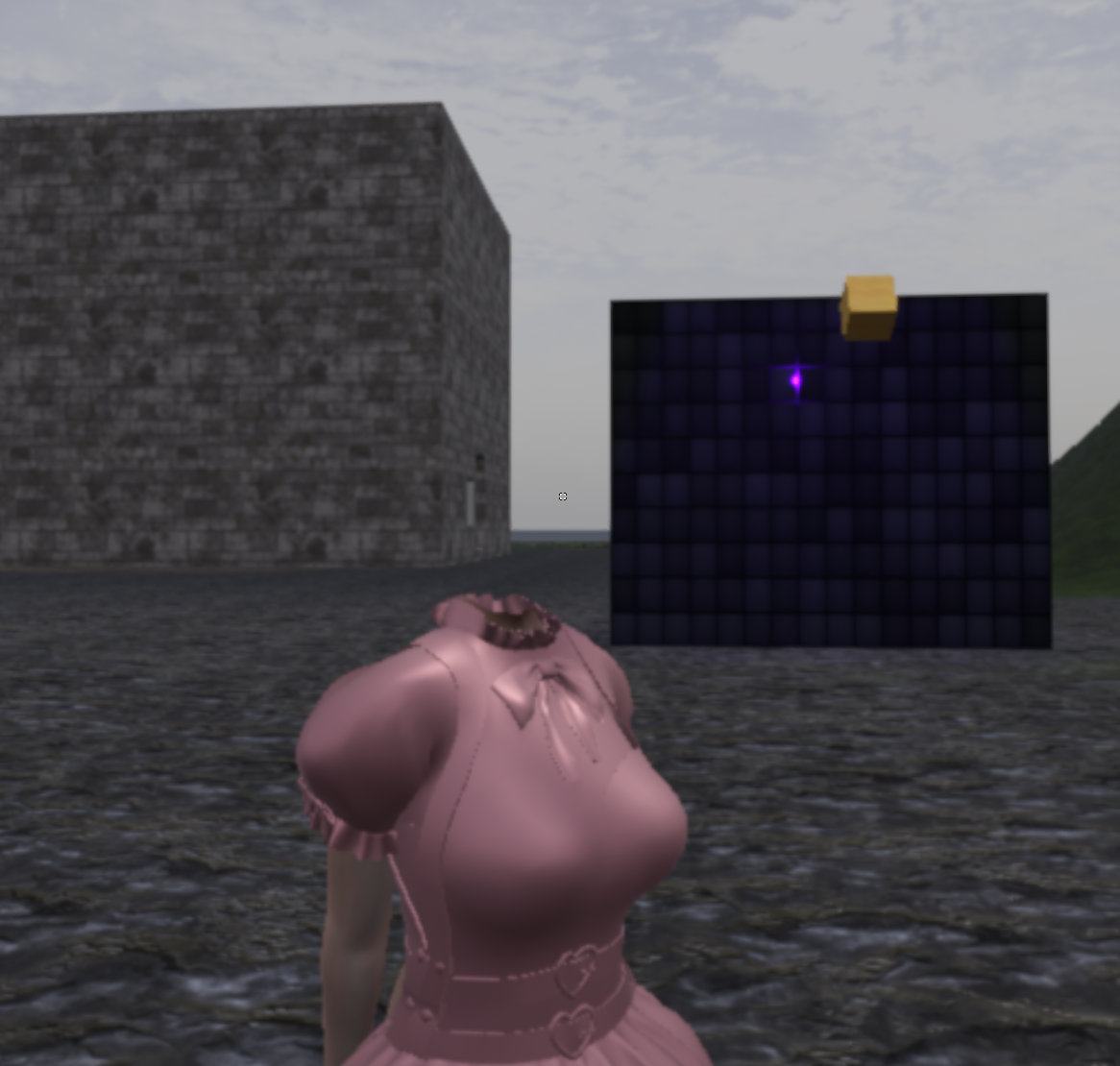
  • A – slight – issue of losing your head when using the upcoming Mirrors capability from Mouselook (see: BUG-234342 via Github archive).
Don’t do this at home, kids! Viewing oneself using the upcoming Mirrors feature when in Mouselook…
  • A discussion on emojis / unicode / Display Names.
  • A discussion on avatar complexity, policing, limitations, impact of allowing avatars to effectively be given a “free pass” in terms of proper optimisation  / LI accountability, and developing a terminology to help users (and creators?) properly understand the impact their avatars can have on general viewer performance.

Next Meeting

† The header images included in these summaries are not intended to represent anything discussed at the meetings; they are simply here to avoid a repeated image of a gathering of people every week. They are taken from my list of region visits, with a link to the post for those interested.

VWBPE 2024 What’s up With the Lab: Grumpity, Kali and Signal Linden

via VWBPE

Update: March 16th, 2024: Regarding SL Voice and capabilities, as mentioned in the latter part of this summary, please also refer to: 2024 week #11: SL TPVD summary: new approach to voice in SL for information on the new WebRTC for Voice in SL.

On Thursday, March 14th, 2024 Grumpity Linden, the Lab’s Senior Vice President of Operations, along with Kali and Signal Linden joined Phelan Corrimal for the annual Above the Book session at the Virtual Worlds Best Practice in Education (VWBPE) conference, entitled What’s Up At the Lab.

The function of the session is to explore what’s “new” at Linden Lab  / with Second Life and their impact on educators and non-profit organisations using the platform.

The following is a summary of the session covering the core topics raised. The notes provided have been taken directly from the official video of the session, which is embedded at the end of this article. Time stamps to the video are also provided to the relevant points in the video for those who wish to listen to specific comments.

Notes:

  • This is a summary, not a full transcript, and items have been grouped by topic, so may not be presented chronologically when compared to the video.
  • Timestamps are included to allow a direct jump to a subject / comment.

A Little Background

Grumpity Linden: is responsible for the Second Life Product and Engineering teams. She originally started at LL whilst working for The Product Engine, and was involved in the development of Viewer 2 (as designed by 80/20 Studio), prior to joining LL full-time in 2014. Her role covers all aspects of product development and platform engineering, and as well as having a strong technical background, she also brings a strong element of interpersonal skills and psychological expertise to the Lab’s management team via her studies at the Johns Hopkins University.

Kali Linden: is now a Director of Engineering at the Lab, reporting into Grumpity, specifically focused on the Lab’s web properties (e.g. lindenlab.com, secondlife.com, the Marketplace, etc.) and associated UI and API design. She has a keen focus on matters pertaining to content creation and also in working in the non-profit sphere, describing herself as a “Nonprofit-preneur” as well as a “Nerd-Gamer”.

Signal Linden: is the Director of the Second Life Server and Viewer engineering and development teams. He has been involved with Second Life since 2008, and joined Linden Lab in 2015 by way of the likes of Amazon. He is a strong believer in the potential of virtual worlds, and a keen proponent of open-source software and collaborative development. He has perhaps most recently been visible as the communicator of, and driving force behind, the Lab’s moves to the use of Github to manage viewer development and issue tracking for their engineering and development environments.

Product Development Path

The glTF™ Roadmap

[Video: 4:43-19:26]

  • When SL introduced mesh import (2011), the COLLADA (Collaborative Design Activity) interchange file format  interactive 3D applications was selected for use within SL for importing mesh models to the platform. This decision was based on its widespread (at the time) use and recognition as an international standard (ISO/PAS 17506).
  • Since then, content creation and the industry have moved on, and the glTF (graphics library Transmission Format) has been developed over the last decade by the Khronos Group (also responsible for COLLADA), as  a standard file format for three-dimensional scenes and models. Recognised and adhered to through the industry, it is the specification of choice for Second Life to move to using.
  • Linden Lab views glTF adoption as a combination of:
    • Making the platform more accessible to a wider pool of content creators (as in theory, content made for X or Y in adherence to the core glTF specification (currently version 2.0 (no extensions) for SL) could be dropped directly into SL “as is” subject to licensing)
    • Making the actual import and use of glTF objects and scenes adhering to the specification pretty much a drag-and-drop capability.
  • While the techniques involved in glTF content production may be more complex, it is hoped that by adhering to the specification, content creators and users in SL will have great access to more accurate documentation to support the learning process, and have access to a broader set of libraries / tools presenting the means for that drag-and-drop capability with items and objects arriving in SL and looking vastly different to how they appear in authoring tools.
  • Physically based rendering (PBR) for materials was the first step in glTF adoption, and required a large-scale overhaul of the SL rendering engine. With its deployment and update, LL are now looking to to build out glTF support and capabilities.
  • Notably, the work now allows LL the opportunity to investigate  – and potentially implement – the support of  importing of entire glTF scenes (object, scripts, animations, etc., as noted above) into SL and have them stored as a recognisable asset.
    • This requires another significant overhaul of SL to support glTF hierarches, and so is liable to be a long-term project.
    • However, work on scene import and its associated requirements is due to start around mid-2024.
  • Note: this conversation included the export of glTF scenes from SL to elsewhere. As Linden Lab are still investigating requirements for permissions, etc., plus determining what will be required to allow scene import, no definitive answer on this could be given at this point, and so I’ll do no more than mention it here. Please refer to the video below if interested in the conversation.

SL Mobile

[Video: 30:02-36:28]

  • SL Mobile remains in closed Alpha testing (Premium Plus users only) and the current testing is generating a lot of feedback.
  • The initial focus was on rendering – with work still on-going – to ensure scenes and avatars could be rendered with a fidelity similar to that of the viewer and robustly.
  • This saw limited functionality in other areas to start with, but the functionality is being built out, and will continue to be built out and enhanced. Recent updates include:
    • Start a new chat from any chat screen
    • On the Nearby Chat screen, see how many people are nearby.
    • Streaming audio support.
  • As the functionality is built out, LL plan to start looking more broadly at Mobile use-cases (e.g. bringing-in new users, which requires considering a set of capabilities – signing-up, getting in-world, making connections, etc.) which are different to many of those sought by existing users (e.g inventory sorting).
  • Some capabilities found in the viewer will not be available in Mobile “for a while” (e.g. building), and core capabilities required for content creation (e.g. mesh importing) may well remain bound to the desktop.
  • That said, basic object interactions – sitting on objects, driving vehicles, etc., – will be supported.
  • In terms of broadening the existing SL Mobile user base, the hope is to do so “in the first half” of 2024.
    • More widespread usage does require more thought around interactions with third party environments (app stores, Tilia for L$ management, etc.) before such expansion can take place.

On-Boarding New User Experience

[Video: 36:40-42:34]

  • With the introduction of the Senra avatars in 2023, LL added a web-based avatar customisation flow as a part of the on-boarding process. This process continues to be refined, wit the idea remaining that new users will start with Senra and its available clothing and accessories (LL supplied or via user creators), but eventually move to other systems.
  • However, it is recognised that in-world avatar customisation is “hard”, so to further assist in new users gaining familiarity with in-world avatar customisation, LL are – as has been suggested by existing users – looking to implement a similar, easy-to-understand flow to customising avatars in-world.
    • This does require a series of back-end changes to systems to be made, so will still be a while in come.
    • It will, by necessity, given the huge range of options available in avatar customisation, be somewhat constrained it terms of trying to build a more complex look, but it should allow use users to make changes to their avatar and produce a good result.
  • As a part of the on-boarding process, LL is looking to improve the registration API that is provided to Community Gateways for on-boarding users directly. No firm decisions on what might be updated and why, but the Lab is interested in hearing from Gateway Communities, those using the Reg API on the changes they would like to see. suggestions via the Second Life Feedback Portal.

General

  • Scripting [Video: 19:27-24:52]:
    • The last two years have seen LL become more responsive to requests for more scripting capabilities and functionality.
    • The plan is to continue with this, and those with specific requests – even if made in the past – are asked to use the Scripting Requests board on the Second Life Feedback Portal to do so.
    • Interoperability with external API (e.g. web APIs) is often being considered on a request basis.
  • Voice in Second Life [Video: 24:56-29:50]:
    • It is acknowledged that SL’s voice capabilities (powered by Vivox) have been largely unchanged since their introduction in 2007 (and Vivox has long since ceased active support on Linux).
    • LL are looking to improve Voice capabilities in SL with technologies which will enable the addition of new functionalities – such as new capabilities in-world such as adding scripted control of voice capabilities.
    • As with PBR and glTF, the work currently under consideration for Voice in SL would be foundational as / when decisions are made and projects start rolling, allowing capabilities and options to be built up over time.
  • Marketplace [Video: 42:40-43:56]:
    • In line with the work on SL Mobile, the Marketplace / web team are working on trying to make the Marketplace responsive on Mobile, enabling shopping via ‘phone or tablet and also improving the MP’s appearance on the viewer’s in-built browser.
    • Marketplace Search is also going to see further improvements (e.g. additional filtering).
    • Also see my more recent Web User Group summaries.
  • Feedback move from Jira to Github  / Canny [Video: 44:14-48:30]:
    • The decision to move away from Jira was primarily due to Atlassian (who produce the Jira software) changing their licensing model, making an open-ended system available to all SL users prohibitively expensive for the Lab.
    • Github Issues was selected as the core replacement tool due to it both it being a good collaborative tool or developers and users, and it is a key tool used within the likes of viewer (open-source and simulator code development.
    • Canny was settled on for the general user-facing front-end the Feedback Portal) as it has “good” integration with Github, and has a range of tools which allow information to be grouped and displayed (e.g. Marketplace bug / issues; viewer bug reports, projects such as Combat 2.0, etc.).
    • It also allows for a wider range of feedback to be given, and for prioritising work in terms of popularity of ideas, identifying issues that can be widely beneficial and rapidly implemented, etc.
    • The Feedback Portal provides general user access to tickets; those with Github accounts (e.g. open source or third-party viewer developers) can access the Github issues side of the system (with some security / sensitive data exceptions) via their Github accounts.
    • The switch-over was completed in mid-February 2024.